Category: Uncategorized

  • Pi Network Token Nears All-Time Low Amid Gaming Gains

    Pi Network Token Nears All-Time Low Amid Gaming Gains

    Pi Network Token Nears All-Time Low Amid Market Downturn

    The native token of Pi Network is experiencing a significant downturn, mirroring the broader cryptocurrency market’s struggles. The token’s price has fallen sharply, approaching its all-time low recorded in February, despite recent project developments and the release of new games aimed at its user base, known as Pioneers.

    The past week has been particularly challenging for cryptocurrency markets. Bitcoin (BTC) saw a substantial drop to just over $65,000, while Ethereum (ETH) plunged to $1,800. Most altcoins have followed suit, and PI has not been an exception. The token has declined by 22% over the past month, reaching $0.136 earlier today, its lowest point since February.

    In February, PI faced repeated rejections at the $0.20 mark, leading to an all-time low of $0.1312. The subsequent month saw a significant recovery, with PI more than doubling in value by “PiDay 2026” (March 14) after its listing on Kraken. However, this surge proved to be a classic “sell the news” event, followed by a substantial crash to below $0.18.

    Today’s drop below $0.14 occurred amidst sustained selling pressure and the loss of several key support levels, including $0.18 and $0.16.

    Data from PiScan indicates that the average daily number of tokens scheduled for release in the coming month is relatively modest, around 5.4 million. However, certain days are expected to see unlockings exceeding 10 million tokens, with one day slated for 16 million. These substantial unlocks could potentially intensify immediate selling pressure and contribute to further price declines.

    In parallel with these market movements, CiDi Games, a company within the Pi Network Ventures portfolio, recently announced the upcoming launch of new games for Pioneers. A portion of these games has already been made available.

    CiDi Games aims to provide Pioneers with new avenues to utilize Pi through gaming, while simultaneously expanding the Pi ecosystem with infrastructure designed to support a growing number of games and developers over time.

    The newly released games include:

    • Coin Whack, an arcade roguelike.
    • Fruit Stack, a match-3 fruit puzzle.
    • Gemnova, a cosmic match-3 adventure.
    • RainbowCubes, a colorful elimination puzzle.

    Separately, the Pi Network Core Team recently confirmed the successful deployment of protocol update version 23. The next update, version 24, was anticipated to be completed by June 2, though official confirmation was pending at the time of reporting.

  • Crypto Plummets Amidst Middle East Tensions

    Crypto Plummets Amidst Middle East Tensions

    Crypto Plummets as Geopolitical Tensions Flare

    Cryptocurrencies experienced a sharp overnight decline, with over $700 million in leveraged long positions being forcibly liquidated within a 12-hour period. The sell-off was triggered by Iranian strikes on Kuwait’s international airport and escalating conflict in the Strait of Hormuz, which sent risk assets spiraling.

    Bitcoin saw a significant drop, approaching critical support levels, and the total cryptocurrency market capitalization fell to $2.31 trillion.

    Traders seeking an explanation for the steep downturn were met with a stark, two-part answer: a geopolitical shock and a pre-existing leverage overhang that was ripe for a cascade.

    A Confluence of Vulnerabilities

    The market’s vulnerability was amplified by elevated open interest across perpetual futures markets, a situation that had been building for weeks. This created a structurally fragile environment.

    The subsequent Iranian drone strike on Kuwait International Airport, reportedly causing severe damage, fires, and structural collapses, served as the exogenous trigger. This was compounded by a U.S. military response targeting Qeshm Island in the Strait of Hormuz. Bitcoin had already been under pressure due to geopolitical tensions and leverage, and this event acted as the catalyst for a full liquidation.

    Escalation in the Strait of Hormuz

    The drone attack on Kuwait’s international airport, which resulted in significant damage, injuries, and the suspension of air traffic, was the immediate flashpoint. Kuwait’s Ministry of Defence spokesman described the incident as “criminal Iranian aggression.”

    In response, U.S. Central Command conducted strikes on an Iranian military ground control station on Qeshm Island, located deep within the Strait of Hormuz. The Islamic Revolutionary Guard Corps (IRGC) issued a warning that “disrupting the security of the Strait of Hormuz will carry a heavy price for the aggressive US military.” This threat prompted immediate repricing of risk across markets.

    The Strait of Hormuz is a vital artery for global energy, carrying approximately 20–30% of the world’s seaborne oil trade. Any sustained disruption there has global implications for energy prices. Oil prices surged on the news of the escalation, the U.S. dollar strengthened as a safe-haven asset, and Treasury bonds also saw increased demand.

    This trifecta of rising oil prices, a stronger dollar, and demand for bonds represents a classic risk-off rotation, historically draining liquidity from speculative assets. Despite narratives of Bitcoin as “digital gold,” the cryptocurrency continues to trade as a high-beta risk asset during periods of significant geopolitical stress, exhibiting a strong correlation with the Nasdaq rather than gold.

    Technical Damage and Future Outlook

    The technical damage from this episode is considerable. Bitcoin has fallen below the Short-Term Holder Realized Price support, a level historically considered a dividing line between healthy consolidation and sustained downturns. The psychological $70,000 floor was breached during the liquidation flush, and the total crypto market cap is now testing the $2 trillion threshold.

    The path forward for cryptocurrencies hinges on de-escalation. If U.S.-Iran back-channel talks resume meaningfully, shipping risk premiums in the Strait of Hormuz subside, and exchange-traded fund (ETF) inflows return within 48 to 72 hours, Bitcoin could reclaim $70,000, triggering short squeezes and potentially pushing prices toward $74,000 to $75,000. However, such a scenario requires de-escalation signals that are currently absent.

    Should geopolitical tensions persist without further direct escalation, cryptocurrencies may consolidate in the $66,000 to $70,000 range as leveraged positions reset and macro traders await further U.S. inflation data. The Federal Reserve’s higher-for-longer interest rate stance is expected to cap upside potential even in this scenario.

    Any further Iranian strikes, a significant shipping incident in the Strait of Hormuz involving a major tanker, or an unexpected surge in inflation could push Bitcoin below $65,000. This would break the range structure that has held since early 2026 and could lead to a move toward $60,000 to $62,000, a scenario that traders are reportedly stress-testing.

    The current structural outlook remains bearish until Bitcoin reclaims $70,000 on a closing basis. Any price action below this level is considered damage control territory.

  • XRP Price Drops Below Key Support, Further Decline Possible

    XRP Price Drops Below Key Support, Further Decline Possible

    XRP Price Suffers Significant Losses, Breaking Key Support Levels

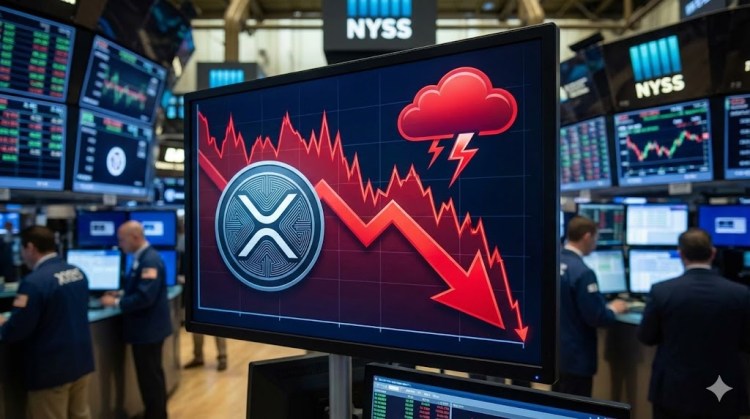
    XRP is experiencing a sharp decline, trading between $1.21 and $1.24, marking a 2% drop today and a concerning 7% decrease over the past week. This sell-off has intensified since earlier this week, extending a downtrend that began in mid-May when XRP reached a local peak of $1.55. Since then, the token has fallen through a critical support zone, hitting its lowest price since February.

    XRP ETFs Continue Inflows Amidst Broader Market Downturn

    Despite the broader market’s struggles, XRP Exchange-Traded Funds (ETFs) have not seen a single red day since April. Data from SoSoValueCrypto indicates that XRP spot ETFs attracted an additional $4.13 million on June 1, continuing a streak of positive inflows throughout May. The last recorded outflow for these ETFs occurred at an unspecified earlier date.

    Cumulative Drawdown and Market-Wide Correction

    The cumulative drawdown for XRP now exceeds 66% from its all-time high last year. However, this decline is not isolated; the total cryptocurrency market capitalization has plummeted from over $4 trillion to $2.4 trillion, with most altcoins experiencing double-digit losses, mirroring XRP’s performance.

    Discrepancy Between Fundamentals and Price Action

    The current price action for XRP appears unusual given its underlying fundamentals. In May alone, spot XRP ETFs garnered over $131 million, marking their strongest monthly performance this year. Furthermore, Ripple’s RLUSD stablecoin boasts over $1.8 billion in Assets Under Management (AUM) and $22 billion in 30-day volume. This suggests a disconnect between strong fundamental indicators and the token’s depreciating price.

    Technical Analysis and Potential Price Targets

    XRP’s price has broken through a crucial support level and has yet to reclaim it. The $1.20 zone, which previously served as consolidation support throughout the first quarter, is now a critical level to monitor. A confirmed daily close below this figure could pave the way for a further decline towards the $1.00–$1.05 range, a level last tested in late 2024. On the upside, the former support around $1.40–$1.45 has now transitioned into resistance. Reclaiming this level would be a prerequisite for any significant bullish recovery.

    Near-Term Scenarios for XRP

    Three potential scenarios are shaping XRP’s near-term trajectory. In an optimistic outlook, accelerated ETF inflows and a positive shift in market sentiment could see XRP reclaim the $1.40 level within two weeks, potentially initiating a recovery. Alternatively, the token might trade sideways between $1.20 and $1.35 as the broader market stabilizes.

    The most bearish scenario involves the $1.20 floor breaking, triggering momentum selling and potentially pushing the token below $1.10. Current momentum indicators appear to favor this bearish outlook.

    Long-Term Outlook and Regulatory Wins

    Ripple’s recent regulatory successes, including securing licenses in the UK, Australia, and the EU, coupled with a company valuation of $50 billion, provide a long-term foundation for sentiment. While AI-driven price models remain bullish on a 12-month horizon, near-term technicals suggest a need for caution.

    Market Insights and Emerging Opportunities

    The significant weekly decline of a major-cap asset like XRP, even with institutional ETF demand, underscores that size does not guarantee safety in the current market cycle. This situation highlights a potential strategy of rotating into earlier-stage infrastructure projects before institutional price discovery begins.

    One such project, LiquidChain ($LIQUID), is a Layer 3 infrastructure initiative aiming to serve as a cross-chain liquidity layer for the next market cycle. Its core objective is to consolidate liquidity from Bitcoin, Ethereum, and Solana into a unified execution environment, enabling developers to deploy applications across all three ecosystems simultaneously with a single deployment.

    LiquidChain’s architecture features a Unified Liquidity Layer, Single-Step Execution, Verifiable Settlement, and a Deploy-Once Architecture, designed to address the fragmentation that currently complicates and increases the cost of cross-chain development.

    The LiquidChain presale is currently live, with the $LIQUID token priced at $0.01466 and having raised $820,000 to date.

  • XRP Falls Below Triangle, Eyes $1.14 Target

    XRP Falls Below Triangle, Eyes $1.14 Target

    XRP Drops Below Key Technical Pattern, Analyst Sets $1.14 Target

    Cryptocurrency analyst Ali Martinez has pointed to a recent technical development for XRP, noting that the digital asset has broken below a symmetrical triangle pattern. This breakdown, according to Martinez, could signal a potential price target of $1.14.

    Symmetrical Triangle Breakdown

    In a recent post on X, Martinez discussed a symmetrical triangle pattern that had been forming on XRP’s daily price chart prior to its recent downturn. A symmetrical triangle is a technical analysis formation characterized by two converging trendlines, with the upper line acting as resistance and the lower line as support. The pattern typically indicates a period of consolidation before a significant price move.

    The key characteristic of a symmetrical triangle is that its trendlines approach each other with roughly equal and opposite slopes, causing the trading range to narrow over time. A breakout above the resistance line or below the support line is often interpreted as a signal for a continuation of the prevailing trend.

    Martinez shared a chart illustrating the symmetrical triangle that had been shaping XRP’s price action. The data showed XRP trading within this pattern for several months. However, as the trading range tightened in May, a breakout occurred. This breakout, unfortunately for XRP holders, was to the downside, with the price slipping below the established support level.

    As per technical analysis principles, a breakdown below the support of a symmetrical triangle can be a bearish indicator, suggesting a continuation of the downward trend. The chart shared by Martinez appears to confirm this, showing bearish momentum persisting since the support level gave way. Based on this pattern and the subsequent price action, Martinez has projected a target of $1.14 for XRP. The market will now watch to see if XRP moves towards this level or if its trajectory reverses.

    Long-Term Parallel Channel

    Martinez also highlighted that the symmetrical triangle was a short-term pattern. In a separate X post, the analyst drew attention to a longer-term pattern: a parallel channel that XRP’s monthly price has potentially been confined within for years.

    A parallel channel consists of two trendlines that run parallel to each other. The chart provided by Martinez indicates that XRP retested the resistance level of this long-term channel in 2025 but was ultimately rejected. Since this reversal, the cryptocurrency has experienced a decline.

    Martinez suggested that if XRP continues to respect this parallel channel, the mid-range of the channel, currently around $0.73, could present an attractive accumulation zone.

    At the time of reporting, XRP was trading around $1.23, marking a nearly 8% decrease over the past seven days.

  • Gate Partners Alpaca for Global Stock Trading

    Gate Partners Alpaca for Global Stock Trading

    Gate Partners with Alpaca to Expand Real Stock Trading Access

    Cayman Islands, British Overseas Territories, June 3rd, 2026 – Gate has announced a strategic partnership with Alpaca, a move designed to broaden access to real stock trading for eligible users. This collaboration represents a significant step in Gate’s ongoing initiative to integrate digital assets with traditional financial markets, offering a unified multi-asset trading experience.

    The upcoming launch will grant Gate users access to over 10,000 stocks and exchange-traded funds (ETFs) across major U.S. securities markets, including the New York Stock Exchange (NYSE) and Nasdaq. The service will support fractional share trading, with a minimum purchase requirement of just $1. By leveraging Gate’s unified account system, users will be able to trade stocks and ETFs using USDT, thereby fostering a more seamless connection between digital assets and conventional financial markets.

    Expanding Access to Traditional Financial Markets

    Established in 2013, Gate has evolved into a prominent global platform for cryptocurrency and integrated financial services, serving more than 54 million users worldwide. The forthcoming introduction of stock trading is a key component of Gate’s long-term strategy to develop a comprehensive, multi-asset platform that bridges digital assets and traditional financial markets.

    Historically, accessing global equity markets has often necessitated opening separate brokerage accounts, navigating complex onboarding processes, and managing capital across disparate platforms.

    To address these challenges, Gate has expanded its offerings beyond its core digital asset services, aiming to build a more holistic financial ecosystem. The introduction of its stock trading services marks a crucial advancement toward creating a unified environment where users can access multiple asset classes through a single platform and account structure. Gate’s stock offering will provide access to real stock and ETF trading via regulated market infrastructure, allowing users to engage with traditional financial markets within a familiar, crypto-native experience.

    Powered by Alpaca’s Brokerage Infrastructure

    Gate selected Alpaca as its infrastructure partner due to its regulated, self-clearing brokerage framework, its API-first architecture, and its extensive experience supporting financial platforms globally. As the clearing broker partner, Alpaca will be responsible for the execution, clearing, settlement, and custody of orders, as well as managing dividend payments and corporate actions.

    This integration enables Gate to efficiently scale its stock trading capabilities while maintaining a fluid user experience. By utilizing Alpaca’s brokerage infrastructure, Gate can offer eligible users access to a wide array of U.S.-listed stocks and ETFs, further solidifying its position as a leading multi-asset trading platform.

    A Shared Vision for Financial Accessibility

    Dr. Han, Founder and CEO of Gate, stated, “The future of finance is becoming increasingly interconnected. As the boundaries between digital assets and traditional financial markets continue to evolve, users are looking for more efficient ways to access a broader range of investment opportunities. Our partnership with Alpaca will help advance that vision by providing seamless access to real stock market investing while maintaining the simplicity and efficiency that users expect from a modern digital asset platform. We believe multi-asset access will play an increasingly important role in the next generation of global financial services.”

    Yoshi Yokokawa, Co-Founder and CEO of Alpaca, commented, “At Alpaca, our mission is to open financial services to everyone on the planet through modern infrastructure. We are pleased to partner with Gate as it expands access to the U.S. stock market and continues building a more comprehensive financial ecosystem for users around the world. Together, we are helping create a more connected and efficient global investment experience.”

    Advancing Gate’s Multi-Asset Strategy

    The partnership with Alpaca aligns with Gate’s overarching strategy to construct a unified platform that connects digital assets with traditional financial markets. In addition to its forthcoming support for trading across more than 10,000 stock assets, Gate is actively expanding its traditional finance (TradFi) offerings to include equities, indices, commodities, metals, and foreign exchange markets, providing users with enhanced opportunities for cross-market participation and portfolio diversification.

    As the convergence between cryptocurrency and traditional finance accelerates, Gate remains committed to broadening market access, improving capital efficiency, and delivering a more streamlined multi-asset investing experience for users globally.

    About Gate
    Founded in 2013 by Dr. Han, Gate is a leading global cryptocurrency and integrated financial services platform. Serving over 54 million users worldwide, it supports trading across more than 4,700 digital assets and 10,000 stock assets, while also offering comprehensive TradFi trading services spanning metals, stocks, indices, forex, and commodities, providing users with a one-stop, multi-asset trading experience. Gate was among the first platforms to implement 100% Proof of Reserves. Its ecosystem includes Gate Wallet, Gate Ventures, Gate for AI Agent, and a wide array of products and services.

    About Alpaca
    Alpaca is a U.S.-headquartered, self-clearing broker-dealer and a global leader in brokerage infrastructure APIs, facilitating access to traditional and on-chain asset classes. Alpaca currently supports over 10 million brokerage accounts across hundreds of fintechs and institutions in more than 40 countries, backed by over $320 million in funding.


  • XRP Price Drops Below $1.22 Amidst Negative Market Sentiment

    XRP Price Drops Below $1.22 Amidst Negative Market Sentiment

    XRP Price Slides Below Key Support Levels, Bears in Control

    The price of XRP has extended its losses, trading below the $1.220 mark. The cryptocurrency is currently consolidating its decline, facing immediate resistance hurdles at $1.2350 and $1.250.

    XRP Price Dips Below $1.250

    XRP’s inability to sustain its position above $1.30 has led to a significant downturn, mirroring movements seen in Bitcoin and Ethereum. The digital asset fell below $1.2850 and $1.2650, entering a short-term bearish territory. Losses deepened further, pushing the price below $1.220.

    A low was established at $1.1924. XRP is now consolidating these losses well below the 23.6% Fibonacci retracement level of the move from a swing high of $1.3640 to the recent low of $1.1924. The price is trading below $1.2320 and the 100-hourly Simple Moving Average.

    Should a recovery attempt materialize, XRP could encounter resistance near the $1.2330 level. The first significant resistance zone is situated around $1.2580. A more substantial barrier lies at $1.2780, which also corresponds to the 50% Fibonacci retracement level of the aforementioned downward swing. A decisive close above $1.2780 could propel XRP towards $1.2850, with the next hurdle at $1.2880.

    A bearish trend line is forming on the hourly chart of the XRP/USD pair, with resistance at $1.2850. A clear break above the $1.2880 resistance could pave the way for a move towards the $1.30 level. Further gains might see XRP target the $1.3250 resistance.

    More Losses on the Horizon?

    If XRP fails to overcome the $1.2580 resistance zone, a fresh decline could be initiated. Initial support on the downside is observed near the $1.2050 level, followed by a major support at $1.20. A downside break and a close below $1.20 could lead to further declines towards $1.1920. The next significant support is located around the $1.1880 zone, below which the price could extend lower towards $1.1840.

    Technical Indicators

    The hourly MACD for XRP/USD is currently gaining momentum in the bearish zone. The hourly RSI (Relative Strength Index) is trading below the 50 level, indicating bearish sentiment.

    Major Support Levels: $1.1920 and $1.1840
    Major Resistance Levels: $1.2350 and $1.2580

  • Schwab Aims for Mid-2027 Crypto Trading Launch for Advisors

    Schwab Aims for Mid-2027 Crypto Trading Launch for Advisors

    Schwab Eyes 2027 for Advisor Crypto Trading Launch

    Charles Schwab is reportedly gearing up to expand its cryptocurrency offerings, with plans to introduce spot trading, transfer, and custody services for financial advisors on its platform by 2027. This strategic move would significantly broaden direct digital asset access within one of the largest advisor networks in U.S. wealth management, extending Schwab’s crypto ambitions beyond its recently launched retail services.

    Jalina Kerr, Managing Director of Schwab Advisor Services, indicated during a virtual media roundtable that the firm is targeting a launch next year. While the timeline is not definitive, Kerr emphasized that the project remains active and on schedule, suggesting a rollout around the middle of 2027.

    A Significant Development for the Crypto Market

    The proposed product would equip advisors with direct access to spot crypto trading, transfer, and custody tools integrated into Schwab’s existing custody infrastructure. This represents a key distinction from Schwab’s current retail offering, which began earlier this year. An advisor-focused rollout would embed cryptocurrency trading directly within the operational workflows of registered investment advisors managing client portfolios. This contrasts with current practices, where clients might manage exchange accounts independently or rely solely on exchange-traded crypto products.

    Charles Schwab stands as a major player in custody and brokerage, reporting $12.61 trillion in total client assets and 39.3 million active brokerage accounts as of April 30, 2026. The Schwab Advisor Services division alone manages approximately $5.31 trillion in client assets, highlighting the substantial scale of the advisor channel that could benefit from direct crypto tools.

    This advisor initiative follows Schwab’s April announcement of Schwab Crypto, a phased retail platform that initially offered spot trading for Bitcoin and Ethereum. The retail service allows eligible U.S. clients to trade BTC and ETH across Schwab’s digital platforms, with a fee of 75 basis points on the dollar value of each trade. Schwab has also stated its intention to incorporate additional cryptocurrencies and introduce deposit and withdrawal capabilities in the future.

    Currently, the retail crypto accounts are facilitated by Charles Schwab Premier Bank, SSB, with Paxos providing sub-custody and trade execution services. Schwab’s disclosures also clearly delineate the differences between crypto products and traditional brokerage protections, noting that crypto products are “not FDIC insured, not SIPC protected, not deposits, and may lose value.” These distinctions are expected to be carefully considered for the advisor product.

    While Schwab has confirmed the fee structure, custody setup, and asset list for its retail launch, details regarding the 2027 advisor rollout remain unconfirmed. It is yet to be determined if the service will initially focus solely on Bitcoin and Ethereum, whether the pricing will mirror the retail 75 basis point fee, or if Paxos will also support the advisor-side infrastructure.

    Schwab already provides investors with access to a range of crypto-linked products, including exchange-traded products tied to Bitcoin and Ethereum, crypto-related equities, futures, mutual funds, trusts, and listed options on spot Bitcoin ETPs. However, the introduction of direct spot trading and custody would position Schwab to offer a more comprehensive crypto infrastructure for advisors, moving beyond mere market access through securities wrappers.

    At press time, the total cryptocurrency market capitalization stood at $2.32 trillion.

  • Dogecoin’s 2021 Surge: Could History Repeat at $2?

    Dogecoin’s 2021 Surge: Could History Repeat at $2?

    Dogecoin Analyst Predicts $2 Rally, Citing 2021 Bull Run Parallels

    A cryptocurrency analyst has presented a new bullish outlook for Dogecoin (DOGE), highlighting a long-term chart pattern that he claims mirrors the setup preceding the meme coin’s explosive rally in 2021. The analyst also pointed to recurring shifts in market sentiment, where traders often dismiss early price movements before rushing to buy at higher levels.

    Dogecoin Forecasted to Reach $2

    Market analyst Crypto Patel shared a new Dogecoin chart analysis on X, projecting a potential rally toward the $2 mark within the current market cycle. His optimistic forecast is rooted in historical market patterns, with a particular emphasis on the robust structure observed during Dogecoin’s significant bull run in 2021.

    In that previous cycle, Dogecoin surged from a low of approximately $0.002 in 2020 to a peak exceeding $0.72 in 2021. This represented a gain of over 26,800%, solidifying its place as one of the most dramatic rallies in meme coin history. Prior to reaching its all-time high, the chart exhibited two major breakouts, followed by successive upward movements categorized as stages 3, 4, and 5.

    Crypto Patel argues that Dogecoin’s current chart configuration closely resembles this 2021 bull pattern. He noted that the meme coin has already experienced two breakout phases between 2023 and 2024, followed by a retest of key support levels within a broader accumulation zone. Following this retest, Dogecoin initiated its next significant upward leg in 2025, labeled as stage 3 on the chart. Since then, the meme coin’s price has traded within a tight range inside a descending channel. The chart also indicates another retest of the previous accumulation area around the $0.11 level, which the analyst interprets as a second confirmation of support.

    Based on this structural analysis, Crypto Patel believes Dogecoin is poised for a sharp rally toward $2. From its current levels near $0.10, this would signify a potential increase of more than 2,700%.

    Market Psychology and DOGE’s Path to $2

    In addition to chart patterns, Crypto Patel also discussed the role of market sentiment and psychology in influencing Dogecoin’s potential ascent to $2. The analyst observed that at lower price points, such as $0.05, many traders still dismissed Dogecoin as a defunct asset.

    As the meme coin climbed towards $0.25, Crypto Patel noted that some market participants remained hesitant, expecting a price correction and observing from the sidelines. Once Dogecoin approaches the $1 mark, the analyst predicts that a strong sense of Fear Of Missing Out (FOMO) will likely re-emerge in the market, driving investors to chase potential gains. Finally, at his projected target of $2, he anticipates a familiar pattern of regret among those who did not invest earlier, mirroring sentiment seen in past bull cycles.

  • Crypto Treasury Outflows Slow, Hitting Lowest Point Since 2024

    Crypto Treasury Outflows Slow, Hitting Lowest Point Since 2024

    Bitcoin Dominates Crypto Inflows Amid Broader Market Slowdown

    Crypto treasury companies saw their monthly inflows plummet to $180 million in May, marking the weakest performance since October 2024. Bitcoin-linked firms were the primary drivers of this figure, accounting for $177 million. Smaller contributions came from ZCash, Story, and Sui, while Litecoin experienced an outflow of $1.89 million.

    This sharp decline represents a 95% drop from April’s $4.4 billion and is approximately 93% below the monthly average recorded between January and May. The figures for March and April each surpassed $4 billion, highlighting the significant slowdown.

    Post-Election Surge Fades for Treasury Firms

    The recent dip follows a robust surge in investment late last year, when digital asset inflows exceeded $12 billion, spurred by the 2024 US election results and a more favorable policy environment. Data from DefiLlama indicates that this trend cooled throughout 2025, remaining below $10 billion monthly until late summer before declining further.

    This cooling market has presented treasury firms with a more challenging proposition. The subsequent market downturn has intensified pressure, and companies that previously relied solely on token accumulation are now facing greater investor scrutiny compared to the boom period.

    Yield Pressure Forces Treasury Firms to Adapt

    Industry leaders suggest that the traditional buy-and-hold strategy is losing its efficacy. Galaxy Digital, for instance, has advocated for treasury firms to actively deploy assets through staking, validator services, DeFi lending, or other revenue-generating activities.

    Patrick Ngan of Zeta Network Group emphasized that companies holding Bitcoin must demonstrate capabilities beyond simply holding the asset on their balance sheets. He noted that businesses with tangible cash flow might be better positioned than those solely focused on asset holdings.

    Arthur Firstov of Mercuryo pointed out that the advent of ETFs offers institutions a cost-effective and liquid avenue for direct crypto exposure. This, he explained, makes it more difficult for publicly listed treasury firms to maintain premium valuations. While staking can generate revenue for proof-of-stake treasuries, Firstov cautioned that it cannot compensate for operational weaknesses, excessive dilution, or balance sheet losses.

    Hybrid Models Emerge as Sector Loses Momentum

    The shift towards more active asset management is already evident in hybrid models. Grant Cardone, for example, has integrated Bitcoin with multifamily housing investments, utilizing rental income and property appreciation to support further Bitcoin acquisitions within a treasury-like structure.

    Current data indicates a significant deceleration in the crypto treasury sector. Although Bitcoin continues to lead the market, the latest figures strongly suggest that the era of easy capital has concluded.

  • Ethereum Poised to Outshine Bitcoin as Prices Fall: Standard Chartered

    Ethereum Poised to Outshine Bitcoin as Prices Fall: Standard Chartered

    Strategy’s Bitcoin Sale Signals Potential Turning Point for Ethereum, Analyst Says

    Standard Chartered’s Geoff Kendrick has identified a counterintuitive shift favoring Ethereum following Strategy’s recent Bitcoin sale. The move, disclosed on Monday, has created favorable conditions for the second-largest digital asset by market capitalization, which has lagged behind Bitcoin for months, according to a Tuesday note from the bank’s head of digital asset research.

    Kendrick observed that Ethereum experienced one of its most significant price movements against Bitcoin in years after Strategy reduced its holdings by $2.5 million. He further noted that since the beginning of 2024, Ethereum has demonstrated stronger daily gains relative to Bitcoin, experiencing fewer instances of decline.

    The analyst projects that Bitcoin’s dominance over Ethereum will diminish by year’s end to levels not seen since September, forecasting a ratio of 0.04. Under this scenario, and assuming Bitcoin’s price remains stable, Kendrick estimates Bitcoin would be valued at $67,300, while Ethereum would surge 41% from its current $1,900 to approximately $2,700.

    Kendrick highlighted a key difference in business models between firms that invest in Ethereum and those that favor Bitcoin. He explained that Ethereum’s staking mechanism, which allows participants to earn rewards by validating transactions and generating revenue, reduces the necessity for sales compared to Bitcoin-holding companies.

    Last week, Standard Chartered projected a year-end target of $4,000 for Ethereum, arguing that its current price does not reflect its improving internal metrics. Kendrick drew a parallel between this disparity and Amazon’s significant decline during the dot-com bubble’s collapse.

    Kendrick’s analysis specifically focused on the “ETH/BTC” ratio. This ratio reached a peak of 0.042 in August of the previous year, coinciding with Ethereum’s all-time high near $5,000. However, the asset, built around smart contracts that power tokens, decentralized applications, and NFTs, has historically trended lower since 2022.

    Despite this historical trend, Kendrick believes Ethereum is well-positioned to benefit from increasing Wall Street interest in stablecoins as a modern form of money and in tokenization as a new market infrastructure.

    Ethereum’s prominence in these areas has been acknowledged by major asset managers like BlackRock. Kendrick has set a long-term price target of $40,000 for Ethereum by the end of the decade, while anticipating Bitcoin to reach $500,000 over the same period.

    Historically, periods of Bitcoin rallying to all-time highs have been followed by a sustained outperformance of altcoins, a phenomenon known as “alt season.” However, some analysts have questioned this traditional market dynamic, pointing to the maturation of Bitcoin’s market structure, particularly with the introduction of exchange-traded funds.