Category: Uncategorized

  • Kalshi, Coinbase Gain Partial Victory in Illinois Sports Contracts Case

    Kalshi, Coinbase Gain Partial Victory in Illinois Sports Contracts Case

    Landmark Ruling Favors Kalshi and Coinbase in Sports Contract Regulation Battle

    Kalshi and Coinbase have secured a significant victory in the ongoing dispute over regulatory authority for sports event contracts. On October 2, 2026, U.S. District Judge Martha M. Pacold in Illinois granted a partial preliminary injunction, ruling in favor of the two companies and the Commodity Futures Trading Commission (CFTC) against state officials.

    The ruling, however, comes with a caveat. While the judge determined that Illinois’s licensing requirements likely conflict with federal derivatives law, she left the state’s transaction fee regulations unresolved. The parties have been instructed to return to court with proposed terms for the injunction.

    At the heart of the legal challenge is the doctrine of preemption, which dictates that federal law supersedes state law when the two are in conflict. Judge Pacold concluded that certain Illinois licensing provisions, specifically those under 230 ILCS 45, appear to clash with the federal Commodity Exchange Act (CEA). The CEA governs swaps and other derivatives, placing them under the exclusive jurisdiction of the CFTC.

    The plaintiffs’ case hinges on the classification of Kalshi’s sports event contracts. If these contracts are deemed “swaps” under the CEA, they would fall under federal oversight, preempting state gambling laws. The court’s preliminary decision supports this argument, indicating a likelihood of success for the plaintiffs. It is important to note that a preliminary injunction is not a final judgment, but rather an indication of the court’s initial assessment.

    The issue of transaction fees remains open. The court has not yet decided whether Illinois can impose its transaction fee rules on these contracts and has requested further legal arguments on the matter.

    Parties Tasked with Defining Injunction Scope

    Both sides now face the task of proposing specific terms for the injunction. These terms will ultimately define the practical limitations placed on Illinois’s regulatory actions.

    Kalshi is already familiar with federal oversight, having been a CFTC-registered designated contract market (DCM) since November 2020. The company launched trading on sports event contracts in January 2025, allowing users to speculate on game outcomes. While state regulators view these as akin to sports betting, Kalshi classifies them as derivatives trading.

    Coinbase joined the partnership in December 2025, announcing it would provide its users access to Kalshi’s sports event contracts.

    The CFTC’s involvement as a co-plaintiff is a significant development, signaling the federal regulator’s assertion that these contracts fall squarely within its purview.

    Broader Regulatory Landscape and Future Implications

    This Illinois case is part of a larger, multi-state legal battle over the regulation of sports-related contracts. Courts have issued divergent opinions, creating uncertainty about whether these instruments fall under the jurisdiction of federal derivatives regulators or state gambling authorities.

    The unresolved transaction fee issue warrants close attention. Such fees directly impact the economic viability of trading platforms. Even if Illinois loses on licensing authority, retaining some control over fees could still influence profitability for operators within the state. The forthcoming legal briefs on this matter will be crucial.

    Similarly, the precise wording of the injunction terms will be critical. A narrowly tailored order might leave Illinois with avenues for regulatory action, whereas a broad injunction would more definitively clear the path for Kalshi and Coinbase customers in the state.


  • Arbitrum Halts Stylus Activations Amid Security Emergency

    Arbitrum Halts Stylus Activations Amid Security Emergency

    Arbitrum Halts New Stylus Contract Deployments Amid Security Concerns

    Arbitrum has temporarily suspended a key developer feature, pausing all new activations of its Stylus contracts across Arbitrum One and Nova. The decision, enacted by the Arbitrum Security Council on October 2, 2026, at 11:30 EST, addresses vulnerabilities within the Stylus framework. Existing Stylus contracts remain unaffected and continue to function.

    Stylus Framework Under Scrutiny

    Stylus is designed to enable developers to write smart contracts in languages such as Rust and C++, while maintaining compatibility with the Ethereum Virtual Machine (EVM). These programs are compiled into WebAssembly (WASM), a compact, low-level code format. The current concern centers on hand-crafted WASM programs that have not been updated.

    Research indicates that these unpatched programs could be exploited as denial-of-service (DoS) vectors, potentially impacting the network’s liveness. While such issues do not pose a risk to user funds, they could lead to network slowdowns or complete halts. Previous patches to Arbitrum’s operating system (ArbOS) had already addressed some of these liveness concerns.

    The pause is intended as a preemptive measure, preventing unpatched WASM programs from being deployed before upcoming ArbOS updates.

    Enhanced Dispute Resolution System

    In addition to pausing Stylus activations, the emergency upgrade introduced a new safety mechanism to Arbitrum One’s dispute resolution system, known as BoLD. This mechanism, a “guard” on the BoLD one-step proof, is designed to protect against potential soundness issues. If the system were to accept contradictory proofs, this guard could delay unconfirmed withdrawals.

    BoLD is Arbitrum’s system for resolving disagreements about the state of the blockchain. A one-step proof represents the final stage of such a dispute, where a single contested computational step is directly verified. The newly added permissionless guard on Arbitrum One’s one-step proof mechanism aims to prevent the system from accepting conflicting proofs, allowing settlements to be paused in a timely manner if such a scenario arises. The practical implication is that unconfirmed withdrawals could face delays if this safeguard is triggered.

    It is important to note that the BoLD guard was specifically added to Arbitrum One, while the Stylus activation pause affects both Arbitrum One and Nova.

    Impact on Developers and Future Outlook

    For development teams with existing Stylus contracts already deployed, daily operations are largely unchanged. These active contracts will continue to function and can be renewed until their expiration. However, developers planning new Stylus deployments will have to wait for an unspecified timeline.

    The Arbitrum Foundation stated that it will collaborate with the ArbitrumDAO to determine when new Stylus activations can resume. The Foundation characterized the emergency upgrade as part of a broader series of proactive measures to safeguard the network’s security and integrity.

    The identified issues primarily affect network liveness rather than the security of user funds, and no user funds are currently at risk. The distinction is crucial: a network outage is an inconvenience, whereas a loss of user deposits constitutes a crisis.

    The implementation of the BoLD guard serves as a backstop against potential misbehavior within the proof system itself. The trade-off for this added security is the possibility of unconfirmed withdrawals being held in limbo if the guard is activated.

    The decision to utilize the Security Council for this emergency upgrade highlights the existence of special powers for critical situations where a full governance vote might leave a known vulnerability exposed. By returning the decision on when to re-enable Stylus activations to the ArbitrumDAO, the council appears to be acting as an initial responder rather than a permanent arbiter of Stylus’s future.

  • Sam Altman Reaffirms OpenAI-Cerebras Partnership

    Sam Altman Reaffirms OpenAI-Cerebras Partnership

    Sam Altman, CEO of OpenAI, has publicly reaffirmed the company’s close partnership with AI chipmaker Cerebras Systems, addressing recent market speculation that suggested a cooling relationship. The statement, shared on the platform X, aims to clarify the ongoing collaboration despite reports of OpenAI’s newest model, GPT-6.1 Sol, initially deploying on Nvidia hardware.

    OpenAI and Cerebras Systems announced a significant multi-year partnership on January 14, 2026. Under this agreement, OpenAI committed to purchasing up to 750 megawatts of Cerebras AI inference capacity over the following three years. The initial value of this deal was reported to be over $10 billion, with potential extensions that could push the total value beyond $20 billion. Cerebras pitches its hardware specifically for ultra-low-latency inference, designed to make AI responses faster. This capacity is intended to be integrated into OpenAI’s inference stack, aiming to enhance the responsiveness of applications like ChatGPT.

    Speculation Fueled by Deployment Reports

    The reaffirmation comes after market rumors surfaced in early October 2026, suggesting that OpenAI’s GPT-6.1 Sol model was initially deployed on Nvidia GPUs rather than Cerebras hardware. According to those reports, this development, coupled with Cerebras’s focus on ultra-low-latency inference, fueled speculation among investors about a potential shift in OpenAI’s strategy and a cooling of the partnership. Cerebras shares had reportedly come under pressure following these rumors, highlighting a structural vulnerability for the company due to customer concentration, as OpenAI represents a significant portion of its business.

    Altman’s Dual Role and Investment

    Altman’s personal investment in Cerebras, dating back to at least February 2017, adds another layer to the situation. As of May 2026, he held approximately 89,373 shares in the company, which went public in May 2026. His dual role as CEO of OpenAI, a major customer, and a longtime shareholder in Cerebras makes his public reassurance notable and may continue to prompt discussions about governance.

    Complementary Hardware Strategy

    Both OpenAI and Cerebras have framed the partnership as complementary. Cerebras’s dedicated, low-latency capacity is seen as sitting alongside OpenAI’s existing general-purpose GPU fleet from suppliers like Nvidia and AMD, rather than as a replacement. The agreement is multi-year, with the capacity rollout planned in phases through 2028. Analysts believe that the market may have overstated the risk associated with the initial deployment choice for a single model, emphasizing that a one-time deployment decision does not alter a three-year purchase commitment.

    Uncertainties Remain

    While Altman’s statement on X provides clarity, the exact timing of his post remains unspecified. The potential for the total deal value to exceed $20 billion is also subject to extensions, and the extent to which governance questions will be raised regarding Altman’s dual role remains to be seen. Despite these nuances, the core message from OpenAI’s CEO is that the partnership with Cerebras remains a key component of its infrastructure strategy.

    Why This Matters

    The materials describe a narrow update: Sam Altman publicly stated that Cerebras is a close partner of OpenAI, following market rumors suggesting a cooling relationship. The exact timing of Sam Altman’s reaffirmation on X.

    Broader Context

    Source materials place the factual news in this context: The reaffirmation, shared on X, follows a stretch of speculation about whether the relationship between OpenAI and the AI chipmaker was cooling.

  • Bank of North Dakota’s Roughrider Coin Launches on Fiserv Platform, Settles on Solana

    Bank of North Dakota’s Roughrider Coin Launches on Fiserv Platform, Settles on Solana

    The Bank of North Dakota’s Roughrider Coin, a dollar-backed stablecoin, has launched on Fiserv’s digital asset platform, settling on the Solana blockchain. This initiative is designed to offer over 90 banks and credit unions in North Dakota a new method for interbank money transfers.

    Fiserv announced on October 1 that its digital asset platform is now live with financial institutional clients, with the Roughrider Coin being the first product to operate on this infrastructure. The platform aims to provide financial institutions with enhanced efficiencies in banking and payments through digital assets.

    Fiserv is providing the issuance, reserve, custody, and settlement infrastructure for the Roughrider Coin. VersaBank is handling the coin’s issuance and custody, including minting, burning, and managing reserve assets. Fireblocks is supplying the digital asset infrastructure and tokenization services, while transactions are processed on the Solana blockchain.

    “Roughrider Coin is a new tool to move money more efficiently across North Dakota’s interbank network,” according to information provided. Fiserv stated it is “helping clients unlock new efficiencies in banking and payments” while maintaining expected security and regulatory standards. David Taylor, VersaBank founder and president, described the combination of Fiserv’s scale with VersaBank’s regulated capabilities as a “trusted foundation to bring stablecoins into established banking and payments systems.”

    Participating institutions will access the Roughrider Coin via Fiserv’s Commercial Center online banking system. Fiserv’s digital asset platform also supports other services, including stablecoin card issuance, cross-border payments, programmable commerce, treasury automation, tokenized deposits, and global currency account services.

    The launch of the Roughrider Coin occurs as financial institutions navigate evolving regulatory landscapes and consumer perceptions of stablecoins. The Federal Reserve has proposed two rules under the GENIUS Act concerning stablecoin backing and issuance by supervised banks. These proposals, open to public comment for 60 days, aim to establish guidelines for reserve backing and bank issuance of payment stablecoins. The specific details and outcomes of these proposed rules remain uncertain.

    Consumer awareness and trust also present challenges for stablecoin adoption. A Visa study indicated that 56% of surveyed Americans had never heard of stablecoins. However, the study also found that 45% would be willing to use them when offered by an existing financial provider, compared to 36% in a scenario without hypothetical bank-level fraud protection and deposit insurance. The extent to which consumer confidence will grow, despite initial low awareness, is an area of uncertainty.

    Don Morgan, Bank of North Dakota’s chief executive, commented on the coin’s purpose. Sunil Sachdev is Fiserv’s head of embedded finance and digital assets.

    Why This Matters

    The materials describe a narrow update: The Bank of North Dakota’s Roughrider Coin, a dollar-backed stablecoin, has been launched on Fiserv’s digital asset platform. The specific details and outcomes of the Federal Reserve’s proposed stablecoin rules.

    Broader Context

    Source materials place the factual news in this context: The launch comes as financial institutions face questions about how stablecoins should be backed, supervised, and presented to customers.

  • Ethereum Foundation Launches zkAPI for Private AI Service Payments

    Ethereum Foundation Launches zkAPI for Private AI Service Payments

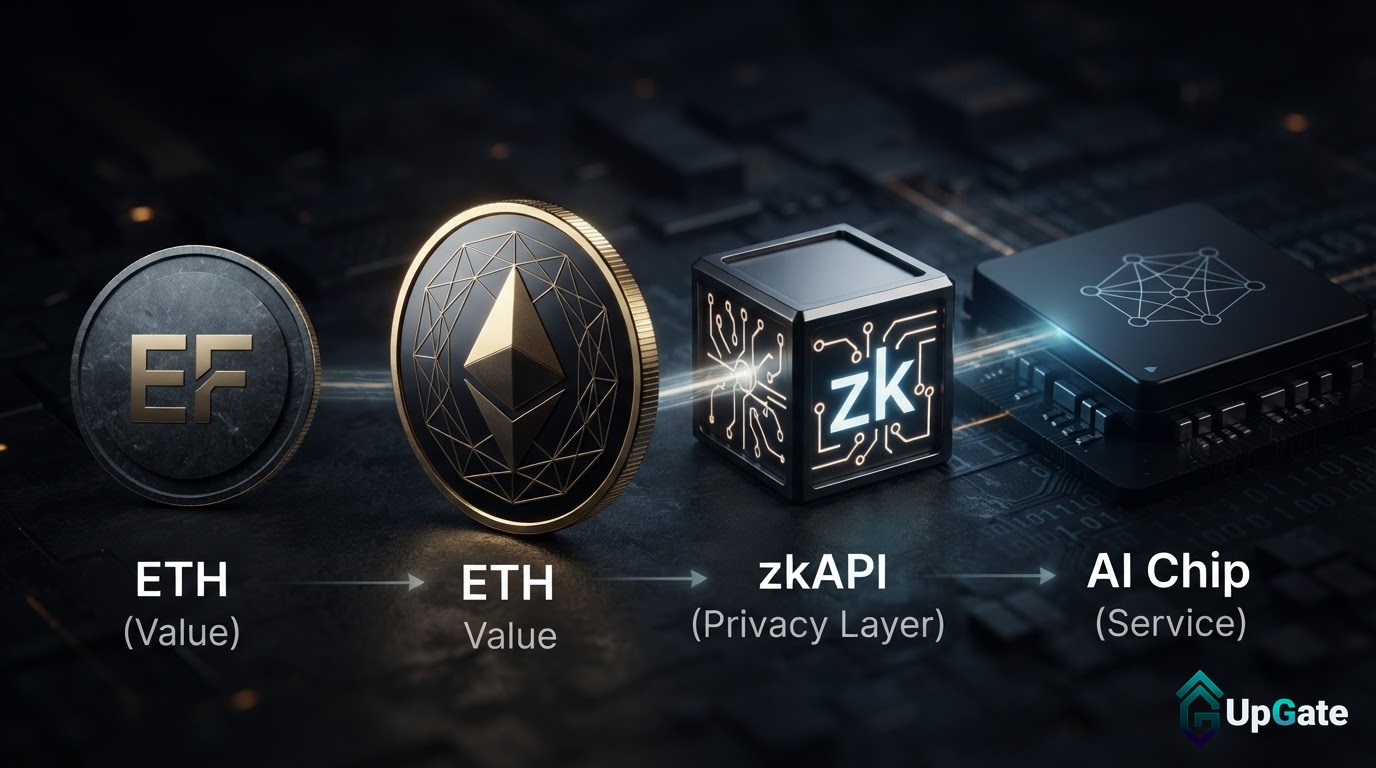
    The Ethereum Foundation has launched zkAPI on Ethereum’s mainnet, a new system designed to enable private payments for artificial intelligence (AI) services. This development aims to address growing privacy concerns by decoupling users’ identities from their AI queries, according to the Ethereum Foundation’s announcement.

    zkAPI, developed in collaboration with the Open Anonymity Project, allows users to pay for AI services using cryptocurrencies like ETH and USDC without linking their personal identity to their AI interactions. Users deposit funds into a vault contract on the Ethereum network, which then functions as private digital cash. A zero-knowledge proof is employed to verify that sufficient funds are available without revealing specific transaction details. Subsequently, a temporary API key is issued to the user’s device, granting access to AI services. Usage is charged based on actual consumption after the key expires, with AI providers and payment processors having separate visibility into the query and the spending, respectively, preventing them from linking the two.

    Addressing AI Privacy Concerns

    The Ethereum Foundation argued that current AI usage models compromise user privacy by linking queries to billing relationships. “Prompts are personal. People ask AI models about their health, their finances, their doubts. Under the current model, using AI means handing a running transcript of your thinking to whoever holds the billing relationship,” the Ethereum Foundation stated. zkAPI aims to resolve this by making “your balance exist as a private note: digital cash that only you can spend and that nobody can trace back to the deposit.”

    The system works with OpenRouter, a service that provides access to numerous AI models through a single connection. The project’s documentation indicates that any application compatible with the OpenAI format can integrate with zkAPI by pointing to a local address. The temporary API keys are capped at a specific dollar amount and exist only in the device’s memory, expiring after use.

    Origins and Broader Context

    The concept behind zkAPI originated from a proposal by Davide Crapis and Vitalik Buterin on Ethereum Research in February. Crapis, who leads the Ethereum Foundation’s dAI team, which focuses on making Ethereum a preferred settlement and coordination layer for AI, had previously suggested Ethereum’s potential as infrastructure for software agents. In August 2025, Crapis and Marco De Rossi proposed the ERC-8004 standard, a framework for AI agents to find each other, verify identity, and transact. Crapis has predicted that machine-generated Ethereum traffic could constitute the majority within three to five years.

    Vitalik Buterin has also been active in outlining Ethereum’s role in AI. On February 10, he presented an Ethereum-AI roadmap that included zero-knowledge payments for private API use. In April, he discussed the alternative of running open-source AI models locally on personal hardware, such as an Nvidia 5090 graphics card, to keep data private. zkAPI addresses scenarios where prompts still need to be sent to external servers.

    The concern over AI privacy is underscored by recent events, such as a federal court order in May 2025 for OpenAI to preserve its output logs, including deleted chats, in response to a lawsuit by The New York Times and other publishers. The potential applications for zkAPI extend beyond AI services, with the possibility of covering other metered services like blockchain data queries, image and video generation, and VPNs.

    Experimental Status

    It is important to note that the zkAPI protocol is labeled as experimental in its repository, and a formal audit has not been listed. Providers integrating with zkAPI would need to accept a proof instead of a traditional API key and settle signed usage receipts.

    Why This Matters

    The materials describe a narrow update: zkAPI, developed with the Open Anonymity Project, allows users to pay for AI services using cryptocurrency (ETH, USDC) without linking their identity to their AI queries. The formal audit status of the zkAPI protocol.

  • Powerus tokenized stock PUSA Surges to $8M Volume on Solana in Four Hours

    Powerus tokenized stock PUSA Surges to $8M Volume on Solana in Four Hours

    Powerus Corporation’s stock has found a dynamic new avenue for trading on the Solana blockchain, experiencing significant activity just days after its Nasdaq debut.

    Tokenized Shares Surge on Solana

    On October 1, 2026, Powerus Corporation officially listed on the Nasdaq. By the following day, its stock had a parallel existence on the Solana network, where it generated substantially higher trading volumes. The tokenized $PUSA share recorded $8 million in trading volume within its first four hours of listing, a figure that more than doubled the dollar volume of the actual Nasdaq-listed stock during the same period.

    The token went live on October 2, 2026, facilitated by Backpack Securities through its Sunrise platform. Each $PUSA token is backed on a 1:1 basis by actual Powerus common stock held in custody, with holders retaining the ability to redeem their tokens for the underlying shares. By the close of its initial 24 hours of trading, the token’s total volume reached approximately $12 million.

    A key advantage highlighted for the tokenized version is its continuous trading capability. Unlike the Nasdaq, which operates within traditional business hours, the $PUSA token can be traded around the clock, including after the stock market’s closing bell.

    Powerus Corporation’s Business Focus

    Powerus Corporation is a defense technology firm specializing in autonomous drones and counter-drone systems. The company’s product line features US-built autonomous aerial and maritime systems, alongside technology designed to neutralize unauthorized drones.

    Public Market Entry and Contract Wins

    The company achieved its public market status through a merger with Aureus Greenway Holdings Inc., which was finalized on October 1, 2026. Powerus now trades on the Nasdaq Capital Market under the ticker symbol PUSA.

    This listing was preceded by significant contract awards. Powerus secured a defense purchase order valued at approximately $2.5 million for its first-person-view (FPV) aircraft, which are drones piloted via a live camera feed. Additionally, the company holds a long-term indefinite delivery, indefinite quantity (IDIQ) contract with the US Air Force for its Guardian-2 counter-drone system. This type of government contract structure establishes a potential ceiling for spending rather than a guaranteed payout, with this particular contract potentially worth up to $90 million through mid-2028.

    Growing Tokenized Equities Market

    The $PUSA token’s launch occurs within a burgeoning market for tokenized equities on Solana. Platforms such as Backpack Securities and xStocks are already facilitating substantial trading volumes in this space. Recent data indicates that 63% of trades within Solana’s tokenized equities market take place outside of traditional market hours, underscoring the appeal of continuous trading.

  • Bitcoin Surges 42.9% in Q3 2026, Outperforming Gold and Stocks

    Bitcoin Surges 42.9% in Q3 2026, Outperforming Gold and Stocks

    Bitcoin Surges 42.9% in Q3 2026, Outpacing Traditional Assets

    Bitcoin experienced a significant rebound in the third quarter of 2026, posting a 42.9% gain that left gold, stocks, and most other assets trailing far behind. This rally marked the end of a three-quarter losing streak and delivered Bitcoin’s strongest third quarter performance since 2017.

    Bitcoin’s Strongest Quarter in Years

    The digital currency began the quarter trading around $58,500 and closed September between $83,000 and $86,000. This approximately 43% surge represents Bitcoin’s best quarterly performance of any kind since the fourth quarter of 2024. The last time Bitcoin saw a better third quarter was in 2017, when it climbed 80%.

    The strength of the quarter was further underscored by its consistent upward momentum. July, August, and September all concluded with positive monthly closes, a first for Bitcoin in a third quarter.

    Traditional Assets Lag Significantly

    In stark contrast to Bitcoin’s performance, traditional assets saw modest gains. Gold rose by approximately 8.7% over the same period, while the S&P 500 and the Nasdaq each added around 2%.

    ETF Inflows Fuel Demand

    A substantial portion of the demand for Bitcoin during the quarter was attributed to U.S. spot Bitcoin Exchange-Traded Funds (ETFs). These products saw inflows totaling approximately $6.3 billion. A significant portion of this investment arrived late in the quarter, with about $2.4 billion flowing in during the week ending September 25 alone.

    Corporate treasuries also re-entered the market. Strategy, a company now primarily known for its substantial Bitcoin holdings, resumed its purchasing activity during the quarter. The company’s Bitcoin reserves now stand at approximately 847,666 BTC.

    Macroeconomic Tailwinds Support Rally

    Bitcoin’s ascent did not occur in isolation. Several macroeconomic developments contributed to a more favorable environment for risk assets. In mid-August, U.S. Treasury announcements regarding debt repurchases helped to ease pressure in bond markets, encouraging investors to seek riskier investments elsewhere.

    Inflation data also played a role. Positive shifts in Personal Consumption Expenditures (PCE) inflation readings, the Federal Reserve’s preferred inflation gauge, reduced the likelihood of further interest rate hikes by the Fed.

    Record Highs Still Distant

    Despite the impressive third-quarter gains, Bitcoin remains a considerable distance from its all-time high. The cryptocurrency reached its peak of nearly $126,000 in October 2025. As of early October 2026, Bitcoin was trading near its third-quarter closing range.

    Institutional Interest a Key Driver

    The source of demand is a significant takeaway from the quarter. The approximately $6.3 billion in ETF inflows suggests a growing influence of institutional and advisor-driven capital, rather than solely retail traders chasing price action.

    Bitcoin as a Store of Value Debate

    Bitcoin’s outperformance against gold also reignites the ongoing debate about its role as a store of value. While both assets saw gains, Bitcoin captured significantly more upside. Gold proponents, however, may highlight its 8.7% gain with considerably less volatility, a valid point.

    Potential Risks on the Horizon

    Several risks loom for Bitcoin. Long-term holders who acquired the cryptocurrency at lower prices may view the current range as an opportunity to realize profits. Elevated Treasury yields also present a potential pressure point.

    Furthermore, the macroeconomic conditions that supported Bitcoin’s third-quarter rally could shift. The current momentum relies on cooling inflation and a less hawkish Federal Reserve outlook. A resurgence in inflation or a change in the Fed’s tone could quickly erode some of this support.

    Key Indicators to Watch

    Looking ahead, several factors will be crucial to monitor. ETF flow data will indicate whether institutional appetite for Bitcoin persists into the fourth quarter. Strategy’s purchasing activity will signal the commitment of corporate buyers. Additionally, Treasury yields and upcoming inflation readings will shape the broader macroeconomic backdrop.

  • Solana ETFs Surpass XRP Funds in Net Assets Amid Strong Inflow Streak

    Solana ETFs Surpass XRP Funds in Net Assets Amid Strong Inflow Streak

    Solana’s exchange-traded funds (ETFs) have now overtaken XRP-based funds in total net assets, marking a significant shift in investor allocation. This development follows an eight-day inflow streak for Solana ETFs, which collectively attracted approximately $254 million.

    The sustained inflow has propelled Solana’s ETF complex to hold more net assets than its XRP counterparts. This surge is particularly noteworthy when considering the market capitalization of the underlying digital assets. Solana (SOL) currently has a smaller market capitalization than XRP.

    Despite XRP’s larger overall market capitalization, the recent asset accumulation in Solana ETFs means that the value held within these ETFs now represents a larger proportion of SOL’s total market value than XRP’s ETF holdings do of XRP’s market value. This suggests a potentially stronger relative market penetration for Solana’s ETF products.

    The trend indicates growing investor interest in Solana-backed investment vehicles, leading to their surpassing XRP funds in total net assets. While XRP maintains a larger market capitalization, the recent performance of Solana ETFs points to their increasing significance within the digital asset investment landscape.

    Broader Context

    Source materials place the factual news in this context: Solana ETFs have overtaken XRP products in total net assets after an eight-day inflow streak brought in nearly $254 million.

  • SBI Holdings Acquires Bitbank, Consolidating XRP Market Infrastructure

    SBI Holdings Acquires Bitbank, Consolidating XRP Market Infrastructure

    SBI Holdings has completed its acquisition of Japanese cryptocurrency exchange Bitbank, making it a wholly owned subsidiary as of October 1st.

    This acquisition integrates Bitbank, recognized as one of Japan’s busiest XRP markets, into SBI Holdings, a long-standing partner of Ripple in Asia. The move signifies a consolidation of XRP market infrastructure within a key industry player’s network.

    The financial scope of the acquisition for SBI Holdings was 290 million USD, equivalent to 46.7 billion JPY.

    This strategic integration by SBI Holdings reflects broader trends of consolidation within the cryptocurrency sector, particularly impacting assets like XRP and the partnerships that underpin their market presence.

    Why This Matters

    The materials describe a narrow update: SBI Holdings acquired full ownership of Bitbank, making it a wholly owned subsidiary. Consolidation of XRP market infrastructure within Ripple’s partner network.

    Broader Context

    Source materials place the factual news in this context: SBI Holdings has taken full ownership of Bitbank on Oct. 1, folding one of Japan’s busiest XRP markets into one of Ripple’s oldest partners in Asia.

  • Nvidia Shares Hit Record High on Investor Return

    Nvidia Shares Hit Record High on Investor Return

    Nvidia Reclaims Record High as Buyback Fuels AI Optimism

    Nvidia shares surged to a new all-time high on October 2, 2026, marking the first time the chipmaker’s stock has reached such territory since May. The milestone comes after a challenging period where a two-month selloff erased over $1 trillion in market value.

    Record Breaker

    During trading on October 2nd, Nvidia’s stock climbed to approximately $237.75, a 2.9% gain for the day. This level surpassed the previous record close of $235.74, which was set on May 14, 2026. The ascent represents a significant recovery rally, with the stock gaining nearly 25% from its late July lows.

    Market Cap Milestone

    The recent rebound has propelled Nvidia’s market capitalization to approximately $5.7 trillion, bringing the company within striking distance of the $6 trillion mark. Year-to-date, through early October 2026, Nvidia’s stock has climbed about 27%, positioning the company for its fourth consecutive year of double-digit returns.

    Massive Buyback Authorization

    The latest surge in Nvidia’s stock price was preceded by a significant corporate announcement: the board of directors approved a $150 billion increase to its share repurchase program. This represents the largest single additional buyback authorization in the company’s history.

    Future Capacity and Analyst Support

    With this new authorization, Nvidia’s total remaining buyback capacity now stands at $235 billion, with the program extending through fiscal year 2028. The positive sentiment was further bolstered by analysts, with Morgan Stanley reinstating Nvidia as its top semiconductor pick following a meeting with CEO Jensen Huang.

    AI Demand Remains Key Driver

    Underpinning investor optimism is the sustained demand for artificial intelligence infrastructure, particularly the data center hardware that powers AI models. Analysts and investors will be closely watching Nvidia’s progress toward the $6 trillion market capitalization threshold, with the company now less than $300 billion away.

    Strategic Implications of Buybacks

    The substantial share repurchase program introduces a significant structural tailwind for Nvidia’s stock. The company now possesses a considerable pool of capital, $235 billion through fiscal 2028, that can be deployed to support its own share price. However, this strategy also sparks debate, as the significant allocation to buybacks means these funds are not being directed towards other potential avenues such as acquisitions or new investments.

    Investor Playbook

    For traders, the key indicators to monitor include developments in AI capital spending, the pace at which Nvidia executes its buyback program, and any further analyst commentary, such as that from Morgan Stanley.