Category: Uncategorized

  • Crypto Market Shows Divergence: Stable Bitcoin and Ethereum Prices Amidst Liquidations and ‘Greed’ Sentiment

    Crypto Market Shows Divergence: Stable Bitcoin and Ethereum Prices Amidst Liquidations and ‘Greed’ Sentiment

    The cryptocurrency market is currently presenting a complex picture, with major assets like Bitcoin and Ethereum maintaining stable prices while the broader market experiences substantial liquidations. Investor sentiment, as measured by the Crypto Fear and Greed Index, remains in the ‘greed’ zone, even as traditional financial markets face downturns.

    On September 30, Bitcoin was trading above $83,000, marking a slight 24-hour gain of 0.33%. Ethereum hovered near $2,670, experiencing a minor dip of less than 0.2%. Despite these relatively stable price points for the two largest cryptocurrencies, the overall crypto market saw over $272 million in liquidations within the past 24 hours. Data from Binance, CoinGecko, alternative.me and CoinGlass indicates that long positions accounted for over 60% of these liquidations, totaling approximately $175 million, while short positions saw $97 million liquidated.

    This period of significant liquidations occurred against a backdrop of broader economic shifts. On Monday, September 29, major US stock indices including the Dow Jones Industrial Average, S&P 500, and Nasdaq Composite closed lower. Concurrently, bond yields rose, with the 30-year US Treasury yield reaching a multi-year high of 5.59%. These movements in traditional markets typically signal a move away from riskier assets.

    However, the cryptocurrency market’s sentiment appears to be diverging from these traditional market trends. The Crypto Fear and Greed Index, according to Alternative.me, stood at 71 on September 30, firmly within the ‘greed’ territory. This indicates that investors are feeling optimistic, a sentiment that has persisted over the last eight days with the index ranging between 70 and 74. This persistent greed, even with market downturns elsewhere, suggests that the overall investment sentiment has not turned significantly pessimistic.

    Technical indicators for Bitcoin show its price above its 20-day (80,974 USD), 50-day (76,895 USD), and 200-day (71,238 USD) simple moving averages. Bitcoin’s Relative Strength Index (RSI 14) is at 61.3, indicating a strong region. The MACD for Bitcoin shows a bearish alignment, but its histogram is narrowing, suggesting weakening downward momentum. For Ethereum, the price is also above its 20-day (2,599 USD), 50-day (2,420 USD), and 200-day (2,108 USD) simple moving averages, with its RSI 14 at 61.7. However, Ethereum’s MACD shows a bearish alignment with a widening histogram, indicating strengthening downward momentum.

    The largest single liquidation event reported occurred on HTX for the ETH-USDT pair, amounting to $5.06 million. Other cryptocurrencies also saw price movements, with SOL trading at $118.84, up 0.67% in 24 hours, and XRP at $1.4914, up 0.24% in the same period.

    Uncertainties remain regarding the specific triggers for the substantial long position liquidations despite stable major asset prices. Additionally, the future direction of Bitcoin and Ethereum prices is subject to interpretation given the mixed signals from technical indicators. The market continues to digest expectations that the Federal Reserve may maintain high interest rates for an extended period, a factor that could influence risk asset flows.

    Why This Matters

    The cryptocurrency market’s current dynamics, characterized by stable major asset prices, significant liquidations, and optimistic sentiment amidst broader economic headwinds, present a complex scenario for investors. Understanding these divergent signals is crucial for navigating the current economic landscape.

    Broader Context

    Source materials place the factual news in this context: Bitcoin’s price is above its SMA20 (80,974), SMA50 (76,895), and SMA200 (71,238), with moving averages in a bullish alignment. MACD for Bitcoin shows a bearish alignment, but the histogram is narrowing, indicating weakening downward momentum. Ethereum’s price is above its SMA20 (2,599), SMA50 (2,420), and SMA200 (2,108). MACD for Ethereum shows a bearish alignment and the histogram is widening, indicating strengthening downward momentum.


  • Aztec Labs Relaunches zk.money for Private Stablecoin Transactions on Ethereum

    Aztec Labs Relaunches zk.money for Private Stablecoin Transactions on Ethereum

    Aztec Labs has relaunched zk.money, its privacy-focused Ethereum wallet, enabling users to conduct private stablecoin transactions. The self-custodial wallet operates on the Aztec Network, a layer-2 solution designed for privacy.

    The relaunched zk.money allows users to send and receive stablecoins such as USDC, USDT, and DAI without revealing transaction details like balances, amounts, or recipients to the public. While transactions within zk.money remain private, deposits originating from the Ethereum network are publicly visible. According to Aztec’s posts on X, users can claim a tag, for example, bob.zk.money, which resolves to a deposit address through the Ethereum Name Service (ENS), enhancing usability.

    Privacy functions within zk.money are processed on the user’s device, generating zero-knowledge proofs. These proofs serve as cryptographic receipts that validate transactions without disclosing their specifics. The company’s developer documentation describes the Aztec Network as a privacy-first Ethereum layer-2.

    However, the service includes limitations: transactions are capped at $2,500 each, and all users share a collective daily deposit ceiling of $50,000. Aztec Labs emphasizes that as a self-custodial wallet, it cannot control or freeze user funds, and no administrator holds such privileges.

    The original zk.money debuted in 2021, attracting over 75,000 wallets and processing approximately $100 million in volume before the team focused on building its own network. In 2021, Aztec Labs secured $17 million in a funding round led by Paradigm. The company also expanded its offerings with Aztec Connect, a toolkit designed to integrate its privacy technology into decentralized finance (DeFi) protocols.

    The relaunch of zk.money occurs amid a broader focus on privacy enhancements within the Ethereum ecosystem. Proposals for the upcoming Hegecta upgrade are being considered, which could potentially allow privacy pools to manage their own transaction fees without intermediaries. Ethereum co-founder Vitalik Buterin has also discussed the potential for special-purpose applications to achieve significant privacy through zero-knowledge proofs as part of his vision for a “cryptographic world computer.”

    Why This Matters

    The relaunch of zk.money by Aztec Labs offers enhanced privacy for stablecoin transactions on Ethereum, operating as a self-custodial layer-2 solution. This development is significant as it aligns with growing interest in privacy solutions on Ethereum and Vitalik Buterin’s vision for cryptographic privacy.

    Broader Context

    Three years after initially shelving the project, Aztec Labs has relaunched zk.money. The original iteration of the wallet debuted in 2021, attracting substantial user interest and volume before the team shifted focus to developing their underlying network infrastructure.

  • Robinhood Expands Perpetual Futures Trading to Traditional Assets in Europe

    Robinhood Expands Perpetual Futures Trading to Traditional Assets in Europe

    Robinhood announced on July 1 that it is expanding its perpetual futures trading offerings in Europe to include traditional assets such as commodities, exchange-traded funds (ETFs), and foreign exchange (FX) pairs. This move marks a significant diversification beyond the cryptocurrency-only perpetual futures that the platform previously offered in the region.

    Eligible European customers can now trade perpetual futures contracts linked to assets including gold, crude oil, popular ETFs like QQQ and EWY, and FX pairs such as EUR/USD. These new offerings come with up to 10x leverage and are available for trading 24 hours a day, seven days a week. Perpetual futures are financial contracts that allow traders to speculate on an asset’s price without owning the underlying asset, and they do not have an expiration date. Their price is typically kept aligned with the spot price through a mechanism known as funding rates.

    This expansion into traditional assets represents a notable step for Robinhood, moving beyond its initial focus on crypto perpetual futures. According to the FactSheet, when Robinhood first introduced perpetual futures for Bitcoin and Ethereum in Europe, the product line eventually expanded to include other cryptocurrencies like XRP, DOGE, SOL, and SUI, offering up to 7x leverage. These crypto perpetual futures quickly became one of the fastest-growing products on the platform following their European rollout.

    The expansion of perpetual futures to traditional assets is part of a broader international strategy for Robinhood. The company is actively pursuing other international market opportunities, including seeking crypto trading capabilities in the United Kingdom. Additionally, Robinhood has acquired WonderFi to establish a presence in the Canadian market and is pursuing a capital markets service license in Singapore.

    Beyond product and market expansion, Robinhood is also developing its own blockchain infrastructure. The company is working on Robinhood Chain, a Layer-2 blockchain designed for tokenized assets, with a public mainnet launch planned. Furthermore, users of the Robinhood Wallet in eligible regions can access decentralized perpetual futures through the Lighter exchange, which includes incentive structures tied to the $LIT token.

    This strategic diversification and international push indicate Robinhood’s ambition to broaden its appeal and service offerings to a wider range of investors and markets globally.

    Why This Matters

    The materials describe a narrow update: Robinhood has launched perpetual futures trading for traditional assets such as commodities, ETFs, and foreign exchange pairs in Europe. The expansion into traditional assets represents a meaningful leap beyond Robinhood’s previous crypto-only perpetual futures.

    Broader Context

    Source materials place the factual news in this context: Robinhood announced on July 1 that it’s expanding its perpetual futures offerings in Europe to include traditional assets like commodities, ETFs, and foreign exchange pairs, a meaningful leap beyond the crypto-only perps it launched earlier.

  • Huang: White House AI Declaration Reshapes Industry

    Huang: White House AI Declaration Reshapes Industry

    White House Embraces Industry Self-Regulation for AI Development

    Nvidia CEO Jensen Huang secured a significant victory from Washington this past Friday, as President Trump unveiled a voluntary self-regulation accord for the artificial intelligence industry. The agreement, announced at a White House luncheon on September 29, effectively delegates oversight to the tech sector, signaling a hands-off approach from the administration.

    The gathering brought together a formidable roster of AI leaders, including Elon Musk of xAI and Tesla, Greg Brockman of OpenAI, and Google CEO Sundar Pichai. The executives convened with President Trump to deliberate on the future governance of AI in the United States. The outcome was a unified commitment to self-regulation, eschewing the imposition of prescriptive government mandates.

    President Trump drew a parallel between the transformative potential of AI and the industrial revolution. He also suggested rebranding AI technology as “super intelligence” and vowed that the U.S. would “never stifle” its advancement.

    Treasury Secretary Scott Bessent underscored the administration’s position, confirming that President Trump is “completely aligned” with Huang’s perspectives on AI policy.

    Huang has been instrumental in shaping adjustments to export rules, which have permitted the limited sale of advanced chips, such as the H200, to Chinese buyers. This arrangement, however, includes a stipulation: a 25% reduction in U.S. revenue from these transactions.

    Huang’s advocacy has consistently focused on two core principles: market-driven safety protocols and the preservation of American leadership in AI technology. Both these priorities were evident in the September 29 accord, which prioritized the pace of innovation over regulatory prudence.

    For investors, the key takeaways from the meeting—encompassing AI hardware, policy direction, exports, and regulation—suggest continued momentum for American technology companies.

    The potential downside is equally apparent. Should a significant AI safety incident occur within this self-regulatory framework, the ensuing political repercussions could be severe and swift. Companies that have structured their strategies around regulatory flexibility would face the greatest exposure.

  • Volmex Launches Bitcoin Implied Volatility Futures on Hyperliquid

    Volmex Launches Bitcoin Implied Volatility Futures on Hyperliquid

    Volmex Launches First On-Chain Bitcoin Volatility Futures on Hyperliquid

    Volmex Finance has introduced perpetual futures contracts tied to its Bitcoin Volmex Implied Volatility Index (BVIV) on the Hyperliquid exchange. This development marks the debut of an on-chain market specifically designed for trading Bitcoin’s expected volatility as a distinct asset.

    This new offering can be seen as the cryptocurrency market’s equivalent to the VIX, Wall Street’s widely recognized “fear gauge” that monitors anticipated S&P 500 volatility. Unlike the VIX, which is typically accessed through institutional brokerage accounts, the BVIV futures are available on a decentralized exchange and offer leverage of up to 5x.

    The BVIV index measures Bitcoin’s 30-day expected implied volatility by aggregating real-time options data from Deribit and OKX, two of the leading cryptocurrency options trading platforms. Recent readings for the index have hovered in the mid-to-high 30s, providing a general indication of the market’s current sentiment regarding near-term price fluctuations for Bitcoin.

    The perpetual futures contract employs a linear payout structure. For every one-point movement in the index, a trader’s profit or loss is equivalent to $1 USDC. For instance, a trader holding a long BVIV position at 35 that surges to 50 during a period of market turmoil would realize a gain of $15 per contract, without the need to understand complex options Greeks.

    These contracts are collateralized with USDC and utilize isolated margin. This means that a losing position in a volatility trade will not impact other assets held by the trader on the platform. Funding rates are calculated on an hourly basis, a departure from the more common eight-hour intervals found on most perpetual futures markets, reflecting the potentially abrupt shifts characteristic of a volatility index.

    The initial open-interest cap has been set at $2 million, a precautionary measure to allow the market to stabilize. Trading is accessible via the Markets by Kinetiq frontend under the ticker mkts:BVIV.

    Volmex CEO Cole Kennelly highlighted the launch as a significant opportunity for crypto traders and investors to engage in hedging and speculation strategies, bypassing the typical complexities associated with options trading.

    The selection of Hyperliquid as the listing venue is noteworthy. The platform has emerged as a leading decentralized perpetual futures exchange, facilitating billions in daily trading volume and achieving a valuation exceeding $90 billion. The addition of a volatility-specific product broadens the exchange’s offerings beyond simple cryptocurrency price speculation.

    However, the product is not without its inherent risks. Volatility indices can experience “gap behavior,” where the index experiences sharp jumps between calculation periods rather than smooth progression. For traders employing leverage, such gaps can lead to significant losses, potentially resulting in liquidation. While the isolated margin system helps to mitigate this risk, it does not entirely eliminate it.

  • Bitwise Launches US Spot Ether ETF After Token Surges

    Bitwise Launches US Spot Ether ETF After Token Surges

    Bitwise Launches First Spot Near ETF in U.S.

    Bitwise commenced trading its Near ETF on Tuesday, offering U.S. investors a new avenue to gain exposure to the AI-focused Near blockchain through conventional brokerage accounts. The fund, listed on NYSE Arca under the ticker NRR, carries an annual fee of 0.75%, according to Bitwise.

    The company touts the fund as the first spot Near fund in the United States. The term “spot” signifies that the ETF holds actual Near tokens, as opposed to futures contracts, which are derivatives based on anticipated price movements.

    Exchange-traded funds (ETFs) are investment vehicles that can be bought and sold like stocks. For individuals who have avoided cryptocurrency exchanges or digital wallets, this offers a simplified entry point: the underlying tokens are held within the fund, and the ETF shares appear alongside other investments in their brokerage application.

    The timing of the ETF’s launch appears opportune, particularly given Near’s recent surge in performance, with its value skyrocketing since May.

    This is not the first significant price movement for Near this year. In May, the token experienced a 28% jump within 24 hours, driven by upgrades related to privacy, artificial intelligence, and scaling. However, it subsequently retreated to around $2 over the summer. Currently, Near is trading just above $5, with a market capitalization of $6.5 billion. Despite this recent uptick, the token remains approximately 75% below its all-time high of over $20.

    Near operates as a layer-1 blockchain, serving as a foundational network upon which other applications are built, placing it in the same category as prominent networks like Ethereum and Solana. Its main network was launched in 2020.

    The connection to artificial intelligence stems from co-founder Illia Polosukhin, who is also a co-creator of the Transformer architecture, the underlying technology for models such as ChatGPT. Near established an AI research lab in May 2024, under the leadership of Polosukhin and co-founder Alex Skidanov.

    Bitwise’s investment thesis emphasizes the potential of AI agents, which are software programs designed to perform tasks on behalf of users, such as making payments or booking travel arrangements.

    “We are moving toward a world in which AI agents increasingly act on our behalf, coordinate with one another, and participate in the economy,” stated Bitwise CEO Hunter Horsley. “We believe this shift—to an agentic economy where more and more happens through AI agents—could unlock an enormous new frontier for the global economy. NEAR is building a platform for that future.”

    Bitwise also highlighted that Near Intents, a service facilitating asset swaps across different blockchains, has processed over $32 billion in volume.

    The Bitwise fund also engages in token staking. Staking involves locking up tokens to support the validation of network transactions, with participants earning rewards in return, akin to interest but paid in additional tokens. Bitwise anticipates that its internal team will stake the fund’s Near holdings to achieve average rewards of approximately 5%, which will accrue to shareholders through an increase in the fund’s per-share value.

    However, these rewards are not guaranteed. Bitwise’s disclosures indicate that reward rates are subject to change, and staking carries the risk of “slashing,” which involves penalties imposed when a validator violates network rules. Furthermore, the fund concentrates on a single asset, and Bitwise cautions that investors could potentially lose a substantial portion or all of their investment.

    Bitwise initially filed paperwork in Delaware for a Near fund in April 2025, when the token was trading at $2.61. Grayscale subsequently filed in January 2026 to convert its existing Near trust into an ETF, at a time when Near was priced around $1.54.

    The regulatory landscape for such funds became more favorable in September 2025, when the SEC approved generic listing standards. These standards allow exchanges to list qualifying crypto funds without requiring individual approval for each one. Following this, funds for Litecoin, Hedera, and Solana were introduced in October of that year, including Bitwise’s own Solana staking ETF.

    Bitwise charges an annual fee of 0.75% for the NRR ETF, which translates to $75 for every $10,000 invested.

  • CryptoQuant: Bitcoin Correction Looms as Profits Peak

    CryptoQuant: Bitcoin Correction Looms as Profits Peak

    Bitcoin holders are realizing profits at a pace not seen in months, prompting on-chain analytics firm CryptoQuant to urge market observers to pay close attention. The firm has identified a confluence of signals—surging realized profits, cooling spot demand, and a persistently negative Coinbase Premium Index—that collectively suggest a market correction may be on the horizon.

    CryptoQuant is careful to emphasize that these indicators do not guarantee a slide into bear market territory. However, the current market dynamics bear an uncomfortable resemblance to those observed during the 2022 downturn, a period marked by speculative rallies that repeatedly misled participants into believing the worst had passed.

    On May 4, daily realized profits reached 14,600 BTC, the highest level recorded since December 10, 2025. By mid-August, daily realized profits had peaked between 23,000 and 25,700 BTC, contributing to approximately 110,000 BTC in net realized profits since mid-August alone.

    Unrealized profit margins hit 17.7% in early May, marking the highest reading since June 2025. By September, this figure had surged to 33%.

    The Coinbase Premium Index, which measures the price difference between Coinbase (serving as a proxy for U.S. spot buyers) and other global exchanges, has consistently registered negative values throughout 2026. A negative reading indicates that U.S. buyers are paying less than the global average.

    CryptoQuant has characterized recent price rallies as “speculative” or “bear market rallies,” attributing these recoveries primarily to activity in the futures and derivatives markets rather than genuine accumulation of spot Bitcoin. The divergence between price action driven by futures and weakening spot demand is the dynamic that CryptoQuant finds most concerning.

    Exchange inflows remain relatively low, suggesting that holders are not rushing to deposit large amounts of Bitcoin onto exchanges. While diminishing, demand in the futures market is still present.

    CryptoQuant CEO Ki Young Ju has noted that the market is exhibiting shallower peaks and troughs, a characteristic consistent with a maturing market. The firm’s overall assessment is that Bitcoin is currently in a “bullish cooldown” phase, rather than transitioning into a full-blown bear market.

    The Coinbase Premium Index, exchange inflows, and the velocity of realized profits are the three key variables CryptoQuant identifies as most likely to determine whether any potential correction remains shallow or escalates into something more severe. The continued low level of exchange inflows is considered one of the most bullish data points in the current environment. A sudden spike in realized profits concentrated over a few days can overwhelm order books and trigger cascading liquidations in the futures market.

    The pattern identified by CryptoQuant echoes the dynamics of 2022, when rallies repeatedly attracted buyers only to reverse sharply as profit-taking and weak spot demand reasserted themselves.

  • Bitcoin ETFs Attract $2.95 Billion in 30 Days, Boosting Investor Profitability

    Bitcoin ETFs Attract $2.95 Billion in 30 Days, Boosting Investor Profitability

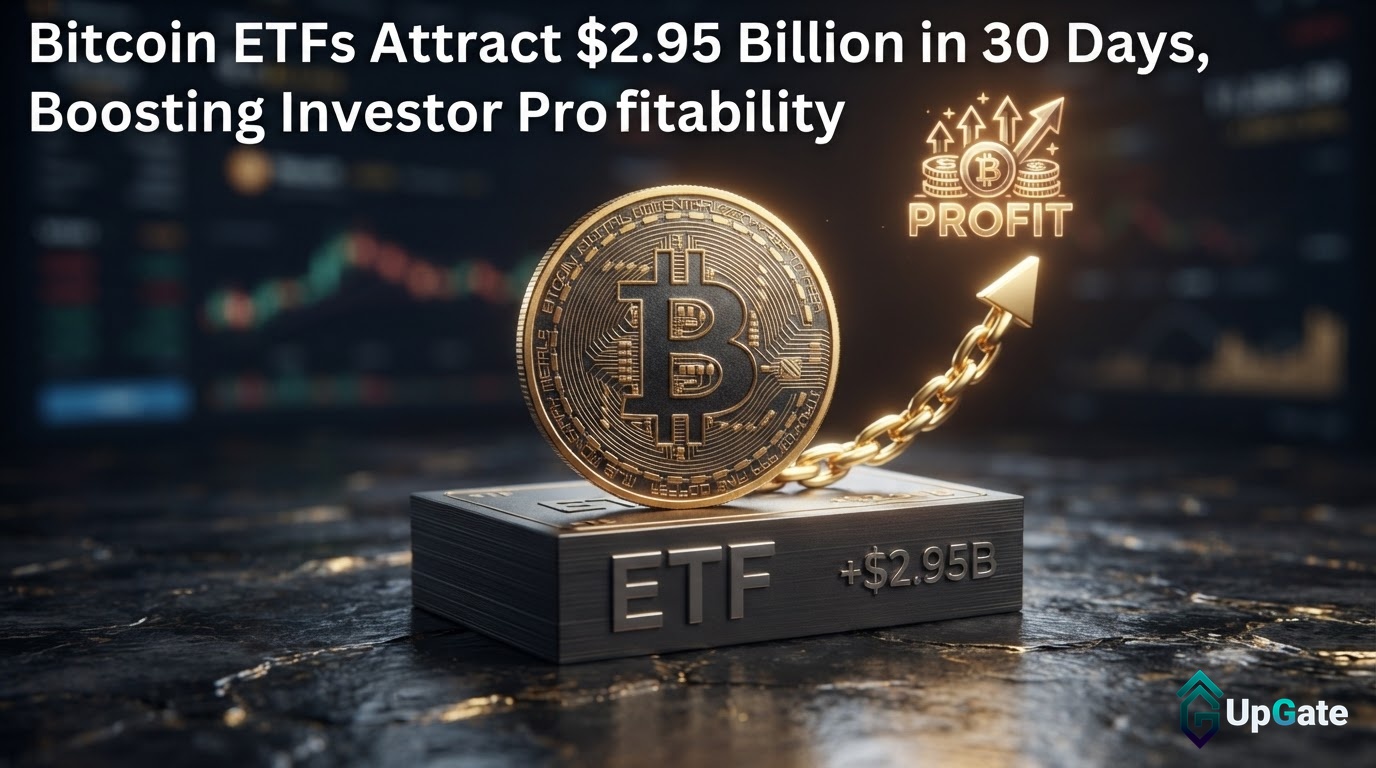
    U.S. Bitcoin ETFs have seen substantial net inflows totaling $2.95 billion over the past 30 days, extending a streak of positive daily inflows to eight consecutive trading days. This sustained investor interest has coincided with a return to profitability for the average ETF holder, whose cost basis stands at $81,722.

    While the streak has been positive, the most recent day of inflows saw a modest $31.07 million, marking the weakest day of the current run. BlackRock’s iShares Bitcoin Trust (IBIT) continued to attract investment, adding $54.84 million on Monday. However, other major funds experienced outflows, with Grayscale’s Bitcoin Trust (GBTC) losing $23.19 million and Fidelity’s FBTC shedding $10.90 million on the same day.

    This recent period of positive inflows follows a more turbulent stretch. On September 15th, Bitcoin ETFs collectively experienced an outflow of $450.4 million, the largest single-day loss since June 24th. This outflow occurred on the same day the U.S. Senate voted 49-50 against advancing the Clarity Act, a measure that required 60 votes to proceed. Ethereum ETFs also saw outflows on that day, losing $142.3 million.

    The week ending September 15th was particularly challenging for Bitcoin ETFs, with net inflows totaling just $6.2 million, the smallest weekly inflow recorded in 141 weeks. However, investor activity rebounded sharply in the subsequent days. On September 21st, Bitcoin ETFs attracted nearly $1 billion, followed by $715 million on September 22nd. While the pace moderated, inflows continued, with $347 million on September 23rd, $191 million on September 24th, and $134 million on September 25th. This resulted in a weekly total inflow of approximately $2.4 billion for the week ending September 25th, marking the largest weekly haul since October 2025.

    The positive trend in Bitcoin ETFs has also seen the cryptocurrency trading above the average ETF holder’s cost basis of $81,722, indicating that typical investors in these funds are now in profit for the first time since January. Bitcoin was trading above $84,000 on Monday.

    This broader interest in crypto investment vehicles is not limited to Bitcoin. Over the past 30 days, Ethereum ETFs have added $982.5 million, with $17.1 million in inflows on Monday, according to SoSoValue. Solana funds saw inflows of $278.2 million over the month, and XRP funds brought in $127.05 million during the same period.

    While the current streak of inflows is notable, it is not a record for the summer. An earlier nine-day run of inflows ended on August 28th, when the funds experienced $201.9 million in outflows. This occurred after comments from Federal Reserve Chair Kevin Warsh at Jackson Hole, a period where market participants often attempt to anticipate the Federal Reserve’s future monetary policy decisions.

    The current inflows suggest a renewed investor confidence in Bitcoin ETFs, driving profitability for many investors. However, the market remains subject to fluctuations, as evidenced by past outflows and the mixed performance of individual funds on a daily basis.

    Why This Matters

    The materials describe a narrow update: Bitcoin ETFs in the U. The exact date of the ‘Monday’ mentioned for the weakest inflow day and specific fund movements is not provided.

    Broader Context

    Source materials place the factual news in this context: Bitcoin ETFs are having a very good month, all things considered.

  • Grayscale: Zcash Market Cap Hits 1.5% of Bitcoin’s in One Year

    Grayscale: Zcash Market Cap Hits 1.5% of Bitcoin’s in One Year

    Zcash Surges as Demand for Financial Privacy Grows

    New York, NY – September 30, 2026 – A year ago, Zcash was a negligible player in the cryptocurrency market, its market capitalization a mere 0.1% of Bitcoin’s. However, recent research from Grayscale indicates a dramatic shift, with Zcash’s market share climbing to 1.5% by September 2026.

    The digital currency, ZEC, experienced a remarkable surge, escalating from approximately $60 to around $1,500 over twelve months. This nearly 19-fold increase propelled its market capitalization to nearly $13.74 billion by late August. For perspective, Bitcoin’s market capitalization stood at approximately $1.56 trillion during the same period.

    Grayscale’s report, released on September 29, 2026, attributes this significant rally to an increasing demand for financial privacy. The underlying thesis suggests that as blockchain transparency advances and on-chain surveillance tools become more prevalent, a growing number of users and investors are prioritizing the ability to conduct transactions privately.

    Zcash’s defining characteristic is its shielded transactions, which allow users to encrypt sensitive data such as sender, receiver, and transaction amounts, while still maintaining settlement on a public blockchain.

    By the end of September 2026, ZEC was trading around $1,400, with its market capitalization reported to be between $23 billion and $24 billion. This suggests sustained momentum following an initial price spike earlier in the summer.

    Grayscale analyzes this market opportunity in relative terms. The firm identifies Bitcoin as the dominant force in the “currencies sector” of the crypto market, commanding approximately 90-93% of that category’s total market capitalization.

    Grayscale Launches Zcash ETF, Boosting Accessibility

    A key development contributing to Zcash’s increased visibility was the launch of Grayscale’s Zcash ETF on August 25, 2026. Trading under the ticker ZCSH on NYSE Arca, the exchange-traded fund represents a conversion of Grayscale’s established Zcash Trust, which has been in operation since 2017.

    The transition from a trust to an ETF is significant because it addresses the persistent issue of premiums or discounts to net asset value that affected Grayscale’s earlier trust products. The ZCSH ETF now offers direct exposure to ZEC, incorporating an arbitrage mechanism designed to keep its market price closely aligned with the underlying asset’s value. Reports indicate that the ETF has attracted substantial inflows since its inception.

    Future Potential and Associated Risks

    Grayscale’s research also includes hypothetical scenarios illustrating ZEC’s potential price trajectory based on different levels of market-cap capture relative to Bitcoin. For instance, if Zcash were to achieve 2% of Bitcoin’s market capitalization, the implied ZEC price would be approximately $1,622. Grayscale emphasizes that these figures are purely hypothetical and not predictive forecasts.

    Zcash’s privacy features are optional, allowing users to enable or disable them as needed, utilizing shielded transactions powered by zero-knowledge proofs.

    However, Grayscale acknowledges that privacy-focused cryptocurrencies carry inherent risks. ZEC exhibits significantly higher volatility compared to Bitcoin. Furthermore, regulatory scrutiny poses a considerable challenge, with several exchanges having delisted privacy-centric tokens in recent years due to concerns over money laundering.

    Mirroring Bitcoin’s scarcity model, Zcash also features a capped supply of 21 million coins.

  • Bitcoin ETFs See Sustained Inflows Amidst Price Consolidation and Options Market Activity

    Bitcoin ETFs See Sustained Inflows Amidst Price Consolidation and Options Market Activity

    Spot Bitcoin ETFs have logged an eight-day streak of net inflows, attracting approximately $2.39 billion in the past week—the largest weekly inflow since October 2025. This sustained institutional interest contrasts with Bitcoin’s current trading range, which remains significantly below its all-time high. Concurrently, options traders are positioning for potential price increases, with a notable concentration of call positions at the $90,000 and $95,000 strike prices.

    Despite these bullish signals from both ETF flows and options markets, Bitcoin’s spot price is trading around $83,000 to $84,000, approximately 34% below its peak of $126,000 reached in October 2025. Since their January 2024 launch, US spot Bitcoin ETFs have accumulated roughly $57.5 billion in net inflows, with total assets nearing $108 billion. BlackRock’s iShares Bitcoin Trust (IBIT) and Fidelity’s FBTC have been leading in attracting capital.

    This recent trend of consistent inflows marks a shift from earlier in 2026, a period that saw net outflows from the ETF complex. The current price consolidation, despite the inflow data, has led some market observers to point to the phenomenon of ‘gamma pinning.’ According to options traders, market makers hedge their exposure to options positions by trading the underlying asset, a dynamic that can pull prices toward specific strike prices. This activity is suggested as a factor contributing to Bitcoin’s current reluctance to break decisively out of its range, similar to dynamics observed around a large options expiry in December 2025.

    There appears to be a growing divergence between the positive sentiment reflected in ETF inflow data and the current spot price action. This suggests that the capital entering the market through ETFs may be patient, long-duration institutional allocation rather than short-term speculative trading. As stated by market participants, many institutional allocations are strategic and may not be chasing immediate price movements.

    Looking ahead, the upcoming options expiry cycle is being watched as a potential catalyst for increased price volatility. If a significant concentration of call options expires worthless, market makers will unwind their hedges, potentially freeing up price action. Conversely, if Bitcoin’s price pushes into the $85,000 to $90,000 zone before these expiries, the same hedging dynamics could accelerate upward momentum as market makers are compelled to buy the underlying asset to maintain neutrality.

    Key uncertainties remain regarding Bitcoin’s price trajectory. It is uncertain whether the current spot price will break out of its consolidation range, the precise impact of gamma pinning on price movements, and the direction of price action following the next major options expiry. The distinction between ETF buyers and leveraged spot traders also remains a point of observation.

    Why This Matters

    The sustained net inflows into Bitcoin ETFs, totaling approximately $2.39 billion in one week and $57.5 billion cumulatively since January 2024, alongside significant options market activity, highlight ongoing institutional interest. However, Bitcoin’s current trading range, about 34% below its all-time high, and the potential influence of ‘gamma pinning’ dynamics suggest that market mechanics are currently creating a divergence between inflow data and spot price action, with upcoming options expiries posing a potential catalyst for future volatility.

    Broader Context

    Spot Bitcoin ETFs have seen an eight-day streak of net inflows, pulling in roughly $2.39 billion in a single week, the largest weekly haul since October 2025. This trend contrasts with earlier in 2026, when the ETF complex experienced stretches of net outflows. The current price consolidation, despite the inflow data, has led some market observers to point to the phenomenon of ‘gamma pinning,’ where market makers hedge their exposure to options positions by trading the underlying asset, a dynamic that can pull prices toward specific strike prices. This activity is suggested as a factor contributing to Bitcoin’s current reluctance to break decisively out of its range, similar to dynamics observed around a large options expiry in December 2025.