Blog

  • LBank Boosts TRX Earn with Up to 11% APR

    LBank Boosts TRX Earn with Up to 11% APR

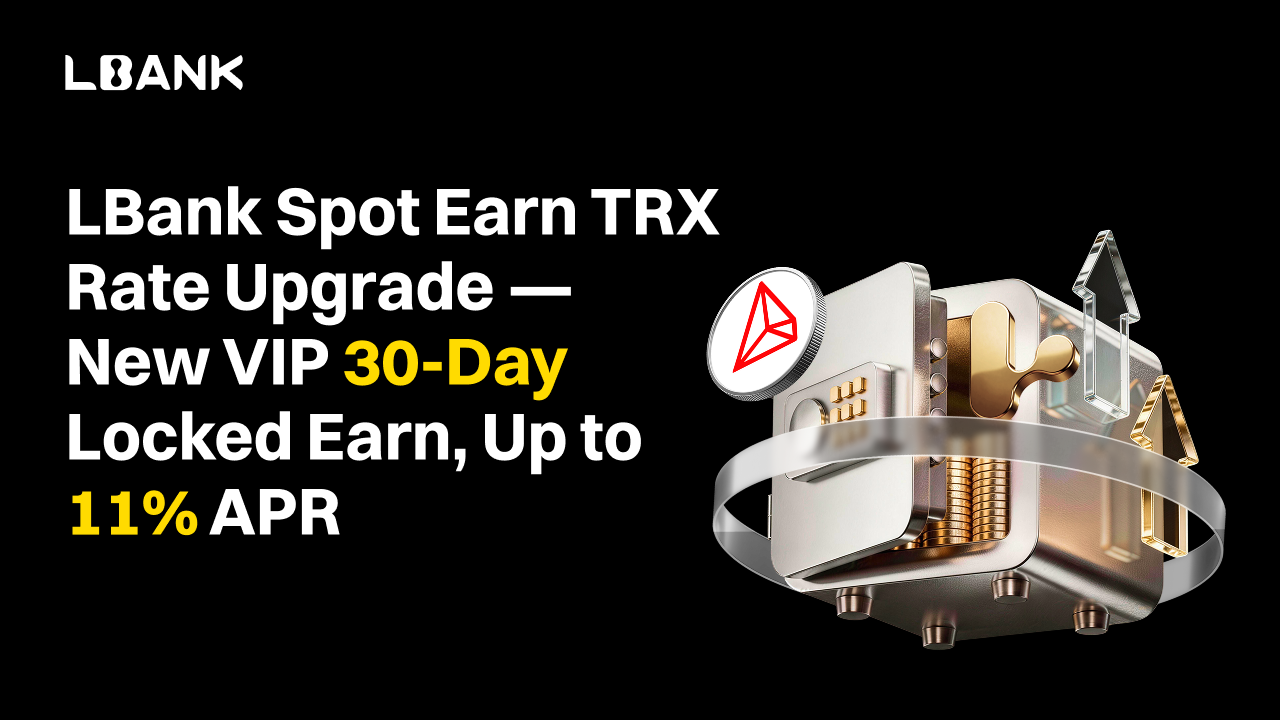
    LBank Boosts TRX Earn Offerings, Promising Up to 11% APR

    Singapore, Singapore – June 12, 2026 – LBank, a prominent global cryptocurrency exchange, has announced a significant upgrade to its TRX Earn program, now offering users the potential to earn up to 11% Annual Percentage Rate (APR). The enhanced offerings, which include both flexible and locked earning products, are designed to optimize capital utilization for users and provide attractive passive income streams, while simultaneously supporting the expansion of the TRON ecosystem.

    The upgraded Spot Earn TRX product features a tiered reward system. Users holding up to 1,000 TRX will benefit from an industry-leading Annual Percentage Yield (APY) of 11%. Balances exceeding 1,000 TRX are eligible for a 9% APY. Complementing this, LBank has introduced Locked TRX Earn products, providing stable returns for those seeking longer-term investment horizons. A VIP Exclusive TRX Locked Earn option is also available for premium users, offering returns of up to 10% APY, thereby creating a diversified yield structure to accommodate varying investment preferences and risk tolerances.

    “TRON continues to be one of the most dynamic ecosystems globally, bolstered by a robust user base, widespread payment adoption, and increasing on-chain activity,” stated Eric He, LBank’s community angel officer and risk control adviser. “Through our revamped TRX Earn program, we aim to broaden access to high-quality yield opportunities and deliver added value to long-term TRX holders. This initiative underscores LBank’s ongoing dedication to providing practical financial products that combine competitive returns with an intuitive user experience.”

    Looking ahead, LBank plans to further expand its Earn product suite and identify new opportunities within other leading cryptocurrency ecosystems. By offering flexible wealth management solutions alongside innovative trading and on-chain products, LBank remains committed to empowering users to maximize the potential of their digital assets and contribute to the sustainable growth of the broader crypto economy.

    About LBank

    Established in 2015, LBank is a leading global cryptocurrency exchange serving over 25 million registered users across 160 countries and regions. With a daily trading volume exceeding $10.5 billion and a decade-long track record of security with no reported incidents, LBank is committed to delivering a comprehensive and user-friendly trading experience. The platform’s innovative trading solutions have enabled users to achieve average returns of over 130% on newly listed assets. LBank has listed more than 300 mainstream cryptocurrencies and over 50 high-potential altcoins, positioning itself as a market leader with rapid altcoin listings, substantial liquidity, and industry-first trading guarantees, making it a preferred platform for crypto investors worldwide.


  • LG Electronics Partners with Arbitrum for Blockchain Ad Platform

    LG Electronics Partners with Arbitrum for Blockchain Ad Platform

    LG Electronics has developed its own layer-2 blockchain network in collaboration with Arbitrum, aiming to revolutionize its digital advertising platform. The South Korean consumer electronics giant revealed to Fortune that this Arbitrum-based network will function as a comprehensive platform for the placement, purchase, sale, and management of digital advertisements, thereby cutting out traditional intermediaries within the advertising supply chain. LG has already completed a pilot program with a Japanese advertising agency and is currently assessing the feasibility of launching the product to market later this year.

    LG Electronics Building with Arbitrum

    LG’s dedicated blockchain team, operating within the company’s research and development division, is currently piloting an on-chain advertising network built on Arbitrum.

    “We are evaluating whether this approach can deliver meaningful value to advertisers, publishers, and audiences,” stated Samuel Byungsun Park, head of LG Electronics’ blockchain research department.

    Steven Goldfeder, a co-founder of Arbitrum, highlighted that the blockchain approach eliminates the necessity for manual interventions in ad transactions. “You don’t need manual interventions,” Goldfeder explained, elaborating that the technology facilitates automated market operations through software.

    Following the announcement of the partnership with LG Electronics, Arbitrum’s native token, ARB, saw a 5% increase, according to data from CoinGecko.

    This advertising blockchain initiative marks LG’s latest engagement with distributed ledger technology. The company’s IT services division, LG CNS, previously introduced the Monachain enterprise blockchain platform in 2018, although LG discontinued its Art Lab NFT marketplace last year. The current endeavor leverages LG Ad Solutions, the company’s advertising arm which oversees a global smart TV installed base of 216 million units, including 49 million in the United States.

    LG’s move aligns with a broader trend of major corporations developing custom blockchain infrastructure for business applications. Notable examples include Samsung’s supply chain ledger, J.P. Morgan’s JPM Coin deposit token, and Mastercard’s stablecoin settlement infrastructure. These initiatives are increasingly being deployed on public or Layer-2 chains rather than private, permissioned ledgers.

    This trend suggests a growing enterprise adoption of crypto infrastructure, even as blockchain received limited attention at CES 2026, where artificial intelligence dominated technology discussions.

  • LBank Sponsors VIP Matchday for Argentina vs. Austria at AT&T Stadium During FIFA World Cup 2026

    LBank Sponsors VIP Matchday for Argentina vs. Austria at AT&T Stadium During FIFA World Cup 2026

    LBank to Host Exclusive VIP Matchday Experience at AT&T Stadium During FIFA World Cup 2026

    Singapore, Singapore – June 12, 2026 – LBank, a prominent global cryptocurrency exchange, is set to host an exclusive Matchday Experience on June 22 at AT&T Stadium in Dallas, coinciding with the FIFA World Cup 2026. The event will bring together international partners, VIP guests, and key representatives from the Argentine Football Association (AFA) for a full-day celebration centered around the Argentina versus Austria match. The occasion aims to blend top-tier football with strategic networking and community engagement.

    Attendees can anticipate exceptional stadium access, premium hospitality, and a range of immersive activities designed to underscore the growing collaboration between LBank and the AFA. A significant highlight of the day will be a special partnership ceremony and jersey exchange involving Leandro Petersen, Chief Marketing Officer of the AFA, and LBank executives. This event reinforces LBank’s role as an Official Regional Sponsor of the Argentina National Team, strengthening an alliance that merges football enthusiasm with the innovation of digital assets.

    “The synergy between LBank and the AFA continues to unlock exciting opportunities for global communities through the universal language of football,” stated Karen, Business VP of LBank. “The World Cup provides the ideal platform to connect our partners, users, and supporters while celebrating the shared values of competition, teamwork, and global connection that are fundamental to both football and the cryptocurrency space.”

    Kaia, VP Commercial & Partnership at LBank, added, “This event is about more than just watching a game; it’s about creating enduring memories, fostering stronger partnerships, and building connections that extend far beyond the football pitch.”

    This Matchday Experience is a key component of LBank’s broader World Cup 2026 campaign, which includes the recently launched World Cup Super League Campaign offering a substantial $5 million prize pool. With a user base exceeding 25 million registered individuals across more than 160 countries and regions, LBank is committed to driving global expansion through strategic sports sponsorships, localized initiatives, and continuous product development.

    Looking forward, LBank remains focused on developing dynamic and engaging experiences that seamlessly integrate sports, technology, and digital assets, aiming to empower communities both online and offline on the world’s most significant stages.

    About LBank
    Established in 2015, LBank is a leading global cryptocurrency exchange serving over 25 million registered users in 160 countries and regions. With a daily trading volume surpassing $10.5 billion and a decade of operational safety with no security incidents, LBank is dedicated to delivering a comprehensive and user-friendly trading experience. The platform’s innovative trading solutions have enabled users to achieve average returns exceeding 130% on newly listed assets. LBank has listed over 300 mainstream cryptocurrencies and more than 50 promising altcoins. Recognized as a leader in categories such as 100x Gems, Highest Gains, and Meme Share, LBank distinguishes itself with rapid altcoin listings, exceptional liquidity, and industry-first trading guarantees, positioning it as a preferred platform for cryptocurrency investors globally.

  • Crypto Poised for Gains as Iran Tensions Ease

    Crypto Poised for Gains as Iran Tensions Ease

    Global Markets Rally on Iran De-Escalation, Crypto’s Response Muted

    Optimism surged across global financial markets following U.S. President Donald Trump’s announcement that planned American strikes on Iran had been canceled.

    New data from Santiment revealed a significant uptick in social media discussions surrounding peace talks, ceasefires, agreements, and conflict resolution, reaching their highest point this month. This surge coincided with reports indicating that negotiators are nearing a potential deal.

    The proposed agreement is understood to encompass an extension of the ceasefire, the reopening of the Strait of Hormuz, and the resumption of diplomatic discussions. Santiment noted that this development elicited a strong and swift reaction in traditional markets within an hour of the news breaking.

    Equities experienced a sharp upward movement, while gold and silver prices also climbed. Traders adjusted their positions in anticipation of a more stable geopolitical landscape and an improved economic outlook.

    In contrast, cryptocurrency markets exhibited a less immediate and pronounced response compared to traditional assets. Bitcoin managed to reclaim the $63,000 mark, bringing its weekly gains to a modest 1.7%. However, Santiment suggests that if confidence in a finalized deal continues to grow, the crypto market may still find room for recovery as traders react to diminishing geopolitical uncertainty, potentially in 2026.

    Separately, online interest in cryptocurrencies has also shown signs of revival. Alphractal reported an increase in Google searches related to crypto in June, signaling renewed engagement from retail investors. The platform observed that individuals are actively searching for various crypto assets as they reconnect with the market, noting that spikes in Google Trends often correlate with periods of heightened fear or excitement.

    Other analysts, however, are awaiting stronger confirmation of a sustained market upturn. Michaël van de Poppe, founder of MN Fund, pointed out that Bitcoin has remained largely range-bound, failing to achieve a confirmed breakout above the critical $64,000 to $65,000 resistance zone. He emphasized that reclaiming this level is essential for renewed momentum across the crypto markets.

    Van de Poppe suggested that a significant immediate move following the market open appeared unlikely, partly due to the anticipated SpaceX IPO. Nevertheless, he indicated that if lower timeframes continue to show higher lows and tensions in the Middle East de-escalate, the market could witness a strong week with improved liquidity flowing into crypto assets.

  • Crypto Trading Volume Hits 2-Year Low; Relief Rally Imminent?

    Crypto Trading Volume Hits 2-Year Low; Relief Rally Imminent?

    Crypto Trading Volume Hits Two-Year Low Amid Investor Apathy

    Trading volume across the cryptocurrency sector has plummeted to its lowest point in two years, signaling a significant shift in investor focus away from the market.

    Santiment Highlights Declining Activity

    On-chain analytics firm Santiment noted this trend in a recent post on X, drawing attention to the diminishing trading volume of crypto assets. Trading volume, in this context, measures the total amount of a specific token actively traded on centralized exchanges. A rise in this metric indicates increased trader engagement and interest in an asset, while a decline suggests waning investor enthusiasm and reduced participation.

    The firm shared a chart illustrating the downward trajectory of trading volume for major cryptocurrencies over the past few years. The data reveals that the combined crypto sector experienced its peak trading volume in mid-2025. Since then, the metric has steadily declined across various digital assets. The latest continuation of this downtrend has pushed crypto trading volume to its lowest level since mid-2024.

    Santiment attributed this slump to a confluence of factors, stating, “Traders appear reluctant to aggressively buy or sell as macro uncertainty, geopolitical tensions, and recent liquidations keep participants on the sidelines.”

    Potential for Future Recovery

    Despite the seemingly bearish outlook, Santiment suggested that historical patterns might indicate a different future for the market. The firm explained, “Historically, some of crypto’s strongest recoveries have emerged from periods when interest, volume, and participation were at their lowest.” The coming weeks will be crucial in observing how the sector evolves.

    Adoption Continues to Grow

    While trading activity has slowed, the adoption of cryptocurrencies has not followed suit. In a separate X post, Santiment highlighted that the “Total Amount of Holders,” an indicator tracking the number of unique non-empty addresses on a network, has been steadily increasing for top digital assets.

    The data indicates that Ethereum has seen the strongest adoption, with its Total Amount of Holders reaching 195 million. Santiment commented, “While social media remains focused on $ETH’s underperformance, user adoption has continued moving in the opposite direction.”

    At the time of writing, Bitcoin was trading around $62,700, marking a 1.8% increase in the past 24 hours.

  • DOGECOIN FLASHES RARE CAPITULATION SIGNAL

    DOGECOIN FLASHES RARE CAPITULATION SIGNAL

    Dogecoin Valuation Hits Deeply Depressed On-Chain Territory, Analysis Suggests

    Dogecoin’s on-chain valuation has entered a significantly depressed zone, with the cryptocurrency trading well below its realized price and key profitability metrics indicating potential capitulation among holders, according to an analysis by Aphractal AI. This situation is noteworthy as it suggests the market may have already absorbed considerable pain, despite ongoing fragility in price momentum and derivatives positioning.

    Deep Value Trading

    The analysis places Dogecoin’s current market capitalization at $13.36 billion, with a circulating supply of 154.58 billion coins, trading at approximately $0.08475. However, its realized price, which represents the aggregate cost basis of all holders, stands considerably higher at $0.12845. This substantial gap means Dogecoin is currently trading about 34% below this on-chain cost basis, a key factor in the current market setup.

    Aphractal AI’s report highlights a Market Value to Realized Value (MVRV) ratio of 0.6730, indicating that Dogecoin’s market value is approximately 32.7% lower than its realized value. Furthermore, the Net Unrealized Profit/Loss (NUPL) metric, which measures aggregate unrealized profit and loss for holders, is at -0.4859, a level classified as “Capitulation.”

    “This is the clearest on-chain signal in DOGE right now: the average holder is underwater,” the analysis stated. “Price remains $0.04370 below realized price, which places the asset in a depressed valuation regime. MVRV below 1 and negative NUPL together point to a market where holders are still carrying substantial unrealized losses, not one showing euphoric excess.”

    Slowdown in Valuation Expansion

    Despite these indicators of deep value, the report cautions that Dogecoin has not yet confirmed a bottom. A long-term delta growth rate of -77.79% suggests a severe slowdown in valuation expansion compared to previous periods. Aphractal AI interprets this as Dogecoin remaining in a “post-distribution / low-growth phase” rather than entering a renewed structural bull market.

    Mixed Network Activity

    Network activity presents a more nuanced picture. Active addresses saw an increase, rising to 37,510, up 13.71% over 24 hours and 2.43% over seven days. Transaction counts reached 23,665, a 3.88% increase on the day, though still down 3.97% weekly. Adjusted on-chain volume showed stronger performance, climbing to $185.55 million, a 69.69% day-over-day increase and a 29.23% rise over seven days.

    This divergence suggests that larger transfers, rather than a broad increase in everyday usage, are driving the volume surge. In Aphractal AI’s assessment, Dogecoin is exhibiting “better value flow than user-flow.”

    Modestly Constructive Exchange Balances

    Dogecoin exchange reserves have shown a modestly constructive trend. Reserves currently stand at 28.33 billion DOGE, valued at approximately $2.42 billion. These reserves decreased by 0.20% in one day and 0.60% over seven days. While not indicative of aggressive accumulation, this gradual decline suggests that exchange supply is slowly decreasing, rather than building towards immediate sell pressure.

    Weak Market Structure and Derivatives Caution

    Nevertheless, the broader market structure for Dogecoin remains weak. The cryptocurrency has experienced significant declines, down 4.59% over seven days, 21.99% over 30 days, 31.69% year-to-date, and 58.01% over the past year. It is also trading 23.09% below its 200-day moving average. The Relative Strength Index (RSI) is near oversold territory at 33.9982, and the daily MACD indicator remains bearish.

    Derivatives positioning adds another layer of caution. Open interest stands at $750.82 million, up 1.79% in 24 hours but down 5.18% weekly. The open interest-to-market cap ratio is 5.73%. Traders exhibit a strong long bias, with a long/short ratio of 2.3167 and top trader sentiment at 2.4115. However, a negative whale-versus-retail delta of -0.3004 indicates that larger players’ behavior does not mirror the broader speculative optimism.

    Recent liquidations have also highlighted pressure on bullish positions. Over the past 24 hours, Dogecoin saw $2.30 million in liquidations, with longs accounting for approximately $1.62 million (70.6%) and shorts for $0.68 million. This suggests that bullish bets have been more vulnerable to recent downward price movements.

    The primary recovery threshold for Dogecoin is its realized price of $0.12845. A move back towards this level would signal that the cryptocurrency is beginning to bridge the gap between its spot price and the cost basis of its holders. At press time, DOGE was trading at $0.08516.

  • XRP Price: Three-Part Impulse Signals Next Move

    XRP Price: Three-Part Impulse Signals Next Move

    XRP Bulls Eye Larger Recovery Beyond Mere Bounce

    XRP bulls are attempting to transform a sharp selloff into a significant recovery, with technical analysis suggesting a potential three-part impulse wave from recent lows. However, the success of this scenario hinges on buyers’ ability to push the price past key resistance levels that crumbled during the recent downturn.

    XRP Chart Suggests Three-Part Impulse Formation

    A notable technical outlook for XRP’s price centers on a potential three-leg recovery structure, originating from the cryptocurrency’s most recent low near $1.07. This projection outlines an initial impulsive move towards the $1.94 mark, followed by a pullback to the $1.46 zone, and subsequently a more substantial advance into the upper resistance band between $2.39 and $3.11.

    This intriguing chart pattern, shared on X by RWA_Investor, illustrates a broader corrective sequence unfolding since XRP’s peaks above $3 last year. This pattern is characterized as a classic W-X-Y double zigzag, which has spanned several months of price action. The initial leg, Wave W, concluded a full ABC decline, finding a significant bottom labeled (C)/(W) on the chart in early February. A linking wave, X, then spurred a counter-rally that propelled XRP above $1.50 in mid-May, exhibiting its own internal (X)-(A)-(B) sequence before reversing. This reversal initiated the final Y leg, which has since driven XRP’s price back to the $1.12 range as of this report.

    Impulse Setup Targets Return Above $3

    With the (C)/(Y) wave currently playing out at lows around $1.12, the prevailing technical setup anticipates a shift from correction to a bullish impulse wave. The projected move involves a three-wave ABC recovery, targeting a price zone between $2.39 and $3.11.

    Wave A is expected to aim for the $2.12 level. However, this projection is not without its challenges. XRP faces immediate resistance from a support/resistance trendline around $1.46, which will serve as the initial test. A further potential rejection point is anticipated around $2.12. Wave B would then see a retracement back to approximately $1.46, but this pullback should not be interpreted as a bearish signal. Wave C, the final and most potent leg of this sequence, is projected to drive the price into a target zone ranging from $2.70 to $3.10.

    A decisive break above $3.10 would suggest that XRP has established its macro bottom at $1.05. In such a scenario, the three-part structure would begin to resemble the nascent stages of a broader trend reversal, potentially leading to new all-time highs. Conversely, if XRP falters below the upper band and loses momentum following the anticipated rebound, it could eventually revisit the $0.75 to $1 range to complete a corrective macro wave 2. Notably, several analysts have identified the $0.87 to $0.92 region as a potential bottom target for XRP under a corrective macro wave scenario.

  • OpenAI Sparks Price War, Validates DeepSeek’s Strategy

    OpenAI Sparks Price War, Validates DeepSeek’s Strategy

    OpenAI is reportedly considering significant price reductions for its developer and enterprise offerings, a move that could signal a broader shift in the generative AI market. The Wall Street Journal reported that these discussions are underway as OpenAI anticipates similar price cuts from competitor Anthropic. Both companies have reportedly filed confidentially for initial public offerings (IPOs) this month, underscoring a period of intense competition and financial pressure, as neither has yet achieved profitability.

    A Tightening Market

    “I think we’ll have a lot of ways we can help people get more value for less spend,” Sam Altman, OpenAI’s CEO, was quoted as saying at a recent event, according to The Wall Street Journal. This statement comes as OpenAI grappled with a challenging financial quarter. In Q1 2026, the company posted an adjusted operating margin of -122%, indicating a loss of $1.22 for every dollar earned.

    The competitive landscape is intensifying. As previously reported by Decrypt, ChatGPT’s dominance in global generative AI web traffic has waned, dropping from 77.6% in May 2025 to 53.7% by April 2026. Furthermore, the Ramp AI Index reveals that more companies are now subscribing to Anthropic’s services than OpenAI’s. Anthropic has experienced explosive growth, with its annualized run rate soaring from $9 billion at the end of 2025 to $47 billion by May 2026, a remarkable 422% increase in just five months. This surge is largely attributed to its Claude Code product, and Q2 2026 marked the company’s first profitable quarter.

    In response, OpenAI has prioritized its own coding tool, Codex, but faces the challenge of catching up in a rapidly evolving market.

    The “Tokenmaxxing” Frenzy

    Both OpenAI and Anthropic are engaged in a fierce battle to capture market share amidst what is being described as the most significant tech boom since the dot-com era. Businesses across all sectors are scrambling to integrate AI into their operations. Uber’s Chief Technology Officer, for instance, reportedly exhausted the company’s entire 2026 AI budget by April. Employees at JP Morgan are also spending more on AI tools than their own salaries, according to the bank’s chief data officer for its payments division.

    This phenomenon has been dubbed “tokenmaxxing” by Silicon Valley observers, referring to the practice of consuming vast quantities of AI tokens—the units of data processed by AI models—often without a clear return on investment. Palantir CEO Alex Karp likened the trend to a “porn addiction” at AIPCon last week, while JP Morgan analysts published a note this month titled “AI Bills Are Out of Control.” Companies most vulnerable to the fallout from this trend are those now contemplating price wars.

    Structural Pressures and Open Source Competition

    Tommy Shaughnessy of Delphi Ventures highlighted a structural challenge in a widely shared X post this week. He argued that the initial $20 per month flat fee for AI services was priced below the actual cost of heavy usage, serving as a loss-leader to drive adoption rather than cover compute expenses. As businesses scale their AI needs, they transition to API access, incurring per-token costs that consume significantly more computing power.

    However, this perspective is not universally shared. Some analysts believe that the concentration of AI capabilities in the Western hemisphere allows companies to command premium prices for prompt processing, citing the lower costs of Chinese AI models as evidence. If this is the case, substantial price adjustments might be feasible without jeopardizing financial stability.

    The competitive pressure is amplified by the rapid growth of open-source inference providers, which offer compute power for AI models. These platforms are increasingly supporting leading Chinese AI models such as DeepSeek, GLM, MiMo, Kimi, and Minimax. These models are demonstrating competitive performance on coding benchmarks, often at a fraction of the cost of closed-source alternatives.

    “Chinese labs open source frontier-grade models,” Shaughnessy wrote. “The model is the single biggest cost an inference provider has, and they get it for free.” This dynamic suggests a continuous downward pressure on AI intelligence pricing, making margin recovery a complex mathematical challenge for companies like OpenAI and Anthropic. The prevailing theory holds that this trend would only reverse if China were to shift towards closed-source models, which would then benefit U.S.-based AI labs. Thus far, China’s AI sector appears committed to an open-source approach.

  • Grok AI Predicts Bitcoin Surge: Traders Risk Missing Out

    Grok AI Predicts Bitcoin Surge: Traders Risk Missing Out

    Elon Musk’s Grok AI has analyzed a Bitcoin chart showing a decline of over 50%, identifying it as a classic accumulation zone and projecting a price target of $150,000 to $225,000 by the end of 2026.

    Accumulation Zone Prediction

    With Bitcoin (BTC) currently trading around $62,800, this forecast represents a potential 2.5x to 3.5x increase, predicated on the principle that significant downturns often present the greatest opportunities. The core argument hinges on the convergence of structural scarcity and persistent demand. Grok AI suggests that Bitcoin is not merely experiencing a dip but is poised for a supply and demand supercycle.

    The post-halving reduction in new Bitcoin issuance, coupled with sustained demand from spot ETFs, corporate treasuries, and potential momentum for a Strategic Bitcoin Reserve, is expected to constrict the available supply. When supply tightens concurrently with intensifying demand, prices typically experience sharp upward movements, forming the basis of this optimistic outlook.

    Bull Case Catalysts

    The bull case is bolstered by several key catalysts. Post-halving scarcity, relentless institutional demand via spot ETFs, increasing adoption by corporate treasuries, and supportive regulatory tailwinds are anticipated to drive a robust recovery and new all-time highs. The projected target of $150,000 to $225,000 by the end of 2026, a 2.5x to 3.5x surge, assumes improving liquidity and escalating buying pressure from nation-states and corporations. This scenario positions the current dip as the last opportunity for entry at a historically low price before Bitcoin matures.

    Bear Case Scenario

    In contrast, the bear case is comparatively mild. Prolonged macroeconomic headwinds could potentially confine BTC to a range between $50,000 and $75,000 through late 2026. However, the established institutional support and recurring cyclical patterns make a prolonged bear market unlikely. The key distinction is that the current situation appears to be a correction within a larger uptrend, rather than the onset of a multi-year downturn. Overall, the market setup strongly favors bullish sentiment, with the current dip presenting a prime buying opportunity.

    Chart Analysis

    Examining the Bitcoin chart on a weekly timeframe, the price is currently at $62,857, following a significant drop from its all-time high of $126,000 reached in October 2025. The current structure represents a deep correction, exceeding 50% from its peak, with the price now entering a major previous accumulation zone. Pattern analysis indicates a return to the $55,000 to $70,000 range, which served as a launchpad for the previous significant upward movement.

    Key support levels are identified at $60,000, with the next floor near $55,000 and deeper demand anticipated around $50,000. Resistance is observed at $70,000, followed by $80,000, and a more substantial ceiling at $90,000.

    The Relative Strength Index (RSI) is currently at 33.97, with its signal line at 40.40. This indicates that momentum is well below its average and approaching oversold territory on the higher timeframe. The notable gap of approximately 6.4 points between the RSI and its signal line suggests significant short-term selling pressure. However, historically, such stretches on the weekly chart have often marked major cycle lows. A return of the RSI above the 40.40 signal line would re-establish a long-term bullish outlook. When these factors are considered together, the chart suggests Bitcoin is positioned within a key accumulation zone that has historically preceded significant upward price movements. Maintaining the $55,000 to $70,000 band could pave the way back toward six-figure prices, aligning with the projected $150,000 to $225,000 target.

    Infrastructure Plays and Interoperability

    While large-cap cryptocurrencies like Bitcoin, Ethereum, and XRP have been testing resistance levels for weeks without significant breakthroughs, the focus is shifting towards infrastructure plays. The current market dynamic, where the next major move for established assets depends on external decisions, is characterized as a “waiting room” rather than a strategic trade.

    The capital that drives market cycles often moves preemptively, before the ultimate destination is widely recognized. Smaller market cap infrastructure projects operate on different principles, where a relatively small rotation of capital can lead to substantial repricing of undiscovered projects. The opportunity lies in the discrepancy between a project’s intrinsic value and its current market valuation, a gap that closes upon market discovery.

    The fragmentation across multiple blockchains, including Bitcoin, Ethereum, and Solana, presents a persistent and costly challenge in decentralized finance (DeFi). These networks operate as isolated systems with no native interoperability, leading to significant costs in fees, slippage, and failed transactions whenever value is transferred between them.

    LiquidChain aims to address this issue by enabling free cross-chain transactions within a single execution environment. This approach offers unified deployment, complete ecosystem access, and eliminates transaction taxes. The project’s presale is currently at $0.01454, having raised over $830,000, positioning it as an early and undiscovered opportunity.

    However, the execution and adoption of LiquidChain remain unproven. Established assets offer predictability within a known market ceiling. LiquidChain represents an entry point that may cease to exist once it gains market recognition.

  • Coinbase: Bitcoin Must Prepare for Quantum Threat Now

    Coinbase: Bitcoin Must Prepare for Quantum Threat Now

    Coinbase Council Urges Proactive Quantum Security Preparations for Blockchains

    Coinbase’s quantum advisory council is pressing blockchain developers to begin preparing for a post-quantum future immediately, arguing that the technical work required to upgrade Bitcoin, Ethereum, and other networks should not be delayed until a consensus is reached on how to handle vulnerable or abandoned coins.

    In a report released Thursday, the council highlighted one of the most contentious issues facing the industry: the fate of cryptocurrencies whose owners fail to migrate to quantum-safe addresses.

    “No quantum computer can break blockchain cryptography right now,” the council stated. “But timelines are uncertain, and the crypto community needs to start preparing now rather than debating exactly when the threat will arrive.”

    Launched in January, Coinbase’s Independent Advisory Board on Quantum Computing and Blockchain comprises researchers from academia and industry, including representatives from Stanford University, the University of Texas at Austin, the Ethereum Foundation, Eigen Labs, Bar-Ilan University, and UC Santa Barbara. The board’s mission is to study quantum risks to blockchain networks.

    The report emerges as researchers warn that a “cryptographically relevant quantum computer”—one powerful enough to break the elliptic curve digital signatures that secure Bitcoin, Ethereum, and other major blockchains—is more likely than not to exist as early as 2030.

    According to the advisory council, this issue could impact millions of Bitcoin currently held in legacy addresses where public keys are already exposed, rendering them directly susceptible to future quantum attacks.

    “Many of these are believed to be Satoshi’s coins or funds whose owners have long since lost their keys,” the report noted. “Factor in address reuse across other address types, and approximately 7 million Bitcoin total are currently considered quantum-vulnerable.”

    The report outlines three potential approaches for coins that do not migrate to quantum-safe addresses. The first option is to permanently freeze, or “burn,” these coins after a specified deadline. The second is to take no action, allowing users to decide their course, with the council adding that “forcing coins to be burned overrides property rights and sets a precedent for network-level interference that conflicts with Bitcoin’s core principles.” The third approach suggests intermediate steps, such as limiting the number of vulnerable coins that can be moved per block or accepting special cryptographic proofs in lieu of legacy signatures, enabling users to “pre-commit to migrations without publicly moving funds yet.”

    “We stress that the above proposals are compatible with each other; there is no reason to not adopt more than one or all of them, since each has its own advantages,” the council wrote.

    This debate unfolds as major blockchain networks begin their own preparations for a post-quantum era. In January, the Ethereum Foundation established a team to coordinate Ethereum’s transition to post-quantum security and has been exploring the replacement of validator and wallet signatures with quantum-resistant alternatives. This was followed in February by Ethereum co-founder Vitalik Buterin’s release of a roadmap for quantum upgrades.

    In April, the Coinbase advisory council cautioned that proof-of-stake networks, including Ethereum and Solana, might be particularly vulnerable to future quantum attacks. This is because the validator signatures used to secure these blockchains rely on cryptography that quantum computers could eventually compromise.

    On Tuesday, the Stellar Development Foundation unveiled a roadmap for migrating users to quantum-safe cryptography. Meanwhile, Bitcoin developers continue to deliberate on how vulnerable coins should be migrated and what actions should be taken regarding those that remain unmoved.

    “The right time to prepare for a cryptographic transition is before it becomes urgent,” a Coinbase Advisory Board spokesperson previously told Decrypt. “Our view is that customer assets are safe today, but the industry should not confuse ‘not imminent’ with ‘not important.’”