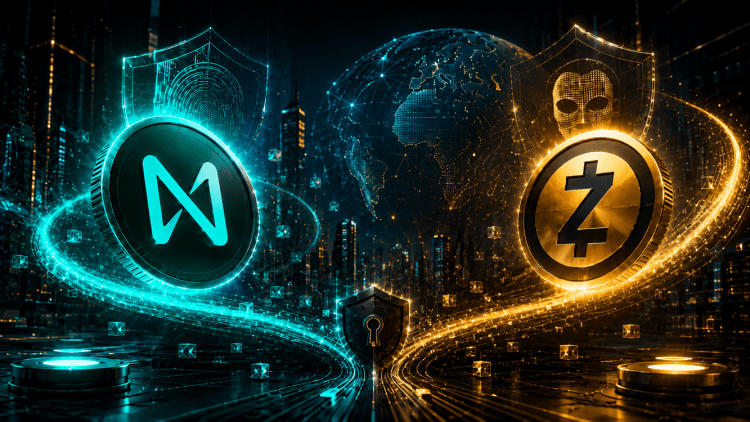
Hayes on Privacy-Focused Crypto
Arthur Hayes, Chief Investment Officer of Maelstrom, has identified NEAR Protocol and Zcash as the core of his privacy-focused cryptocurrency investments, arguing that the market is beginning to reprice assets tied to private value transfer, sovereignty in the age of AI, and sound protocol economics. In an interview with The Rollup, Hayes stated that NEAR could offer “20x potential,” while Zcash might have “5x potential” over the next year. He framed these assets as part of a broader reaction to the influence of “big tech, big government,” and AI-driven surveillance.
Macroeconomic Shift Fuels Investment
Hayes’ investment thesis is rooted in a macroeconomic shift. Earlier this year, he adopted a cautious stance, believing that Bitcoin had already priced in an “AI deflationary credit event.” He anticipated that monetary authorities would be hesitant to aggressively print money until a crisis forced their hand. However, he believes this changed after the Iran conflict, which crystallized a liquidity-positive environment for markets. “Governments print money to win war. AI is part of war. The AI capex will be underwritten, both in the United States and China, by the governments,” Hayes said. He added that governments in the US, China, and Europe would likely fund a wartime economy and AI infrastructure through monetary expansion, with some of that liquidity flowing into Bitcoin and select crypto assets.
The Case for NEAR and Zcash
Hayes’ strongest comments were reserved for privacy-focused cryptocurrencies. He reaffirmed Zcash as his “second biggest bag” and stated that the asset had become investable again after earlier concerns about its trusted setup, issuance profile, and developer subsidy faded. He views the current Zcash trade as cleaner, more liquid, and more relevant to the current political and technological climate. “There’s nothing wrong with wanting to have private money over the internet,” Hayes said. “And that’s what Zcash represents, that’s what Monero represents. And as we are learning the ability for big tech, big government and AI to essentially know everything about us and to trace everything that’s going on in our lives, to have pure, just cryptographically proven privacy with money is going to be super needed.”
Hayes’ renewed interest in Zcash was spurred by a conversation with Naval Ravikant during Tokyo 2049. According to Hayes, Ravikant argued that Monero’s ring signatures were weaker than commonly assumed, referencing a Japanese law enforcement case involving deanonymization. Hayes subsequently purchased $1 million of Zcash and continued accumulating the asset as he researched the thesis further.
NEAR’s Role in Private Value Transfer
Hayes’ price targets are linked to NEAR’s role in facilitating private value transfer across assets and chains. He argues that while shielded Zcash is important, the greater opportunity lies in the ability of users to move from shielded ZEC into other assets, including stablecoins, through NEAR Intents. “Within the ZODL app, I can now send any crypto asset I want to anyone across the Internet in an anonymous way. From Shielded Zcash, using Near Intents. Now I’m into, you know, USDT on Tron and I’ve sent it to whoever I’m going to send it to in an anonymous fashion. That’s huge,” Hayes said.
He believes Zcash remains the primary expression of the privacy trade, but NEAR may offer a more asymmetric setup due to its connection to the execution layer behind confidential transfers. “I think Near has a 20x potential where, you know, Zcash might have a 5x potential over the next year or something like that,” he said.
NEAR’s Economic Fundamentals
NEAR co-founder Illia Polosukhin reinforced the economic side of the argument, stating that NEAR Intents is approaching $20 billion in lifetime volume, with $18.9 billion cited during the interview, and has generated $33 million in fees. He explained that NEAR takes a fee from every transaction and uses it to buy back NEAR, while the ecosystem has already halved inflation and may push for further reductions as revenue grows.
Hayes also highlighted NEAR’s token structure, noting that it benefits from being “fully diluted,” avoiding the large overhang of venture allocations that still affect many Layer-1 assets. He believes this clean supply profile is advantageous for a token expected to perform well in an upmarket.
Risks and Outlook
Hayes acknowledges that the primary risk to his thesis is macroeconomic. He intends to hold his positions until the broader liquidity backdrop changes, but he cautioned that reduced government support for AI capital expenditure or a worsening war scenario could alter the setup. For now, he sees privacy, AI-linked sovereignty, and exchange revenue as the trades with the clearest market validation.
At the time of this report, Zcash was trading at $624.
Leave a Reply