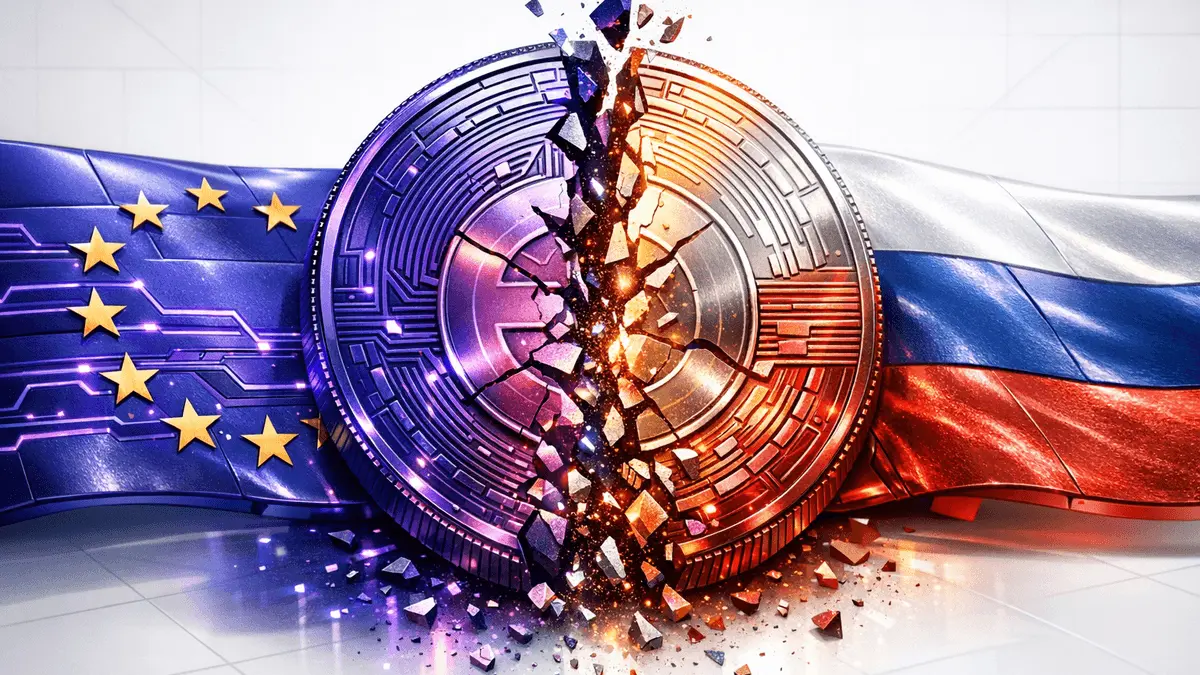
EU Unveils Sweeping Sanctions, Empowering Crypto Sector Bans on Nations
Brussels, Belgium – European Commission President Ursula von der Leyen has announced the European Union’s 21st sanctions package against Russia, introducing a significant and unprecedented legal tool: the authority to prohibit all crypto-asset services operating from any foreign country found to be facilitating Russia’s evasion of sanctions.
The announcement came on the same day that Russia’s Deputy Finance Minister Ivan Chebeskov, speaking at the SPIEF 2026 forum, declared the imposition of punitive fees of up to 3% on stablecoins linked to Western entities, including Tether (USDT) and USD Coin (USDC).
This simultaneous policy shift marks an official fracturing of the global crypto market, a development that analysts have been anticipating for two years.
The June 9 sanctions package represents a doctrinal escalation rather than an incremental tightening of existing measures. For the first time, the EU is proposing a mechanism that targets entire jurisdictions, not just individual entities. Previous sanctions packages have focused on naming specific exchanges, wallets, and individuals.
The 21st package grants Brussels the power to designate an entire country’s crypto sector as off-limits if that nation is identified as hosting platforms that enable Russian entities to circumvent sanctions.
President von der Leyen articulated the significance of this new tool, stating, “For the first time, we will introduce the possibility of a full third-country ban for crypto-asset services. It will act as a strong deterrent for the countries hosting platforms that help Russia evade our sanctions.”
The enforcement process involves the European Commission identifying a foreign jurisdiction – with countries such as Turkey, the UAE, Kazakhstan, and Hong Kong reportedly under scrutiny as key intermediary hubs for Russian crypto flows. If the Commission determines that a jurisdiction is materially enabling sanctions evasion, it can then impose a blanket ban on all crypto-asset service activities connecting that country to EU-regulated markets. Consequently, any exchange, liquidity provider, or settlement layer interacting with that jurisdiction would be cut off from European counterparties.
The 21st package also expands transaction bans to an additional 20 non-EU entities, including banks, crypto platforms, and oil traders, and adds 31 Russian banks to the existing transaction ban list.
This action follows the 20th sanctions package, adopted on April 23 and effective May 24, which already prohibited all Russia-based crypto asset service providers as a category and explicitly banned dealings with the state-backed RUBx stablecoin and the digital ruble.
Western crypto firms, already grappling with escalating compliance demands across multiple jurisdictions, now face a new layer of risk: third-country exposure. This is a challenge that current compliance manuals do not adequately address.
Chainalysis, which previously described the 20th package as a “paradigm shift” from entity-level pressure to targeting the “evasion architecture itself,” now faces an even more complex analytical task. The 21st package necessitates that Virtual Asset Service Providers (VASPs) assess entire settlement ecosystems and jurisdictional exposure, moving beyond simply screening named individuals against sanctions lists.
The rationale behind the emerging stablecoin ban architecture in Brussels is underscored by data indicating that the total value received by illicit crypto addresses reached $154 billion in 2025, with Russia-linked flows constituting a significant portion of this total.
Leave a Reply