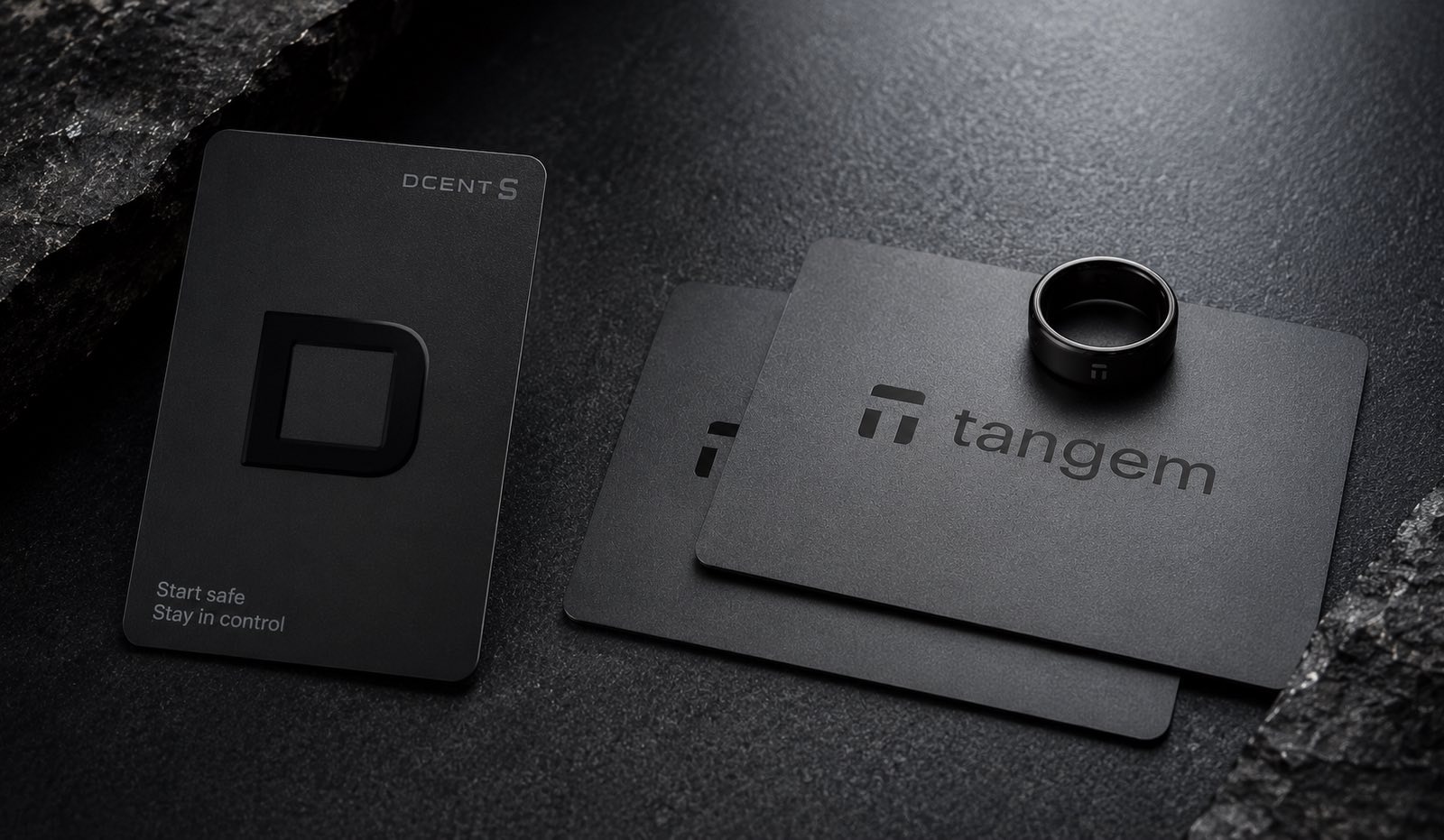
The hardware wallet market is seeing a shift towards innovative form factors, with card-shaped devices like the DCENT S and Tangem emerging as key players. While both wallets share a convenient credit-card size and utilize NFC technology for secure transaction signing, their approaches to backup and recovery present a critical distinction for users, according to the article.
Shared Foundations: Design and Security
Both DCENT S and Tangem wallets are designed to be battery-free and powered by NFC during transaction signing. They employ EAL6+ certified secure elements, a robust security standard also used in government IDs and payment cards. This ensures that private keys are generated on-device within the secure chip and never leave it, significantly reducing the attack surface. A notable trade-off for this compact form factor is the absence of a display on either wallet, requiring users to rely on their paired mobile application to verify transaction details before signing.
The Crucial Difference: Backup and Recovery
The primary divergence lies in how these wallets handle backup and recovery. The DCENT S features a dedicated ‘R3covery Card.’ This card is exclusively for restoring wallet access if the main DCENT S card is lost and cannot sign transactions itself. The backup data is stored securely on another chip, eliminating the need for users to write down recovery phrases. The article notes that while this design prevents direct fund theft from a stolen recovery card alone, it is recommended to store the primary and recovery cards in separate physical locations.
Tangem takes a different approach by selling wallets in sets of two or three identical cards. The private key is copied to all cards in the set during setup, meaning any card can function as the primary wallet and sign transactions. This provides immediate redundancy; if one card is lost, another from the set can be used. However, the article points out that this convenience comes with a security consideration: if a backup card is compromised along with the user’s PIN, access to funds is at risk. This highlights a trade-off between DCENT S’s segregated, recovery-focused backup and Tangem’s multi-card accessibility.
Features and Usability
In terms of supported assets, DCENT S supports over 100 blockchain networks and more than 4,900 tokens, with a strong emphasis on full XRP Ledger (XRPL) functionality. Tangem supports over 90 blockchain networks and more than 14,000 tokens, covering major cryptocurrencies like Bitcoin, Ethereum, and XRP. The article suggests that the difference in token counts is largely due to counting methodologies rather than significant functional disparities for most users.
Usability is streamlined for both, requiring an NFC-enabled smartphone. Setup is quick, with Tangem estimating two minutes and DCENT S estimating three. Daily use involves tapping the wallet against the phone to sign transactions, a process described as seamless and akin to contactless payments. Both come with companion mobile apps for Android and iOS for asset management and transaction handling. Tangem’s app is noted for its more mature feature set, including built-in swapping and staking, while DCENT’s app covers essential functions effectively.
Durability and Value
DCENT S offers IP69 dust and water resistance, while Tangem provides IP69K resistance and additional advertised protection against X-rays and electromagnetic pulses. Both have similar operating temperature ranges. Tangem provides a 25-year warranty, whereas DCENT S offers a limited lifetime warranty.
Conclusion: Which Wallet for You?
The article suggests that while both wallets advance accessible self-custody, the DCENT S may appeal more to security-conscious users due to its segregated backup system and robust XRP Ledger support. The author leans towards the DCENT S, citing its thoughtful security design and IOTRUST’s longer experience in hardware wallet engineering since 2017. Tangem, conversely, offers immediate convenience through its multi-card redundancy. The choice ultimately depends on individual user priorities regarding security versus immediate backup availability.
Why This Matters
The materials describe a narrow update: The article compares two card-shaped hardware cryptocurrency wallets, DCENT S and Tangem, detailing their features, strengths, and weaknesses across various categories including design, security, backup and recovery, supported cryptocurrencies, daily usability, mobile apps, and overall value. The exact launch date of DCENT S is stated as July 2026, which is in the future.
Broader Context
Source materials place the factual news in this context: The hardware wallet market has seen a quiet revolution over the past few years.
Leave a Reply