Author: Admin_Up

  • XRP Price Surge Fueled by African Stablecoin Initiative

    XRP Price Surge Fueled by African Stablecoin Initiative

    Ripple Invests in Flutterwave, Positioning RLUSD as African Payment Backbone

    A significant strategic investment in Flutterwave’s Series E funding round is poised to establish RLUSD as the foundational stablecoin for continental payment infrastructure. While this development offers a bullish outlook for XRP price predictions, the broader market is still assessing its full implications.

    Adding to market caution, the current macroeconomic climate is keeping traders on edge. The Federal Reserve is expected to hold interest rates steady today, but attention is firmly fixed on Chair Kevin Warsh’s press conference regarding forward guidance, particularly given inflation remains at a three-year high.

    Reece Merrick of Ripple articulated the company’s objective clearly: “Our investment will embed RLUSD within that infrastructure, with Flutterwave facilitating stablecoin flows over the XRPL and enhancing its function as a settlement layer for real-world payments across the continent.”

    Flutterwave is a substantial entity in the African market, recognized as a leading provider of blockchain-based enterprise infrastructure. Integrating RLUSD into its network targets a significant payment corridor, where Sub-Saharan on-chain transactions exceeded $205 billion in the past twelve months.

    RLUSD itself holds considerable market presence, boasting a $1.6 billion market capitalization and ranking tenth among stablecoins globally. However, XRP’s price has yet to fully reflect these developments.

    Ripple has acquired an equity stake in Flutterwave, valuing the African fintech at $3.3 billion. This move signifies an intensification of Ripple’s expansion into Africa’s cross-border payments sector.

    XRP Price Analysis and Outlook

    XRP is currently trading within a recent range of $1.20 to $1.25, with its spot price hovering near $1.20 and a market capitalization close to $75 billion. While a weekly gain of 8% appears positive on the surface, the underlying technical indicators suggest a less robust setup.

    Technical analysts are observing a developing head-and-shoulders pattern, identifying $1.18 as a critical support level. A breach below this zone would confirm the pattern, potentially leading to a decline towards $1.10 and possibly below the dollar mark.

    On the upside, resistance is noted in the $1.28-$1.30 band. A decisive break above this level could trigger a rally towards the $1.80 swing level, which is being monitored by longer-term technical frameworks. 21Shares projects a 30% probability of XRP reaching $2.69 by 2026, with a base case scenario of $2.45 contingent on ETF inflows and increased utility, both of which the Flutterwave deal is expected to advance.

    An important data point is the significant reduction in Binance’s estimated XRP leverage ratio, which has fallen by approximately 78% from its mid-2025 highs. This decrease substantially lowers the likelihood of severe liquidation cascades, contributing to a more stable trading environment.

    Bitcoin Hyper Emerges as a New Contender

    While XRP’s stablecoin thesis for Africa is compelling, its substantial market capitalization limits the potential for significant upside even in a bullish scenario. Traders seeking earlier-stage infrastructure plays are exploring different risk-reward profiles, a niche that Bitcoin Hyper aims to fill.

    Bitcoin Hyper ($HYPER) is positioning itself as the first Bitcoin Layer 2 solution to integrate with the Solana Virtual Machine (SVM). This integration is designed to address three long-standing limitations of Bitcoin’s decentralized finance (DeFi) utility: slow transaction speeds, high fees, and a lack of native programmability.

    The platform promises sub-second transaction finality and low-cost smart contract execution, all while leveraging Bitcoin’s robust security layer. The project’s presale has already raised $32.8 million, with the current token price at $0.0136. Staking is available for early participants.

    The Decentralized Canonical Bridge facilitates BTC transfers without relying on centralized custody, a key differentiator in a landscape where bridge exploits remain a persistent risk. Investors are encouraged to research Bitcoin Hyper before the presale concludes.


  • Illinois Enacts Nation’s Toughest Crypto Law

    Illinois Enacts Nation’s Toughest Crypto Law

    Crypto Executive Slams Illinois’ New Digital Asset Tax as “Most Anti-Crypto Law in the US”

    Andreessen Horowitz crypto executive Miles Jennings has sharply criticized Illinois’ newly enacted Digital Asset Privilege Tax Act, labeling it “one of the most anti-crypto laws in the US” on June 17. The legislation imposes a 0.2% tax on the exchange, transfer, and custody of digital assets, with virtually no exemptions for common self-custody activities.

    According to Jennings, no other U.S. state has implemented a transaction-based tax specifically on cryptocurrency. He further noted that comparable levies do not exist for traditional assets like stocks, bonds, or derivatives anywhere in the country. “That means crypto is being singled out in violation of several federal laws,” he stated.

    Jennings’ remarks echoed concerns raised in a June 16 letter from the Crypto Council for Innovation (CCI) to Illinois Governor J.B. Pritzker, urging him to veto the legislation. The CCI argued that the law places unique and disproportionate burdens on individuals simply for holding digital assets, potentially driving users and entrepreneurs out of the state.

    The organization expressed the view that the measure taxes blockchain-based activity based on the underlying technology rather than the nature of the transaction itself. The CCI also raised concerns about the legislative process, highlighting that affected stakeholders were not afforded an opportunity to provide input.

    Jennings also criticized Governor Pritzker’s timing, pointing out that Illinois had recently adopted the Digital Asset and Consumer Protection Act, which he described as a “constructive approach to blockchain technology.”

    “So, rather than embracing innovation and the cost efficiencies blockchain can deliver for ordinary people in Illinois, the state is poised to punish its entrepreneurs and citizens that want to use crypto,” Jennings argued.

    The Illinois law emerges as the U.S. Congress is actively working toward establishing a national framework for crypto taxation. The CCI’s letter had advised Governor Pritzker to defer his state-level approach until federal standards were in place. The group warned that Illinois’ decision could contribute to a fragmented landscape of crypto tax laws across the remaining 49 jurisdictions, further complicating matters.

    This concern is not without precedent. Earlier this month, Coinbase vice president of tax, Lawrence Zlatkin, testified before the House Ways and Means Committee, advocating for simplified federal crypto tax rules. His proposals included treating federally regulated stablecoins as equivalent to cash and establishing de minimis exemptions for small transactions.

    The congressional hearing addressed six standalone bills aimed at updating the U.S. tax code’s treatment of digital assets. Jennings’ post on X underscored the broader implications: “When states adopt discriminatory, asset-specific taxes that drive builders and users elsewhere, we all lose.”

  • CoinFund, Coinbase Back Trace in $32M Stablecoin Funding

    CoinFund, Coinbase Back Trace in $32M Stablecoin Funding

    Trace Finance Secures $32 Million Series A to Bridge Digital and Traditional Finance

    Trace Finance, a financial infrastructure company facilitating stablecoin settlements between banks in Brazil and the United States, announced Wednesday it has raised $32 million in a Series A funding round. The round was led by CoinFund and included investments from Coinbase Ventures, Haun Ventures, Jump Capital, and other crypto-focused investors.

    This funding comes at a pivotal moment as Brazilian regulators begin to classify cross-border cryptocurrency transfers as foreign-exchange operations. This regulatory shift is prompting institutional capital to move away from unregulated crypto platforms and toward licensed, bank-grade intermediaries—precisely the market niche Trace Finance has cultivated.

    The New York-based company reports having processed over $10 billion in cross-border transaction volume. It has established itself as a key settlement partner for several major global payment firms operating in Latin America, including the Uruguay-based payments company dLocal.

    Bernardo Brites, co-founder and CEO of Trace, emphasized the company’s strategy of integrating stablecoins with traditional banking compliance, rather than positioning digital currency as a replacement for existing regulated financial systems.

    “Stablecoins alone do not solve cross-border payments. Stablecoins plus regulated local bank infrastructure does,” Brites stated. “This round allows us to enhance the banking, payments, and compliance infrastructure that global fintechs, exchanges, international banks, and enterprises depend on to connect digital settlement with trusted local financial systems.”

    The new capital will support Trace Finance’s expansion beyond its initial U.S.-Brazil corridor into other Latin American markets, as well as the United States and the Asia-Pacific region.

    The funding round also saw participation from strategic investors such as Chainlink Labs and prominent individual backers with significant ties to the crypto industry, including Circle co-founder Sean Neville and Solana Labs co-founder Anatoly Yakovenko. Ricardo Villela Marino, vice chairman of Itaú Unibanco, Latin America’s largest bank, also participated.

    “The next era of global money movement will be dominated by companies that can bridge on-chain settlement with trusted local banking systems,” said Einar Braathen, Partner at CoinFund. “Brazil represents one of the world’s largest and most operationally complex payment environments, and Trace has successfully built the regulated infrastructure that global blue-chip businesses are leveraging for scale, while simultaneously reducing time and costs compared to legacy alternatives.”

    Trace Finance’s previous funding, a seed round in 2022, was led by HOF Capital. The company indicated it is currently developing additional settlement products aimed at strengthening its banking relationships across Brazil and the wider region.

  • GLAAD: AI Fails LGBTQ Users, Risks Mount

    GLAAD: AI Fails LGBTQ Users, Risks Mount

    AI Amplifying Anti-LGBTQ Bias, Discrimination, Report Finds

    Artificial intelligence is exacerbating anti-LGBTQ bias, misinformation, and discrimination, with potential impacts spanning healthcare, employment, housing, and privacy, according to a new report from the advocacy organization GLAAD.

    The report, titled “Build for Everyone: A Framework for LGBTQ Representation and Safety in AI,” released Wednesday, asserts that LGBTQ safety should be a fundamental requirement in the development of responsible AI.

    GLAAD warns that AI systems trained on biased or incomplete data risk reinforcing stereotypes, silencing LGBTQ voices, exposing users to privacy vulnerabilities, and producing discriminatory outcomes as the technology becomes increasingly integrated into daily life.

    “AI is a civil rights issue,” GLAAD President and CEO Sarah Kate Ellis stated in the report. “Neutrality is no longer an option. To build AI that is ethical, inclusive, and responsible, tech leaders must proactively embrace intentional practices to create safe products.”

    The study identified several areas of concern, including biased training data, the proliferation of anti-LGBTQ misinformation, discriminatory results from predictive AI systems, failures in content moderation, and privacy risks. The report argues that AI trained on incomplete or inaccurate information about LGBTQ individuals can perpetuate harmful stereotypes.

    Ellis contended that responsible AI is not only beneficial for business but also essential for future-proofing AI companies. “More than 20 percent of Gen Z is LGBTQ,” she wrote. “These are your future employees and consumers.”

    A 2023 study by advisory and investment firm LGBT Capital indicated that the global buying power of LGBTQ individuals stands at $4.7 trillion, a figure projected to reach $33 trillion by 2030.

    “To put that in perspective, if we were a country, we would be the 4th largest economy in the world,” Ellis noted.

    The GLAAD report emerges amidst ongoing discussions about AI bias. In May, researchers observed that prominent AI models consistently favored Catholicism in their responses while exhibiting less favorable treatment toward Jehovah’s Witnesses, atheism, and agnosticism.

    Earlier this month, former xAI engineer Devin Kim filed a lawsuit against xAI and SpaceX, alleging wrongful termination after he raised concerns about Grok’s inadequate safeguards against misinformation and bias. Concurrently, Elon Musk’s xAI is engaged in a legal dispute with the state of Colorado over a law mandating that companies assess and mitigate discrimination risks in AI systems used for decisions related to housing, employment, and lending.

    GLAAD emphasizes that the implications of AI bias extend beyond simple chatbot interactions and image generation.

    “While not specific to LGBTQ people, we must also mention other emerging challenges as AI development and adoption progresses,” the study stated. “These can include model hallucinations or sycophantic behavior that generate misinformation, including about consequential topics such as health or elections.”

    These concerns are amplified, the study noted, as companies deploy AI agents capable of performing tasks with minimal human supervision. GLAAD cautioned that autonomous agents could inherit existing biases and automate discriminatory outcomes, such as excluding LGBTQ-affirming healthcare providers from search results or making incorrect assumptions about users’ identities.

    To mitigate these risks, GLAAD urged developers to enhance LGBTQ representation in training data, bolster privacy protections, ensure human oversight of moderation systems, and collaborate more closely with advocacy groups. The report also calls for increased industry accountability and regulatory scrutiny.

    “Failure to account for LGBTQ experiences and issues in training data, product design, and governance can result not only in harm to marginalized communities but also in inaccurate, lower-quality products that may undermine user trust in a growing demographic,” the study concluded.

  • Allbirds Soars on AI Pivot and Smartbird Rebrand

    Allbirds Soars on AI Pivot and Smartbird Rebrand

    Allbirds, the footwear company once synonymous with its wool runners and a strong emphasis on sustainability, is pivoting entirely away from its original business. It is reinventing itself as an artificial intelligence infrastructure firm under a new banner: Smartbird.

    The San Francisco-based company, which is publicly traded on Nasdaq under the ticker BIRD, announced Wednesday that it has finalized the sale of its Allbirds shoe and apparel operations. This move, initially disclosed in April, also saw the appointment of Nadia Carlsten, a seasoned executive from the AI and advanced computing sector, as its new president, CEO, and a member of its board.

    Investors responded favorably to the latest developments. BIRD shares surged 52% on the day, reaching a recent price of $5.99. This follows a volatile period in April, when the stock saw a significant jump from $2.49 to a high of $24.31 before retracing most of those gains. Despite the fluctuations, BIRD shares remain up 46% year-to-date.

    Carlsten joins Smartbird from DCAI, a company specializing in GPU compute infrastructure, where she previously served as CEO. In that role, she was instrumental in the launch of a sovereign AI supercomputer in collaboration with Nvidia. Her professional background also includes positions at Google spinoff SandboxAQ and Amazon Web Services, where she contributed to the introduction of Amazon’s quantum computing service. Carlsten holds degrees in chemistry and physics from the University of Virginia and an engineering doctorate from the University of California at Berkeley.

    She succeeds Joe Vernachio, who is departing the company and its board. Lily Yan Hughes, an independent director, has been appointed board chair, while Annie Mitchell will continue in her role as chief financial officer. The company had previously considered rebranding as NewBird AI before ultimately selecting Smartbird.

    “Smartbird is entering the market at a pivotal moment in the evolution of AI infrastructure,” Carlsten stated. “AI is rapidly becoming mission-critical for organizations across every industry, yet many organizations lack a practical path to deploy and operate the dedicated infrastructure these workloads require.”

    She further elaborated, “There is a clear opportunity to meet the growing need for enterprise-grade AI infrastructure that delivers control and performance without the capital and operational burden of hardware ownership. With a differentiated strategy, significant capital, and the opportunity to build an exceptional team, we are uniquely positioned to capitalize on one of the most significant infrastructure opportunities of the next decade.”

    As part of this strategic shift, the company has increased its convertible financing facility from $50 million to $100 million. This infusion of capital will enable Smartbird to develop what it describes as managed, dedicated AI computing clusters for its enterprise clients. The company indicated that it is actively engaged in discussions with potential customers and is currently designing its initial cluster deployments.

  • AI Predicts Hyperliquid Could Overtake Ripple by 2026

    AI Predicts Hyperliquid Could Overtake Ripple by 2026

    HYPE, the native token of the decentralized crypto exchange Hyperliquid, has experienced a remarkable surge, reaching a new all-time high even as the broader digital asset market continues to grapple with a prolonged downturn. The token recently outpaced Dogecoin (DOGE) to claim the 10th position among the largest cryptocurrencies by market capitalization. This development prompted an inquiry into whether HYPE could potentially surpass Ripple’s XRP within the current year, with insights sought from three prominent AI-powered chatbots.

    HYPE’s Ascent and Market Position

    Earlier this week, HYPE’s price climbed to a historic peak of approximately $77, accompanied by a market capitalization reaching around $16 billion. Despite this significant appreciation, HYPE’s valuation remains considerably lower than XRP, which currently boasts a market capitalization of roughly $74 billion.

    AI Perspectives on HYPE’s Potential to Overtake XRP

    ChatGPT assessed the likelihood of HYPE surpassing XRP as low, citing the substantial market cap disparity. However, OpenAI’s platform did identify several potential catalysts that could drive HYPE’s valuation to such levels. These include the growing popularity of Hyperliquid, its potential expansion to rival major exchanges like Binance, and endorsements from influential figures within the industry.

    The report also referenced Arthur Hayes, co-founder of BitMEX, who had a significant stake in HYPE. While Hayes reportedly sold his holdings, the blockchain analytics platform Lookonchain suggested he may have repurchased nearly 34,000 HYPE tokens for over $2 million, a claim Hayes has since denied.

    ChatGPT further suggested that institutional interest could positively impact HYPE. Data indicates that inflows into spot HYPE exchange-traded funds (ETFs) have recently outweighed outflows, accumulating approximately $180 million in net inflows. This figure, however, falls short of the $1.44 billion attracted by XRP-based ETFs since their introduction in late 2025.

    Perplexity echoed a similar sentiment, positing that a significant rise for HYPE is only conceivable within a “narrow sense.” The AI highlighted that beyond its market cap advantage, XRP benefits from a large and dedicated community, which could present a formidable obstacle to HYPE’s ascent. Perplexity elaborated, stating, “In 2026, HYPE can plausibly flip XRP on price momentum, narrative strength, or even short-term market cap at times, but XRP has a much larger base to overtake, so a full sustained flip is less likely without a major rotation in capital.”

    Google’s Gemini offered a more cautious outlook, identifying pure mathematics as the primary challenge for HYPE, rather than its utility. Gemini characterized XRP as a “highly liquid, large-cap legacy asset” with a market cap that remains in the tens of billions of dollars even during market corrections, supported by “deep institutional plumbing and international remittance use cases.” Gemini concluded, “For HYPE to flip XRP, it would need to see an astronomical influx of capital, multi-billion-dollar daily trading volumes, and massive speculative retail FOMO – all while XRP would have to severely stagnate or decline.”

  • Bitcoin Recovery Hinges on Key Support

    Bitcoin Recovery Hinges on Key Support

    Bitcoin’s recovery has stalled after hitting a significant resistance cluster, with the cryptocurrency now consolidating below a key supply zone. Current price action indicates bulls are striving to maintain upward momentum, but the market is at a pivotal juncture where the next move—either a breakout or rejection—will likely dictate the short-term trend.

    Daily Chart Dynamics

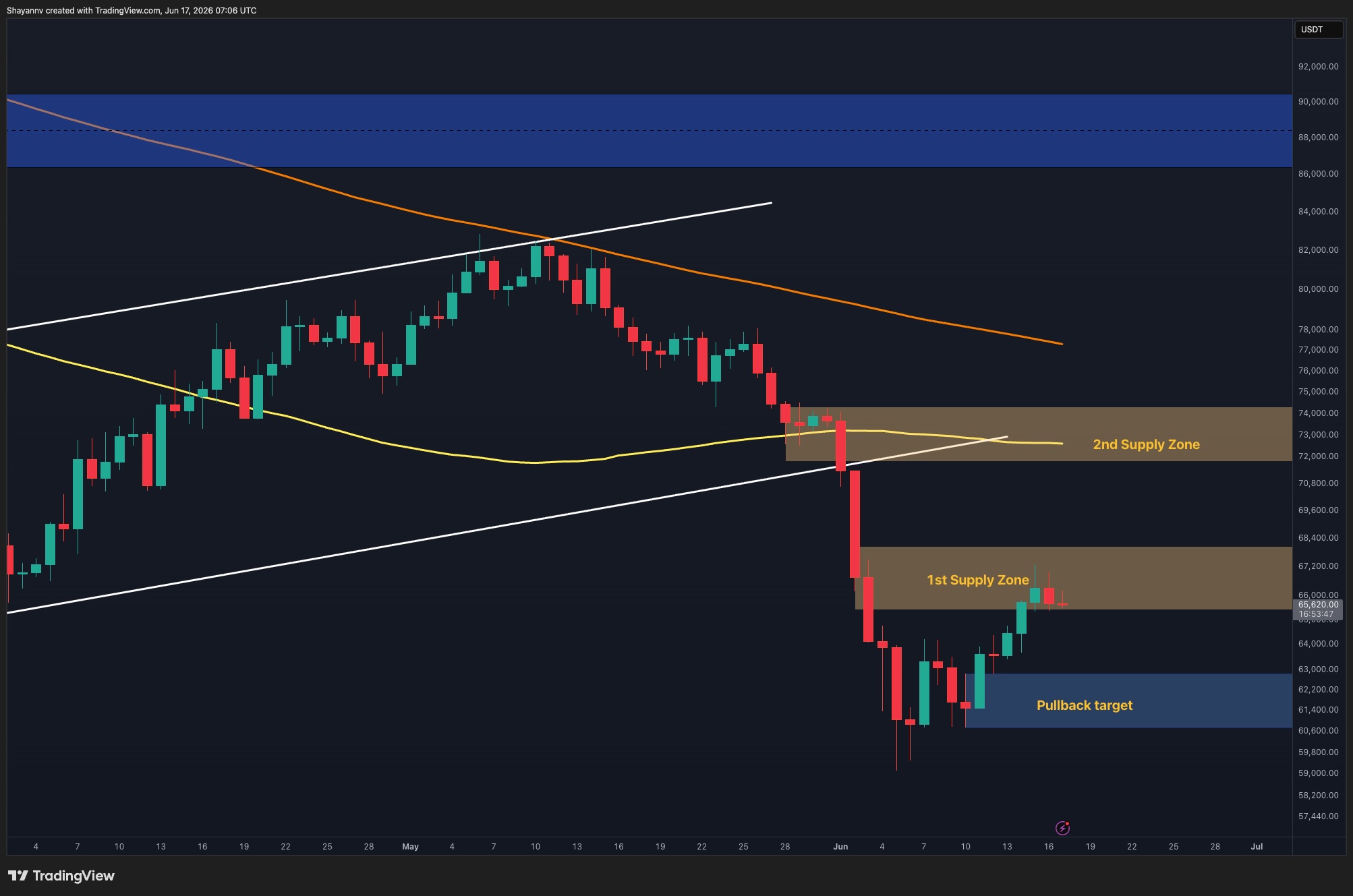
    On the daily chart, Bitcoin is trading near $65,000, having rebounded from the $60,000 support level earlier this month. This recovery has propelled the price directly into the initial major supply zone, situated between $65,000 and $67,000, where selling pressure has begun to manifest.

    Recent daily candles show consolidation within this resistance area rather than an immediate sell-off, which is generally viewed as a positive sign for buyers. However, Bitcoin remains below its 100-day moving average, which is hovering around $72,000, and its 200-day moving average, located near $77,000. This suggests that the broader upward trend has not yet fully re-established itself.

    Should buyers successfully reclaim the current supply zone, the next upward target would be the higher resistance region between $72,000 and $74,000. This area is significant as it coincides with the second supply zone, the 100-day moving average, and the lower boundary of a previously breached ascending channel, presenting the next substantial obstacle for the market.

    On the downside, the $60,000 to $62,000 range continues to serve as the critical support zone. As long as Bitcoin maintains its position above this level, the recent recovery structure is expected to remain intact.

    Four-Hour Chart Perspective

    The four-hour chart illustrates the recent rally into the $65,000-$67,000 supply zone, following a breakout from an ascending recovery channel. After reaching the upper limit of this zone near $66,800, Bitcoin has entered a phase of sideways consolidation.

    The latest price movements suggest that neither bulls nor bears currently hold dominant control. The asset is holding above the former breakout region, roughly between $64,000 and $65,000, while sellers have so far prevented a decisive breach of the supply zone.

    A breakout above $67,000 would bolster the bullish outlook and potentially pave the way toward the higher resistance area around $72,000. Conversely, a failure to hold the $64,000 support region could trigger a more significant pullback toward the demand zone between $61,000 and $62,000.

    For the immediate future, the short-term technical structure remains constructive, provided that higher lows continue to form above the recent breakout area.

    Liquidity Heatmap Analysis

    The Binance liquidation heatmap reveals a notable concentration of liquidity both above and below the current price. However, the closest and most significant cluster of liquidity is situated between $67,000 and $69,000.

    Given that Bitcoin is currently consolidating around $65,000, this overhead liquidity zone could act as a short-term magnet. A move through the current supply region might trigger liquidations of short positions, potentially accelerating momentum toward the $68,000-$69,000 area.

    Concurrently, a substantial liquidity pocket exists below the market, between $62,000 and $63,000. If Bitcoin were to lose the $64,000 support area, the market could be drawn lower to absorb this liquidity before establishing its next directional trend.

    Overall, the heatmap indicates that the market is currently positioned between two major liquidity pools. Considering the proximity of the upper cluster and Bitcoin’s ability to hold within the $65,000-$67,000 resistance zone, the short-term bias leans slightly toward an upward sweep of liquidity into the $67,000-$69,000 region before a more significant directional decision is made.

  • Ethereum Price Surge Possible After FOMC, Glamsterdam Tests Conclude

    Ethereum Price Surge Possible After FOMC, Glamsterdam Tests Conclude

    Ethereum Price Holds Steady as Investors Await FOMC Decision and Key Upgrade

    Ethereum’s price is currently trading below the $1,800 mark, consolidating within a narrow range as the market anticipates the Federal Open Market Committee’s (FOMC) interest rate decision. Two significant factors, one macroeconomic and the other protocol-level, are poised to influence the trajectory of Ether (ETH).

    Glamsterdam Upgrade Nears Final Testing Phase

    On the development front, the Ethereum Foundation has confirmed that testnets are actively running with all planned Ethereum Improvement Proposals (EIPs) for the upcoming Glamsterdam upgrade. This significant network enhancement combines the Amsterdam execution layer and the Gloas consensus layer hard fork, marking the final stage of pre-public testnet development.

    If these tests proceed without major disruptions, the mainnet activation is slated for the latter half of 2026. The Glamsterdam upgrade is primarily focused on Layer 1 scalability. Features like proposer-builder separation (ePBS) and block aggregation (BALs) are designed to accelerate block processing and enable future parallel execution. Additionally, a proposed adjustment to gas fees could reduce the cost of simple ETH transfers by up to 71%, potentially helping Ethereum reclaim market share from rivals like Solana and other major Layer 1 blockchains.

    Market Dynamics and Technical Outlook

    Recent market activity saw significant accumulation, with “whales” acquiring approximately 400,000 ETH between Sunday and Monday, briefly pushing the price up by 6%. However, this momentum has since subsided, with the price returning to its established range.

    Technically, Ethereum’s price action presents a discernible, albeit not definitive, structure. Intraday trading has been capped below $1,800, with the consolidation zone identified between $1,760 and $1,800. The $1,800 level represents the first significant resistance. A decisive move above this threshold, particularly breaking through the $2,000 zone which aligns with the lower boundary of the Ichimoku cloud, could signal a breakout. Such a move might lead to a measured advance towards $2,200, with a broader target of $3,000–$3,050 if sustained momentum is achieved.

    FOMC Decision and Protocol Developments as Catalysts

    A dovish stance from the FOMC, potentially including a surprise rate cut or easing language, could trigger a relief rally for ETH, with some analyses suggesting a potential move towards the $2,600–$2,700 range. Concurrently, progress on the Glamsterdam testnet provides a protocol-level catalyst.

    Conversely, if the Federal Reserve maintains an ambiguous stance, ETH is likely to remain range-bound for another week as traders await clearer market signals. Given that the FOMC is widely expected to hold rates steady within the 350-375 basis point range, the current price action may already reflect this anticipation.

    Institutional Interest and Emerging Infrastructure Plays

    Analysts at Standard Chartered have highlighted the ongoing momentum of Ethereum Exchange-Traded Fund (ETF) inflows, bolstered by institutional interest in products like BlackRock’s staked ETHB. While this represents a structural demand, it may not immediately override short-term macroeconomic influences.

    Ethereum’s current price at $1,800 signifies a recovery from multi-month lows. However, the percentage upside from this level is structurally less than it was six months ago. The combination of whale accumulation and ETF inflows suggests conviction at current levels. Yet, the persistent range-bound trading indicates that the market is pricing in uncertainty rather than immediate opportunity. This environment often favors early-stage infrastructure projects that attract capital rotating away from more established, crowded large-cap assets.

    LiquidChain Aims to Unify Fragmented Liquidity

    In this landscape, projects addressing core infrastructure challenges are gaining attention. LiquidChain ($LIQUID) is an L3 infrastructure project designed to tackle the issue of fragmented liquidity across major blockchains like Bitcoin, Ethereum, and Solana. Its Unified Liquidity Layer aims to integrate BTC, ETH, and SOL execution environments into a streamlined, single-step architecture.

    LiquidChain’s proposition allows developers to deploy applications once and access all three ecosystems. The project’s presale is currently priced at $0.0147, having raised $850,000 to date. Key features include Verifiable Settlement and a Deploy-Once Architecture, intended to mitigate cross-chain friction, which currently results in measurable slippage and latency for DeFi protocols. The LiquidChain presale warrants consideration before its next price adjustment.

  • Coinbase Stock, Options Surge: Analyst Bullish on Evolving Exchange

    Coinbase Stock, Options Surge: Analyst Bullish on Evolving Exchange

    Coinbase Unveils Ambitious Expansion Beyond Crypto, Analyst Sees Major Upside

    Coinbase hosted an event Tuesday to unveil a suite of upcoming product additions, including tokenized equities trading and the introduction of options trading for both cryptocurrency and stocks. Prominent analysts believe these moves signal significant upside potential for the crypto exchange as it broadens its offerings well beyond traditional crypto trading.

    On Wednesday, Mark Palmer, Managing Director and Senior Research Analyst at Benchmark-StoneX, stated that the firm is maintaining its price target for Coinbase’s stock (COIN) at $270. This represents a nearly 60% increase from its closing price of over $169 on Tuesday.

    “The ambition on display was sweeping enough to put every brokerage, bank, and fintech in the country on notice,” Palmer wrote in a note to clients. “The company unveiled a suite of products spanning stocks, derivatives, artificial intelligence, and consumer finance, extending the strategy it first announced last December and pushing the platform well beyond crypto into every asset class it can reach.”

    Coinbase used its Tuesday event to reveal several new products as it aims to become an “everything exchange.” The most significant announcement was the upcoming launch of tokenized U.S. equities. Coinbase stated these will represent real shares backed 1:1, with automatic dividend payouts, distinguishing them from rival tokenized stock products which the company characterizes as derivatives.

    The company also plans to introduce options trading for both cryptocurrencies and traditional equities, and will enable users to transfer existing stock portfolios onto its platform. Additional updates include the ability to borrow against staked Solana, a Coinbase One Card travel portal offering 5% Bitcoin rewards, USDC-backed card access, and new short-term crypto price-prediction contracts.

    “In our view, the company’s update yesterday provided the clearest evidence yet that it is rapidly evolving from a cyclical crypto brokerage into a foundational infrastructure platform linking the emerging on-chain economy to the traditional one,” Palmer added.

    Coinbase’s stock (COIN) traded relatively flat on Wednesday, recently hovering just above $169, according to Yahoo Finance data. The shares have experienced a 13% decline over the past month and are down 25% year-to-date, reflecting broader declines in the cryptocurrency market.

    In May, Coinbase announced a workforce reduction of 14%, citing a strategy to enhance efficiency with a smaller team by leveraging artificial intelligence. The firm also reported its second consecutive quarterly loss, with a deficit of $394 million for the first quarter of 2026.

  • Warsh’s First Fed Decision Looms Over Crypto

    Warsh’s First Fed Decision Looms Over Crypto

    Fed Policy Decision Looms as Key Event for Crypto Market

    The Federal Open Market Committee (FOMC) is set to convene on Wednesday, June 17, for a policy decision that marks the first under new Chair Kevin Warsh. Bitget CEO Gracy Chen has identified this meeting as a pivotal macroeconomic event for the cryptocurrency sector.

    Chen described the current economic landscape as exceptionally challenging, characterized by persistent inflation and a White House keen on increasing liquidity, all while the Federal Reserve appears more internally divided than in recent years.

    Market observers, based on online commentary, do not anticipate any changes to interest rates, with a hold being widely priced in. Some analysts, such as HaxKai, suggest that focusing solely on the rate decision itself is a misdirection, stating that “watching the rate decision itself is watching the wrong thing.”

    Instead, the focus is expected to be on the FOMC’s “dot plot,” which signals future rate expectations, and, crucially, on how Warsh navigates his inaugural press conference as chair. Chen believes that cryptocurrencies have evolved into a truly cross-asset class, a dynamic that older analytical frameworks fail to adequately capture.

    “The old idea that crypto only trades on crypto-native narratives is outdated,” Chen posted on X. “Today, BTC, US equities, gold, FX and commodities are all reacting to the same macro question: Where is liquidity going next?”

    Chen anticipates that if Warsh adopts a hawkish tone, the U.S. dollar is likely to strengthen, exerting downward pressure on gold and risk assets. Conversely, a dovish stance from Warsh could potentially trigger a relief rally across equities and cryptocurrencies. However, she cautioned that the market would likely scrutinize the justification for any easing measures given the prevailing high inflation.

    This perspective is supported by recent data. An analysis by Charlie Bilello on June 16 indicated that Bitcoin and gold are the only major asset classes showing losses year-to-date in 2026, with cryptocurrency down 27%, while the S&P 500 has gained 9% and small-cap stocks have risen 19%.

    Previous analysis by XWIN Research on Warsh suggested a greater emphasis on balance sheet reduction over interest rate cuts. This research also posited that reducing liquidity through quantitative tightening could negatively impact risk assets, even if short-term rates remained unchanged.

    In contrast, investor Ran Neuner expressed a “mega bullish” outlook heading into the meeting. His reasoning is that any indication of the Fed moving away from a rate hike path could bolster risk assets, particularly if inflation expectations decline alongside lower oil prices.

    HaxKai, however, remains less optimistic. They pointed out that Bitcoin has historically declined following most FOMC meetings and noted that the recent rally from $59,000, which stalled at $67,000 earlier this week, leaves considerable room for a downturn. Consequently, they advised traders to exercise caution and avoid making immediate moves in the aftermath of the announcement.

    At the time of this report, Bitcoin was trading near the $65,000 mark, representing a roughly 2% decrease from the previous day but a nearly 6% gain over the preceding seven days.