Author: Admin_Up

  • FairGambling Unveils Crypto Casino Analytics Platform

    FairGambling Unveils Crypto Casino Analytics Platform

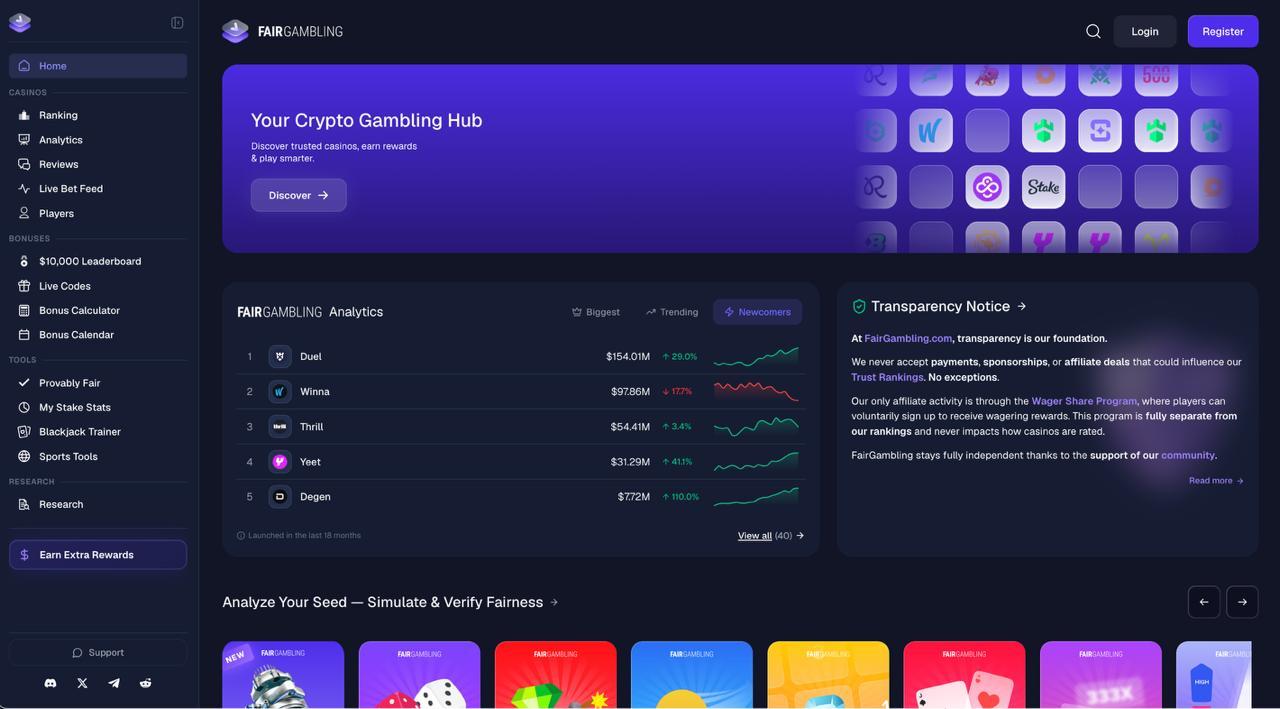
    FairGambling Launches Crypto Casino Review and Analytics Platform With Provably Fair Tools and Extra Rewards

    New York, USA – June 5th, 2026 – FairGambling, a new platform designed to enhance transparency and rewards for cryptocurrency casino players and Bitcoin gamblers, announced its public launch today. The platform integrates on-chain analytics, provably fair verification tools, independent reviews of crypto casinos, live feeds of bonus codes, and an exclusive rewards program offering up to 30% rakeback. This program extends across more than 40 prominent crypto casino operators, including Stake, Roobet, Shuffle, BC.Game, Gamdom, Bitcasino, 1win, Winna, Thrill, and Duel, with plans to expand its coverage further.

    FairGambling enters a market that saw over $80 billion in crypto casino deposit volume last year. The platform’s analytics layer is already monitoring more than $45 billion of this volume in real-time across the operators it covers. Despite the market’s significant scale, players have historically had limited tools to verify fairness, compare operators, or independently assess the flow of their funds.

    Built as a Utility Layer, Not Another Affiliate Site

    “Most casino review sites today are essentially just rankings and sign-up bonuses,” stated Seb, Co-Founder of FairGambling. “We aimed to create something fundamentally different. A space where players can genuinely observe on-chain activity, verify their own bets, compare casinos based on concrete data rather than marketing claims, and earn additional rewards. All of this is offered for free, with no strings attached. This is the gap we are addressing, and what is live today is merely the initial phase of our development.”

    The platform consolidates several player-centric tools into a single, accessible location:

    Data-Driven Casino Comparison

    In contrast to traditional affiliate sites that base casino rankings on commercial agreements, FairGambling’s ratings are derived from a weighted rubric that evaluates analytics, fairness, financial transparency, bonus structures, compliance, and security. Each operator profile provides details on deposit volumes, visibility of hot wallets, licensing information, no-KYC policies, and bonus testing results that illustrate the actual rewards players receive for a given wager amount. These metrics are presented in side-by-side comparisons against other operators.

    The analytics section is accessible to all visitors and displays live on-chain transaction flows, enabling players to distinguish operators processing substantial volume from those with minimal activity. This level of data insight has traditionally been exclusive to industry insiders.

    Community Reviews and Earning Crypto

    FairGambling places verified player reviews at the core of its review system. Verified users can earn cryptocurrency rewards for eligible contributions. To ensure authenticity and filter out the prevalence of fake reviews found on other online gambling review sites, the platform requires verification of casino activity, such as VIP tier or wager history, before approving reviews.

    “Trust in this sector has been eroded,” Seb added. “We understand that rebuilding it won’t happen overnight. However, by equipping players with the data, the tools, and the rewards to critically engage with the operators they use, we are laying a crucial foundation. Everything else will be built upon that.”

    The platform empowers players to identify the best crypto casinos based on data, verify the fairness of games, and earn supplementary rakeback in addition to existing casino offers. FairGambling is now live and accessible globally, subject to local regulations and eligibility criteria.

    About FairGambling

    FairGambling is a transparency and rewards platform for crypto casinos, designed to help players make more informed decisions across major Bitcoin and cryptocurrency gambling operators. The platform features on-chain casino analytics, independent crypto casino reviews and ratings, provably fair verification tools, live bonus code feeds, player statistics tools, a blackjack trainer, and an additional rewards program offering up to 30% extra rakeback. FairGambling currently covers over 50 crypto casino operators and has tracked more than $45 billion in historical deposit volume, with new operators being added regularly.

    For further information, users can visit FairGambling.com.

    Responsible gambling notice: FairGambling is not a casino and does not accept bets or process gambling transactions. The platform provides analytics, reviews, verification tools, and rewards related to third-party crypto casino operators. FairGambling is intended for users aged 18+ or the legal gambling age in their jurisdiction. Gambling involves risk and can be addictive. Please play responsibly and adhere to all applicable local laws.

  • ChatGPT’s Latest Prediction Disappoints XRP Holders

    ChatGPT’s Latest Prediction Disappoints XRP Holders

    The cryptocurrency market has experienced a dramatic downturn in recent weeks, far exceeding expectations from mid-May. Bitcoin (BTC) has fallen below the $60,000 mark for the first time since November 2024, while Ethereum (ETH) has plunged to a 14-month low. XRP has also succumbed to the selling pressure, dropping below critical support levels and reaching a 19-month low of under $1.10 on Friday.

    The immediate concern for XRP investors is whether the current support above the crucial psychological threshold of $1.00 will hold, or if the cross-border payment token is destined for a significant decline into the sub-dollar range.

    According to a new analysis from a prominent AI solution, the most probable initial bearish target for XRP, should it breach $1.00, is $0.90. This scenario appears increasingly likely given the prevailing market conditions. For context, Bitcoin’s recent dip below $60,000 marked its lowest point since before the U.S. elections in late 2024.

    Similarly, XRP has retreated to its lowest levels since that period in November 2024, currently trading below $1.10. Having broken through its last significant support at $1.00, this level is now under intense scrutiny, with a further downward move potentially testing it imminently.

    The AI model suggests that a drop to $0.90 would represent an additional 18%-20% decline for XRP and would likely be accompanied by continued weakness across the broader cryptocurrency market.

    However, the AI also outlined even more pessimistic scenarios should bullish sentiment completely evaporate. In a more extreme bearish outlook, XRP could fall to the $0.75-$0.80 range.

    A full capitulation scenario, while considered a “low-probability outcome,” envisions XRP dropping to $0.60. The AI platform noted that such a drastic decline would likely require a confluence of factors, including macroeconomic instability, a widespread crypto bear market, and the erosion of key positive narratives like ETF optimism and institutional adoption.

    Conversely, the AI also presented a more optimistic perspective, suggesting that XRP might be “approaching a point where conditions become favorable for a relief rally.” Drawing on historical data, particularly for previous Junes in U.S. midterm election years, the AI highlighted that “pessimism often preceded major recoveries.”

    Based on this, the AI outlined a potential for a swift rebound to $1.25 and even $1.40, contingent on buyers successfully defending the $1.05-$1.10 support region. The coming days, or even hours, will be crucial in determining whether this support holds.

  • Binance Fuels Massive Crash for Four Altcoins

    Binance Fuels Massive Crash for Four Altcoins

    Binance Delists Four Altcoins, Triggering Significant Price Drops

    Major cryptocurrencies like Ethereum (ETH), Ripple (XRP), and Solana (SOL) have seen declines of 5% to 8% in the past 24 hours, mirroring a broader downturn in the market. However, four less prominent tokens have experienced far more severe losses, with the primary catalyst identified as Binance.

    The world’s largest cryptocurrency exchange recently completed another review of the digital assets available on its platform. This assessment evaluated whether the tokens met industry standards, including factors such as team commitment, development activity, trading volume, liquidity, and network stability.

    Following this analysis, Binance announced it would cease all services for Contentos (COS), Dar Open Network (D), Highstreet (HIGH), and MOBOX (MBOX). The delisting is slated for June 19, but the announcement alone has already led to a sharp price collapse for the affected coins. Each has fallen by over 25% in a single day, with COS suffering the most significant decline, dropping approximately 31%.

    Such drastic price volatility is not unexpected. Losing support from a major exchange like Binance typically results in reduced liquidity, decreased accessibility, and reputational damage for the delisted assets.

    This move follows a similar pattern from just a few weeks prior, when Binance delisted Automata (ATA), Harvest Finance (FARM), Enzyme (MLN), Phoenix (PHB), and Syscoin (SYS), which also triggered notable price reactions.

    Binance also removed several trading pairs, including AXL/BTC, CRV/BTC, EGLD/BTC, OPN/BNB, POL/ETH, QTUM/USDC, and SKY/BTC. While this action did not result in a substantial price drop, the complete termination of trading services for the four aforementioned tokens has had a more pronounced impact.

    Binance to Support NEAR Protocol Network Upgrade

    In separate news, Binance has confirmed its support for the upcoming NEAR Protocol (NEAR) network upgrade and hard fork, scheduled for June 10. The exchange will temporarily suspend token deposits and withdrawals on the NEAR blockchain during this period.

    Binance has pledged to manage all technical aspects for its users, assuring that operations will resume once the upgraded network is deemed stable. The exchange also stated that trading of the NEAR token will not be affected.

    This type of network upgrade support is a standard procedure that Binance has undertaken multiple times previously, with no significant complications reported to date. In late May, the exchange briefly halted deposits and withdrawals on the Ethereum network for wallet maintenance. Prior to that, similar measures were implemented to support upgrades across other blockchain ecosystems, including Cardano and BNB Chain.

  • Zcash Plummets, Erasing Billions in Market Cap—Can ZEC Rebound?

    Zcash Plummets, Erasing Billions in Market Cap—Can ZEC Rebound?

    Zcash Plummets After Discovery of Four-Year-Old Vulnerability

    Zcash (ZEC) experienced a dramatic price drop of over 40% in a single day following the revelation of a four-year-old vulnerability within one of its core privacy transaction pools. The flaw, which could have potentially allowed for the unlimited minting of ZEC, sent shockwaves through the investor community.

    The network’s native token has seen a 35% decline in the past 24 hours, recently trading around $339. During the sell-off, ZEC briefly dipped below $300, marking its lowest point since early April and erasing billions from its market capitalization. This sharp downturn follows a significant rally, where the token had climbed from below $200 in March to a high of $675 by the end of May.

    The recent gains have now been wiped out, leaving investors who had bet on the coin’s upward trajectory questioning Zcash’s ability to regain its momentum.

    “The news emerged at a time when the privacy narrative was gaining significant traction, and ZEC had already tripled its value since April, outperforming Bitcoin and other major cryptocurrencies,” Ish Asad, a research analyst at Bitwise Research, told Decrypt. “The timing of this disclosure is precisely why ZEC plummeted 40%.”

    The severity of the price decline is also attributed to the lingering uncertainty surrounding the situation. Although the vulnerability was patched earlier this week, the nature of the Zcash network means it remains unclear whether malicious actors may have exploited the bug to create counterfeit ZEC tokens.

    “The price reaction is more a reflection of that uncertainty than the bug itself,” explained Nicolai Sondergaard, a research analyst at blockchain analytics firm Nansen. “A patched vulnerability in a lesser-known privacy coin would typically be a minor issue. The 30% drop indicates the market is assigning a non-trivial probability to the scenario where some counterfeiting did occur and is permanently undetectable without the proposed upgrade.”

    Zcash, which had neared $700 in November and recently approached that level again, has been a standout performer in the cryptocurrency market over the past year, with gains exceeding 580%, even after accounting for its recent sharp decline.

    However, a swift recovery of its recent gains appears unlikely, according to Jake Kennis, a senior research analyst at Nansen. Kennis pointed to the substantial price drop and the significant increase in trading volume during the sell-off, which exceeded $3 billion in the last 24 hours as of this writing.

    “It would likely require either a broader resurgence of the privacy coin narrative and demand for privacy, a major protocol-level catalyst, or a larger rotation into privacy assets,” he told Decrypt, adding that a token typically needs to “find its footing” after such a sell-off before it can rebound.

    In contrast, Asad believes that traders may be reacting prematurely to the disclosure. “Often, the market gets ahead of itself and reprices assets, sometimes dramatically, in real time,” he stated. “But the fundamental story remains unchanged: Zcash is a clone of Bitcoin with added privacy and encryption features, which will carve out its own market.”

    BitMEX founder Arthur Hayes appears to be among those acting on this real-time assessment. He informed his social media followers that he had sold his entire ZEC holdings, partly because the exploit “violated his narrative mental map.” Despite this, Hayes asserted that “privacy is priceless” and indicated he would have no issue repurchasing ZEC at higher prices should the cryptocurrency recover.

    Meanwhile, the question arises whether other privacy coins could benefit from the fallout surrounding Zcash and attract traders disillusioned by the vulnerability. Nansen’s Kennis, however, does not foresee this happening in the immediate future.

    “I don’t believe a potential vulnerability in a privacy protocol like this would be seen as a positive catalyst for any of its competitors in the near term,” he concluded.

  • Congress Introduces Seven Crypto Tax Bills

    Congress Introduces Seven Crypto Tax Bills

    House Republicans Unveil Seven Crypto Tax Bills Ahead of Key Hearing

    House Republican leadership has introduced seven new cryptocurrency tax bills that are slated to be the central focus of a significant hearing next week. These legislative proposals address a range of contentious issues, including de minimis exemptions, the tax treatment of rewards from crypto staking and mining, and the establishment of an IRS safe harbor for individuals who have previously failed to report crypto gains. This move marks the first instance of congressional leadership in either the House or Senate advancing tax-focused cryptocurrency legislation, despite previous attempts to introduce similar bills in both chambers.

    The new crypto tax bills, circulated by the Republican leadership of the House Ways and Means Committee, are expected to be discussed at a committee hearing on digital asset taxation scheduled for Tuesday, according to sources familiar with the matter.

    The seven bills, which have been reviewed, appear to fulfill long-standing requests from the cryptocurrency industry. One bill, titled the Tax Clarity for Mining and Staking Act, proposes to exempt cryptocurrency generated through staking and mining activities from a holder’s taxable income. In recent years, legal challenges have emerged regarding whether staking and mining rewards should be considered taxable income at the time of their creation. Currently, cryptocurrency users who stake their assets—meaning they pledge a certain amount to a network like Ethereum or Solana—are required to report the rewards they receive as income, even if those rewards are never sold or converted into fiat currency.

    Another piece of legislation, the Less Tax Paperwork for Digital Asset Owners Act, aims to establish a $10 de minimis tax exemption for cryptocurrency network transaction fees, commonly referred to as gas fees. Under this proposed law, a taxpayer could exempt up to 5,000 such transactions annually. At present, cryptocurrency users are obligated to report every transaction on a blockchain network as a taxable event, regardless of whether the value is less than a few cents.

    Notably, however, the bills scheduled for discussion on Tuesday do not include a broader de minimis exemption for everyday purchases made with popular cryptocurrencies such as stablecoins and Bitcoin. A cryptocurrency tax bill introduced last year by Senator Cynthia Lummis (R-WY) had proposed a $300 de minimis for transactions in any cryptocurrency, with an annual cap of $5,000, and would have exempted stablecoin payments.

    Leaders within the cryptocurrency industry have long advocated for a more expansive de minimis exemption for crypto transactions, believing it would foster the use of digital assets in daily commerce, particularly for stablecoins, which are crypto tokens pegged to the dollar and were legalized under last year’s GENIUS Act. Without such exemptions, crypto users face the burden of calculating capital gains taxes each time they use Bitcoin or stablecoins to purchase goods or services.

    An additional bill slated for debate on Tuesday would exempt U.S. citizens from being classified as U.S. residents for certain digital asset sales if at least 10% of the income derived from the sale is paid to a foreign country as income tax. Furthermore, the Digital Assets Voluntary Disclosure Program Act would offer U.S. crypto holders a two-year amnesty period to self-report past failures to pay taxes on their cryptocurrency holdings. Individuals who pay the outstanding taxes or establish a payment plan would be protected from future criminal liability.

    The Digital Chamber, a cryptocurrency trade association based in Washington D.C., stated that the tax bills were developed through “months of industry engagement.” Cody Carbone, the group’s CEO, commented in a statement, “We’re encouraged to see the suite of discussion drafts. Next Tuesday’s legislative hearing is a welcome opportunity to refine these proposals and keep the bipartisan tax effort moving forward.”

  • Pi Network Hits Major Milestone Amidst Price Plunge

    Pi Network Hits Major Milestone Amidst Price Plunge

    Pi Network Completes Major Milestone Amidst Price Plunge

    The team behind the controversial cryptocurrency project has rolled out a significant upgrade aimed at bolstering its entire ecosystem. However, this positive development has failed to spur a recovery for PI, whose valuation has plummeted to a new all-time low.

    Recent Protocol Advancements

    Pi Network has demonstrated considerable progress in recent months. In February, the Core Team introduced protocol version 19.6, followed by an upgrade to v19.9. Subsequently, they launched the highly anticipated v20.2, which laid the groundwork for smart contract functionalities.

    Last month, the team announced a migration to protocols v22 and v23, setting June 2 as the deadline for transitioning to v24. This update was shared on Pi Network’s official X account earlier today, June 5.

    “Great job to all Nodes! This was one of the most challenging migrations,” the announcement stated.

    The upgrade to protocol 24 primarily focuses on enhancing the underlying infrastructure that supports node operations and mainnet activity. The Core Team has indicated that migration to v25 is the next step, with June 18 designated as the completion deadline.

    Expansion into Gaming

    In addition to protocol updates, Pi Network has recently made further strides in the gaming sector. CiDi Games, a company within the Pi Network Ventures portfolio, has released four new games for Pioneers: Coin Whack, Fruit Stack, Gemnova, and RainbowCubes.

    Persistent Price Suppression

    Despite these developments, PI’s valuation remains heavily impacted by the prevailing bear market and the recent market-wide pullback across the cryptocurrency landscape.

    Earlier this week, the token’s price collapsed to a new all-time low of approximately $0.12. This represents a 33% decrease for the month and a staggering 96% drop from its historic peak of $3, recorded at the beginning of 2025. PI’s market capitalization has consequently fallen to around $1.3 billion, positioning it as the 58th-largest cryptocurrency.

    Indicators of Further Correction

    Several factors suggest that an additional price correction may be imminent. Data indicates a substantial increase in PI coins held on exchanges, with over 500,000 coins added in the past 24 hours, bringing the total to over 550 million. This surge suggests that a significant number of investors have moved their holdings to centralized platforms, potentially increasing immediate selling pressure.

    Upcoming token unlocks also present a potential challenge, with approximately 160 million PI tokens slated to enter circulation within the next 30 days. June 11 is projected to be a notable day, with 16 million coins scheduled for release. While this does not guarantee a steeper decline, it could provide an opportunity for some investors to liquidate long-held tokens.

  • Flare Secures $4M XRP Liquidity Milestone

    Flare Secures $4M XRP Liquidity Milestone

    Flare Network Achieves Milestone with $4 Million XRP Liquidity Rollover

    The decentralized finance ecosystem on Flare Network has reached a significant milestone with an automated liquidity rollover, successfully moving over $4 million in capital between fixed-term yield markets without disrupting trading activity.

    Seamless Transition for Yield Markets

    The rollover, which occurred on June 4, 2026, involved the largest stXRP fixed-term pool on Spectra Finance reaching its maturity date. Managed by GamiLabs’ FXRP MetaVault, the process automatically transferred liquidity into successor pools scheduled to expire on August 27 and November 26, 2026.

    MetaVaults Streamline DeFi Operations

    Introduced in February 2026, MetaVaults were designed to address operational challenges inherent in fixed-term yield tokenization. The system utilizes a single smart contract to monitor market expiries, identify new investment opportunities, and route liquidity according to predefined on-chain rules.

    Under this model, liquidity providers deposit assets once and receive a vault token representing their stake. The vault then autonomously manages subsequent rollovers, eliminating the need for users to manually withdraw and reallocate funds each time a market expires.

    Overcoming the “Expiry Cliff”

    This automated transition directly tackles a persistent issue in fixed-term DeFi markets known as the “expiry cliff.” Historically, maturing pools have often led to fragmented liquidity and diminished market activity as participants scramble to move capital into new opportunities.

    In the case of the June rollover, liquidity was already established in the replacement markets prior to the original pool’s maturity. This proactive approach ensured the maintenance of continuous market depth, thereby avoiding the typical disruptions associated with fixed-term expiries.

    Significant Market Activity Precedes Rollover

    The importance of this rollover was underscored by the substantial scale of the maturing market. The stXRP pool had recorded over $25 million in lifetime trading volume during its four-month tenure. By May, it was offering double-digit fixed rates, a testament to sustained activity leading up to its expiry.

    Spectra Finance continues to be a prominent yield trading platform on Flare, facilitating structured yield products through FXRP. FXRP itself functions as a trustless and overcollateralized representation of XRP within Flare’s FAssets framework.

    Collaborative Ecosystem Drives Growth

    GamiLabs manages the FXRP MetaVault, while Firelight is responsible for issuing the stXRP utilized within the ecosystem. In conjunction with Spectra’s protocol infrastructure, these elements collectively support a burgeoning market for XRP-denominated yield strategies.

    The operational advantages of this structure were highlighted by Spectra Finance co-founder Gaspard Peduzzi. He stated that the MetaVault framework transforms expiry events into seamless market transitions. Peduzzi further suggested that this methodology could foster deeper and more efficient XRP yield markets by mitigating the operational friction associated with fixed-term maturities.

  • XRP Price Plunge Risk: What Happens If $1 Support Fails?

    XRP Price Plunge Risk: What Happens If $1 Support Fails?

    XRP Begins June With Steepest Decline in Three Months

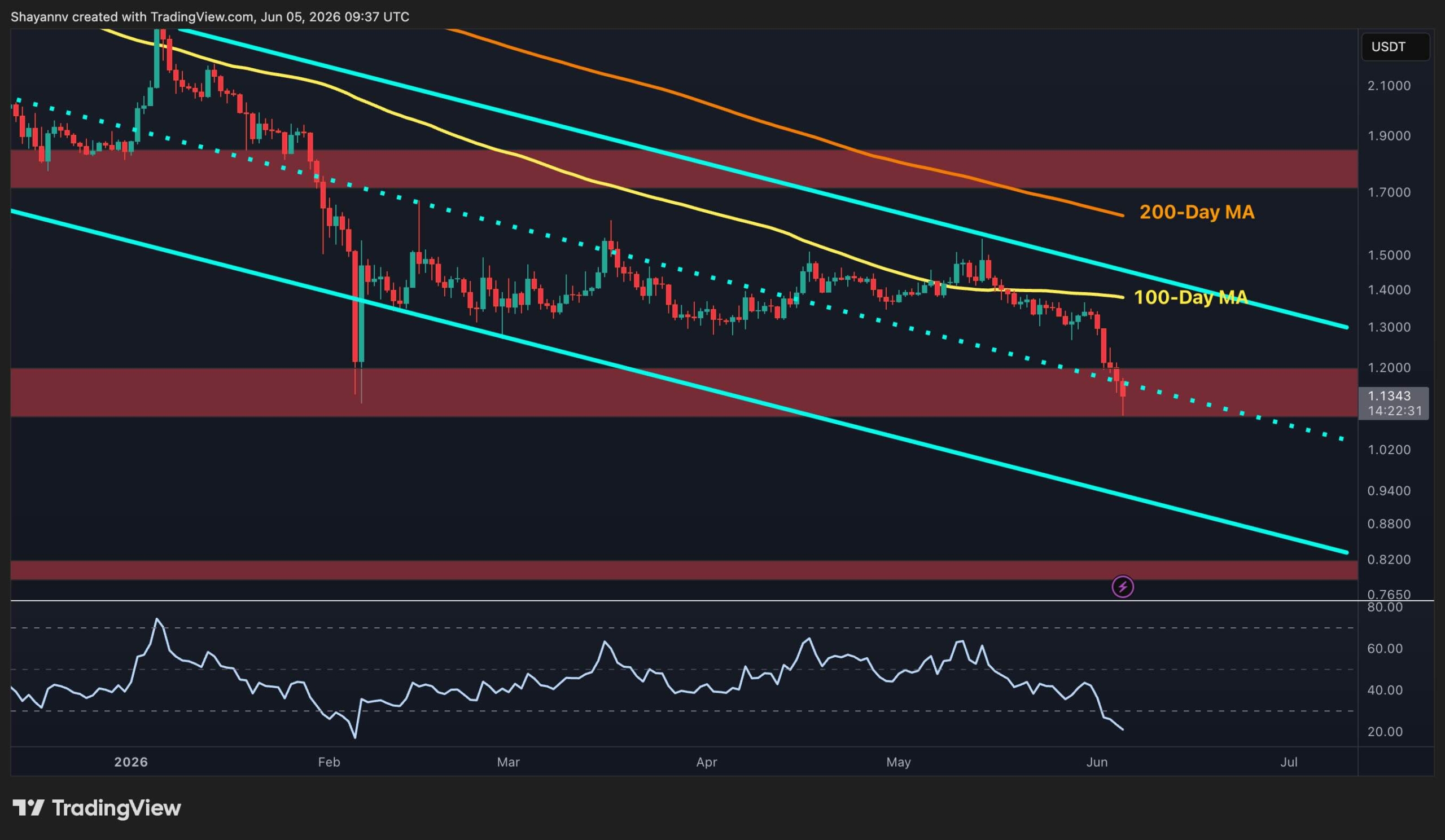
    XRP has opened June with its most significant price drop in the past three months, as the critical $1.20 support level, which had acted as a firm floor for months, is now being breached. The cryptocurrency is currently trading at $1.11. The Relative Strength Index (RSI) is also registering its lowest point since the capitulation seen in February, with the next significant support level appearing to be approximately $0.30 lower. Analysts suggest this is not merely a pullback from resistance but rather a breakdown of XRP’s last line of defense.

    On the USDT chart, the $1.20 support band, which proved resilient during the February market crash and had remained untouched since, is now on the verge of collapse. The RSI has similarly plummeted to around 20-25, nearing the oversold territory observed during the February capitulation low. This reading alone is noteworthy, as historically, RSI levels at this extreme have preceded at least a sharp relief bounce, even within a broader downtrend.

    However, an oversold RSI does not automatically signal that a bottom has been established. The $1.20 level is now likely to transition into resistance. For the current breakdown to be considered reversed rather than merely paused, any subsequent bounce would need to reclaim this level on a sustained closing basis.

    Below the current trading price, the next key structural reference point is the $0.80 demand zone. This area also aligns with the lower boundary of a descending channel, presenting a significant confluence of support, albeit at a considerably lower valuation. With the 100-day moving average at $1.35 and the 200-day moving average at $1.60 now both acting as substantial overhead resistance, the USDT-paired chart shows XRP facing considerable selling pressure above and limited structural support below.

    XRP/BTC Pair Shows Greater Resilience

    In contrast, the BTC pair is presenting a more robust picture. XRP/BTC is currently trading at 1,800 satoshis, holding above recent lows of 1,740 satoshis. The RSI, which had surged to 70 at the end of May, suggesting a potential shift in momentum, has since retreated to 50. This indicates that the brief period of strength has not translated into sustained buying pressure.

    The price is trading below the short-term resistance of 1,850 satoshis, having been rejected at this level once again. The declining 100-day moving average, situated around 1,900 satoshis, is acting as immediate dynamic overhead resistance. The fact that the XRP/BTC ratio has held its ground while the USDT pair has weakened suggests that XRP’s dollar-denominated weakness is partly attributable to broader altcoin selling pressure rather than a specific deterioration of XRP’s standing against Bitcoin.

    A confirmed close below 1,740 satoshis on the BTC pair, especially if it occurs concurrently with continued weakness in the USDT pair, would signify a definitive breakdown across both pairings. Such a scenario would expose the 1,500 satoshis area as the next significant level of support.

  • Lawmaker: Government Stablecoins Risk Fueling Tax Evasion

    Lawmaker: Government Stablecoins Risk Fueling Tax Evasion

    Sherman Slams Stablecoin Payments as Tax Evasion Tool

    Longtime cryptocurrency critic U.S. Representative Brad Sherman (D-CA-32) voiced strong opposition to government stablecoin payments during a House hearing on banking regulators Thursday, asserting that such a system would facilitate tax evasion.

    During the hearing, titled “Oversight of Prudential Regulators,” National Credit Union Administration Chairman Kyle Hauptman presented the idea of the federal government distributing funds via stablecoins. He highlighted that stablecoins operate around the clock, unlike traditional payment systems constrained by business hours. Hauptman suggested this could allow for tax refunds to be issued on Sundays or holidays and emergency stimulus payments to be delivered more swiftly and securely.

    Sherman, however, countered that he “can’t think of a worse idea,” arguing that government payments in stablecoins would “sanctify an alternative to the U.S. dollar, an alternative designed to facilitate a tax-evasion economy.”

    Hauptman defended dollar-pegged tokens as a means to counter rivals in Beijing, Tehran, and Moscow and to preserve the dollar’s global standing by stimulating demand for U.S. Treasuries.

    The issue of stablecoin yields also arose, with Sherman warning that “the smartest, or at least the best-paid lawyers in the country” were already seeking loopholes around interest payments on stablecoins. He urged supervisors to “write regulations that withstand that.”

    World Liberty Financial Charter Application Sparks Confrontation

    The hearing also featured Comptroller of the Currency Jonathan Gould defending his agency’s handling of the national trust-bank charter application from World Liberty Financial, a firm linked to the Trump family.

    The House Financial Services Committee hearing became contentious when Representative Gregory Meeks (D-NY-5) directly questioned Gould’s independence, asking if he was “working for the American people or working for the Trump family.”

    Gould pushed back, labeling Meeks’ remarks as “unfortunate and without precedent.” He added, “Your attempts to continue to pressure me are the only political pressure I’ve felt from anyone other than your Senate colleagues.”

    Regulators Outline Stablecoin Oversight Progress

    Beyond the World Liberty Financial issue, federal regulators provided updates on their progress in overseeing stablecoins under the GENIUS Act, passed last summer. FDIC Chairman Travis Hill stated that his agency, along with others, would soon propose customer identification requirements for stablecoin issuers.

    These regulatory developments coincide with increased access for cryptocurrency firms to traditional banking infrastructure. Falcon Financial launched its fUSD stablecoin on Wednesday, utilizing Anchorage Digital—the first federally chartered crypto bank—as a GENIUS-compliant payments token. The Federal Reserve has also granted cryptocurrency exchange Kraken a master account, though with certain limitations, similar to the “skinny” master account proposed by the Fed’s board of governors last year.

    World Liberty Financial claimed last month to be in the “final stages” of receiving conditional approval, asserting that the Trump sons have not abandoned the project despite regulatory hurdles.

    Banking charter approvals for crypto firms have become a politically charged issue. Senator Elizabeth Warren (D-MA) has deemed approvals for firms like Coinbase and Ripple as illegal. Meanwhile, the Trump White House had previously directed the Federal Reserve to review master account access for crypto firms and instructed federal regulators to remove “overly burdensome and fragmented regulations and supervisory practices.”

  • XRP Sentiment Sours: Divine Ray ICO’s Live Product Outshines Waiting

    XRP Price Faces Stagnation Amidst Institutional Accumulation and Shifting Crowd Sentiment

    XRP’s price saw a 3% dip last week, now trading within the $1.30 to $1.40 range, a situation that has proven frustrating for many holders. However, beneath the surface of this price stagnation, significant activity is unfolding. Institutions are reportedly making daily purchases, and Exchange Traded Fund (ETF) inflows continue to pour in. Concurrently, crowd sentiment has once again turned sharply negative.

    Divine Ray ICO Surpasses $100,000 on Launch Day

    In contrast, a cryptocurrency presale known as Divine Ray ($DCR) has achieved a notable milestone, raising over $100,000 on its opening day. Divine Ray distinguishes itself with a live social media application and its own proprietary blockchain.

    While XRP holders await a delayed breakout, Divine Ray presents a functional product and a $5 million valuation, a combination that analysts suggest is compelling.

    Analyst Predicts Bold XRP Targets Amidst Accumulation

    Crypto analyst Patel recently shared an updated XRP chart on a four-day timeframe. The analysis places XRP’s current trading price at $1.3607, situated firmly within a multi-year accumulation zone that spans roughly from $0.50 to $1.80.

    Patel has outlined ambitious long-term price targets for XRP, indicating potential upside levels of $5, $10, and even $15 per token. He attributes this optimistic outlook to sustained institutional buying, noting that these entities are not selling but are instead quietly increasing their holdings daily.

    Data supports this observation, with total net ETF inflows for XRP reaching $1.41 billion since their inception. Over the past 15 trading days alone, there have been $116.48 million in direct inflows. Outflow days have been infrequent, occurring on only 13 out of 193 days, meaning over 90% of trading days have seen net inflows. This suggests substantial capital accumulation by large investors while retail interest appears subdued. Patel characterizes this period as “the calm before the storm,” advising potential buyers to consider accumulating during significant market downturns within the $1 to $0.70 range.

    Crowd Sentiment Dips into “FUD Zone”

    Santiment’s latest data on XRP crowd sentiment reveals a significant shift, with the ratio of positive to negative commentary dropping to a mere 1.1 bullish comments for every bearish comment. This marks the highest level of crowd fear, uncertainty, and doubt (FUD) observed in three weeks. The sentiment ratio chart indicates a sharp decline into the “FUD Zone,” a region historically associated with price stabilization and subsequent bounces, as seen in late April and early May.

    Historically, such widespread fear and skepticism have served as a contrarian indicator for XRP’s price. When social media sentiment becomes excessively fearful, it often signifies that many less committed investors have already exited the market, thereby reducing selling pressure and creating conditions conducive to a rebound. Conversely, periods of extreme optimism, where the sentiment ratio enters the “FOMO Zone,” have often coincided with local price peaks due to widespread bullish positioning. Currently, the market’s position within the fear zone suggests a potentially opportune time for buying.

    XRP Price Prediction and Divine Ray’s Value Proposition

    Based on this data, an XRP price prediction suggests a potential bounce towards the $1.50 to $1.60 range in the coming weeks. Continued ETF inflows and sustained institutional demand could propel XRP above $1.60, potentially opening the path to $2.00 and beyond. However, even the most optimistic long-term targets of $5 to $15 per XRP, representing a 3x to 10x return over multiple years, are considered respectable but not necessarily life-changing for smaller investment portfolios.

    Divine Ray, on the other hand, offers a tangible product with its fully functional mobile social media application, available on both the Apple App Store and Google Play. This approach, launching a product before its token, is a rarity in the cryptocurrency space. Users can download the app, create an account, and begin using it immediately.

    The project is built on its own blockchain infrastructure, developed using the Cosmos SDK and integrated with the IBC network, granting Divine Ray complete control over its technology, scalability, and future ecosystem development. Divine Ray Coin ($DCR) is already trading on the Osmosis decentralized exchange, providing immediate liquidity and market validation from the presale’s inception.

    Divine Ray targets the expanding global consciousness and wellness economy, a sector encompassing meditation, yoga, retreats, spiritual content, and conscious communities. The platform aims to connect creators, retreat centers, events, and communities within a unified ecosystem. The $DCR token possesses multiple utilities, including memberships, advertising, NFT minting, creator rewards, and community growth incentives, each contributing to demand drivers within the platform’s social economy.

    The project’s initial valuation of approximately $5 million during Phase 1 of its ICO is considered exceptionally low compared to industry norms, where many projects launch with websites alone at valuations of $50 million or $100 million. Divine Ray’s existing live app, functional blockchain, and DEX listing present a significant valuation gap, offering potential for substantial returns.

    The $DCR presale is structured in four phases, with prices increasing incrementally. Phase 1 offers 400 billion DRC at $0.0000015 per token, with subsequent phases moving to $0.000002, $0.0000025, and $0.0000035. Phase 1 remains open, but its momentum, evidenced by exceeding $100,000 on day one, suggests it may not last. Divine Ray is positioned as a presale to watch this summer.