Category: Uncategorized

  • XRP ETFs Hit Record High Amid 9-Week Inflow Streak

    XRP ETFs Hit Record High Amid 9-Week Inflow Streak

    XRP ETFs Reach New All-Time High Amid Sustained Inflow Streak

    Exchange-traded funds tracking the popular cross-border token have seen nine consecutive weeks of positive performance, attracting nearly $19 million in the latest reporting period, mirroring the previous week’s figures.

    This sustained inflow has pushed the cumulative net inflows to another all-time high. However, the underlying asset itself continues to face challenges in breaking through key resistance levels, with its mid-August rally losing momentum.

    During the final full week of August, spot XRP ETFs recorded their strongest performance since early December 2025, drawing in $110.49 million. This followed an impressive prior week that saw net inflows approach $40 million.

    While inflows moderated at the beginning of September, they remained firmly in positive territory. Despite a single day experiencing outflows for the first time in a month, the funds collectively gained $18.96 million in the week ending September 4. The subsequent four-day trading week saw a similar inflow of $18.98 million.

    Tuesday’s figures were relatively modest, with $1.55 million in net inflows. Wednesday saw a significant uptick to $12.29 million, followed by another $5.14 million on Thursday. Notably, Friday registered zero net flows, according to data from SoSoValue, a development that surprised many given the significant market volatility experienced that day.

    Overall, XRP ETFs have now reached a cumulative all-time high of $1.7 billion. Bitwise’s XRP fund, which recently surpassed $500 million in assets under management, continues to lead in cumulative net inflows with $608 million, ahead of Canary Capital’s XRPC, which has $490 million.

    The underlying XRP asset experienced a dramatic surge between August 19 and 22, climbing 70% in less than 72 hours. It rose from $1.00 to $1.70 before encountering strong selling pressure and reversing course, despite the positive sentiment surrounding ETF inflows.

    In the past week, XRP attempted to breach the critical $1.40 resistance level but was once again thwarted. Friday saw a volatile two-hour period following the release of Consumer Price Index (CPI) data. XRP fluctuated from $1.36 to $1.32 before briefly soaring to nearly $1.45. However, it failed to sustain the upward momentum and is currently trading below $1.40.

    Crypto analysts are divided on XRP’s short-term prospects. Ali Martinez has cautioned that significant holders, or “whales,” have begun to take profits, and a notable decrease in network activity could signal further price declines. Conversely, Celal Kucuker has identified a historical pattern that preceded a 600% price increase, suggesting a similar surge could be on the horizon.

  • Lisk (LSK) Surges 325% Daily Amidst Bitcoin’s Range-Bound Trading Near $77,000

    Lisk (LSK) Surges 325% Daily Amidst Bitcoin’s Range-Bound Trading Near $77,000

    The cryptocurrency market is currently characterized by a significant divergence in performance, with Lisk (LSK) experiencing a notable 325% surge in a single day, while Bitcoin (BTC) has maintained a consolidated trading range between $77,000 and $77,400 over the weekend. This contrast underscores shifting investor focus and evolving market dynamics, particularly in the wake of recent macroeconomic data releases.

    Lisk (LSK) has posted an extraordinary daily gain of 325%, reaching $0.82, and an even more striking 800% surge over the past week. This performance sharply contrasts with Bitcoin’s consolidation. According to CryptoPotato, Bitcoin’s market capitalization has dipped below $1.550 trillion on CoinMarketCap, with its dominance over altcoins standing at 58.7%.

    Bitcoin’s price action over the past week has been notably volatile, influenced by economic indicators. In the first week of September, Bitcoin reached a high of $82,400 before a Friday drop below $79,000, following the US jobs report. The subsequent week saw Bitcoin trading between $80,000 and $77,600. A further dip occurred on a Thursday, with Bitcoin slipping to $77,000. The release of August’s CPI numbers initially drove Bitcoin down to $76,000, a multi-week low. However, it recovered to $79,800 within an hour, only to face another rejection and return to the $77,000 level. Since then, Bitcoin has traded sideways between $77,000 and $77,500.

    Other major altcoins have shown mixed results. Ethereum, after reaching nearly $2,700 on Friday, is now contending to remain above $2,500. BNB has experienced a 1.3% daily decline, trading at $722, while XRP remains significantly below the $1.40 level. SOL, TRX, DOGE, XMR, and LINK are also reported to be slightly down. Conversely, smaller gains were noted in RAIN (over 2%), CRO (3%), PUMP (6%), and BTW (11% to over $0.55).

    The total cryptocurrency market cap is approximately $2.640 trillion on CoinMarketCap, showing minimal change from the previous day. The substantial gains in Lisk (LSK) against Bitcoin’s consolidation and the broader market’s reaction to economic data suggest a complex and segmented crypto landscape. The specific drivers behind Lisk’s significant surge and the sustainability of its performance are points of ongoing observation, as is the market’s continued response to macroeconomic factors.

    Why This Matters

    The materials describe a narrow update: Lisk (LSK) surged by 325% daily and 800% weekly. The exact timing of the CPI numbers release relative to the Thursday drop.

    Broader Context

    Source materials place the factual news in this context: Similar to the previous weekends, this one is quite sluggish for bitcoin.

  • XRP Consolidates Within Descending Channel; Key Support and Resistance Levels Under Scrutiny

    XRP Consolidates Within Descending Channel; Key Support and Resistance Levels Under Scrutiny

    XRP’s price is currently navigating a descending channel, a pattern indicating consolidation rather than a clear directional trend, leaving its immediate future uncertain. This pattern follows a significant surge in August, which saw XRP’s price climb from around $0.99 to over $1.50. Since then, XRP has formed a series of lower highs, suggesting a corrective price action.

    According to the analysis, XRP is presently trading around $1.37, testing a near-term support zone identified between $1.33 and $1.34. While buyers have shown some defense of this area, leading to modest rebounds, the momentum has not been sufficient to break the sequence of declining highs. The data suggests this consolidation places the market at an important juncture.

    Key Technical Levels Dictate Trajectory

    Technical indicators point to several key levels that may likely dictate XRP’s short-to-medium term trajectory. On the downside, if the $1.33-$1.34 support zone fails, the next significant area of interest is around $1.26. This level aligns with the 0.618 Fibonacci retracement and a moving average, forming part of a broader support zone between $1.22 and $1.27. As per the report, losing this $1.22-$1.27 area would represent a more significant deterioration in market structure, potentially exposing deeper support around the $1.09-$1.13 zone.

    On the upside, XRP faces resistance. The upper trendline of the descending channel is approaching the $1.40-$1.42 region, acting as dynamic resistance. To amid reported market activity in the corrective trend, XRP would need to break above this descending trendline and achieve acceptance above the $1.40-$1.42 zone. Further recovery would then require navigating the $1.45-$1.50 resistance area before challenging the major resistance zone located between $1.61 and $1.70.

    Current Price Action Remains Corrective

    The current price action remains corrective rather than decisively bullish, according to the analysis. Buyers have yet to generate enough momentum to overcome the pattern of lower highs established since the August peak. A rejection from the current trendline would likely keep the descending structure intact, potentially leading to revisits of the channel’s lower boundary, which converges with the $1.22-$1.27 support zone.

    The analysis suggests that while XRP is consolidating, its price action is dependent on holding key support levels and breaking through resistance zones. The immediate outlook remains uncertain, with no definitive bullish or bearish signal yet established. The market is at a critical juncture, and the defense of the $1.33-$1.34 support will be a key indicator of near-term sentiment. A notable move above the descending trendline and subsequent acceptance above the $1.40-$1.42 zone would be the first meaningful indication that the correction is losing strength, according to the analysis.

    Why This Matters

    The materials describe a narrow update: XRP experienced a surge in August, reaching above $1.50 from around $0.99. Whether buyers can regain control and establish a clear direction remains uncertain.

    Broader Context

    Source materials place the market analysis in this context: Ripple’s XRP has yet to establish a clear direction after its August surge, with repeated rebounds being capped before buyers can regain control.

  • ETH Surges Past $2.5K, $3K Target in Sight

    ETH Surges Past $2.5K, $3K Target in Sight

    Ethereum is attempting to convert its post-rally consolidation into a continuation setup. The cryptocurrency remains compressed near the upper end of its trading range, and a sustained breakout could pave the way for another bullish leg. However, a recent Consumer Price Index-driven false breakout underscores the need for confirmation.

    Daily Timeframe Analysis

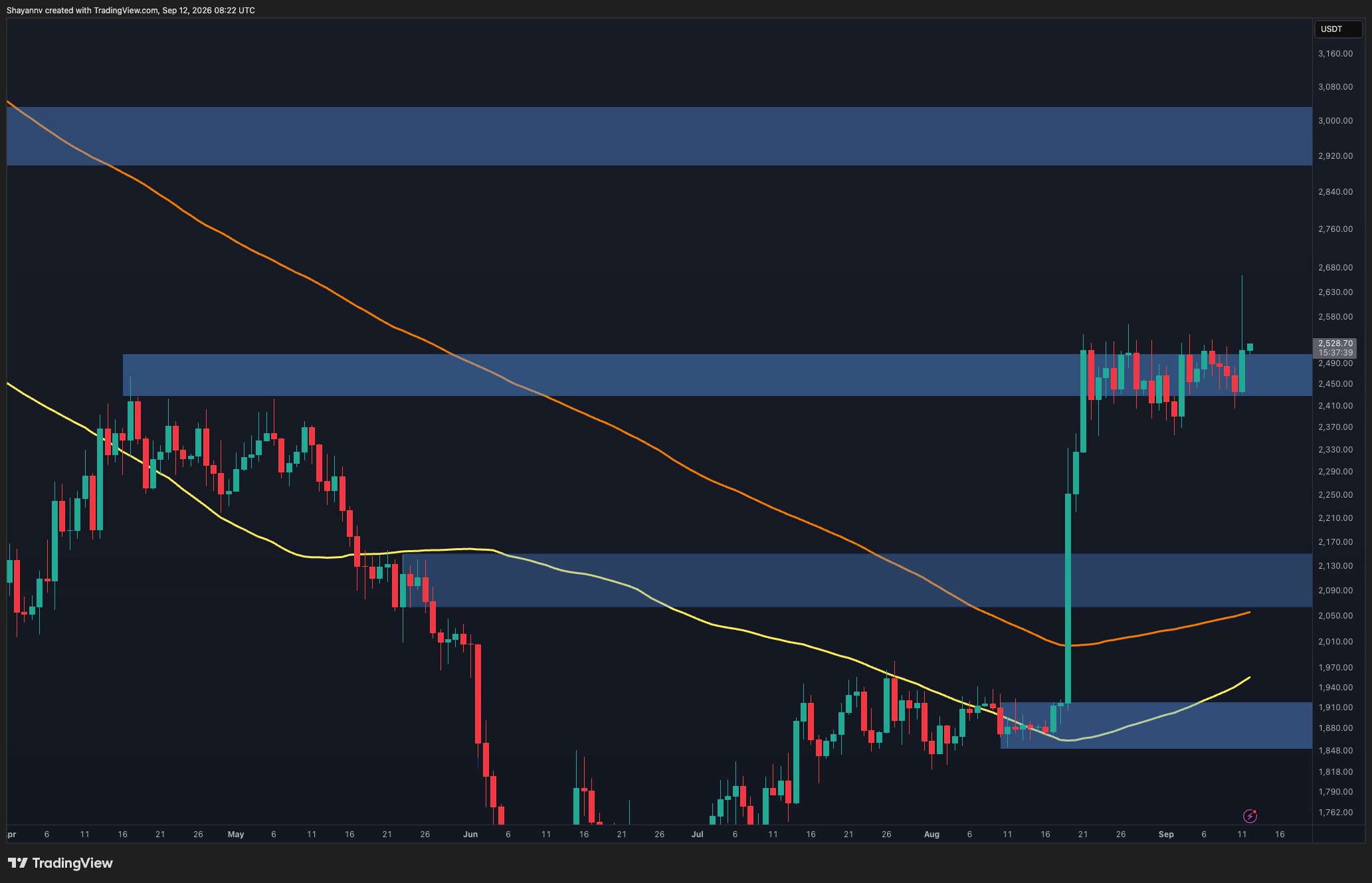
    On the daily chart, Ether (ETH) continues to hold the substantial gains achieved during its explosive August breakout. Crucially, the market has avoided a significant retracement despite repeated tests of the $2.43K-$2.52K area. This suggests that sellers have so far been unable to force prices back toward lower support zones.

    The current consolidation is occurring around the $2.45K-$2.52K resistance zone, with ETH trading near $2.52K. A convincing daily breakout and close above this region would bolster the bullish structure and could open the door to higher prices. In such a scenario, the next major resistance level visible on the chart is situated around the $2.92K-$3.03K zone.

    However, the market must first establish acceptance above the current resistance. Failure to do so would leave ETH vulnerable to further rotation within the existing range. The $2.05K-$2.14K region represents the next significant daily support area below, with moving averages also gradually trending upward beneath the price.

    Four-Hour Chart Insights

    The four-hour chart offers a clearer perspective on the immediate breakout attempt. ETH has spent several weeks trading within a range of roughly $2.35K to $2.56K, repeatedly encountering rejections at both ends without establishing a sustained directional move.

    The most recent CPI-driven volatility briefly pushed the price above the $2.56K range high, with a wick extending toward $2.66K. However, buyers were unable to sustain the breakout, and ETH quickly retreated back within its established structure. This false breakout is significant, as it demonstrates that simply trading above the range is insufficient. The market needs to hold above the $2.56K resistance level to confirm a genuine structural breakout.

    Nevertheless, ETH has recovered toward the upper boundary once more, rather than experiencing a sharp rejection. If buyers can secure acceptance above $2.56K, the consolidation could resolve into another bullish leg.

    Conversely, another rejection would keep the range intact and initially expose the $2.43K-$2.45K support zone. A more decisive breakdown below the range floor around $2.35K would weaken the continuation scenario and could shift attention toward the $2.22K-$2.27K support zone.

    Spot Taker CVD Analysis

    The 90-day Spot Taker CVD (Cumulative Volume Difference) tracks the cumulative difference between market buy and market sell volume. An increasing positive CVD indicates dominance by taker buyers, while a declining negative reading reflects stronger aggressive selling.

    The latest data reveals a notable shift toward positive readings, indicating that taker buyers have regained dominance after more neutral conditions were observed during July and early August. This transition has coincided with ETH’s recovery toward the $2.5K region and serves as a constructive signal for the current consolidation.

    If taker-buy dominance persists while ETH establishes itself above the range resistance, the combination would provide stronger confirmation that demand is supporting another bullish leg. A loss of this buy-side dominance, particularly alongside another failed breakout, would instead suggest that aggressive demand is not yet robust enough to sustain the upward move.

  • UniCredit Explores Crypto Custody, Seeks Tech Partner

    UniCredit Explores Crypto Custody, Seeks Tech Partner

    UniCredit Explores Digital Asset Expansion, Seeking Technology Partner

    UniCredit is reportedly exploring a significant expansion into digital assets, which would include offering cryptocurrency custody and brokerage services. The Italian banking giant has begun the process of selecting a technology provider to manage these assets and facilitate client transactions, according to sources familiar with the matter cited by Bloomberg.

    The discussions are in their nascent stages, and no definitive decisions have been made. Potential areas under consideration for the bank’s digital asset strategy encompass custody and brokerage, the development of tokenized investment products and fixed-income securities, and the implementation of stablecoin applications for its clientele. UniCredit has not yet disclosed the specific providers it is evaluating, the potential investment amount, or a timeline for selecting a partner.

    Any cryptocurrency services launched by UniCredit would operate under the European Union’s Markets in Crypto-Assets (MiCA) regulation, which became fully effective on July 1. MiCA mandates that crypto-asset service providers obtain a license and permits authorized firms to offer custody and trading services across the 30-country European Economic Area.

    The strategy of enlisting an external technology provider for digital asset custody is a path already adopted by other major financial institutions. Deutsche Bank, for instance, partnered with the Swiss firm Taurus for its digital asset custody and tokenization initiatives, following an extensive selection and due diligence process.

    UniCredit has not shied away from introducing crypto-related products to its clients. In July 2025, the bank launched a five-year, dollar-denominated certificate linked to BlackRock’s iShares Bitcoin Trust (IBIT). This product, available to professional clients, offers full capital protection at maturity, a cap of 85% on returns, and requires a minimum investment of $25,000. It marked the first offering of its kind in Italy.

    Further demonstrating its engagement with tokenization, UniCredit, in collaboration with state lender Cassa Depositi e Prestiti, structured Italy’s first tokenized minibond on a public blockchain in December 2025. This involved a €5 million issuance for E4 Computer Engineering, recorded on the Polygon network.

    Additionally, UniCredit is a member of Qivalis, an Amsterdam-based consortium comprising 37 European banks across 15 countries. This consortium plans to launch a MiCA-compliant euro stablecoin on the Ethereum blockchain in the latter half of 2026. The stablecoin would be backed one-to-one by euro deposits, pending approval from the Dutch central bank.

    Other prominent lenders have already begun offering cryptocurrency services to their customers. BBVA has introduced Bitcoin (BTC) trading and custody for its private banking clients in Switzerland. Similarly, Israel’s Bank Leumi has partnered with Galaxy to manage trading and custody services, with a planned launch in 2027 that will include Bitcoin, Ethereum (ETH), and Solana (SOL).

    UniCredit’s digital market expansion extends beyond cryptocurrencies. On September 8, the bank acquired a minority stake in VC Trade, a Frankfurt-based platform focused on digitizing bond and loan transactions. This platform operates within the debt markets, separate from the bank’s cryptocurrency initiatives, and has facilitated over €90 billion in transactions across more than 600 deals.

  • India’s Demat 2.0 Pilot Integrates Tokenized Bonds into Regulated Market

    India’s Demat 2.0 Pilot Integrates Tokenized Bonds into Regulated Market

    India has launched Demat 2.0, a pilot infrastructure for issuing, holding, trading, and settling corporate bonds as digital tokens. This initiative integrates directly into the nation’s existing regulated securities market and connects with the Reserve Bank of India’s (RBI) wholesale digital rupee via the Unified Market Interface (UMI) to enable atomic delivery-versus-payment.

    The Demat 2.0 system allows corporate bonds to be created natively on a distributed ledger, with ownership records managed by statutory depositories. This integration aims to streamline the bond issuance and trading process by enabling simultaneous transfer of securities and cash, thereby eliminating the settlement risk inherent in traditional, multi-day processes.

    Early transactions under the pilot have seen significant activity. On September 7, REC Limited issued the first tokenized bonds, raising ₹500 crore from 18 investors. Larsen & Toubro also issued tokenized bonds worth ₹500 crore. On September 9, IIFL raised ₹25 crore from a single investor. Collectively, these initial issuances total ₹1,025 crore (approximately $116 million).

    According to SEBI, issuers can now receive funds on the same day as bidding, a marked improvement over the traditional two-to-three-day settlement period. Secondary-market investors can also receive their proceeds immediately. Furthermore, the infrastructure supports smart contracts for automating coupon and redemption payments directly to investors’ central bank digital currency (CBDC) wallets.

    Crucially, tokenized bonds issued under Demat 2.0 remain legally identical to conventional bonds. Existing regulations concerning credit ratings, disclosures, debenture trustees, and investor protection continue to apply. The infrastructure is private and permissioned, with nodes operated by depositories and stock exchanges, ensuring it operates within the established financial system.

    The rollout of Demat 2.0 is planned in three stages. The current phase focuses on institutional corporate bond issuance. The second stage will introduce secondary-market trading and expand access to retail investors. The final stage may involve bringing additional regulated entities onto the network and exploring the tokenization of other financial instruments.

    While the pilot demonstrates a clear path for integrating distributed ledger technology into India’s financial markets, specific details regarding the timeline for the second and third stages, as well as the exact nature of additional entities and instruments to be included, remain to be clarified.

    Why This Matters

    The materials describe a narrow update: SEBI and RBI have introduced Demat 2. The exact date for the second and third stages of the Demat 2.0 rollout.

    Broader Context

    Source materials place the factual news in this context: Unlike many tokenization experiments built on standalone blockchain platforms, India’s Demat 2.0 model is being integrated directly into the nation’s existing regulated securities market.

  • XRP Price Consolidation: Key Catalysts and Technicals Shape Uncertain September Outlook

    XRP Price Consolidation: Key Catalysts and Technicals Shape Uncertain September Outlook

    XRP is currently consolidating in the low-$1.30s, a period characterized by market indecision as participants await crucial catalysts. These include a significant regulatory decision, potential shifts in whale investor behavior, and the defense of key technical support levels. According to price analysis, the current trading range reflects a sideways-to-mildly bearish structure heading into the final stretch of September.

    Key Support and Resistance Levels
    The mid-to-high-$1.30s represent a critical demand zone where substantial XRP volume has previously traded. This area, along with support near the low-$1.30s (close to the 20-day EMA) and a more significant zone around $1.25–$1.30 (near the 50-day EMA), is being closely watched. Resistance is building above the current range, with initial hurdles identified in the mid-$1.30s to low-$1.40s, followed by heavier supply noted between $1.45–$1.55. The $1.55–$1.70 region stands as the next major test for any potential upward movement.

    Factors Driving Uncertainty
    Several factors are contributing to the current uncertainty surrounding XRP’s trajectory. A looming regulatory decision is considered a potential swing factor for the next major price move, with traders monitoring the CLARITY Act vote timeline. Additionally, shifts in whale behavior, such as the movement of dormant coins, are being observed as potential catalysts, though not necessarily indicative of a sale. The broader macroeconomic environment, particularly signals from Federal Reserve policy, is also impacting the cryptocurrency market as a whole, influencing XRP’s price action.

    Technical Indicators and Market Context
    Technical indicators suggest a neutral Relative Strength Index (RSI), while expanding Bollinger Bands hint at potentially building volatility rather than fading momentum. CoinMarketCap’s tracking shows that XRP has underperformed against the wider crypto market during recent risk-off movements. This follows an August rally that saw XRP climb from approximately $1 to the high-$1.60 range. The current consolidation is occurring within what appears to be a descending triangle pattern.

    Potential Scenarios
    The market’s immediate focus is on whether buyers will defend the low-to-mid-$1.30s support. A break below this level would weaken the current recovery thesis and could lead to a retest of the mid-$1.20s. Conversely, a bullish scenario would involve XRP reclaiming the low-$1.40s, potentially paving the way toward the $1.60 area and possibly the high-$1.80s if a triangle pattern breaks higher. However, the base case, according to analysis, is continued price action between roughly $1.30 and $1.40 as traders await a fresh catalyst.

    Related Market News
    In related market news, Bitcoin Hyper ($HYPER), a Bitcoin Layer 2 project integrating the Solana Virtual Machine, is noted for its positioning as a fast SVM-based execution layer. Currently priced at $0.013686, its presale has raised over $33 million, offering early participants a 35% APY for staking rewards. Research indicates that some traders are exploring earlier-stage infrastructure plays with more room for growth.

    Ultimately, XRP’s next significant move hinges on the interplay of these technical levels, regulatory clarity, and investor sentiment. The current phase is characterized by ambiguity, with the outcome of these converging factors expected to shape XRP’s trajectory into Q4.

    Why This Matters

    The materials describe a narrow update: XRP is trading in the low-$1. Whether buyers will defend the low-to-mid-$1.30s support or allow it to crack.

  • Revolut Data Breach Exposes Passports, Bitcoin Histories

    Revolut Data Breach Exposes Passports, Bitcoin Histories

    Fintech Giant Revolut Compromised by Sophisticated Phishing Scam, Exposing Sensitive Customer Data

    Revolut, the prominent fintech firm, has disclosed a significant data breach that resulted in the exposure of sensitive customer information, including passport copies and detailed Bitcoin transaction histories. The breach occurred after the company fell victim to a fraudulent request disguised as a legitimate government inquiry.

    Details of the Breach

    According to a customer notification shared by crypto investigator ZachXBT, Revolut received a request for customer data that appeared to originate from a government agency. The request was sent from an unauthorized email account that had successfully spoofed the agency’s official domain. Crucially, the message included valid domain authentication credentials, leading Revolut to believe the request was genuine and proceed with fulfilling it.

    The compromised data is extensive, encompassing a wide range of personal and financial details. Affected customers had their full names, dates of birth, and occupations exposed. Contact information, including postal addresses, email addresses, and phone numbers, was also compromised. Furthermore, identity verification documents, such as copies of passports or driver’s licenses, and verification selfies were handed over.

    For cryptocurrency holders, the breach is particularly concerning as it includes financial data such as account statements with IBAN and wallet reference numbers, withdrawal records, and complete transaction histories, including Bitcoin transactions. Revolut has stated that no biometric facial telemetry data was involved in the incident.

    Revolut’s Response and Impact

    A spokesperson for Revolut confirmed the breach to TechCrunch, characterizing it as “a sophisticated external impersonation scam where an unauthorised third party utilised a legitimate government agency domain email to submit fraudulent requests for information.”

    The company indicated that a “limited” number of customers were affected. Revolut has since blocked the fraudulent email address and has alerted the relevant government agency, law enforcement, and regulatory bodies. The company maintained that its internal systems and customer funds remain unaffected. Revolut declined to specify the exact number of customers impacted or the identity of the government agency that was impersonated.

    Wider Implications and Industry Concerns

    ZachXBT suggested that the incident may have specifically targeted high-net-worth individuals, a development that raises concerns given the recent increase in violent “wrench attacks” against known cryptocurrency holders. The leak has drawn sharp criticism from users on social media, with many arguing that the episode highlights how know-your-customer (KYC) regulations may create risks without delivering commensurate benefits.

    One user, Marc Zeller, posted on social media platform X (formerly Twitter), “Woke up to all my data leaked by @Revolut. Sharp reminder that KYC hasn’t produced meaningful upside and has put many in harm’s way.”

    This breach occurs during a challenging period for companies that hold personal data of cryptocurrency users. Hardware wallet manufacturer Trezor recently experienced a support-vendor breach that exposed tens of thousands of additional customers. Separately, X (formerly Twitter) appeared to suffer its own data breach, which led to a flood of password reset requests for its users.

    Revolut, which launched its euro-pegged EURR stablecoin earlier this year, is reportedly considering an initial public offering (IPO).

  • Ripple (XRP): 21Shares Lists 4 Investor Must-Knows

    Ripple (XRP): 21Shares Lists 4 Investor Must-Knows

    21Shares Identifies Key Investment Drivers for XRP

    Swiss-based asset manager 21Shares has presented a compelling investment case for XRP, pointing to enhanced regulatory clarity, increased institutional access, growing utility on the XRP Ledger (XRPL), and a predictable supply as key factors. However, the report also acknowledges a significant ongoing risk that continues to cast a shadow over the underlying asset.

    Regulatory Clarity and Institutional Adoption

    The firm’s report designates regulatory clarity as the primary pillar of its investment thesis. The favorable outcome of Ripple’s protracted legal battle with the U.S. Securities and Exchange Commission (SEC) in the past year has significantly eased compliance burdens for institutions. The report notes that the regulatory landscape for XRP has become considerably clearer since August 2025, offering a more defined treatment compared to the previous SEC administration.

    This improved regulatory environment appears to be directly contributing to the second pillar: expanding institutional access. The launch of several spot XRP Exchange Traded Funds (ETFs) on Wall Street last November saw substantial inflows, exceeding $1 billion within the first six weeks. Recent reports indicate that cumulative inflows have reached a new all-time high of over $1.7 billion, demonstrating sustained investor interest even amidst a challenging market for the asset.

    Growing XRPL Utility and Predictable Supply

    The third key driver highlighted by 21Shares is the increasing real-world usage of the XRP Ledger. The report states that the XRPL has processed nearly $500 billion in on-chain value over the past 12 months. Concurrently, Ripple’s RLUSD stablecoin has experienced significant growth, expanding its market capitalization from $72 million to $1.6 billion in under two years.

    Furthermore, tokenized assets on the XRPL have seen substantial expansion, recently reaching a valuation of $4 billion. The network continues to focus on facilitating payments, stablecoins, and real-world assets. Crypto commentator Vincent Van Code echoed these sentiments, suggesting that Ripple’s comprehensive infrastructure offers an “out-of-the-box, turnkey end-to-end solution” for institutions venturing into digital assets.

    The final pillar cited is XRP’s fixed maximum supply of 100 billion tokens. The absence of an ongoing inflation schedule, coupled with a small amount of XRP being permanently burned through transaction fees, contributes to its predictable supply dynamics.

    Acknowledging the Lingering Risk

    Despite these positive indicators, 21Shares acknowledges a critical weakness in its investment thesis: increased XRPL usage does not automatically equate to heightened demand for XRP. Institutions may utilize the network without holding XRP for extended periods, or their engagement with the token might be minimal.

    The central question remains whether the expansion of payments, stablecoins, and tokenized assets will ultimately lead to sustainable value accrual for XRP.

    For investors who believe in the increasing digitization of global finance, 21Shares posits that XRP offers one of the more regulated and institutionally connected avenues for exposure to this trend. However, the investment case is contingent on adoption translating into genuine demand for the underlying asset, which, as of press time, continues to face resistance around the $1.40 mark.

  • Reform UK Receives £72 Million in Donations Amidst Funding Investigations and Regulatory Scrutiny

    Reform UK Receives £72 Million in Donations Amidst Funding Investigations and Regulatory Scrutiny

    Reform UK has received a combined £72 million ($97 million) in donations from two billionaires, Ben Delo and Christopher Harborne, over two days. Delo donated £36 million, and Harborne matched this with another £36 million. These contributions are notable for their scale, potentially representing the largest single donation and a significant matching donation to a British political party.

    The donations occur while Reform UK is under criminal investigation regarding its funding. The Metropolitan Police opened an inquiry on Tuesday into allegations from Channel 4 footage concerning methods to circumvent the ban on foreign political donations. This inquiry is being integrated into an existing investigation into payments received by the party before the last general election.

    Britain banned crypto political donations in March. Both Delo and Harborne stated that their recent donations, as well as previous ones, were not made using cryptocurrency. The timing of these large donations also coincides with the government considering tighter regulations on political funding. While there is no limit on donations from UK-based individuals, Labour has proposed capping gifts from Britons living overseas and plans similar restrictions for recent returnees. Donors giving more than £100,000 annually must have been on the electoral register for at least 12 months.

    Ben Delo, co-founder of BitMEX, announced his £36 million donation in The Telegraph on Friday. This amount is reportedly more than four times the £8 million he had already contributed to Reform UK this year. Reports suggest Delo is providing the funds upfront, equivalent to £1 million per month until the latest possible election date in 2029, potentially to preempt future government caps on large donations. Delo, who previously pleaded guilty to anti-money laundering failures at BitMEX, has stated his intention to return from Hong Kong. He was pardoned by U.S. President Donald Trump in 2025.

    Christopher Harborne, an investor in Tether, matched Delo’s donation on Saturday. Harborne, who has previously donated £15 million to Reform UK since the last election, cited a “competitive spirit” as his motivation, adding that he expected “nothing, personally.” The Parliamentary Commissioner for Standards is reviewing whether Nigel Farage, the leader of Reform UK, should have declared a £5 million personal gift from Harborne.

    A spokesperson for Reform UK stated that the funds would be used to hire “the brightest and best minds to work on policy” and to recruit 400 campaign managers, one for each target seat, indicating the party is “now on election footing.”

    Reform UK has denied any wrongdoing and pledged full cooperation with the ongoing investigations. The party faces scrutiny not only over its funding but also concerning past declarations, such as the £5 million gift to Farage. The Metropolitan Police’s inquiry focuses on allegations of circumventing foreign donation bans, separate from the recent large contributions from Delo and Harborne.

    This situation highlights the complex interplay between significant political funding, evolving regulatory frameworks, and ongoing investigations into party finances. While the donations represent a substantial financial boost for Reform UK, their context within the current scrutiny and potential future regulatory changes adds layers of uncertainty to their ultimate impact. The donations are significant given the government is considering tighter rules on donations and the party is under criminal investigation.

    Why This Matters

    The materials describe a narrow update: Ben Delo and Christopher Harborne donated a combined £72 million ($97 million) to Reform UK over two days. Whether Nigel Farage declared a £5 million personal gift from Harborne.

    Broader Context

    Source materials place the factual news in this context: Two crypto billionaires have given Nigel Farage’s Reform UK £72 million ($97 million) in two days, more than every British party raised last year combined.