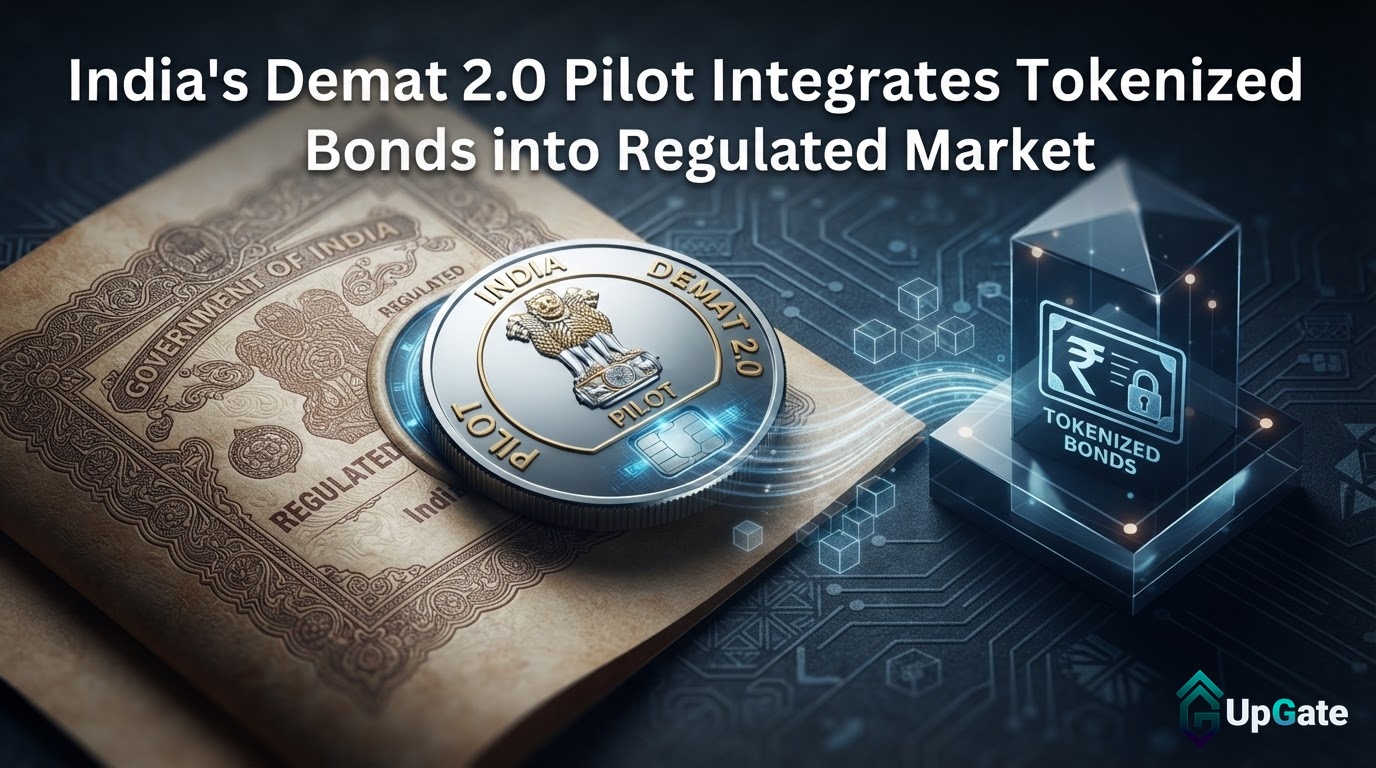
India has launched Demat 2.0, a pilot infrastructure for issuing, holding, trading, and settling corporate bonds as digital tokens. This initiative integrates directly into the nation’s existing regulated securities market and connects with the Reserve Bank of India’s (RBI) wholesale digital rupee via the Unified Market Interface (UMI) to enable atomic delivery-versus-payment.
The Demat 2.0 system allows corporate bonds to be created natively on a distributed ledger, with ownership records managed by statutory depositories. This integration aims to streamline the bond issuance and trading process by enabling simultaneous transfer of securities and cash, thereby eliminating the settlement risk inherent in traditional, multi-day processes.
Early transactions under the pilot have seen significant activity. On September 7, REC Limited issued the first tokenized bonds, raising ₹500 crore from 18 investors. Larsen & Toubro also issued tokenized bonds worth ₹500 crore. On September 9, IIFL raised ₹25 crore from a single investor. Collectively, these initial issuances total ₹1,025 crore (approximately $116 million).
According to SEBI, issuers can now receive funds on the same day as bidding, a marked improvement over the traditional two-to-three-day settlement period. Secondary-market investors can also receive their proceeds immediately. Furthermore, the infrastructure supports smart contracts for automating coupon and redemption payments directly to investors’ central bank digital currency (CBDC) wallets.
Crucially, tokenized bonds issued under Demat 2.0 remain legally identical to conventional bonds. Existing regulations concerning credit ratings, disclosures, debenture trustees, and investor protection continue to apply. The infrastructure is private and permissioned, with nodes operated by depositories and stock exchanges, ensuring it operates within the established financial system.
The rollout of Demat 2.0 is planned in three stages. The current phase focuses on institutional corporate bond issuance. The second stage will introduce secondary-market trading and expand access to retail investors. The final stage may involve bringing additional regulated entities onto the network and exploring the tokenization of other financial instruments.
While the pilot demonstrates a clear path for integrating distributed ledger technology into India’s financial markets, specific details regarding the timeline for the second and third stages, as well as the exact nature of additional entities and instruments to be included, remain to be clarified.
Why This Matters
The materials describe a narrow update: SEBI and RBI have introduced Demat 2. The exact date for the second and third stages of the Demat 2.0 rollout.
Broader Context
Source materials place the factual news in this context: Unlike many tokenization experiments built on standalone blockchain platforms, India’s Demat 2.0 model is being integrated directly into the nation’s existing regulated securities market.
Leave a Reply