Category: Uncategorized

  • Sun Yuchen Slashes Ethereum Holdings by 80-90%, Remains Bearish on Bitcoin

    Sun Yuchen Slashes Ethereum Holdings by 80-90%, Remains Bearish on Bitcoin

    Sun Yuchen Discusses Personal Holdings Beyond TRON, Expresses Caution on Bitcoin

    In a recent interview with Jin Ming, TRON founder Sun Yuchen (Justin Sun) revealed details about his personal cryptocurrency and stock holdings outside of the TRON ecosystem. He identified Ethereum and Bitcoin as his primary allocations, alongside smaller positions in top-tier tokens with practical applications. In the stock market, his main focus is on Nvidia, with additional exposure to the Nasdaq index.

    Sun Yuchen did not disclose specific amounts or percentages for his holdings, instead outlining his general investment strategy.

    When asked about portfolio adjustments since the crypto market’s peak last year, Sun Yuchen stated that Ethereum, previously his largest holding, was significantly reduced. He explained that he sold off “at least eighty to ninety percent” of his Ethereum position when the price was between $3,600 and $4,000. He agreed with Jin Ming’s estimation that this occurred around November and December of the previous year.

    He attributed this decision to a perceived “double top” technical pattern in Ethereum’s price chart. Sun Yuchen noted that Ethereum’s initial surge towards $4,800 was followed by a pullback, and its subsequent attempt to rally was bolstered by ETF-related buying and other market participants. He described this structure as “very fragile.”

    Data from Binance shows that Ethereum reached highs of approximately $4,957 in August 2025 and $4,755 in October of the same year, before falling to a low of around $2,624 in November. As of midday on October 17th, Ethereum was trading at approximately $2,428, representing a decline of 33% to 39% from the price range where Sun Yuchen sold.

    Sun Yuchen mentioned that the capital freed up from his Ethereum sales has remained in cash for nearly a year. During this period, he invested heavily in U.S. stocks, believing that capital would increasingly flow into the American market. He also reiterated in another segment of the interview that his primary DeFi mining activities continue to be on Ethereum, citing the limited liquidity on other chains as a reason for concentrating large capital on Ethereum.

    Regarding Bitcoin, Sun Yuchen stated, “We did not reduce our BTC holdings,” explaining that Bitcoin is held as a foundational asset. He drew an analogy to Nvidia, which he considers his foundational holding in the AI sector, asserting he would not sell any unless he completely lost faith in AI. Jin Ming summarized this by characterizing Bitcoin as a foundational asset and Ethereum as an offensive position, a distinction Sun Yuchen affirmed.

    Growing Skepticism Towards Bitcoin Amidst AI and Quantum Computing Concerns

    When questioned about his outlook on Bitcoin versus Ethereum over the past two years, Sun Yuchen expressed a contrarian view, stating, “I am somewhat more bearish on Bitcoin.” His primary concerns revolve around the advancements in AI algorithms and the potential impact of “Q-Day”—the point at which quantum computers become powerful enough to break current encryption standards. He believes that many in the industry underestimate the threat this poses to Bitcoin and that the market has not yet priced in this risk.

    Sun Yuchen initially estimated Q-Day to be about two years away but now believes it could occur within one to one-and-a-half years. He also pointed to progress in mathematical research by OpenAI, suggesting a possibility that Bitcoin could be compromised by traditional computing methods even before Q-Day, potentially by cracking Satoshi Nakamoto’s wallet. He also noted that many exchange wallets lack basic security protections.

    Despite these concerns, Sun Yuchen continues to hold Bitcoin. His immediate plan is to secure these holdings by transferring them to new, never-before-signed addresses, effectively creating a cold storage solution. While this process is straightforward and takes only a few days, it will introduce some inconvenience in future access.

    Whether he will ultimately sell his Bitcoin holdings remains to be seen, as he is now closely monitoring developments in the tech community, a shift from his previous lack of attention to this issue. He also revealed that TRON’s anti-quantum algorithm is currently running on its testnet and is slated for mainnet launch at least a year before their projected Q-Day.

    Sun Yuchen indicated that his Nasdaq positions are still active, but he holds a “slightly bearish” medium-term view, though he has not yet initiated short positions. He believes that capital has become excessively concentrated, leading to inflated valuations for both the Nasdaq index and AI-related stocks. He also highlighted U.S. Treasury bonds as a significant source of capital, suggesting that high yields could prompt a return of funds from the stock market to Treasuries.

    Within the AI industry, Sun Yuchen is most optimistic about real-world applications, particularly in AI-driven health management. He views memory and optical module sectors as overvalued due to excessive capital concentration, with many hardware stocks trading at valuations typically associated with software companies. He reported minimal holdings in A-shares and expressed a general lack of confidence in “old-generation assets” (a Chinese internet term for assets favored by older demographics), citing baijiu (Chinese liquor) as an example.

    On October 12th, on-chain analytics platform Arkham reported that it had identified 211 addresses associated with Sun Yuchen, collectively holding approximately $2.25 billion. This included roughly 239,000 stETH (Lido’s staked Ether, valued at about $608 million) and 4,042 Bitcoin. Arkham’s figures are based on the addresses it could identify, while Sun Yuchen’s discussion in the interview pertained to his personal portfolio outside of TRON.


  • US Spot Bitcoin and Ethereum ETFs See Net Outflows; Market Sentiment Remains Cautious

    US Spot Bitcoin and Ethereum ETFs See Net Outflows; Market Sentiment Remains Cautious

    US spot Bitcoin and Ethereum Exchange Traded Funds (ETFs) experienced net outflows on October 16, with combined outflows totaling approximately $152 million. Bitcoin ETFs saw net outflows of $82.39 million, while their Ethereum counterparts recorded outflows of $69.68 million.

    These figures suggest a cautious market sentiment. For Bitcoin ETFs, the $82.39 million outflow represents less than a tenth of one percent of their total assets, which are estimated to be between $105 billion and $106 billion. Collectively, these ETFs hold over 1.27 million Bitcoin. In contrast, Ethereum ETFs hold approximately $15 billion in total assets, meaning the $69.68 million outflow represents a more significant proportion of their asset base.

    Despite the net outflows on October 16, the week ending the same day saw substantial trading volume for Bitcoin ETFs, exceeding $7.5 billion. Net selling for Bitcoin ETFs over that same week was approximately $145 million. This indicates that while some investors were reducing positions, overall engagement in the market remained significant, suggesting caution rather than a definitive market shift.

    Looking at broader trends, Bitcoin ETFs have experienced net outflows of roughly $535 million through the middle of October. This follows a period of strong inflows, with Bitcoin ETFs accumulating about $2.6 billion in net inflows during September. Since their launch in January 2024, US spot Bitcoin ETFs have seen cumulative net inflows totaling approximately $57 billion. The outflows observed in October thus far amount to less than 1% of these cumulative inflows.

    Variations in reported figures for ETF flows are common due to different data sources and settlement schedules. For instance, alternative tallies for Bitcoin’s daily outflow on October 16 were as low as $10.6 million. Fidelity’s FBTC was noted as leading redemptions among Bitcoin ETFs on that day.

    Bitcoin was trading near $82,000, and Ethereum was trading between $2,400 and $2,500 at the time of reporting. The simultaneous outflows from both Bitcoin and Ethereum funds may indicate a broader cautious sentiment in the market, rather than a specific view on one asset. However, uncertainty remains regarding the precise reasons for this cautious market posture. The data indicates a period of adjustment for investors, with significant trading volume persisting despite the net selling observed.

    Why This Matters

    The materials describe a narrow update: On October 16, US spot Bitcoin ETFs saw net outflows of $82.39 million, and their Ethereum counterparts experienced outflows of $69.68 million. Exact daily outflow figures for Bitcoin ETFs can vary due to differing data sources.

    Broader Context

    US spot Bitcoin ETFs launched in January 2024.

  • Sam Bankman-Fried’s Supreme Court Appeal Centers on Forfeiture and Loss Arguments

    Sam Bankman-Fried’s Supreme Court Appeal Centers on Forfeiture and Loss Arguments

    Sam Bankman-Fried’s legal team has petitioned the U.S. Supreme Court to review his case, raising arguments that his $11 billion forfeiture order may be unconstitutional and that the lower court improperly excluded evidence regarding the extent of losses to those affected. This appeal represents a potential final legal avenue for Bankman-Fried following his conviction on seven fraud charges and a subsequent loss in his second-level appeal.

    Challenging the Forfeiture Order
    The defense’s core argument to the Supreme Court centers on the contention that the $11 billion forfeiture order potentially violates the Eighth Amendment’s prohibition against excessive fines. According to SBF’s legal team, this order is lifelong, meaning any assets Bankman-Fried might acquire after his release could theoretically be seized by the government. While lifelong forfeiture is not uncommon in major white-collar crimes, the scale of $11 billion is described as rare.

    Questioning Loss Evidence
    Secondly, the defense argues that the trial court’s refusal to admit evidence detailing limited losses was prejudicial. This challenges the prosecution’s theory that fraud occurred the moment FTX customer funds were transferred to Alameda Research, regardless of intent to repay. The prosecution, however, cites the U.S. Supreme Court case Kousisis v. United States, which established that fraud convictions do not necessarily require proof of actual financial loss to the affected parties. This precedent is considered to carry more weight than the 2007 First Circuit case, United States v. Carpenter, which the defense references to suggest a jury might have ruled based on “moral outrage” rather than evidence.

    Uncertainty Regarding Acceptance
    Legal experts and analysts express skepticism about the likelihood of the Supreme Court accepting Bankman-Fried’s appeal. Mark Bini, a partner at Reed Smith and former federal prosecutor, stated that the chance of the Supreme Court accepting the appeal is “very low.” The evidence chain in Bankman-Fried’s case is described as complete, with consistent testimony from multiple witnesses, including former Alameda Research CEO Caroline Ellison. The legal community generally views the defense’s attempt to leverage older case law against the more recent Kousisis precedent as an uphill battle.

    Potential Precedent-Setting Impact
    Despite the low probability, the forfeiture argument holds potential significance. If the Supreme Court were to review the $11 billion forfeiture solely on Eighth Amendment grounds, it could establish a new standard for property forfeiture in white-collar crime cases. However, if the Court were to accept the argument of excessive forfeiture, it is more likely to reduce the amount rather than order a new trial.

    Background and Timeline
    Bankman-Fried was convicted in 2023 and sentenced to 25 years in prison. He lost his second-level appeal in June. The U.S. government’s response to the Supreme Court petition was extended to November 16. The Supreme Court is expected to decide whether to hear the case in late 2026 or early 2027, with a potential ruling by June 2027. The estimated release date for Bankman-Fried is 2043.

    While the outcome of this appeal may have symbolic significance for the cryptocurrency industry, its practical impact is considered limited. FTX’s liquidation and compensation processes for creditors are nearing completion, and the industry has largely moved forward. However, any intervention by the Supreme Court would signify a re-examination of conviction standards and property disposition for crypto fraud within the U.S. legal system, potentially setting a precedent for future cases.

    Broader Context

    Source materials place the factual news in this context: SBF was convicted in 2023 on 7 fraud charges and sentenced to 25 years in prison.

  • Strive Buys Bitcoin, TD Cowen Raises Target Price 27% on $630M Preferred Stock Deal

    Strive Buys Bitcoin, TD Cowen Raises Target Price 27% on $630M Preferred Stock Deal

    TD Cowen Boosts Strive Price Target to $56 on Aggressive Bitcoin Buys

    TD Cowen has significantly increased its price target for Strive (NYSE: ASST) by 27% to $56, citing the company’s recent aggressive Bitcoin acquisitions that have already surpassed the brokerage’s initial fourth-quarter estimates within the past two weeks. Strive has also expanded its SATS preferred stock offering to 7 million shares, aiming to raise $630 million by October 20th, with all proceeds earmarked for further Bitcoin purchases.

    Strive’s Bitcoin Holdings Surge Amidst Market Optimism

    The recent surge in Bitcoin buying by asset management firm Strive has reignited bullish sentiment on Wall Street. Analysts Lance Vitanza and Jonnathan Navarrete at TD Cowen raised their price target for Strive from $44 to $56 on Friday. They highlighted that the Bitcoin treasury company acquired more BTC in just 14 days than the brokerage had originally projected for the entire fourth quarter.

    Strive’s Bitcoin holdings have rapidly grown from 28,000 coins at the end of September to the current 35,595 coins, valued at approximately $2.9 billion at the current market price of around $81,500 per coin. This expansion includes two substantial purchases: 3,311 BTC (approximately $280 million) reported via an SEC 8-K filing on October 13th, followed by another 2,822 BTC (approximately $235 million) acquired through a separate 8-K filing on October 14th. These transactions have propelled Strive’s Bitcoin holdings to become the fourth-largest among publicly traded U.S. companies, surpassing MARA Holdings (which holds 35,770 coins).

    Preferred Stock Offering to Fuel Further Bitcoin Accumulation

    TD Cowen analysts specifically pointed to Strive’s ongoing SATS preferred stock public offering, which has been expanded to 7 million shares priced at $90 each, targeting a total of $630 million by its completion on October 20th. This capital infusion is crucial for Strive, as it will enable the company to continue increasing its Bitcoin holdings without diluting its common shareholder equity.

    The company also plans to maintain sufficient cash reserves to cover 18 months of preferred stock dividend payments, providing a buffer against potential Bitcoin price volatility. TD Cowen views this as a strategic move that offers both offensive and defensive advantages, with the expanded offering size granting Strive greater flexibility for immediate Bitcoin acquisitions.

    Dilution Concerns and Stock Performance

    However, Strive’s rapid expansion of its Bitcoin treasury has also introduced a dilutive effect. TD Cowen analysts noted that warrants previously issued at $27 per share are being exercised in large numbers, leading to a significant increase in diluted shares and consequently reducing the BTC Yield (Bitcoin holdings per common share). Some investors have reportedly sold their shares immediately after exercising their warrants, adding pressure to the stock price.

    As of Friday’s closing, ASST shares traded at $23.96, marking a 6.6% decline. Despite this, the stock has seen a year-to-date increase of over 38%. TD Cowen believes that with all the $27 warrants now exercised, future dilution pressure is expected to subside, which is a positive signal for the BTC Yield.

    Strive’s Strategy and Future Outlook

    The “Bitcoin treasury” sector has seen a notable uptick since the latter half of 2026. Strive’s strategy of “buy Bitcoin first, then issue preferred stock for funding” has resulted in the acquisition of nearly 7,600 Bitcoins in less than a month, significantly exceeding TD Cowen’s initial Q4 forecast of only 4,750 coins. This pace is comparable to the long-term buying strategy of Strategy (formerly MicroStrategy), but Strive’s smaller scale and greater flexibility allow for more pronounced short-term adjustments.

    Key variables for the market moving forward include the successful completion of the SATS preferred stock offering and Strive’s acceleration of Bitcoin purchases once the funds are secured. If the $630 million is successfully raised, Strive could theoretically add another 7,000 to 9,000 Bitcoins in the next 3 to 6 months, further narrowing the gap with Strategy.

  • Gold and Bitcoin: Complementary Assets in a De-Monetization Strategy

    Gold and Bitcoin: Complementary Assets in a De-Monetization Strategy

    Asset management executive Steve Neamtz of Yorkville America proposes that gold and Bitcoin are not competing investments but rather represent different stages of the same “de-monetization” investment logic. According to Neamtz, gold benefits from established infrastructure, while Bitcoin, through the advent of spot ETFs, is addressing critical custody gaps. Both assets are viewed as complementary in an era characterized by high debt and eroding currency purchasing power.

    This perspective emerges against a backdrop of significant macroeconomic shifts. US Federal debt has surpassed $39 trillion, with annual interest payments alone reaching approximately $1 trillion. Concurrently, the purchasing power of the US Dollar has diminished by roughly 40% over the past two decades. These conditions are intensifying the appeal of assets with limited, non-expandable supply.

    Neamtz points out that the core appeal of both gold and Bitcoin stems from their inherent scarcity, a trait that central banks and treasuries cannot replicate through monetary policy. In an environment of escalating debt, this scarcity becomes a critical factor for investors seeking to preserve value. He suggests that investors are increasingly making a “de-monetization bet” rather than simply seeking a buffer against market downturns.

    Gold, with its approximately 5,000-year track record, possesses a deeply entrenched infrastructure, particularly within central bank reserves. This established pipeline gives it a leading position. Bitcoin, with a history of about 17 years, is in an earlier stage of development and market penetration. The approval of Bitcoin spot ETFs in 2024 has been a significant step in addressing custody issues, making the asset more accessible to institutional investors. However, Neamtz believes that Bitcoin still requires central bank-level recognition and qualification as a reserve asset, a process that necessitates extensive coordination of regulatory frameworks, accounting standards, and international clearing systems, potentially taking five to ten years.

    Global central banks have demonstrated a growing interest in gold, purchasing a record 289 metric tons in the second quarter of 2026 and 244 metric tons in the first quarter of the same year. This trend, alongside institutional investment in Bitcoin ETFs, signals a broader movement towards de-monetization strategies.

    Neamtz believes that the real question for investors in 2027 will not be which asset will outperform, but rather how much of each should be held in a portfolio. The decision on allocation should be based on individual risk tolerance and time horizon. Gold may be suitable for those seeking stability, while Bitcoin might appeal to investors willing to bear higher volatility for potentially greater growth. The coexistence of both assets is seen not as a compromise, but as an acknowledgment that the same macroeconomic phenomenon—the devaluation of fiat currency—can be addressed with different tools at different stages of development.

    Key uncertainties remain regarding the timeline for Bitcoin’s full integration into reserve systems and the optimal portfolio allocation percentages for individual investors. The future trajectory of US Federal debt and its impact on currency purchasing power also present ongoing considerations.

    Why This Matters

    The materials describe a narrow update: Steve Neamtz of Yorkville America posits that gold and bitcoin are not mutually exclusive investments but represent different phases of a “de-monetization” investment strategy. The exact timeline for Bitcoin to achieve central bank-level recognition and reserve qualification.

    Broader Context

    Source materials place the market analysis in this context: The article references previous articles: “《比特幣本位》導讀:從歷史、經濟、政治經濟和心理學分析比特幣的完整系統” and “黃金叩關3000美元創歷史新高!比特幣「避險敘事失靈」苦苦掙扎”.

  • Solana Ecosystem Shows Diversification with $193M in Application Revenue and Surging Real-World Assets

    Solana Ecosystem Shows Diversification with $193M in Application Revenue and Surging Real-World Assets

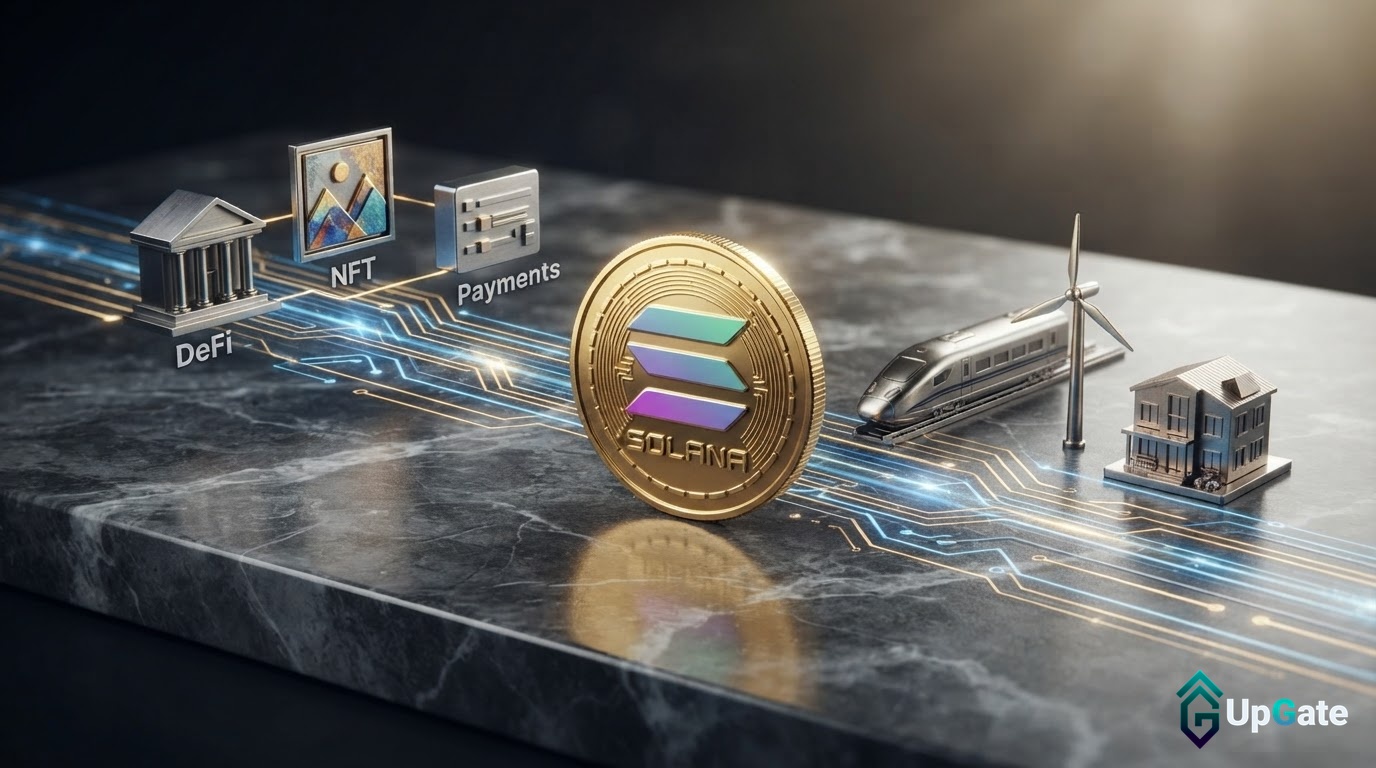
    Solana’s ecosystem is demonstrating diversification, evidenced by $193.1 million in application revenue over the past 30 days and a substantial surge in real-world asset (RWA) value. Over the last year, the value of RWAs on the Solana network has grown from $700 million to $4.37 billion.

    The $193.1 million in application revenue generated in the past 30 days highlights active development and usage on the platform. According to Castle Labs research, this figure is nearly double the total revenue generated by Hyperliquid during the same period.

    The expansion of real-world assets is a key indicator of this diversification. The growth from $700 million to $4.37 billion in RWA value over the past year signifies a move towards more tangible and utility-driven applications, suggesting a shift away from speculative assets as a primary growth driver.

    This evolution indicates a maturing network with broadening utility. The substantial revenue generated by applications and the significant rise in real-world asset value collectively illustrate an evolving Solana network that is broadening its utility and appeal.

    Why This Matters

    The materials describe a narrow update: Solana’s application revenue reached $193. Solana’s growth is moving beyond meme coins.

    Broader Context

    Source materials place the factual news in this context: Solana Apps Generate $193M in 30 Days Amid Real-World Assets Surge.

  • SoftBank Eyes $18 Billion Allied Universal Deal

    SoftBank Eyes $18 Billion Allied Universal Deal

    SoftBank in Early Talks to Acquire Allied Universal for Up to $18 Billion

    SoftBank Group Corp. is reportedly engaged in preliminary discussions to acquire Allied Universal, the largest security services provider in the United States. The potential transaction could see Allied Universal’s equity valued at as much as $18 billion.

    The news was met with investor apprehension, as SoftBank’s American Depositary Receipts (ADRs), trading under the ticker SFTBY, experienced a decline of approximately 9.5% to 10% following the report on October 16, 2026.

    Sources indicate that the negotiations are in their nascent stages, with no definitive decisions made regarding the price or structure of a potential deal. Representatives for both SoftBank and Allied Universal declined to comment on the ongoing discussions.

    Deal Valuation and Debt

    The reported $18 billion equity valuation represents only a portion of the overall financial picture. Allied Universal also carries approximately $12 billion in publicly traded debt. When combined with the equity value, the total enterprise value of such a deal could approach $30 billion.

    Investor Backing and Business Scope

    Allied Universal is currently supported by significant investors, including the private equity firm Warburg Pincus and the Canadian pension fund manager La Caisse de dépôt et placement du Québec. Any acquisition would likely require their approval, although the sources did not disclose their positions on a potential sale.

    The company’s operations encompass security staffing for corporate clients and events, and it is increasingly involved in providing support services for data centers.

    Strategic Rationale for SoftBank

    The reported motivation behind SoftBank’s interest is a desire to integrate artificial intelligence and robotics into physical infrastructure and daily operations. Allied Universal’s extensive workforce and broad network of sites present an ideal environment for testing and deploying such technologies.

    Acquiring Allied Universal would provide SoftBank with a direct customer base and a practical testing ground for its technological advancements. Rather than selling robots to security firms, SoftBank would become the security firm itself. The deployment of humanoid robots in these settings is considered a longer-term objective.

    SoftBank has made substantial investments in AI, which relies heavily on data centers. These facilities require robust physical security, a sector where Allied Universal already operates.

    Broader Investment Strategy

    This potential acquisition aligns with SoftBank’s recent pattern of significant AI-focused commitments, including a $30 billion investment in OpenAI. The company also previously acquired ABB’s robotics business for $5.4 billion, bolstering its industrial robotics capabilities.

    Shareholder Concerns

    The sharp decline in SoftBank’s ADRs suggests that shareholders are concerned about the scale and complexity of a potential Allied Universal deal. An enterprise value nearing $30 billion, coupled with the $30 billion commitment to OpenAI, raises questions about the concentration of capital in long-term, high-risk ventures.

    Furthermore, assuming approximately $12 billion in existing Allied Universal debt would increase leverage for a company already under scrutiny for its balance sheet.

    Business Model Considerations

    The security services industry is characterized by low margins and labor intensity, requiring a distinct operational skill set compared to venture capital investing or AI research funding.

    Moving forward, key developments to monitor will include whether these discussions progress beyond the initial stage, the final price and structure of any agreement, and SoftBank’s proposed financing strategy.

  • Pi Network Price Surges 4% Following Developer Summit Announcement

    Pi Network Price Surges 4% Following Developer Summit Announcement

    Pi Network Announces Inaugural Ecosystem Summit

    Pi Network is set to host its first-ever Pi Ecosystem Summit from November 17-19, 2026, a three-day online event designed to bring together developers and community members. The summit will concentrate on platform updates, developer tools, and applications aimed at expanding the utility of the Pi cryptocurrency.

    The announcement has coincided with a notable uptick in the price of Pi Network’s native token, PI. The cryptocurrency reportedly saw a 4% rebound, reaching approximately $0.0804. Analysts have identified $0.086 as a potential recovery target, with further resistance anticipated in the $0.09 to $0.10 range.

    Focus on Developers and Application Growth

    Unlike Pi Day and Pi2Day, which celebrate the network’s overall progress, the Pi Ecosystem Summit will specifically highlight the innovations being built for the Pi ecosystem. The event aims to foster growth by showcasing new tools, applications, and services developed by the community.

    According to a recent tweet from the Pi Network team, the summit will feature platform updates, demonstrations of developer tools, showcases of existing applications, and discussions involving developers and the Pi Core Team. These sessions are intended to illustrate how developers are leveraging Pi’s tools to create new services and enhance user experience.

    Exploring Resources and Future Opportunities

    The summit will also serve as a platform for developers and “Pioneers” (Pi Network users) to explore available resources and discover emerging projects. The overarching goal is to facilitate the creation of more practical applications and provide users with expanded real-world use cases for Pi.

    A significant component of the summit will involve in-depth demonstrations of Pi’s development tools, explaining how developers can utilize the platform’s features and resources to build applications. The event will also feature showcases of applications developed by both companies and community developers, detailing the services they offer and their integration with Pi.

    Upcoming Hackathon and Core Team Engagement

    Further details are expected regarding an upcoming Pi hackathon, which is poised to offer developers a new avenue for building applications on the Pi platform. While specific details will be unveiled during the summit, the hackathon is anticipated to be a key opportunity for innovation.

    Discussions between developers and the Pi Core Team will also form a crucial part of the summit, addressing developer needs, desired functionalities, and strategies to enhance Pi’s overall usefulness through their applications.

    Technological Advancements Underpinning the Summit

    The Pi Ecosystem Summit takes place as Pi Network continues to advance its underlying technology. The Core Team has scheduled a Protocol 28 Mainnet upgrade, which is expected to introduce support for more sophisticated smart contracts, including subscription services, escrow functionalities, and NFTs.

  • Solana Foundation Postpones Shanghai Event Amid Registration Surge; Law Enforcement Reports Unconfirmed

    Solana Foundation Postpones Shanghai Event Amid Registration Surge; Law Enforcement Reports Unconfirmed

    The Solana Foundation has announced the postponement of its Accelerate event in Shanghai, citing an overwhelming surge in registrations that exceeded the venue’s capacity. This official reason is juxtaposed with unconfirmed social media reports.

    Concurrent social media accounts suggest a different scenario unfolded at the venue, indicating the presence of law enforcement and attendees being kept outside for hours. The exact reason for the postponement and the extent of any law enforcement involvement remain uncertain, as the Solana Foundation has not officially commented on these reports.

    The core reported fact is that the Accelerate event was canceled due to a surge in registrations, with the number of attendees overwhelming the designated venue.

    Why This Matters

    The materials describe a narrow update: The Solana Foundation announced the postponement of its Accelerate event in Shanghai, citing an overwhelming number of registrations that exceeded the venue’s capacity. The exact reason for the event’s postponement.

    Broader Context

    Source materials place the factual news in this context: The Solana Foundation stated that the Accelerate event was canceled due to a surge in registrations, with people overwhelming the designated venue. Nonetheless, social media reports indicate the presence of law enforcement at the venue, with attendees remaining left outside for hours.   Solana Accelerate Event Postponed in China, Reports Indicate Law Enforcement Presence at […].

  • Taiwan Blocks Coinbase, Kalshi Ahead of Local Vote

    Taiwan Blocks Coinbase, Kalshi Ahead of Local Vote

    Taiwan Blocks Coinbase and Kalshi Amid Election Betting Concerns

    Taiwan has reportedly blocked access to cryptocurrency exchange Coinbase and prediction market Kalshi, citing suspicions of election betting. The move comes just weeks before local elections scheduled for November 28, the first since President Lai Ching-te assumed office in 2024.

    Court Order Targets Online Platforms

    A ruling by a New Taipei court, seen by Bloomberg News, authorized Taiwan’s communications regulator and internet registry to restrict domestic access to both platforms. Some Coinbase users in Taiwan had already reported difficulties accessing the website since October 14.

    Election Integrity and Foreign Interference Cited

    The Criminal Investigations Bureau, which initiated the request for the block, stated that the websites may be in violation of Taiwan’s Public Officials Election and Recall Act. This law prohibits operating gambling operations for profit based on election or recall outcomes. The bureau indicated that the restrictions are aimed at safeguarding election integrity and preventing “overseas interference,” though further details were not provided.

    Company Responses

    Coinbase acknowledged that some users in Taiwan were experiencing access issues and stated it was investigating the matter. Kalshi, in its response, asserted that it does not permit trading within Taiwan.

    Broader Concerns Over Election Influence

    While authorities have not directly accused either company of handling funds from mainland China, Taiwanese officials have previously expressed concerns about potential Chinese influence on elections through illicit financial channels. The government has intensified its scrutiny of illegal financial flows and underground gambling operations in the lead-up to the November 28 polls, where voters will select local officials including village chiefs, city councillors, and mayors.

    Taiwan’s Stance on Election Wagering

    Taiwan is among the jurisdictions that criminalize election wagering. An amendment to its Election Act in 2023 stipulates penalties of up to six months in prison for bettors and up to five years for gambling operators. Polymarket, a primary competitor to Kalshi, has also been previously blocked in Taiwan.

    International Legal Scrutiny

    Similar legal pressures have emerged internationally. South Korean police have initiated criminal cases against 26 Polymarket users and referred 18 to prosecutors for alleged wagers totaling approximately $12.7 million, utilizing public blockchain records to identify individuals despite the platform’s non-custodial nature.

    Kalshi Faces U.S. Legal Challenges

    Kalshi has also encountered separate disputes in the United States. In April, the platform suspended three political candidates for trading contracts linked to their own campaigns. New York filed a lawsuit against Kalshi in July, alleging it offered illegal gambling products without a state license. In August, Baltimore also filed lawsuits against Kalshi and Polymarket concerning sport-related contracts.