Category: Uncategorized

  • Brazilian Farmers Use Tokenized Cows as Collateral for Farm Loans Amidst Credit Challenges

    Brazilian Farmers Use Tokenized Cows as Collateral for Farm Loans Amidst Credit Challenges

    In Imbituva, Paraná, Brazil, farmers are exploring a novel approach to securing farm loans by tokenizing their livestock. Fazenda Engenho Velho has utilized ten cows, valued at R$120,000 (approximately $23,310), as collateral to obtain a R$100,000 (around $19,420) rural credit certificate (CPR-F). This method employs blockchain and artificial intelligence (AI) technology to create digital identities for the animals, potentially offering a new avenue for credit access amidst significant financial pressures in the agribusiness sector.

    The process, facilitated by agricultural tech startup Cowmed and financial entities BMP and Target FIDC, involves equipping cows with AI-powered sensor collars. These collars generate unique digital IDs from health, behavioral, and location data, creating a tamper-resistant record. This data is then used to formally register the tokenized cows on B3, Brazil’s main stock exchange, as a financial security. This approach aims to provide farmers with an advantageous opportunity for financing, opening a new collateral alternative at a time of strong credit restrictions in agribusiness.

    This innovation emerges as Brazilian agribusiness grapples with a challenging credit environment. Agribusiness bankruptcy protection requests in Brazil reached 1,990 in 2025, a substantial increase from the 534 filed in 2023, per Serasa Experian. High interest rates, declining commodity prices, and climate shocks have contributed to this difficult financial landscape for the sector.

    Traditionally, banks often discount livestock as collateral by as much as 60%. The tokenization model, however, seeks to mitigate this uncertainty by providing reliable tracking of an animal’s condition and existence. Cowmed currently monitors 100,000 cows across 1,200 farms in Brazil and other countries, with an estimated total value of R$2 billion (approximately $395.4 million). The company projects that within two years, 20% of its monitored herd, valued at R$400 million (around $77.6 million), could be pledged as tokenized collateral.

    BMP, a central bank-authorized direct credit company, facilitated the loan, with Target FIDC, a fund that purchases and monetizes receivables, acquiring the credit rights. The transaction was then registered on B3. This operation allows farmers to access credit with potentially more attractive costs and limits. Humberto Brenner, from Fazenda Engenho Velho, highlighted the potential of this new collateral alternative, while Thiago Martins, from BMP, expressed a desire to connect farmers and financial institutions with this new option.

    This initiative aligns with the broader trend of Real World Asset (RWA) tokenization, where physical assets are converted into digital tokens usable as financial instruments. This application with tokenized cows is part of a global movement that has already seen significant value locked in tokenized U.S. treasuries and real estate.

    Despite the potential benefits, uncertainties remain regarding the long-term success and scalability of tokenizing livestock as collateral, as well as the extent to which traditional financial institutions will adopt this new model. The full impact of climate shocks on the Brazilian farming sector also presents an ongoing challenge. The target is to reach R$5 million (around $971,000) in credit through this tokenized cow model by the end of 2026.

    The reported transaction, according to Globo Rural, represents a practical test of whether tokenizing physical assets can provide a viable solution for farmers facing limited credit options. The digitalization process allows for formal registration on B3, offering a new collateral avenue in a sector experiencing significant financial strain.

    Why This Matters

    The materials describe a narrow update: Ten cows from Fazenda Engenho Velho were tokenized using AI-powered sensor collars by Cowmed, creating unique digital IDs. The long-term success and scalability of tokenizing livestock as collateral.

    Broader Context

    Source materials place the factual news in this context: Brazil’s farming backdrop sharpens the stakes.

  • Cardano Price Outlook: Bullish vs. Bearish Signals

    Cardano Price Outlook: Bullish vs. Bearish Signals

    Cardano’s native token, ADA, has emerged as one of the top-performing cryptocurrencies among the top 100 by market capitalization over the past week, with its price climbing 8% to approximately $0.17.

    Two significant developments suggest this upward trend may be in its nascent stages, though another factor indicates a potential correction is equally plausible.

    Earlier this month, large ADA investors, commonly referred to as “whales” in the crypto community, increased their total holdings to 25.6 billion coins. This accumulation represents nearly 70% of the token’s circulating supply and marks the highest level seen since February 2023. Concurrently, retail investors have scaled back their exposure to ADA. According to data analytics firm Santiment, this divergence in investor behavior could establish a favorable foundation for the asset.

    More recently, prominent analyst Ali Martinez reported that whales have acquired 30 million ADA units, valued at over $5 million at current market rates, within the last month. This renewed activity from this influential investor group signals their strategic positioning for a potential future price surge. In the cryptocurrency sphere, a prevailing theory posits that whales possess privileged information regarding events or news that could influence an asset’s valuation, and that their investment decisions are rarely driven by mere speculation. Their actions, therefore, could potentially incentivize smaller investors to enter the ecosystem and inject fresh capital.

    The second bullish indicator for ADA is its Relative Strength Index (RSI). This technical analysis tool gauges the speed and magnitude of recent price changes to determine if a token is due for a trend reversal. Readings below 30 typically signal oversold conditions, suggesting a potential rally, while levels above 70 serve as a warning of an impending correction. Currently, ADA’s RSI hovers around 28.

    However, a bearish factor also warrants consideration. In recent times, exchange inflows have outpaced outflows, indicating that investors are moving their assets from self-custody to centralized platforms. This trend can heighten immediate selling pressure.

    Several analysts on the social media platform X have commented on ADA’s rebound, anticipating a more substantial upward movement in the short term. “Master of Crypto” suggested that if the positive momentum persists, the price could reach $0.219.

    Other analysts, such as JAVON MARKS, express even greater optimism, forecasting significant price increases that appear ambitious from the current vantage point. This analyst believes ADA is approaching a “key converging/breaking point” that could pave the way for a rise as high as $2.90. Celal Kucuker also recently weighed in, predicting a major ascent to $5.

  • Farage, Harborne, £5M Gift: UK Crypto Fuels Reform

    Farage, Harborne, £5M Gift: UK Crypto Fuels Reform

    Harborne Under Dual Regulatory Scrutiny Over £30M Political Donations

    Christopher Harborne, a significant stakeholder in cryptocurrency firms Tether and Bitfinex, is facing a dual regulatory investigation in the UK following substantial political donations totaling approximately £30 million. The scrutiny intensified after it emerged that Harborne made an undeclared £5 million personal gift to Nigel Farage, leader of Reform UK, shortly before the 2024 general election. This donation reportedly makes him the largest single donor in UK political history.

    Investigations Launched into Farage and Harborne

    Both the Parliamentary Commissioner for Standards and the Electoral Commission have initiated formal investigations into the matter. A separate referral also accuses Farage of leveraging his parliamentary position to lobby against the development of a digital pound, a move that would directly challenge Harborne’s cryptocurrency interests.

    £5 Million Gift and Broader Donations Under Review

    The £5 million gift to Farage, received prior to his entry into Parliament, was not declared as required by the MPs’ Code of Conduct. This sum is in addition to over £25 million that Harborne has donated to Reform UK and its predecessor parties since 2019, according to reporting by Al Jazeera. These contributions represent roughly two-thirds of Reform UK’s total funding since its inception.

    Farage has characterized the £5 million as an unconditional, personal gift intended to fund his lifelong security needs, asserting he has done nothing wrong and denies any impropriety. He resigned his parliamentary seat on July 7, 2026, framing the subsequent Clacton by-election as a contest between himself and “the establishment.”

    Allegations of Crypto Lobbying Against Digital Pound

    A more significant allegation centers on the intersection of cryptocurrency lobbying and central bank policy. Records indicate that Farage used a meeting in September 2025 with Bank of England Governor Andrew Bailey to express opposition to plans for a retail central bank digital currency (CBDC), or “Britcoin,” which would directly compete with privately issued stablecoins like Tether.

    The Bank of England has confirmed to Al Jazeera that no final decision has been made regarding the digital pound. For market participants monitoring stablecoin regulation, this decision remains a critical pending policy development in the UK.

    Labour MP Phil Brickell, chair of the All-Party Parliamentary Group on Anti-Corruption and Responsible Tax, lodged a formal referral to the standards commissioner in July 2026 concerning these grounds. Harborne’s financial stake in Tether, and its competitive position against any state-backed digital currency, is direct. His economic interest in Tether is estimated at approximately 12%, with the stablecoin issuer reportedly generating around $10 billion in annual profit on roughly $184 billion in USDT in circulation.

    Ideological Links and Expert Concerns

    Analysts suggest that the ideological alignment between Farage, Reform UK, and cryptocurrency backers like Harborne is not coincidental. Economist Frances Coppola, quoted by Al Jazeera, described the underlying ideology of cryptocurrency as “essentially anarcho-capitalism,” representing a rejection of centralized banking and democratic oversight of monetary systems.

    Sam Power, an expert in political financing and electoral regulation at the University of Bristol, told Al Jazeera that Farage and Reform UK are facing “a significant amount of trouble.” The scandal surrounding the Harborne donation reportedly impacted Reform UK in the Makerfield by-election, where their candidate lost to the new Prime Minister Andy Burnham. Power believes that while Reform’s core support base of 20% of the British vote is resilient, the additional 10% needed to win a general election “is already melting away.”

    Reputational Risks Associated with Tether

    The association with Tether further compounds the reputational risk. A 2024 report by the UN Office on Drugs and Crime identified Tether as the “preferred choice for crypto money launderers” in Southeast Asia. The stablecoin has also been linked to human trafficking operations in Cambodia and large-scale fraud, allegations that Tether disputes.

    David Gerard, author of the Pivot to AI blog, told Al Jazeera that Tether continues to be the infrastructure of choice for fraud networks, citing its use in human trafficking operations in Cambodia.

    The pattern of cryptocurrency political donations influencing policy is not unique to the UK. Ethics provisions in US crypto legislation are reportedly facing similar pressure from industry-aligned political funding, and conflicts of interest between crypto funding and policy-making have drawn scrutiny from the Department of Justice in Washington.

  • Bybit TradFi Lists 10 Stock CFDs

    Bybit TradFi Lists 10 Stock CFDs

    New Stock CFDs Now Available

    Ten new stock Contracts for Difference (CFDs) have been introduced, offering traders the opportunity to engage with their preferred stocks and explore emerging market prospects.

    CFD Specifications

    Liquidity Notice: Traders should be aware that CFD quotes may experience reduced liquidity outside of United States trading hours.

    For comprehensive details on all available TradFi trading pairs, please consult the Help Center.

  • Bitcoin Price Action Divides Analysts Amid Shifting ETF Flows

    Bitcoin Price Action Divides Analysts Amid Shifting ETF Flows

    Bitcoin’s valuation has rebounded to hover around $65,000, a notable recovery from its dip below $58,000 in late June. This price movement has triggered a divergence of opinions among market analysts regarding whether the current surge indicates a sustainable uptrend or a potential precursor to a significant downturn.

    Bearish Outlooks and Historical Parallels

    Some analysts express caution, drawing parallels to past market events. X user BATMAN noted that the current price increase mirrors a bullish pump observed in autumn 2022, which was subsequently followed by a substantial price drop to approximately $16,000. BATMAN stated, “Side by side, this level looks concerning. It mirrors a similar bullish pump from 2022 that coincided with nothing afterward. History might not repeat itself, but it sure does rhyme.”

    Echoing this cautious sentiment, X user Kabuki views the latest price setup as a potential bull trap. Kabuki suggests that Bitcoin could decline to as low as $47,000 by August before potentially initiating a major uptrend that could lead to over $200,000 by the start of next year. These perspectives highlight a concern that the current rally might be a deceptive move before a more significant price correction.

    Bullish Undercurrents and Institutional Interest

    Conversely, other market participants point to renewed institutional interest as a positive indicator. Inflows into spot Bitcoin Exchange-Traded Funds (ETFs) have surpassed outflows for seven consecutive days, a trend not seen since April. This development suggests increasing exposure to Bitcoin by institutional investors, including pension funds and hedge funds. This contrasts with the situation at the end of June, when spot BTC ETFs experienced a weekly outflow of approximately $1.8 billion.

    Technical Indicators and Key Levels

    Technical analysis also informs the ongoing discussion. X user Ted emphasized the importance of Bitcoin maintaining its value above certain levels, suggesting that a price of $67,500 to $68,000 could be achievable if the cryptocurrency stays above key support. Meanwhile, Bitfinex’s analysts have identified a critical reaction zone between $67,900 and $68,300. This area is significant as it aligns with the short-term holder realized price and the opening level for the second quarter. According to Bitfinex’s analysts, a decisive move either above or below this range could significantly influence Bitcoin’s short-term direction.

    Navigating Market Uncertainty

    The prevailing sentiment in the market remains one of uncertainty. While recent ETF inflows offer a glimmer of optimism and suggest renewed institutional confidence, historical price patterns and key technical levels present cautionary signals. The market is left to weigh these divergent views, with the potential for both a continued uptrend and a significant price correction remaining possibilities. The future trajectory of Bitcoin’s price is currently unclear.

    Why This Matters

    The materials describe a narrow update: Bitcoin’s valuation has recently risen to around $65,000 after a dip below $58,000 in late June. Whether the current Bitcoin rally marks the start of a new bull run or will end in a major collapse.

    Broader Context

    Source materials place the market analysis in this context: The primary cryptocurrency has staged a minor resurgence over the past week, with its valuation briefly rising to nearly $67,000 and now hovering around $65,000.

  • XRP Recovery: A Trap Until This Key Event

    XRP Recovery: A Trap Until This Key Event

    XRP Faces Key Resistance as Recovery Stalls

    Ripple’s XRP is currently struggling to break through a significant technical resistance level, despite a recent recovery from its late June lows. While the uptick has boosted short-term sentiment, the cryptocurrency is approaching a critical juncture where buyers must overcome substantial overhead supply to signal a broader trend reversal.

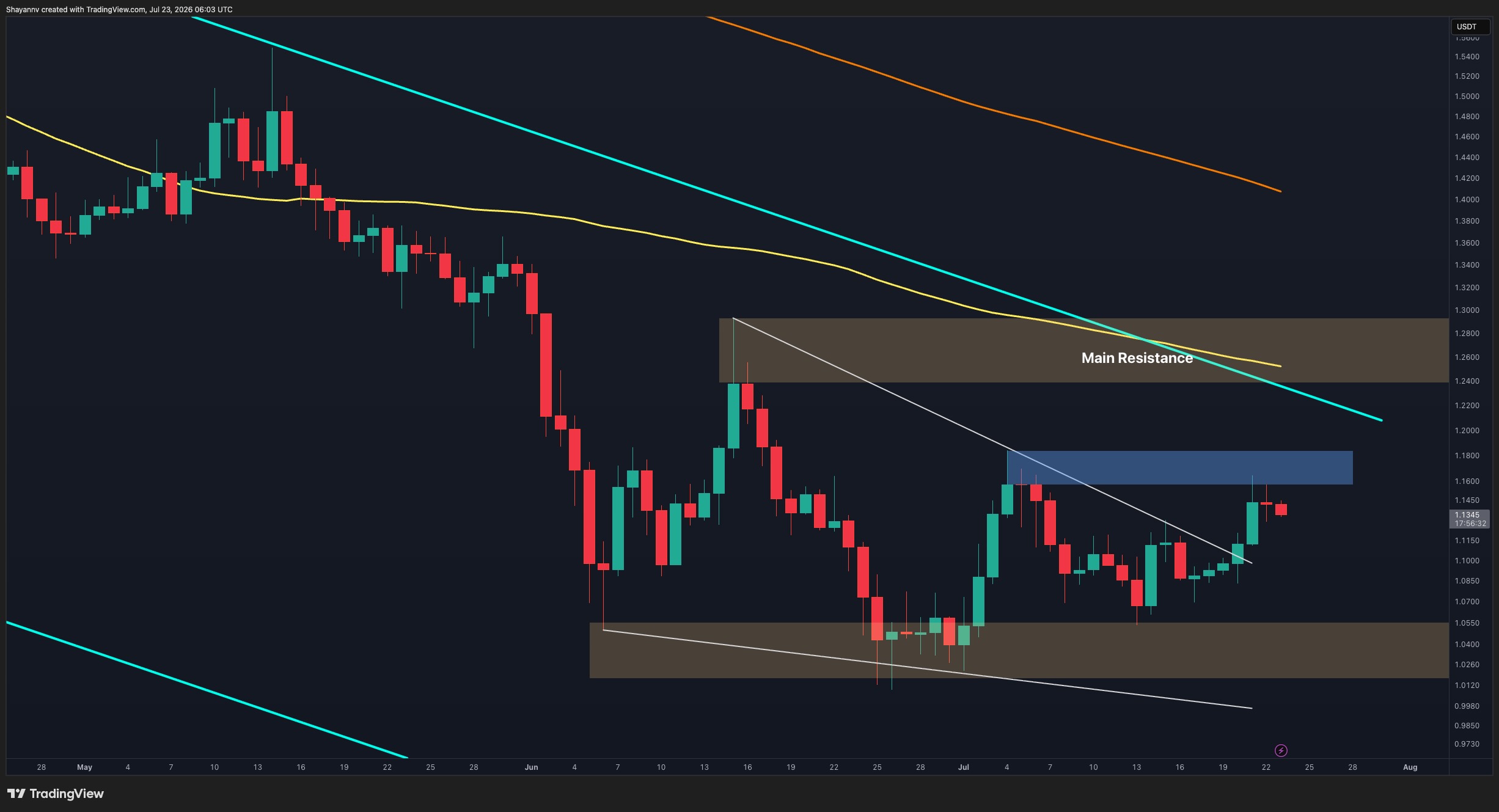
    On the daily chart, XRP continues to trade within a clearly defined long-term descending channel. Although the recent rebound has pushed the asset away from the $1.02 to $1.05 demand zone, the overall structure still favors sellers as long as XRP remains below the channel’s upper boundary and key moving averages.

    The immediate obstacle lies within the $1.24 to $1.29 resistance area, where the upper channel boundary intersects with the 100-day moving average. This confluence of technical indicators makes this zone particularly crucial; a rejection here would serve to reinforce the prevailing downtrend. A successful breach of this region would then bring the 200-day moving average into focus, but buyers must first establish a foothold above the current resistance cluster for a more positive outlook to emerge.

    On the downside, the $1.02 to $1.05 demand zone remains the primary support level. A failure to hold this area could see momentum shift back towards the broader bearish trend.

    Short-Term Outlook Offers Glimmer of Hope

    The 4-hour chart presents a more constructive short-term scenario. XRP has successfully reclaimed a descending trendline that had capped its price action throughout July and is now consolidating just below the $1.16 to $1.18 supply zone. This resistance has repeatedly thwarted bullish attempts in recent weeks, making it a pivotal level to watch. A decisive move above $1.18 could potentially propel the price towards the daily resistance zone of $1.24 to $1.29. Conversely, another rejection at this level would likely lead to a retest of the broken trendline as initial support.

    As long as XRP maintains its position above the reclaimed trendline, buyers hold a modest short-term advantage. However, the broader trend is expected to remain neutral to bearish until the price can establish acceptance above the overhead resistance cluster.

  • UN: Southeast Asian Scam Networks Swindle $114 Billion Annually

    UN: Southeast Asian Scam Networks Swindle $114 Billion Annually

    Southeast Asia’s Scam Industry Evolves into Vast Criminal Network, UN Reports

    Southeast Asia’s burgeoning scam industry has coalesced into a single, interconnected criminal economy, with its financial losses now rivaling the economic output of entire nations, according to a report released Tuesday by the United Nations.

    The UN Office on Drugs and Crime (UNODC) detailed a “fundamental” restructuring of the region’s criminal underworld. Syndicates, once confined by geography and specialization, have merged into a transnational network. These groups now offer a suite of services—including money laundering, fraud, human trafficking, and data harvesting—to one another, operating on shared infrastructure, the report found.

    Technology is rapidly transforming the operational models of transnational organized crime, a shift most starkly evident in Southeast Asia. The latest UNODC threat assessment report highlights the pervasive influence of cyber scams, synthetic drug production, and human trafficking.

    Delphine Schantz, UNODC Regional Representative for Southeast Asia and the Pacific, described the model as akin to “corporate franchising,” with specialized departments for money laundering, human trafficking, and data harvesting integrated into a unified, service-based network.

    The combined losses from scam offenses across East Asia, Southeast Asia, Australia, and New Zealand were estimated to be between $88.3 billion and $114.1 billion in 2025 alone. This figure, the UNODC noted, “outstrips the GDP of several countries in the region.” A significant portion of these illicit funds moves through cryptocurrency, with investment and romance scams, often termed “pig butchering,” laundering proceeds on-chain. The UNODC warned that regional police forces still lack the necessary training to trace these funds in the “new crypto context.” Schantz emphasized that seizing proceeds is now crucial, as “disruption alone does not work.”

    Instead of smuggling physical contraband, criminal groups are increasingly focused on selling cyber-enabled fraud, criminal infrastructure, and platform-based financial settlements that leave minimal traces and are difficult to attribute. This elaborate system is fueled by forced labor on a global scale, with individuals from at least 80 countries identified within scam compounds. The report also indicated that scam networks are actively broadening their recruitment efforts, placing advertisements that target individuals with European and North American language skills.

    The report specifically flags the rise of generative AI, deepfakes, and near-automated fraud. It also noted a 42% year-on-year increase in “malvertising”—the hijacking of legitimate ad networks to spread malware—in 2025. Criminal operations are increasingly “decoupled” from local telecommunications infrastructure, utilizing satellite internet services like Elon Musk’s Starlink to operate from remote locations, the report stated.

    Beyond scams, the UNODC report sheds light on other rapidly expanding criminal markets. It identifies the Sulu and Celebes Seas—the maritime region encompassing Indonesia, Malaysia, and the Philippines—as an emerging smuggling corridor. Furthermore, the report warns that criminals are increasingly employing gamification tactics in online gambling to attract younger users.

    UNODC Executive Director Monica Juma underscored the “flexible, persistent, and adaptable” nature of these networks, which can shift across borders and resume operations even after law enforcement crackdowns. This adaptability, she noted, makes international cooperation essential for their dismantling.

    Law enforcement agencies worldwide are intensifying their response to this growing threat. U.S. prosecutors recently seized over $25 million in cryptocurrency linked to investment and romance scams routed through the region, while Interpol has designated these compound networks as a global threat. The human cost is also becoming increasingly apparent, with Amnesty International documenting a humanitarian crisis as workers flee compounds in Cambodia. This same country was the site of the arrest of alleged Prince Group boss Chen Zhi, pending extradition to China, in a case that involved one of the largest Bitcoin seizures on record.

  • EU Expands Sanctions to Target Entire Crypto Jurisdictions

    EU Expands Sanctions to Target Entire Crypto Jurisdictions

    The European Union has enacted its 21st sanctions package against Russia, significantly expanding its powers to target entire cryptocurrency jurisdictions deemed complicit in facilitating Russian financial transactions. This move allows the EU to block crypto services from a nation or jurisdiction if it is viewed as a hub for laundering Russian financial transactions, a development that broadens the scope of sanctions beyond individual entities.

    Under the new package, EU persons are barred from transacting with 11 unnamed crypto operators and 94 banks and financial institutions. While the identities of the 11 crypto operators have not been disclosed, the EU has indicated that they primarily operate in Belarus and Nigeria, allegedly acting as conduits for funneling money between Russia and countries subject to sanctions. This represents a shift from previous measures, which were limited to sanctioning individual firms.

    In addition to the crypto-related measures, the sanctions package designates 32 Russian banks and the Moscow stock exchange, leading to the freezing of their assets held within the EU and a ban on transactions. The package also targets vessels within Russia’s shadow fleet for the first time. European Commission President Ursula von der Leyen reported that oil cap prices are frozen at $44.10 a barrel, aiming to prevent Russia from benefiting from market fluctuations. Brussels also plans to ban Russian combatants from entering the EU.

    These measures follow earlier actions targeting the digital ruble space. Earlier this year, the A7A5 stablecoin, which reportedly served as a bridge between sanctioned exchanges Garantex and Grinex, was designated. The RUBx token and the digital ruble were also included in previous sanctions.

    The United Kingdom has also taken parallel action, sanctioning the HTX (formerly Huobi) exchange in May due to alleged ties to A7 and Garantex. A report by Global Ledger indicated that HTX processed approximately $21 billion in high-risk crypto transactions over the past five years, with nearly $8 billion linked to Russian actors and darknet markets. The specific nature of these alleged ties and transaction volumes remains a point of scrutiny.

    The EU’s expanded authority over crypto jurisdictions is seen as a significant development in the ongoing efforts to combat sanctions evasion. However, uncertainties remain regarding the specific identities of the 11 crypto operators and the precise details of the targeted ‘shadow fleet’ vessels. The effectiveness of these broader sanctions in disrupting Russian financial flows and weakening its economic capacity will be a key area for future observation.

    Why This Matters

    The materials describe a narrow update: The EU’s 21st sanctions package bars EU persons from transacting with 11 unnamed crypto operators and 94 banks and financial institutions. The names of the 11 unnamed crypto operators have been withheld.

    Broader Context

    Source materials place the factual news in this context: The European Union agreed on Thursday to its 21st sanctions package against Russia.

  • Bitwise CIO Identifies Potential Drivers for Future Digital Asset Market Cycles

    Bitwise CIO Identifies Potential Drivers for Future Digital Asset Market Cycles

    The next digital asset market cycle may be driven by the convergence of traditional and onchain finance, rather than speculative demand, according to Bitwise Chief Investment Officer Matt Hougan. This thesis may reflect changing conditions from previous cycles fueled by speculative interest to one built on “real financial activity and revenue,” which could lead to a larger, albeit potentially slower and less volatile, market expansion.

    Hougan argued that this evolving landscape could be characterized by several key onchain financial activities. These include the increased use of stablecoins, the tokenization of traditional assets, the implementation of 24/7 trading, instant settlement capabilities, and the growth of institutional decentralized finance (DeFi) platforms. This contrasts with earlier market cycles that were primarily propelled by speculative demand.

    The article notes that the idea of revenue and crypto rails driving the next cycle is not entirely new, and institutional involvement in digital assets is also a concept that has been discussed for some time. However, it highlights the significance of the CIO of Bitwise formally presenting this thesis, covering these two factors.

    Hougan framed the opportunity within the digital asset space as two distinct “lanes.” The first, referred to as the “Hyperliquid Lane,” focuses on protocols that create demand for their own tokens, addressing a historical challenge where applications generated fees and volume without necessarily driving token value. The second lane, the “Robinhood Lane,” represents the entry of traditional finance players into the digital asset ecosystem. Examples cited include Citadel’s involvement with Crypto.com, Morgan Stanley’s presence on E*TRADE, the DTCC’s work on tokenization, and Robinhood’s continued engagement in the digital asset space.

    While the analysis and opinions presented are attributed to the author of the original piece and do not necessarily reflect the views of Decrypt, the core argument from Hougan may reflect changing conditions in the underlying forces expected to shape future digital asset market performance. The formal articulation of these drivers by a prominent figure like Hougan provides a structured outlook for the market’s potential evolution.

    It remains uncertain whether Hougan’s prediction about the drivers of the next market cycle will suggest correct. However, the thesis presented offers a framework for understanding potential future market dynamics, emphasizing a move towards more integrated and revenue-driven onchain financial activities.

    Broader Context

    Morning Minute is a daily newsletter written by Tyler Warner.

  • Arbitrum Perp DEX AFX Loses $24M to Hacker, Offers 30% Bounty

    Arbitrum Perp DEX AFX Loses $24M to Hacker, Offers 30% Bounty

    DeFi Protocol Drained of $24 Million in Bridge Exploit

    AFX Trade, a decentralized perpetuals exchange operating on the Arbitrum network and settling in the stablecoin USDC, was drained of $24.15 million on Wednesday due to an exploit targeting a bridge managed by the protocol, according to security firm Blockaid.

    In a statement, AFX Trade indicated that the precise method of the attack is still under investigation. On-chain analysis reveals that the perpetrator bridged the stolen USDC to the Ethereum network and subsequently exchanged it for 12,468 ETH, which is now held in a single wallet, PeckShield reported.

    AFX Trade acknowledged an incident involving its USDC custody bridge on Arbitrum. “Upon detecting the incident, we immediately suspended bridge operations and initiated our incident response procedures. Our engineering and security teams are actively investigating the root cause,” the protocol stated on X (formerly Twitter) on July 23, 2026.

    Arbitrum moved swiftly to distance itself from the incident. Co-founder Steven Goldfeder clarified that the network’s native bridge “has not been hacked or exploited in any way,” emphasizing that the compromised transaction originated from a third-party protocol. A breach of Arbitrum’s core bridge would have wider implications across the entire layer-2 network, whereas a compromised application built on top represents a more contained failure.

    AFX Trade suspended its bridge operations, stating that the damage appeared “isolated to the AFX-operated custody bridge.” The protocol stressed that its trading infrastructure, mainnet, and the Arbitrum network itself remained unaffected.

    The firm added that it was collaborating with ecosystem partners and security firms to track the stolen assets. Hours later, AFX’s head of growth, Ken C, publicly offered the attacker a deal: return 70% of the stolen funds and keep the remaining 30% as a “white hat bounty.” Such public overtures have become a common tactic in cryptocurrency exploits, mirroring a similar attempt by Solana’s Drift Protocol following its $285 million hack in April.

    This theft marks another significant loss in a challenging year for decentralized finance (DeFi), which has seen over $840 million lost to hacks in 2026. The incident also hits close to home for the Arbitrum ecosystem, as Ostium, another perpetuals venue on the network, was drained of $18 million just a week prior due to a compromised oracle key.