Category: Uncategorized

  • Circle Acquires IBM Blockchain Patents, Becomes Top US Holder

    Circle Acquires IBM Blockchain Patents, Becomes Top US Holder

    Circle, the company behind USDC, a digital dollar utilized by millions globally for payments, savings, and international transfers, has acquired IBM’s extensive blockchain patent library, a collection built over more than a decade. The deal, announced on July 27, transfers over 1,000 blockchain patents issued by IBM worldwide to Circle.

    Patents grant holders exclusive legal rights over specific inventions. For instance, a patent on a method for processing transactions on a blockchain—a distributed digital ledger where cryptocurrency activities are permanently recorded and immutable—allows the holder to control its usage and terms. IBM had been accumulating such leverage since its significant push into enterprise blockchain in the mid-2010s.

    By December 2025, patent analytics firm PatSnap had recognized IBM as holding 790 U.S. blockchain patents, more than any other American company, with Bank of America a distant second at approximately 200. Circle, which secured its inaugural patent in December 2023 for parallel blockchain data processing—a technique for simultaneously verifying multiple transaction groups—has now ascended to the top of U.S. rankings from a near-zero position.

    “The portfolio comprises over 680 patent families and nearly 1,000 issued patents worldwide, spanning foundational blockchain technology, banking, financial services, insurance, enterprise infrastructure, supply chain verification, and secure cloud operations,” Circle stated in its official announcement.

    Circle intends to integrate these patents across its entire operational framework. “The expanded IP position directly supports Circle’s foundation for building the internet financial system, including USDC, Circle Payments Network, Arc, and a growing suite of onchain products and agentic financial tools,” the company elaborated. Arc is Circle’s proprietary payment-focused blockchain designed for institutional finance, while agentic tools refer to AI-powered software capable of autonomously executing financial transactions without human intervention at each step.

    “Intellectual property is critical to advancing our mission and expanding adoption of onchain infrastructure,” said Sarah Wilson, Circle’s General Counsel and Corporate Secretary. “IBM has been a pioneer in technological innovation, and this acquisition expands Circle’s ability to advance the infrastructure that powers global, internet-native finance.”

    Prior to this acquisition, Circle had become a member of the LOT Network, a consortium that protects its members from lawsuits by patent trolls—entities that acquire patents solely to extract settlement fees from other companies without developing their own innovations. With nearly 1,000 patents now under its belt, Circle possesses sufficient intellectual property to pursue an offensive strategy if it chooses, though the company has not disclosed its intentions.

    IBM is also a confirmed partner in Open Standard, the consortium behind Open USD, a stablecoin pegged 1:1 to the U.S. dollar. Open USD launched on June 30 with over 140 backers, including major players like Visa, Mastercard, Google, BlackRock, Stripe, and Coinbase. The stablecoin’s model distributes reserve income directly to its partner distributors, a strategy designed to potentially impact the revenue streams that Circle relies upon.

    IBM divested its foundational blockchain intellectual property to Circle while simultaneously endorsing a stablecoin aimed at capturing market share from USDC. Circle’s shares (CRCL) saw a 2.57% increase on Monday following the announcement.

  • Ripple Expands to Full-Stack Institutional Digital Asset Infrastructure Platform

    Ripple Expands to Full-Stack Institutional Digital Asset Infrastructure Platform

    Ripple has evolved beyond its origins as a cross-border payments company to establish itself as a comprehensive digital asset infrastructure platform for institutions. This strategic expansion integrates a suite of services, including custody, stablecoins, treasury management, and institutional trading, with the aim of simplifying operations for financial institutions by providing a single, consolidated provider.

    Ripple SVP Jack McDonald informed Grayscale Research that the company has significantly broadened its scope. “In 2013, @Ripple was just a payments company. Today it spans custody, payments, native stablecoins, treasury management, and prime brokerage, all under one roof,” McDonald stated. This transformation has been fueled by both internal product development and strategic acquisitions, notably Standard Custody & Trust Company and Hidden Road, which have enhanced Ripple’s capabilities in custody and institutional trading, respectively.

    The company is now focusing on large financial institutions, including banks, fintechs, payment firms, and asset managers, that require regulated, enterprise-grade infrastructure. McDonald indicated that this institutional focus guides every major product launch and acquisition. Ripple’s current platform offerings include digital asset custody, the U.S. dollar-backed stablecoin RLUSD, treasury management, and institutional trading infrastructure.

    Regarding RLUSD, McDonald characterized it as infrastructure designed for enterprise payment and treasury workflows, rather than a market share play, with Ripple prioritizing practical use cases over rapid supply growth. This approach aligns with the company’s broader institutional strategy.

    Ripple also highlighted its extensive regulatory compliance, reporting over 60 regulatory licenses, registrations, and approvals globally. This established regulatory framework is positioned as increasingly valuable amid evolving digital asset regulations, appealing to banks and regulated financial firms.

    Furthering its long-term development, Ripple invests in blockchain research through its University Blockchain Research Initiative, a program involving over 60 academic partners worldwide. This initiative explores blockchain technology, tokenization, artificial intelligence, and post-quantum cryptography.

    Despite this comprehensive expansion, challenges persist. The successful integration of Standard Custody and Hidden Road into a unified platform is anticipated to require time, and institutions will ultimately evaluate Ripple based on its operational performance. Key indicators for Ripple’s success will include RLUSD adoption, the seamless integration of its acquisitions, and the growth of its enterprise product offerings.

    The institutional demand for blockchain-based financial services continues to grow across the industry, presenting opportunities for Ripple while simultaneously intensifying competition. Ripple’s strategy aims to address a common obstacle in institutional crypto adoption: the reliance on multiple, disparate providers for custody, liquidity, stablecoin infrastructure, and execution services.

    Why This Matters

    The materials describe a narrow update: Ripple has evolved from a cross-border payments company into a platform offering institutional digital asset infrastructure, including custody, stablecoins (RLUSD), treasury management, and trading services. The successful integration of Standard Custody and Hidden Road into a seamless platform will take time.

    Broader Context

    Source materials place the factual news in this context: Ripple SVP Jack McDonald told Grayscale Research that the company has moved well beyond its origins as a cross-border payments provider.

  • NOWPayments and BlockSec Release Checklist to Bolster Crypto Payment Security

    NOWPayments and BlockSec Release Checklist to Bolster Crypto Payment Security

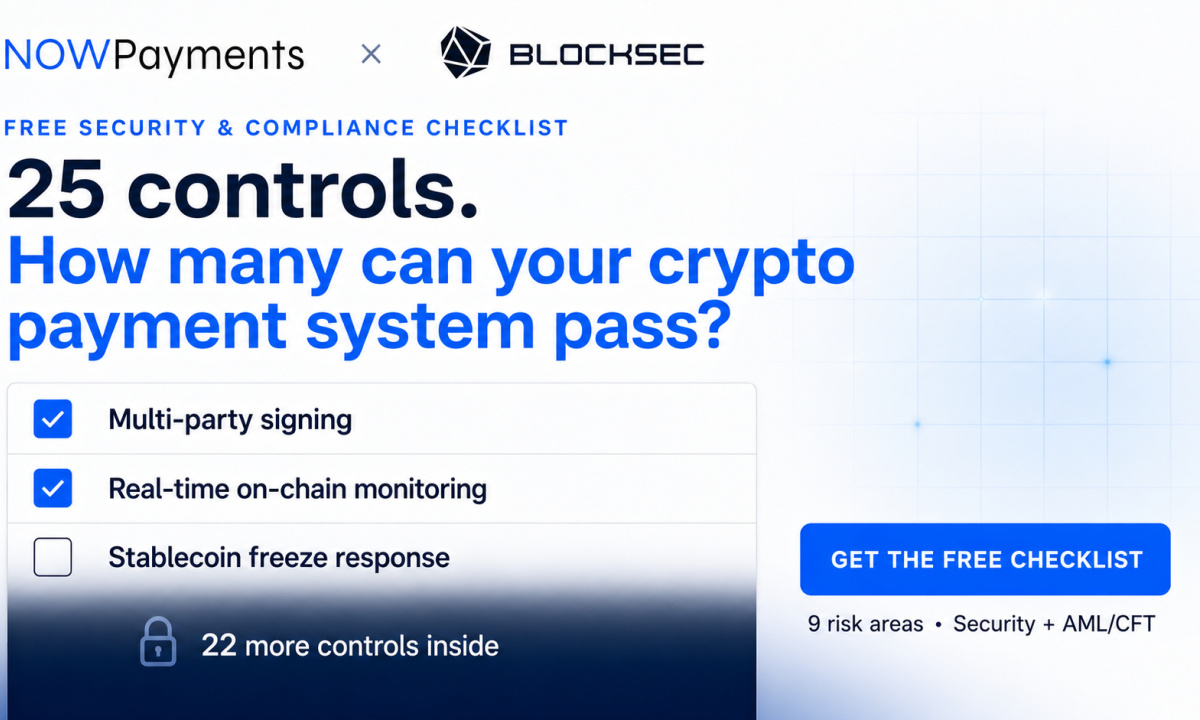
    NOWPayments and BlockSec have jointly released a free checklist designed to enhance the security and technical compliance of cryptocurrency payment systems. Published on July 27th, 2026, the resource offers businesses a structured framework for identifying and addressing potential control gaps.

    The release addresses the growing need for robust security in the cryptocurrency payment landscape. As digital transactions become more prevalent, businesses face risks from inadequate security measures, such as weak key management or insufficient compliance checks. This checklist aims to mitigate these concerns.

    Featuring 25 controls across nine security and technical compliance categories, the checklist empowers businesses to pinpoint control deficiencies, assign ownership, and develop actionable improvement steps. According to NOWPayments and BlockSec, the tool translates broad security principles into specific, implementable checks for security, operations, compliance, and product teams.

    This educational resource is targeted at merchants, marketplaces, gaming operators, SaaS companies, and Web3 platforms. It can be used during the initial setup of crypto payments, for regular system reviews, or as part of vendor assessments, aiming to standardize security reviews.

    NOWPayments is a global crypto payment gateway supporting over 350 cryptocurrencies and more than 30 stablecoins. BlockSec specializes in blockchain security and compliance. Their collaboration seeks to provide practical guidance for strengthening crypto payment infrastructure. The checklist is explicitly an educational tool, not a certification or legal advice.

    By providing a consolidated record of controls, evidence, ownership, and next steps, the checklist fosters cross-departmental understanding. This approach is intended to support the secure growth of crypto operations without introducing undue complexity. The guide is particularly beneficial for companies already accepting crypto, preparing to launch, or reassessing their payment systems.

    Complementing its security focus, NOWPayments also offers payout services, including zero-fee payouts to ChangeNOW Pro wallets, which can reduce operational costs and manual effort.

    Why This Matters

    The materials describe a narrow update: NOWPayments and BlockSec have published a free checklist containing 25 controls across nine security and technical compliance categories for crypto payment systems. The checklist turns broad security principles into checks that security, operations, compliance, and product teams can work through together.

    Broader Context

    Source materials place the announcement in this context: Crypto payments are easy to turn on. What’s hard is keeping the whole payment flow safe from key compromise, suspicious transactions, account takeover, or a stablecoin freeze.

  • Robinhood Tokenized Stocks Surge 500%

    Robinhood Tokenized Stocks Surge 500%

    Robinhood Chain Sees Surge in Tokenized Stocks Amidst Shifting Investor Interest

    Tokenized real-world assets, specifically stock shares trading on the blockchain, have experienced a dramatic surge on Robinhood Chain, increasing approximately fivefold in less than two weeks to reach around $70 million.

    Following the launch of Robinhood Chain on July 1, the platform was initially dominated by memecoins, leading to speculation that the infrastructure investment was primarily attracting speculative trading. However, this trend appears to be shifting. A dozen tokenized stocks are now each recording daily trading volumes exceeding $500,000, with five surpassing the $1 million mark. GameStop leads this segment with $26.6 million in daily volume, followed by Nvidia at $14 million and SpaceX at $6.4 million.

    The broader Robinhood Chain ecosystem has also seen rapid expansion. Total value locked (TVL) has roughly tripled since mid-July, now standing at approximately $312 million. The chain is processing over $600 million in daily decentralized exchange (DEX) volume and has logged more than 138 million transactions in the past 30 days, positioning it among the most active networks in the cryptocurrency space. Specifically concerning tokenization, over 100 assets have been tokenized, with the total value of real-world assets (RWAs) approaching $25 million. Daily trading volumes for these tokenized assets have surged from around $5 million per day to $60 million per day, representing the most significant growth story on the platform.

    This development is particularly timely as Robinhood is scheduled to report its earnings this week. CEO Vlad Tenev will be addressing Wall Street analysts shortly after this data emerged, providing him with a strong incentive to highlight these figures. Tenev has been a vocal proponent of the chain, from announcing “Robinhood Summer” to fueling the memecoin frenzy. Tokenization now presents a strategic narrative that can justify the platform’s development to shareholders. Investors can anticipate Tenev to emphasize the RWA and tokenized equity numbers.

    The key question for the market is whether Robinhood’s stock (HOOD) is currently reflecting this growth and how Tenev will frame these developments, potentially with further announcements. The prevailing sentiment suggests that the growth may not yet be fully priced into the stock, with the upcoming earnings call expected to provide clarity.

  • Coinbase CEO Brian Armstrong: Crypto and AI Are Complementary, Not Competing

    Coinbase CEO Brian Armstrong: Crypto and AI Are Complementary, Not Competing

    Coinbase CEO Brian Armstrong has characterized the trend of cryptocurrency firms pivoting to artificial intelligence (AI) as “zero-sum, scarcity thinking.” Instead, he argues that these two technologies are complementary, with crypto poised to provide essential financial infrastructure for AI agents.

    Armstrong’s perspective emerges as a counterpoint to a reported industry trend where crypto companies are reportedly shifting their focus to AI. He contends that the rise of AI actually enhances the importance of crypto, viewing it as a foundational technology similar to electricity or the internet. According to Armstrong, AI agents will require their own financial infrastructure because traditional banking systems are ill-suited for the frequent, programmable transactions they are expected to conduct.

    He elaborated that AI agents are anticipated to engage in financial activities such as trading, managing project funds, and offering financial advice. For these functions, they will need “real-time programmable money,” a role crypto can fulfill. Coinbase’s USDC stablecoin is reportedly powering the “vast majority” of these agentic payments.

    Coinbase is actively positioning itself at the nexus of AI and crypto, a strategy Armstrong has termed ‘AiFi.’ This involves developing AI capabilities in parallel with blockchain technology. The company’s contributions to the x402 protocol and its operation of the Base blockchain exemplify this dual focus. Armstrong envisions AI providing intelligence and crypto offering the necessary financial rails for their synergistic operation.

    This strategic direction follows a significant restructuring at Coinbase earlier this year, which included a 14% staff reduction. Armstrong described this reorganization as an effort to rebuild Coinbase to be “lean, fast, and AI-native.” This internal adjustment is presented as part of the company’s broader strategy to integrate AI and leverage the synergy between AI and crypto.

    Armstrong’s viewpoint suggests a future where AI agents operate within a crypto-enabled financial ecosystem, thereby driving demand for the infrastructure that companies like Coinbase are developing. This contrasts with the notion that companies must choose between focusing on AI or crypto, proposing instead a path of integration and mutual enhancement.

    Why This Matters

    The materials describe a narrow update: Coinbase CEO Brian Armstrong expressed his view that crypto companies should not pivot to AI, but rather see them as complementary technologies. Armstrong views crypto and AI as complementary layers, with AI providing intelligence and crypto providing the financial rails.

    Broader Context

    Source materials place the factual news in this context: Armstrong is responding to a wave of crypto firms reorienting around AI.

  • Dogecoin Bulls Target $0.10 Breakout

    Dogecoin Bulls Target $0.10 Breakout

    Dogecoin Hovers Near Key Support as Bulls Eye Potential Breakout

    Dogecoin is currently trading just below $0.073, marking a modest 1% gain for the week. However, the immediate price point is less critical than the sustainability of the $0.07 level, which could either solidify as support or re-emerge as resistance. A weekend rally saw Dogecoin briefly surpass $0.073 before momentum waned.

    Market sentiment, as reflected by Polymarket, suggests a low probability of a significant Dogecoin breakout before the end of July, a stark contrast to odds just weeks prior. This rapid shift underscores a growing caution among traders, even amidst the recent price uptick.

    Factors Influencing the Market

    The weekend’s price action was partly attributed to easing geopolitical tensions, which spurred a broader “risk-on” sentiment in the cryptocurrency market. Analyst Ali Martinez identified a buy signal for Dogecoin with a target of $0.16, while TradingView’s MACD indicator also flipped to a buy signal for the DOGE/USD pair.

    Despite these positive technical indicators, 24-hour trading volumes have remained between $670 million and $950 million. While activity has improved, it has not reached the surge levels typically associated with sustained breakouts.

    The trajectory of Dogecoin, whether it is building a foundation for further gains or forming a local peak, will largely depend on the overall sentiment within the altcoin market. For now, traders are closely monitoring the $0.07 support level to see if it can withstand renewed selling pressure.

    Technical Analysis and Price Levels

    Dogecoin’s current price is situated in a contested zone. Multiple analyses highlight $0.072 as a crucial support level for bulls. A breach below this point would weaken the short-term technical structure. Resistance around $0.075 has consistently capped recent rallies, leading to pullbacks after testing this area. Dogecoin’s market capitalization is approximately $11.3 billion, positioning it among the largest cryptocurrencies by market value.

    Analyst Peter Zhang describes the current setup as a “coiled spring” between support and resistance. He notes a neutral Relative Strength Index (RSI) and weak near-term momentum but maintains a target of $0.16 should buyers regain control. The MACD buy signal from TradingView adds a constructive data point, though analysts caution that technical signals without robust volume may not be definitive confirmations.

    Bullish and Bearish Scenarios

    The bullish outlook for Dogecoin hinges on its ability to defend support around $0.072 and reclaim $0.075 with significant trading volume. Such a development could bolster momentum and keep the path towards Martinez’s $0.16 target open.

    The base case scenario anticipates continued consolidation around current levels until a new macroeconomic or social catalyst emerges. On the downside, a decisive break below $0.072 accompanied by increasing volume would signal a bearish shift in the market structure. Analysts also warn that even a successful breakout would require sustained buying pressure to prevent a repeat of previous failed rallies.

    Polymarket data continues to reflect a cautious outlook, with the broader market unconvinced of an imminent major breakout. While technical buy signals are present, traders are likely awaiting stronger volume confirmation before treating them as more than preliminary indicators. Dogecoin has a history of generating signals that ultimately fade without the social and retail momentum that fueled its significant runs in 2021.

    Emerging Infrastructure Projects

    For traders observing Dogecoin’s consolidation at a resistance ceiling, the risk-reward calculus shifts. The potential for a $0.10 Dogecoin, with a market cap around $19 billion, presents a different investment profile compared to early-stage infrastructure projects in their presale phases. This is where projects like LiquidChain ($LIQUID) enter the discussion.

    LiquidChain is a Layer 3 infrastructure project founded on the principle that fragmentation across Bitcoin, Ethereum, and Solana ecosystems represents a structural inefficiency that diminishes value, rather than merely a user experience inconvenience.

    Its Unified Liquidity Layer aims to consolidate liquidity from BTC, ETH, and SOL into a single execution environment. Features include Single-Step Execution, Verifiable Settlement, and a Deploy-Once Architecture, enabling developers to access all three ecosystems without the need for redeployment.

    As of the latest update, the LiquidChain presale has raised $920,000, with the current price per $LIQUID at $0.01484. This precise pricing is intentional, and the project’s growth trajectory is reportedly building momentum. For investors evaluating early-stage infrastructure plays against memecoins consolidating at resistance, the entry mathematics are considered noteworthy.

  • ETH Price Surges Past $2,000 as Unstaking Queue Empties

    ETH Price Surges Past $2,000 as Unstaking Queue Empties

    Ethereum’s validator exit queue has fallen to zero, a dramatic turnaround from bearish price predictions made less than a year ago. Ether (ETH) is currently trading around the $1,950 mark, attempting to reclaim the crucial $2,000 resistance level. While the price chart has yet to fully reflect it, staking data tells a compelling story that could shape the cryptocurrency’s recovery in the coming sessions.

    Validator Queue Clears, Activation Queue Swells

    Data from the Ethereum validator queue reveals that the exit queue has completely cleared. This comes after it swelled to approximately 2.6 million ETH last year, a period when validators faced withdrawal wait times of around 45 days. The situation has now reversed: over 2.5 million ETH is currently waiting to be staked, resulting in an activation delay of nearly 44 days.

    Staked ETH Reaches Record High

    The total amount of ETH staked has climbed to about 40.9 million coins, representing roughly 33.6% of the circulating supply. This marks the highest staking ratio in Ethereum’s history. With nearly 887,000 active validators now securing the network, the demand clearly favors long-term participation over exiting stakes.

    Staking Dynamics Could Bolster Price

    These staking dynamics have the potential to influence ETH’s price. A growing portion of Ether remains locked in staking, thereby reducing the amount readily available for trading. Simultaneously, the cleared exit queue eliminates a significant bearish concern from last year, when traders worried about a flood of unstaked ETH hitting exchanges. If demand remains robust, this supply dynamic could continue to support Ethereum’s recovery.

    ETH Consolidating Near Key Levels

    Ether is currently consolidating near the $1,970 level, having recovered from recent lows. Intraday trading has fluctuated between approximately $1,880 and $1,970, indicating a persistent battle between buyers and sellers. The price action suggests a contested zone rather than a clear directional trend.

    Technical Outlook Remains Defined

    The technical picture for ETH remains straightforward. The cryptocurrency continues to trade within a well-defined range of $1,900 to $2,200. Immediate resistance is situated around $2,000, followed by the $2,080 to $2,120 area. A sustained move above $2,200 would bolster bullish momentum, while $2,400 is widely viewed by traders as the level that would confirm a lasting trend reversal.

    Bullish Scenario Hinges on Key Levels

    The bullish scenario for ETH is straightforward: it needs to reclaim and hold the $2,000 level before pushing through the $2,080 to $2,120 resistance zone. If buyers maintain their momentum, the next target would be $2,200, with $2,400 serving as the major breakout level. The recent staking queue data continues to support this longer-term outlook.

    Consolidation Remains the Base Case

    The base case, however, still favors consolidation. ETH could spend several more sessions trading between $1,900 and $2,200 before establishing a clear direction. Nevertheless, a daily close below $1,900 would shift focus to the support area between $1,850 and $1,800. A break below $1,800 would weaken the short-term outlook, even if the long-term thesis remains intact.

    Funding Rates and Derivatives to Watch

    Funding rates and derivatives positioning will be key signals to monitor alongside spot price action. Together, these indicators should reveal whether buyers possess sufficient conviction to break through resistance or if another rejection is imminent.

    Long-Term Math vs.

    Near-Term Opportunities

    While ETH at $2,000 presents a compelling long-term mathematical case, the potential upside from current prices to $7,500 represents a roughly 3.5x move over an estimated 18 months of volatility. Traders seeking asymmetric exposure within the same timeframe often look to earlier stages of the risk curve, where entry prices and market caps have not yet fully priced in the thesis.

    Maxi Doge Enters Presale

    Maxi Doge ($MAXI), a meme token built around a high-conviction trading community, has launched its presale on Ethereum (ERC-20). The project’s mascot is described as a “240-lb canine juggernaut embodying 1000x leverage trading mentality.”

    The current presale price is set at $0.0002831, with $4.8 million raised to date. The project features dynamic APY staking, exclusive trading competitions for holders with leaderboard rewards, and a Maxi Fund treasury designated for liquidity and partnerships.

    For traders who size appropriately and track the presale-to-listing cycle, the early entry price and community mechanics of Maxi Doge warrant research before the current presale stage concludes.

  • Storj Files Chapter 11 Bankruptcy; STORJ Token Drops 17%

    Storj Files Chapter 11 Bankruptcy; STORJ Token Drops 17%

    Storj Files for Chapter 11 Bankruptcy as STORJ Token Plunges 17%

    Decentralized cloud storage provider Storj Labs has voluntarily filed for Chapter 11 bankruptcy protection in the U.S. Bankruptcy Court for the Northern District of West Virginia. The company aims to restructure its finances while ensuring its business operations continue without interruption.

    Accelerated Financial Reorganization

    In an open letter to its community, Storj’s management and board characterized the move as an accelerated financial reorganization. This process is designed to address obligations that largely predate the company’s current business strategy. Storj stated that it has already reduced its operations, implemented tighter cost controls, and operates with a leaner team, while continuing to receive support from Inveniam. However, the company acknowledged that its historical liabilities could not be resolved through business growth alone.

    Transparent Framework for Obligations

    The company believes the Chapter 11 process offers a transparent framework for resolving these obligations and will provide the necessary time to present a long-term business plan. Storj also sought to reassure users and token holders that its decentralized storage network remains fully operational and that the utility of the STORJ token within the network is unaffected by the bankruptcy filing.

    Token Price Reaction and Future Ownership

    Following the announcement, the STORJ token experienced a significant drop, falling by over 17% to $0.06. While the team acknowledged that trading volume has been “quiet and low” for an extended period, they declined to comment on the token’s price fluctuations during the bankruptcy proceedings.

    Storj expressed its intention for the company to ultimately be owned by those who have built and supported it, including management, its decentralized community, token holders, and other investors. As part of its planned restructuring, the company intends to propose a mechanism allowing token holders to participate in the equity of the restructured business. Specific eligibility requirements, structure, and terms are still under development and will be disclosed through the formal court process. Any proposed plan will require court approval and must adhere to legal priorities governing different stakeholder groups.

    Broader Crypto Industry Trends

    The filing occurs amidst a challenging month for the cryptocurrency industry, with several companies seeking bankruptcy protection. On July 22, Singapore-based Bitcoin mining firm Poolin and its U.S. affiliates, Lonestar Dream Inc. and Lonestar Taproot LLC, also filed for Chapter 11 protection in New Jersey. Separately, Movement Labs sought bankruptcy protection in Delaware following months of financial difficulties linked to its MOVE token launch.

    Other crypto companies have also ceased or are in the process of winding down their operations. For example, crypto derivatives exchange BitMEX announced its permanent closure on September 23, after more than 11 years in business. Shortly thereafter, BitMart revealed plans to wind down its trading operations, while DEX aggregator Odos and exchange Dango announced they would discontinue their services.

  • XRP Price Holds Steady Around $1.10 Amidst Consistent Weekly ETF Inflows

    XRP Price Holds Steady Around $1.10 Amidst Consistent Weekly ETF Inflows

    XRP’s price has remained relatively stable, trading around the $1.10 mark, despite significant net inflows into XRP spot Exchange Traded Funds (ETFs) during the week of July 20-24. This trend suggests a complex interplay of market forces, where institutional demand is being met by persistent selling pressure.

    ETF Inflows Detail Institutional Demand

    According to SoSoValue, XRP spot ETFs collectively experienced $8.15 million in net inflows over the specified trading week. Franklin Templeton’s XRPZ fund led this activity, recording $5.66 million in inflows and bringing its cumulative total to $421 million. Bitwise also contributed to the inflows, with its XRP ETF seeing $2.49 million added, pushing its total to $501 million. These figures contribute to the total net assets across XRP spot ETFs, which now stand at $997 million. Historically, cumulative net inflows for XRP ETFs have reached $1.49 billion, with current ETF assets representing approximately 1.46% of XRP’s total market capitalization.

    Selling Pressure Absorbs Inflows, Stalling Price Action

    Despite this consistent institutional accumulation, XRP’s price has shown little upward momentum, largely staying flat and trading around $1.10. Over the past seven days, XRP has seen a modest increase of roughly 1.2%. This lack of a significant price reaction to substantial inflows indicates that persistent selling is absorbing the newly introduced capital. The market setup for the upcoming week appears more nuanced than the headline inflow figures might suggest, with any potential price breakout likely dependent on buyers eventually overwhelming the existing supply.

    Market Context and Near-Term Outlook

    XRP is currently trading within a tight range. The $1.10 level is acting as immediate demand support, while $1.11 represents recent buying pressure resistance. Even with steady ETF inflows, the token has struggled to build sustained momentum. This suggests that weekly ETF inflows, amounting to approximately $8 million, may be too small to materially shift prices for an asset with XRP’s market capitalization of about $69.1 billion. A market of this scale typically requires sustained and larger institutional buying to drive a meaningful price move.

    Three scenarios are currently framing the near-term outlook for XRP. The bull case anticipates ETF assets decisively surpassing the $1 billion mark, potentially encouraging buyers to reclaim the $1.11 resistance level. The base case suggests XRP will continue trading within the $1.10 to $1.11 range, reflecting muted retail participation. Conversely, a break below the $1.10 support level could expose the psychological $1.00 level if selling pressure intensifies.

    For active traders, the demand zone around $1.10 and the resistance near $1.11 are key levels to monitor. A convincing close above resistance, accompanied by strong trading volume, would be necessary to shift the current outlook. Until such a move occurs, range trading is expected to remain the dominant theme for XRP.

    Broader Market Implications

    The consistent ETF flows do suggest that institutional capital is flowing into crypto infrastructure. However, given XRP’s substantial market capitalization, the potential for significant upside from these inflows is fundamentally different compared to early-stage crypto assets. Traders seeking asymmetric returns are increasingly looking towards other areas of the market.

    One such area of interest for traders comfortable with early-stage exposure is the infrastructure angle. Projects like LiquidChain, an L3 infrastructure project, aim to fuse liquidity from Bitcoin, Ethereum, and Solana into a single execution environment. This approach seeks to address the fragmentation issues currently impacting DeFi protocols. LiquidChain’s architecture powers features like a Unified Liquidity Layer and Single-Step Execution, targeting cross-chain coordination problems that can lead to measurable volume loss for DeFi protocols daily. The presale for LiquidChain is currently priced at $0.01484, with approximately $920,000 raised to date. For those interested in early-stage infrastructure plays, this project warrants further research.

    Why This Matters

    The materials describe a narrow update: XRP spot ETFs experienced $8. Whether buyers will finally overwhelm the persistent selling pressure to cause a sustained price breakout.

  • Crypto Market Shows Tentative Gains Amid Easing Geopolitical Tensions and ETF Inflows; ETH/BTC Ratio Offers Potential Altcoin Signal

    Crypto Market Shows Tentative Gains Amid Easing Geopolitical Tensions and ETF Inflows; ETH/BTC Ratio Offers Potential Altcoin Signal

    The cryptocurrency market is exhibiting tentative upward movement, with Bitcoin and Ethereum prices showing gains. This rally is being attributed to a confluence of factors: easing geopolitical tensions between the United States and Iran, sustained positive inflows into crypto Exchange Traded Funds (ETFs), and a strengthening ETH/BTC ratio. While these developments are being analyzed for their potential to signal a broader market recovery or the onset of an altcoin season, significant uncertainties persist regarding the sustainability of these trends.

    Geopolitical Shift and Risk Appetite
    The de-escalation of tensions between the US and Iran, marked by consecutive days without escalation, has contributed to a roughly 5% drop in oil prices. According to the article, this shift has reportedly increased investor risk appetite, potentially encouraging a rotation back into riskier assets like cryptocurrencies. Bitcoin has reclaimed the $65,000 level, and Ethereum has led gains among major coins, with a daily increase exceeding 4%.

    Institutional Demand and ETF Performance
    Institutional demand for digital assets remains a notable factor. Spot Bitcoin, Ethereum, Solana, and XRP ETFs collectively attracted $152 million in weekly inflows. This consistent institutional interest underscores a growing acceptance of cryptocurrencies within traditional financial markets.

    ETH/BTC Ratio: A Potential Altcoin Signal
    The ETH/BTC ratio has also drawn attention, climbing back toward 0.030 after breaking above a multi-month downtrend. Historically, the source states, a strengthening ETH/BTC ratio has preceded capital rotation into the wider altcoin market. However, this pattern is considered a potential signal rather than a definitive indicator of an impending altcoin season, and uncertainty remains about its predictive power.

    Market Dynamics: Liquidations and Exchange Closures
    Market activity includes the liquidation of over $200 million worth of crypto positions in the past day, with the majority stemming from short positions being forced to cover. In parallel, the cryptocurrency landscape is witnessing the winding down of operations by some exchanges. BitMart announced plans to cease operations, following other notable exits this week, such as BitMEX. The disappearance of exchanges, a pattern observed in previous market cycles following major events like Mt. Gox in 2014, BitGrail in 2018, and FTX in 2022, is being interpreted by some as a sign that the market may be moving closer to a long-term bottom, though this is not a certainty.

    Uncertainties and Outlook
    Despite these positive indicators, uncertainty persists regarding the sustainability of the current rally. It remains to be seen whether this upward movement will mark the beginning of a sustained recovery or suggest to be another short-lived bounce. The final outcome of the CLARITY Act, with potential hurdles remaining in the Senate, and any future announcements from figures like Michael Saylor also add layers of uncertainty to the market’s outlook. The source states that while the ETH/BTC ratio strengthening and exchange capitulation are observed patterns, they do not definitively suggest an altcoin season or an absolute market bottom.

    Why This Matters

    The materials describe a narrow update: The cryptocurrency market experienced a significant upswing, driven by a decrease in geopolitical tensions between the US and Iran, which coincided with lower oil prices and increased investor risk appetite. Whether the current rally will become the first chapter of a much broader recovery or another short-lived bounce.

    Broader Context

    Source materials place the factual news in this context: Traders were preparing for another round of geopolitical escalation.