Category: Uncategorized

  • Gemini AI Predicts Soaring Solana Price by 2026

    Gemini AI Predicts Soaring Solana Price by 2026

    Google Gemini AI has issued a bold price prediction for Solana, bypassing conventional analysis to pinpoint a target that has captured significant attention.

    Currently, Solana processes over 96% of global on-chain equity volume, a statistic that signifies not just market share growth, but a market that has arguably already been secured.

    Gemini projects a December 2026 price target for Solana, currently trading around $74, to reach between $180 and $220. This forecast is bolstered by substantial stablecoin liquidity, exemplified by Circle’s recent infusion of $500 million in USDC into the network.

    The network’s future development hinges on the Alpenglow upgrade, designed to dramatically increase throughput and enable high-frequency use cases on-chain for the first time. Coupled with deep institutional integration for real-world assets, Gemini’s outlook suggests Solana’s infrastructure is poised to become indispensable, moving beyond mere speculation.

    However, this optimistic scenario is contingent on a sustained macroeconomic expansion. Without a broader return of risk appetite, even dominant infrastructure assets may remain undervalued.

    Gemini’s bearish outlook, by contrast, appears to be a secondary consideration. Potential regulatory hurdles concerning ecosystem ETFs or unexpected network congestion could temper retail investor enthusiasm and push Solana’s price (SOL) into a defensive range of $45 to $55. This downside scenario is presented as a contained correction rather than a market collapse, suggesting a pause rather than a reversal.

    Market Performance and Technical Analysis

    Solana’s price closed at $74.67, down 0.78%, with the session trading between $74.12 and $75.69. While this daily movement is unremarkable, the broader chart history reveals a more compelling narrative.

    SOL reached a peak near $257 in September 2025, followed by a nearly uninterrupted decline through the February crash, falling below $80. Since that downturn, the price has spent five months consolidating within a wide range of approximately $60 to $100. Three distinct rally attempts in March, May, and July have each faltered near the $95 to $100 resistance zone.

    This repeated rejection at a specific price level suggests it has become the market’s consensus on fair value.

    Immediate support is identified at $70, followed by the June low near $60, which has held firm on two occasions. Resistance levels are stacked at $80, then $85, and finally the persistent $95 to $100 zone.

    The Relative Strength Index (RSI) offers a noteworthy observation. The RSI stands at 46.03, with its signal line at 54.63. This signal line has been on a steady ascent since the June low, closely mirroring the price recovery.

    The current divergence between the RSI and its signal line indicates a slight cooling of short-term momentum following the recent bounce. However, the upward trend of the signal line itself is a more significant indicator, reaching levels not seen since October, when SOL was trading above $200.

    For Gemini AI’s prediction of $180 to become plausible, Solana must decisively break above the $100 mark with conviction, a feat it has failed to achieve on three separate occasions since February. While the fundamental case for Solana’s infrastructure may already be established, the price action has yet to fully reflect this potential.

    The Case for Undiscovered Infrastructure Plays

    The current market environment sees major cryptocurrencies like Bitcoin, Ethereum, and XRP struggling to break through persistent resistance levels, with macro catalysts and institutional adoption timelines repeatedly pushed back. Waiting for external validation is not a viable trading strategy.

    In contrast, small-cap infrastructure projects operate under different dynamics. A market rotation that might be negligible for larger assets can lead to significant repricing for undiscovered projects. The opportunity lies in the discrepancy between an asset’s intrinsic value and its current market valuation, a gap that closes once discovery occurs.

    Multi-chain fragmentation remains one of the most costly and unresolved challenges in decentralized finance. Bitcoin, Ethereum, and Solana currently function as isolated ecosystems with no native interoperability or shared architecture. Every transfer of value between these networks incurs fees, slippage, and potential transaction failures.

    LiquidChain aims to eliminate these cross-chain costs by unifying these three networks within a single execution environment, offering single deployment, complete ecosystem access, and zero transaction taxes. Gemini AI’s analysis supports this vision.

    The LiquidChain presale is currently priced at $0.01454, having raised just over $900,000. This combination of early stage and undiscovered potential is a rare and fleeting opportunity.
  • Hardware Wallet Security Debated as Investigator Questions Self-Custody Alternatives

    Hardware Wallet Security Debated as Investigator Questions Self-Custody Alternatives

    The security and practicality of cryptocurrency self-custody solutions are under scrutiny following a prominent investigator’s critique of hardware wallets. The debate, which has unfolded across platforms like Telegram and X (formerly Twitter), questions the efficacy of dedicated hardware devices compared to alternatives such as dedicated mobile phones or multi-signature setups.

    Crypto investigator ZachXBT ignited the discussion by stating on his Telegram channel that hardware wallets are “complete garbage” and not advisable for storing funds or signing transactions. He suggested that a spare iPhone could serve as a more practical alternative for users handling significant amounts of cryptocurrency. ZachXBT specifically criticized Ledger, claiming that its Ledger Live software frequently undergoes updates that disrupt basic functionalities. He also listed potential issues with hardware wallets, including battery failures, mandatory upgrades, user interface changes, and bugs that can prevent multisignature transactions.

    In response to ZachXBT’s assertions, other figures in the crypto space offered their perspectives. Axel Bitblaze questioned the security of using a phone as a replacement, noting it could represent a single point of failure. Bitblaze recommended a 2-of-3 multisignature setup using separate signing devices as a more robust solution. Roman Storm, who is facing a prison term after being convicted of operating an unlicensed money-transmitting business in 2025, agreed with the concept of using a mobile device but pointed out that current mobile wallets often lack support for BIP39 passphrases, a key advantage of hardware wallets for enhanced security.

    Wallet manufacturers also weighed in on the debate. Trezor argued that phones, running full operating systems, present numerous potential attack vectors. In contrast, hardware wallets are designed as dedicated devices that keep private keys isolated from general computing environments. Keystone Wallet acknowledged the potential of an isolated phone but maintained that purpose-built hardware wallets are generally better suited for most users, emphasizing that phone security relies heavily on strict user discipline. Ledger, while not directly addressing ZachXBT’s claims, reiterated its security model, stating that private keys which never touch the internet cannot be phished or compromised through online means.

    The discussion also touches upon the inherent risks in self-custody. An incident earlier this year saw a victim lose $282 million in Bitcoin and Litecoin from an offline device due to a social engineering scam, highlighting that even offline storage is not immune to sophisticated attacks.

    The debate underscores that no single self-custody solution is universally perfect. Users must consider the trade-offs between security, usability, and the specific risks associated with each method. While hardware wallets offer a dedicated, offline environment for private keys, their usability can be hampered by updates and potential bugs. Mobile devices, if properly secured and potentially enhanced with features like BIP39 passphrase support, could offer an alternative, but they also introduce the risks associated with general-purpose operating systems. Ultimately, the choice of self-custody solution depends on an individual’s risk tolerance, technical expertise, and security priorities.

    Why This Matters

    The materials describe a narrow update: ZachXBT claimed hardware wallets are ‘complete garbage’ and suggested a spare iPhone could be a better alternative for signing transactions and storing funds. Ledger’s direct response to ZachXBT’s claims.

    Broader Context

    Source materials place the factual news in this context: The debate was sparked by ZachXBT’s claims on his Telegram channel.

  • ECB Flags Stablecoin Risk to Deposits, Outlines Digital Euro Safeguards

    ECB Flags Stablecoin Risk to Deposits, Outlines Digital Euro Safeguards

    The European Central Bank (ECB) has warned that the increasing adoption of stablecoins could lead to a significant drain of retail deposits from traditional European banks. Piero Cipollone, an ECB executive board member, stated that stablecoins, which allow users to hold and move money outside the banking system, pose a risk by potentially drawing away these crucial deposits. This concern follows a trend where mobile payment apps have already eroded bank revenues from fees and transaction data.

    Mobile payments have become increasingly prevalent, now exceeding one in ten point-of-sale transactions in Ireland, the Netherlands, and Finland. When customers use these services, banks often incur higher fees and lose valuable transaction data, impacting their revenue streams and business intelligence. Stablecoins, described as privately issued crypto tokens pegged 1:1 to a fiat currency, offer users a way to manage funds entirely outside of conventional banking infrastructure.

    The ECB’s proposed solution to this potential deposit drain is a digital euro. This digital currency is designed to be distributed through commercial banks, rather than replacing them. Safeguards are planned, including the digital euro paying no interest to discourage large holdings and implementing holding limits to cap the amount individuals can possess. The ECB’s financial stability analysis suggests this design poses no material risk to bank liquidity.

    Despite the ECB’s warnings and proposed measures, the stablecoin market continues to grow, with its global value estimated at approximately $300 billion. Critics remain unconvinced about the potential impact of a risk-free, government-backed digital wallet on bank deposits, suggesting it could drain them similarly to stablecoins. Legislative negotiations on the digital euro are currently underway, with a target deal anticipated by the end of 2026. A 12-month pilot program involving 36 payment providers is slated to begin in the second half of 2027, with the first issuance of the digital euro eyed for 2029.

    The potential loss of retail deposits could have significant consequences, particularly for smaller cooperative banks that rely on these deposits for lending to local businesses and homebuyers. For these institutions, a substantial reduction in deposits could present an existential challenge, rather than a mere accounting issue. The ECB’s efforts to navigate the evolving digital payment landscape aim to balance innovation with financial stability, though uncertainties remain regarding the ultimate impact of stablecoins and the effectiveness of the proposed digital euro.

    Why This Matters

    The materials describe a narrow update: An ECB executive board member, Piero Cipollone, stated that stablecoins, which allow users to hold and move money outside the banking system, pose a risk to banks by potentially drawing away retail deposits. The extent to which stablecoins will actually drain retail deposits from European banks.

    Broader Context

    Source materials place the factual news in this context: European banks are losing the payments war in installments.

  • Cardano Surges on Decentralization Push

    Cardano Surges on Decentralization Push

    Cardano’s Founding Developer Cedes Control of Core Infrastructure

    Input Output Global (IOG), the primary developer behind the Cardano blockchain, announced Friday it will transfer control of key blockchain infrastructure to external specialist firms. This significant shift, commencing in August, will see the Haskell node, Plutus smart-contract platform, Daedalus wallet, and Hydra scaling technology all transition to outside management.

    External Firms to Oversee Cardano’s Core Components

    Among the firms taking over are Se7en Labs, a development agency with prior experience in Solana infrastructure, and Teragone, a cryptographic research team already spearheading development of Mithril, Cardano’s stake-based signature protocol. The plan involves running at least three independent node implementations in Haskell, Rust, and Go concurrently. Oversight of these operations will be managed by community bodies Intersect and Pragma. This comprehensive transition is slated to conclude by 2027.

    The blockchain’s new guiding principle will be: “Built by many, owned by all.”

    Voltaire Era Nears Completion with Decentralization Push

    Charles Hoskinson, Cardano’s founder, characterized this move as the final push of the Voltaire era, the phase of governance and decentralization that Cardano has been progressively building towards since 2024. “Our partners are ready, and the ecosystem now has many diverse options,” Hoskinson stated in the IOG Group announcement.

    Cardano’s protocol and governance mechanisms are already decentralized. This transition extends that decentralization to its engineering operations.

    An official statement from Input Output Group on July 17, 2026, read: “The last stage of the Voltaire era is full decentralization of node and reference blueprint development. Since 2024, IOG and its partners have carefully managed a process that will conclude…”

    Van Rossem Hard Fork Set to Go Live

    The Van Rossem hard fork is scheduled to go live on the mainnet on July 18 at 21:44 UTC. This upgrade, ratified on July 13 with 77.63% approval from delegated community representatives, will advance Cardano to Protocol Version 11. It also introduces new Plutus built-in functions aimed at reducing smart contract execution costs.

    Market Performance and Investor Sentiment

    Cardano, trading under the ticker ADA, saw a modest increase of approximately 2% on the day, trading near $0.165 with a market capitalization of $6 billion. Open interest in ADA futures stands at around $193 million. The current long-to-short ratio of 2.84 suggests that a majority of traders are anticipating a price surge.

    Input Output Global’s Future Focus

    For Input Output Global, this handover marks the end of a significant chapter. The company will now redirect its efforts towards research and new ventures through its IO Labs and IO Ventures divisions. The responsibility will fall upon the community to demonstrate whether a decentralized engineering model can achieve greater velocity than the system it is replacing.

    Technical Analysis and Future Outlook

    From a purely technical standpoint, a rapid upward trend appears unlikely in the immediate future. ADA has not approached its 2024 highs of nearly $1.20, and current chart indicators are not encouraging. The coin has been in a downward grind since August 2025, with the 50-week exponential moving average falling below the 200-week average.

    The Relative Strength Index (RSI), a momentum indicator, is currently at 34. On a scale of 0 to 100, readings above 70 are considered overbought and below 30 oversold. The Average Directional Index (ADX), which measures trend strength, indicates a strong bearish long-term trend. Investing at current levels appears to be an act of faith rather than a conviction-based trade.

    However, ADA has surprised traders in the past. If the Van Rossem hard fork successfully delivers on its cost-reduction promises, the Leios upgrade arrives as scheduled, and decentralized engineering proves more productive than the current model, investors holding ADA at 16 cents could potentially see significant upside.

  • Galaxy Secures 15-Year Naming Rights to Texas Tech Stadium in Crypto Deal

    Galaxy Secures 15-Year Naming Rights to Texas Tech Stadium in Crypto Deal

    Texas Tech’s Football Stadium to Be Renamed Galaxy Stadium in Landmark Deal

    Starting with the 2026 season, Texas Tech University’s football stadium, currently known as Jones AT&T Stadium, will undergo a significant rebranding to Galaxy Stadium. The announcement comes after Galaxy Digital, a Nasdaq-listed company specializing in trading, asset management, and data centers, finalized a 15-year naming-rights agreement with the university on Friday.

    The timing of this deal is particularly opportune for the Red Raiders, who recently secured the Big 12 championship and earned a spot in the College Football Playoff. The team is slated to inaugurate their new era in Galaxy Stadium on September 5th with a season opener against Abilene Christian.

    “We are pleased to welcome Galaxy as the new naming rights partner of our football stadium,” stated athletics director Kirby Hocutt. “This long-term partnership with Galaxy will have a lasting impact on Texas Tech Athletics.”

    The comprehensive agreement, valued at over $70 million, also designates Galaxy as the official data center and digital assets partner for Texas Tech Athletics. This partnership extends branding opportunities across football and both men’s and women’s basketball programs, while also creating Name, Image, and Likeness (NIL) opportunities for student-athletes through “branded activation campaigns and original content.”

    Galaxy’s Strategic Investment in West Texas

    Galaxy CEO Mike Novogratz highlighted the company’s significant investment in its Helios campus, located in nearby Dickens County. “At our Helios campus in nearby Dickens County, we’re building the infrastructure that powers the code economy,” Novogratz said.

    Galaxy is reportedly investing billions into the Helios project, a data-center campus designed with 1.6 gigawatts of approved capacity for high-performance computing. Novogratz described it as “the infrastructure that powers the code economy” and pledged to create local jobs and operate as a “good neighbor.”

    The Crypto-Stadium Connection and Associated Risks

    The move by a cryptocurrency firm to secure naming rights for a football stadium underscores a growing trend driven by the pursuit of visibility and credibility. Similar strategies have been employed by other crypto entities, such as Crypto.com’s involvement with the F1 Miami Grand Prix. However, the cautionary tale of FTX’s former NBA arena naming rights serves as a stark reminder of the inherent risks associated with long-term deals in the volatile cryptocurrency sector.

    Galaxy Digital itself has experienced considerable market fluctuations. The company’s shares saw a significant decline following a $482 million quarterly loss. In response, Galaxy has strategically shifted its focus from pure crypto trading towards the more stable, yet power-intensive, sectors of AI and HPC data centers.

    This strategic pivot aligns with a broader industry trend where Bitcoin miners and crypto-native companies are emerging as key players in the AI boom. Analysts at Bernstein have characterized them as “unlikely power brokers” in the race for essential infrastructure. Galaxy’s Helios development is recognized as one of the largest of its kind in North America.

    However, the establishment of gigawatt-scale data centers in drought-prone West Texas has ignited concerns regarding water usage and strain on the local power grid. Galaxy’s proposed “closed-loop” water system is expected to face intense scrutiny as these environmental challenges are addressed.

  • Moonshot AI’s Kimi K3 Open-Source Model Achieves Top Benchmark Scores, Challenging Proprietary AI

    Moonshot AI’s Kimi K3 Open-Source Model Achieves Top Benchmark Scores, Challenging Proprietary AI

    Moonshot AI has released Kimi K3, an open-source AI model that has achieved top rankings in writing and coding benchmarks, presenting a competitive challenge to established proprietary AI leaders and prompting discussions around U.S. chip export controls.

    Benchmark Performance Highlights

    According to benchmark results from July 2026, Kimi K3 demonstrated strong performance across several key evaluations. It achieved a score of 2,840 on Towards AI’s Writing Elo benchmark, surpassing Claude Fable 5’s score of 2,760. In Arena AI’s Frontend Code Leaderboard, Kimi K3 scored 1,679, exceeding Claude Fable 5’s 1,631. The model also secured third place on the Artificial Analysis Intelligence Index with a score of 57, positioned behind Claude Fable 5 (60) and GPT-5.6 Sol (59), as reported by citing performance data.

    Technical Specifications and Cost-Effectiveness

    Kimi K3 is engineered with 2.8 trillion parameters and boasts a one-million-token context window. The model incorporates architectural innovations such as Kimi Delta Attention, which reportedly accelerates decoding for long sequences up to 6.3 times faster at million-token contexts, and Attention Residuals, designed to enhance training efficiency. These advancements enable Kimi K3 to deliver near-frontier performance at mid-tier pricing.

    Moonshot AI has set competitive pricing for Kimi K3 at $3 per million input tokens and $15 per million output tokens, a rate comparable to Anthropic’s mid-tier model, Claude Sonnet 5. On a per-task basis across a nine-benchmark suite, Kimi K3 is priced at $0.94, compared to $1.04 for GPT-5.6 Sol and $1.80 for Claude Opus 4.8. This pricing strategy positions Kimi K3 as a cost-effective option for users seeking high-end AI capabilities.

    Geopolitical Context and Export Controls

    The development and release of Kimi K3 occur within the context of U.S. chip export controls. Moonshot AI has reported that earlier models were trained on restricted hardware, including Nvidia’s H800 GPUs. Kimi K3’s documentation references advanced GPUs, potentially including Huawei Ascend hardware. This situation fuels policy discussions regarding the effectiveness of export controls in shaping AI advancement in China.

    Potential Risks and Accessibility

    While Kimi K3 showcases significant performance improvements, its hallucination rate on the AA-Omniscience benchmark has increased from 39% in K2.6 to 51% in K3. The model’s documentation also notes a tendency to be “excessively proactive.” For teams considering an upgrade from Kimi K2.6, these aspects warrant careful stress-testing, particularly for applications demanding high accuracy.

    Kimi K3’s weights are scheduled for release on July 27, making them available for enterprises and businesses. The model is currently accessible for free trial, subscription, or API use. However, high demand has resulted in server congestion, impacting the usability of the free version. Paid access via subscription or API is recommended as a more reliable option.

    Uncertainty persists regarding the exact source of the alternative vendor GPUs used for Kimi K3 training and the long-term policy implications of U.S. chip export controls. The practical usability of the free version due to server congestion also remains a point of uncertainty.

    Why This Matters

    The materials describe a narrow update: Moonshot AI has launched Kimi K3, an open-source AI model that has surpassed existing models like Claude Fable 5 and GPT 5. The exact source of the ‘GPGPU from an alternative vendor’ used by Moonshot AI for Kimi K3 training.

    Broader Context

    Source materials place the factual news in this context: Towards AI’s Writing Elo benchmark ranks models based on blind script judging using an Elo system.

  • Kimi K3 Sparks DeepSeek Stock Market Fears

    Kimi K3 Sparks DeepSeek Stock Market Fears

    China’s AI Leap Sparks Market Jitters

    Chinese artificial intelligence lab Moonshot AI has once again sent shockwaves through global markets with the late-night launch of its Kimi K3 model. The development triggered a significant sell-off in semiconductor and AI stocks on Friday, as investors reacted to what they perceive as China closing the technological gap.

    Market Sell-Off Across Sectors

    The impact was felt broadly, with Taiwan’s benchmark stock index plummeting over 6% and Japan’s market closing down 4%. In the United States, the Nasdaq Composite slid 1.5%, marking its worst trading session of the week.

    This reaction echoes the market’s response to DeepSeek’s R1 model release in January 2025. At that time, the assumption that cutting-edge AI required exorbitant spending and corresponding chip orders was challenged, leading to a dramatic drop in Nvidia’s market capitalization, which shed approximately $590 billion in a single trading session. This latest development, however, has seen the damage spread more widely across the entire sector.

    The VanEck Semiconductor ETF (SMH) fell below its exponential moving average (EMA) support band for the first time since April. This decline extends a rout that has pushed the ETF more than 20% below its record high reached in late June.

    Kimi K3 Performance and Accessibility

    On the Artificial Analysis Intelligence Index, a composite benchmark that evaluates model performance across reasoning, knowledge, mathematics, and coding, Kimi K3 achieved a score of 57. This places it ahead of Claude Opus 4.8 and GPT-5.5, and on par with Claude Fable 5 and OpenAI’s GPT-5.6 Sol. Notably, K3 outperformed these models in specific benchmarks while operating at a fraction of the cost.

    Further amplifying its impact, the full weights for K3 are scheduled for release on July 27 under a Modified MIT license. This open-source approach means the model will be available for free to smaller research labs.

    Analyst Perspectives

    Wall Street analysts largely anticipated this trend. Robin Zhu of Bernstein described the release as “confirmatory,” viewing it as another data point supporting a trend that has been building throughout the year. Gary Yu, an analyst at Morgan Stanley, characterized K3 as the product of steady, compounding progress rather than a sudden breakthrough. “K3 has received positive feedback globally, signaling an all-round catch-up of Chinese LLMs with U.S. leaders in model size, performance, and pricing,” Yu wrote.

    Bernstein’s Zhu echoed this sentiment, stating, “At a high level, K3 feels confirmatory of our views that (1) AI [state of the art] continues to evolve rapidly; and (2) China AI can continue to keep pace with global [state of the art], and take some share over time.”

    Moonshot AI’s Backing and Reach

    Moonshot AI is backed by Alibaba, which invested $1 billion in the company in 2024 at a valuation of $2.5 billion. The startup’s current valuation is estimated to be around $31.5 billion.

    As previously reported, Moonshot AI already has a more significant presence in U.S. developer communities than is widely recognized. Cursor’s Composer 2 was found to be running on Kimi K2.5 without disclosure, a fact later acknowledged by the Cursor team, which confirmed the use of the open-source base.

  • Crypto Reverses CPI Gains Amid Quiet Strategy

    Crypto Reverses CPI Gains Amid Quiet Strategy

    Bitcoin Reverses CPI-Fueled Gains as Geopolitical Tensions and Strategy Remain in Focus

    Bitcoin experienced volatility over the past week, dipping below $62,000 on multiple occasions. These declines were attributed to a significant sale by MicroStrategy and renewed geopolitical tensions in the Middle East. Despite these setbacks, the cryptocurrency managed to recover substantially by the weekend, trading sideways around the $64,000 mark.

    The week began with another sharp drop, with Bitcoin falling below $62,000 as markets reacted to new attacks between the United States and Iran over the weekend. However, strong buying conviction from bulls helped to defend this crucial support level.

    CPI Data Sparks Brief Rally

    All eyes were on the US Consumer Price Index (CPI) data for June, released on Tuesday. Market experts had anticipated a notable decrease from May’s multi-year high of 4.2%, with most forecasts hovering between 3.8% and 3.9%. The actual figures proved even more encouraging, revealing a drop to 3.5%.

    The primary cryptocurrency reacted swiftly to the signs of cooling inflation, surging to $64,000 within hours and reaching a high of $65,500 on Wednesday. This marked Bitcoin’s highest price point in approximately three weeks.

    Gains Erode as Altcoins Face Steep Losses

    However, Bitcoin’s upward momentum stalled at this level. The cryptocurrency began a gradual decline, falling to $62,400 earlier today. While it has since recovered about $1,000, it remains down by over 2% for the week. Many altcoins have fared even worse, with Hyperliquid’s native token, HYPE, leading the downturn.

    HYPE has plunged by more than 12% since last Friday, followed by Solana (SOL) with a 6.5% drop and Cardano (ADA) with a nearly 6% decrease. In contrast, Ondo Finance (ONDO) has seen a significant jump of almost 12%, and Zcash (ZEC) is up by 3.7%.

    Cryptocurrency Market Overview Weekly July 17
    Source: QuantifyCrypto
    Market Cap: $2.254T | 24H Vol: $61B | BTC Dominance: 56.5%
    BTC: $63,210 (-2.45%) | ETH: $1,825 (+0.74%) | XRP: $1.08 (-3.2%)

    Geopolitical Uncertainty and Corporate Moves

    Reports emerged last week detailing a new strategy from former President Trump concerning Iran. The proposed escalation of attacks, reportedly wider in scope than previous actions, could increase pressure on risk-on assets like Bitcoin.

    In other news, Crypto.com has secured $400 million in funding led by Citadel Securities, marking its first institutional funding round. The exchange’s native token, CRO, initially surged 25% on the news but quickly retraced its gains.

    Exactly one year ago, Ripple’s XRP token reached an all-time high of $3.65. The subsequent twelve months have seen the asset decline by 70%, though the company behind it continues to pursue significant developments.

    Base creator Jesse Pollak has stepped down from his leadership role, admitting that the network’s development strategy, which heavily emphasized social features, proved unsuccessful.

    Long-time Bitcoin critic Peter Schiff reiterated his bearish stance, urging Bitcoin holders to sell their positions at current levels, warning they might regret not doing so.

    Meanwhile, MicroStrategy has managed to boost its USD reserves by $450 million without selling any Bitcoin. Following a significant sale the previous week, investors had anticipated further controversial announcements. Instead, the company focused on increasing its dollar holdings.

  • UK Men Jailed for Impersonating Police in $5.3 Million Cryptocurrency Fraud

    UK Men Jailed for Impersonating Police in $5.3 Million Cryptocurrency Fraud

    Three men have been sentenced in the UK for a sophisticated cryptocurrency fraud scheme, stealing approximately £4 million (over $5.3 million) from eight victims by impersonating police officers. The sentences were handed down on Thursday at Southwark Crown Court.

    The group operated by contacting victims, falsely claiming to be police officers investigating compromised cryptocurrency accounts. They persuaded individuals to transfer their digital assets to what they believed were secure police-controlled accounts. These were, in fact, fake accounts controlled by the fraudsters, who then laundered the stolen funds through a complex network.

    Anthony Ikenwe and Kevin Nwamma each received six-year sentences for conspiracy to commit fraud and five-year sentences for money laundering, to run concurrently. Hamza Bashir was sentenced to three years and nine months for fraud and three years for laundering, also to run concurrently.

    Victims began coming forward in January 2025, leading to arrests in November after officers raided seven addresses across London and Essex. The Metropolitan Police’s Cryptocurrency Team investigated the case using a data-driven approach. By piecing together blockchain transactions, exchange records, communications, financial records, and internet service provider data, investigators linked what initially appeared to be separate crimes into a single organized network operating across multiple platforms and jurisdictions.

    Detectives discovered the men were living lifestyles far exceeding their declared incomes. For instance, one individual had a recorded annual income of just £444, yet the group purchased a car worth nearly £60,000 with cryptocurrency. They also kept around £500,000 in cash in a safety deposit box in Dubai and funded holidays to destinations including Thailand, Japan, Paris, Mykonos, the Maldives, and the Seychelles. Purchases at luxury retailers such as Harrods, Hermès, and Louis Vuitton were also noted, with crypto routinely converted into prepaid payment cards, according to the Met.

    Officers linked more than £1 million in cryptocurrency to wallets controlled by Ikenwe and traced stolen funds flowing into bank accounts associated with Nwamma’s luxury chauffeur business. Recovered luxury goods were valued at over £26,000.

    Ikenwe and Nwamma pleaded guilty in April, while Bashir changed his plea to guilty on the eighth day of his trial. The Metropolitan Police stated that they are continuing to work with UK and international partners to identify other individuals linked to the conspiracy and to recover assets for the victims. Around £1 million in crypto linked to victims has been recovered so far.

    This case highlights a recurring trend in cryptocurrency crime where criminals impersonate law enforcement. Similar scams have been reported, including one last year where a scammer posing as UK police stole $2.8 million in Bitcoin. In the US, fraudsters have posed as Denver police, and in France, robbers dressed as police carried out a $1 million Bitcoin robbery. In Ukraine, men posing as police were arrested for extorting $250,000 in Tether.

    “Criminals should be under no illusion that policing is evolving alongside technology,” said Detective Inspector Geoff Donoghue. The Metropolitan Police’s investigation demonstrates their adaptation to combating complex financial crimes through sophisticated data analysis. However, uncertainties remain regarding the full extent of the laundering network and the total value of assets that can ultimately be recovered for the victims.

    Why This Matters

    This case underscores the evolving tactics of cybercriminals who impersonate law enforcement to defraud victims of digital assets. The Metropolitan Police’s data-driven investigation demonstrates their adaptation to combating complex financial crimes, highlighting the ongoing technological race between criminals and law enforcement. The approximately £4 million ($5.3 million) stolen from eight victims represents a significant financial impact, emphasizing the need for public vigilance against sophisticated impersonation scams.

    Broader Context

    Impersonating police has become a recurring thread in crypto crime, with similar incidents reported globally. This case is part of a broader trend where criminals leverage the authority of law enforcement to exploit individuals’ trust in digital asset security.

  • XRP Momentum Falters, Sub-$1 Drop Looms

    XRP Momentum Falters, Sub-$1 Drop Looms

    XRP Faces Persistent Selling Pressure, With Bitcoin Pair Showing Significant Weakness

    XRP is currently under pressure across both its USDT and BTC trading pairs, with the broader market structure continuing to favor sellers. While the token has managed to find some stability above immediate support on its dollar chart, its Bitcoin counterpart is consistently printing lower highs and lower lows, underscoring its ongoing relative weakness.

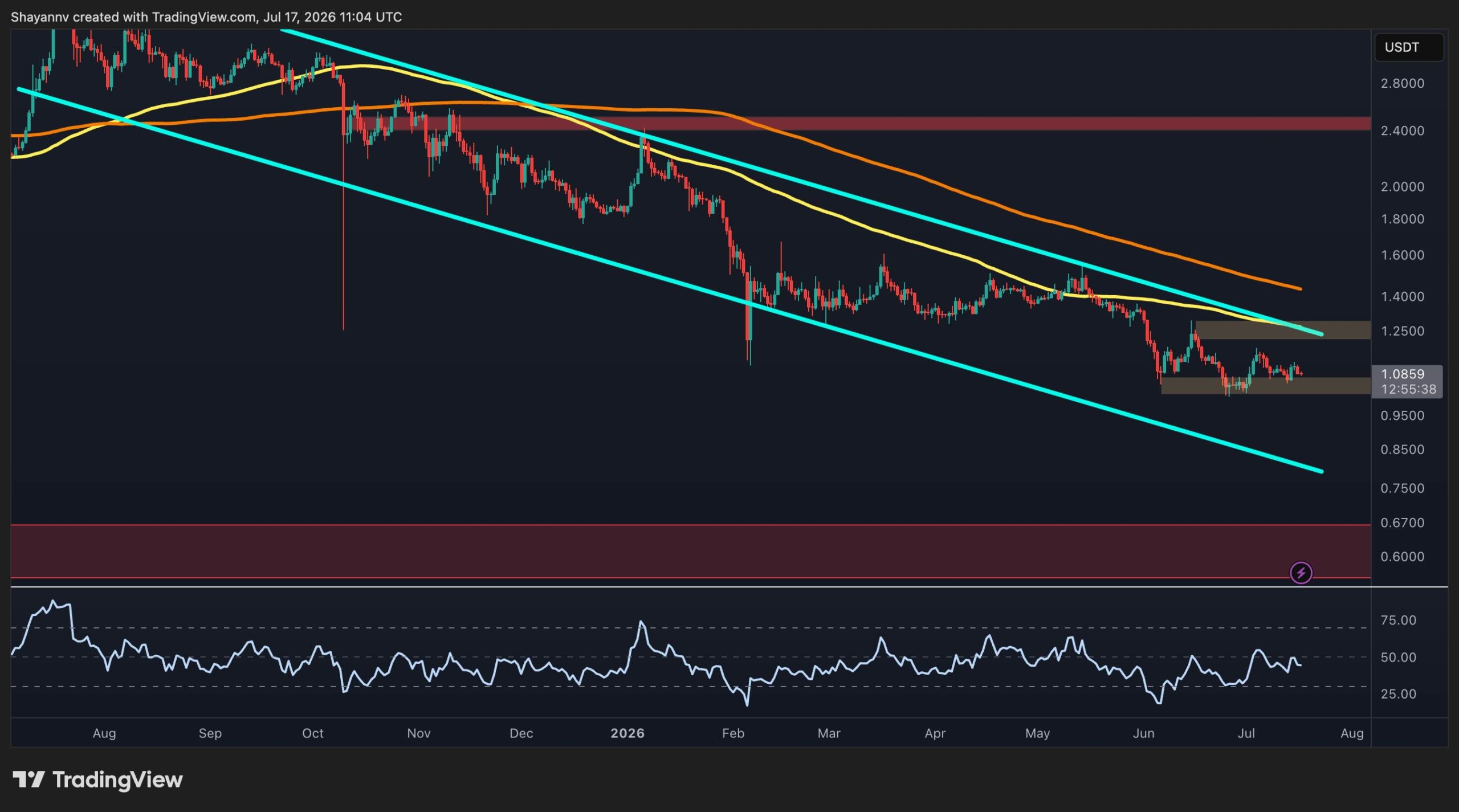
    On the daily chart, XRP is trading around $1.08 following an extended decline within a clearly defined descending channel. Although the asset has recently moved sideways rather than continuing its downward trajectory, the overall trend remains bearish. XRP is trading below both its 100-day and 200-day moving averages, both of which are also sloping downwards, reinforcing the prevailing negative momentum.

    Since a significant breakdown in June, XRP has established a consolidation range between the $1 support zone and the $1.25 resistance area. Buyers have repeatedly defended the lower boundary, but every attempt at recovery has been rejected before reclaiming the declining 100-day moving average or breaking above the channel’s upper boundary. This indicates that bullish momentum remains constrained.

    A breakout above the $1.25 resistance would be the first indication that buyers are regaining control and could open the path towards the descending channel’s upper boundary, which represents the next major hurdle. Until then, the broader structure continues to suggest further downside, with a loss of the $1 support potentially leading to significantly lower demand zones.

    The Relative Strength Index (RSI) is hovering near the neutral 50 level, reflecting a current balance between buyers and sellers after weeks of intense selling pressure. However, without a decisive bullish breakout, the indicator does not yet signal a meaningful shift in the trend.

    XRP/BTC Pair Shows Deeper Weakness

    The XRP/BTC daily chart presents an even more concerning picture. The pair has been confined within a long-term descending channel for nearly a year, consistently trading below both the 100-day and 200-day moving averages, highlighting sustained underperformance against Bitcoin.

    Following several unsuccessful recovery attempts in May and June, XRP/BTC has now fallen below the crucial horizontal support level of approximately 1,720 satoshis. This level had previously attracted buyers multiple times over recent months, but each rebound has resulted in another lower high, signaling that selling pressure continues to dominate.

    On the upside, the next significant resistance is located around the 1,850 satoshis region, where previous support has now transitioned into resistance. A move above this area would improve the short-term outlook, but the descending channel and the 200-day moving average, currently near 2,000 satoshis, remain the primary obstacles to a broader trend reversal.

    Meanwhile, the RSI remains below the midpoint, suggesting that momentum still favors sellers. Unless XRP/BTC can reclaim key resistance levels and break its long-standing bearish structure, the pair appears vulnerable to another test of the channel’s lower boundary, which is now situated around 1,500 satoshis.