Category: Uncategorized

  • Thailand’s SEC Establishes Crypto ETF Regulations, Effective October 16th

    Thailand’s SEC Establishes Crypto ETF Regulations, Effective October 16th

    Thailand’s Securities and Exchange Commission (SEC) has finalized a regulatory framework for cryptocurrency Exchange Traded Funds (ETFs), with the new rules set to take effect on October 16th. This framework initially permits ETFs tracking Bitcoin (BTC) and Ethereum (ETH), marking a structured approach to integrating digital assets into the nation’s financial system.

    According to the Thai SEC, these cryptocurrency ETFs must maintain at least 80% net exposure to their underlying assets. The announcement also specifies that licensed custodians and fund managers are mandatory, ensuring operations are handled by regulated entities. To bolster investor awareness and protection, participants will be required to sign risk disclosure documents.

    Reflecting a conservative strategy, the Thai SEC has prohibited margin loans for the purchase of these crypto ETFs. Trading will be confined to the Stock Exchange of Thailand (SET), a measure intended to keep transactions within a regulated environment from order placement through settlement. The selection of Bitcoin and Ethereum as the initial eligible assets is based on their market capitalization, liquidity, and global acceptance, which the SEC believes allows for more precise risk modeling and price monitoring.

    This regulatory stance is notably more conservative than that of the US SEC, which permits margin trading and a broader range of crypto assets for ETFs. The Thai SEC’s framework, as per source claims, aims to offer a higher degree of protection for ordinary investors by implementing measures like the prohibition of margin loans to mitigate liquidation and forced closure risks, particularly given the historical volatility of cryptocurrencies.

    The requirement for licensed custodians is a critical security measure designed to safeguard private keys and actual holdings. The overall framework is seen as a pathway for regional markets to integrate crypto assets into formal financial systems within a controlled scope. While uncertainties remain regarding the specific format of the risk disclosure document, the exact launch dates for the first ETFs, the participating fund managers, and whether the scale will achieve sufficient liquidity, the regulations provide a clear foundation.

    It is uncertain whether the Thai SEC will eventually relax regulations to include more crypto assets. However, the current framework is designed to foster a controlled and licensed ecosystem for digital asset investment. The October 16th effective date signifies a key development in Thailand’s digital asset landscape, prioritizing investor protection and regulatory oversight as it introduces these new financial products.

    Why This Matters

    The materials describe a narrow update: The Thai SEC has established a regulatory framework for cryptocurrency ETFs, specifying that the initial offerings will be limited to Bitcoin and Ethereum. The specific format of the risk disclosure document.

    Broader Context

    Source materials place the factual news in this context: Thailand’s central bank is cracking down on crypto money laundering, targeting large USDT transactions and referring them to the SEC for investigation.


  • Crypto Whales Buy Dip as BTC, ETH, XRP Plunge

    Crypto Whales Buy Dip as BTC, ETH, XRP Plunge

    Crypto Market Plummets, Whales Show Signs of Accumulation

    Major cryptocurrencies experienced a significant downturn in recent days, with Bitcoin leading the decline. The flagship cryptocurrency plunged from a high of $87,000 to below $81,000, marking its lowest price in over two weeks.

    Larger altcoins were not immune to the sell-off. XRP, in particular, saw a double-digit percentage drop over the past seven-day period. This market correction has raised questions about the behavior of large holders, often referred to as “whales,” and the future trajectory of these digital assets.

    Several factors are believed to have contributed to Bitcoin’s sharp decline. These include substantial outflows from Bitcoin Exchange Traded Funds (ETFs), apprehension fueled by large transfers of cryptocurrency by the U.S. government, broader macroeconomic news, and typical profit-taking activity. Amidst this volatility, analysis suggests that whales have been actively accumulating assets.

    Popular analyst Ali Martinez highlighted this trend in a recent X post, stating that large market participants significantly increased their Bitcoin holdings, adding over $1.2 billion worth of the cryptocurrency within a 72-hour span.

    In a separate bullish outlook, Martinez pointed to the TD Sequential indicator flashing a buy signal on Bitcoin’s four-hour chart. This development follows a roughly 7% price drop over a few days and could signal a potential rebound.

    The TD Sequential indicator has issued a buy signal on Bitcoin’s four-hour chart. This comes after BTC fell 5.55%, from $86,976 on October 5 to $82,150. The signal suggests that this pullback may be nearing its end, with a rebound now worth monitoring.

    Ethereum and XRP Follow Suit Amidst Whale Activity

    Ethereum, the leading altcoin, also experienced a sharp decline, falling from over $2,700 to $2,400 before finding some support. While it managed a rebound to $2,500 on Friday, it remains significantly down on a weekly basis.

    According to Martinez, Ethereum whales also increased their positions, acquiring approximately 166,000 tokens, representing a 0.64% increase in their holdings, as the asset’s price corrected.

    Ethereum’s approximately 8% weekly decline also triggered a change in the TD Sequential indicator. Similar to Bitcoin, the four-hour chart displayed a buy signal after the asset dipped below $2,550, its current trading level. Martinez suggested that a recovery could push Ethereum’s price between $2,620 and $2,650.

    Ripple’s native token, XRP, continues to trade down by double digits week-over-week, despite a rebound from its local low of $1.34. However, the rejection at $1.51 and the subsequent retracement provided an opportunity for whales to resume their accumulation.

    Martinez reported that these large market players purchased over 45 million XRP tokens, valued at approximately $63 million, during the price dip. Furthermore, XRP’s four-hour chart also presented a new buy signal from the TD Sequential indicator.

    “An earlier sell signal aligned closely with XRP’s local high. Now, the question is whether this buy signal marks a local low,” Martinez added.

  • Empire Market Founder Sentenced to 40 Years, $100M in Bitcoin Seized

    Empire Market Founder Sentenced to 40 Years, $100M in Bitcoin Seized

    Raheim Hamilton Sentenced to 40 Years for Operating Empire Market, Millions in Assets Seized

    A Virginia man has been sentenced to 40 years in prison for his role in co-managing Empire Market, a major dark web marketplace for illicit goods. Raheim Hamilton will also forfeit 1,230 Bitcoin (BTC) and pay a $5 million fine. His partner, Thomas Pavey, previously pleaded guilty and surrendered 1,584 BTC last year.

    Justice Department Cracks Down on Dark Web Drug Economy

    The U.S. Department of Justice has delivered a significant blow to the dark web drug trade. Raheim Hamilton, from Suffolk, Virginia, was sentenced by a federal court in Chicago to 40 years in prison for co-founding and operating the dark web drug platform Empire Market. He has also agreed to forfeit 1,230 Bitcoin, valued at approximately $101 million, along with three properties. Hamilton was also fined $5 million. His co-conspirator, Thomas Pavey, pleaded guilty last year and surrendered 1,584 Bitcoin and other assets.

    Empire Market Facilitated Millions in Illicit Transactions

    According to the Department of Justice (DOJ), Hamilton and Pavey operated Empire Market from 2018 to 2020, facilitating over 4 million drug transactions. The platform generated nearly $375 million from drug sales alone. When combined with sales of stolen account credentials, personal information, counterfeit currency, and hacking tools, the total transaction volume exceeded $430 million.

    Hamilton, 30, also agreed to surrender 24.4 Ethereum (ETH), worth about $60,000, and three real estate properties, in addition to the Bitcoin.

    Pavey, 41, from Ormond Beach, Florida, surrendered 1,584 Bitcoin, two boxes containing 25 ounces of gold bars, three vehicles, and two properties when he pleaded guilty last year. Pavey is scheduled for sentencing later this month.

    Cryptocurrency as the Backbone of Dark Web Commerce

    The DOJ noted that Hamilton and Pavey mandated cryptocurrency payments and encouraged customers to use mixing services to obscure transaction trails. This model is standard in the dark web criminal ecosystem, utilizing Bitcoin as the payment layer and mixers or mixing services as the laundering layer, making it difficult for law enforcement to trace funds.

    The total Bitcoin seized in this case amounts to approximately 2,814 BTC (1,230 from Hamilton and 1,584 from Pavey), valued at over $200 million at current prices. This represents one of the largest seizures of Bitcoin from a single dark web platform by U.S. authorities in recent years, underscoring that cryptocurrency has evolved from a mere “auxiliary tool” to the fundamental infrastructure of the dark web economy.

    Broader Crackdown on Dark Web Platforms

    Empire Market is not the only dark web platform targeted by the DOJ. In February, Ruis-Sian Lin, a Taiwanese national suspected of operating Incognito Market, was sentenced to 30 years in federal court. Earlier that month, the U.S. government seized $400 million in cryptocurrency assets, properties, and cash linked to Helix, a dark web Bitcoin mixing service.

    The DOJ stated that Helix was used by drug traffickers and other criminals for money laundering, processing at least 354,468 Bitcoin, which would be worth approximately $29 billion at current prices.

    The Enduring Resilience of the Dark Web Economy

    While the seizure of 2,814 Bitcoin and the imprisonment of two key figures represent a significant success, the dark web economy has historically demonstrated remarkable resilience. For every platform that falls, a new one emerges to take its place. Following the seizure of $400 million from Helix, more decentralized mixing tools appeared on the market, and after Empire Market was shut down, new platforms quickly filled the void.

    The focus moving forward should not solely be on the amount of Bitcoin seized in this instance, but on the DOJ’s pursuit of Helix. The scale of money laundering, involving 354,468 Bitcoin and $29 billion, indicates that the financial pool of the dark web economy is far larger than the $430 million in transactions from a single platform.

    As law enforcement increasingly targets the mixing layer, the arms race between on-chain analysis tools and mixing technologies is set to intensify. The pseudo-anonymous nature of Bitcoin means that every “perfect crime” could potentially be unraveled years later through on-chain data.

  • Turkey Enacts Social Media Age Restrictions for Users Under 15

    Turkey Enacts Social Media Age Restrictions for Users Under 15

    Turkey has implemented new regulations, effective November 1, that restrict social media access for individuals under the age of 15. The measures mandate age verification for all social media users, requiring them to use age certificates issued by the Turkish government’s e-Devlet system.

    Under the new rules, existing accounts belonging to users under 15 will be closed after a verification period. Users aged between 15 and 17 will be transitioned to a segregated service designed specifically for teenagers. Social media platforms face significant penalties for non-compliance, including fines up to 3% of their global annual revenue and potential reductions in internet bandwidth.

    The regulation, which amends Law No. 5651, defines individuals under 18 as children. The age verification process, managed through the e-Devlet system and an age certificate issued by the Presidential Digital Transformation Office, will determine if a user is under 15, between 15 and 18, or over 18. Platforms are prohibited from using this age certificate for purposes other than age verification and must continuously verify user ages, suspending accounts if usage is inconsistent with the verified age. Appeals against account suspensions cannot be solely based on automated mechanisms.

    For users aged 15-17, the segregated service will include restrictions on addictive features, default private accounts, and limitations on public profile options. Features such as synchronized friend lists, account recommendations, and the ability to screenshot profile pictures and posts will be prohibited. Live streaming, infinite scrolling feeds, sequential short video playback, personalized content, and targeted advertising based on behavior will also be disallowed for this age group. Parents will have the ability to manage account settings, require parental consent for purchases, monitor usage time, and set time limits for users aged 15-17.

    The government’s move comes amid concerns about the impact of social media on young people. President Erdoğan has previously stated that some digital sharing applications are “corrupting children’s minds.” The Minister of Family and Social Services has also highlighted concerns about excessive screen time affecting sleep and its links to depression and anxiety.

    Penalties for non-compliance are substantial. Platforms failing to adhere to the regulations may face a ban on new advertising contracts and payments from Turkish advertisers. Continued non-compliance could lead to a 50% reduction in internet bandwidth, potentially increasing to 90% after further non-compliance.

    This development in Turkey aligns with a broader global trend of countries implementing stricter regulations for social media platforms concerning minors. Australia is set to implement a ban for under 16s starting in December 2025, with platforms responsible for age determination. Indonesia will prohibit under 16s from certain digital services starting in March 2026. The UK, France, and Spain are also considering or have implemented similar measures.

    Uncertainties remain regarding the specific technical guidelines for the age certificates, their structure, format, and the process for their issuance by the Presidential Digital Transformation Office. The timeline for the release of these detailed guidelines is also not yet clear, potentially creating challenges for social media companies in achieving full compliance by the effective date.

    Why This Matters

    The materials describe a narrow update: Turkey has enacted a new regulation, effective November 1, prohibiting social media platforms from allowing users under 15 to create accounts. The exact structure, format, and process of the age certificates to be issued by the Presidential Digital Transformation Office.

    Broader Context

    Source materials place the factual news in this context: The regulation was announced shortly after a school shooting incident where a 14-year-old boy killed 9 students and 1 teacher.

  • Crypto Liquidity Diverges: Bitcoin, Ethereum Recover While Altcoins Decline One Year Post-Liquidation Event

    Crypto Liquidity Diverges: Bitcoin, Ethereum Recover While Altcoins Decline One Year Post-Liquidation Event

    One year after a significant liquidation event on October 10, 2025, cryptocurrency market liquidity has shown a stark divergence, with Bitcoin and Ethereum recovering while altcoin liquidity continues to contract, according to CoinDesk Research.

    Bitcoin and Ethereum Rebound

    Research indicates that liquidity for major cryptocurrencies has improved. Bitcoin’s 1% order book depth on October 7, 2026, reached approximately $11.7 million, marking a 75% increase compared to the day of the crash. Ethereum has also seen substantial gains, with its 0.5% order book depth more than doubling to around $4.2 million, and its 1% order book depth rising by roughly three-quarters to approximately $5.3 million.

    These figures suggest that market makers are committing more capital to Bitcoin and Ethereum, a trend attributed by CoinDesk Research not just to lower prices but to a deeper commitment of funds.

    Altcoin Liquidity Erosion

    In contrast, the USD depth for a basket of altcoins has steadily declined since January 1, 2025. The depth at 5% from the price for altcoins has decreased by about one-third since early 2025, now standing at approximately $2 million. CoinDesk Research interprets this recovery in altcoin depth, when measured in token quantity, as primarily a result of price drops, potentially masking a continuous erosion of committed capital.

    Trading Volume and Event Context

    This liquidity divergence occurs alongside significantly lower spot trading volumes compared to the liquidation event. The average weekly spot trading volume for the four weeks ending September 27, 2026, was approximately $279 billion, a sharp decrease from the $801 billion recorded during the week of the October 10, 2025 event. August 2026 saw weekly spot trading volume hit a low of about $135 billion.

    The October 10, 2025 liquidation event, which saw over $19 billion in leveraged positions liquidated, was triggered partly by Bitcoin’s drop below $105,000 following an announcement by President Trump regarding tariffs on Chinese imports. CoinDesk Research analyzed market depth across several key dates, including January 1, 2025, the crash day, January 1, 2026, and the current week.

    Outlook

    Market makers have largely returned to major cryptocurrencies, with liquidity now exceeding pre-crash levels. This trend is anticipated to persist into the next year, with major cryptocurrencies expected to continue dominating institutional interest and trading volume, barring a few exceptions among altcoins. Uncertainties remain regarding the precise amount of capital flowing into Bitcoin and Ethereum, specific altcoins that may defy the trend, and the long-term trajectory of altcoin liquidity.

    Why This Matters

    The materials describe a narrow update: One year after a significant liquidation event on October 10, 2025, research indicates that liquidity for Bitcoin and Ethereum has improved, with order book depth increasing. The exact amount of capital that has rotated into Bitcoin and Ethereum.

    Broader Context

    Source materials place the factual news in this context: The article discusses the one-year anniversary of a major liquidation event on October 10, 2025, which involved over $19 billion in leveraged positions being liquidated.

  • Ethereum ETFs Suffer Largest Weekly Outflow Since January

    Ethereum ETFs Suffer Largest Weekly Outflow Since January

    Ethereum ETFs Face Steepest Weekly Outflow Since January

    US spot Ethereum exchange-traded funds (ETFs) experienced their worst week since late January, with investors withdrawing $542.1 million during the trading week ending October 9, 2026. This marks the largest weekly exodus from these funds in over eight months and coincides with Ether’s price falling below a key trading threshold.

    Concentrated Redemptions Drive Outflows

    The significant outflows were not evenly distributed among the funds. BlackRock’s iShares Ethereum Trust (ETHA) accounted for approximately $477 million of the total weekly redemptions, representing about 88% of all withdrawals in the category. Grayscale’s ETHE followed with $31.9 million in outflows during the same period.

    For perspective, the last time the Ethereum ETF category saw such substantial weekly outflows was in late January, when withdrawals totaled $611 million.

    Extended Period of Outflows

    The recent week’s performance is part of a broader trend of declining investor interest. The funds have now recorded nine consecutive trading days of outflows, beginning on September 29. Over this extended period, total redemptions have reached $697.2 million.

    Price Decline and Reduced Trading Activity

    The price action for Ether has offered little solace to investors. ETH settled near $2,491 on October 10, marking a decline of over 7% from the previous week. This price movement pushed Ether below two significant technical indicators: its 50-day simple moving average and the $2,500 level. Trading volume for ETH also saw a considerable drop, falling 61% to $7.2 billion.

    Broader Market Trends

    Ether was not the only cryptocurrency ETF to experience outflows. Bitcoin ETFs saw approximately $681 million withdrawn during the same period. In a more symbolic development, spot Solana ETFs recorded their first outflows since their launch, ending a 14-week streak of inflows.

    As of October 9, 2026, cumulative net inflows into US spot Ethereum ETFs stood at approximately $13.26 billion, with total net assets across the funds estimated at $15.71 billion. While the recent redemptions are substantial, they represent a relatively small portion of the overall capital invested in these products.

    Investor Confidence and Market Sentiment

    The significant concentration of outflows in BlackRock’s ETHA, the largest fund in the category, suggests it serves as a primary avenue for large holders to quickly reduce their exposure. Analysts suggest these outflows may signal waning investor confidence amid shifting market conditions. The simultaneous declines in both Ether and Bitcoin could indicate a broader bearish sentiment, potentially influenced by external economic factors and regulatory uncertainties.

    Key Signals for Ether’s Trajectory

    For those monitoring Ether’s performance, several key indicators are noteworthy. The ability of ETH to reclaim the $2,500 level and its 50-day moving average will be crucial. Additionally, a rebound in trading volume, currently at $7.2 billion, and a reversal of the nine-day outflow streak in daily ETF data will be closely watched.

    The continued redemptions from newer products like spot Solana ETFs, following a prolonged period of inflows, could suggest a broader trend of investors trimming riskier crypto positions across the market rather than reallocating capital between different assets.

  • SUI Token Surges Amidst Ecosystem Growth, Yet Key Uncertainties Persist

    SUI Token Surges Amidst Ecosystem Growth, Yet Key Uncertainties Persist

    The native token of the Sui Network, SUI, has experienced a notable price increase of approximately 54% over a 30-day period concluding in early October 2026, outperforming major cryptocurrencies like Bitcoin and Ether during the same timeframe. However, this rally is accompanied by significant uncertainties regarding the sustainability of these gains and the interpretation of on-chain metrics.

    Why This Matters

    The materials describe a narrow update: The native token of the Sui Network, SUI, increased in value by approximately 54% over a 30-day period ending in early October 2026. The sustained real-world usage performance of Sui’s network compared to its off-chain stress test results.

    Ecosystem Developments as Potential Drivers

    The recent price surge for SUI coincided with several key developments within the Sui ecosystem. According to the article, the total value locked (TVL) in Sui’s decentralized finance (DeFi) applications grew by 15.5% over the four weeks leading up to early October 2026. This growth contributed to Sui’s DeFi TVL peaking at approximately $1.21 billion on September 22, 2026, with NAVI Protocol being a notable contributor. Despite this overall growth, the source states that SUI experienced a 5.2% decline in price over the most recent week. This weekly TVL drop is presented as a reminder of how tightly Sui’s DeFi metrics track its token.

    Further bolstering the ecosystem narrative, Bitwise launched its PPLUS Premium+ RWA Vault on the Sui Network. This vault is designed to target a net yield of more than 10% for institutional assets, introducing real-world assets onto the blockchain. Additionally, during the Sui Basecamp conference, held from October 7-8, 2026, an off-chain stress test of the Sui network recorded an impressive throughput of 40.6 million transactions per second. While this demonstrates the underlying technology’s potential under controlled conditions, the source cautions that this is different from sustained real-world usage on the live network.

    Samsung also announced support for USDC on its Galaxy devices, with integrated Sui capabilities, potentially exposing millions of users to Sui-powered features. These developments, according to the article, did not happen in a vacuum and may have contributed to the positive sentiment surrounding SUI.

    Market Context and Performance Metrics

    In terms of market performance, SUI traded between $1.15 and $1.27 during the 30-day period leading up to early October 2026. By early October 2026, SUI was trading at approximately $1.12 to $1.15, with a market capitalization around $4.6 billion. Approximately 4.1 billion SUI tokens were in circulation, representing about 41% of the eventual maximum supply of 10 billion tokens. Investors evaluating SUI’s market cap are advised by the source to consider the fully diluted picture.

    Despite the recent gains, SUI remains significantly below its all-time high. The token reached a peak of around $5.35 in January 2025. At its early October 2026 price, SUI was roughly 78% below this all-time high. This suggests that a holder who bought at the peak would need the token to roughly quadruple from its current price just to break even, highlighting the potential for continued volatility.

    Navigating Uncertainty

    Key uncertainties remain for the Sui Network and its token. The source states that the sustained real-world usage performance of the network compared to its off-chain stress test results is a point of ambiguity. Furthermore, the impact of the remaining 59% of SUI tokens entering the market over time on its price is also uncertain. The correlation between SUI’s price and its DeFi TVL, as indicated by the recent weekly decline, suggests that token price fluctuations can directly impact reported ecosystem metrics, reinforcing the need for cautious interpretation.

  • Bitcoin Price Analysis: US Demand Dips, Is BTC’s Rally Over?

    Bitcoin Price Analysis: US Demand Dips, Is BTC’s Rally Over?

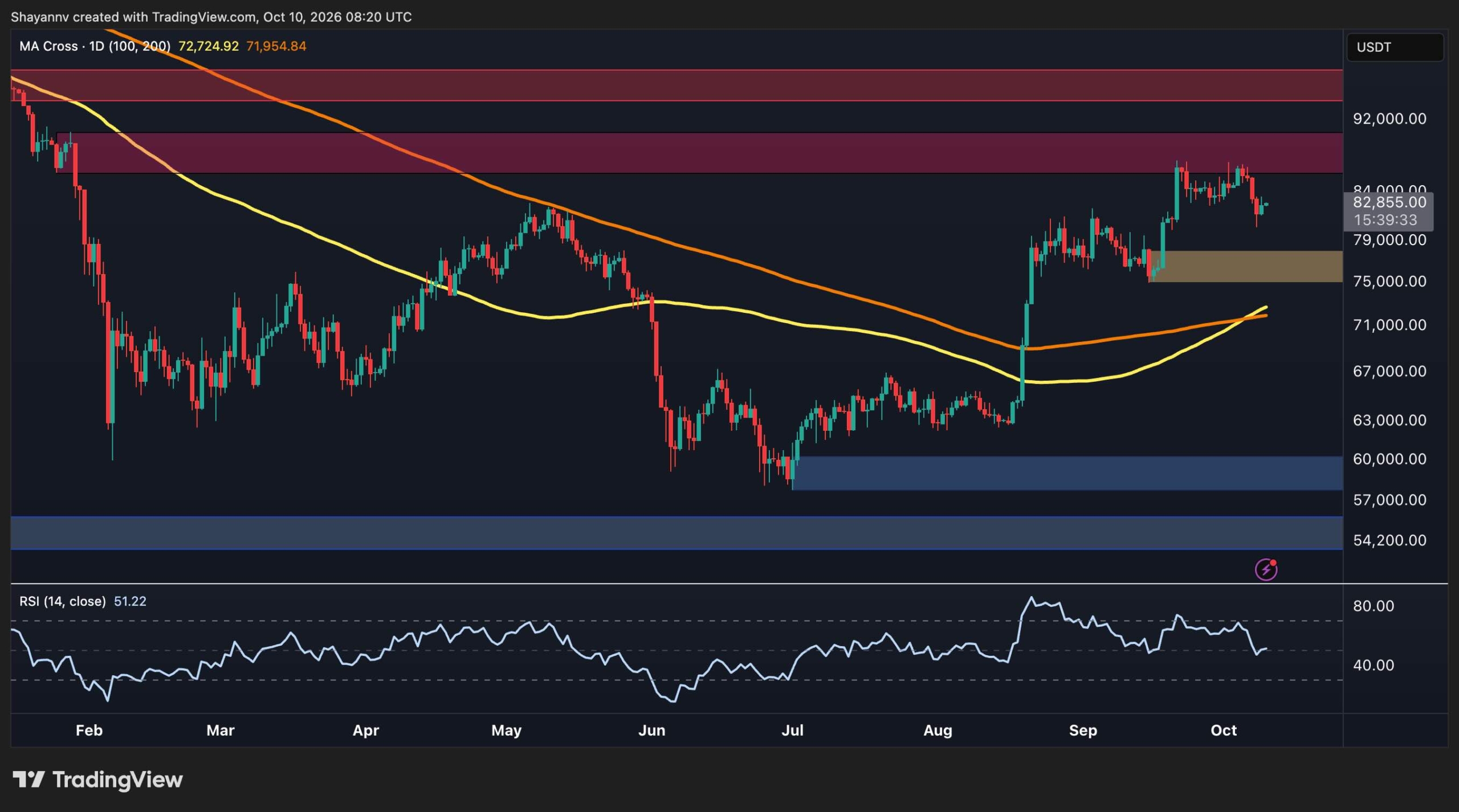
    Bitcoin is currently trading around $83,000, following a rejection from the $86,000 to $90,000 resistance zone, which has weakened its short-term structure. Concurrently, the Coinbase Premium Index has turned sharply negative, suggesting a potential waning of U.S.-based buying demand. While Bitcoin is attempting to stabilize, buyers must reclaim nearby resistance levels to improve the cryptocurrency’s outlook.

    Bitcoin’s Recovery Faces Resistance

    Bitcoin’s daily chart illustrates a significant recovery from its June lows near $58,000 to recent highs around $86,000. However, this rally has encountered robust resistance, and recent price action indicates that sellers are regaining short-term control.

    BTC has been rejected at the $86,000 to $90,000 resistance zone, with the lower boundary of this area, approximately $86,000, serving as the immediate hurdle for any renewed advance. A broader resistance level is observed around $95,000, which would become relevant should Bitcoin reclaim the nearer supply zone and resume its upward trajectory.

    Despite these headwinds, the price remains above the 100-day and 200-day moving averages, both currently situated near $72,000, following a bullish crossover. While BTC is comfortably trading above these averages, their recent crossover and upward trend reflect an improved medium-term structure after the summer’s recovery. These moving averages could emerge as significant dynamic support if the current correction deepens, but they are not immediate downside targets as long as the market stays above nearer support zones.

    The first critical downside area to monitor is the $77,000 demand zone, established by the bullish order block that fueled the final leg of the recent rally. A loss of this area, coupled with a price close below $75,000, would undermine the recovery structure and expose the aforementioned moving averages around $72,000.

    For the time being, the daily structure remains in a recovery phase. However, the rejection from resistance and a potential loss of short-term support could signal that Bitcoin may require a deeper correction before attempting another upward move.

    Short-Term Outlook Deteriorates

    On the 4-hour chart, Bitcoin has broken below a rising wedge pattern after being rejected from the $86,000 region. This breakdown below the pattern’s lower trendline suggests a bearish resolution for the pattern, at least in the short term.

    Following the breakdown, BTC experienced a decline towards the $80,000 area before staging a modest rebound to approximately $83,000. This recovery indicates buyers are attempting to stabilize the price, but the bounce appears limited, with a bearish order block forming near $85,000 that could exert downward pressure on the asset once more.

    On the downside, the $80,000 low represents the nearest level where buyers have recently intervened. A loss of this zone would lead to the next significant support being the $75,000 to $78,000 demand area, which is also visible on the daily chart.

    The 4-hour Relative Strength Index (RSI) has recovered from oversold territory and is now in the mid-40s, suggesting that selling momentum has somewhat eased. However, it remains below the neutral 50 level, indicating that the rebound has not yet established convincing bullish momentum.

    Consequently, the short-term outlook remains cautious. Bitcoin could continue to consolidate between $82,000 and $84,000 if buyers successfully defend recent lows. However, another rejection below $86,000, followed by a break under $80,000, would increase the probability of a deeper move towards the $75,000 to $78,000 demand zone.

    Coinbase Premium Index Signals Weakening Demand

    The Coinbase Premium Index chart reveals a sharp negative turn in its latest reading, falling to approximately -0.1 while Bitcoin trades near $82,700. This index measures the price difference between Bitcoin on Coinbase and a comparable market price. A negative reading generally signifies that BTC is trading at a discount on Coinbase relative to the reference market.

    A consistently positive premium can signal stronger buying pressure on Coinbase, often associated with U.S. spot demand. Conversely, a negative premium suggests weaker relative demand or stronger selling pressure on the platform. It is important to note that this metric is not a direct measure of total U.S. investor flows and can also be influenced by variations in liquidity and market conditions across exchanges.

    The recent deterioration is noteworthy as it coincides with Bitcoin’s rejection from the $86,000 resistance region and its subsequent breakdown from the 4-hour rising wedge. The alignment between weakening price structure and a negative Coinbase Premium suggests that spot demand may not be robust enough to support an immediate continuation of the rally.

    The index has exhibited repeated swings between positive and negative territory throughout its history, so the latest decline should not be interpreted as definitive proof of sustained distribution. Nevertheless, a continued negative premium alongside further price weakness would bolster the bearish case, particularly if BTC loses the $80,000 support area.

  • CFTC Clarifies Prediction Markets vs. Gambling in New Rules

    CFTC Clarifies Prediction Markets vs. Gambling in New Rules

    CFTC Moves to Define Prediction Markets as Swaps, Clarify Gambling Exclusion

    The Commodity Futures Trading Commission (CFTC) is intensifying its efforts to assert authority over prediction markets, unveiling two measures Friday that would formally classify event contracts as “swaps” under federal law, while simultaneously excluding traditional gambling activities.

    The first measure, a proposed rule now open for public comment, aims to explicitly broaden the definition of a “swap” to encompass event contracts. These contracts can be tied to a wide array of outcomes, including sports, politics, cultural events, and weather. The CFTC stated that these contracts are financial instruments “commonly known to the trade as swaps,” and that this action will eliminate any uncertainty regarding their regulatory status. “These products are commodity derivatives squarely within the CFTC’s regulatory remit under the Commodity Exchange Act and are within the agency’s exclusive jurisdiction,” CFTC Chairman Michael Selig said in a statement.

    The second measure, an interim final rule effective immediately upon publication, draws a contrasting boundary. It codifies the agency’s long-standing position that casino-style gambling products, such as sportsbook wagers and casino games, are not considered swaps. “Casino-style gambling products are not derivatives,” Selig explained, characterizing this step as a clarification of “the limits of its regulatory remit.” Both proposals include a 30-day public comment period.

    Collectively, these two rules sharpen a critical distinction at the center of an intense jurisdictional dispute. If event contracts are deemed swaps, they fall under the CFTC’s purview, which Selig has argued is exclusive, thereby shielding platforms like Kalshi and Polymarket from the oversight of state gambling regulators. Several states have initiated lawsuits against prediction market operators, alleging illegal gambling, and the CFTC has filed counter-suits to defend its regulatory territory.

    These filings formalize proposals that the agency submitted to the White House for review late last month. This move is part of a broader strategy by the CFTC to proactively assert its authority rather than await congressional action.

    The agency has generally adopted an industry-friendly approach towards both traditional and cryptocurrency markets. The Commission recently issued no-action relief that permits crypto applications to offer regulated derivatives and has advanced separate rulemakings concerning crypto markets.

    The legal stakes for prediction markets are escalating. A judicial disagreement over whether event contracts qualify as federally regulated swaps, which has pitted the NFL and other entities against Kalshi, has attracted the attention of the Supreme Court. This means the question the CFTC is now attempting to resolve through regulation may ultimately be decided by the nation’s highest court.

  • Bitcoin Miners Ease Selling Pressure: A Bullish Sign for BTC

    Bitcoin Miners Ease Selling Pressure: A Bullish Sign for BTC

    Bitcoin Miners Halt Aggressive Selling, Signaling Potential Boost for BTC

    Bitcoin miners have significantly reduced their selling pressure, a development that could provide a substantial tailwind for the cryptocurrency’s price, according to a recent report from CryptoQuant. The analysis indicates that miner revenues have surged 78% from their July lows, leading to improved profitability and a cessation of extreme outflows from mining operations.

    CryptoQuant, a prominent blockchain analytics firm, concluded that these key network participants have navigated their most challenging period of the year. The removal of consistent selling pressure from miners, the firm suggests, could further benefit Bitcoin’s price trajectory.

    The report highlighted that no extreme miner outflow events have been recorded since August 21. On that date, approximately 29,000 BTC were moved from wallets associated with miners as the cryptocurrency’s price climbed from below $65,000 to $76,000. The largest daily outflows observed since then have been around 12,000 BTC, a figure the analytics company considers within a normal operational range.

    Furthermore, older mining entities are also offloading significantly fewer coins. Excluding Bitcoin associated with the enigmatic Satoshi Nakamoto, miners from the Satoshi era moved roughly 600 units from their wallets in September. This represents a substantial decrease of approximately 70% compared to the 2,000 BTC moved in January. Despite this reduced selling, their combined holdings remain substantial, close to 590,000 bitcoins.

    This trend of reduced selling extends to larger, more modern mining operations. Addresses holding between 100 and 1,000 BTC saw their collective balance decrease by about 20%, from approximately 64,000 BTC in December 2025 to 51,000 BTC by early September. However, this figure has since stabilized, indicating a halt in the decline.

    While CryptoQuant acknowledged that miners are not yet actively accumulating Bitcoin, the report determined that the persistent selling pressure has effectively ended. This marks a notable shift from early August, when major miners, including Marathon Digital Holdings (MARA) and Riot Platforms, were reportedly moving Bitcoin to custodians like NYDIG amidst challenging industry and market conditions.

    The report attributes the miners’ reduced need to sell to Bitcoin’s recent rally. The cryptocurrency has surged 45% from under $58,000 at the start of July to over $83,000 this week. This price appreciation has boosted total daily miner revenue from $27 million to around $48 million, representing the aforementioned 78% increase. Transaction fees have also seen a recovery, rising from a seven-day average of $195,000 to $275,000, though they remain considerably below the peaks observed in 2025.

    CryptoQuant’s Miner Profit/Loss Sustainability Indicator has shifted from an “extremely underpaid” status between May and August to “fairly paid” after August 21. This suggests that miners are now earning sufficient revenue to cover their operating costs, reducing the necessity to liquidate Bitcoin simply to remain solvent.

    Bitcoin’s hash rate has also shown signs of recovery, increasing from under 900 exahashes per second (EH/s) in late July to over 960 EH/s. The drawdown from its previous peak has narrowed from 18% to 13%. CryptoQuant interprets this as a sign of mining capacity returning rather than a capitulation of mining operators.

    However, the report identified a crucial missing element: while miners have ceased aggressive selling, they have not yet begun to rebuild their Bitcoin balances. CryptoQuant believes that a sustained return to accumulation by miners would provide a stronger signal that the fundamental backbone of the Bitcoin network is transitioning from a source of market supply to that of long-term holders.