Category: Uncategorized

  • GhostSwap Defies Delistings, Keeps Monero Accessible Without KYC

    GhostSwap Defies Delistings, Keeps Monero Accessible Without KYC

    Privacy Coins Face Delisting Wave, GhostSwap Offers Alternative

    The cryptocurrency landscape has seen a significant shift in recent years, with a growing number of centralized exchanges delisting privacy-focused coins. This trend, which began in earnest in 2024, is largely attributed to mounting compliance and regulatory pressures.

    Binance, for instance, announced the removal of Monero (XMR) trading in February 2024. Shortly thereafter, OKX delisted Monero, Zcash (ZEC), and Dash (DASH) within the same year. By mid-2026, the number of exchanges worldwide that had delisted privacy coins had surged to 73, a notable increase from 51 in 2023. Monero has been particularly affected, experiencing a six-fold increase in yearly delistings, followed by Dash.

    Regulatory scrutiny continues to intensify. Dubai’s financial regulator has prohibited privacy coins such as Monero and Zcash on licensed platforms within the Dubai International Financial Centre. Concurrently, the European Union’s Markets in Crypto-Assets (MiCA) regulation, which fully came into effect in late 2024, mandates a review by the European Commission by June 30, 2027. This review could lead to further legislative changes that might impose stricter restrictions on privacy-focused assets.

    GhostSwap’s Non-Custodial Approach

    In contrast to this trend, GhostSwap, a non-custodial and no-KYC crypto swap service, continues to support Monero, Zcash, Dash, and numerous other privacy tokens. The platform has recently launched a public swap-rate API that provides live Monero (XMR) rates, complete with minimum and maximum limits, without requiring an API key. This feature is designed to enable developers and price-display websites to instantly integrate privacy coin pricing.

    GhostSwap operates on a model where user funds are never held on the platform, allowing it to function outside the purview of traditional exchange controls. This fundamental difference is why privacy tokens remain swappable on GhostSwap even as custodial exchanges are compelled to delist them.

    A Different Model for Crypto Swaps

    GhostSwap distinguishes itself from centralized exchanges by functioning as a privacy-first, non-custodial swap platform. Users select their desired coins, send funds to a GhostSwap-provided address, and the service facilitates the swap by finding the optimal route and depositing the destination coin directly into the user’s wallet. Crucially, GhostSwap never takes custody of user funds. There are no accounts or logins required; all swaps are conducted on-chain, wallet-to-wallet, with no personal data collected.

    Effectively, GhostSwap acts as a smart liquidity router, connecting decentralized pools and centralized exchange liquidity behind the scenes. Unlike traditional exchanges, which must comply with regulatory demands to delist assets due to holding user funds and operating under specific licenses, GhostSwap merely routes users to available liquidity across various sources. As it does not custody assets, it avoids the same compliance ultimatums.

    This resilience extends to Zcash, Dash, and other privacy-focused assets. While major exchanges like Binance and OKX have removed these tokens from their order books, GhostSwap continues to support them as core trading pairs. Monero remains a primary asset, with pairs such as BTC to XMR and ETH to XMR listed among the platform’s most prominent offerings.

    Real-Time Pricing for Privacy Coins

    Integrators and users can now access real-time Monero pricing through GhostSwap’s public, no-key API. The endpoint is CORS-enabled and rate-limited to 60 requests per minute, returning GhostSwap’s aggregated best rates, including the required minimum and maximum swap sizes. This open model reduces barriers for wallets, trading bots, and dashboards looking to incorporate privacy coins.

    Each swap includes explicit minimum and maximum limits provided by the quote API. For example, a sample public API call indicated a minimum of 0.10 XMR and a maximum of approximately 2,337 XMR for Monero. These values fluctuate with liquidity, but their visibility via the API eliminates guesswork for integrators. Price-display and comparison sites can now dynamically showcase GhostSwap’s best privacy coin rates.

    The Privacy vs. Surveillance Debate

    Regulators, however, argue that such swaps create “blind spots” for surveillance. This highlights a clear tension: while privacy coins are becoming less accessible on traditional exchanges, platforms like GhostSwap are maintaining their liquidity and swappability. This dynamic is leading to an emerging clash between open-access cryptocurrency infrastructure and Anti-Money Laundering (AML) rules.

    Swapping Bitcoin to Monero on GhostSwap is presented as one of the most effective methods for converting cryptocurrency into a private, untraceable form without requiring KYC or account creation. Bitcoin transactions are transparent and publicly visible on the blockchain, allowing for the tracing of wallet balances and payment histories. By converting BTC to XMR, users can leverage Monero’s comprehensive privacy features.

    Monero’s privacy is achieved through technologies like ring signatures, stealth addresses, and RingCT, which render all transactions untraceable by default. This ensures that transaction details, balances, and payment histories remain invisible to external observers.

    While BTC holdings are traceable on the Bitcoin blockchain, once converted to XMR through a no-KYC exchange like GhostSwap, there is no account or identity linking the two. Furthermore, Monero transaction fees are exceptionally low, typically less than $0.01 per transaction, making XMR practical for regular private transactions, not just large transfers.

    GhostSwap processes BTC to XMR swaps without KYC, sign-ups, or personal data collection, ensuring that the swap remains as private as Monero itself.

    Seamless Bitcoin to Monero Swaps

    Exchanging Bitcoin for Monero on GhostSwap is described as an instant process, requiring no sign-up, identity verification, or limits. The Monero typically arrives in the user’s wallet within 2 to 10 minutes, corresponding to 10 block confirmations. Monero fees remain consistently low at approximately $0.01 per transaction.

    The process for swapping Bitcoin to Monero on GhostSwap is outlined as straightforward:

    1. Select Bitcoin in the “You Send” field, enter the amount, and choose Monero in the “You Get” field.
    2. Provide your Monero wallet address for receiving XMR.
    3. Send your BTC to the provided address to initiate the exchange.
    4. Upon completion, receive XMR in your wallet.

    The entire process is non-custodial, with GhostSwap never holding user funds, ensuring user control from start to finish.

    The Future of Privacy Coins

    The wave of delistings shows no signs of abating. With MiCA reviews on the horizon in 2027 and ongoing regulatory scrutiny in Asia and the Middle East, privacy coins face an uncertain future on traditional exchanges. However, platforms like GhostSwap are demonstrating that the infrastructure for private, permissionless crypto transactions remains resilient.

    GhostSwap’s ability to keep Monero swappable and make privacy coin pricing accessible to developers, wallets, and comparison sites globally may define the next phase of crypto infrastructure: one that is accessible, resilient, and caters to users who value both privacy and choice.

  • Crypto Investors: This Week’s Key Watchlist

    Crypto Investors: This Week’s Key Watchlist

    Crypto Markets Brace for Volatility Amid Geopolitical Tensions and Key Economic Data

    Cryptocurrency markets experienced a period of stagnation over the weekend, following a tumultuous week that saw approximately $140 billion drained from the digital asset space. The subdued sentiment comes as geopolitical tensions escalate in the Middle East, with the United States launching strikes against Iranian military targets in multiple locations in retaliation for Iran’s drone attack on a commercial vessel.

    TradFi Fear and Greed Index Hits Multi-Month Low

    The traditional finance (TradFi) fear and greed index has fallen to 24.8, its lowest point since early April, according to a report from The Kobeissi Letter. The coming week is poised to be significant for financial markets, laden with crucial labor market data that could heavily influence the Federal Reserve’s future monetary policy decisions.

    Bitcoin Struggles as Geopolitical Events Unfold

    Monday saw markets reacting to the renewed military actions, with cryptocurrencies already trading in negative territory. Bitcoin, the leading cryptocurrency, failed to maintain the $60,000 mark, signaling ongoing pressure.

    Key Economic Indicators on the Horizon

    Economic data releases are set to begin on Tuesday with the May JOLTs Job Openings report and the June CB Consumer Confidence survey. These will be followed on Wednesday by the June ISM Manufacturing PMI, a key indicator of the health of the industrial sector and broader business conditions.

    The week’s most anticipated report is the June Jobs report, scheduled for release on Thursday. This data is expected to significantly shape the direction of interest rates and market sentiment, potentially extending its influence through September, as it represents the sole employment report the Federal Reserve will review before its July meeting.

    Labor Market Weakness Fuels Stagflation Concerns

    Continued weakness in the labor market would lend credence to concerns about stagflation, a scenario where economic growth stagnates while inflation persists, according to BarChart. A robust jobs report, conversely, would likely lead to expectations of higher interest rates, creating a more challenging environment for risk assets like cryptocurrencies. However, current market pricing appears to anticipate a softer jobs number, meaning a surprise upside could pose a greater risk.

    Key Events This Week:

    • US Markets React to Strait of Hormuz Strikes – Monday
    • May JOLTs Job Openings data – Tuesday
    • June CB Consumer Confidence data – Tuesday
    • June ISM Manufacturing PMI data – Wednesday
    • June Jobs Report – Thursday
    • US Markets Closed for Independence Day – Thursday

    Overall Outlook Remains Bleak for Crypto

    The broader outlook for the cryptocurrency market remains challenging, with negative sentiment deepening amid what many are describing as a crypto winter. Total market capitalization has receded to its lowest level since September 2024, standing at $2.13 trillion. Bitcoin has been at the forefront of these losses, with capitulation appearing to continue.

    Bitcoin experienced a 1.5% decline on Monday, dipping to $59,000 during early Asian trading sessions before a slight recovery. The cryptocurrency is currently testing critical support levels; a breach of this threshold could precipitate a sharp decline towards the realized price of approximately $53,000, a level historically associated with bear market bottoms.

    Ethereum (ETH) is already trading near its multi-year bear market lows, struggling to break above the $1,570 mark and showing consistent weakness.

  • CAPUSDT Perpetual Contract Launches on Innovation Zone with 10x Leverage

    CAPUSDT Perpetual Contract Launches on Innovation Zone with 10x Leverage

    Bybit Lists Cap App Perpetual Contract in Innovation Zone

    Cryptocurrency exchange Bybit has announced the listing of the Cap App (CAP) USDT Perpetual Contract, now available for trading in its Innovation Zone. The new contract offers users leverage of up to 10x.

    The CAPUSDT Perpetual Contract is based on the Cap App (CAP) underlying asset and settles in USDT. Key trading parameters include a tick size of 0.00001, a maximum leverage of 10x, and a capped funding rate of 2.5%. Funding fees will be settled every four hours, with trading available 24/7.

    The official website for Cap App is https://www.cap.app/, and its official X (formerly Twitter) account can be found at https://x.com/capapp.

    Bybit has cautioned that the CAPUSDT contract is situated within the Innovation Zone, which entails a higher trading fee compared to other available contracts. Further details regarding the Innovation Zone can be found on Bybit’s help center.

  • Risk Limits Adjusted for HBARUSDT, ROSEUSDT Perpetual Contracts

    Risk Limits Adjusted for HBARUSDT, ROSEUSDT Perpetual Contracts

    Bybit to Adjust Risk Limits and Leverage for Select Perpetual Contracts

    Cryptocurrency exchange Bybit announced it will be adjusting the risk limits and applicable leverage for a number of its Perpetual Contracts. The changes are intended to enhance the trading experience for users.

    Implementation Details

    The adjustments are scheduled to take effect and be automatically applied to user accounts by approximately 7:30 AM UTC on June 30, 2026.

    Affected Contracts

    The following Perpetual Contracts will see their risk limits modified:

    HBARUSDT, ROSEUSDT, MOVEUSDT, ONTUSDT, METUSDT, AXLUSDT, BRETTUSDT, MINAUSDT, ORDIUSDT, TREEUSDT, 1000TOSHIUSDT, AIOZUSDT, CELOUSDT

    Updated risk limit information can be found on Bybit’s website.

    Margin Requirements and Restrictions

    If, by the implementation deadline of June 30, 2026, 7:30 AM UTC, a user’s existing position does not meet the new margin requirements, and the adjustment cannot be automatically applied, traders will only be permitted to reduce their affected Perpetual Contract positions. Any orders that would increase the position size will be restricted until the user selects a supported risk limit or leverage.

    Recommendations for Traders

    Bybit advises users to manage their positions and account risk proactively. This can be achieved by transferring additional funds or adjusting their settings by July 17, 2026, 7:30 AM UTC, to mitigate the risk of potential liquidation.

    Impact on Copy Trading and Trading Bots

    These changes will also extend to positions held within Bybit’s Copy Trading and Trading Bot services. Existing positions managed by a Trading Bot will not be automatically closed, and the bot will not place new orders during a specified buffer period. Users are encouraged to manually terminate their bots or increase their investment in existing bots before the buffer period concludes to accommodate the new risk limits.

    Further details regarding the rules of risk limits are available in a dedicated article on Bybit’s help center.

  • USDT Perpetual Contract Tick Size Change Effective June 30, 2026

    USDT Perpetual Contract Tick Size Change Effective June 30, 2026

    Bybit to Adjust Tick Sizes for Perpetual Contracts

    Singapore – Crypto derivatives exchange Bybit announced it will adjust the tick size for several perpetual contracts on June 30, 2026, at 7:20 AM UTC. The move aims to enhance market liquidity and improve the trading experience for users.

    The following contracts will see their tick sizes modified:

    • OPNUSDT: Current tick size 0.0001, New tick size 0.00001
    • ONDSUSDT: Current tick size 0.01, New tick size 0.001
    • MYXUSDT: Current tick size 0.0001, New tick size 0.00001
    • ESUSDT: Current tick size 0.00001, New tick size 0.000001
    • CTRUSDT: Current tick size 0.00001, New tick size 0.000001
    • DRAMUSDT: Current tick size 0.001, New tick size 0.01

    Bybit clarified that no trading functions for USDT Perpetual Contracts were impacted during the adjustment process.

    API users will be able to retrieve prices reflecting the updated tick size through the GET /v5/market/instruments-info endpoint after the specified timestamp. Further details are available in the exchange’s API documentation.

    Orders that were placed prior to the adjustment will remain in the order book with their original tick size. Traders are advised to review and adjust their trading strategies accordingly to accommodate the new tick sizes.

    Bybit expressed its apologies for any inconvenience this may cause and thanked its users for their continued support.

  • CoinEx: Iran’s Crypto Economy Gateway

    CoinEx: Iran’s Crypto Economy Gateway

    Billions in Crypto Transactions Linked to Sanctioned Iranian Entities via CoinEx

    More than $3.84 billion in blockchain transactions have been traced between cryptocurrency exchange CoinEx and sanctioned Iranian entities over a period exceeding seven years, according to a new report.

    The findings emerge shortly after the U.S. Treasury’s Office of Foreign Assets Control (OFAC) imposed sanctions on four Iranian exchanges—Nobitex, BitPin, Wallex, and Ramzinex—under Executive Orders 13224 and 13902. These four platforms accounted for approximately $7.7 billion, or 78%, of Iran’s estimated $10 billion in attributed crypto activity in 2025, the report by TRM Labs stated. Despite ongoing enforcement actions, Iran’s annual crypto volumes have remained substantial.

    CoinEx, founded in 2017, has processed over $79 billion in trading volume and has faced regulatory scrutiny in multiple countries. TRM Labs’ analysis indicates that CoinEx is the largest external counterparty for Nobitex, Iran’s biggest crypto exchange. Since late 2018, over $2.7 billion has moved between the two platforms through approximately 6.2 million blockchain transfers, averaging about $1 million daily. Nobitex has sent roughly $360 million more to CoinEx than it received, suggesting a consistent flow of funds from Iran to international markets via CoinEx.

    Activity between CoinEx and Nobitex surged from around $13 million in 2020 to $575 million in 2021. Following a dip in 2022 and 2023, volumes rebounded to $714 million in 2024 and $763 million in 2025. CoinEx was responsible for over 16% of Nobitex’s annual transaction volume.

    TRM Labs also identified direct connections between CoinEx and more than 60 Iranian crypto businesses, including Wallex, Ramzinex, BitPin, Aban Tether, Excoino, Bit24, Ompfinex, Sarmayex, and Exir. The report suggests that a similar proportion of transaction volumes was routed through CoinEx across multiple Iranian exchanges, coupled with the gradual onboarding of platforms over several years. This pattern points to an organized relationship rather than independent market behavior.

    The blockchain intelligence firm further discovered that approximately $67 million originating from the Central Bank of Iran reached CoinEx through a complex laundering structure between June 2025 and June 2026. Funds reportedly traversed multiple blockchains, cross-chain bridges, Gnosis Safe contracts, and Aave tokens before arriving at CoinEx. The exchange allegedly provided transaction fees that facilitated these transfers.

    ViaBTC, a mining pool operated by CoinEx’s parent company, also showed close ties to Iran. TRM traced over $154 million between ViaBTC and Nobitex-linked wallets, with most transfers flowing from the mining pool to Iranian wallets. Following a cyberattack on Nobitex in 2025, previously inactive mining wallets transferred about $2.7 million to a new Nobitex wallet. ViaBTC also appeared in the transaction chain, indicating that mining reserves may have been used to restore liquidity.

    TRM also found CoinEx’s exposure to wallets linked to the IRGC, Palestinian Islamic Jihad, Hezbollah, Garantex, Bitzlato, the CoinEx hack, BlackSuit ransomware, and the Wasabi mixing service. Transaction patterns shifted after the intensification of the U.S.-Iran-Israel conflict in early 2026, with average transfer sizes and the frequency of larger transactions increasing sharply.

    Following OFAC’s sanctions on several Iranian exchanges earlier this month, transaction volumes between CoinEx and Iranian entities have significantly decreased. However, the firm cautioned that private exchange accounts could still enable activity outside of public blockchain visibility.

    CoinEx has denied any relationship with the Iranian government or sanctioned entities, stating it has never provided them with funding or support. The exchange also asserted that blockchain transactions do not inherently prove involvement in illegal activities.

  • Q2 2026: Crypto Hacks Hit Record High

    Q2 2026: Crypto Hacks Hit Record High

    Q2 2026 Sees Record High in Crypto Hacks, Losses Mount

    Decentralized finance (DeFi) platforms have been hit by 121 hacks this year, resulting in approximately $942 million in losses, according to a report released this week by crypto market tracker CryptoRank.

    The second quarter of 2026 proved to be the most volatile period on record for the crypto sector, with 85 incidents and an estimated $775 million stolen. This surge in attacks coincides with a broader struggle in the cryptocurrency market, marked by declining investor confidence. The total value locked (TVL) in DeFi protocols has seen a consistent monthly decrease throughout the year, falling from around $115 billion in January to $70 billion by late June.

    CryptoRank’s data indicates that the 85 incidents in Q2 2026 represent a significant increase, exceeding the second-highest frequency of exploits—which occurred in Q1 2026—by 49. However, the total dollar value of losses in the second quarter did not reach previous peaks. The data provider noted that two major attacks in April accounted for the majority of the quarter’s losses.

    Major Heists Fuel Q2 Losses

    Drift Protocol and KelpDAO collectively lost $590 million, a sum that represents more than half of all DeFi losses recorded in 2026. Drift Protocol reported that attackers made off with approximately $285 million in user assets. Investigations by blockchain intelligence firm TRM Labs have linked this operation to hacking groups with ties to North Korea.

    According to TRM, the preparatory stages of the attack began on-chain as early as March 11 with a 10 ETH withdrawal from Tornado Cash. This transaction followed months of in-person meetings between proxies of the Pyongyang regime and Drift employees. TRM Labs stated in a report published April 30 that “the attacker used social engineering to induce Drift Security Council multisig signers into pre-signing transactions that appeared routine but carried hidden authorizations for critical admin actions.”

    Just over two weeks later, North Korea’s Lazarus Group targeted KelpDAO, a liquid restaking protocol, exploiting its LayerZero bridge infrastructure and stealing roughly $290 million worth of rsETH. Chainalysis reported at the time that the attackers forged a cross-chain message on April 18 after compromising two remote procedure call nodes utilized by LayerZero’s Decentralized Verifier Network. Concurrently, the criminals launched a distributed denial-of-service attack on a third node, manipulating the system to rely on compromised verifiers. This compromised verification process allowed for the creation of rsETH tokens on Ethereum without the corresponding assets being burned on Unichain.

    Broader Market Impact and Shifting Landscape

    In the immediate aftermath of these attacks, the lending protocol Aave experienced a sharp decline in its TVL, dropping from $26.4 billion to $14.3 billion, with $12 billion in funds withdrawn, representing a decrease of approximately 46%.

    This significant dip in Aave’s TVL was not an isolated incident. CryptoRank’s data confirms that the value locked across all of DeFi declined every month in 2026, falling from $115.3 billion in January to just over $70 billion in June. While hacks were not the sole driver of this decline, the firm suggested that the increased frequency of such incidents likely eroded user confidence, leading to a broader shift away from the sector.

    However, the current downturn is less severe than the one experienced during the 2021-2022 cycle, when DeFi TVL plummeted by more than 70% in seven months. CryptoQuant notes that the current decline has been more gradual, and the market structure has evolved. The stablecoin supply has grown to approximately $300 billion, real-world asset tokenization is expanding, and capital is now more dispersed across various sectors, including derivatives, infrastructure, and lending, rather than being concentrated in a few automated market makers (AMMs) and yield farms.

    Among the largest ecosystems by TVL, only Tron and Hyperliquid have shown growth this year, with Tron gaining 5% and Hyperliquid adding nearly 7%, solidifying its position as a dominant venue for on-chain perpetuals. The remaining top 10 chains have experienced significant declines, with Plasma and Arbitrum being the hardest hit, seeing their TVL plunge by 74.6% and 55%, respectively.

  • ETH RSI Divergence Signals Potential Bottom

    ETH RSI Divergence Signals Potential Bottom

    Ethereum Faces Selling Pressure, But Signs of Weakening Bearish Momentum Emerge

    Ethereum continues to grapple with downward pressure on higher timeframes, though recent price action suggests that bearish momentum may be losing steam. While the overarching trend remains decidedly negative, current movements indicate that sellers could be nearing exhaustion after weeks of consistent declines.

    Demand Zone Holds Firm

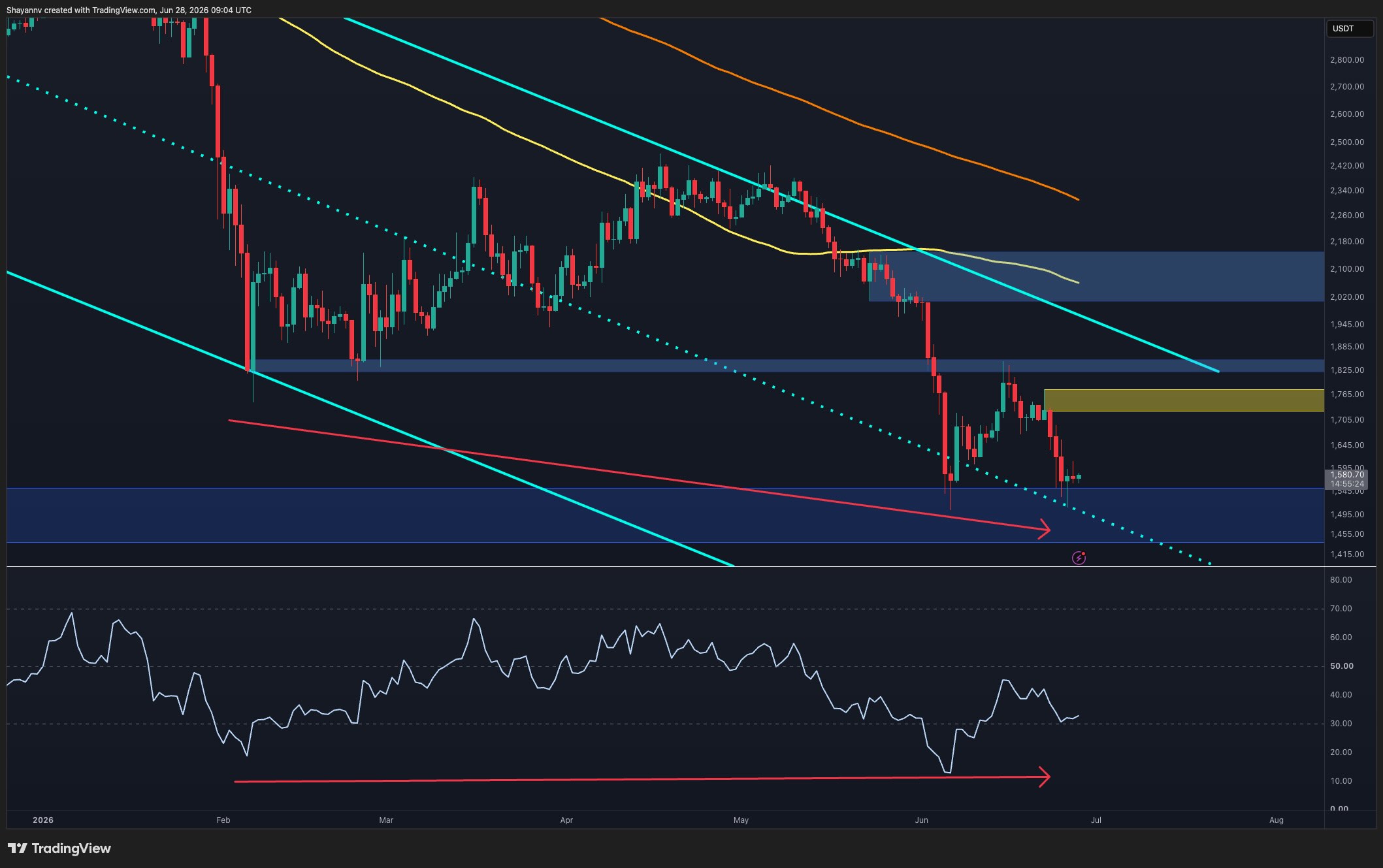
    Ethereum’s recent retreat from the $1.72K-$1.78K supply zone initiated another downward move, pushing the cryptocurrency back into the critical $1.46K-$1.53K demand region. This area has repeatedly served as support throughout June and continues to attract buyers whenever the price approaches it.

    Bullish Divergence on Daily Chart

    A significant development on the daily timeframe is the emergence of bullish divergence on the Relative Strength Index (RSI). While Ethereum has consistently made lower lows during June, the RSI has been forming higher lows near oversold territory. This divergence signals a weakening of downside momentum, even as ETH hovers near cycle lows.

    Although a bullish divergence alone does not guarantee a reversal, it often appears in the later stages of bearish trends and can serve as an early indicator that sellers are losing control. As long as ETH maintains its position above the $1.46K-$1.53K support area, the divergence remains valid, increasing the likelihood of a relief rally.

    Confirmation of a potential reversal would necessitate a break above key resistance zones, particularly the $1.72K-$1.78K supply area. Until then, the broader trend remains bearish, despite the improving momentum indicators.

    Consolidation and Trendline Resistance

    On the 4-hour timeframe, Ethereum has spent recent sessions consolidating above the lower demand zone following a sharp sell-off from resistance. A descending trendline has capped every recovery attempt since the rejection on June 22. However, the asset is now compressing directly beneath this trendline, with contracting volatility. This setup presents the possibility of a short-term breakout if buyers can overcome the trendline resistance.

    A successful breakout could target the $1.72K-$1.78K supply zone, which was the origin of the latest decline. Such a move would align with the bullish RSI divergence observed on the daily chart and could signal the first meaningful recovery rally in several weeks.

    On the downside, the $1.52K area remains a critical level to monitor. A loss of this support would invalidate the short-term bullish outlook and shift focus back toward further downside continuation within the broader downtrend. For now, Ethereum appears caught between support and descending resistance, with the next directional move likely determined by which side breaks first.

    Liquidity Heatmap Reveals Potential Upside Sweep

    The liquidation heatmap indicates an interesting shift in liquidity positioning. While liquidity remains concentrated above the current price, particularly between approximately $1.68K and $1.80K, Ethereum is currently trading below these significant clusters. Markets often gravitate toward areas with substantial leveraged positions, making these overhead liquidity pools attractive short-term targets.

    This scenario suggests that ETH could stage an upside liquidity sweep before any larger directional move develops. A breakout above the 4-hour descending trendline would increase the probability of price moving into these overhead liquidity pockets, triggering short liquidations and fueling a squeeze toward the $1.7K-$1.8K region.

    Simultaneously, the heatmap also shows notable liquidity beneath the market around the lower support region, indicating that both sides of the current range remain vulnerable to liquidation-driven volatility.

    Combined with the bullish daily RSI divergence and the compression beneath the 4-hour trendline resistance, the current setup suggests Ethereum may first attempt an upside liquidity grab before the market determines whether a more sustainable recovery can materialize. The reaction around the $1.72K-$1.80K liquidity cluster will likely offer crucial insights into Ethereum’s next major trend.

  • XRP Plunge Expected: Will Ripple Shock the Market?

    XRP Plunge Expected: Will Ripple Shock the Market?

    XRP Faces Steep Declines, But History Suggests a Potential Rebound

    The cryptocurrency XRP has endured a challenging period in recent months. Following a peak in mid-July 2025, the asset has seen a significant downturn, shedding over 70% of its value and falling towards the $1.00 mark. It has also been overtaken by BNB and USDC in market capitalization and experienced a six-month losing streak.

    Bearish Outlook Amidst Declines

    This adverse performance has led some analysts to adopt a bearish stance on XRP. While many believe the asset is at a critical juncture in the current cycle, figures like Ali Martinez have warned of potential drops to support levels at $0.80, $0.62, or even $0.51 if the $1.00 threshold fails to hold.

    Data from Glassnode indicates that XRP holders are realizing more losses than profits, suggesting sustained selling pressure even from investors currently at a deficit. Artificial intelligence platform ChatGPT has also issued cautionary predictions should XRP lose the $1.00 level, flipping it from support to resistance. However, such widespread pessimism could paradoxically set the stage for a recovery.

    Historical Precedents for Market Turns

    Market history often shows that extreme consensus, particularly widespread pessimism, can precede significant reversals. As investor Warren Buffett famously advised, “Be fearful when others are greedy, and be greedy when others are fearful.”

    Periods of extreme pessimism have frequently coincided with crucial turning points in the cryptocurrency market. Bitcoin (BTC), Ethereum (ETH), and XRP have all experienced phases where sentiment plummeted before major recoveries began. This pattern often occurs as less committed investors exit the market, allowing long-term holders to accumulate assets at lower prices.

    Signs of Accumulation and Oversold Conditions

    For XRP, evidence of such accumulation appears to be emerging from exchange-traded fund (ETF) investors. Funds tracking XRP’s performance have recorded eight consecutive weeks of inflows, a stark contrast to the significant outflows experienced by BTC and ETH ETFs.

    The recent sell-off has also pushed several on-chain and technical indicators into historically oversold territory. Some analysts suggest that XRP may be approaching a zone where the risk-reward profile becomes more favorable, despite the potential for continued short-term volatility.

    History offers a compelling parallel for XRP. In mid-June, the asset’s sentiment had similarly plunged, only to surge by double digits within 24 hours. Analytics firm Santiment attributed that rally to deteriorating investor behavior.

    June’s Weakness and July’s Potential

    Current data indicates XRP is on track to finish June with a decline exceeding 20%, marking its worst monthly performance since February 2025. CryptoRank data suggests this aligns with historical trends, as June has historically been a predominantly bearish month for XRP.

    In contrast, July has historically been a strong month for XRP. The asset has closed each of the past six Julys in positive territory, often with significant gains. Five of those six months saw double-digit price increases, including substantial rallies of over 45% in 2020 and 2023. The median gain for July stands at nearly 11%.

  • California’s DFAL Deadline Looms: XRP Fate Uncertain

    California’s DFAL Deadline Looms: XRP Fate Uncertain

    California’s Digital Financial Assets Law Looms, Impacting Ripple and XRP

    California’s Digital Financial Assets Law (DFAL) is set to take effect on July 1, mandating that any firm conducting digital asset business with state residents must obtain a DFAL license or have a pending application with the Department of Financial Protection and Innovation (DFPI). Failure to comply will require cessation of such operations. Public records currently show no Ripple entities among the applicants, a development that coincides with XRP’s price falling below the $1.10 mark amid this regulatory uncertainty.

    The DFAL encompasses a broad range of digital asset activities, including exchanges for fiat or other digital assets, transfers between individuals, custody services, and the issuance of reserve-backed instruments. These provisions directly align with Ripple’s existing operations in California, which include its payments infrastructure, custody services, and the issuance and redemption of RLUSD, its dollar-pegged stablecoin.

    Regulatory Landscape and Ripple’s Position

    Ripple’s existing portfolio of over 40 U.S. money transmitter licenses does not automatically satisfy the DFAL requirements. The new law establishes a distinct regulatory framework managed by the DFPI through the Nationwide Multistate Licensing System.

    By the July 1 deadline, companies have three avenues for legal compliance: securing a DFAL license, submitting a complete application to the DFPI, or qualifying for a limited statutory exemption. This exemption is primarily available to banks, certain trust companies, and entities already registered with the SEC or CFTC that operate within their existing regulated activities.

    Ripple has engaged with the DFPI, submitting a formal comment letter advocating for the elimination of redundant money transmitter license requirements for DFAL-licensed firms. However, this engagement does not equate to a filed license application. Law firms, including those recognized by Chambers, have characterized the DFAL as one of the most comprehensive state-level digital asset licensing regimes in the United States.

    XRP Price Dynamics Amidst Regulatory Scrutiny

    XRP is currently trading near $1.10, a significant drop from the $2.50 price point many had anticipated. Recent price action indicates weak momentum, with sellers consistently capping rallies in the $1.15 to $1.20 range. Despite ongoing attention on Ripple’s regulatory developments, the market has not yet factored in a decisively positive outcome.

    Investors remain keenly focused on several legal and regulatory milestones involving Ripple. While a previous court finding that XRP itself is not inherently a security removed a major source of uncertainty, the outstanding penalty and injunction issues remain significant as they could influence Ripple’s future business operations and market sentiment.

    From a technical standpoint, XRP must first reclaim the $1.15 to $1.20 zone before a stronger trend reversal can be discussed. Should buyers regain control and regulatory developments continue to be favorable, the next resistance level could emerge between $1.30 and $1.50. A sustained move above these levels would likely necessitate a substantial catalyst.

    On the downside, support is currently clustered around $1.05 and $1.00. A weakening of regulatory expectations or a downturn in the broader cryptocurrency markets could place pressure on these levels. The $1.00 mark represents an important psychological threshold, as a decisive breach could trigger further selling.

    For the time being, the market appears to be awaiting confirmation rather than trading on speculation. While regulatory progress could improve sentiment, XRP’s longer-term trajectory will likely be shaped by both legal clarity and a resurgence of stronger market demand.