Category: Uncategorized

  • Copilot AI Forecasts Massive Bitcoin Surge by 2026

    Copilot AI Forecasts Massive Bitcoin Surge by 2026

    Microsoft Copilot AI has presented a comprehensive outlook on Bitcoin’s price trajectory, suggesting the current market stands at a critical juncture. The AI model forecasts a realistic base scenario of $100,000 to $130,000 by the close of 2026. In a more optimistic “bull case,” the price could surge to $150,000 to $180,000, provided certain conditions align favorably.

    A Pivotal Inflection Point

    Bitcoin is currently trading around $59,800, a level the AI model identifies as a pivotal inflection point. This position signifies a transition between short-term volatility and sustained long-term structural demand.

    Several enduring forces underpin the bull case, rather than relying on a single, short-lived catalyst.

    • Digital Gold Narrative: Institutional investors continue to view Bitcoin as a form of “digital gold.” This perception has strengthened as traditional capital increasingly seeks assets that can act as a hedge against inflation.
    • ETF Demand: Demand from Bitcoin Exchange-Traded Funds (ETFs) remains robust, even amidst recent outflows. This suggests that the core buyer base has not abandoned the market, despite potentially volatile headlines.
    • Halving Impact: The lingering effects of the 2024 Bitcoin halving are also significant. With daily issuance reduced to approximately 450 BTC, supply is tightening precisely as global liquidity is anticipated to ease.

    The AI model posits that if macroeconomic conditions become genuinely supportive, adoption accelerates beyond expectations, and long-term investors gain prominence over short-term traders, the combination of these factors could propel Bitcoin’s price toward the $150,000 to $180,000 range.

    The Bear Case Scenario

    Conversely, the AI model also outlines a plausible bear case. Should prevailing macroeconomic headwinds, such as prolonged high interest rates, a recessionary shock, or renewed regulatory crackdowns, dominate the financial landscape, Bitcoin could remain confined to a range of $55,000 to $75,000 for an extended period.

    This scenario would imply a considerably longer wait for the structural bull case to materialize, with the price essentially trading sideways as these headwinds are resolved.

    Current Market Dynamics

    On a daily chart, Bitcoin is trading at approximately $59,887. This follows a significant decline from highs near $128,000 reached in October. The downtrend has been persistent, punctuated by a relief rally in May that peaked near $83,000 before reversing into the current period of weakness.

    For the past several weeks, Bitcoin’s price has been consolidating in the high $50,000s to low $60,000s, aligning closely with the $59,800 level identified as the pivotal point in the AI’s prediction. This type of tight, prolonged consolidation around a psychologically significant number often indicates a market awaiting a definitive catalyst rather than committing to a particular direction.

    Immediate resistance is observed near $64,000, a level that has been tested and failed multiple times recently. A more substantial ceiling lies further up, around $76,000, where the May rally ultimately lost momentum.

    Support is holding in the $58,000 to $59,000 zone, an area Bitcoin is currently testing. The broader market structure remains a clear downtrend dating back to October, characterized by lower highs and lower lows throughout the move.

    Momentum on the daily charts appears subdued rather than decisive, with small, choppy candles clustering near the lows, indicating a lack of strong directional conviction.

    Given the precise alignment of the current price with the predicted inflection point, the next decisive break above $64,000 or below $58,000 is likely to signal which trajectory—the base or bull case—will begin to unfold.

    A Shift in Capital Allocation

    The market is already experiencing a rotation, though its full implications may only become apparent in hindsight. Large-cap cryptocurrencies are not failing but are instead facing limitations in their upside potential. Bitcoin, Ethereum, and XRP have been consolidating against similar resistance levels for weeks, while anticipated macroeconomic tailwinds continue to be delayed.

    Institutional inflows are being postponed to subsequent quarters. Holding assets whose upside is contingent on uncontrollable catalysts is less a strategy and more a form of waiting. Capital that has weathered multiple market cycles tends to move proactively rather than waiting for destinations to become obvious.

    Early-stage infrastructure projects operate on a different economic model. Their smaller market capitalization means that even modest capital rotations can lead to significant price movements. This asymmetry arises because the market has not yet fully priced in the potential of these nascent developments. The returns are generated from the gap between current valuations and the true worth of the project.

    The fragmentation of multi-chain ecosystems imposes substantial costs on decentralized finance (DeFi) daily. Bitcoin, Ethereum, and Solana maintain isolated liquidity systems with no native interoperability. Users transferring value between these ecosystems incur direct costs through fees, slippage, and failed transactions.

    LiquidChain aims to unify these three networks into a single execution layer, enabling one deployment and full ecosystem access without cross-chain transaction taxes. The market has yet to discover this solution, which is the core of its potential.

    The LiquidChain presale is currently priced at $0.01454, having raised over $840,000. This represents an early stage in its lifecycle, with inherent risks such as unproven execution and unknown adoption rates. While established assets offer a more predictable path to a visible ceiling, this opportunity provides an earlier entry into a project still in its foundational phase.
  • XRP Faces Crucial Decision as Calm Precedes Potential Volatility

    XRP Faces Crucial Decision as Calm Precedes Potential Volatility

    XRP Faces Intense Selling Pressure Amidst Broader Crypto Downturn

    XRP is currently experiencing significant selling pressure, a trend that mirrors the broader cryptocurrency market. Both its trading pairs against Tether (USDT) and Bitcoin (BTC) are entrenched in clear downtrend structures. While the dollar-denominated pair is testing a critical demand zone, the BTC pair is hovering just above a key support level, placing the market at a pivotal juncture.

    XRP/USD Analysis

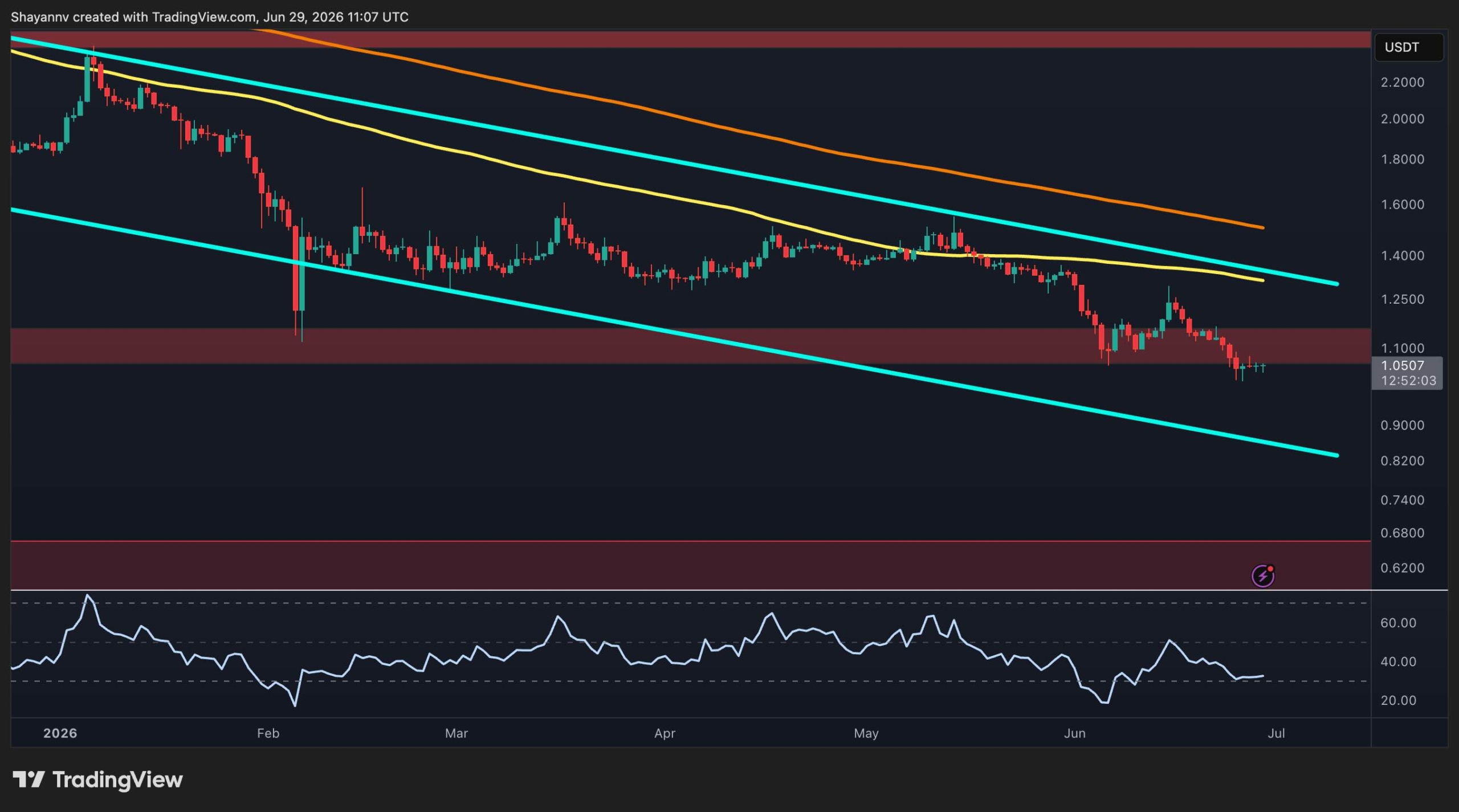
    On the daily chart, XRP continues to exhibit its established bearish structure, remaining confined within a long-term descending channel. The digital asset is presently trading around the $1.05 mark, having failed to establish higher lows in recent weeks, a clear indication of sustained seller dominance on higher timeframes.

    The most significant support for XRP/USD is now situated between $1.00 and $1.10, an area where the price is attempting to find stability. This zone has historically attracted buying interest and could potentially trigger a relief bounce if buyers successfully defend it. However, the overarching trend remains bearish, with XRP trading below both its 100-day and 200-day moving averages. These averages are both sloping downwards, serving as dynamic resistance levels.

    Any attempt at a recovery is likely to encounter its initial hurdle around the 100-day moving average, which is positioned near the $1.30 level and aligns with the upper boundary of the descending channel. A decisive break above both this channel resistance and the moving average would be necessary to signal a meaningful shift in the market’s structure.

    Conversely, a failure to hold the current support area could expose XRP to the lower boundary of the descending channel, located near the $0.80 region. This makes the current support zone particularly crucial for the medium-term outlook.

    XRP/BTC Analysis

    Against Bitcoin, XRP continues to underperform, with the XRP/BTC pair firmly entrenched within its own descending channel. The pair is currently trading at approximately 1,750 satoshis, sitting directly above a horizontal support level that has repeatedly halted deeper declines since May.

    Despite this support holding on multiple occasions, none of the subsequent rebounds have resulted in a clear bullish breakout, underscoring persistent selling pressure and a lack of sustained upward momentum. Repeated rejections near the 100-day moving average further reinforce the bearish structure.

    On the upside, the first major horizontal resistance is observed around 1,850 satoshis, which converges with the declining 100-day moving average. Above this, stronger resistance emerges near 2,000 satoshis, followed by the descending 200-day moving average and the upper channel resistance. As long as XRP remains below these resistance clusters, the trend against Bitcoin suggests continued relative weakness.

    On the downside, a confirmed breakdown below the 1,700 satoshis support region would likely invalidate the current consolidation pattern and pave the way for another downward leg towards the psychological support level around 1,500 satoshis, and potentially lower. This positions XRP at a critical decision point on both its USDT and BTC charts, as buyers and sellers vie for dominance over the prevailing trend.

  • BNY Mellon Taps Circle’s USDC for Institutional Clients

    BNY Mellon Taps Circle’s USDC for Institutional Clients

    BNY Mellon Expands Stablecoin Services for Institutional Clients

    The Bank of New York Mellon (BNY), the United States’ oldest bank, has deepened its collaboration with Circle to offer new stablecoin services tailored for institutional clients.

    Under the agreement, Circle’s USD Coin (USDC) will be the inaugural stablecoin available on BNY’s Digital Asset Custody platform. This integration will empower BNY clients to manage USDC, including storage, transfers, minting, and burning, through the bank’s established custody services.

    The move significantly expands BNY’s role as the primary custodian for USDC reserves, according to an official blog post. Institutional clients utilizing BNY’s digital asset custody platform can now hold USDC within their custody wallets and leverage the bank to facilitate the conversion of U.S. dollars into USDC via Circle.

    Clients will also have the capability to redeem USDC for U.S. dollars through the burning mechanism. Circle stated that these services are designed to encompass the full spectrum of institutional stablecoin operations, bridging traditional cash services with digital asset custody within a unified framework. BNY highlighted that these stablecoin functionalities are integral to its comprehensive Digital Assets platform, which aims to assist institutional clients in navigating the evolving intersection of traditional finance and digital assets.

    By integrating custody and cash management services, BNY intends to provide access to blockchain-based networks while upholding the stringent controls, governance, and operational resilience demanded by institutional markets. The bank also indicated plans to extend support to other stablecoin issuers and additional digital cash workflows in the future.

    Carolyn Weinberg, BNY Mellon’s Chief Product and Innovation Officer, commented, “As digital assets become increasingly integrated into financial markets, institutions need infrastructure that seamlessly works across traditional and blockchain-based systems. With the addition of our enhanced stablecoin enablement capabilities, we’re expanding the ways clients can move value with the operational scale, trust, and resiliency they expect from BNY.”

    BNY Mellon and Circle initially formed a partnership in March 2022, when the bank was appointed as a primary custodian for the reserves backing the stablecoin. Since then, BNY has consistently bolstered its presence in the digital asset sector over the past few years.

    This year, the financial institution expanded its digital asset custody business by partnering with Finstreet and ADI Foundation to develop regulated crypto infrastructure within Abu Dhabi’s ADGM financial hub.

  • Bitmine Acquires 27,000 ETH Amid Market Downturn, Nearing 5% of Supply

    Bitmine Acquires 27,000 ETH Amid Market Downturn, Nearing 5% of Supply

    Bitmine Expands Ethereum Holdings Amid Market Downturn

    [City, Date] – Bitmine Immersion Technologies, a prominent former Bitcoin miner, has once again increased its Ethereum holdings. The move comes during a week where the cryptocurrency experienced a significant slump, falling by over 8% and hitting a multi-month low of $1,500 before finding some support.

    The company now holds just over 5.7 million ETH tokens, representing approximately 4.7% of Ethereum’s total circulating supply of 120.7 million coins.

    Based on an ETH price of $1,570 as of June 28, Bitmine’s total crypto, cash, and investment holdings are valued at roughly $10 billion. This expansion solidifies its position as the world’s largest corporate holder of ETH and the second-largest public crypto treasury, trailing only Strategy, which recently announced a new initiative unrelated to Bitcoin purchases.

    Chairman and long-time Ethereum proponent Tom Lee acknowledged the recent market weakness but expressed confidence in Bitmine’s long-term strategy.

    “This past week was a challenging one for crypto investors as ETH fell by 8%, even as Ethereum witnessed notable positive developments such as the creation of Ethlabs, and even the Bank of England softened its stance around stablecoins,” Lee stated. “We are nearing quarter-end for June, and it is not surprising to see ‘window dressing’ leading to investors reducing their holdings in assets which have fallen in the past 3 months.”

    Lee reiterated his belief that Ethereum is poised to benefit from Wall Street’s increasing adoption of blockchain-based financial infrastructure and the development of agentic AI payment systems operating on crypto networks.

    A press release from Bitmine also highlighted that the company has staked nearly 4.9 million tokens, representing over 85% of its total holdings, through its institutional staking platform, MAVAN. With a current staking yield of 2.75%, this is projected to generate an annualized revenue of approximately $211 million.

    While Bitmine maintains its lead in ETH accumulation, rival SharpLink made a notable return to the market last week with significant purchases. After an eight-month hiatus, the firm, chaired by Joe Lubin, acquired 5,000 ETH on Friday and continued to add to its holdings over the weekend.

    In total, SharpLink invested over $62 million to acquire 39,196 ETH, a quantity exceeding Bitmine’s purchases during the same period. However, the substantial difference in their overall holdings means the gap between the two remains considerable.

  • $18.5M ADA Heist: Even Wallet Creator Unaware of Thief

    $18.5M ADA Heist: Even Wallet Creator Unaware of Thief

    Hacker’s Identity Shrouded in Mystery as $18.5 Million in ADA Moves from Vulnerable Wallets

    Cardano – The identity of the “white hat” hacker who moved approximately $18.5 million worth of ADA from vulnerable SecondFi wallets remains unknown to Emurgo, the firm that developed the platform, according to Charles Hoskinson.

    Hoskinson, speaking on June 25 during his X Spaces session titled ‘The Bingo Hall,’ relayed information from a contributor named ‘Jer.’ Jer had attended a meeting between the Cardano governance body Intersect and SecondFi’s developers. “A member of the Emurgo team said the identity of the white hat hacker is not known to Emurgo… or at least [Emurgo] said it is not affiliated with Emurgo,” Hoskinson stated.

    This distinction is significant, leaving open the possibility that Emurgo may be unaware of the hacker’s identity or is strategically managing its public statements.

    The price of ADA has seen a notable decline, dropping 21% over the past two weeks and currently trading near $0.145. These levels represent multi-year lows, approximately 95% below the asset’s all-time high.

    While the recent crypto incident did not compromise the Cardano protocol itself – with both Intersect and Hoskinson emphasizing that the vulnerability was confined to the wallet application layer – the reputational impact on the ecosystem is tangible, and the market appears to be factoring this into ADA’s valuation.

    Recovery Efforts Underway for Affected Users

    The team managing the recovery process is reportedly on track with an estimated two-week timeline. Significant progress is being made as engineering teams explore multiple technical avenues concurrently to identify the most secure method for recovering funds for affected users.

    SecondFi, a prominent Cardano wallet provider formerly known as Yoroi Wallet, experienced a critical flaw in its key-generation software. This led to three external attackers draining an estimated 16 million ADA, valued at approximately $2.4 million, from 374 addresses across four separate incidents.

    The larger movement of 129 million ADA, which is at the heart of the identity dispute, was characterized by SecondFi as an emergency rescue operation. These funds were reportedly transferred to an “independent, qualified third-party custodian” for the benefit of the affected addresses. Cybersecurity firm SlowMist has estimated the total exposure could surpass $20 million.

    SecondFi conducted a final balance snapshot on June 26 and has stated its intention to return lost user assets within two weeks. However, the company has cautioned that this timeline is not guaranteed and has advised users against moving funds to new wallets in the interim, warning that “independent actions taken outside of official guidance create additional risks.”

    Technical Analysis of ADA Price Action

    ADA is currently trading near $0.145, marking a 21% decrease over the last two weeks. The cryptocurrency is trading well below its 50-day Exponential Moving Average (EMA) of $0.1904, its 100-day EMA of $0.2248, and its 200-day EMA of $0.3006.

    The Relative Strength Index (RSI) is hovering around 29, approaching oversold territory. The Moving Average Convergence Divergence (MACD) has turned marginally positive, suggesting a fading bearish momentum rather than a confirmed reversal.

    Key support is identified at the psychological level of $0.140, with a structural low near $0.1382. A daily close below $0.1451 could expose this zone directly.

    On the upside, initial resistance is observed in the $0.1726–$0.1737 range, which encompasses a broken descending trendline and the 23.6% Fibonacci level. Further resistance is expected at the 50-day EMA ($0.1904) and the 38.2% Fibonacci retracement level ($0.1957).

    The CoinGlass long-to-short ratio stands at 0.72, the lowest it has been in over a month. Funding rates are negative at -0.0055%, indicating that short positions are currently paying long positions, a mild contrarian signal.

  • Bybit Lists Nibiru (NIBI) v2.15.0 Upgrade

    Bybit Lists Nibiru (NIBI) v2.15.0 Upgrade

    Bybit to Support Nibiru Network Upgrade, Halting Deposits and Withdrawals

    Cryptocurrency exchange Bybit has announced its support for the upcoming Nibiru (NIBI) v2.15.0 network upgrade. The upgrade is scheduled to occur on June 30, 2026, at approximately 02:00 AM UTC, or upon reaching block height 42,739,079.

    In preparation for the transition, Bybit will temporarily suspend deposits and withdrawals for Nibiru (NIBI) starting at 01:00 AM UTC on June 30, 2026. The exchange has assured users that trading activities will remain unaffected during this period.

    Bybit has stated that no further announcements will be made regarding the resumption of deposit and withdrawal services. Users wishing to be notified when these services are back online are advised to visit the Deposit or Withdrawal page and select the “Set Alert” option.

    Further details about the Nibiru network upgrade can be found in the official release notes.

  • Ansem Meme Coin Deployer Nets $5.5K, Ansem Claims $71M

    Ansem Meme Coin Deployer Nets $5.5K, Ansem Claims $71M

    Meme Coin Named After Influencer Skyrockets, Deployer Nets Minimal Profit

    A Solana-based meme coin bearing the name of prominent crypto influencer Ansem has surged to a fully diluted valuation exceeding $108 million. On-chain data reveals that Ansem’s own wallet holds over $71 million worth of the token. In stark contrast, the individual who initially launched the coin reportedly walked away with a profit of just $5,500.

    On June 29, on-chain analytics firm Lookonchain detailed the situation, stating that the deployer, identified by the wallet tag “yHCxHB,” invested $6,300 to launch The Black Bull (ANSEM). During the launch, the deployer acquired 792.45 million tokens. Of this amount, 650 million tokens were transferred directly to Ansem’s wallet without charge. The deployer subsequently sold the remaining 142.45 million tokens for $11,800, resulting in a net profit of $5,500. The meme coin has since achieved a market capitalization of over $43 million, according to CoinGecko.

    Hupzy, an analyst at Spot On Chain, offered a direct interpretation of the figures. “The deployer handed over 80%+ of his allocation to a single influencer for free, strongly suggesting a pre-arranged promotion deal,” Hupzy wrote. “Ansem’s incentive is to pump and dump. The deployer making only $5,500 confirms he was in it for the relationship, not the token.”

    Hupzy further noted that ANSEM’s supply structure is “highly concentrated” and “influencer-controlled,” cautioning that any price movements should be viewed as “potentially manipulated.” Rugcheck.xyz echoed this warning, flagging a risk of market manipulation due to the significant concentration of tokens in unidentified wallets.

    As of this report, ANSEM is trading around $0.108, marking a roughly 284% increase in the past 24 hours and a staggering over 19,000% rise over the past week. The token reached an all-time high of $0.1212 earlier today and recorded a 24-hour trading volume of approximately $87.8 million, a 245% jump from the previous day.

    A tracking account for the Pump.fun ecosystem has been documenting the meme token’s ascent in real-time. It noted that ANSEM was the top-traded token on Pump.fun by volume in the last 24 hours, with $60 million in trades, significantly outperforming tokens like Jotchua ($5.63 million) and Fartcoin ($3.77 million).

    The same account indicated that Ansem linked his X account to Pump.fun 12 days ago and announced he would share a portion of creator rewards with his followers. This announcement appears to have generated substantial early interest, with some traders profiting from early entry.

    Lookonchain highlighted one wallet, CxCTVj, which achieved a 261x return by converting $2,330 into $614,500 after purchasing 14.2 million ANSEM tokens near the coin’s inception. Another trader reportedly bought $3,370 worth of the asset when its market cap was around $4 million, later selling for $37,580, securing an 11x gain.

    Analyst Ash Crypto pointed out on X that ANSEM had experienced a dramatic surge, moving from a market capitalization of $173,000 to nearly $109 million in a single day, representing a move of approximately 63,000%.

    However, the broader meme coin sector has faced significant downturns. Data from CryptoRank indicates that the sector has lost over 84% of its collective value from a 2024 peak of $135 billion to the current $20.74 billion. The sharp, vertical ascent of ANSEM in such a declining market has drawn comparisons to other meme coins like SIREN, which experienced a 95% crash after its whales liquidated 92% of the circulating supply.

    Analytics platform Bubblemaps and on-chain investigator ZachXBT had previously warned about SIREN’s concentrated supply months before its collapse. It remains to be seen if ANSEM will face a similar fate, but current data indicates that a single wallet controls a substantial portion of the supply, while the coin’s deployer has realized minimal profits.

  • Ukraine Seizes $8.3M in Crypto for State Management

    Ukraine Seizes $8.3M in Crypto for State Management

    Ukraine Takes Custody of Seized Cryptocurrency in Landmark Move

    Ukraine has officially taken its first seized cryptocurrency into state custody, marking a significant development for a nation that has quietly emerged as one of the world’s largest government holders of digital assets.

    More than $8.3 million in the stablecoin USDT has been transferred to a cryptocurrency wallet managed by ARMA, Ukraine’s asset-recovery agency, the country’s Prosecutor General’s Office announced in a statement on Telegram. “This is the first case where seized crypto assets have actually been transferred to the management of the state,” the office stated, according to a translation of the post.

    The USDT originated from wallets reportedly controlled by a member of an international hacking group. The State Bureau of Investigation alleges that the group conducted cyberattacks across Europe and the U.S., stealing confidential data, demanding ransoms, and laundering the proceeds within Ukraine by acquiring real estate, vehicles, and other high-value assets.

    Prosecutors estimate the damages caused by the group’s activities to be as high as $100 million. Four individuals, including the alleged ringleader, have been detained and remain in custody. Authorities have seized over $11.1 million in assets, including homes, vehicles, $1 million in cash, and the cryptocurrency.

    ARMA, officially the National Agency for Finding, Tracing and Management of Assets, is responsible for overseeing property seized in criminal cases. This marks its inaugural handling of digital assets, following a 2025 reform of the agency, which had faced criticism. The overhaul unlocked hundreds of millions of euros in European Union support and aimed to enhance transparency in the management of seized assets.

    This milestone occurs as Ukraine, a country with a highly active cryptocurrency landscape, formalizes its approach to digital assets. According to Chainalysis, Ukraine ranked fourth in Europe for crypto transaction volume, receiving $206.3 billion between mid-2024 and mid-2025. Public officials reportedly hold approximately $2.8 billion in Bitcoin. Local media reports from last year also indicated that the country has been exploring the possibility of establishing a strategic crypto reserve.

    Ukraine legalized virtual assets in 2022 and is currently advancing legislation to tax and regulate the market in alignment with European Union standards, a move that supports Kyiv’s bid for EU membership. Parliament passed the bill in its first reading last year.

    The UK’s Royal United Services Institute estimated last year that Ukraine could recover at least $10 billion in stolen funds and lost tax revenue by strengthening its crypto regulations. The institute warned that lax oversight had transformed the country into a hub for money laundering, including Russian funds. The transfer of seized cryptocurrency into state hands represents a step toward establishing the necessary formal frameworks to address this issue.

    “Modern crime has long since moved into the digital space,” the Prosecutor General’s Office stated. “We continue to work.”

  • Pi Network Pioneers: Essential Pi2Day Guide

    Pi Network Pioneers: Essential Pi2Day Guide

    Pi2Day Arrives with Ecosystem Expansion, Token Price Dips

    June 28, celebrated by the Pi Network community as Pi2Day, a nod to the mathematical constant π, has historically been a period of heightened anticipation for potential token listings or significant feature rollouts. This year’s event, however, saw the native token’s value decline further following the team’s latest announcements.

    Leading up to Pi2Day, speculation ran high within both the community and among observers. Hopes ranged from the introduction of major new functionalities to rumors of listings on prominent exchanges, echoing the excitement that surrounded Pi Day on March 14, which saw discussions about a potential Kraken listing.

    The actual announcement detailed the launch of three new initiatives: SoloHost, Pi Sign-in, and PiVerify. These developments are designed to broaden the Pi Network’s reach beyond its core applications, extending into artificial intelligence, digital identity, and third-party services. The aim is to position Pi as a versatile platform supporting AI applications, decentralized computing, and digital identity, moving beyond its foundational blockchain capabilities.

    These three launches effectively extend Pi’s utility by allowing developers, businesses, and third-party applications to tap into the network’s computing infrastructure, user base, and Know Your Customer (KYC) capabilities.

    SoloHost appears to be the flagship release, designed to support AI applications running locally on user devices. This includes the new Homes AI assistant, which processes and stores data entirely on the user’s machine, eschewing cloud infrastructure. The Pi Network team stated this approach enhances user privacy and reduces reliance on centralized servers.

    The second major feature, Pi Sign-in, will enable users to authenticate into supported third-party websites and applications using their Pi credentials. This offers external developers access to Pi’s verified user base while streamlining the login process for existing Pi Pioneers.

    Rounding out the new offerings is PiVerify, a new identity verification service that opens Pi’s existing KYC infrastructure to external businesses. The team highlighted that Pi’s hybrid AI-and-human verification system has already processed over 18 million users across more than 200 countries and regions. PiVerify will integrate with this system, empowering fintech companies, exchanges, Web3 applications, and other businesses to utilize Pi’s identity infrastructure for customer onboarding, anti-money laundering (AML) screening, duplicate account detection, and compliance processes.

    Despite the introduction of these new features aimed at enhancing the overall user experience, the protocol’s native token has experienced a “buy the rumor, sell the news” reaction. PI has seen a decline of over 4% in the past 24 hours, a move that contrasts with a broader market rebound from weekend lows.

    PI briefly dipped below $0.12 but has managed to stay just above its all-time low of $0.1189. While currently trading above $0.12, the token remains down 10.5% for the week. Furthermore, it is still approximately 96% below its all-time high of $2.99, which was recorded in February 2025.

  • Loopring Shuts DEX, Citing Engineering Focus

    Loopring Shuts DEX, Citing Engineering Focus

    Loopring DEX to Cease Trading Services Amid Technical and Business Challenges

    Loopring, a pioneer in launching zero-knowledge rollups on Ethereum, has announced the immediate cessation of all trading services on its decentralized exchange. The platform’s relayer has already been taken offline.

    The decision, made with considerable regret after years of effort to maintain operations, stems from a confluence of factors, according to the team.

    A primary driver for the closure was the platform’s inherent technical limitations. Loopring’s initial zkRollup design lacked a virtual machine, which constrained its composability and restricted its potential for broader real-world applications, including payment solutions. These limitations hampered ecosystem growth and made it difficult for Loopring to remain competitive against emerging technologies.

    The team also acknowledged a disparity in their strengths, admitting to possessing stronger engineering acumen than business development expertise. They described themselves as “engineers at heart, not business operators.” Further compounding the challenges, the delisting of its native token, LRC, from major exchanges in 2026 added significant pressure to the project.

    “We poured countless late nights into building the very first zkRollup on the market. That achievement still fills us with pride,” the team stated. “But today, we must face reality and announce, with deep regret, that Loopring DEX will cease all trading services effective immediately.”

    Loopring explained that newer zkEVM solutions, which offer compatibility with Ethereum smart contracts and greater interoperability, have outpaced its specialized architecture. The team views its technology as now outdated and concluded that shutting down the service was preferable “rather than running a hollow service.”

    User Funds Secured, Distribution Process Underway

    The company assured users that their funds remain secure and outlined a distribution process for asset repatriation. Rather than requiring users to navigate the original self-custody withdrawal mechanism involving Merkle proofs, Loopring will manage the entire process and absorb all associated transaction fees. While acknowledging this approach is more centralized, the team characterized it as the most straightforward option for users.

    Loopring also plans to publish a comprehensive list of final account balances in the coming days. This will encompass spot holdings and liquidity pool positions, which will be converted into their underlying tokens. A two-week review period will be provided for users to verify their balances before distributions commence.

    In a separate incident in June 2024, attackers reportedly stole approximately $5 million from users of the Loopring wallet who relied exclusively on the platform’s Official Guardian service for account recovery. The breach was attributed to a vulnerability in the service’s two-factor authentication system, which enabled attackers to impersonate wallet owners and gain unauthorized access to their accounts.