Category: Uncategorized

  • XRP Price Poised for Surge Past $8, But Key Zone Remains Resistance

    XRP Price Poised for Surge Past $8, But Key Zone Remains Resistance

    Ripple (XRP) has seen its value plummet by nearly 10% over the past week, thwarting multiple attempts at recovery. The cryptocurrency is currently trading around $1.11, following a 2% dip on Tuesday.

    Potential for Significant Gains

    Despite the recent downturn, a market analysis by crypto analyst EGRAG CRYPTO suggests that XRP could surge to between $5.70 and $8 if historical price patterns surrounding a key technical level hold true.

    EGRAG CRYPTO highlighted that XRP’s “Central Line” has historically served as a dividing point between periods of accumulation and significant price expansion. The analyst noted that the token has experienced substantial gains in previous market cycles after breaking above this level, leading to the identification of two potential upside targets for the current cycle.

    According to the analyst’s chart, XRP is presently trading below the Central Line, which is positioned above the asset’s current market price and is projected to move into the approximately $2.20-$2.60 range over time. These projected targets are based on historical percentage gains above this level, rather than XRP’s current trading price.

    EGRAG CRYPTO detailed that in one past cycle, XRP surged approximately 330% above the Central Line, while another saw gains of around 200%. An average of these movements suggests a potential expansion of roughly 265% above the Central Line, which the analyst estimates could place the asset near the $8 mark.

    The analyst also presented a more conservative outlook, where XRP achieves only a portion of the gains seen in prior cycles. In this scenario, if the market delivers approximately 60% of the strength observed in the previous cycle, it would translate to an increase of about 120% above the Central Line, setting a target near $5.70.

    Based on these calculations, EGRAG CRYPTO has identified $5.70 as the conservative target and $8 as the objective based on average historical cycle performance. These projections are rooted in historical price expansions above the Central Line, independent of current market sentiment.

    The analyst cautioned that XRP remains below the Central Line, indicating it is still trading within an “uncomfortable zone.”

    Easing Selling Pressure and Shifting Exchange Activity

    Meanwhile, separate data from CryptoQuant indicates a potential easing of selling pressure on XRP, as large holders appear to be reducing transfers to Binance. Whale activity on the exchange has decreased in recent weeks, suggesting a reduction in short-term selling. However, XRP continues to trade below the McGinley Dynamic indicator, signaling weak overall momentum. A reclaim of this level is deemed necessary to support a stronger recovery, with the $1.08 area remaining a crucial support zone.

    Concurrently, XRP activity has shown a notable shift towards South Korea’s Upbit exchange. Data reveals that Upbit’s net wallet-flow dominance surged from 13% on June 8 to 37% by June 22, marking its highest level in over a year.

    During the same period, Binance’s reading dropped from 16% to zero, while Crypto.com also fell to zero, and Coinbase remained around 9%. Just two weeks prior, Binance had slightly outperformed Upbit, but the latest figures indicate a growing concentration of XRP deposits on the South Korean platform. This metric tracks whether deposits exceed withdrawals on individual exchanges, rather than total XRP holdings.

  • Ripple’s MiCA Approval Fuels RLUSD, XRP Holds $1.10 Support

    Ripple’s MiCA Approval Fuels RLUSD, XRP Holds $1.10 Support

    Ripple Secures Preliminary EU Crypto License, XRP Sees Little Impact

    Ripple has obtained preliminary approval as a Crypto Asset Service Provider (CASP) from Luxembourg’s financial regulator, the CSSF, under the European Union’s Markets in Crypto-Assets (MiCA) regulation. Despite this significant regulatory milestone, the price of XRP dipped 3% following the announcement, trading at $1.10 and down 5% over the past 24 hours amid a broader crypto market downturn.

    The approval, while a genuine regulatory achievement, did not translate into a direct catalyst for XRP. Ripple’s announcement framed the development primarily around its stablecoin, RLUSD, and its Ripple Payments infrastructure. XRP was mentioned only as a foundational element supporting these solutions, appearing as a secondary detail within Ripple’s own communication about its network’s native token.

    This CASP green light permits Ripple to offer regulated crypto-asset services across all 30 member states of the European Economic Area. However, it does not establish a direct demand mechanism for XRP.

    A Phased Approval Process

    The CSSF’s approval takes the form of a “Green Light Letter,” signifying preliminary consent that is contingent upon meeting final conditions before full MiCA compliance is officially conferred. Ripple stated that once fully approved, this CASP license, combined with its existing Electronic Money Institution (EMI) license also issued by Luxembourg, will ensure its complete compliance with MiCA.

    The core of this approval focuses on Ripple Payments and the infrastructure for distributing RLUSD. The commercial proposition is that European banks, fintech companies, and corporations can manage collections, exchanges, and payouts through a single, integrated Ripple solution spanning the entire EEA.

    Stablecoin Status Under MiCA Remains Unclear

    A crucial nuance not fully resolved by Ripple’s announcement concerns the regulatory standing of RLUSD itself. While a CASP license authorizes crypto-asset services, it is distinct from the separate authorization required for a stablecoin to be issued as a MiCA e-money token. Ripple’s announcement highlights its stablecoin payments infrastructure but does not clarify RLUSD’s specific status under MiCA’s non-euro token regime, which imposes limitations on the use of dollar-pegged stablecoins as a means of exchange within the bloc.

    In contrast, Tether’s USDT was effectively excluded from the European market prior to MiCA’s implementation, as Tether opted not to seek approval. Circle, however, successfully brought its stablecoins, USDC and EURC, into compliance through its EMI. The precise positioning of RLUSD within this regulatory landscape is a key question that institutions will likely seek clarification on before committing to integration.

    Late Entry Compared to Competitors

    Ripple’s achievement also comes later than that of some of its peers. MiCA became fully applicable to crypto-asset service providers in December 2024. Competitors like Circle secured their approvals in April 2025, while B2C2 obtained a CASP license from the Luxembourg CSSF in May 2025. Major exchanges such as OKX, Coinbase, and Kraken also received clearance throughout 2025.

    A Comprehensive Payments Solution

    Ripple’s key differentiator lies in its combined EMI and CASP offering, presenting a “one regulated rail for the entire payments flow.” This is supported by over $100 billion in Ripple Payments volume across more than 60 markets and a global portfolio of over 75 licenses, presenting a compelling proposition for enterprise clients. Crucially, this strategy does not direct revenue or demand through XRP.

    This approach is consistent with a broader trend. The XRP community has recently voiced concerns about Ripple’s strategic priorities, particularly regarding the development of RLUSD over the performance of XRP. RLUSD’s regulatory pathway extends beyond Europe, with a California DFAL filing deadline adding another stablecoin-focused regulatory hurdle.

    The consistent pattern across major Ripple announcements this cycle confirms a singular thesis: the company is building a compliant payments infrastructure where RLUSD is the primary product, and XRP serves as background infrastructure. The MiCA green light has not yet been factored into XRP’s valuation because, structurally, there is no direct benefit for XRP to be priced in.

  • Thailand Probes $300M Chinese Crypto Laundering Ring

    Thailand Probes $300M Chinese Crypto Laundering Ring

    Thailand Intensifies Crypto Mining Crackdown, Targeting Chinese Crime Syndicates

    Thailand’s premier investigative agency is escalating its crackdown on illicit cryptocurrency mining operations, which it alleges are being used as a front for money laundering by Chinese-linked criminal syndicates.

    The Department of Special Investigation (DSI) announced Friday that it has broadened its inquiry into a network of “grey” Chinese capital—a term referring to illicit funds channeled through seemingly legitimate avenues—connected to illegal mining and transnational money laundering. According to a DSI press release, these financial flows are estimated to exceed 10 billion baht ($300 million) annually.

    The investigation originated from raids conducted in 2025, during which the DSI’s Technology and Cyber Crime Bureau dismantled three mining networks suspected of stealing electricity to power their equipment. Authorities confiscated over 6,390 machines, estimating the financial damage to the state-run Provincial Electricity Authority at more than 953 million baht, approximately $29 million. This incident represents one of the most significant instances of utility theft in recent memory.

    Investigators claim these mining operations served as a central hub for laundering proceeds from call-center scams and online gambling. Myanmar nationals were reportedly recruited to withdraw substantial sums, ranging from 30 million to 50 million baht ($920,000 to $1.5 million) daily, in cash from Thai banks.

    The DSI has issued arrest warrants for eight individuals, including four Chinese financiers and four Myanmar nationals. The agency is actively seeking seven additional suspects and has summoned five others to face charges.

    One key figure identified by the DSI is Wang Yicheng, who is also a suspect in a major digital asset fraud case flagged by U.S. law enforcement. The U.S. Secret Service has seized over $17.8 million (approximately 620 million baht) in cryptocurrency linked to Wang, connected to losses exceeding 2 billion baht. Wang, a businessman based in Bangkok, had previously come under American scrutiny when the Secret Service traced funds from a U.S. scam victim to a cryptocurrency account in his name, which authorities linked to a “pig butchering” operation.

    The probe has also implicated Thai officials. The DSI has referred two cases to the National Anti-Corruption Commission. These cases involve seven officials from the electricity authority, one law enforcement officer, and 13 investors or alleged accomplices accused of facilitating the miners’ access to power and aiding them in evading detection.

    This expanded crackdown builds upon a series of raids that commenced in December, when the DSI seized 3,642 mining rigs valued at $8.6 million from locations associated with Chinese scam networks operating out of Myanmar.

    The intensified efforts in Thailand align with a broader regional push across Southeast Asia to combat cryptocurrency-linked power theft. Malaysia’s state utility has reported approximately $1.1 billion in stolen electricity over the past five years, and the United Nations Office on Drugs and Crime has issued warnings that transnational gangs are increasingly utilizing illegal crypto mining for money laundering purposes, moving billions of dollars.

  • XRP Faces Deeper Drop as $1.07 Support Falters

    XRP Faces Deeper Drop as $1.07 Support Falters

    XRP Faces Renewed Pressure as Key Support Level Tested

    XRP’s recovery attempt last week has faltered, with sellers reasserting control near a significant resistance zone. This has pushed the cryptocurrency back towards a crucial support area, which is now shaping the short-term trend.

    Daily Chart Analysis

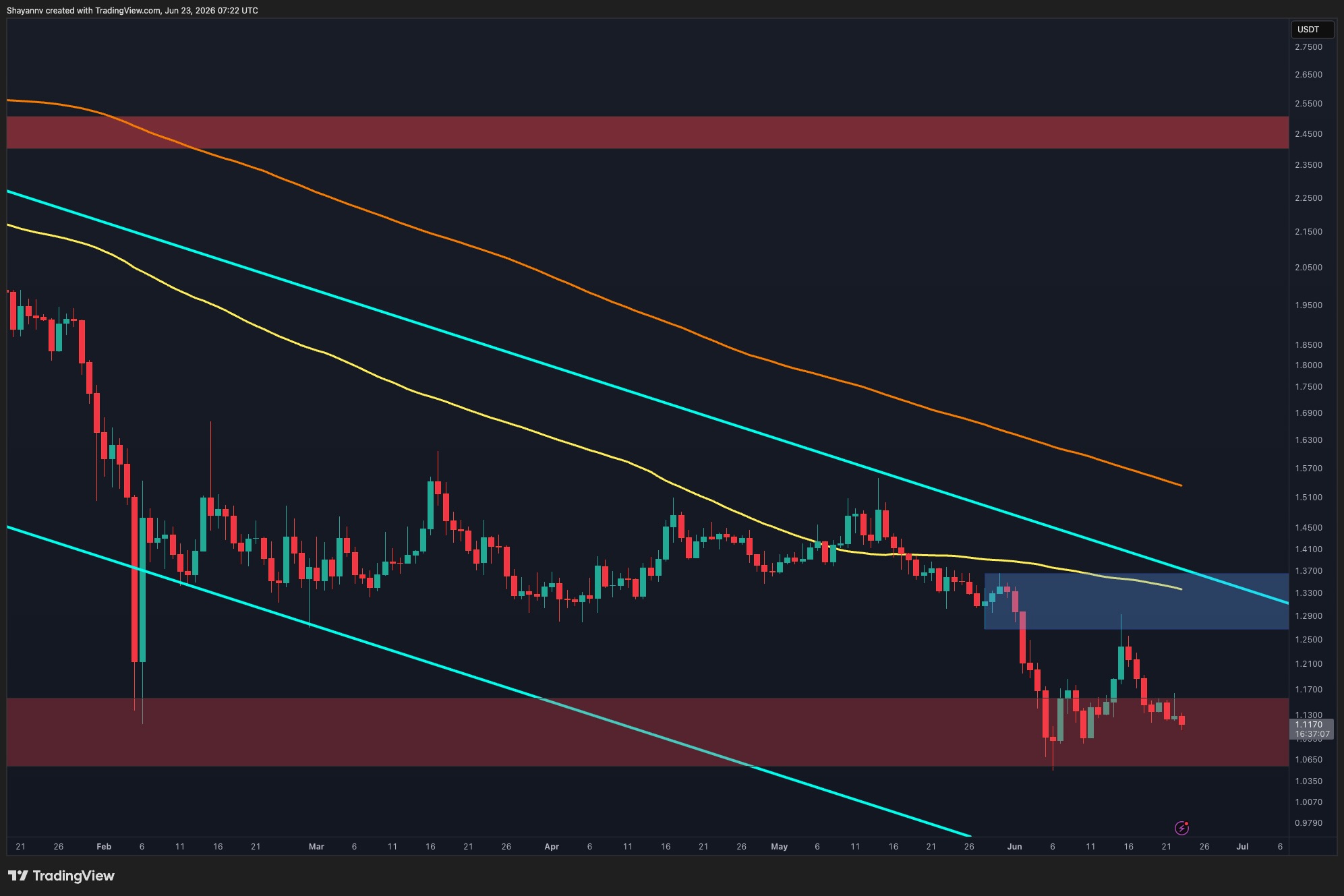
    On the daily chart, XRP continues to trade within a broad descending channel, remaining below both its 100-day and 200-day moving averages. A recent rebound stalled just below the 100-day moving average and the lower end of a key resistance zone, estimated between $1.28 and $1.35. This failure to break higher reinforces the bearish structure observed on higher timeframes.

    The most recent price action saw XRP rejected from this resistance area, leading to a subsequent decline back towards the demand zone between $1.07 and $1.15. This support region has proven attractive to buyers throughout June and remains the most critical level on the chart.

    As long as XRP can maintain its position above this zone, the market may continue to consolidate within its current trading range. However, a decisive breach below $1.07 would expose the previous swing low and significantly increase the likelihood of a further downward movement.

    For any meaningful trend reversal to be considered, buyers must first reclaim the resistance area between $1.28 and $1.35.

    Short-Term Momentum Deteriorates

    The 4-hour chart reveals a clear weakening of short-term momentum. After failing to surpass the ascending resistance trendline and the supply zone between $1.26 and $1.3, XRP reversed course, erasing most of its recent gains.

    Notably, the latest rebound from the support zone resulted in another lower high near $1.25 before sellers took charge. Since then, the price has drifted back towards the $1.1 support region and is currently trading near the lower boundary of this range.

    Current price action suggests diminishing buying pressure, with XRP struggling to generate any substantial bounce despite being positioned on support. This places increased focus on the $1.07 to $1.15 demand zone.

    Should buyers successfully defend this area, a recovery towards $1.2 and subsequently $1.26 remains a possibility. Conversely, a breakdown below support would invalidate the recent consolidation pattern and could trigger a more significant price decline.

    Outlook Remains Cautious

    Overall, the short-term outlook for XRP has become increasingly defensive. The cryptocurrency remains capped by key resistance levels while repeatedly testing support, making the $1.07 to $1.15 region the pivotal level likely to dictate the next directional move.

  • Morning Minute: Fomo Secures $75M, VCs Double Down on Consumer Crypto

    Morning Minute: Fomo Secures $75M, VCs Double Down on Consumer Crypto

    Fomo Raises $75 Million at $550 Million Valuation as Major VCs Bet on Consumer Crypto

    A consumer-focused cryptocurrency trading application has secured $75 million in funding from investors who typically avoid the crypto space.

    Fomo, a social-first crypto trading app, announced a $75 million Series B funding round led by Index Ventures, valuing the company at $550 million. Union Square Ventures also participated, alongside existing investor Benchmark and angel investors including Mark Pincus, founder of Zynga; Humam Sakhnini, CEO of Discord; and Kevin Hartz, co-founder of Eventbrite.

    Founded in 2025 by three former dYdX employees—Paul Erlanger, Se Yong Park, and Prashan Dharmasena—Fomo aims to make on-chain trading as seamless as a conventional consumer application. Key features include non-custodial accounts, a rapid onboarding process of approximately 30 seconds, social functionalities like leaderboards and copy trading, and access to a wider array of assets than Coinbase across multiple blockchains, all without the need for users to manage wallets, bridges, or gas fees.

    Since its launch in May 2025, Fomo has attracted over 625,000 users and facilitated $4 billion in trading volume. The platform is currently onboarding around 3,500 new users daily with a lean team of 17 employees. This latest funding round brings Fomo’s total capital raised to approximately $94 million.

    Julia Andre, a partner at Index Ventures, noted a significant market shift towards consumer blockchain trading and expressed confidence in Fomo’s ability to capitalize on it. “We’re not investing in Fomo because it’s a crypto business,” Andre stated. Co-founder Paul Erlanger was direct about the challenge they are addressing: “On-chain trading is simply impossible.” His vision is for Fomo to be perceived not as a crypto app at all, mirroring the trajectory of Coinbase and Robinhood.

    The involvement of established, non-crypto venture capital firms in a nine-figure raise for a crypto startup, particularly during a challenging market downturn, signals a strong conviction that the next wave of users will engage through user-friendly consumer applications rather than complex exchanges. This timing also aligns with a recent uptick in retail search interest and trading volume, as Bitcoin stabilizes near the $64,000 mark.

    Fomo’s ambitions extend beyond digital tokens. The company introduced derivatives trading in June and plans to integrate equities, derivatives, and prediction markets as they move on-chain, positioning it as a direct competitor to Coinbase’s “everything app” and Robinhood. Co-founder Se Yong Park indicated that the new funds will be used for acquisitions and to expand the engineering team, providing them with the necessary resources to pursue these goals.

    Strategy Buys Just 520 BTC After Raising $300 Million in Cash

    MicroStrategy sold $335.5 million worth of its stock last week but allocated only a fraction of those proceeds to Bitcoin, purchasing just 520 BTC, valued at approximately $35 million, at an average price of $67,068. This acquisition brings MicroStrategy’s total Bitcoin holdings to 847,363 coins. The remainder of the funds raised was retained as cash.

    The company significantly increased its U.S. dollar reserves, adding roughly $300 million to reach a total of $1.4 billion. This cash is earmarked for supporting the credit quality of its preferred shares and covering dividend payments and debt obligations.

    Some analysts interpret this move as damage control for MicroStrategy (MSTR). Saylor’s preferred stock, which pays dividends and has been instrumental in funding Bitcoin acquisitions, recently hit a record low of $83 before a partial recovery. The selloff in preferred shares also coincided with a dip in Bitcoin’s price and broader market sentiment. By raising equity and accumulating cash instead of aggressively buying more Bitcoin, MicroStrategy appears to be prioritizing the strengthening of its balance sheet over expanding its digital asset holdings.

    Michael Saylor, MicroStrategy’s CEO, personally purchased $1 million worth of MSTR stock, vowing to hold it until it returns to par value, a public display of confidence amidst growing scrutiny of the company’s model in a prolonged bear market.

    This strategy suggests that Saylor and MicroStrategy are focused on protecting both the company’s stock and its Bitcoin reserves. This may involve prioritizing MSTR’s financial stability, even if it means a slower pace of Bitcoin accumulation. While concerns about MicroStrategy’s financial stability may be overstated, MSTR shareholders could face further short-term volatility.

    BitMine, SharpLink, and Joe Lubin Fund New Ethereum Research Lab

    Two of the largest corporate holders of Ethereum have now invested in the research and development of the Ethereum network itself.

    BitMine, SharpLink, and Joe Lubin are the primary financial backers of ETHLabs, a new independent nonprofit research and development laboratory. The lab is staffed by five researchers who previously worked at the Ethereum Foundation.

    ETHLabs has set an ambitious goal: to establish Ethereum as the settlement layer for the global economy. Its initial research efforts are specifically targeting institutional adoption, focusing on areas such as faster settlement times, native asset issuance, cross-chain interoperability, increased mainnet capacity, and research into Ethereum’s monetary properties. In addition to the three anchor funders, community supporters include Hayden Adams of Uniswap, Jesse Pollak of Base, and prominent researchers Justin Drake, Danny Ryan, and Tim Beiko.

    BitMine and SharpLink are the two largest corporate holders of ETH. By funding research aimed at enhancing ETH’s value, these entities with significant ETH holdings are directly investing in the network’s future growth. Analyst Tom Lee has highlighted the role of institutions and AI agents in driving adoption, emphasizing the ecosystem’s need for increased talent and research to support this expansion. ETHLabs is also explicitly focused on value accrual and the practical application of decentralized finance (DeFi), areas that ETH holders have long argued have been underemphasized by the Ethereum Foundation in its pursuit of credible neutrality.

    To ensure that funding does not translate into undue influence, ETHLabs routes all contributions through an independent grants administrator, creating a clear separation between the researchers and the entities providing financial support.

    This development occurs amid a period of talent attrition from the Ethereum Foundation and heightened debate over the direction of Ethereum’s development and how the ETH asset captures value. ETHLabs is being positioned as a complementary entity to the Foundation, rather than a breakaway faction, representing a fusion of idealism and pragmatism. The core strategy is to align the largest ETH holders with the researchers capable of fostering network growth, with an independent administrator ensuring transparency and accountability.

  • MyTonWallet Rebrands to My Wallet Following 11-Blockchain Expansion

    MyTonWallet Rebrands to My Wallet Following 11-Blockchain Expansion

    MyTonWallet Rebrands to My Wallet, Expands to 11 Blockchains with Enhanced Features

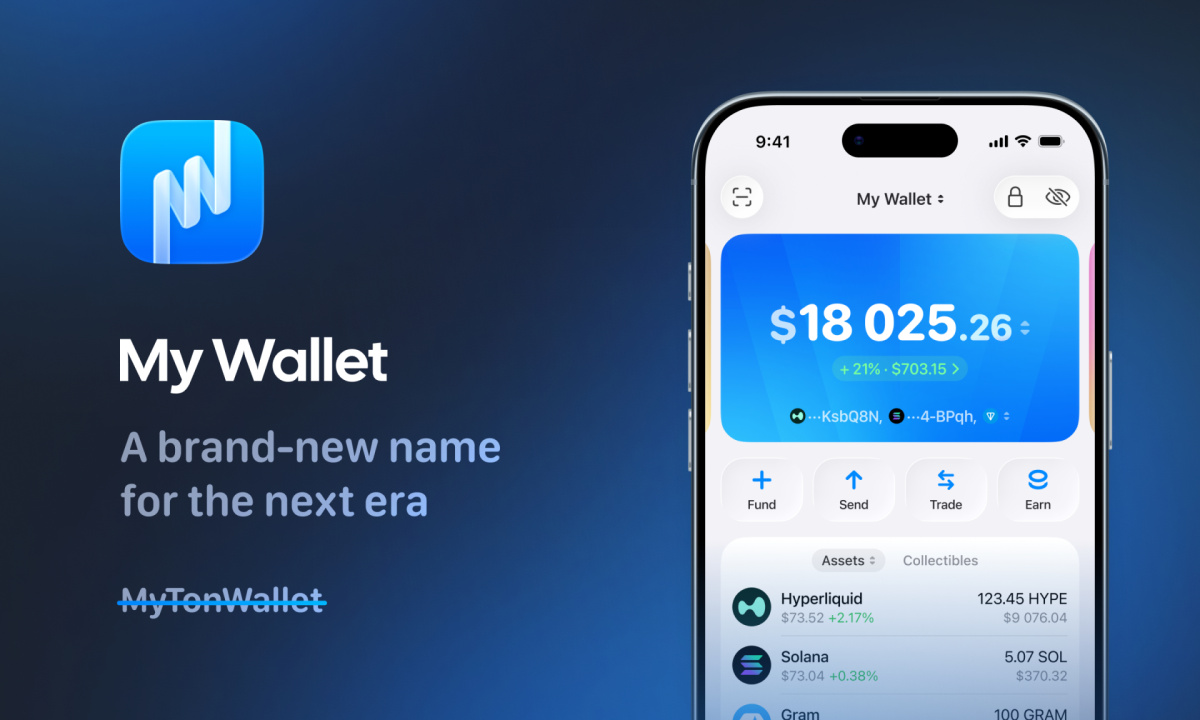
    Dubai, United Arab Emirates – June 23rd, 2026 – MyTonWallet, a prominent wallet built for The Open Network (TON), has officially rebranded to My Wallet and announced a significant expansion, now supporting 11 blockchain networks. The open-source, self-custodial wallet, launched in 2022, has evolved from a single-chain solution to a comprehensive platform aiming to simplify the user experience across the decentralized ecosystem.

    With over 9 million users, My Wallet has broadened its reach beyond TON to include TRON, Solana, Ethereum, Base, BNB Chain, Polygon, Arbitrum, Monad, Avalanche, and Hyperliquid. Bitcoin is slated as the next addition to its roadmap. The company assures existing users that their current wallets and seed phrases remain unaffected, requiring no migration process.

    Integrated Portfolio Tracking Across Multiple Chains

    A key enhancement in My Wallet is its built-in portfolio tracking functionality, which aggregates net worth and performance data across all 11 supported networks within the non-custodial wallet interface. Users can visualize their balances and returns over time through detailed charts for total value, profit and loss (P&L), daily P&L, and portfolio share. The platform offers flexible date ranges, token-level filters, and breakdowns by chain, asset mix, and staked assets, providing a clear overview of portfolio composition. Users can also track their holdings in their preferred fiat currency.

    This integrated approach distinguishes My Wallet from competitors. While some wallets, like MetaMask, relegate portfolio analytics to separate web applications, and others, like Phantom, offer P&L tracking for a single chain, My Wallet consolidates comprehensive net worth and P&L tracking for all supported networks directly within the wallet itself, eliminating the need for third-party tools or browser dapps.

    Seamless User Experience and Gasless Transfers

    My Wallet aims to provide a native-like experience across all supported blockchains, including EVM-compatible networks. By maintaining persistent, high-frequency connections to each blockchain and employing optimistic UI techniques, the wallet enables near-instantaneous transfer confirmations, mimicking the responsiveness of a messaging application.

    Further reducing friction, My Wallet introduces gasless transfers on TON and Solana. This feature allows users to send assets, such as USDC, without needing to hold the native cryptocurrency of the network (e.g., SOL) for transaction fees. The fee is instead covered by the token being transferred. A similar mechanism is reportedly under development for EVM chains.

    “Stablecoins already move more money than Visa — $33 trillion in 2025,” stated Alex Zinchuk, Founder of My Wallet. “For that to reach people outside crypto, the wallet has to stop being the hardest part, and the blockchain fees should be simplified.”

    Transaction Simulation and Unified Activity History

    The wallet also incorporates transaction simulation, allowing users to preview smart contract interactions before confirmation. This includes a clear display of assets leaving and arriving from the wallet, as well as the specific contract being called. A unified activity history consolidates transaction records from all 11 supported chains into a single view, eliminating the need for users to navigate separate interfaces for each network.

    AI-Powered Assistance and Robust Security

    My Wallet features a native AI Crypto Agent designed to assist users with natural language commands for tasks such as sending assets, swapping tokens, and staking cryptocurrencies. The agent can also provide information on token prices, portfolio performance, and market indicators like the Fear & Greed Index.

    Security remains a core focus, with My Wallet holding the No. 7 ranking on CertiK’s Wallet Security Leaderboard at the time of publication, alongside established names like MetaMask and Coinbase Wallet. The wallet has undergone CertiK audits, features an open-source codebase, and supports reproducible builds since its inception. A $100,000 bug bounty program on CertiK SkyShield has been active since March 2024, with no critical vulnerabilities reported to date.

    Designed as a self-custodial solution, My Wallet emphasizes user control, with the team unable to access user funds, seed phrases, private keys, or passwords.

    “We started My Wallet because we could not find a wallet we wanted to use ourselves — one where security and usability were both taken seriously, at the same time,” Zinchuk commented. “The name was the last thing to catch up.”

    Future Developments

    Active development is underway for several new features, including Bitcoin support, Ledger hardware wallet integration across all chains, staking and lending capabilities on every supported network, and a headless wallet mode for AI agents.

    My Wallet aims to be a user-friendly, self-custodial wallet that offers advanced multichain capabilities with a focus on clear design, speed, and familiarity, even for users new to cryptocurrency. It combines CertiK-audited security, open-source code, and full user control.

    My Wallet is available on iOS, Android, macOS, Windows, Linux, and as a browser extension via mywallet.io.

    About My Wallet
    My Wallet, formerly MyTonWallet, is an open-source, self-custodial multichain wallet supporting TON, TRON, Solana, Ethereum, Base, BNB Chain, Polygon, Arbitrum, Avalanche, Hyperliquid, and Monad. Founded in 2022, it has been audited by CertiK and holds a top-7 ranking for wallet security. The platform serves over 9 million users across mobile, desktop, web, and Telegram Mini App. Staking within My Wallet is powered by its proprietary protocol, Stakee, which is recognized among the top TON DeFi protocols by Total Value Locked (TVL) on DefiLlama.

  • Senate Approves Housing Bill, Includes Four-Year Fed CBDC Ban

    Senate Approves Housing Bill, Includes Four-Year Fed CBDC Ban

    U.S. Government Stalls Digital Dollar Amid Housing Bill Passage

    A U.S. moratorium on a government-issued digital dollar is unexpectedly on the verge of becoming law, attached to an unrelated housing bill.

    The Senate passed the 21st Century ROAD to Housing Act on Monday night with an 85-5 vote. The bipartisan legislation aims to increase housing supply and curb the acquisition of single-family homes by large investors. Embedded within the bill is a provision that would prohibit the Federal Reserve from issuing a central bank digital currency (CBDC) until the end of 2030.

    The measure explicitly states that the Fed “may not issue or create a central bank digital currency or any digital asset that is substantially similar” to one, whether “directly or indirectly through a financial institution or other intermediary.” Even after the prohibition expires in 2030, the central bank would require explicit congressional approval to proceed with a digital dollar.

    The language of the bill carves out private stablecoins, exempting any “dollar-denominated currency that is open, permissionless, and private.” This leaves issuers such as Circle and Tether, which are currently regulated under last year’s GENIUS Act, unaffected.

    Currently, there is no active federal initiative to develop a CBDC. The Federal Reserve has not progressed beyond the research phase, and both Fed Chair Jerome Powell and former President Donald Trump have publicly expressed opposition to a digital dollar, which critics on the right view as a tool for financial surveillance. Trump signed an executive order in January 2025 directing his administration not to pursue such a currency.

    Senators characterized the vote as a rare bipartisan achievement. Banking Committee Chair Tim Scott (R-SC), who co-authored the bill with Ranking Member Elizabeth Warren (D-MA), stated on the Senate floor that “housing prices are too darn high and housing supply is too low.”

    Prior to the bill’s passage, Senator Warren remarked that the outcome demonstrated “that bipartisan legislation doesn’t have to be the weakest, most milquetoast agreement.” She described the package as the most significant housing legislation in three decades, while Senate Minority Leader Chuck Schumer commented that it “shows Americans how we should govern.”

    Speeches on the Senate floor primarily focused on housing supply and corporate landlords, rather than the digital dollar ban accompanying the bill. The ban was included as a political incentive to garner support from House Republicans and expedite the package’s progress. The Senate initially added the provision in March, passing that version by an 89-10 vote. Negotiators reached an agreement on the reconciled text last week after months of discussions with the House.

    Some conservative members in the House have advocated for a permanent rather than a temporary freeze. Representative Anna Paulina Luna (R-FL) stated, “CBDCs are bad for everyone.” House leadership is expected to bring the bill to a vote quickly, potentially as early as Tuesday, before it moves to President Trump’s desk.

    The U.S. stance against a CBDC contrasts with global trends. The European Central Bank is preparing a digital euro, with a pilot program anticipated next year and a full launch targeted for 2029. China has been expanding the cross-border usage of its e-CNY, onboarding 26 financial institutions this month, according to Reuters. Globally, three countries have launched a CBDC, and dozens more are piloting or developing one, according to the Atlantic Council.

  • Ripple Gains Luxembourg CASP Approval

    Ripple Gains Luxembourg CASP Approval

    Ripple Secures Preliminary Luxembourg Crypto Asset Service Provider Approval

    Ripple has announced it has secured preliminary approval as a Crypto Asset Service Provider (CASP) from Luxembourg’s financial regulator, the Commission de Surveillance du Secteur Financier (CSSF). This development positions Ripple to operate across the entire European Economic Area (EEA) under the forthcoming Markets in Crypto-Assets (MiCA) regulatory framework.

    Path to Expanded European Operations

    The Luxembourg approval is seen as a significant step beyond a single jurisdiction win, enabling Ripple to potentially offer its services throughout the EEA. The CSSF’s green light also paves the way for Ripple to pursue a full Electronic Money Institution license, which would allow for regulated crypto payment services and CASP-type activities across all EU member states. Ripple has characterized this approval as foundational for the “next wave of regulated digital payments” in Europe.

    XRP Market Performance Amidst Broader Crypto Downturn

    Despite the regulatory milestone, the price of XRP has not yet reflected the news, trading at $1.10, down 3% on the day as the broader cryptocurrency market experiences a significant downturn. XRP’s 24-hour trading range has been breached, with the asset now trading below its previous week’s range of $1.18. Trading volume has also decreased, falling from over $2 billion to $1.5 billion.

    Technical Outlook for XRP

    XRP is currently holding above the $1.00 support level, but the overall market sentiment is bearish for major altcoins. Immediate support is identified at $1.05, with a break below this level potentially leading to a retest of the $1.00 mark. On the upside, resistance is encountered at $1.15 and then $1.20, a zone that previously acted as a local high. Analysts suggest that reclaiming a descending weekly trendline above $1.15 could open the path towards $1.25, with $1.30 identified as a prior liquidity cluster.

    A sustained hold above the $1.10 support and a subsequent break above $1.25 on significant volume could, with regulatory follow-through, drive XRP towards $1.30. Conversely, a daily close below $1.00 could signal a structural breakdown, shifting focus to the $0.90 region. The 50-day Exponential Moving Average (EMA) is considered a critical indicator to monitor this week.

    Investor Focus Shifts Amidst Market Conditions

    While XRP’s regulatory momentum is evident, the current trading entry at $1.10 with an aspirational target of $2 represents a less than 100% potential upside against an asset facing considerable overhead resistance and a substantial market capitalization. Traders seeking different risk/reward profiles are reportedly exploring other opportunities.

    LiquidChain Emerges as Infrastructure Play

    In this environment, LiquidChain ($LIQUID), an L3 infrastructure project, is gaining attention. The project aims to create a Unified Liquidity Layer by integrating liquidity from Bitcoin, Ethereum, and Solana into a single execution environment. This architecture is designed to allow developers to deploy applications that can simultaneously access all three ecosystems, addressing the fragmentation that has impacted Decentralized Finance (DeFi) protocols.

    LiquidChain’s presale is currently priced at $0.01472, having raised $850,000 to date. Key features of its platform include Single-Step Execution, Verifiable Settlement, and a Deploy-Once Architecture across multiple chains. Investors are encouraged to research LiquidChain before the presale concludes.

  • BlackRock, Institutions Eye Blockchain: Aptos CBO Interview

    BlackRock, Institutions Eye Blockchain: Aptos CBO Interview

    The narrative surrounding tokenization is not just expanding; it’s undergoing a significant transformation. While initial discussions centered on the feasibility of bringing real-world assets onto the blockchain, financial institutions are now posing a fundamentally different question: can existing blockchain infrastructure truly support financial markets at scale?

    This evolving perspective is increasingly evident across various networks, including Aptos. Reports indicate that Securitize-related assets on the platform saw a remarkable surge of 632% in June, reaching $276 million. With major products like BlackRock’s BUIDL fund expanding their presence on the network, Aptos is strategically positioning itself as a robust infrastructure designed for continuous settlement, institutional-grade financial activities, enhanced liquidity, and more.

    In an interview, Solomon Tesfaye, Chief Business Officer at Aptos Labs, delves into the rapid growth of tokenized assets on the platform, the critical infrastructure that institutions prioritize, and the potential for the next wave of blockchain adoption to be driven by the convergence of both markets and machines.

    Institutional Focus Shifts to Operational Functionality

    Securitize-related assets on Aptos have reportedly grown by 632% this month, reaching $276 million. What does this level of growth reveal about the current institutional approach to on-chain markets?

    While the percentage growth is noteworthy, the more crucial aspect is where activity concentrates once assets are live on-chain. Securitize, which issues and manages tokenized real-world assets for institutional sponsors like BlackRock and Apollo, utilizes networks such as Aptos. Once these assets are deployed, the primary focus shifts from mere issuance to how these assets function within actual financial systems.

    This is where the move towards “markets” becomes apparent. Settlement, collateral movement, and integration with trading and payment workflows gain greater importance than the act of tokenization itself. On Aptos, these transactional flows are supported by infrastructure engineered for continuous, high-frequency activity, rather than static record-keeping.

    Across the industry, we’re witnessing a transition from proving that assets can be tokenized to determining whether blockchain infrastructure can genuinely support real financial activity at scale. The networks that are poised to benefit are increasingly those capable of facilitating continuous market operations, not just initial issuance.

    Operational Demands Drive Asset Concentration

    What do you believe is fueling the recent uptick in Securitize-related activity specifically on Aptos?

    As tokenized assets become actively traded, operational requirements become paramount. Tokenized funds are not static holdings; they are integral to settlement processes, collateral workflows, liquidity venues, and treasury operations. This necessitates a different infrastructure than simply recording ownership on-chain.

    Aptos has processed over 5 billion transactions, maintains approximately 30-millisecond block times, and has achieved 99.99% uptime since its mainnet launch. These are the operational characteristics that institutions scrutinize because they mitigate execution uncertainty.

    The industry trend indicates a growing concentration of activity on infrastructure that has already demonstrated its reliability under real-world conditions, rather than relying solely on theoretical performance metrics.

    Aptos Positions for Institutional RWA Market

    BlackRock’s BUIDL fund, tokenized by Securitize, has expanded to Aptos alongside several other chains, introducing one of the largest tokenized fund products into the Aptos ecosystem. What does this signify for Aptos’ standing in the institutional real-world asset (RWA) market?

    This development signals that infrastructure choices are increasingly being made at a highly technical and operational level. BlackRock’s selection of chains is not driven by visibility but by a rigorous evaluation of whether the infrastructure can support regulated financial products operating at scale with predictable settlement and performance.

    The expansion of BUIDL through Securitize onto Aptos reflects this thorough evaluation process. It underscores confidence that Aptos meets the stringent requirements for institutional-grade financial products, particularly concerning consistent performance, reliability, and the capacity to support continuous market activity.

    More broadly, this reinforces Aptos’ positioning in the RWA market as an infrastructure built for high-frequency, always-on financial systems where tokenized funds, settlement flows, and collateral movement can operate frictionlessly and at scale. The key takeaway is that institutional adoption is increasingly converging on infrastructure capable of supporting actual financial market operations on-chain, moving beyond mere tokenization experiments.

    Current Use Cases for Tokenized Real-World Assets

    Much of the discussion around tokenization still emphasizes future potential, including tokenized stocks and other multi-trillion-dollar markets. What are tokenized real-world assets actually being used for on-chain today?

    Currently, adoption is concentrated within relatively familiar financial instruments. Money market funds, Treasury products, private credit, and short-duration fixed-income assets constitute a significant portion of the activity. Notable examples include products like BlackRock’s BUIDL and Franklin Templeton’s BENJI.

    What is particularly significant is that institutions are not necessarily venturing into entirely new asset classes. Instead, they are focusing on assets where operational improvements can be realized immediately through faster settlement, reduced reconciliation efforts, enhanced collateral mobility, and greater programmability. In essence, the initial wave of tokenization is less about fundamentally altering the nature of assets and more about transforming the operational infrastructure that supports them.

    Essential Infrastructure for Institutional Scale

    For tokenized assets to transition from early adoption to institutional scale, what infrastructure elements are most critical: speed, settlement finality, compliance tooling, identity, liquidity, custody, interoperability, or something else?

    Every component is vital: compliance, custody, identity, liquidity, interoperability, and settlement. However, reliability serves as the fundamental prerequisite. Institutions can address many operational challenges, but they cannot overcome infrastructure that exhibits inconsistent behavior under load. Financial systems operate continuously, making sustained performance far more critical than peak performance.

    Once reliability is established, the remaining aspects become integration challenges across custody, compliance, trading, and liquidity. Increasingly, institutions are evaluating blockchain infrastructure with the same rigor they apply to traditional financial infrastructure: assessing resilience, predictability, and uptime.

    Technical Priorities Translate to Institutional Advantages

    Aptos has consistently emphasized performance, scalability, and reliability. How do these technical priorities translate into tangible advantages for institutions issuing or managing tokenized assets on-chain?

    The most effective infrastructure is that which operates seamlessly in the background. Institutions are not aiming to optimize for blockchain activity itself; their goal is to operate financial products efficiently and predictably. Performance is only valuable if it translates into operational certainty.

    Features such as parallel execution, fast finality, and the security offered by the Move programming language help ensure that institutions can concentrate on the asset and its associated workflows, rather than being preoccupied with the underlying infrastructure. As tokenized assets, stablecoins, and automated financial systems scale, this is where markets and machines begin to converge. In such an environment, consistent execution holds far greater significance than peak throughput, transforming technical architecture into a tangible business outcome.

    Balancing Transparency and Privacy in Financial Markets

    As more financial assets move on-chain, how should the industry approach the relationship between public blockchain transparency and the privacy or compliance requirements of traditional financial institutions?

    Transparency and privacy are not mutually exclusive goals. Institutions require auditability, regulatory oversight, and verifiable settlement, while simultaneously needing confidentiality for sensitive financial activities. The long-term solution lies not in choosing one over the other, but in developing systems where outcomes can be verified without unnecessarily exposing underlying information. This becomes increasingly crucial as markets become more automated and trust shifts from manual processes to cryptographic verification.

    Aptos’ Vision for the Next Phase of Institutional Adoption

    Looking ahead, what role does Aptos Labs envision for itself in the next phase of institutional blockchain adoption: infrastructure provider, ecosystem builder, capital markets partner, or a broader capacity?

    Markets are already migrating on-chain through tokenized assets, stablecoins, and settlement infrastructure. Concurrently, machine-driven systems are emerging that can transact, allocate capital, and interact directly with these markets. Aptos is being developed to support both of these trends, providing the infrastructure for financial markets to operate at scale while enabling increasingly autonomous systems to participate in the economy.

    Performance, reliability, and continuous operation are not optional features in either domain; they are foundational requirements. We believe that the convergence of markets and machines will be the primary driver of future infrastructure demand.
  • Ripple Gains MiCA License: A Key Milestone

    Ripple Gains MiCA License: A Key Milestone

    Ripple Secures Preliminary MiCA License in Luxembourg

    Ripple has announced it has received preliminary approval for a Crypto Asset Service Provider (CASP) license from Luxembourg’s Commission de Surveillance du Secteur Financier. The approval, granted under the European Union’s Markets in Crypto-Assets regulation (MiCA), was issued via a Green Light Letter and is contingent on meeting final conditions.

    If fully approved, the license would enable Ripple to offer regulated cryptoasset services across the European Economic Area (EEA). This development builds on Ripple’s existing presence in Luxembourg, where the company had previously secured preliminary approval for an Electronic Institution (EMI) license, paving the way for digital payment services. The CASP approval further bolsters Ripple’s strategy, particularly as it expands its RLUSD stablecoin, which has recently gained prominence through Mastercard’s broader stablecoin settlement initiatives.

    Ripple stated that the combination of the CASP license and its existing EMI license will provide European banks, fintech firms, and corporations with a unified integration point to access its cryptoasset and stablecoin payment infrastructure. This will facilitate services such as fund collection, exchange, and disbursement across supported networks.

    The significance of this approval lies in MiCA’s role as the EU’s primary regulatory framework for crypto companies, stablecoin issuers, and service providers. For companies targeting institutional clients, obtaining regulatory licenses is increasingly becoming a necessity rather than a competitive advantage.

    The company indicated that this approval could allow it to scale its services to all 30 EEA countries. Cassie Craddock, Managing Director for UK & Europe at Ripple, commented on the development: “Financial market infrastructure is moving onchain – from cross-border payments and settlement to collateral management and tokenised assets – and banks and fintechs are actively building the digital asset capabilities they need to remain competitive. With our growing European presence, regulatory track record and institutional-grade infrastructure, we’re ready to meet the moment and support that transition at scale.”

    Ripple views this license approval as part of a broader regulatory expansion. The firm highlighted that it holds over 75 regulatory licenses globally, including its EMI license and cryptoasset registration from the UK’s Financial Conduct Authority, effective January 2026.

    The timing of this announcement is also noteworthy. RLUSD is being positioned as a key component of Ripple’s institutional infrastructure stack, alongside XRP and Ripple Payments. This comes at a time when major payment companies are actively exploring the use of stablecoins for settlement and liquidity management.