Category: Uncategorized

  • Bitmine Buys Record Ethereum Haul Amidst Tom Lee Selloff Dismissal

    Bitmine Buys Record Ethereum Haul Amidst Tom Lee Selloff Dismissal

    Bitmine, the world’s largest Ethereum treasury, has significantly increased its ETH purchases amid the latest cryptocurrency market downturn, executing its largest acquisition of the year.

    Bitmine Doubles Down on Ethereum

    Bitmine Immersion Technologies announced Monday that it acquired over 126,971 ETH, valued at approximately $214 million, during last week’s price dip. This marks the treasury’s most substantial purchase of 2026 to date. Following this acquisition, Bitmine’s combined crypto and cash holdings now stand at $9.6 billion at current valuations. The treasury’s assets include 5,543,872 ETH at $1,630 per ETH, 204 Bitcoin (BTC), a $180 million stake in Beast Industries, an $88 million investment in Eightco Holdings as part of its “Moonshots” initiative, and $247 million in cash.

    In a statement, Bitmine Chairman Tom Lee explained that the firm viewed the recent price decline, which saw Ethereum reach a one-year low of $1,505 on Sunday, as a strategic buying opportunity. He asserted that Ethereum’s underlying fundamentals are strengthening. “We increased our buying as we believe this pullback in ETH prices does not reflect the strengthening of Ethereum fundamentals,” Lee stated. “This is not surprising given we are in the early stages of crypto spring.”

    Lee characterized the broader crypto market sell-off as a “superficial take,” driven more by short-term panic than by genuine weakness. He also contended that the recent Zcash Orchard incident bolsters Ethereum’s use case. “AI systems are going to find flaws in centralized financial services rails and weak decentralized protocols. We believe this actually strengthens the use case and product market fit for hardened and reliable decentralized blockchains like Ethereum,” he added. Consequently, the treasury firm believes that “ETH prices should not be coming under pressure.”

    Following the latest purchase, Bitmine’s ETH holdings now represent 4.59% of the altcoin’s total supply. Lee anticipates the company will achieve its goal of holding 5% of the supply “sometime in 2026.”

    ETH Eyes Key Technical Level

    Despite Bitmine’s sustained commitment to Ethereum, the leading altcoin has faced challenges over the past week, retracing approximately 15% and falling below its February lows for the first time in four months. Market observer Ash Crypto noted that ETH is exhibiting a pattern similar to one observed during the previous bear market. “Back in June 2022, ETH broke through every support level and crashed to $880. Everyone gave up on it. That turned out to be the exact bottom of the whole bear market,” he wrote.

    This time, Ethereum has declined 68% from its 2025 peak and has broken through multiple support levels after losing the 200-week Moving Average (MA), which is currently around $2,471. The next critical support level to monitor is $1,500, which could determine whether ETH follows its previous trajectory.

    If ETH maintains the $1,500 level, the market watcher believes the current setup could mirror the 2022 scenario, potentially leading to a fivefold increase in price over the subsequent 18 months. Conversely, if Ethereum falls below $1,500 on a weekly timeframe, he suggested the price could drop to the $1,000 area, where the next significant support zone is located.

    As of this report, ETH is trading at $1,687, showing a 4.8% increase in the daily timeframe.
  • DOGE Faces 32% Crash or Rally: Two Scenarios Emerge

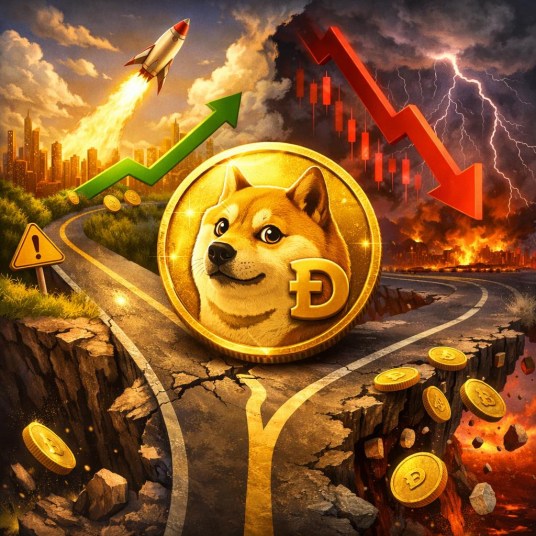
    DOGE Faces 32% Crash or Rally: Two Scenarios Emerge

    Dogecoin experienced a modest rebound on Monday, climbing to approximately $0.086 after dipping to a multi-year low of $0.077 over the weekend. Market analyst Ali Martinez has released a technical update suggesting that DOGE is currently at a “critical structural inflection point,” offering two potential paths forward based on chart patterns and on-chain activity.

    Is A Macro Expansion Cycle Next?

    Martinez posits that Dogecoin is resting on a significant demand base that has historically underpinned major macro expansion cycles. He views the current situation as more than a fleeting recovery, citing long-term structural behavior. According to his analysis, Dogecoin has historically navigated extended, multi-year consolidation phases, characterized by compressed volatility and gradual supply transfer. These periods, he argues, typically precede substantial bull markets.

    The analyst notes that Dogecoin is presently testing a crucial technical area at $0.081, just below its current trading price. This level aligns with the lower mid-range boundary of a five-year parallel channel. Martinez emphasized that this key chart level is bolstered by on-chain support, referencing the UTXO Realized Price Distribution (URPD) data. This metric tracks the price points at which tokens in circulation were last moved.

    Martinez highlighted a significant cluster around $0.081, with over 30 billion Dogecoin tokens having been transacted at approximately this price. This concentration of historical activity, he explained, often forms a psychological and financial “wall of defense,” making it challenging for sellers to drive the price lower.

    Two Scenarios For Dogecoin

    Martinez identified two key levels to monitor: $0.081, where the URPD volume cluster intersects with the channel’s mid-range, and $0.058, which he terms the multi-year absolute channel floor.

    He then outlined two potential scenarios. In Scenario A, if the $0.081 volume block successfully absorbs market supply and this support holds, Martinez anticipates a more stable rebound and expansion towards higher channel targets.

    Scenario B presents a more cautious outlook. Martinez suggested that if macroeconomic headwinds intensify and Dogecoin closes a weekly candle below $0.081, the chart structure would shift into what he described as an “extended valuation reset.” In this event, the token could be pushed towards the lower end of the macro channel, potentially reaching the $0.058 support floor. This would represent a further 32% decline for the memecoin.

  • XRP Poised for Surge at $0.90, Analyst Predicts

    XRP Poised for Surge at $0.90, Analyst Predicts

    XRP Analyst Identifies Key Support Level at $0.90

    A cryptocurrency analyst has drawn attention to the $0.90 mark for XRP, noting its alignment with a significant long-term support level within the asset’s monthly price chart.

    XRP Potentially Following Long-Term Ascending Triangle Pattern

    In a recent post on the social media platform X, analyst Ali Martinez shared a technical analysis of XRP’s monthly price action, identifying a channel that appears to be forming a specific chart pattern. The pattern consists of two trendlines: a horizontal upper boundary and a lower boundary that slopes upward. This type of converging trendline formation is commonly known as a triangle.

    Specifically, Martinez has identified this as an Ascending Triangle. The upward slope of the lower trendline indicates that as XRP’s price trades within this pattern, its trading range narrows, with a net upward bias. This characteristic is the reason for the “ascending” designation.

    As is typical with consolidation patterns in technical analysis, the upper trendline of an Ascending Triangle acts as resistance, while the lower trendline serves as support. A decisive break above either boundary could signal a continuation of the trend in that direction.

    The chart provided by Martinez illustrates the Ascending Triangle that XRP’s monthly price has been trading within for the past several years. The data shows that XRP’s monthly price retested the Ascending Triangle’s resistance level last year but was subsequently rejected. Since that point, the cryptocurrency has experienced a significant price decline, and its current price is now closer to the lower boundary than the upper one.

    Martinez has extended the current trajectory on the chart to project a potential path for XRP in the coming months. This projection suggests that XRP could retest the lower trendline, which is situated around the $0.90 level.

    “I’m watching $0.90 closely on $XRP,” Martinez stated. “If price gets there, I think it could offer a compelling long-term buying opportunity.”

    It remains to be seen whether XRP’s current bearish trend will persist long enough for this support level to be tested.

    Other Consolidation Patterns and Ethereum’s Trajectory

    Triangles are not the only category of consolidation patterns in technical analysis. Another major group includes Parallel Channels, characterized by two parallel trendlines. In a separate post on X, Martinez highlighted that Ethereum has been trading within such a channel on its weekly timeframe. The chart indicates that Ethereum has moved approximately 75% of the way down this channel during its recent price correction. The next significant level for Ethereum is identified at $1,096, which corresponds to the bottom trendline of its parallel channel.

    XRP’s price recently dipped to a low of $1.05 before experiencing a modest rebound to $1.15.

  • XRP Ledger Set for Major Upgrade Next Week

    XRP Ledger Set for Major Upgrade Next Week

    XRP Ledger Set for Software Upgrade, Renaming Core Server

    The XRP Ledger (XRPL) is scheduled to activate version 3.2.0 of its core server software on June 15. While the update does not introduce significant new features for users, it incorporates several changes designed to enhance the network’s long-term operational efficiency.

    A key change is the renaming of the server software from “rippled” to “xrpld.” This rebranding aims to better align with the broader XRPL ecosystem and mitigate potential confusion with other products associated with Ripple.

    Following the upgrade, node operators will see “xrpld 3.2.0” displayed in their command line interfaces when checking software versions. Developers stated that this renaming reflects the increasing independence and technical maturity of the XRP Ledger’s infrastructure.

    The release also promises substantial performance improvements across the network. According to developers, server memory usage could decrease by as much as 40%, enabling nodes to operate more efficiently, particularly under increased demand.

    In addition to memory optimization, the update introduces system-wide refinements intended to boost overall network efficiency. These enhancements are also expected to support higher transaction throughput as activity grows in areas such as decentralized finance, tokenization, and real-world asset applications.

    Version 3.2.0 also includes numerous bug fixes and technical refinements. Improvements to number handling, rounding logic, and core code maintenance are aimed at bolstering network stability without impacting the end-user experience.

    This upcoming release follows the deployment of version 3.1.3 on the XRPL mainnet in late May. That earlier update addressed issues related to NFTs, Permissioned Domains, Vaults, the Lending Protocol, and Multi-Purpose Tokens.

    Network data indicates that approximately 84% of XRPL nodes have already adopted version 3.1.3, suggesting the ecosystem is well-prepared for a smooth transition to the new software version.

    Developers are urging validators and node operators to update their systems before the activation date. Servers that continue to run older versions may encounter limitations in fully participating in consensus and other network functions post-upgrade.

    Beyond upgrade readiness, the release incorporates ongoing behind-the-scenes security enhancements. These include expanded AI-assisted testing and active bug bounty programs, part of broader initiatives to strengthen the ledger’s resilience as institutional and blockchain-based use cases continue to expand.

  • Zcash Plunges 50% on Old Secret; Recovery Underway

    Zcash Plunges 50% on Old Secret; Recovery Underway

    Zcash Completes Emergency Upgrade to Patch Four-Year-Old Critical Vulnerability

    Zcash has successfully implemented a two-phase emergency network upgrade to address a critical vulnerability within its Orchard shielded pool. The flaw, which remained undetected for four years, theoretically could have allowed for the creation of unlimited, undetectable counterfeit ZEC. Its disclosure triggered a significant price collapse before the network’s rapid response began to restore confidence and drive a recovery in ZEC’s value.

    Developer Confirms Network Security

    Josh Swihart, CEO of Electric Coin Company, the primary developer of Zcash, confirmed on X on June 7 that the fix was complete and the network was secure. His statement coincided with ZEC’s initial recovery from the lows experienced after the vulnerability was revealed.

    The announcement came at a crucial juncture for the cryptocurrency. ZEC had plummeted approximately 50%, from a June 4 peak of $624 to $309 on June 5, erasing over $3 billion from its market capitalization, according to a timeline documented by the BitMEX Blog.

    Discovery and Nature of the Zcash Bug

    The vulnerability was identified on May 29, 2026, by security researcher Taylor Hornby during a protocol audit commissioned by Shielded Labs. Hornby pinpointed a “soundness” flaw in Zcash’s Orchard zero-knowledge proof circuit. Specifically, an under-constrained element within the Orchard Action circuit could have permitted invalid state transitions, posing a theoretical risk of double-spending within the shielded pool.

    The discovery was made using Anthropic’s Claude Opus 4.8 AI model in conjunction with a custom analysis suite, as detailed in Shielded Labs’ official disclosure. Hornby and the AI developed a functional proof-of-concept that successfully generated unlimited, entirely undetectable counterfeit ZEC in a local test environment. An independent analyst described it as “about the worst kind of bug a cryptocurrency can have,” according to Yahoo Finance’s reporting on the disclosure.

    Crucially, the flaw did not enable inflation of the total ZEC supply on the live network. Zcash’s internal accounting mechanism, which monitors the total value entering and exiting the shielded pool, confirmed that no unauthorized value creation occurred while the flaw was active, according to Shielded Labs’ official statement. However, the organization acknowledged that due to the privacy features of Orchard and the nature of the bug, there is no definitive cryptographic method to ascertain whether exploitation had occurred. This inherent limitation of the shielded pool’s design became a source of market concern. The vulnerability had been present since Orchard’s activation in May 2022, a period of four years, without detection.

    The Emergency Response

    Zcash’s development ecosystem responded with remarkable speed. The first phase involved an emergency soft fork, deployed via Zebra 4.5.3 and activated at block 3,363,426 on June 2. This measure temporarily disabled all Orchard transactions, effectively removing the attack vector while developers prepared the permanent solution. Transparent and Sapling transactions continued to operate without interruption, as announced by the Zcash Foundation on X.

    The second phase was implemented on June 3 through the NU6.2 hard fork, activated at block 3,364,600 via Zebra 5.0.0. This upgrade introduced a corrected circuit and a new verifying key, patching the flaw and re-enabling Orchard transactions, according to the Foundation.

    The market’s initial reaction to the hard fork was positive. ZEC saw an increase from $544 on June 2 to $603 on June 3, reaching $624 on June 4, its highest point since the rally began. Subsequently, Arthur Hayes publicly announced his exit from his entire ZEC position on June 4, the same day as the price peak. He cited five macroeconomic factors, including rising energy prices and upcoming AI IPOs, in an X post that was covered in prior reporting. The combination of Hayes’ departure and lingering uncertainty about potential exploitation prior to the patch led to ZEC’s drop to $309 on June 5.

    The Recovery and Its Implications

    Swihart’s X post on June 7, which reassured the community that the total ZEC supply remained intact and that the network had navigated the emergency without confirmed exploitation, appears to have catalyzed the ongoing recovery. The swift two-phase response, coupled with the Foundation’s transparent disclosure and Swihart’s direct communication, provided the market with the necessary confidence signal.

    This development represents a pivotal and challenging moment for Zcash’s long-term standing in the nascent cryptocurrency sector. A four-year-old vulnerability in the Orchard pool—the very component central to ZEC’s core privacy value proposition—has been successfully patched without confirmed exploitation.

    However, the inherent irony that the privacy features making Zcash valuable also make it impossible to definitively confirm whether the vulnerability was ever exploited will likely remain a point of discussion for the community as the recovery progresses. As of this writing, ZEC is trading around $430, showing a recovery from its June 5 lows as confidence in the network’s security response gradually rebuilds.

  • XRP Flashes Rare Binance Buy Signal Amidst Market Surge

    XRP Flashes Rare Binance Buy Signal Amidst Market Surge

    XRP is currently attempting to regain the $1.15 mark following a significant downturn that saw its price plummet to its lowest point since 2024. This decline has effectively nullified months of recovery progress, leaving investors in a market environment with little immediate clarity on future direction.

    Amidst this attempted rebound, an analysis by Arab Chain, which tracks trading volume on Binance, has identified a key signal within the data. This signal provides crucial context for both the recent price drop and the ongoing recovery efforts.

    Volume Surge on Binance

    The XRP Volume Z-Score on Binance, a metric that quantifies how current trading activity deviates from the 30-day average, recently spiked to approximately 4.5. This represents the highest reading in four months. A Z-Score of this magnitude indicates trading activity significantly exceeding the recent baseline, a phenomenon typically associated with major price events, forced liquidations, or substantial repositioning by large market participants.

    However, this surge proved to be short-lived. The index rapidly retreated from its peak of 4.5 and has since fallen to around -0.70, suggesting current trading activity is now below the 30-day average. The exceptional volume spike appeared, influenced price action, and then dissipated as swiftly as it emerged.

    Arab Chain’s analysis delves into what this sequence—a sharp volume surge followed by a rapid return to normal levels—reveals about the nature of XRP’s recent decline and whether the current recovery attempt possesses sufficient trading momentum to sustain prices above $1.15.

    Volume Spiked While Price Fell

    The Arab Chain analysis directly links the volume surge to the price decline, shedding light on the selling dynamics that drove XRP to its lowest point since 2024. The Z-Score reaching 4.5 while the price was falling towards $1.13 points to a specific market condition: elevated participant activity concentrated on selling rather than buying. This drove volume higher as transactions were executed at scale in a downward price direction.

    The analytical interpretation is straightforward: a sharp increase in trading volumes coinciding with a price drop typically signals one of two scenarios. Either accelerated selling pressure from participants eager to exit at any available price, or large-scale repositioning by significant holders adjusting their XRP exposure in response to evolving market conditions. Both scenarios result in volume spikes during price declines but carry different implications for subsequent market movements.

    The volatility context identified by the analysis is a forward-looking element worth monitoring. Historically, elevated volume activity accompanying sharp price movements has often been followed by continued volatility rather than immediate stabilization. The repositioning or selling that fueled the initial volume surge tends to create ripple effects as the market adjusts to the new supply and demand balance established during the high-volume session.

    XRP, in its attempt to reclaim $1.15 in the wake of a 4.5 Z-Score volume event, is striving for recovery within a market structure that has recently undergone a fundamental repricing. The speed at which volume normalized below the 30-day average suggests that the exceptional activity has concluded rather than merely paused.

    XRP Price Testing Fresh Lows

    XRP is currently attempting to stabilize around the $1.15 level after experiencing one of its most significant corrections since the 2024 breakout. The weekly chart indicates that sellers have erased nearly all of the gains achieved in the first half of 2025, pushing the asset back towards a critical long-term support zone.

    A key technical development is XRP’s test of the 200-week moving average, which is currently situated between $1.10 and $1.15. This moving average has historically served as a major trend-defining level. The current weekly candle is attempting to hold above this threshold despite the recent wave of selling pressure. A failure to hold this level would significantly weaken the broader market structure, potentially exposing XRP to a move towards the psychological $1.00 mark and possibly the $0.85–$0.90 region.

    From a trend perspective, XRP remains bearish. The price is trading below both the 50-week and 100-week moving averages, with these averages continuing to trend downwards. The rejection from the $1.40–$1.50 area in recent weeks confirmed that sellers are still in control and that recovery attempts are being met with further selling. For bullish sentiment to return, XRP needs to reclaim $1.30 and then $1.50 to begin rebuilding momentum. Until then, the focus remains on whether XRP can defend the 200-week moving average and prevent a deeper decline below $1.10.

  • Dogecoin Poised for Major Rally, Analysts Predict

    Dogecoin Poised for Major Rally, Analysts Predict

    Dogecoin Hovers Near Key Support as Analysts Eye Potential for Next Major Move

    Dogecoin (DOGE) saw a modest 2% gain on Monday, trading near $0.086 and holding just above a significant support zone. However, new analysis suggests the original meme coin is at a critical juncture.

    Technical Patterns and On-Chain Data Signal Strong Demand

    Long-term technical patterns and on-chain data indicate a robust demand area that has historically underpinned substantial market movements. Crypto analyst Ali Martinez noted that DOGE’s price action has historically followed multi-year consolidation channels since its inception. These periods involve extended ranges that compress volatility and redistribute supply before larger bull cycles commence. Currently, Dogecoin is trading above $0.081, which marks the lower mid-range boundary of a parallel channel that has been active since 2021.

    On-Chain Metrics Highlight Support at $0.081

    Martinez pointed to on-chain data to underscore the strength of this support level. The UTXO Realized Price Distribution (URPD) metric, which tracks the price points at which circulating tokens were last transacted, reveals a significant concentration of supply at $0.081. Over 30 billion DOGE tokens were last moved at this price, forming what Martinez describes as a major historical cluster of spot exposure, providing both psychological and structural support.

    Adding to this bullish sentiment, whale activity over the past week shows an accumulation of more than 200 million DOGE tokens, signaling sustained buying interest in this price vicinity.

    Strategic Accumulation Levels Identified

    Martinez advocates for a dollar-cost averaging approach rather than attempting to time short-term price fluctuations or pinpoint exact bottoms. His strategy involves gradually building positions across two key levels. The primary level is $0.081, aligning with the URPD concentration and the mid-range of the long-term channel. The secondary level is $0.058, representing the lower boundary of the multi-year channel structure.

    Potential Scenarios for Dogecoin

    Martinez outlined two potential scenarios. In the first, if the $0.081 level continues to absorb selling pressure, Dogecoin could stabilize and trend back towards higher levels within its broader channel, bolstered by ongoing whale demand. The second scenario posits that if broader macroeconomic conditions drive the price below $0.081 on a weekly close, the asset would enter a deeper valuation phase, with the next significant support anticipated at $0.058.

    CVDD Signal Suggests Bottoming Phase

    In a separate analysis, Joao Wedson of Alphractal stated that DOGE is currently in a price bottoming phase, as indicated by the CVDD Signal, which has historically marked major market bottoms. Wedson observed that strong reversals have consistently followed instances where Dogecoin approached or briefly traded below this level. He added that the next signal would be triggered if DOGE falls below $0.08.

  • XRP Surges Past $10: Data Confirms Bullish Trajectory

    XRP Surges Past $10: Data Confirms Bullish Trajectory

    XRP Faces Potential Liquidity Sweep Before Significant Upside, Analyst Suggests

    XRP’s price has experienced considerable downward pressure in recent days, mirroring broader market trends. The cryptocurrency has retreated to a critical support zone around $1.10, with sellers maintaining control of short-term momentum. This decline has positioned XRP squarely within a significant area on its long-term monthly candlestick chart.

    XRP in a “Face-Melting Phase”

    Technical analysis by crypto analyst EGRAG CRYPTO indicates that XRP may undergo one final liquidity sweep before embarking on a substantial rally potentially exceeding $10. EGRAG’s assessment is based on XRP’s behavior on higher timeframes, specifically around the 50-month and 100-month exponential moving averages (EMAs).

    According to the analyst, XRP has historically followed a recurring pattern after decisively losing the 50 EMA. This breakdown is typically characterized by weak momentum, emotional selling, and a concluding liquidity sweep towards the 100 EMA before a new rally commences.

    The current monthly candle has opened below the 50 EMA, placing XRP’s price action in a precarious position. This scenario, described as a “face-melting phase,” suggests a possibility of further decline towards the 100 EMA as the market continues to seek its macro bottom. EGRAG’s projected path anticipates further downside, with charts indicating a potential drop below $1.

    Building a Position Amidst Uncertainty

    Intriguingly, while anticipating further declines, EGRAG CRYPTO is actively accumulating XRP. Instead of waiting for a confirmed reversal, the analyst is building a position across a range of entry prices, including $1.09, $0.92, $0.85, and even $0.70, treating each level as a potential probability zone.

    Projections Point to Over $10

    Beyond the immediate downside potential, EGRAG’s analysis highlights significant upside targets. The projected recovery path suggests XRP could break above its current cycle high of $3.65. The charts indicate potential upside levels at $9, $13, $17, $20, and $27.

    EGRAG emphasizes that the precise bottom may become less critical if XRP ultimately reaches these projected bullish targets. The analyst argues that effective risk management is more crucial than pinpointing the exact bottom. His strategy illustrates that entering at lower prices like $1.09, $0.92, $0.85, or $0.70 would yield substantial returns if XRP reaches targets of $7, $8, $13, or even mid-double-digit figures.

    At the time of reporting, XRP was trading at $1.14, marking a 12% decrease over the past seven days. A move from the current price to $10 would necessitate a rally of approximately 777%. Reaching $13 would represent a gain of over 1,040%, while a surge to the $27 level on the chart would require XRP to increase by more than 2,260% from its current trading range.

  • OpenAI Files Confidentially for IPO, Timing Undisclosed

    OpenAI Files Confidentially for IPO, Timing Undisclosed

    OpenAI Confirms Confidential IPO Filing, Signaling Public Market Ambitions

    OpenAI, the artificial intelligence powerhouse behind ChatGPT, confirmed on Monday that it has submitted a confidential S-1 registration statement to the U.S. Securities and Exchange Commission (SEC), marking a significant step toward a potential initial public offering (IPO). This filing formally initiates the process for the company to become publicly traded.

    “We recently submitted a confidential S-1,” the company stated in a post on X. “We expect it to leak, so we’re just announcing it.”

    The S-1 document is a crucial registration filing that companies must submit to the SEC before offering shares to the public. A confidential filing allows regulatory bodies to commence their review of the necessary paperwork before sensitive financial details are disclosed to the wider market.

    However, OpenAI cautioned that this filing should not be construed as an indication that an IPO is imminent.

    “We have not decided on timing yet; it may be a while because there are things we want to do that are likely easier as a private company,” OpenAI explained. The company added that the filing provides it with “the option to go public sooner if that ends up being best.”

    This announcement follows months of persistent speculation regarding OpenAI’s preparations for a public listing. In May, The Wall Street Journal reported that the company was contemplating a September IPO and had enlisted Goldman Sachs and Morgan Stanley to advise on the offering. That report emerged shortly after the dismissal of a lawsuit filed by Elon Musk, which had challenged OpenAI’s corporate structure and presented a notable legal hurdle.

    OpenAI is not the only prominent artificial intelligence firm charting a course toward public markets. Earlier this month, competitor Anthropic disclosed its own confidential IPO filing. Separately, Elon Musk’s aerospace company, SpaceX, revealed its IPO plans in May.

  • Bank of America Expands Global Payments Strategy

    Bank of America Expands Global Payments Strategy

    Bank of America is bolstering its global payments strategy with an intensified focus on enhancing cross-border transaction capabilities, underscoring the escalating significance of seamless international money transfers in contemporary finance. As one of the world’s preeminent financial institutions, and a company frequently cited in discussions around Ripple and payment innovation, Bank of America’s latest initiative highlights the ongoing evolution of global settlement infrastructure.

    Banking Giants Embrace Hybrid Payment Models

    Bank of America, a known partner of Ripple, is reportedly preparing to introduce a new cross-border payments service that will integrate SWIFT. An analyst, identified as SMQKE on X, has observed that rather than completely replacing existing systems, banks are increasingly adopting hybrid payment models that leverage both Ripple and SWIFT for international transactions. This dual-framework approach offers a practical solution for financial institutions, as RippleNet can be integrated into existing banking infrastructure much like a traditional payment system.

    SMQKE posits that Ripple’s collaboration with Bank of America could pave the way for XRP to gain access to the bank’s extensive global payment network. This arrangement would allow banks to maintain their SWIFT connectivity for broad international reach while simultaneously utilizing XRP through RippleNet as a source of on-demand liquidity. Consequently, Bank of America’s new cross-border real-time payment service, operating within this hybrid model, is expected to further solidify the groundwork for XRP’s integration into the bank’s core payment infrastructure.

    XRP Ledger’s Institutional Compliance Advantages

    The assertion that XRP is unsuitable for tokenization is technically unfounded, according to proponents. Crypto analyst CharuSan has highlighted that the XRP Ledger, with its institutional-grade compliance features, inherent security architecture, and deep liquidity capabilities, stands out as one of the most secure and appropriate networks for tokenization in the current market.

    Unlike the Ethereum network, which requires the development of external smart contract code, such as ERC-20 tokens, to tokenize an asset, the XRP Ledger embeds tokenization directly into the core code of its Native Issued Assets. This eliminates the need for custom smart contract development, a common source of vulnerabilities, exploits, and cyberattacks. CharuSan explains that by integrating tokenization at the protocol level, the XRP Ledger enables the secure issuance and transfer of real-world assets like real estate, stocks, and bonds within seconds, without exposing institutions to smart contract risks.

    Furthermore, regulatory compliance remains a critical prerequisite for institutional adoption. Wall Street and institutional banks are mandated to adhere to stringent Know Your Customer (KYC) and Anti-Money Laundering (AML) regulations, including controls over who can hold tokenized assets. The XRP Ledger addresses these requirements natively by empowering issuers to restrict access and freeze suspicious accounts when necessary, ensuring that only authorized participants can receive tokens at the protocol level.