Category: Uncategorized

  • Neura Secures Funding, Partnerships for Emotional AI with Persistent, User-Owned Memory

    Neura Secures Funding, Partnerships for Emotional AI with Persistent, User-Owned Memory

    Neura Secures Strategic Funding to Pioneer Emotional AI with Persistent, User-Owned Memory

    Tokyo, Japan – June 9th, 2026 – Neura, a company developing the foundational layer for AI empathy and memory, has announced the successful closure of a strategic funding round. The investment, which includes participation from prominent figures and firms in the Web3, AI, and cultural sectors, will accelerate the development of AI agents capable of persistent emotional memory and user-controlled identity.

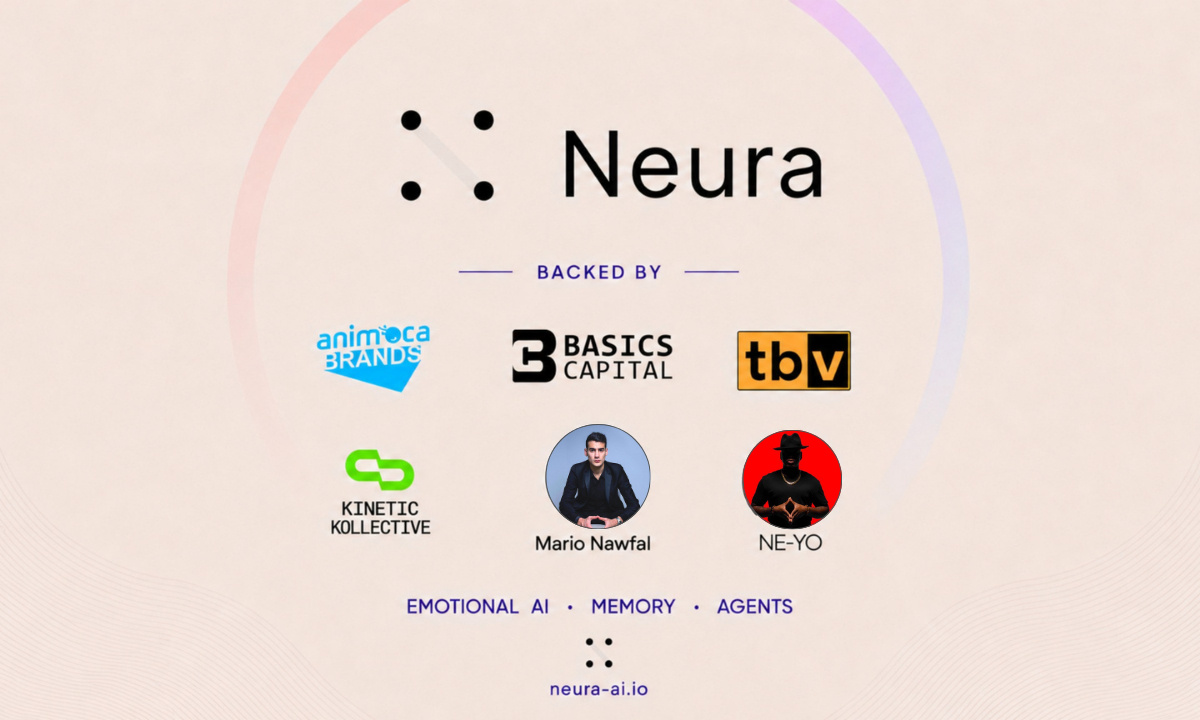
    Among the key investors and partners are Animoca Brands, Basics Capital, TBV, Kinetic Kollective, Mario Nawfal, and Grammy Award-winning artist Ne-Yo.

    Current artificial intelligence systems, while rapidly advancing in intelligence, lack the ability to retain user context beyond a single session or device. They process spoken words but fail to interpret emotional nuances. Neura aims to bridge this gap by creating AI agents that can interpret tone and emotional context, recall a user’s emotional history across interactions, and evolve over time to foster enduring relationships. A core tenet of Neura’s approach is anchoring this memory on-chain, ensuring it is owned by the user rather than confined within centralized applications.

    “Emotional intelligence is the missing piece in AI, and memory is what makes it truly functional – we are building both,” stated Sahin Bayar, CMO of Neura. “While the industry is focused on IQ, we believe the next significant advancement lies in EQ. The most sophisticated tool is ineffective if it doesn’t remember who you are. At Neura, your AI will understand your feelings, and that memory will be yours.”

    The newly acquired capital will support Neura’s three-stage development roadmap. This includes Neura Social, a consumer application for interacting with emotional AI companions; the Neura AI SDK, which will empower developers to create agents with persistent context and emotional states; and the Neura Protocol, a decentralized network designed for verifiable computation and community governance. Through Neura’s on-chain Memory Ledger, emotional context will be preserved using privacy-first cryptographic proofs, making it portable across different AI models, platforms, and devices.

    The broad spectrum of backing from investors across Web3 infrastructure, capital markets, and global culture, notably including Ne-Yo’s involvement which highlights Neura’s potential impact on the creator economy and entertainment industry, underscores a growing consensus that emotionally intelligent, user-owned AI represents the next frontier for both consumer adoption and the broader AI landscape.

    Neura is actively inviting developers, creators, and the wider community to join its initiative in building the Emotional AI Economy.

    Further information can be found at neura-ai.io.

    About Neura

    Neura is pioneering the world’s first Emotional AI Economy, a decentralized protocol designed to imbue AI agents with empathy, persistent emotional memory, and user-owned identity. Unlike most current AI systems that process user input without understanding emotional context and forget users when sessions end or devices change, Neura’s agents interpret tone, recall emotional history, and adapt to build lasting relationships. This memory is user-owned and anchored on-chain via Neura’s Memory Ledger, secured by privacy-preserving cryptographic proofs and portable across various AI models and platforms. Neura integrates blockchain technology, tokenomics, and emotional AI to create a new category of long-lasting, community-owned digital agents. The company posits that the future of AI lies not just in IQ, but in EQ.

  • XRP Nears 8-Year Buy Zone, Analyst Predicts $3 Rally

    XRP Nears 8-Year Buy Zone, Analyst Predicts $3 Rally

    Ripple’s cross-border token, XRP, may still face further turbulence following a recent price crash, with analysts suggesting a potential descent to and below the $0.90 mark.

    A Necessary Dip for a Major Rally

    However, analyst Ali Martinez, echoing sentiments from EGRAG CRYPTO, believes such a downturn could be a prerequisite for a significant surge toward $3.00 and beyond. In a recent X post, Martinez highlighted that XRP has historically demonstrated a swift rebound nearly every time it has touched a rising trend line, a pattern he describes as marking a “major turning point.” This historical trend suggests that the cryptocurrency has, on a macro scale, rocketed back to $3.00 after such instances. The current trend line, situated between $0.70 and $0.90, is now identified as the next critical support level.

    “If buyers defend this zone, a rally back to $3.00 becomes a realistic scenario,” Martinez stated.

    His outlook becomes even more optimistic if XRP can overcome an eight-year resistance level that has previously thwarted major breakout attempts. In such a scenario, Martinez projects next macro targets to fall between $8.00 and $13.00.

    While these figures may seem ambitious given current market conditions and XRP’s recent drop to a 19-month low, Martinez is not alone in his assessment. EGRAG CRYPTO, another market commentator with a macro focus, has also outlined a similar trajectory for XRP, involving a dip towards $0.90 followed by a long-term recovery to $8.00 or even $13.00.

    Whale Activity and Accumulation

    Shifting to a more granular perspective, analyst CW has been closely observing activity in the XRP spot trading market. CW noted that “big whales” continue to dominate trading, a trend that has persisted for approximately four years. These large market participants, according to CW, typically lead during accumulation phases and tend to step back when XRP’s price experiences an uptrend. Their heightened activity has been particularly evident since last October, influenced by broader market movements and developments concerning Ripple’s token.

  • Zcash Surges Past $470 on Ironwood Upgrade News

    Zcash Surges Past $470 on Ironwood Upgrade News

    Zcash Recovers as Network Prepares for Integrity-Boosting Upgrade

    Zcash (ZEC), the native cryptocurrency of the privacy-focused Zcash network, is showing signs of recovery after a significant price drop. The digital asset has surged back above $400 in recent days, rebounding from a low in the $300 range.

    This price resurgence coincides with the Zcash team’s announcement of a forthcoming upgrade designed to address a critical integrity flaw within the network. The Ironwood Upgrade, slated for late July, aims to empower users with the ability to independently verify the circulating supply of ZEC, thereby preventing the creation of counterfeit coins.

    The necessity for the Ironwood upgrade emerged following a series of events initiated by Zcash researcher Taylor Hornby. Hornby identified a vulnerability within the network’s most recent shielded transaction system, known as Orchard. This counterfeiting vulnerability in Orchard prompted the Zcash team to implement a two-stage upgrade, which was completed by June 2.

    Amidst considerable concern from the cryptocurrency community, developers acknowledged that it was impossible to definitively determine whether the vulnerability had been exploited by malicious actors prior to the fix. They indicated that it was plausible that bad actors could have minted fraudulent ZEC coins using the bug, thereby inflating the circulating supply. However, without a method to audit the total ZEC supply, confirming the absence of such counterfeiting was not possible. This uncertainty underscored the need for the Ironwood upgrade.

    Upon its activation in late July, the Ironwood upgrade will introduce a “turnstile” mechanism intended to safeguard Zcash users against the potential threat of counterfeit coins. This upgrade will also signify the migration of ZEC from the existing Orchard pool to the new Ironwood pool. This transition will enable node operators to audit the total supply without relying on the developers.

    Crucially, the Ironwood pool will utilize the same Orchard protocol but will commence with a clean slate. Users will no longer be able to send or receive payments on the old Orchard pool; all funds will be redirected to the new Ironwood pool. These operational changes are designed to be seamless for end-users.

    A significant benefit of the Ironwood upgrade is its potential to reassure the Zcash community that no counterfeiting occurred before the Orchard bug was rectified. This assurance is expected to mitigate further sell-offs that could lead to substantial price declines, similar to the drop witnessed recently.

    The news of the Zcash bug had a swift impact, with BitMEX co-founder Arthur Hayes reportedly selling his entire ZEC holdings shortly after the vulnerability became public. Hayes’ divestment intensified selling pressure on the asset, fueled by widespread fear, uncertainty, and doubt, which sent the coin plummeting from approximately $578 to near $255.

    As developers continue their work to resolve the underlying issue, ZEC has experienced a notable rebound, gaining over 56% this week. At the time of reporting, the asset was trading above $470, according to data from CoinMarketCap.

  • Citrini Research Spotlights Hyperliquid for Wall Street

    Citrini Research Spotlights Hyperliquid for Wall Street

    Citrini Research Identifies Hyperliquid’s HYPE Token as a Standout in Crypto Market

    Citrini Research has highlighted Hyperliquid’s HYPE token as a cryptocurrency asset possessing a cash-flow profile that distinguishes it from the broader market, which the firm characterizes as the “memetic majority.” In its June 2026 “State of the Themes” report, the research firm argued that HYPE’s fee-driven buyback structure, its expanding Assistance Fund, and an emerging exchange-traded fund (ETF) narrative position Hyperliquid as a compelling market-structure story now attracting attention on Wall Street.

    Hyperliquid Captures Wall Street’s Attention

    At the heart of Citrini’s analysis is the assertion that HYPE is not merely a speculative exchange token but an asset intrinsically linked to recurring platform economics. “This is what makes HYPE compelling — unlike the memetic majority of crypto (bitcoin included), HYPE generates legitimate cash flow,” the firm stated. Citrini further explained that this cash flow is bolstered by a protocol-level repurchase mechanism. According to the report, over 90% of the fees generated by Hyperliquid are channeled into the Assistance Fund, which then systematically acquires HYPE tokens on the open market. Citrini described these repurchases as “built into the fabric of the Hyperliquid protocol.”

    Significant Scale of Buyback Program

    Citrini also underscored the substantial scale of Hyperliquid’s buyback initiative. “The structure in itself is attractive, but what’s more astonishing is the pure scale of the Fund,” the firm noted. Since the Assistance Fund’s inception in January 2025, cumulative purchases have exceeded $2 billion, the report indicated. Citrini added that, by certain metrics, Hyperliquid’s buybacks accounted for nearly half of all token buyback activity across the entire crypto market in 2025.

    When measured against its token market capitalization, Citrini stated that HYPE’s buyback activity “clocks in at roughly 7% annually.” This figure is significant as it aligns HYPE more closely with traditional capital-return frameworks than the typical cryptocurrency token model. A sustained annual buyback rate of 7% offers investors a tangible benchmark for assessing token supply dynamics and protocol economics. While it does not eliminate execution risk, it shifts the discussion from pure speculation to the sustainability of Hyperliquid’s trading volume, fee generation, and competitive standing.

    Future Supply-Side Developments

    Citrini also pointed to an upcoming development on the supply side. The report mentioned that the Hyperliquid Foundation has initiated a validator vote that would officially burn $1 billion in HYPE tokens currently held within the Assistance Fund. “Looking forward, all HYPE tokens held in the Assistance Fund will be viewed as burned,” the firm stated. This treatment is expected to strengthen the token’s buyback narrative. Rather than being perceived as a passive reserve, Citrini’s analysis suggests that investors may increasingly consider Assistance Fund holdings as economically removed from the circulating supply, a distinction that holds considerable weight in a market closely monitoring float, unlocks, and emissions.

    Expanding Runway and Institutional Interest

    The report’s final point focused on Hyperliquid’s growth potential. Citrini noted that the “advent of Hyperliquid ETFs” has drawn increased attention to the exchange, citing Bitwise’s spot HYPE ETF, trading under the ticker BHYP US. “The Hyperliquid runway is wide,” the firm concluded. “We think there is still significant market share to be captured.”

    This represents the Wall Street perspective: Hyperliquid is no longer solely discussed within crypto-native circles as a rapidly expanding decentralized perpetuals venue. Citrini is presenting it as a market-structure asset that generates cash flow and is supported by buybacks, potentially benefiting from institutional product development and continued gains in derivatives trading market share.

    At press time, HYPE was trading at $62.13.

  • Crypto Firms Urge Senate Vote on CLARITY Act Before July 4

    Crypto Firms Urge Senate Vote on CLARITY Act Before July 4

    Crypto Industry Urges Senate Vote on CLARITY Act Amid Tight Deadline

    More than 200 cryptocurrency companies have jointly penned a letter to Senate Majority Leader John Thune and Minority Leader Chuck Schumer, demanding an immediate floor vote on the CLARITY Act. Among the prominent signatories are Coinbase, Ripple, Kraken, Circle, Binance US, and Andreessen Horowitz.

    The bill previously cleared the Senate Banking Committee with a 15-9 vote on May 14 and was added to the General Orders Calendar by June 1. However, no floor vote has yet been scheduled.

    The pressure is mounting, and the legislative window is rapidly closing. The White House has set an unofficial July 4 deadline, while Congress faces an August recess, and the Senate’s floor schedule is already heavily burdened with competing legislative priorities.

    A coalition, including Stand With Crypto and over 200 other organizations, has conveyed a clear message to Senate leadership: it is time for the CLARITY Act. The crypto community, encompassing large corporations, startups, associations, and grassroots groups nationwide, is united in its expectation that lawmakers will deliver regulatory clarity.

    Galaxy Digital estimates the bill’s chances of becoming law at approximately 60%. This figure reflects both the genuine political momentum behind the legislation and the significant procedural hurdles that remain before a Senate vote can occur.

    Treasury Secretary Scott Bessent and White House Crypto Advisor Patrick Witt have publicly urged lawmakers to advance the CLARITY Act for a potential July 4 signing by President Donald Trump, framing the date as an administration-level expectation rather than a mere suggestion. This leaves the Senate with roughly three weeks of legislative working time before the symbolic deadline loses its impact.

    The path to a vote is complex. Senator Thune would need to formally schedule debate, allow for amendments through a manager’s amendment process, navigate any procedural challenges, and secure 60 votes for cloture before the chamber recesses.

    Senator Cynthia Lummis has indicated strong political will, stating, “We did not come this far to quit at the 5-yard line.” However, political will alone does not guarantee floor scheduling.

    Procedural Hurdles and Committee Reconciliation

    A crucial, often overlooked, step is the reconciliation process. The version of the CLARITY Act passed by the Senate Banking Committee must be merged with the Senate Agriculture Committee’s Digital Commodity Intermediaries Act. This is necessary because the CLARITY Act’s framework divides jurisdiction between the Securities and Exchange Commission (SEC) and the Commodity Futures Trading Commission (CFTC), with both committees having claimed oversight. This merger is not yet complete. If a vote does not occur before the recess, the July 4 target will be missed, and the political opportunity may not reappear under the same conditions.

    The Senate’s filibuster rule requires 60 votes to advance major legislation to a final passage vote. With Republicans holding 53 seats, the CLARITY Act would need at least seven Democratic crossovers. A prior procedural motion in March garnered 64 votes, suggesting theoretical achievability, but a procedural motion is structurally less demanding than a full cloture vote on a contentious market-structure bill.

    The bill secured two Democratic votes in committee: Senator Ruben Gallego of Arizona and Senator Angela Alsobrooks of Maryland. Transitioning from two to seven Democratic votes on the full floor presents a different challenge.

    Unresolved Concerns and Industry Opposition

    Lingering Democratic concerns include an ethics provision tied to President Trump’s personal cryptocurrency holdings, a sticking point that remains publicly unresolved and could alienate potential supporters under floor pressure.

    The banking industry’s opposition represents another significant obstacle. JPMorgan CEO Jamie Dimon has pledged to challenge provisions related to stablecoin yields and what he describes as inadequate bank-equivalent regulation for stablecoin issuers.

    The CLARITY Act’s proposed structure, which categorizes digital assets as SEC-regulated securities, CFTC-regulated digital commodities, or stablecoins under joint oversight, directly challenges the competitive standing of traditional finance in payment infrastructure. Dimon’s stance suggests the banking lobby will actively engage in the floor debate. While the bill passed committee 15-9, achieving 60 votes on the floor is a fundamentally different challenge.

    Key Indicators for the Path Forward

    The most critical signal will be whether Senator Thune’s office formally adds the CLARITY Act to the active Senate floor schedule within the next two weeks. The introduction of a manager’s amendment addressing the ethics provision and the Agriculture Committee reconciliation would indicate progress toward a genuine vote, rather than further procedural delays.

    Attention will also be focused on whether Dimon and the banking lobby intensify their opposition or, under White House pressure, moderate their stance on the stablecoin yield provisions.

    The July 4 deadline is a political construct, not a legal mandate. However, such political constructs define legislative windows. If the Senate fails to act before its recess, the cryptocurrency industry will require a new opportunity, and these do not typically arise on a predictable schedule.

  • Russia Targets Pro-Western Crypto With New Fees and Limits

    Russia Targets Pro-Western Crypto With New Fees and Limits

    Russia Targets ‘Unfriendly’ Crypto Assets with New Fees and Safeguards

    St. Petersburg, Russia – Moscow is developing a suite of measures, including fees, trading limits, and technical safeguards, specifically aimed at cryptocurrencies deemed “unfriendly,” Deputy Finance Minister Ivan Chebeskov announced on June 9. Speaking on the sidelines of the St. Petersburg International Economic Forum (SPIEF 2026), Chebeskov identified USDT, USDC, and BNB as prime targets.

    Vladimir Chernov, an analyst at Freedom Global, estimates that transaction fees for broadly classified unfriendly assets could range from 0.5% to 2%, potentially escalating to as high as 3% for dollar-pegged stablecoins.

    While the official justification for these measures is investor protection, the targeted assets share a common characteristic: their issuers—Tether, Circle, and Binance—are entities with Western ties. These companies have previously frozen wallets linked to sanctioned addresses, a move that appears to be a key consideration in Russia’s evolving regulatory framework.

    Russia’s Central Bank First Deputy Governor Vladimir Chistyukhin confirmed that under the new Digital Currency and Digital Rights Law, non-qualified retail investors will be restricted to trading only BTC, ETH, and USDT from July 1, 2026. Other assets will be unavailable to ordinary investors.

    Chebeskov elaborated on the proposed measures, stating, “These could include both technical protection measures and various economic incentives, commissions or recommendations, that would encourage citizens to own other assets.” This suggests a strategic intent to steer capital away from dollar-pegged instruments and towards ruble-based or BRICS-aligned alternatives.

    The proposed measures are not yet law but are currently under negotiation ahead of the second reading of the State Duma bill titled ‘On Digital Currency and Digital Rights.’ The bill passed its first reading on April 21, 2026, by a vote of 327 to 13.

    The initial reading established the foundational elements of the framework, including five license categories for crypto operators, broad supervisory powers for the Bank of Russia, a continued prohibition on domestic crypto payments, and an explicit allowance for cross-border crypto settlements. This latter provision is seen as a crucial mechanism for Russia to facilitate trade and circumvent sanctions.

    The second reading is expected to be the most contentious phase, where specific details will be finalized. Anatoly Aksakov, Chairman of the Duma Financial Markets Committee, has highlighted the crypto market bill as a legislative priority, alongside the ‘Antifraud 2.0’ package. The aim is to complete the main framework by July 1, 2026, with enforcement rules to be operational by July 1, 2027.

    The debate surrounding Russia’s crypto regulation is largely centered on this second reading, with the fee structure for unfriendly assets at the forefront. The term “unfriendly” carries significant legal weight in Russia, directly correlating with the government’s official list of countries that imposed sanctions following the 2022 invasion of Ukraine, a list that includes the United States, EU member states, and the United Kingdom.

    Consequently, crypto assets issued or controlled by entities within these jurisdictions are classified as unfriendly. This classification explains why USDT (Tether, based in the British Virgin Islands), USDC (Circle, based in the US), and BNB (Binance, with substantial US regulatory exposure) are the primary assets facing scrutiny.

  • Trump Crypto Allegations Spark Prediction Market Probe

    Trump Crypto Allegations Spark Prediction Market Probe

    Trump Administration’s Crypto Ties Under Fire Amidst Allegations of Internal Purge

    The Trump administration’s involvement with cryptocurrencies has moved from controversy to the brink of a potential institutional crisis. Explosive new reporting from The New York Times alleges that enforcement staff at the Commodity Futures Trading Commission (CFTC) were suspended, subjected to internal investigations, and effectively removed after questioning companies linked to the Trump family.

    Meanwhile, the cryptocurrency market remains on edge, with Bitcoin hovering just above $63,000 as regulatory uncertainty fuels both risk and opportunity across the sector.

    According to The Times’ investigation, when three companies with ties to the Trump administration applied to operate prediction market businesses at the CFTC, two employees who raised compliance concerns were suspended and barred from the workplace. Three additional staff members responsible for enforcing cryptocurrency laws reportedly faced similar repercussions. A subsequent internal investigative report summarized the findings starkly: current and former employees described a clear institutional directive, “Don’t cause trouble for these industries.” Acting CFTC Chair Caroline Pham and senior advisor Bridget Wales are alleged to have intervened directly in individual cases, extending preferential treatment to firms with which they had prior connections.

    The impact on enforcement is quantifiable. The CFTC announced only two digital asset cases during Trump’s second term, both targeting individual business owners, a stark contrast to over 80 cases under the Biden administration and more than 20 during Trump’s first term. At least five active crypto investigations were reportedly halted, including a probe into a major exchange that was in its final stages. The magnitude of this pullback suggests a systemic issue rather than a routine policy adjustment. As the administration’s stance becomes clearer, related regulatory pressures continue to mount across the sector.

    Political Connections Fueling Crypto Ventures

    The political dimension of these developments is no longer abstract. World Liberty Financial, a prominent crypto venture associated with the Trump family, secured a $500 million investment for a 49% stake from a firm linked to the United Arab Emirates. This transaction occurred shortly before favorable U.S. policy shifts toward the UAE.

    Ethics experts and Democratic lawmakers have characterized this as a clear instance of self-dealing. Estimates of the Trump family’s total crypto holdings now reportedly reach $7 billion, encompassing memecoins, decentralized finance (DeFi) ventures, and prediction markets.

    The White House issued a characteristically direct response: “President Trump has always acted in the best interests of the American people. There are no conflicts of interest whatsoever.”

    However, market participants are factoring in the uncertainty differently. The TRUMP memecoin, which briefly attracted high-profile investors including Justin Sun, exhibits extreme volatility tied almost entirely to political news rather than fundamental value.

    Tokens associated with Trump’s orbit are entirely dependent on continued regulatory leniency. Should the Senate Permanent Subcommittee on Investigations accelerate its inquiry into Trump-crypto ties, or if a federal court challenge to CFTC enforcement decisions gains momentum, the current market outlook could shift rapidly.

    Shifting Capital Towards Fundamentals

    For investors holding tokens with strong political correlations, the reality is stark: upside potential is contingent on a specific political outcome, while downside risk is not. This asymmetry is driving capital towards infrastructure projects with fundamentals independent of Washington’s political headlines.

    Bitcoin Hyper ($HYPER) is currently in its presale phase, priced at $0.0136 and having raised $32 million. This figure suggests institutional-grade accumulation rather than speculative retail interest. The project’s core offering is technically ambitious, aiming to be the first Bitcoin Layer 2 solution with Solana Virtual Machine (SVM) integration. This integration promises sub-second finality and smart contract capabilities while maintaining Bitcoin’s underlying security model.

    This development represents a significant leap forward, directly addressing Bitcoin’s long-standing limitations in speed and programmability. The inclusion of a Decentralized Canonical Bridge for BTC transfers and high-APY staking further enhances its feature set.

    For traders observing politically exposed cryptocurrency names facing regulatory scrutiny, exploring Bitcoin Hyper as a fundamentals-driven alternative presents a structurally sound option at this juncture.

  • XRP Poised for Major Surge Next Week

    XRP Poised for Major Surge Next Week

    XRP Sees Modest Gains Ahead of Network Upgrade

    XRP is trading up approximately 3% as a significant technical upgrade to its underlying network looms, an event that could reshape its performance. The infrastructure enhancement is slated for June 15, and the market may begin to price in its potential impact imminently.

    The XRP Ledger is preparing to activate version 3.2.0 of its core server software. Following this upgrade, server memory usage is anticipated to decrease by as much as 40%, leading to improved node efficiency and increased transaction throughput capacity.

    The server software itself is undergoing a name change, from “rippled” to “xrpld,” a move that signifies the network’s growing independence from the company Ripple. Post-upgrade, node operators will see “xrpld 3.2.0” displayed on their command lines. Version 3.2.0 also includes bug fixes related to number handling and rounding logic, enhancing stability without altering the user interface.

    Current Market Snapshot

    XRP is currently priced at $1.17, marking a 2.8% increase on the day with moderate trading volume. This uptick suggests mild buying interest but is not yet indicative of a sustained trend. On higher timeframes, the technical structure remains corrective, with XRP trading below key moving averages and momentum indicators still showing bearish sentiment.

    Short-Term Outlook

    Analysts project XRP to trade within a $1.12 to $1.23 range over the next 24 hours, barring any new catalysts. Resistance is identified in clusters between $1.18 and $1.26, with a further level at $1.37. Support is found between $1.05 and $1.10, with $1.05 marked as the initial significant level where selling pressure could intensify.

    Potential Scenarios Post-Upgrade

    Three scenarios are emerging as the June 15 upgrade approaches. In a positive scenario, the activation of version 3.2.0 could spark bullish sentiment, potentially amplified by ETF news, leading XRP to break through the $1.26 resistance and target the $1.37 to $1.50 zone.

    Alternatively, XRP might consolidate within the $1.10 to $1.23 band, absorbing the upgrade’s impact without a significant breakout, pending broader market and regulatory clarity. The least favorable scenario would involve XRP falling below $1.05, decisively shifting the short-term structure to bearish and likely targeting the psychological $1.00 level.

    Long-Term Projections

    Under a moderate adoption scenario, XRP is projected to reach $1.63 by the end of 2026. A more optimistic long-range model suggests XRP could approach $3.60 within five years, contingent on institutional adoption and favorable macroeconomic conditions. These figures underscore why traders seeking immediate, substantial gains might look to other opportunities.

    Risk-Reward Considerations

    While XRP’s 2.8% daily gain is notable, its current resistance levels compress the risk-reward ratio for near-term trades. This does not preclude potential upward movement but suggests a tighter margin for profit compared to what headlines might imply.

    Emerging Opportunities in Early-Stage Markets

    Traders seeking asymmetric exposure are reportedly exploring early-stage market segments where similar macroeconomic tailwinds can impact smaller market capitalizations more significantly.

    LiquidChain’s Layer 3 Ambitions

    LiquidChain ($LIQUID), an emerging Layer 3 infrastructure project, is positioning itself as a cross-chain liquidity layer. The project aims to unify liquidity from Bitcoin, Ethereum, and Solana into a single execution environment. Its architecture is built on four core principles: a Unified Liquidity Layer, Single-Step Execution, Verifiable Settlement, and a Deploy-Once Architecture, enabling developers to access multiple ecosystems without extensive re-coding.

    The LiquidChain presale is currently underway, with tokens priced at $0.01468. To date, the project has raised approximately $830,000, indicating early traction.

  • XRP’s Future Shifts: Path to $10 Rally Amidst Disappointment

    XRP Price Faces Downtrend Despite Long-Term Optimism

    After years of subdued performance, the XRP cryptocurrency saw a significant rebound in 2024, nearing its all-time high of $3.8 but ultimately falling short. This surge followed the resolution of a protracted legal battle with the U.S. Securities and Exchange Commission (SEC) in the same year, which ignited a wave of recovery. However, the momentum proved short-lived, with XRP’s price appearing to hit a ceiling and entering a downtrend that has persisted for over a year. This decline has pushed the price towards the $1 mark, representing a drop of more than 60% from its 2024 peaks.

    Despite this recent downturn, predictions persist that XRP’s price will eventually surpass $10, underscoring its continued popularity within the cryptocurrency landscape.

    The Evolving “XRP Dream”

    Crypto analyst Crypto Patel recently shared insights on the shifting investor mindset regarding XRP’s price trajectory. On the social media platform X (formerly Twitter), Patel highlighted how the aspiration for XRP was once to simply reach $1, a goal that seemed distant when the digital asset traded around $0.003 in 2017.

    In a notable turn of events, the $1 level that once represented a significant milestone for XRP holders has now become a point of concern for many. However, Patel argues against joining this chorus of complaint, emphasizing that even the current price point represents a substantial improvement from XRP’s historical lows. With XRP trading above $1, it signifies an impressive rally of over 37,000% from its lowest points. Therefore, what is currently perceived as a decline could, from a different perspective, be viewed as a cause for celebration.

    Accumulation Strategy Amidst Market Sentiment

    With current market sentiment weighing on investors, Crypto Patel is identifying lower price levels as opportune moments to begin accumulating XRP again. The analyst points to $1 as the primary accumulation zone, which would entail a decline of over 10% from the price at the time of this report.

    Further down, Patel suggests that XRP’s price could potentially fall as low as $0.6. This would establish an accumulation range between $0.6 and $1, indicating an expectation that the market bottom will likely occur within these levels.

    Despite these short-term price considerations, the analyst maintains that the long-term target of $10 for XRP remains achievable. The prevailing bullish narrative for XRP’s long-term prospects continues to hold strong, with patience and time being key factors in realizing its potential price appreciation.

  • Humanity Protocol Token Plummets 88% After $30M Wallet Drain Triggers Security Fears

    Humanity Protocol Token Plummets 88% After $30M Wallet Drain Triggers Security Fears

    Humanity Protocol Token Plummets 88% Amid $30 Million Wallet Breach

    The native token of Humanity Protocol, known as H token, experienced a dramatic collapse of nearly 88% on June 9, plummeting from approximately $0.78 to around $0.099.

    This sharp decline followed reports of a significant security incident affecting wallets linked to the protocol.

    On-chain investigator Specter initially flagged the issue, revealing that over 17 wallets holding H tokens had been drained. Subsequent reports indicated that attackers had stolen private keys associated with the project, siphoning more than $30 million from these wallets.

    Humanity Protocol later confirmed the security breach. In a statement on X, the team behind the blockchain identity network disclosed that private keys belonging to a member of the Humanity Foundation had been compromised. They advised users to refrain from interacting with the bridge or any liquidity pools until further notice.

    “We are actively working with leading security experts and our exchange partners to assess the scope of the incident and secure all affected systems,” the protocol stated. “We’re deeply sorry that this has happened. Protecting this community is our responsibility, and we don’t take that lightly.”

    However, not all parties accepted Humanity Protocol’s explanation. On-chain investigator ZachXBT challenged the project’s narrative on X, accusing the team of aggressively promoting the token for weeks while offering little in terms of underlying value. ZachXBT also called for the project to disclose any active market maker agreements involving a Hong Kong-based entity.

    In a separate post, ZachXBT suggested the security breach appeared “possibly staged,” adding that it could be a “convenient way for the active MM to have exited.”

    Humanity Protocol is a blockchain-based identity project designed to allow individuals to verify their humanity. It utilizes biometric data and privacy technology, enabling users to prove their identity without sharing personal information.

    Launched on mainnet last year, the project quickly gained attention as a competitor to Sam Altman’s Worldcoin, which has since been rebranded to World Network.

    According to blockchain analytics platform Lookonchain, the perpetrator continued to mint H tokens after the exploit. Initially, 100 million H tokens were created on the BNB Smart Chain, followed by another 100 million. The hacker has reportedly sold a portion of these tokens, acquiring 18,510 ETH, valued at approximately $30.83 million, and 1,548 BNB, worth around $924,000.

    Despite these sales, the attacker still holds an estimated 111.36 million H tokens, with a current market value of nearly $14 million. However, Lookonchain noted that the on-chain liquidity for the token is now nearly depleted.