Category: Uncategorized

  • BitGo CPO Focuses on Product Clarity

    BitGo CPO Focuses on Product Clarity

    BitGo, a pioneer in digital asset custody, is now shifting its focus from securing digital assets to managing the complex operations of tokenized securities. The company, which has largely solved the challenge of safeguarding private keys and building institutional-grade infrastructure, is now looking to build upon its established foundation.

    The Next Frontier: Asset Servicing for Tokenized Securities

    For nearly a decade, the digital asset industry has concentrated on perfecting secure storage solutions, often referred to as “vaults.” BitGo, founded in 2013, has emerged as a leader in this space, now supporting over 1,550 digital assets and serving more than 4,900 clients globally. However, Chief Product Officer Eugene Hahr is now directing the company’s efforts towards the next critical phase: what can be built on top of this secure infrastructure.

    The emerging answer, according to Hahr, lies in asset servicing for tokenized securities. This encompasses essential functions such as dividend distribution, proxy voting, and the transfer of claims. These are the operational intricacies that traditional financial institutions like BNY Mellon and State Street have managed for decades within equity markets, but which remain largely underdeveloped in current crypto infrastructure.

    Real-World Applications and Regulatory Tailwinds

    This strategic pivot is not merely theoretical. The London Stock Exchange is actively developing initiatives for tokenized stocks, and regulatory bodies like the U.S. Securities and Exchange Commission (SEC) are making strides to clarify the path for tokenized assets. As stocks become tokenized, the need for services that ensure holders receive dividends, facilitate proxy voting, and manage corporate actions becomes paramount. Hahr believes BitGo is ideally positioned to provide these crucial services.

    BitGo’s recent corporate developments underscore its ambition. The company went public on the NYSE in January 2026 under the ticker BTGO. It bolstered its capabilities by acquiring NYDIG’s institutional trading business, integrating execution services into its existing custody and settlement framework. Furthermore, BitGo launched BitGo Research on September 24, 2026, and strengthened its leadership in compliance and research.

    Navigating a Competitive Landscape

    BitGo is not alone in this burgeoning market. The race to establish the foundational infrastructure for tokenized real-world assets has drawn significant competition from established players such as Fireblocks, Anchorage Digital, and Coinbase’s institutional division.

    The evolving regulatory environment presents both opportunities and challenges. Progress by the SEC in establishing frameworks for tokenized securities offers companies like BitGo a clearer roadmap for development. Hahr’s approach suggests BitGo intends to make strategic bets on the direction of regulation, rather than waiting for absolute clarity before committing to building new solutions.


  • Bitcoin’s Rate Hike Rally: Can it Survive a Bond Selloff?

    Bitcoin’s Rate Hike Rally: Can it Survive a Bond Selloff?

    Bitcoin’s recent rally has encountered headwinds from a significant shift in the bond market, prompting analysts to reassess the cryptocurrency’s trajectory.

    Bond Market Turmoil

    In mid-September, Bitcoin faced a challenging environment. The failure of the CLARITY Act in the Senate on September 15th, followed by the Federal Reserve’s interest rate hike to 3.75-4.00% the next day, saw Bitcoin briefly dip below $75,000. However, the cryptocurrency rebounded strongly, surpassing $87,000 within a week. This upward momentum stalled as the bond market experienced a dramatic move.

    On September 23rd, the 10-year U.S. Treasury yield surged by over 18 basis points, marking the largest single-day increase since April 2025. The following day, yields climbed above 5.2%, reaching levels not seen since 2007. The 30-year Treasury yield approached 5.50%, a high not observed since 2004. This sharp rise in yields was attributed to a confluence of factors, including robust Purchasing Managers’ Index (PMI) data, a weak five-year Treasury auction, and rising oil prices. Notably, even the Treasury’s $4 billion buyback of long bonds on September 24th failed to curb the upward trend in yields.

    Rate Hikes and ETF Flows

    The Federal Reserve’s rate hike, while significant, had a muted impact on Bitcoin’s immediate price action. The market had largely anticipated the move, with futures markets pricing in a hike of nearly 90% by the eve of the meeting. Some of Bitcoin’s preceding weakness was likely a reflection of this repricing.

    Evidence of this can be seen in the flows of spot Bitcoin ETFs. After experiencing outflows of approximately $750 million on September 15th and 16th, these ETFs saw inflows totaling $2.39 billion in the week ending September 25th, marking their strongest week since October 2025, according to Farside Investors.

    The Bond Selloff’s Impact

    The daily breakdown of ETF flows reveals a more nuanced picture: $999 million on Monday, followed by $715 million, $347 million, $191 million, and $135 million by Friday. While buying persisted, it diminished as yields climbed. Unlike a rate hike, which has a predetermined size, a bond selloff’s extent is dictated by market forces. Yields exceeding 5% present a direct challenge to assets like Bitcoin, which offer no yield.

    An alternative interpretation suggests that if the U.S. Treasury is compelled to borrow at higher rates, the national deficit and the supply of bonds will increase. Many in the cryptocurrency community view this as a long-term bullish case for Bitcoin. However, the immediate impact is evident in the current market flows, with Bitcoin holding its recent gains but struggling to extend them.

    Chart Analysis

    On a 3-day chart, Bitcoin broke above the $70,000 region around August 20th. After consolidating near $80,000 for several weeks, it experienced another breakout last week, reaching above $87,000 before a pullback. This second breakout is significant, potentially marking the first higher high on higher timeframes since the bear market began.

    The moving averages on the 3-day chart further support this constructive outlook. The 20-day exponential moving average (EMA) has crossed above the 50-day EMA for the first time since their bearish crossover in November 2025, which coincided with the start of the bear market. Bitcoin is currently retracing its latest upward move. The next significant support level is identified at $80,000, with the 50% Fibonacci retracement of the recent move from $75,000 to $87,000 falling just above it, around $81,000. As long as Bitcoin maintains the $80,000 area, the overall market structure can be considered constructive. A sustained move below this level would cast doubt on the higher high formation.

    Navigating Bitcoin’s Next Move with PrimeXBT

    As Bitcoin’s recovery faces pressure from rising bond yields, PrimeXBT, a global multi-asset broker and crypto asset service provider, offers traders tools to position for either a continued rally or a deeper correction. Clients can trade Bitcoin through Crypto Futures and CFDs, with options for long or short positions and adjustable leverage. PrimeXBT also facilitates the buying, exchange, and holding of Bitcoin and other cryptocurrencies.

    The platform features competitive fees for Crypto Futures, with maker fees at 0.01% and taker fees starting from 0.045%, decreasing to 0.015% for VIP 5 tier clients through its volume-based VIP program. Crypto CFDs incur no trading commission, and BTC/USD spreads can be as low as $19 for the same VIP tier.

    The same macroeconomic forces influencing Bitcoin are also impacting Gold, U.S. Dollar pairs, and major equity indices. PrimeXBT provides access to these markets, offering over 350 instruments with accounts denominated in USD, USDT, USDC, BTC, and ETH, enabling traders to act on a broader macroeconomic view across both crypto and traditional markets.

    The PXTrader 2.0 platform, powered by TradingView, offers charting capabilities to monitor the $80,000 support area and moving-average signals. Advanced order and risk-management tools are available to help traders manage their positions as the market outlook evolves. Crypto Futures execution combines a real order book and deep liquidity with volume-weighted average pricing (VWAP). With Bitcoin holding its breakout but struggling to advance, the focus shifts from identifying the rally to actively managing trades as new market signals emerge.

  • Spark Funds $210M for Bitcoin-Backed Institutional Loans

    Spark Funds $210M for Bitcoin-Backed Institutional Loans

    Spark Allocates $210 Million for Institutional Bitcoin-Backed Loans

    Spark, the lending division of the Sky ecosystem (formerly known as MakerDAO), has designated $210 million for institutional loans secured by Bitcoin and held in custody by Anchorage Digital. This collaboration aims to merge the capital efficiency of decentralized finance (DeFi) with the regulated infrastructure necessary for institutional compliance.

    So far, three institutional clients have utilized this facility, borrowing $150 million in USDC against $222 million worth of Bitcoin. This represents a collateralization ratio of approximately 148%, meaning borrowers are pledging nearly $1.50 in Bitcoin for every dollar borrowed.

    The operational framework is built upon Anchorage’s Atlas platform, which acts as the collateral agent in a three-party lending agreement. The platform oversees loan-to-value ratios, manages payments, and executes margin calls and liquidations when collateral values fall significantly.

    A key innovation of this arrangement is that borrowers are not required to move their Bitcoin entirely on-chain to access Spark’s liquidity pools. Instead, the Bitcoin remains in Anchorage’s regulated custody, while Spark provides the stablecoin lending capabilities.

    To enhance risk management, Spark integrated RedStone oracles in mid-June 2026. These oracles transmit real-time loan-to-value (LTV) data for the Anchorage-held collateral directly onto the blockchain, offering the protocol and its stakeholders continuous insight into the health of these loans.

    By the end of the second quarter of 2026, Anchorage’s share of Spark’s total lending portfolio had increased by approximately 70%, reaching around $260 million. The Anchorage channel has also emerged as the most profitable segment within Spark’s offerings, generating returns of about 6.5%.

    This expansion occurs within the context of an estimated $33 billion off-chain crypto-backed lending market.

    Anchorage Digital operates as a federally chartered digital asset bank, adhering to a regulatory framework that institutional borrowers and their legal teams can readily acknowledge. By channeling Bitcoin collateral through Anchorage, rather than demanding full on-chain deposits, Spark enables institutions to maintain compliance within traditional finance while simultaneously accessing decentralized liquidity.

  • Blockchain.com Eyes $6B Valuation for IPO

    Blockchain.com Eyes $6B Valuation for IPO

    Blockchain.com is reportedly aiming for a valuation of $4 billion to $6 billion in a potential U.S. initial public offering this year, as the cryptocurrency brokerage seeks to capitalize on an improving market for digital assets.

    IPO Plans and Fundraising

    The company is looking to raise approximately $500 million through the listing, according to sources familiar with the plans cited by Bloomberg. Blockchain.com may opt for a smaller offering depending on market conditions, and discussions are ongoing, with the terms subject to change. These plans follow a confidential filing submitted to the Securities and Exchange Commission in May for an offering of Class A ordinary shares. At the time of that filing, the number of shares and expected price range had not yet been determined.

    Business Expansion Beyond Core Services

    In the months since its confidential filing, Blockchain.com has been actively broadening its business operations, moving beyond its foundational services in crypto wallets and brokerage.

    Last week, the company entered into an agreement with the New York Stock Exchange (NYSE) to explore providing Blockchain.com users with access to tokenized U.S.-listed stocks and exchange-traded funds (ETFs) via the NYSE’s planned digital trading platform. The two entities also intend to integrate market data across their respective platforms.

    This partnership builds upon Blockchain.com’s existing initiatives in tokenized equities. Earlier this year, the company expanded its collaboration with Ondo Finance to offer tokenized U.S. stocks and ETFs to eligible European users, following prior product rollouts in markets such as Africa and South America.

    Diversification into Derivatives and Prediction Markets

    Blockchain.com has also been expanding its offerings into derivatives and prediction markets. In September, it launched perpetual contracts designed to track the valuations of private AI companies OpenAI and Anthropic, utilizing infrastructure powered by Hyperliquid. Additionally, the company partnered with Polymarket in July to incorporate prediction markets into its application.

    Global Growth and Regulatory Milestones

    The company’s international presence has grown in tandem with these product developments. In August, Blockchain.com secured a definitive Virtual Asset Service Provider (VASP) custody services license in the Cayman Islands and was subsequently admitted to the Nigerian SEC’s regulatory incubation program later that month.

    Furthermore, Blockchain.com has expanded its institutional payments business into Brazil, employing stablecoins for cross-border settlement and dollar liquidity. The company reports managing over 95 million wallets and 44 million confirmed accounts, having processed more than $1.2 trillion in transactions across more than 70 jurisdictions.

    Previous IPO Considerations and Valuation Shifts

    Blockchain.com has previously explored public market entry. The company considered an IPO as early as 2022, when private investors had valued it at $14 billion. A subsequent $110 million funding round in 2023 valued the business at less than half of that previous valuation. Since its inception, the company has raised approximately $537 million in equity capital, according to its website.

    Founded in 2011, Blockchain.com initially developed tools for tracking activity on the Bitcoin network before expanding into wallets, brokerage, trading, and institutional crypto services.

    Market Recovery and Profitability

    The renewed push for an IPO comes as Bitcoin has seen a recovery from its decline last year, potentially creating an opportune moment for crypto companies seeking access to public markets. Blockchain.com has also maintained profitability on an adjusted basis for the past three years, according to individuals familiar with the company who were cited when its confidential filing was disclosed earlier this year.

  • Chainlink Empowers Institutions with Custom Bridge Security Post-Kelp Hack

    Chainlink Empowers Institutions with Custom Bridge Security Post-Kelp Hack

    Chainlink Unveils CCIP 2.0, Enhancing Cross-Chain Interoperability with New Security Features

    Chainlink has launched CCIP 2.0, the latest iteration of its cross-chain communication protocol. This software layer is increasingly adopted by financial institutions and cryptocurrency projects to facilitate the transfer of tokenized assets, such as stablecoins, wrapped Bitcoin, and tokenized funds, across different blockchains without the need for custom-built bridges.

    Blockchains, by nature, operate in isolation, meaning one network has no inherent knowledge of activity on another. When a token moves between chains, a mechanism is required to confirm its departure from the origin and its arrival at the destination. This is the role of a bridge, which relies on a verifier to validate the transfer.

    However, this reliance on verifiers has proven costly. Bridges have been the target of numerous hacks, resulting in billions of dollars in losses, often due to a single point of failure—a lone verifier that can be compromised.

    CCIP 2.0 addresses this vulnerability with a new feature called the Cross-Chain Verifier (CCV). This allows institutions to deploy their own verifiers, acting as a secondary check on transactions before they are finalized, or to engage third-party firms like Infosys or Nethermind to provide this service. Starter kits for implementation are available on Amazon Web Services and Google Cloud.

    Underpinning these new options, Chainlink’s default security mechanism remains in place: a committee of 16 independent node operators, representing separate companies, must reach a consensus on the legitimacy of every transfer. This core consensus layer has not been altered.

    More subtle changes have been made to the protocol’s architecture. The Risk Management Network, a separate set of nodes that previously served as a secondary validation layer for the main committee’s work, has been de-emphasized. According to the project’s documentation, “The Risk Management Network’s automated offchain role is no longer active in current CCIP deployments, but is expected to be offered as an optional validation layer in future releases.”

    The on-chain contract now functions primarily as an emergency backup. Chainlink asserts that the independent verification previously provided by the Risk Management Network can now be replicated by the optional CCVs. In practice, this means institutions that do not opt for additional verification layers will rely on a single verification network, a reduction from the previous two.

    The implications of these advancements extend beyond the decentralized finance (DeFi) community. Chainlink reports that $15 billion in tokenized assets have been moved across its network in the past four months, including significant portions of BitGo’s wrapped Bitcoin and Coinbase’s cbBTC. These are assets increasingly integrated into traditional financial products like ETFs and bank offerings, held by everyday investors who may not directly interact with cryptocurrency wallets.

    The timing of this upgrade appears to be influenced by recent security incidents. In April, hackers attributed to North Korea’s Lazarus Group reportedly stole approximately $292 million from Kelp DAO, a protocol that enabled users to stake Ethereum and transfer the resulting tokens across blockchains. Kelp’s bridge was configured with a single verifier on the LayerZero protocol, a setup that LayerZero later acknowledged as a mistake and ceased supporting for new deployments.

    Kelp stated that LayerZero’s team had approved the configuration and did not flag it as risky. LayerZero contested this, asserting that the setup deviated from its own recommendations. Regardless of the specifics, the incident prompted a significant migration of institutions. Kelp itself transitioned to Chainlink, as did Kraken, which moved its wrapped Bitcoin token, and Lombard Finance, which transferred over $1 billion in Bitcoin-linked assets.

    Chainlink’s value proposition centers on its track record as a secure cross-chain solution. CCIP 2.0 offers institutions the flexibility that contributed to LayerZero’s challenges, but with the added assurance that Chainlink’s 16-operator committee still validates every transfer by default.

    “Historically, legacy bridges have lost billions due to insecure infrastructure, while in-house builds are slow and expensive and institutions’ proprietary networks can’t earn the trust of their peers,” said Johann Eid, Chief Business Officer at Chainlink Labs, in the launch announcement.

    Chainlink claims that CCIP currently secures over $84 billion in cross-chain token value, a figure it self-reports. While eighteen companies are listed as launch partners, their statements suggest varying levels of commitment. Fidelity noted the upgrade “has the potential to support” broader distribution, while Further Asset Management indicated it “intends to partner.” As of launch day, confirmed, live deployments utilizing the new verifiers remain limited.

  • Grok AI: XRP to $40 by 2026 on Landmark Event

    Grok AI: XRP to $40 by 2026 on Landmark Event

    Grok AI Forecasts Sky-High XRP Price Target

    Elon Musk’s Grok AI has issued an exceptionally bullish price prediction for Ripple’s XRP token, forecasting a surge to between $25 and $40 by January 1, 2027, with a potential stretch target of over $50. This forecast, if realized, would significantly exceed even the most optimistic expectations of XRP’s dedicated supporters.

    As of September 28, 2026, XRP is trading around $1.50-$1.52, having experienced a nearly 3% decline in the past 24 hours. Daily trading volume stands at $3.5 billion, a slight increase from the previous day’s $3.2 billion.

    This outlook is considered extreme and diverges sharply from conventional institutional forecasts. It hinges on the return of a robust cryptocurrency bull market in late 2026, amplified by an unprecedented institutional catalyst.

    The AI’s scenario envisions major central banks, including the Federal Reserve, European Central Bank, Bank of Japan, and the People’s Bank of China, designating the XRP Ledger as a primary settlement layer for cross-border central bank digital currencies (CBDCs) and tokenized asset flows. Furthermore, it anticipates commercial banks being incentivized or mandated to hold XRP as a liquidity buffer, alongside the revelation of substantial sovereign wealth fund accumulation of the digital asset.

    Under this highly speculative framework, a confluence of forced institutional demand and retail fear of missing out (FOMO) could trigger a classic late-cycle market mania. This dynamic would propel XRP from its current approximate $1.50 range, surpassing previous cycle highs and reaching mid-to-high double digits by early 2027.

    It is crucial to emphasize that this projection remains purely speculative and for entertainment purposes, not a base-case or even a high-probability scenario. Cryptocurrency markets are inherently volatile, and the described catalyst would necessitate multiple extraordinary policy and institutional developments.

    However, with Ripple’s legal case against the U.S. Securities and Exchange Commission (SEC) resolved and the company potentially favored as a U.S.-based digital asset entity under a hypothetical President Trump administration, a perfect alignment of circumstances could indeed place XRP in an advantageous position.

    Technical Outlook and Potential Upside

    On higher timeframes, XRP has already established a constructive recovery base, having reclaimed key moving averages from mid-September lows around $1.25-$1.30. The price is currently consolidating in the $1.45-$1.55 region after testing highs near $1.63-$1.66.

    In a standard bull market, a sustained break above the $1.70-$2.00 range would typically open the path to the prior cycle high of approximately $3.65. However, within the extreme institutional adoption scenario outlined by Grok AI, this prior high would likely be breached with significant force, triggering a series of measured-move and Fibonacci extension targets far beyond historical levels.

    Aggressive projections derived from the multi-year base, combined with the kind of vertical price discovery observed in previous mania phases, could theoretically extend into the $25-$40+ zone if volume and momentum expand dramatically. During such a move, Relative Strength Index (RSI) and momentum indicators would almost certainly reach deeply overbought levels, a characteristic of parabolic advances.

    Key nearer-term support levels remain in the $1.40-$1.45 and $1.30 zones. Holding these levels would preserve the broader recovery structure while the market awaits or prices in any extraordinary catalysts.

    Overall, while current chart patterns support continued upside in a standard bull market, only an extreme surge in institutional demand and narrative intensity could justify the multi-thousand-percent extension implied by the $25-$50 targets.

    Alternative Investment Avenues

    While Grok AI’s prediction of a potential 30x run for XRP is compelling, presale investments have historically demonstrated a stronger track record of producing such returns. This may explain the persistent attention drawn to presale-stage projects with smaller market capitalizations.

    Maxi Doge ($MAXI), an Ethereum-based meme token, is one such example. Built around a large canine mascot and a “1000x leverage” trading culture identity, its presale has raised $4.8 million at a current price of $0.0002841. Dynamic APY staking is currently available for holders.

    Notable features include trading competitions exclusively for holders with leaderboard rewards and a Maxi Fund treasury designated for liquidity and partnerships. The project’s meme-centric, “gym-bro” marketing approach, encapsulated by slogans like “never skip leg day, never skip a pump,” appears to resonate with its target audience, as indicated by accumulation numbers.

  • Polymarket Launches Rapid Bitcoin Prediction Markets Amid Regulatory Questions

    Polymarket Launches Rapid Bitcoin Prediction Markets Amid Regulatory Questions

    Polymarket has launched new 15-minute Bitcoin price prediction markets on its US app, a move that immediately surfaces regulatory questions regarding the classification of these novel, high-frequency contracts. The product, which became available on September 22, 2026, at 12:00 PM ET, allows users to wager on whether Bitcoin’s price will finish above or below a specified reference price at the conclusion of each 15-minute interval.

    These markets operate continuously, 24 hours a day, seven days a week, with automated settlement and resolution data sourced from Chainlink’s BTC/USD oracle. Bitcoin is the sole asset currently offered in this format. Polymarket’s US app operates under the regulation of the Commodity Futures Trading Commission (CFTC), meaning any new product introduced is subject to potential regulatory scrutiny.

    Regulatory Ambiguity Surfaces

    The central uncertainty revolves around how the CFTC will classify these new contracts. Polymarket has historically specialized in longer-duration event contracts, such as those predicting election outcomes or Federal Reserve rate decisions. However, the rapid, 15-minute cadence of these new Bitcoin markets introduces ambiguity, blurring the line between event contracts and derivatives. This distinction is critical from a regulatory perspective, and the CFTC has been examining Polymarket’s operations. A key question regulators must address is where an event contract concludes and a derivative begins.

    Should the CFTC determine that these contracts are, in essence, derivatives disguised as event contracts, Polymarket could face requirements for different registration or product modifications. This potential regulatory classification remains a significant uncertainty. Furthermore, Polymarket’s services already have restricted access in certain US states, and the introduction of high-frequency trading products could heighten state-level regulatory attention.

    Historical Context and Competitive Landscape

    Polymarket previously settled with the CFTC in 2022, a resolution that coincided with the platform’s temporary withdrawal from US markets before its regulated return. This history underscores the sensitivity of its operations to regulatory oversight.

    The commercial success and regulatory reception of Polymarket’s new product will be closely observed by competitors, including Kalshi, which also operates under CFTC oversight. If Polymarket’s 15-minute Bitcoin markets achieve commercial success without drawing regulatory intervention, it could prompt competitors to introduce similar offerings within months. However, the potential for regulatory challenges persists as a notable uncertainty.

    The launch positions Polymarket in more direct competition with crypto derivatives exchanges, a sector with distinct regulatory expectations. The CFTC’s ongoing examination of Polymarket’s operations and this new product could potentially lead to broader regulatory discussions concerning the classification of such contracts within the evolving digital asset market.

    Why This Matters

    The materials describe a narrow update: Polymarket introduced a new product on its US app allowing users to wager on whether Bitcoin’s price will be above or below a reference price at the end of each 15-minute interval. The CFTC’s classification of Polymarket’s 15-minute contracts: whether they are considered event contracts or derivatives.

    Broader Context

    Source materials place the factual news in this context: Polymarket built its reputation on longer-duration event contracts, such as presidential election outcomes and Fed rate decisions.

  • Perplexity AI: BTC Poised for Major 2026 Surge Despite Dip

    Perplexity AI: BTC Poised for Major 2026 Surge Despite Dip

    Perplexity AI has forecast a significant surge for Bitcoin, predicting it could reach $180,000 by January 1, 2027, should a full-fledged bull market return in the fourth quarter. The AI’s bullish outlook places Bitcoin’s potential range between $140,000 and $180,000, with the possibility of a late-cycle rally pushing the cryptocurrency beyond $200,000.

    Currently trading around $83,000, a move to $180,000 would represent an approximate 115% increase. Notably, Bitcoin has already experienced a substantial correction from its previous cycle high of approximately $126,200, recorded on October 6, 2025, followed by a sharp decline throughout 2026.

    Historically, Bitcoin has demonstrated its capacity for substantial gains during robust market cycles. Annual data shows BTC appreciated by roughly 154% in 2023 and 110% in 2024. If current projections materialize, a similar upward trend could be on the horizon.

    Technical Outlook

    Bitcoin has recently broken free from a pattern of lower highs that had persisted since May, reclaiming several key moving averages. According to Reuters’ technical analysis, $81,781 is identified as a crucial support level, while $86,500 represents significant resistance. Beyond this, immediate technical targets are situated around $90,000 and $97,867.

    CryptoQuant has echoed this sentiment, designating $81,700 as a pivotal level due to its alignment with Bitcoin’s 365-day moving average. Resistance levels above this threshold are observed near $86,600 and $88,700.

    Key Resistance Levels

    Bitcoin’s initial major hurdle involves surpassing the $85,000 mark, followed by the $86,000 to $88,000 range. A sustained breakout through this zone is critical, as it would eliminate one of the most significant technical obstacles separating its current price from the $100,000 level.

    A recent analysis highlighted Bitcoin’s potential breakout from a double bottom pattern, with the cryptocurrency now retesting the $82,000 neckline. If this level holds as support, the retest could present a buying opportunity before a rally towards the pattern’s $100,000 target.

    The next significant milestone is approximately $98,000. Beyond this point, the market will approach the all-time high of $126,200, a level where price action becomes particularly dynamic.

    Entering Price Discovery

    Once Bitcoin decisively breaks above $126,000, it is expected to enter a phase of genuine price discovery. Historical resistance above this level is minimal, paving the way for psychological targets such as $130,000, $140,000, and $150,000 to attract momentum traders and institutional investors.

    While a daily drop of 2.5% may not be a major concern for large holders (“whales”) who acquired Bitcoin at significantly lower prices, it could create discomfort for those who purchased above $80,000. This dynamic underscores the appeal of presale opportunities.

    Bitcoin Hyper ($HYPER)

    Bitcoin Hyper ($HYPER) is emerging as the first Bitcoin Layer 2 solution featuring full SVM integration. It promises smart contract execution speeds that surpass Solana, while leveraging Bitcoin’s base-layer security for final settlement.

    The presale for Bitcoin Hyper has reportedly raised over $33.1 million, with the current token price at $0.0136864. Staking rewards are slated to go live at launch with an annual percentage yield (APY) of 35%. The project aims to address Bitcoin’s limitations in transaction speed, fees, and programmability without compromising its inherent trust. A Decentralized Canonical Bridge is designed to facilitate native BTC transfers.

  • BitMine Immersion Technologies Reports 6 Million ETH Holdings, Acquires 17,362 ETH

    BitMine Immersion Technologies Reports 6 Million ETH Holdings, Acquires 17,362 ETH

    BitMine Immersion Technologies reported holding 6,001,302 Ethereum (ETH) as of the week ending September 27, having acquired 17,362 ETH during that period. This acquisition follows a trend of weekly ETH purchases that began on June 30, 2025, as part of the company’s treasury strategy. The latest purchase was smaller than the 27,562 ETH acquired the previous week.

    As of September 27, BitMine Immersion Technologies’ total ETH holdings represent approximately 4.9% of the total ETH supply, approaching its stated goal of holding 5%. The company has valued its ETH holdings at $2,698 per token, contributing to a total valuation of its crypto, cash, securities, and equity stakes at $17.2 billion.

    BitMine has been acquiring ETH weekly since June 30, 2025. The company reported that 5,067,309 ETH of its total holdings were staked, valued at $13.7 billion. This staked amount constitutes 84% of its total ETH holdings. Staking operations are conducted through its Made in America Validator Network (MAVAN), launched in March, and via external partners.

    Projected annualized staking revenue currently stands at $358 million, based on a 2.62% seven-day yield from BitMine’s operations. This projection could rise to $424 million annually if all of its ETH holdings were to be staked.

    In addition to its ETH position, BitMine Immersion Technologies also held 213 Bitcoin (BTC) as of September 27. The company reported other investments, including a $180 million stake in Beast Industries and a $115 million position in Eightco Holdings, which BitMine describes as offering indirect exposure to OpenAI.

    During the week ending September 27, BitMine Immersion Technologies’ cash and marketable securities decreased to $672 million from $714 million in the previous week. The company gave no reason for this decline.

    In the broader market context, ETH has outperformed the S&P 500 by 6,728 basis points in the quarter to date. Tom Lee, who is scheduled to speak at Korea Blockchain Week in Seoul on September 30, has noted that institutions are currently underweight in crypto and are expected to increase their exposure in the final months of 2026.

    Uncertainties remain regarding the specific reason for the decline in BitMine’s cash and marketable securities. The exact total supply of ETH is a dynamic figure, and the precise date of the previous week’s purchase of 27,562 ETH was not specified.

    Why This Matters

    The materials describe a narrow update: BitMine Immersion Technologies reported holding 6,001,302 ETH as of September 27, after purchasing 17,362 ETH in the preceding week. The specific reason for the decline in BitMine’s cash and marketable securities was not provided.

  • ETH Rejection Sparks $2.4K Price Drop Fears

    ETH Rejection Sparks $2.4K Price Drop Fears

    Ethereum Consolidates Below $2.7K Amidst Shifting Market Dynamics

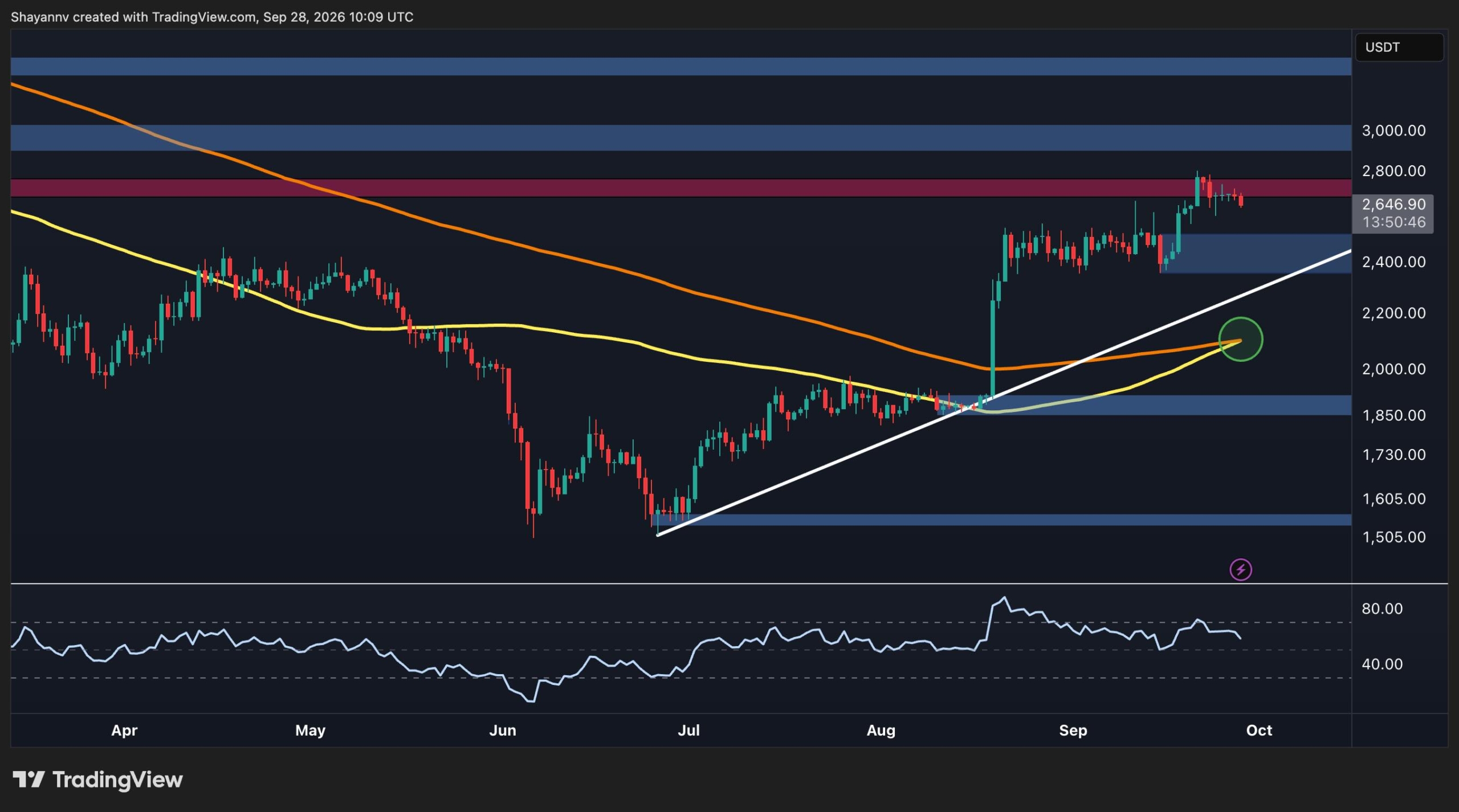
    Ethereum is currently consolidating below the $2,700 mark, following a notable recovery from its June lows. Technical indicators suggest a constructive medium-term outlook, though momentum has softened after Ether (ETH) failed to maintain its advance into the $2,700 resistance zone. The critical question for traders and investors is whether the cryptocurrency can hold its ground above a rising trendline and a nearby demand zone situated around $2,400.

    Daily Chart Structure Shows Improvement

    On the daily timeframe, ETH has exhibited significant structural improvement since hitting a low near $1,500 in June. The asset has established a pattern of higher lows along an ascending trendline and recently surpassed the $2,400 level, which had previously acted as a barrier.

    This breakout propelled ETH towards the $2,700 region, where it encountered a well-defined resistance area. The price briefly touched $2,800 before retreating, with recent trading sessions showing a modest pullback around $2,680. This suggests that buyers have yet to secure a sustained breach above the upper resistance band.

    The most immediate support level is identified around $2,400, the site of the latest consolidation. Moving averages also offer crucial structural reference points. The 100-day and 200-day moving averages are converging near the $2,100 mark and are poised for a bullish crossover, potentially signaling a long-term shift in market structure from bearish to bullish after months of downward price action.

    Short-Term Outlook Remains Neutral

    The 4-hour chart presents a more neutral short-term perspective. ETH experienced a sharp rally from approximately $2,400, establishing a new local high near $2,800. However, the price has since entered a consolidation phase below the $2,700 resistance zone.

    The current price, trading around $2,650, is positioned between resistance near $2,700 and a short-term bullish order block located around $2,500. This order block is particularly significant as it marks the area from which the most recent impulsive upward move originated.

    A rising trendline, currently pointing towards the $2,300-$2,400 area, continues to serve as a structural reference. This trendline has underpinned the sequence of higher lows. A decisive break below it would indicate a more substantial deterioration in the short-term market structure.

    The Relative Strength Index (RSI) on the 4-hour chart has retreated below the mid-range after reaching overbought territory during the September rally. This cooling-off period aligns with the current consolidation rather than an outright trend reversal.

    Consequently, the immediate market structure can be viewed as a range between roughly $2,500 and $2,700. A breakout from either side of this range is expected to provide greater clarity on the next directional move. Above resistance, the psychologically significant $3,000 level emerges as the primary target, while below support, the $2,200-$2,300 area becomes increasingly relevant.

    Network Activity Diverges from Price Action

    An intriguing divergence has emerged between Ethereum’s transaction count and its price performance. The total number of transactions has significantly rebounded from lows observed in early 2026, with the metric recently climbing from approximately 1.6 million to over 2 million transactions, signaling a resurgence in network activity.

    However, the latest price recovery towards $2,600 has coincided with a decline in transaction activity, offering key insights into market participation. This divergence may suggest that the price increase has encouraged investors to hold their ETH rather than engage in short-term trading and profit-taking.

    Given the constructive price action observed on the charts over recent months and the network activity divergence pointing towards holding behavior, investors may find grounds for optimism regarding ETH’s potential to reach higher prices in the coming weeks. This outlook remains contingent on the absence of significant geopolitical or macroeconomic events that could overshadow positive sentiment in the cryptocurrency market.