Blog

  • House Committee Hearing Sees Pushback on Crypto Tax Bills

    House Committee Hearing Sees Pushback on Crypto Tax Bills

    House Crypto Tax Hearing Highlights Partisan Divide, Industry Urges Expansion

    A House hearing on six cryptocurrency tax bills on Tuesday revealed a significant lack of bipartisan consensus, with industry leaders advocating for broader legislation while Democrats expressed reservations about the pace of the process.

    Behind the scenes, the looming prospect of Democrats regaining control of the House in November’s midterm elections is a key factor. Republicans, seeking to advance their crypto agenda while they hold power in Congress and the White House, are pushing for swift passage of these bills. Democrats, conversely, are beginning to frame crypto legislation as an important but not necessarily immediate priority.

    “There is a sense of urgency, but there’s also a sense of, ‘are we acting too quick without knowing what we’re doing?’” Representative John Larson (D-CT) stated during the House Ways & Means Committee’s hearing. “There’s far more questions than there seem to be answers.”

    The committee’s top Democrat, Representative Richard Neal (D-MA), indicated to reporters that a bipartisan agreement on crypto tax policy is unlikely before the midterm elections, according to Punchbowl News. “I’m aligned with that goal—eventually,” Neal remarked at the hearing regarding his interest in passing bipartisan crypto tax legislation.

    A central point of contention between the parties emerged Tuesday concerning the tax treatment of cryptocurrency rewards generated through staking and mining. One of the six Republican-authored bills proposes exempting such rewards from an individual’s taxable income. Currently, staking rewards and newly mined crypto are considered income at the time of receipt, irrespective of whether they are subsequently sold or converted to fiat currency.

    Democrats, including those generally supportive of the crypto industry, voiced concerns that deferring taxes on these rewards could make digital assets more appealing than traditional investments like stocks and bonds, potentially leading to significant shifts in financial markets.

    “It seems to be a real sticking point in all this, and it seems that maybe we’re at an impasse,” Representative Mike Thompson (D-CA) commented on the tax policy surrounding crypto staking and mining. Thompson has previously voted in favor of both the stablecoin-focused GENIUS Act and the more comprehensive Clarity Act, which aims to formally legalize most cryptocurrency activities in the United States.

    Meanwhile, cryptocurrency executives who testified urged lawmakers to broaden certain provisions within the proposed legislation, particularly regarding de minimis exemptions for crypto payments. As currently drafted, one bill would establish a $10 de minimis tax exemption for crypto network transaction fees, commonly known as gas fees. It would also eliminate reporting requirements for stablecoin transactions, treating dollar-pegged tokens as equivalent to U.S. dollars for tax purposes.

    Lawrence Zlatkin, Coinbase’s vice president of tax, advocated for extending the de minimis exemption to encompass all digital assets. “A consumer who uses Bitcoin to buy a pair of jeans still has to calculate and report a capital gain,” Zlatkin argued. “That’s not good tax policy. Americans shouldn’t need an accountant to buy jeans.”

    With the Clarity Act facing a tight deadline in the Senate as the November midterms approach, crypto policy advocates had hoped that progress on crypto taxes could serve as a consolation prize if a broader market structure bill fails to pass before year’s end.

  • Treasury Stablecoin Plan Faces Stark Warning

    Treasury Stablecoin Plan Faces Stark Warning

    Stablecoin Rule Needs Refinement, Policy Center and VC Firm Argue

    The Hyperliquid Policy Center (HPC) and venture capital firm Paradigm have jointly submitted comments to the U.S. Treasury, calling for revisions to a proposed stablecoin compliance rule linked to the GENIUS Act. The rule aims to establish anti-money laundering (AML) and sanctions requirements for “permitted payment stablecoin issuers” (PPSIs), a category intended to foster innovation in payment stablecoins while managing illicit finance risks.

    Narrower Compliance, Less Burden

    While not opposing the framework’s overarching goals, Paradigm and HPC contend that critical aspects of the proposal require clearer definitions. They are particularly concerned that compliance obligations could inadvertently extend beyond the scope and intent of the GENIUS Act.

    A central point of contention is how PPSI duties should apply in the secondary market, where issuers lack direct relationships with counterparties. The firms argue that while Congress intended for PPSIs to conduct due diligence on their direct customers, it did not intend to mandate additional diligence for secondary market trading.

    Drawing an analogy to traditional banking, Paradigm and HPC stated that regulated institutions, after performing Know Your Customer (KYC) checks upon fund entry, are not expected to monitor every subsequent transaction after cash withdrawal. Similarly, they believe that decentralized peer-to-peer stablecoin transfers, and other digital assets, should primarily require KYC at regulated on-ramps and off-ramps, with compliance efforts focused where direct relationships exist.

    The organizations warned that an alternative approach could compel PPSIs to file a high volume of low-value suspicious activity reports (SARs). This, they cautioned, would generate “noisy” reports with false positives, increasing costs for both PPSIs and the Financial Crimes Enforcement Network (FinCEN) without clear public benefit.

    Hyperliquid Policy Center Urges Clarification

    The submitted comments also address the proposed rule’s definition and assignment of obligations related to “lawful orders.” Paradigm and HPC noted that the proposal defines “lawful order” by referencing the GENIUS Act’s definition of “person,” which in turn dictates who might be required to develop technological capabilities.

    They argued that the current draft could be interpreted too broadly, potentially encompassing developers of distributed ledger protocols, decentralized self-custodial interfaces, and other technologies that Congress explicitly excluded from the GENIUS Act’s definition of a “digital asset service provider.”

    The firms asserted that this outcome would contradict congressional intent and recommended a clarification in the final rule to explicitly exempt certain entities and technologies from lawful order requirements.

    Failing to provide such clarity, according to Paradigm and HPC, could unintentionally impose lawful order obligations on every validator on networks like Ethereum, Hyperliquid, Solana, and various Layer 2 systems that process transactions involving PPSI-issued stablecoins. They predicted that this could lead to U.S. validator stakes moving offshore, the relocation of U.S. blockbuilding operations, and a decline in the U.S. share of the validator base, undermining both the GENIUS Act’s onshoring objectives and broader U.S. interests.

  • Sahara AI Denies Security Flaws Amid 60% Token Price Plunge

    Sahara AI Denies Security Flaws Amid 60% Token Price Plunge

    Sahara AI’s SAHARA token experienced a dramatic plunge of approximately 60% on June 9, leading to over $23 million in liquidations. The sharp decline fueled speculation across cryptocurrency markets, particularly as it coincided with a reported breach at the protocol Humanity, which resulted in a $30 million loss and saw its native H token shed nearly 90% of its value.

    Volatility and Initial Response

    Following the sudden drop of SAHARA from around $0.034 to $0.014, according to CoinGecko data, the Sahara AI team issued a statement on X (formerly Twitter). They acknowledged “unusual market volatility” and asserted that no security vulnerabilities had been identified within the platform’s token contracts or products. The team also committed to providing further updates as their internal investigation progressed and more information became available.

    Addressing On-Chain Concerns

    However, the initial explanation faced scrutiny when on-chain observers raised questions about a transfer of 600 million SAHARA tokens, suggesting it might have been the catalyst for the price anomaly. In response, the team released a follow-up post clarifying that the substantial token transfer was a pre-arranged operation to fund a Chainlink CCIP bridge contract, intended to bolster liquidity for their recently launched cross-chain bridge.

    Crucially, Sahara AI emphasized that neither team nor investor wallets had been accessed on-chain, stating unequivocally that “no team and investor tokens have been sold or moved.” To support their claims, the team provided a link to an Etherscan address, inviting interested parties to verify the accuracy of their statements. They reiterated that their investigation into the root cause of the market movement was ongoing and separate from the bridge transfer.

    Community Scrutiny and Market Impact

    The validity of this explanation remains a point of contention within the community. Data from CoinGlass indicates that over the preceding 12 hours, long positions worth $22.9 million were liquidated, contrasted with only $354,000 in short positions. This suggests that the overwhelming majority of losses were borne by traders who had bet on an upward price trajectory.

    The SAHARA token, which was listed on Binance in June 2025 and subsequently reached an all-time high of $0.1605 the following month, was trading at the time of writing nearly 90% below its peak. It had also seen declines of over 50% in the past seven days and almost 54% over the last month.

    This recent downturn follows a pattern of significant price drops for other tokens. Just a week prior, EDGE, the native token of the edgeX decentralized exchange, plummeted by 71% to a new all-time low. Similar to the Sahara AI team, the edgeX developers denied any security breaches, attributing the collapse to external manipulation. However, this claim was publicly disputed by on-chain investigator ZachXBT. In a subsequent report, edgeX acknowledged that some centralized exchanges listing EDGE cited thin liquidity conditions, rather than large-scale selling by the team, as a contributing factor to the token’s collapse.

  • Jericho Joins Kokopi Koalas NFT as Co-Creator

    Jericho Joins Kokopi Koalas NFT as Co-Creator

    Chris Jericho Joins Kokopi Koalas NFT Ecosystem, Will Co-Create Community Traits

    Tampa, Florida – June 9, 2026 – Chris Jericho, the legendary professional wrestler, international rock star, and avid collector, is set to join the Kokopi Koalas NFT project ahead of its June 11 mint on LaunchMyNFT.

    Kokopi Koalas, a customizable NFT ecosystem operating on the Solana blockchain, announced its collaboration with the global icon. As part of the partnership, Jericho will work directly with the Kokopi community to develop official Chris Jericho Traits, which will be launched in the project’s Trait Store.

    Unlike many traditional NFT collections where digital assets remain static after their initial release, Kokopi Koalas offers holders the ability to continuously customize and evolve their digital collectibles through its unique Trait Store. Collectors can acquire, swap, equip, and combine various traits to create personalized Koalas that grow and change over time.

    Jericho to Host Live Community Trait Design Events

    Jericho will lead live community events where Kokopi holders can submit trait concepts inspired by his storied career. During these sessions, he will review submissions and personally select the winning designs, which will then be integrated as official Chris Jericho Traits available in the Trait Store.

    Furthermore, Kokopi token holders will gain exclusive VIP access to Jericho through the project’s Discord and X.com channels. This access will include private voice chats, live sessions, spaces, giveaways, and direct engagement opportunities.

    Real-World Utility and Merchandise Integration

    Beyond digital customization, Kokopi Koalas is extending NFT and trait ownership into the realm of real-world intellectual property. Holders who equip official traits, including the forthcoming Chris Jericho Trait, will be able to connect their wallets via the Trait Store to unlock exclusive access to limited-edition merchandise. This merchandise will feature customized NFTs and include items such as apparel, drinkware, posters, calendars, and toys. These items will be offered at a discount to Kokopi Token/NFT holders, who can also register as affiliates to earn revenue by promoting their personalized merchandise links.

    Jericho Expresses Enthusiasm for Partnership

    “I’ve spent my career entertaining people, bringing communities together, and collecting things that mean something,” Chris Jericho stated. “The Kokopi Koalas Trait Store model feels like the next step in digital collectibles. It puts creativity back in the hands of the fans, and when I saw what the Kokopi team was building, I knew I wanted to be not only an investor, but a partner!”

    BTN, Co-Founder of Kokopi Koalas, added, “Chris Jericho embodies exactly what we’re building at Kokopi Koalas. He deeply understands fandom, collecting, and the power of community. Having him actively involved in the Kokopi community, creating a trait with our holders, is a perfect reflection of our vision — putting real ownership and creative input back into the hands of the people who support the project. This collaboration goes beyond digital collectibles. With the introduction of real-world merch utility and Jericho inspired traits, we’re showing that Kokopi Koalas is designed to grow and evolve long after mint. Chris has spent his career constantly reinventing himself across wrestling, music, and entertainment. There’s no better initial partner to help us bring together diverse communities and prove that NFTs can deliver lasting, meaningful experiences than Chris!”

    Pioneering the Future of Evolving Digital Collectibles

    The upcoming Kokopi Koalas NFT mint on June 11 is set to introduce a novel model of interactive digital ownership. Instead of one-time static purchases, holders will have the ability to continuously upgrade, swap, and personalize their NFTs through ongoing trait releases, future collaborations with other NFT and token projects, limited trait drops, and celebrity and community-driven content.

    The Chris Jericho Trait will be the first celebrity-backed trait introduced into the ecosystem. These partnerships are designed to further expand customization options and foster meaningful cross-community connections among various projects, both within and outside the Solana ecosystem.

    Kokopi Koalas also recently announced plans to release soccer-inspired traits in anticipation of this summer’s World Cup. NFT holders will be able to equip their Kokopi NFTs with country jerseys, stadium backgrounds, and other soccer-themed traits.

    Additional details regarding the live trait design event, submission process, and the mint will be shared through Kokopi Koalas’ official channels.

    About Kokopi Koalas
    Kokopi Koalas is a community-driven, customizable NFT ecosystem built on Solana. Through its Trait Store, holders can collect, equip, and combine traits to create unique and evolving digital collectibles. By integrating community participation, digital ownership, and collectible culture, Kokopi Koalas aims to pioneer a new model for long-term engagement in the NFT space.

  • Chainlink Holders Quietly Accumulate Amid Market Uncertainty

    Chainlink Holders Quietly Accumulate Amid Market Uncertainty

    Chainlink Network Sees Surge in Wallet Holders Amid Market Volatility

    The Chainlink network has surpassed 535,000 wallets holding at least one LINK token, marking the highest number of non-micro wallets since December 2022. This growth has occurred despite LINK’s price remaining significantly below its previous cycle peaks, according to data from Santiment.

    Indicators of Gradual Adoption

    The analytics firm Santiment noted that a consistent rise in wallet counts is historically interpreted as a sign of gradual adoption and accumulation. This increase in new participants is considered an encouraging development, particularly during periods of market uncertainty. Santiment emphasized the importance of tracking wallets with at least one LINK, as this metric reflects network participation rather than short-term speculative trading. While prices are subject to market sentiment fluctuations, a growing holder base can signal increasing long-term trust and interest in the Chainlink ecosystem.

    Underwhelming Price Performance Contrasts Network Growth

    Despite the uptick in network participation, LINK’s price performance has been lackluster. The token has experienced a downward trend over the past month, falling from over $10.4 in early May to approximately $7.9 at the time of reporting. This suggests that the growing interest and adoption within the network have not yet translated into significant price appreciation for the asset.

    Increased Infrastructure Adoption

    Even with LINK facing price pressure, the network has witnessed increased adoption of its infrastructure in recent weeks. Following an exploit in April that affected LayerZero-powered systems, both KelpDAO and Solv Protocol announced their intention to migrate their cross-chain operations to Chainlink’s Cross-Chain Interoperability Protocol (CCIP). KelpDAO plans to transition its rsETH to Chainlink’s framework to enhance security, while Solv Protocol is moving over $700 million in Bitcoin-related assets to CCIP as part of a broader restructuring of its cross-chain infrastructure.

    Chainlink’s Strategic Position and Future Outlook

    Santiment commented on Chainlink’s strategic position, stating, “With Chainlink continuing to play a central role in oracle services, tokenized assets, and real-world asset infrastructure, watch for crypto’s #17 market cap to be a breakout candidate when overall markets turn bullish once again.”

    Expanding Regulatory Engagement and Institutional Adoption

    Chainlink Labs is also increasing its engagement in the regulatory landscape of the cryptocurrency industry. In collaboration with Anchorage Digital, it co-founded the Blockchain Leadership Fund, a Political Action Committee (PAC) that has endorsed ten candidates for the 2026 election cycle who advocate for pro-crypto and blockchain-focused policies. Furthermore, Fidelity International recently adopted Chainlink’s technology for its inaugural tokenized fund, FILQ.

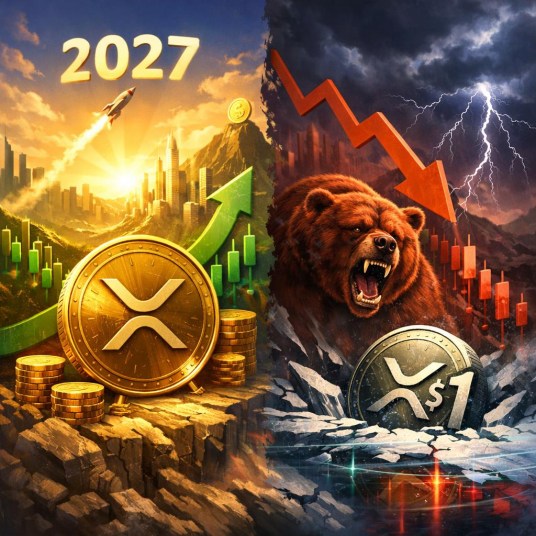
  • XRP Price Forecast: $10 by 2027 or Below $1?

    XRP Price Forecast: $10 by 2027 or Below $1?

    Conservative XRP Outlook

    Market expert Sam Daodu has outlined three potential scenarios for XRP’s trajectory by 2027, factoring in the CLARITY Act, the XRP Ledger (XRPL), and exchange-traded funds (ETFs).

    Under Daodu’s most conservative projection, XRP could trade between $3 and $5 by 2027. This forecast assumes the CLARITY Act progresses and that demand for XRP via ETFs grows steadily, rather than experiencing sharp surges. Daodu suggests this measured progress would be sufficient to return XRP to its previous peak levels within two years, without necessitating a significant, sudden market breakout.

    In this context, Standard Chartered’s $7 XRP target for 2027 is considered optimistic, with the $3 to $5 range presented as the most plausible outcome given current market conditions, provided no major destabilizing events occur.

    A More Bullish Case

    A more optimistic scenario pushes XRP’s potential price range to $7 to $10. For XRP to reach the higher end of this forecast, demand would need to shift decisively in its favor.

    Daodu’s report identifies a key catalyst: banks may begin to hold and settle transactions directly in XRP, rather than solely relying on stablecoins that utilize the XRPL network. Additionally, ETF inflows would likely need to exceed initial expectations, reaching “several billion dollars.”

    If both utility and buying pressure strengthen concurrently, Daodu posits that XRP would possess the necessary combination of functionality and market demand to surpass its previous highs and maintain upward momentum. This bullish pathway aligns with Bitwise’s more optimistic prediction, which places XRP in the $9 to $10 range. This suggests that 2027 could be the year the altcoin’s market value reflects the strength of its underlying infrastructure.

    Daodu frames this scenario as one where adoption and capital inflows mutually reinforce each other, transitioning the market from its current infrastructure-led phase to a more robust demand-driven cycle.

    A Real Chance Of Breaking Below $1

    Daodu also presents a downside scenario, forecasting XRP trading below $1.50 by 2027. This negative outlook hinges less on technological developments and more on whether market sentiment remains subdued for an extended period.

    A significant risk factor is the potential for the CLARITY Act to stall beyond the August recess. Concurrently, broader market conditions could continue to exert downward pressure on risk assets. Ripple’s steady monthly supply pattern is also noted as unlikely to provide independent demand catalysts if buyers remain hesitant.

    In this bearish scenario, Daodu anticipates XRP spending most of 2027 between $1 and $1.50. He also acknowledges a realistic possibility of XRP falling below the $1 mark if selling pressure persists rather than dissipates.

    However, the market may not need to wait until 2027 to witness XRP trading below $1, as it is currently priced around $1.12. While this represents a recovery from a weekend dip to $1.05, concerns remain that this critical support level could be breached in the near term.

  • Kraken Becomes Official Crypto Exchange for FIFA World Cup 2026

    Kraken Becomes Official Crypto Exchange for FIFA World Cup 2026

    Kraken Becomes Official Crypto Exchange Supporter for FIFA World Cup 2026

    Cryptocurrency exchange Kraken has announced a partnership with FIFA, becoming the Official Crypto Exchange Supporter for the FIFA World Cup 2026. The deal was revealed on Tuesday, just two days before the start of the quadrennial soccer tournament.

    The sponsorship will cover the seven-week competition, scheduled to run from June 11 to July 19. Financial details of the agreement were not disclosed.

    The upcoming World Cup is set to be the largest in history, featuring 48 teams and 104 matches played across 16 host cities in Canada, Mexico, and the United States. Organizers anticipate a cumulative global audience exceeding 6 billion viewers, a scale Kraken is leveraging for significant platform exposure.

    “Football has always crossed borders. So does crypto,” said Kraken co-CEO Arjun Sethi in a statement. “For most of history, the best markets were open only to the few. The FIFA World Cup 2026 is where we show everyone else what they’ve been missing: an open, borderless financial system that anyone can join with a phone in their pocket. This isn’t a future concept. It’s here.”

    Kraken’s involvement with FIFA will commence on Wednesday with a multi-country, multi-city countdown concert held on the eve of the opening match. The San Francisco-based exchange, established in 2011 and operating in over 190 countries, also plans to introduce “fan-focused product experiences” throughout North America and Europe during the tournament.

    “Innovation has always played a central role in how FIFA evolves and enhances the fan experience,” stated FIFA Chief Business Officer Romy Gai. “As we prepare to welcome the world to the biggest FIFA World Cup in history, we are delighted to partner with Kraken, an organization that shares our commitment to innovation and technology.”

    This new agreement expands Kraken’s existing sports sponsorship portfolio, which includes partnerships with Premier League club Tottenham Hotspur, Spanish side Atlético de Madrid, German club RB Leipzig, and the Williams Racing Formula 1 team.

    The announcement comes amid warnings from law enforcement agencies about crypto scams targeting soccer fans looking to purchase World Cup tickets or merchandise.

    In April, FIFA announced a separate partnership with ADI Predictstreet, a platform built on the ADI Chain network and focused on the Middle East/South Africa (MENA) market, designating it as the official prediction market platform for the tournament.

  • XRP at Critical Juncture: $1.40 Surge or $0.80 Rebound

    XRP at Critical Juncture: $1.40 Surge or $0.80 Rebound

    XRP is poised at a critical juncture, with analysts suggesting the upcoming monthly candle close will dictate whether the cryptocurrency establishes a double bottom or declines towards $0.80.

    Key Levels Under Scrutiny

    Analyst EGRAG CRYPTO has identified what they term a “macro decision zone” for XRP. While the token has shown some resilience, recovering from a 19-month low of $1.05 last week, it has yet to breach levels that would instill significant confidence in bullish sentiment.

    According to EGRAG, a monthly close above $1.40 would serve as confirmation that the $1.05 low marked the bottom. However, the analyst believes that a genuine bullish recovery would only commence with a reclaim of the $1.61 to $1.65 range, with a break above $1.70 providing further validation. As of now, none of these key resistance levels have been reached.

    Downside Potential and Support Gaps

    EGRAG also outlined a bearish scenario, positing that a loss of momentum could send XRP back down to $0.80. Notably, the analyst did not identify any intermediate support levels between the current price and that target should the structure break down.

    “Hold ground then → double bottom possible,” EGRAG stated. “Lose momentum then → $0.80 retest likely.”

    Earlier, EGRAG had noted XRP reaching $1.1860 and “building momentum for the second push,” setting a short-term target of $1.19 to $1.25. The analyst had cautioned that a drop below $1.14 would open the door to a retest of $1.10.

    Complementary Technical Analysis

    Market observer CasiTrades offered a complementary perspective, observing that XRP had “perfectly” touched a significant .786 macro Fibonacci support at $1.09 on Coinbase. This crypto trader also pinpointed $1.19 and $1.27 as resistance zones, suggesting that failure to overcome these levels could lead to a deeper decline toward the $0.90 area.

    Conversely, if XRP manages to break through both resistance levels, it could signal the formation of a new trend rather than a precursor to another downward wave.

    Long-Term Indicators and Market Context

    Some traders are looking beyond immediate price action. ChartNerd pointed out that XRP has closed below its 200-week simple moving average, a development that has historically preceded cycle lows.

    At the time of reporting, XRP, the world’s sixth-largest cryptocurrency by market capitalization, had seen a modest gain of just over 1% in the preceding 24 hours. This uptick followed news that Japan’s SBI Bank had introduced a program allowing customers to exchange deposit interest for Bitcoin, Ethereum, or XRP.

    Despite this recent movement, XRP remained down by more than 8% over the past seven days, underperforming the broader cryptocurrency market, which had experienced a decline of approximately 5.4% in the same period. XRP has also fallen over 18% in the last month and nearly 49% year-on-year, trading 68% below its all-time high reached in July 2025.

    However, the current price decline is not entirely viewed negatively. On-chain analytics platform Santiment, utilizing its 30-day MVRV metric, indicated that XRP is situated in a “fair buy” zone, suggesting it could be an opportune time for long-term investors to begin accumulating.

    Looking further ahead, ChartNerd has projected potential Fibonacci extension targets for XRP at $8, $13, and $27, contingent on the formation of a proper cycle bottom before the end of the year.

  • Gemini AI’s XRP Price Prediction Faces Reluctant Acceptance

    Gemini AI’s XRP Price Prediction Faces Reluctant Acceptance

    Google Gemini AI’s XRP Price Prediction Sparks Renewed Interest

    Google’s Gemini AI has reignited discussion around XRP with a bold price prediction, forecasting a target of $5.00 to $7.00 by the end of 2026. This projection comes as XRP currently trades around $1.16, suggesting a potential four- to six-fold increase for a cryptocurrency that many holders had reportedly written off.

    The Bull Case: Institutional Adoption and Regulatory Clarity

    The optimistic outlook for XRP hinges on two primary factors: widespread institutional adoption and a resolution to regulatory uncertainty in the United States. Analysts suggest that if Ripple successfully integrates its RLUSD stablecoin, expands its cross-border liquidity network with major global banks, and benefits from a shift towards pro-crypto policies that could pave the way for a spot XRP Exchange Traded Fund (ETF), demand for the token could surge dramatically.

    This projected surge is predicated on XRP finding significant real-world utility, moving beyond mere trading to being used at scale. Such widespread adoption is seen as the driving force behind the ambitious price targets.

    The Bear Case: A Softer Landing

    Conversely, the bearish scenario anticipates a more moderate downturn rather than a complete collapse. Prolonged macroeconomic headwinds, a slowdown in institutional cross-border transaction volumes, or a broader market liquidity crunch could see XRP retreat to support levels between $0.65 and $0.80.

    This zone represents a cooling-off period for the bullish narrative, where investor patience would be tested. However, even this potential downside is considered relatively minor compared to the upside potential if XRP’s utility story unfolds as proponents expect.

    Technical Analysis: Charting the Path Forward

    XRP’s price is currently trading at $1.16 on daily charts, having experienced a significant decline from its July peak of $3.65. The current chart structure exhibits a textbook downtrend, characterized by a consistent pattern of lower highs and lower lows, with a recent local low near $1.04.

    Technically, XRP appears to be trading within a descending channel and is attempting a minor bounce from its recent low. Key support levels are identified at $1.10, with further demand expected around $1.00 and a major support zone at $0.80. Resistance is noted at $1.40, followed by $1.60, and a more significant barrier at $1.80.

    The Relative Strength Index (RSI) is currently at 33.35, with its signal line at 32.05. This indicates that momentum is just above its average and is gradually emerging from oversold territory. The narrow gap between the RSI and its signal line, with the RSI moving above the signal, suggests a potential drying up of selling pressure. A decisive move above the 40-point mark on the RSI would signal renewed buyer interest.

    The overall technical picture suggests a heavily beaten-down asset, forming a potential base for the predicted price surge. A reclaim of the $1.40 resistance level could significantly improve the outlook for XRP’s ascent towards the $5.00 mark.

    Market Dynamics: The Advantage of Early-Stage Infrastructure

    The current market environment sees major cryptocurrencies like Bitcoin, Ethereum, and XRP testing resistance levels they have been unable to break for weeks. Macroeconomic catalysts and institutional inflows are seen as potential triggers, but their timing remains uncertain. Investors holding large-cap assets are perceived to be waiting for external decisions that could influence market direction.

    In contrast, early-stage infrastructure projects operate in a different dynamic. Capital that would have a negligible impact on Bitcoin’s price can significantly move the valuation of smaller projects. This opportunity arises from the gap between a project’s intrinsic value and its current market valuation, a gap that typically closes once the project gains wider recognition.

    LiquidChain: Addressing Multi-Chain Fragmentation

    The issue of multi-chain fragmentation has been a persistent challenge in Decentralized Finance (DeFi), leading to increased fees, slippage, and execution failures for users. Bitcoin, Ethereum, and Solana, built as separate systems, lack native interoperability, and bridges have largely served to monetize this problem rather than solve it.

    LiquidChain aims to eliminate this fragmentation by collapsing these disparate networks into a single execution layer. This allows developers to deploy applications once, enabling users to interact across all ecosystems without incurring cross-chain transaction taxes.

    ChatGPT AI has identified LiquidChain as a project worthy of attention. Its presale is priced at $0.01454, with over $820,000 raised to date.

    However, the project faces execution risks and unproven adoption. Established assets offer a more predictable path, albeit with a ceiling already in place. LiquidChain represents an investment in a nascent ecosystem with significant potential but also inherent uncertainties.

  • Morpho Secures $175M for Wall Street’s DeFi Expansion

    Morpho Secures $175M for Wall Street’s DeFi Expansion

    Decentralized lending protocol Morpho has secured $175 million in new funding, underscoring persistent demand for DeFi infrastructure despite a series of recent setbacks for the sector.

    A Landmark Funding Round

    The platform, which enables users to create isolated lending markets, announced Tuesday that the raise represents one of the largest funding rounds ever for a DeFi platform. Prior to this, Morpho had raised $68 million across two previous financing rounds, according to Crunchbase data.

    With $11 billion in user deposits, the protocol has played a significant role in popularizing curated lending vaults. These vaults function similarly to investment funds, allowing risk managers to define parameters for the automatic allocation of user capital across various crypto-backed markets.

    Strategic Backing and Key Partnerships

    Morpho announced that the funding round was co-led by Paradigm and Andreessen Horowitz (a16z), two of the most prominent venture capital firms in the cryptocurrency space, alongside Ribbit Capital. The raise also attracted strategic investment from Apollo Funds, Circle Ventures, and VanEck, with participation from over a dozen other firms.

    Leading exchanges such as Coinbase and Binance have adopted the protocol, allowing their customers to earn interest on stablecoins like Circle’s USDC or Tether’s USDT, and to take out loans using digital assets like Bitcoin and Ethereum as collateral.

    Navigating Sector Challenges

    Morpho’s funding comes at a time when the DeFi sector has faced increased scrutiny due to a rise in exploits this year. Notable incidents include Aave’s liquidity crisis, triggered by an exploit affecting KelpDAO, and the suspected theft of $285 million from Drift by a hacking group linked to North Korea.

    In its announcement, Morpho highlighted that French banking giant Société Générale is already building on its platform. The protocol also expressed ambitions to become “a shared credit layer that lets banks, asset managers, and fintechs” develop programmable lending products.

    “The true value of finance has always been held back by dated infrastructure,” said Morpho co-founder Paul Frambot in a statement. “We’re building the open credit network for the world, connecting those with excess capital to those who need financing, globally.”

    Future Development and Borrower Risks

    Morpho stated that the newly acquired funds will be allocated towards infrastructure development and commercial integrations with strategic partners. Before this latest round, Morpho had received backing from Coinbase, which utilized the platform to revive its Bitcoin-backed lending program early last year.

    Similar to other lending protocols, borrowers on Morpho face liquidation if their collateral value drops below a certain threshold. This allows third-party buyers to acquire the collateral at a discount. Recently, Coinbase’s platform has experienced an increase in user losses.

    Amid Bitcoin’s recent plunge to a 19-month low, approximately 2,900 Coinbase customers have been liquidated over the past week, according to Dune analytics. When liquidations surged to record levels in February, the exchange informed Decrypt that users are frequently notified about their loan risks, with alerts sent “up to every 30 minutes.”