Blog

  • FTT Surges as SBF Seeks Presidential Pardon Amidst 25-Year Sentence

    FTT Surges as SBF Seeks Presidential Pardon Amidst 25-Year Sentence

    SBF Seeks Trump Pardon, Claims FTX Funds Not Stolen

    Sam Bankman-Fried, the former CEO of the cryptocurrency exchange FTX, has stated that he “absolutely” desires a presidential pardon from Donald Trump. In a phone interview with Fox Business, Bankman-Fried confirmed his willingness to accept clemency from the White House. When asked if his family was actively lobbying for such a pardon, he declined to comment, saying he “can’t speak for them.”

    Bankman-Fried was sentenced to 25 years in prison in March 2024, following the dramatic collapse of FTX in November 2022. He was convicted on charges including wire fraud and conspiracy. The fallout from the exchange’s failure resulted in significant financial losses, with FTX customers reportedly losing approximately $8 billion, investors around $1.7 billion, and lenders to Alameda Research, another of Bankman-Fried’s ventures, about $1.3 billion.

    Despite his conviction, Bankman-Fried continues to dispute the prevailing narrative of the case. He asserted in the interview that he did not steal user funds. He also highlighted the ongoing bankruptcy proceedings, suggesting that a rebound in cryptocurrency prices has allowed customers to recover more than their initial deposits. Bankman-Fried estimated that some users might have received as much as 170% of their original balance, implying that the platform was ultimately “over-collateralized.”

    Following the broadcast of the interview, the price of FTT, FTX’s native token, saw an immediate surge. The token has risen by over 50% in the past 24 hours, trading at approximately $0.37, a level not seen in nearly a month.

  • XRP Eyes Comeback After Reclaiming Key Support

    XRP Eyes Comeback After Reclaiming Key Support

    XRP Faces Critical Juncture as Support Holds Amidst Broader Downtrend

    XRP’s price action on higher timeframes continues to reflect pressure, with the cryptocurrency extending its decline within a broad descending channel. However, the digital asset is now attempting to stabilize above a key support region and is showing early indications of a potential recovery against Bitcoin. The upcoming trading sessions will be crucial in determining whether XRP can establish a meaningful bottom or if it will persist in its longer-term downtrend.

    Daily Timeframe Analysis

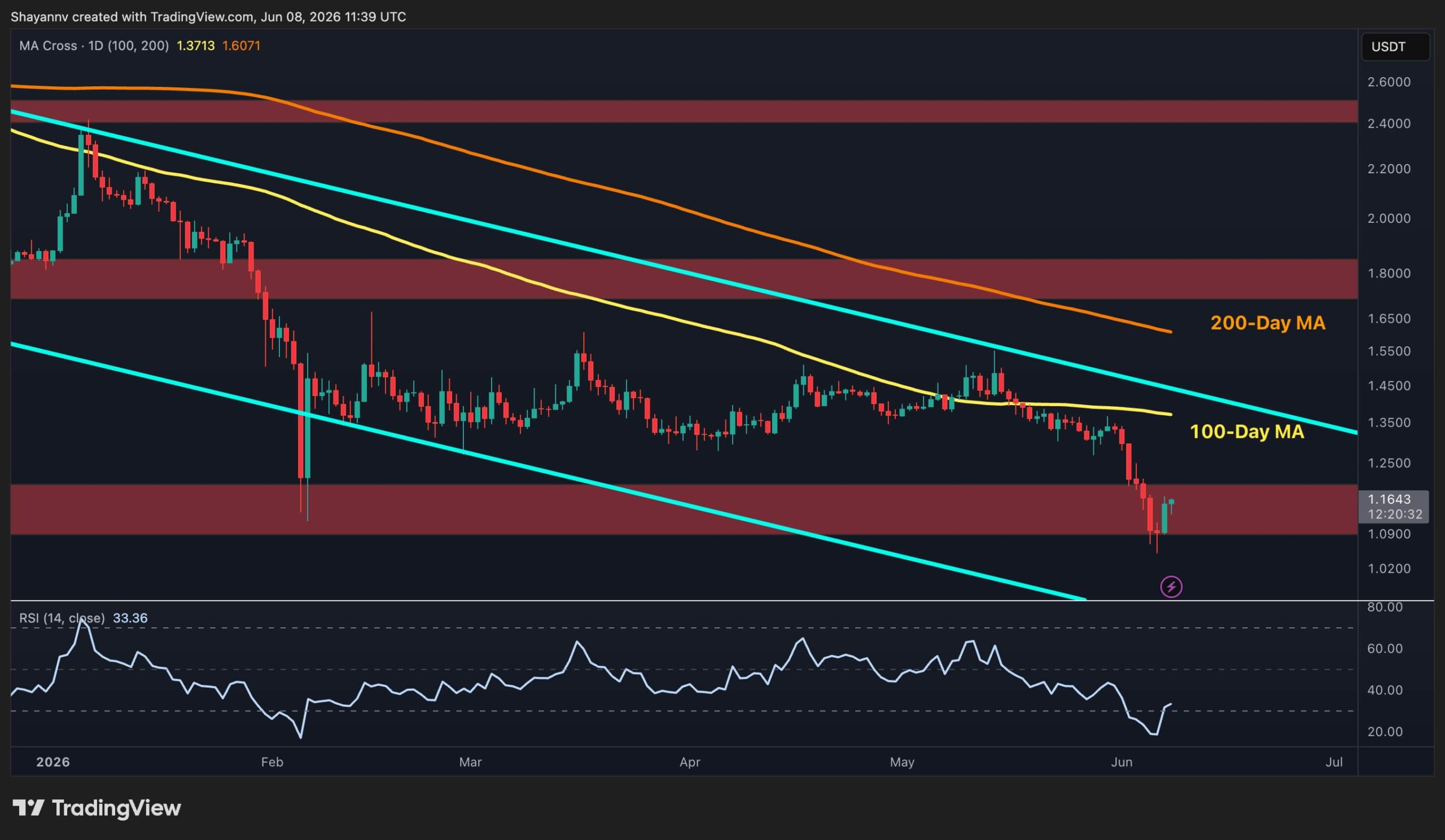
    On the daily chart, XRP recently breached local support around the $1.30 mark, subsequently falling into a significant demand zone situated between $1.10 and $1.20. This area has historically proven attractive to buyers, and it has once again spurred a reaction, with the price rebounding after a brief dip below the zone’s lower boundary.

    Despite this bounce, the overarching market structure for XRP remains bearish. The cryptocurrency is trading within a long-term descending channel and continues to remain below both the 100-day moving average, approximately at $1.35, and the 200-day moving average, near $1.60. The bearish alignment of these moving averages suggests that sellers are still in control of the higher-timeframe trend.

    For buyers to regain momentum, the immediate challenge is to reclaim the 100-day moving average and establish the $1.35-$1.40 region as support. A successful recovery above this area could pave the way for a move towards the next major resistance zone around $1.80. Conversely, a failure to hold the current support could expose the lower boundary of the descending channel, potentially triggering another downward leg. Meanwhile, the Relative Strength Index (RSI) has recovered from near-oversold conditions and is currently hovering around 33, indicating a slight easing of bearish momentum, though a strong bullish reversal signal has yet to emerge.

    XRP vs. Bitcoin Performance

    Against Bitcoin, XRP is exhibiting more constructive price action following several months of underperformance. The XRP/BTC pair recently found support near 1,700 satoshis and has since printed a series of higher lows, suggesting that selling pressure may be waning.

    The pair is currently trading around the 1,820 satoshi region, which coincides with an important resistance area and sits just below the declining 100-day moving average. A decisive breakout above this zone could bolster the recovery narrative and allow XRP to target the next resistance area around 2,000 satoshis, where the 200-day moving average is also located.

    However, the broader trend for the XRP/BTC pair remains negative, as it continues to trade within a long-term descending channel and remains below both the 100-day and 200-day moving averages. Consequently, any sustained bullish continuation will likely necessitate a firm break above the 1,850 satoshi resistance cluster.

    Furthermore, the RSI for the BTC pair has shown notable improvement, hovering near the neutral 55 level, which reflects strengthening momentum compared to XRP’s performance against USDT. As long as XRP maintains its position above the 1,700 satoshi support, the probability of an extension towards higher resistance levels remains elevated. Nevertheless, a breakdown below this floor would invalidate the recent recovery structure and shift the focus towards the lower channel support near 1,500 satoshis.

  • MetaMask Unveils AI-Powered Wallet with Integrated Security

    MetaMask Unveils AI-Powered Wallet with Integrated Security

    MetaMask Unveils Agent Wallet for Autonomous DeFi Trading

    MetaMask has introduced Agent Wallet, a self-custodial cryptocurrency wallet engineered to empower AI agents to autonomously engage in trading and interact with decentralized finance (DeFi) protocols, all while operating under user-defined security parameters.

    The launch arrives as the cryptocurrency development community increasingly focuses on creating AI agents capable of managing portfolios, executing trades, and directly interacting with decentralized applications. The product is currently accessible to approximately 200 users through an Early Access Program, with a broader release anticipated later this summer.

    “It’s genuinely day one for agents, but the infrastructure decision can’t wait because agents are already touching real money, and most of them are doing it the wrong way,” Zhen Yu Tong, MetaMask Senior Director of Product, told Decrypt.

    Tong explained that many existing market solutions grant AI agents direct access to private keys, posing a significant risk of unintended transactions or fund loss due to errors rather than malicious hacks.

    “If the first generation of trading agents normalizes giving away your keys, we’ll be rebuilding the custodial mistakes crypto spent a decade escaping,” he stated.

    MetaMask’s Agent Wallet routes transactions through the company’s existing security infrastructure. This includes transaction simulation, detection of scams and malicious contracts, threat scanning powered by Blockaid, Clear Signing, and Servo MEV protection.

    Rather than assuming AI models can be entirely shielded from manipulation, MetaMask emphasized that the wallet’s design prioritizes controls to mitigate the consequences of agent errors.

    “The honest premise first: You cannot guarantee an LLM won’t be tricked,” Tong said. “Prompt injection is an open research problem, not a bug you patch once.”

    Prompt injection attacks occur when malicious instructions are used to compromise an AI system, leading it to perform unintended actions. In the context of cryptocurrency, this could involve tricking an agent into approving transactions, moving funds, or interacting with a compromised smart contract.

    To counter these risks, Agent Wallet’s default Guard Mode allows users to establish spending limits, approved protocols, and other operational parameters. Transactions that deviate from these rules or are flagged as suspicious necessitate two-factor authentication for completion.

    A less restrictive Beast Mode offers agents greater autonomy, though it still requires approval for transactions identified as malicious.

    “Beast Mode is for users who want genuinely hands-off operation—the agent acts without a pop-up on every transaction,” Tong explained. “What Beast Mode does not do is switch off the safety net. If our threat detection flags a transaction as malicious, 2FA still fires no matter what mode you’re in. That’s non-negotiable.”

    Tong further clarified that operating without explicit approval does not equate to operating without limitations. Beast Mode still adheres to user-defined guardrails, including spending caps, approved assets and protocols, and time-based restrictions. This enables agents to autonomously rebalance portfolios, interact with verified contracts, and settle payments without requiring individual transaction approvals.

    “Think of it like banks or exchanges, where you need to add recipients to an allowlist before you can send to them. That’s Guard Mode—the user pre-approves who the agent can interact with, and anything outside that list triggers 2FA,” he said. “Beast Mode flips it: addresses are scanned in real time, and 2FA fires if any are flagged as bad—but the user doesn’t have to add anyone to an allowlist upfront.”

    The wallet supports Ethereum Virtual Machine-compatible chains and Hyperliquid, along with agent frameworks such as OpenAI Codex, Anthropic’s Claude Code, Cursor, OpenClaw, and Hermes Agent. It utilizes Cubist’s trusted execution environment technology to ensure private keys remain within a hardware-isolated enclave during the signing process, thereby preventing MetaMask and Consensys from accessing user key material.

    MetaMask’s Agent Wallet launch follows similar initiatives from other crypto companies developing infrastructure for AI agents.

    In February, Coinbase introduced Agentic Wallets, a self-custodial wallet designed for AI agents to manage crypto assets and send payments, with private keys isolated within trusted execution environments. In March, MoonPay expanded its agent strategy by integrating Ledger hardware wallets for AI transactions requiring human approval.

    The crypto payments firm later launched the Open Wallet Standard, an open-source framework supported by entities including PayPal, the Ethereum Foundation, Solana Foundation, Ripple, and Base, aiming to standardize AI agent wallet and fund management across blockchains.

    Last week, MoonPay released a desktop application for Claude Code and OpenAI Codex, enabling users to connect AI assistants to wallets, token swaps, prediction markets, and other blockchain tools through a graphical interface.

  • 2026 Crypto-Oil Trading: Top Exchanges Revealed

    2026 Crypto-Oil Trading: Top Exchanges Revealed

    The cryptocurrency landscape has undergone a significant transformation in recent years. When I first entered the space, only a handful of centralized exchanges existed, and the notion of trading stocks or commodities on them was unthinkable. Today, however, tokenization has become a cornerstone of the industry, enabling the trading of commodities like oil with daily trading volumes reaching billions.

    By 2026, as blockchain infrastructure continues its evolution, traders will be able to access oil markets through tokenized assets and decentralized platforms, bypassing traditional brokers entirely. This guide will provide a comprehensive overview of trading oil with crypto, covering exchanges, step-by-step instructions, fees, advantages, disadvantages, and key differences.

    The convergence of oil markets and cryptocurrency has intensified as digital asset platforms expand beyond spot trading into derivatives and real-world asset (RWA) exposure. Historically, oil trading was dominated by futures contracts on regulated exchanges. Now, however, crypto infrastructure facilitates similar exposure through tokenized alternatives. Instead of holding physical oil or relying on legacy brokers, traders can speculate on oil prices using crypto-collateralized perpetual contracts that mirror benchmarks like Brent or WTI.

    Several prominent platforms have already embraced this trend. Hyperliquid, a popular decentralized perpetual contracts exchange, quickly emerged as a preferred venue for oil trading, particularly during periods of geopolitical tension. It remains a leading platform for tokenized oil, boasting billions in open interest within weeks of its launch.

    Centralized exchanges are also gaining traction. Binance, for instance, offers oil-linked derivatives that function similarly to traditional oil futures but are settled in cryptocurrency. Bybit has also introduced trading interfaces that blend traditional finance concepts with digital assets, allowing users to gain exposure to commodities like crude oil alongside crypto markets.

    This evolution signifies a broader shift: cryptocurrency exchanges are rapidly transforming into multi-asset trading venues. Given its status as one of the world’s most liquid commodities, oil represents a natural extension for these platforms. It is important to note that this connection remains synthetic, with prices derived from external markets and positions typically settled in stablecoins or other cryptocurrencies.

    Decentralized and Centralized Exchanges for Oil Trading

    This section will explore both decentralized and centralized exchanges offering oil-linked products tradable with stablecoins. While centralized exchanges have traditionally been perceived as more user-friendly, Hyperliquid offers a comparable experience with the added benefit of self-custody.

    Hyperliquid

    Rating: 4.8/5

    • Pros:

    * 24/7 decentralized commodity trading
    * Complete self-custody with wallet execution
    * Ideal for advanced DeFi derivatives users

    • Cons:

    * Potential smart contract and oracle issues
    * Steeper learning curve for newcomers
    * External ecosystem builders run the markets

    Hyperliquid stands as the largest decentralized cryptocurrency exchange, dominating over 90% of the DEX market share for perpetual futures trading. It pioneered oil-linked derivatives with the launch of HIP-3 on mainnet, becoming a primary venue for trading OIL contracts with crypto, even on weekends. This made it a crucial instrument for price discovery during periods of Middle Eastern conflict.

    Hyperliquid treats crude oil as a 24/7 on-chain perpetual market. Users can post crypto collateral to gain long or short exposure to oil-linked contracts without needing a traditional commodity broker. This offers a truly crypto-native experience, featuring wallet-backed access, on-chain settlement, perpetual futures, funding rates, and continuous trading.

    While centralized venues have since followed suit, Hyperliquid continues to command a significant portion of trading volume for good reason. However, it’s important to acknowledge that Hyperliquid is not a regulated commodity exchange, a characteristic shared by Binance and Bybit. The onboarding process can be intimidating for non-crypto users who need to set up a wallet and bridge funds, but for those familiar with Web3 dApps, the experience is seamless.

    The markets on Hyperliquid are deployed by third-party firms building on the exchange’s infrastructure through its builder codes program. These companies support the markets, meaning the Hyperliquid team is not directly responsible for them. Currently, teams offering oil-linked perps on Hyperliquid include:

    • Astro
    • GMX
    • GMX V2
    • GMX V2 (ETH)
    • GMX V2 (ARB)
    • GMX V2 (AVAX)
    • GMX V2 (FTM)
    • GMX V2 (OP)
    • GMX V2 (POLY)
    • GMX V2 (BASE)
    • GMX V2 (BNB)
    • GMX V2 (MATIC)
    • GMX V2 (ARBITRUM)
    • GMX V2 (OPTIMISM)
    • GMX V2 (FANTOM)
    • GMX V2 (AVALANCHE)
    • GMX V2 (POLYGON)
    • GMX V2 (BASE)
    • GMX V2 (BINANCE SMART CHAIN)
    • GMX V2 (METIS)
    • GMX V2 (CELO)
    • GMX V2 (MOONRIVER)
    • GMX V2 (MOONBEAM)
    • GMX V2 (KAVA)
    • GMX V2 (VELAS)
    • GMX V2 (ELASTOS)
    • GMX V2 (METAVERSE)
    • GMX V2 (XDAI)
    • GMX V2 (CRONOS)
    • GMX V2 (AURORA)
    • GMX V2 (CHI)
    • GMX V2 (BOBA)
    • GMX V2 (CORE)
    • GMX V2 (ZKSYNC)
    • GMX V2 (LINEA)
    • GMX V2 (SCROLL)
    • GMX V2 (ARBITRUM ONE)
    • GMX V2 (OPTIMISM GOERLI)
    • GMX V2 (ARBITRUM GOERLI)
    • GMX V2 (BASE GOERLI)
    • GMX V2 (ZKSYNC GOERLI)
    • GMX V2 (LINEA GOERLI)
    • GMX V2 (SCROLL GOERLI)
    • GMX V2 (CELO GOERLI)
    • GMX V2 (MOONRIVER GOERLI)
    • GMX V2 (MOONBEAM GOERLI)
    • GMX V2 (KAVA GOERLI)
    • GMX V2 (VELAS GOERLI)
    • GMX V2 (ELASTOS GOERLI)
    • GMX V2 (METAVERSE GOERLI)
    • GMX V2 (XDAI GOERLI)
    • GMX V2 (CRONOS GOERLI)
    • GMX V2 (AURORA GOERLI)
    • GMX V2 (CHI GOERLI)
    • GMX V2 (BOBA GOERLI)
    • GMX V2 (CORE GOERLI)
    • GMX V2 (METIS GOERLI)
    • GMX V2 (BNB GOERLI)
    • GMX V2 (MATIC GOERLI)
    • GMX V2 (AVAX GOERLI)
    • GMX V2 (FTM GOERLI)
    • GMX V2 (OP GOERLI)
    • GMX V2 (POLY GOERLI)
    • GMX V2 (BNB TESTNET)
    • GMX V2 (MATIC TESTNET)
    • GMX V2 (AVAX TESTNET)
    • GMX V2 (FTM TESTNET)
    • GMX V2 (OP TESTNET)
    • GMX V2 (POLY TESTNET)
    • GMX V2 (BASE TESTNET)
    • GMX V2 (METIS TESTNET)
    • GMX V2 (CELO TESTNET)
    • GMX V2 (MOONRIVER TESTNET)
    • GMX V2 (MOONBEAM TESTNET)
    • GMX V2 (KAVA TESTNET)
    • GMX V2 (VELAS TESTNET)
    • GMX V2 (ELASTOS TESTNET)
    • GMX V2 (METAVERSE TESTNET)
    • GMX V2 (XDAI TESTNET)
    • GMX V2 (CRONOS TESTNET)
    • GMX V2 (AURORA TESTNET)
    • GMX V2 (CHI TESTNET)
    • GMX V2 (BOBA TESTNET)
    • GMX V2 (CORE TESTNET)
    • GMX V2 (ZKSYNC TESTNET)
    • GMX V2 (LINEA TESTNET)
    • GMX V2 (SCROLL TESTNET)
    • GMX V2 (ARBITRUM ONE TESTNET)
    • GMX V2 (OPTIMISM GOERLI TESTNET)
    • GMX V2 (ARBITRUM GOERLI TESTNET)
    • GMX V2 (BASE GOERLI TESTNET)
    • GMX V2 (ZKSYNC GOERLI TESTNET)
    • GMX V2 (LINEA GOERLI TESTNET)
    • GMX V2 (SCROLL GOERLI TESTNET)
    • GMX V2 (CELO GOERLI TESTNET)
    • GMX V2 (MOONRIVER GOERLI TESTNET)
    • GMX V2 (MOONBEAM GOERLI TESTNET)
    • GMX V2 (KAVA GOERLI TESTNET)
    • GMX V2 (VELAS GOERLI TESTNET)
    • GMX V2 (ELASTOS GOERLI TESTNET)
    • GMX V2 (METAVERSE GOERLI TESTNET)
    • GMX V2 (XDAI GOERLI TESTNET)
    • GMX V2 (CRONOS GOERLI TESTNET)
    • GMX V2 (AURORA GOERLI TESTNET)
    • GMX V2 (CHI GOERLI TESTNET)
    • GMX V2 (BOBA GOERLI TESTNET)
    • GMX V2 (CORE GOERLI TESTNET)
    • GMX V2 (METIS GOERLI TESTNET)
    • GMX V2 (BNB GOERLI TESTNET)
    • GMX V2 (MATIC GOERLI TESTNET)
    • GMX V2 (AVAX GOERLI TESTNET)
    • GMX V2 (FTM GOERLI TESTNET)
    • GMX V2 (OP GOERLI TESTNET)
    • GMX V2 (POLY GOERLI TESTNET)
    • GMX V2 (BNB SMART CHAIN)
    • GMX V2 (METIS)
    • GMX V2 (CELO)
    • GMX V2 (MOONRIVER)
    • GMX V2 (MOONBEAM)
    • GMX V2 (KAVA)
    • GMX V2 (VELAS)
    • GMX V2 (ELASTOS)
    • GMX V2 (METAVERSE)
    • GMX V2 (XDAI)
    • GMX V2 (CRONOS)
    • GMX V2 (AURORA)
    • GMX V2 (CHI)
    • GMX V2 (BOBA)
    • GMX V2 (CORE)
    • GMX V2 (ZKSYNC)
    • GMX V2 (LINEA)
    • GMX V2 (SCROLL)
    • GMX V2 (ARBITRUM ONE)
    • GMX V2 (OPTIMISM GOERLI)
    • GMX V2 (ARBITRUM GOERLI)
    • GMX V2 (BASE GOERLI)
    • GMX V2 (ZKSYNC GOERLI)
    • GMX V2 (LINEA GOERLI)
    • GMX V2 (SCROLL GOERLI)
    • GMX V2 (CELO GOERLI)
    • GMX V2 (MOONRIVER GOERLI)
    • GMX V2 (MOONBEAM GOERLI)
    • GMX V2 (KAVA GOERLI)
    • GMX V2 (VELAS GOERLI)
    • GMX V2 (ELASTOS GOERLI)
    • GMX V2 (METAVERSE GOERLI)
    • GMX V2 (XDAI GOERLI)
    • GMX V2 (CRONOS GOERLI)
    • GMX V2 (AURORA GOERLI)
    • GMX V2 (CHI GOERLI)
    • GMX V2 (BOBA GOERLI)
    • GMX V2 (CORE GOERLI)
    • GMX V2 (METIS GOERLI)
    • GMX V2 (BNB GOERLI)
    • GMX V2 (MATIC GOERLI)
    • GMX V2 (AVAX GOERLI)
    • GMX V2 (FTM GOERLI)
    • GMX V2 (OP GOERLI)
    • GMX V2 (POLY GOERLI)
    • GMX V2 (BNB TESTNET)
    • GMX V2 (MATIC TESTNET)
    • GMX V2 (AVAX TESTNET)
    • GMX V2 (FTM TESTNET)
    • GMX V2 (OP TESTNET)
    • GMX V2 (POLY TESTNET)
    • GMX V2 (BASE TESTNET)
    • GMX V2 (METIS TESTNET)
    • GMX V2 (CELO TESTNET)
    • GMX V2 (MOONRIVER TESTNET)
    • GMX V2 (MOONBEAM TESTNET)
    • GMX V2 (KAVA TESTNET)
    • GMX V2 (VELAS TESTNET)
    • GMX V2 (ELASTOS TESTNET)
    • GMX V2 (METAVERSE TESTNET)
    • GMX V2 (XDAI TESTNET)
    • GMX V2 (CRONOS TESTNET)
    • GMX V2 (AURORA TESTNET)
    • GMX V2 (CHI TESTNET)
    • GMX V2 (BOBA TESTNET)
    • GMX V2 (CORE TESTNET)
    • GMX V2 (ZKSYNC TESTNET)
    • GMX V2 (LINEA TESTNET)
    • GMX V2 (SCROLL TESTNET)
    • GMX V2 (ARBITRUM ONE TESTNET)
    • GMX V2 (OPTIMISM GOERLI TESTNET)
    • GMX V2 (ARBITRUM GOERLI TESTNET)
    • GMX V2 (BASE GOERLI TESTNET)
    • GMX V2 (ZKSYNC GOERLI TESTNET)
    • GMX V2 (LINEA GOERLI TESTNET)
    • GMX V2 (SCROLL GOERLI TESTNET)
    • GMX V2 (CELO GOERLI TESTNET)
    • GMX V2 (MOONRIVER GOERLI TESTNET)
    • GMX V2 (MOONBEAM GOERLI TESTNET)
    • GMX V2 (KAVA GOERLI TESTNET)
    • GMX V2 (VELAS GOERLI TESTNET)
    • GMX V2 (ELASTOS GOERLI TESTNET)
    • GMX V2 (METAVERSE GOERLI TESTNET)
    • GMX V2 (XDAI GOERLI TESTNET)
    • GMX V2 (CRONOS GOERLI TESTNET)
    • GMX V2 (AURORA GOERLI TESTNET)
    • GMX V2 (CHI GOERLI TESTNET)
    • GMX V2 (BOBA GOERLI TESTNET)
    • GMX V2 (CORE GOERLI TESTNET)
    • GMX V2 (METIS GOERLI TESTNET)
    • GMX V2 (BNB GOERLI TESTNET)
    • GMX V2 (MATIC GOERLI TESTNET)
    • GMX V2 (AVAX GOERLI TESTNET)
    • GMX V2 (FTM GOERLI TESTNET)
    • GMX V2 (OP GOERLI TESTNET)
    • GMX V2 (POLY GOERLI TESTNET)

    Together, these teams contribute nearly $1 billion in daily trading volume.

    Binance

    Binance offers direct exposure to crude and Brent oil prices through its derivatives platform, Binance Futures. The available pairs are:

    • BRN1! (Brent Crude Oil Futures)
    • WTI1! (West Texas Intermediate Crude Oil Futures)

    The convenience of Binance is evident. As the world’s largest cryptocurrency exchange with millions of daily active users, it provides immediate access to oil perpetual future contracts. The trading experience mirrors that of cryptocurrency derivatives, requiring no additional learning curve. Trading is available 24/7, with a maximum leverage of 100x.

    • Pros:

    * User-friendly interface for existing Binance users
    * High liquidity and trading volume
    * 24/7 trading availability
    * High leverage options

    • Cons:

    * Not a regulated commodity exchange
    * Requires KYC verification
    * Potential for liquidation risk with high leverage

    Bybit

    Bybit presents another direct option for trading oil with cryptocurrency, particularly for those already using the platform for crypto trading. The exchange offers a TradFi service, enabling trading of WTI and Brent oil using USDT. This model provides a familiar structure for crypto derivatives traders.

    Bybit’s approach simplifies the process, allowing users to bridge crypto balances and traditional markets without needing a separate commodities broker. The platform also offers mobile access and advanced trading tools.

    • Pros:

    * Familiar interface for crypto derivatives traders
    * Convenient integration with existing crypto balances
    * Mobile access and advanced tools
    * 24/7 trading availability

    • Cons:

    * Not a regulated commodity exchange
    * Requires KYC verification
    * Potential for liquidation risk with high leverage

    Fees

    Fees vary significantly across the reviewed platforms and can be influenced by account tier, trading volume, region, and market conditions. It is crucial to look beyond the maker-taker fees and consider funding rates, spreads, slippage, withdrawal fees, bridging costs, and any commissions or overnight charges.

    Advantages of Trading Oil with Crypto

    For those accustomed to traditional commodity trading, the process through brokers, futures exchanges, or CFDs can often feel cumbersome. Setting up traditional brokerage accounts, for example, can involve lengthy administrative procedures that are typically absent in crypto-native platforms. Given that physical oil trading is impractical for most, derivatives are the likely focus. Here are some key advantages of trading oil with crypto:

    • 24/7 Market Access: Many crypto platforms offer round-the-clock access to oil markets, unlike traditional futures markets with set trading hours. This continuous trading capability is particularly attractive during weekends, holidays, or periods of geopolitical instability when news can break while traditional markets are closed.
    • Stablecoin Settlement: If you already engage in crypto trading, you likely hold stablecoins like USDT or USDC. All the reviewed platforms allow direct oil trading using these stablecoins. This provides a familiar experience, enabling collateral posting, position management, and trade settlement in dollar-denominated stablecoins.
    • Reduced Need for Separate Brokers: Crypto platforms can diminish the reliance on separate commodities brokers. For existing crypto traders, this eliminates the friction of opening new accounts with legacy brokerages, learning new interfaces, or transferring capital between different financial platforms. This is especially appealing to crypto-native users.
    • Familiar Trading Experience: Oil-linked products on crypto exchanges closely resemble perpetual futures markets, which many traders are already familiar with. Centralized exchanges, in particular, offer a streamlined setup process.
    • Other Benefits:

    * Speed and Efficiency: Transactions are generally faster compared to traditional financial systems.
    * Global Accessibility: Crypto platforms are accessible to a wider global audience.
    * Innovation: The space is constantly evolving with new features and products.

    Risks of Trading Oil with Crypto

    The risks associated with trading oil with crypto are largely similar to those found in perpetual futures trading, including:

    • Market Volatility: Oil prices can be highly volatile, influenced by geopolitical events, supply and demand dynamics, and economic factors.
    • Leverage Risk: High leverage amplifies both potential profits and losses. Excessive leverage can lead to rapid liquidation of positions.
    • Liquidation Risk: If the market moves against your position and your margin falls below the required level, your position can be automatically liquidated.
    • Smart Contract Risk (for DEXs): Decentralized exchanges rely on smart contracts, which can have vulnerabilities that could be exploited.
    • Counterparty Risk (for CEXs): Centralized exchanges hold your funds, meaning there is a risk of the exchange becoming insolvent or experiencing a security breach.

    Specific Risks to Consider

    • Oracle Risk: Crypto-based oil markets often rely on external price feeds, such as index calculations or oracle systems, to track benchmarks like Brent or WTI. If an oracle is delayed, inaccurate, manipulated, or disconnected from the underlying market, traders may encounter unexpected pricing issues. This risk can affect both decentralized and centralized exchanges.

    Choosing the Right Platform

    There is no single “best” option for every trader. The choice between decentralized and centralized platforms depends on individual experience levels, custody preferences, and risk tolerance.

    | Feature | Decentralized (e.g., Hyperliquid) | Centralized (e.g., Binance, Bybit) |
    | :—————— | :——————————– | :——————————— |
    | Custody | Self-custody | Exchange custody |
    | User Experience | More complex, crypto-native | Simpler, familiar |
    | Regulation | Less regulated | Varies, often requires KYC |
    | Anonymity | Higher | Lower (due to KYC) |
    | Security | Smart contract dependent | Exchange security dependent |
    | Best For | Crypto natives, self-custody advocates | Newcomers, convenience seekers |

    Frequently Asked Questions

    Yes, many crypto platforms now offer oil-linked products that allow traders to gain exposure to crude oil prices using stablecoins or crypto collateral. These are typically derivatives or synthetic markets rather than direct ownership of physical oil.

    Usually, no. Most oil-linked crypto products track benchmarks like Brent or WTI through derivatives, perpetual contracts, indexes, or oracle-based pricing, rather than granting traders ownership of physical crude oil.

    Oil-linked products are available on exchanges such as Hyperliquid, Binance, and Bybit. Availability can change, so it’s advisable to check the live platform before depositing funds.

    Yes, most crypto-based oil markets operate 24/7. However, weekend trading may involve wider spreads, lower liquidity, and pricing discrepancies compared to traditional oil markets.

    Yes, trading oil with crypto is generally considered safe, provided one understands and manages the inherent risks, including market volatility, leverage, and liquidation.

    Yes, USDT or USDC are typically required to trade oil with crypto. Most exchanges support at least one of these stablecoins.

    Hyperliquid is the premier choice for crypto natives seeking an on-chain experience. Binance and Bybit are excellent alternatives for existing users or those prioritizing a reliable and secure centralized exchange.

    The primary appeal of these platforms lies in their convenience. While the initial setup might seem daunting for inexperienced traders, crypto exchanges generally provide comprehensive guidance and educational resources.

    In essence, trading oil with crypto offers significant advantages for those who value speed, stablecoin settlement, and crypto-native access. However, it is not a risk-free endeavor.

  • XRP and Bitcoin: The Only Top 10 Survivors Since 2014

    XRP and Bitcoin: The Only Top 10 Survivors Since 2014

    XRP Price Shows Resilience Amidst Market Turbulence, Analysts Eye Potential Upside

    XRP is currently trading around the $1.15 mark, buoyed by a combination of on-chain activity, institutional interest, and market structure signals that point to underlying strength. Notably, XRP, alongside Bitcoin, is one of the only cryptocurrencies to have consistently maintained a top-10 market capitalization position since 2014, a testament to its enduring presence in the digital asset space.

    XRP Recovers with Conviction

    Following a volatile week, XRP has successfully reclaimed the $1.10 support level, a move that appears to be backed by significant conviction. Data indicates that over 25 million XRP tokens were withdrawn from exchanges during this period, a pattern often associated with accumulation by large holders, or “whales.”

    Strong Inflows and Trading Volume

    Daily spot trading volume for XRP surged by 16%, exceeding $2 billion. Furthermore, XRP investment products have collectively attracted over $1.4 billion in cumulative inflows. These metrics suggest that the current price action is not merely a fleeting fluctuation but rather a data point within a broader, sustained trend.

    Technical Outlook and Support Levels

    XRP is presently consolidating within the $1.13 to $1.15 range, holding firm above the immediate pivot point of $1.08 and building on its re-established $1.10 support. The 16% surge in trading volume accompanying this upward movement is viewed positively by technical traders.

    Potential downside support levels are identified at $1.06, $1.03, and $1.00. The $1.00 level, in particular, serves as a crucial psychological floor; a decisive weekly close below this point would signal a significant bearish shift in market structure.

    Bullish and Bearish Scenarios

    For bullish investors, sustained exchange outflows and an acceleration of the exchange-traded fund (ETF) narrative could propel XRP towards the $1.30-$1.40 resistance zone. Beyond that, analyst consensus suggests a potential target range of $2.50 to $3.50 by 2026.

    Conversely, a deterioration in the broader macroeconomic environment could lead to XRP breaking below the $1.00 mark. Both macro and technical indicators suggest a potential retracement in the near term, following the recent breakout.

    The Challenge of Exponential Growth

    The current market dynamics present a unique challenge for traders. XRP and Bitcoin have weathered numerous market cycles, including periods of rapid growth and subsequent corrections. The potential for exponential gains, similar to those captured by early holders in 2014 or 2017, is structurally limited at their current market capitalizations. This raises the question of where significant future growth opportunities might lie.

    LiquidChain: A New Frontier in Liquidity

    LiquidChain ($LIQUID) is an emerging Layer 3 infrastructure project designed to address the fragmentation of liquidity across major blockchain ecosystems such as Bitcoin, Ethereum, and Solana. Its core innovation is a Unified Liquidity Layer that integrates these three networks into a singular execution environment. This architecture enables Single-Step Execution, Verifiable Settlement, and a Deploy-Once approach, allowing developers to access liquidity from BTC, ETH, and SOL without the need for cross-chain redeployment.

    The presale for $LIQUID is currently underway, with tokens priced at $0.01467. To date, $830,000 has been raised. The current entry price reflects the early-stage infrastructure risk rather than post-hype market premiums. Investors are encouraged to review LiquidChain’s presale terms before the window closes.

  • XRP Crash: Analyst Sees Massive Opportunity

    XRP Crash: Analyst Sees Massive Opportunity

    Crypto Market Faces Headwinds, XRP Analyst Eyes Potential Dip

    Despite a recent, modest recovery, the cryptocurrency sector continues to grapple with the ongoing bear market. Within this challenging environment, one prominent analyst suggests that Ripple’s XRP, which has been significantly impacted by recent market corrections, could fall below $1 in the short term. However, this potential decline, the analyst notes, might present a valuable buying opportunity for long-term investors.

    As of this report, XRP is trading around $1.15, according to CoinGecko data, marking a 12% decrease from its valuation last Monday. X user Ali Martinez stated he is closely observing the $0.90 level, indicating that a drop to this point could offer “a compelling long-term buying opportunity.”

    While some commentators on Martinez’s post expressed skepticism about XRP breaching the $1 mark, others revealed they have already placed buy orders at $0.50. Martinez described this strategy as “not a bad idea.”

    Recent activity from large holders, often referred to as “whales,” suggests that XRP is indeed at risk of further price depreciation. Over the past week, these market participants have offloaded approximately 60 million tokens. This significant sell-off signals waning confidence and could potentially trigger panic among smaller investors, leading to a more substantial sell-off.

    Adding to the bearish sentiment, one anonymous whale has opened a short position on XRP valued at nearly $1.5 million. These large investors are frequently rumored to possess insider knowledge of upcoming events that could influence a token’s price. It remains to be seen whether this whale’s substantial bet will prove profitable or if it will be deemed a reckless gamble.

    Conversely, other analysts maintain an optimistic outlook, believing the worst of the downturn may be over and predicting a strong rebound in the near future. X user CRYPTOWZRD pointed out that XRP closed the previous day on a bullish note, suggesting that a move above $1.15 could signal further upside potential.

    In a more ambitious forecast, Joshua Dalton envisions XRP surging to $3.50 by the end of June, a target that appears ambitious given current market conditions. Meanwhile, Zach Humphries revealed he has purchased XRP for the first time in two years, drawing a parallel to a previous investment. “The last time I bought XRP it was at $0.50 and scooping it up at $1.09 feels like a very similar opportunity,” Humphries explained.

    Underpinning potential upward movement is sustained institutional interest in XRP. Unlike spot Bitcoin and Ether ETFs, those backed by XRP have attracted considerable capital even during the market downturn. This indicates that major players, including pension funds and hedge funds, are continuing to increase their exposure to the token despite the prevailing bearish sentiment.

  • XRP: $1 Target or Sharp Sell-off? Analyst Cites Liquidity Signals

    XRP: $1 Target or Sharp Sell-off? Analyst Cites Liquidity Signals

    XRP Approaches Critical Liquidity Zone Amid Market Flush

    XRP is nearing a pivotal liquidity zone following a significant market-wide cryptocurrency sell-off. Analyst Will Taylor, known on X as @CryptoinsightUK, suggests that downside liquidity has largely been absorbed, with larger pools potentially now situated above the current price. This development occurs as cryptocurrency sentiment has deteriorated sharply, with approximately $5 billion in liquidations across the market.

    XRP Navigates Long-Term Downtrend

    In the latest edition of “The Weekly Insight,” Taylor characterized the current XRP structure not as an isolated altcoin decline, but as part of a broader capitulation event. He noted that Bitcoin, Ethereum, and XRP have all entered regions where substantial liquidity has been tapped, prompting questions about whether the market is poised for another downward move or a sharp reversal.

    For XRP, a key level remains the liquidity band around the $1 mark. Taylor observed that while some downside liquidity persists in this area, it appears modest when compared to the larger liquidity pools situated above the current price. “The discussion is very similar for XRP,” Taylor wrote. “If you zoom in slightly further on the XRP liquidity chart, there is still a liquidity band sitting around the $1 area. However, when you zoom out and compare it to the larger timeframe liquidity pools above us, it becomes relatively insignificant.”

    Market Structure Under Test

    This does not necessarily signal a bullish resolution for the chart. Taylor emphasized that XRP remains entrenched in a broader downtrend that has been in place since August 2025, making the current price action a critical test of market structure. A failure to regain momentum could expose the $1 liquidity band. Conversely, a successful defense of this level would bolster the argument that sellers have largely exhausted their selling pressure.

    The analyst’s overarching thesis is that the market has reached a liquidity-driven inflection point. Bitcoin has absorbed key hourly downside liquidity, Ethereum has retested a trendline while clearing significant daily liquidity below its price, and XRP’s remaining lower liquidity pool appears less substantial than the pools above. In this context, the recent wave of liquidations may have sufficiently reset market positioning to pave the way for a stronger upward move.

    “One positive factor is that we have just experienced a significant liquidation event, with roughly $5 billion worth of liquidations across the market,” Taylor wrote. “Historically, events of that magnitude tend to occur very close to important lows, if not directly at them. Again, that does not mean we cannot see another flush lower, a marginally lower low, or even continued downside.”

    Caution Amid Potential Transition

    The analyst stressed the importance of caution, repeatedly highlighting the potential for continued volatility in the cryptocurrency market, particularly if instability in traditional equity markets spills over into digital assets. The newsletter pointed to a strengthening US Dollar Index (DXY), US 10-year Treasury yields near 4.532%, and an overextended Nasdaq as macroeconomic factors that could continue to pressure risk assets.

    However, the report also suggested that the crypto market might be closer to a transition point than current sentiment indicates. Taylor posited that the next phase of the market could be defined less by widespread speculation and more by tangible utility, with institutions increasingly valuing networks based on their actual usage rather than solely on narrative.

    “My view remains the same,” the analyst wrote. “I continue to believe that all of this is happening because the next phase of the market is going to be the utility phase. The institutions entering this market are not playing the same game that retail has been playing for the last decade.”

    At press time, XRP was trading at $1.14.

  • XRP Poised for Stocks, Loans Settlement: Is Infrastructure Ready?

    XRP Poised for Stocks, Loans Settlement: Is Infrastructure Ready?

    XRP Ledger Evolving Beyond Payments to Become Settlement Layer for Tokenized Assets

    Ripple’s Chief Technology Officer Emeritus, David Schwartz, has outlined an ambitious vision for the XRP Ledger (XRPL), positioning it as a comprehensive settlement and issuance layer for a wide array of tokenized assets, including stocks, money market funds, repos, and on-chain loans. This strategic shift, detailed in a June 5 video segment, signals a significant expansion beyond its initial role as a fast payments network, a development viewed as bullish for XRP.

    A Clear Roadmap and Tangible Progress

    The roadmap presented is notably specific, with an aggressive timeline for infrastructure development and a confirmed list of institutional partners. The key question for observers is the current operational status of these initiatives, distinguishing between what is already live and what remains in the development pipeline.

    Real-World Asset Tokenization Surges

    Evidence of XRPL’s growing traction in the real-world asset (RWA) tokenization space is not speculative but data-driven. Tokenized RWAs on the ledger experienced a dramatic surge, increasing from $24.7 million to $567.9 million throughout 2025, representing a 2,200% growth. By early 2026, this figure had climbed to approximately $2.325 billion.

    This trajectory places XRPL among the top global platforms for distributed tokenized RWAs, capturing an estimated 1.53% of the total market. Key issuers driving this growth include VERT Capital, RLUSD, and OpenEden, which collectively accounted for 85.5% of the tokenized value as of mid-2025. Notably, Ripple’s regulated stablecoin, RLUSD, boasts a market capitalization of $1.3 billion, making it the third-largest US-regulated stablecoin.

    The $2.3 billion figure represents the current live ecosystem. The implications of this growth for XRPL’s broader ambitions in tokenized equities and credit markets are still unfolding.

    Protocol Innovations Fueling Expansion

    Schwartz’s vision hinges on two core protocol mechanisms. The Multi-Purpose Token (MPT) standard is designed to enable the on-chain representation of complex structured assets, such as bonds and funds. MPT incorporates built-in attributes like maturity dates and transfer restrictions, eliminating the need for custom smart contract logic.

    Furthermore, the native lending protocol, slated for rollout under XLS-66 as part of XRPL Version 3.0.0, will facilitate fixed-term institutional loans. This protocol features isolated vaults and automated repayment systems. A permissioned decentralized exchange (DEX), with order books accessible only to Know Your Customer (KYC)-credentialed participants, has already launched its first live offering. These are not theoretical concepts but actively deployed infrastructure.

    The activation of the full lending protocol is contingent on the XLS-66 validator vote, which requires an 80% supermajority.

    Strategic Sequencing of Product Rollouts

    Schwartz’s presentation in the ‘XRP in a Minute’ segment deliberately sequenced the rollout of these capabilities. He began by referencing Bitcoin’s foundational role in establishing public blockchains for value transfer, then positioned XRPL as the subsequent layer, capable of supporting “both the native digital assets similar to bitcoin, as well as issued assets that can represent things like stablecoins or tokenized assets of any kind.”

    He then explicitly named the near-term product categories: “tokenized securities to money market funds, even things like tokenized stocks,” followed by credit-focused offerings: “tokenized repos and tokenized loans.” This ordering is strategic, prioritizing securities and funds due to their clear institutional demand and the existing compliance infrastructure on XRPL. Repos and loans will follow once the XLS-66 lending protocol is fully operational.

    While tokenized stocks have been mentioned, they are not yet confirmed as live products on the ledger. Archax, a UK-regulated digital securities exchange, has committed to a $1 billion pipeline that includes equities and fund units, indicating significant institutional interest. The underlying infrastructure, including MPT, the permissioned DEX, and credential-gated order books, is capable of supporting tokenized equities, though specific live products are yet to be announced.

    Schwartz’s institutional thesis emphasizes that “Enterprises will provide the features that will attract mass retail adoption, where DeFi can truly deliver on its promise of replacing TradFi.” This perspective suggests that compliance-first, enterprise-developed financial products will serve as the primary on-ramp for the next wave of tokenization adoption, rather than permissionless protocols or retail speculation.

  • Schiff Slams Dimon’s Stablecoin Regulation Push

    Schiff Slams Dimon’s Stablecoin Regulation Push

    Peter Schiff Criticizes Jamie Dimon’s Push for Bank-Like Stablecoin Regulation

    Economist Peter Schiff publicly diverged from JPMorgan CEO Jamie Dimon on June 7, arguing that stablecoin issuers should not be subjected to the same capital and compliance standards as traditional banks. The stance was notable, given Schiff’s well-documented skepticism of the cryptocurrency sector.

    In a post on X, Schiff stated his strong disagreement with Dimon’s apparent desire for crypto companies offering interest-bearing products to adhere to the same capital and compliance requirements as established banks. “That’s nonsense,” Schiff wrote. “Banks are FDIC insured and make risky loans under a fractional reserve system. Stablecoin issuers don’t.”

    When a follower pointed out that this position seemed inconsistent with his history of criticizing crypto’s lack of investor protection, Schiff elaborated. He explained that stablecoins have a legitimate use case and that their issuers are not banks, particularly if the tokens are fully backed by dollars and invested solely in U.S. Treasuries.

    Journalist Eleanor Terrett also highlighted the unusual nature of the exchange, posting on X that it marked the first instance of an individual outside the crypto industry advocating against applying bank-like regulations to stablecoins.

    Dimon’s remarks originated from a public interview in late May, where he criticized the CLARITY Act, a bill that had advanced 15-9 in the Senate Banking Committee earlier that month. His primary objections focused on the bill’s provisions for stablecoin yields, which he argued would allow crypto companies to effectively pay interest on deposits without the safeguards afforded to banks and without sufficient anti-money laundering (AML) protocols. Dimon also made disparaging remarks about Coinbase CEO Brian Armstrong, a vocal proponent of the bill, stating, “he’s full of shit.” Armstrong, in turn, expressed mild surprise at Dimon’s comments but affirmed his continued respect for the JPMorgan executive.

    Senator Cynthia Lummis, another key supporter of the CLARITY Act, suggested that Dimon either had not read the bill or was intentionally attempting to “mislead people.” She countered Dimon’s claims by noting that the act actually extends provisions of the Bank Secrecy Act to digital assets.

    Dimon’s public criticism was part of a broader, months-long lobbying effort. In the days leading up to the committee vote, the American Bankers Association reportedly sent over 8,000 letters to Senate offices, advocating for changes to the bill’s language regarding stablecoin yields.

    The issue of AML compliance has also been a significant point of contention. The Bank Policy Institute shared data indicating a 162% surge in illicit crypto flows last year, reaching $154 billion. The institute attributed this increase, in part, to a nearly 700% rise in value received by sanctioned entities, with stablecoins, predominantly Tether’s USDT, accounting for 84% of all illicit transaction volume.

    Despite his recent comments on stablecoin regulation, Schiff has not altered his overall negative stance on cryptocurrency. As recently as the past weekend, he conducted a poll on X asking his followers at what price point Bitcoin would need to fall for them to concede he had been correct about the asset. He has also recently asserted that Bitcoin could drop to $20,000 if it falls below $50,000. Currently, Bitcoin is trading above $63,000, having recovered from a recent sharp decline that saw it reach a 19-month low near $59,000.

  • Bitcoin Bounces as Strategy Buys, Hayes Denies Allegations

    Bitcoin Bounces as Strategy Buys, Hayes Denies Allegations

    Bitcoin Volatility Surges Amid Geopolitical Turmoil and Market Sell-off

    Bitcoin (BTC/USD) experienced significant price swings, dropping below $63,000, recovering to $63,700, and then falling again following fresh Iran-Israel strikes. The turmoil was exacerbated by an 8% crash in South Korea’s KOSPI index, which triggered a circuit breaker and sent Asian stock markets tumbling. Heightened geopolitical tensions have rattled global risk assets, with the cryptocurrency market extending its losses from the previous week.

    Crypto Fear & Greed Index Hits Extreme Low

    The Crypto Fear & Greed Index plummeted to 8, signaling extreme fear and marking the worst sentiment in two months. Last week alone, the cryptocurrency market shed $390 billion, its most significant decline since the FTX collapse. Bitcoin (BTC/USD) fell 17%, while Ethereum (ETH) dropped 22%. Bitcoin briefly tested levels below $60,000 before a weekend rally pushed it back to the $63,000 mark.

    Geopolitical Tensions and Yen Intervention Fears Impact BTC/USD

    Geopolitical tensions have also driven oil prices higher and spurred safe-haven flows into the U.S. dollar. The BTC/USD pair took a hit amid concerns over potential actions by the Bank of Japan (BOJ) to defend the yen. The USD/JPY pair has climbed back above 160, a level at which Japan has historically intervened to support its currency. Such interventions typically lead to a strengthening yen and unwind carry trades, which can negatively impact risk assets like Bitcoin.

    MicroStrategy Remains Committed to Bitcoin Accumulation

    Despite unrealized losses, Michael Saylor, Executive Chairman of MicroStrategy, shared the company’s Bitcoin accumulation chart, suggesting it’s “a good time to add more dots.” Phuong Le, CEO of MicroStrategy, echoed Saylor’s sentiment, stating that “Rumors otherwise are just rumors.” The company continues to execute its long-term strategy of increasing its net Bitcoin holdings and Bitcoin per share, even as public companies holding Bitcoin as treasury assets lost a combined $62 billion in market capitalization during a recent downturn.

    Arthur Hayes Denies Allegations of Pump-and-Dump Scheme

    BitMEX co-founder Arthur Hayes has denied reports from LookOnChain that he repurchased HYPE tokens after a large wallet withdrawal was observed. On-chain investigator ZachXBT publicly accused Hayes of promoting and then dumping HYPE, NEAR, ZEC, and WLD in rapid succession, alleging he created exit liquidity for his followers. Hayes dismissed the accusations, stating he sells to willing buyers and shares his trades openly. The controversy has sparked debates on Crypto Twitter regarding influencer transparency.

    HTX Delists Trump-Backed Stablecoin Amid Wallet Freeze Dispute

    Justin Sun-linked cryptocurrency exchange HTX has delisted the Trump-backed stablecoin USD1 after World Liberty Financial reportedly froze exchange-linked wallets. HTX converted user holdings of USD1 to USDT at a 1:1 ratio and suspended related trading pairs, escalating a public dispute tied to prior sanctions and asset freezes. HTX has indicated it may pursue legal action if the wallet freeze is not reversed.

    Clarity Act Advances in U.S. Senate

    Senator Cynthia Lummis announced a victory as the Clarity Act passed through committee. Lawmakers are now aiming for a full Senate vote before the summer recess. However, the odds for its passage have been adjusted to 60% as the legislative timeline progresses.

    Potential for Recovery Amidst Extreme Fear

    Historically, periods of extreme fear in the crypto market have often preceded significant recoveries. The Crypto Fear & Greed Index readings below 10 have frequently marked local bottoms, leading to powerful rallies in Bitcoin. With corporate buyers like MicroStrategy maintaining their commitment and the potential for geopolitical noise to subside, the current market washout could pave the way for a rebound in cryptocurrency prices.

    Institutional Adoption and Regulatory Clarity as Bullish Catalysts

    The long-term outlook for Bitcoin remains positive, driven by increasing institutional adoption from major financial institutions and the prospect of clearer U.S. regulatory frameworks. These factors are expected to attract capital back into Bitcoin and other quality digital assets. The recent dip in BTC/USD may prove to be a final shakeout before a potential return of strength in the summer months, as extreme fear levels are unlikely to be sustainable.