Tag: Market Trends

  • Pandl to Argue Zcash’s Macro Case in Singapore

    Pandl to Argue Zcash’s Macro Case in Singapore

    Grayscale’s Head of Research, Zach Pandl, is set to present a compelling case for Zcash to institutional investors in Singapore, a proposition that would have been met with skepticism just a few years ago.

    Institutional Pitch for Zcash

    Pandl is scheduled to speak at the Digital Asset Yield Summit (DAYS) on October 6, 2026, at 10:20 AM SGT. This appearance comes amid what appears to be a concerted effort by Grayscale to promote the privacy-focused cryptocurrency. The DAYS event is not a casual retail gathering; it is designed for a curated audience of approximately 300 institutional allocators and asset managers primarily interested in on-chain yield. Pandl’s presentation will focus on his macroeconomic thesis for Zcash, a targeted analysis of a single asset rather than a broad market overview, delivered by the research chief of a prominent digital asset management firm.

    Grayscale’s Zcash Initiatives

    The push for Zcash by Grayscale includes significant strategic moves. Around September 25-26, 2026, the firm filed for a Zcash-linked income ETF, a proposed fund designed to provide bi-weekly cash distributions. This follows the launch of ZCSH, a spot ETF that began trading on NYSE Arca in August 2026, offering direct exposure to Zcash. As of September 25, 2026, ZCSH managed approximately $996 million in assets.

    In late September 2026, Grayscale identified Zcash as a top growth prospect within its “Currencies” category, alongside Bitcoin, Litecoin, and XRP. Analysts have posited that ZEC could potentially capture up to 5% of Bitcoin’s market share, a scenario that could drive significant price appreciation.

    Zcash’s Growth and Privacy Features

    Zcash’s market capitalization has seen a dramatic surge, climbing from roughly $4 billion in March 2026 to approximately $24.27 billion by late September 2026. During this period, ZEC’s trading price rose to the $1,400-$1,500 range.

    At its core, Zcash is a privacy-preserving digital asset distinguished by its ability to conduct shielded transactions. This feature, powered by zk-SNARKs technology, obscures transaction details from public view. The 2026 market rally for Zcash has been accompanied by increased adoption of shielded transactions and a growing public awareness of privacy concerns, particularly in light of advancements in artificial intelligence and surveillance technologies. Pandl has highlighted Zcash’s “second-mover advantages” with its shielded transaction technology, positioning it favorably at a time when AI is intensifying scrutiny of on-chain activities.

    Broader Appeal and Future Outlook

    Grayscale’s multifaceted approach—including research advocacy, the filing for a new income product, managing an existing Zcash fund nearing $1 billion, and direct engagement with institutional allocators—underscores its commitment to the asset. The proposed ETF, with its bi-weekly cash distribution feature, aims to attract allocators who prioritize cash flow alongside potential price appreciation. While regulatory approval for the ETF is not guaranteed and the timeline remains uncertain, Grayscale has been providing Zcash exposure through investment products for nearly nine years.

    The firm categorizes Zcash alongside Bitcoin, Litecoin, and XRP in its “Currencies” segment, arguing that even modest gains in market share from Bitcoin could yield substantial upside for ZEC, albeit with higher volatility and lower liquidity compared to the larger digital currencies. The upcoming presentation by Pandl to approximately 300 yield-focused allocators in Singapore on October 6, 2026, represents a key milestone in Grayscale’s strategy to bolster institutional interest in Zcash.

  • Bitcoin Surges on Strong European Demand

    Bitcoin Surges on Strong European Demand

    Bitcoin’s Shifting Geography: Europe Outpaces US as Demand Data Diverges

    Bitcoin is facing a geographical shift, and for a change, Europe is emerging as the stronger market. Since early September 2026, Europe’s Bitcoin market has seen a 4% increase, while the US market has experienced a 3% decline over the same period.

    Price Movements and Market Indicators

    The cryptocurrency’s price trajectory offers a glimpse into this divergence. In mid-September 2026, Bitcoin hovered near $75,000, a level that prompted caution among traders. By September 23, it had surged to over $87,000 before settling back into a range between $83,000 and $85,000.

    A key indicator of this trend is the Coinbase Premium Index. This metric compares the price of Bitcoin on Coinbase, a platform favored by US investors, against its price on global exchanges like Binance. A positive reading signifies that American investors are willing to pay a premium for Bitcoin, while a negative reading suggests they are bidding below the global market rate. Around October 3, 2026, the index registered negative values for 29 consecutive days, fluctuating between -0.01% and -0.03%.

    Demand Data Paints a Mixed Picture

    Broader demand metrics further illuminate this trend. CryptoQuant’s apparent spot demand metric indicated a contraction of approximately 170,000 BTC in the 30 days leading up to early October.

    Conversely, during the week of September 21-25, 2026, US spot Bitcoin Exchange-Traded Funds (ETFs) recorded net inflows of about $2.39 billion, marking the largest weekly inflow in roughly a year. Products from BlackRock and Fidelity were at the forefront of this surge.

    However, ETF inflows represent a specific investor segment, often institutions and advisors utilizing brokerage accounts. The Coinbase premium, on the other hand, reflects activity on cryptocurrency exchanges. The juxtaposition of a strong ETF week with a negative premium suggests that US demand is not uniformly robust but rather uneven.

    European Innovation and Regulatory Clarity

    Adding to the European momentum, HANetf launched what it described as the first euro-hedged Bitcoin exchange-traded commodity (ETC) on September 29, 2026. ETCs are listed products traded on stock exchanges, offering investors exposure to Bitcoin without the complexities of managing digital wallets or private keys. The euro-hedged feature is designed to appeal to European investors seeking to mitigate volatility, as Bitcoin is predominantly priced in dollars, exposing euro-based investors to both the coin’s price fluctuations and currency swings.

    This launch coincides with Europe’s increasing regulatory clarity under the Markets in Crypto-Assets (MiCA) framework. MiCA establishes a unified set of rules for crypto assets across EU member states, replacing fragmented national approaches.

    Outlook and Key Watchpoints

    While the substantial ETF inflows indicate that confidence among certain US investors remains, the contraction in apparent demand serves as a more significant cautionary signal. The drop of around 170,000 BTC in spot demand over 30 days suggests that the price rally from $75,000 might have been supported by less robust fundamentals than initially perceived, potentially explaining Bitcoin’s retreat from above $87,000 to the low-to-mid $80,000s.

    Investors will be closely monitoring the Coinbase premium for signs of renewed US buyer interest, ETF flow data for sustained institutional appetite, and European product launches to determine if the continent’s 4% outperformance can translate into a more significant trend.

  • SEC Veteran Tapped as AI Czar; Bitcoin Eyes $600K

    SEC Veteran Tapped as AI Czar; Bitcoin Eyes $600K

    Trump Appoints Former SEC Chair Jay Clayton as AI Czar, Sparking Crypto Backlash

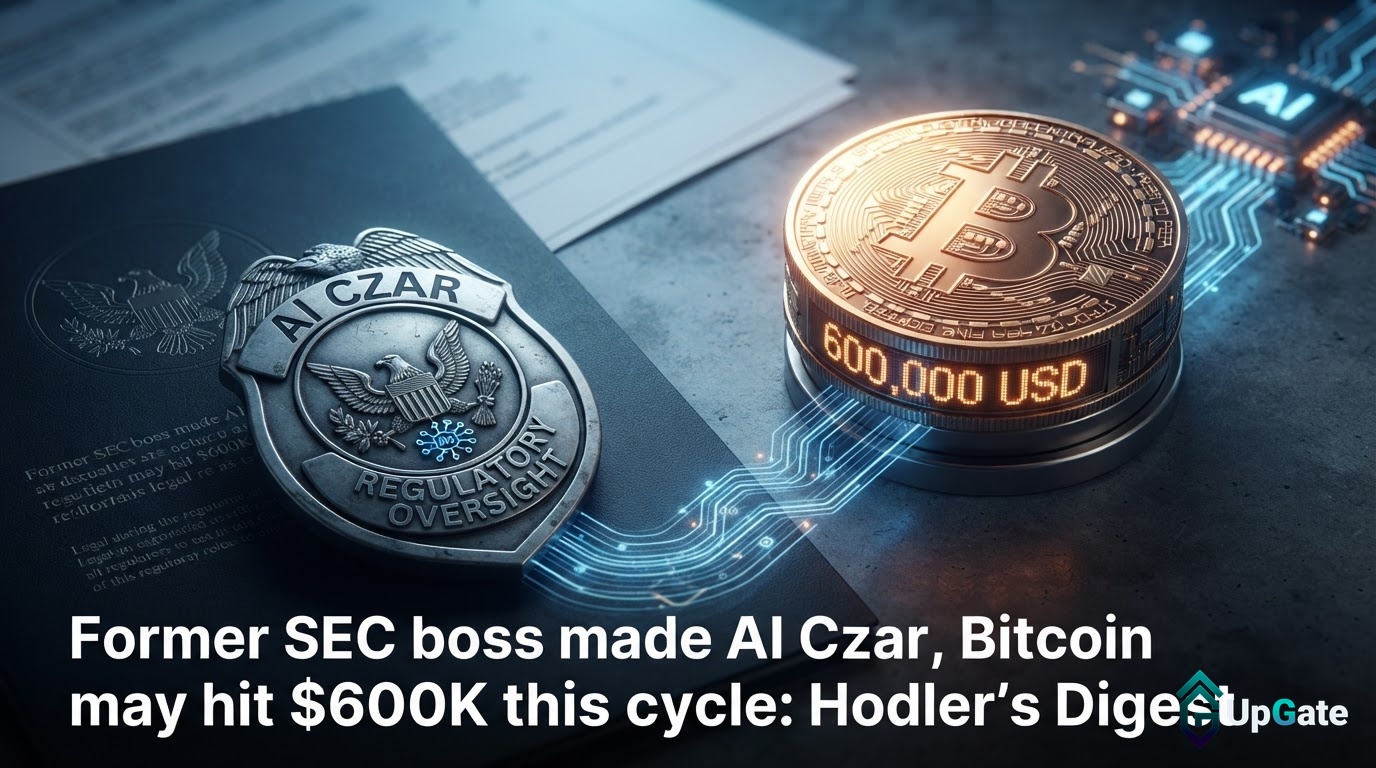
    President Donald Trump has appointed former Securities and Exchange Commission (SEC) Chair Jay Clayton to lead the nation’s new “Super Intelligence Force,” a move that has drawn sharp criticism from figures within the cryptocurrency community, including Roman Storm and the XRP army. The announcement, made via Truth Social on Sunday, follows media reports from Friday indicating Trump’s intention to establish an “AI Force” modeled after the Space Force.

    Trump stated in his post that the Super Intelligence Force will be responsible for “coordinating the effort of the Federal Government to ensure that America continues to lead the World in Super Intelligence.” Clayton, who served as SEC Chair during Trump’s first term, initiated legal action against Ripple on his final day in office. He also led the criminal trial against Roman Storm for his alleged involvement in Tornado Cash during his tenure as U.S. Attorney for the Southern District of New York.

    Roman Storm, a defendant in the Tornado Cash case, commented on the development, suggesting that “Trump’s good buddy Elon Musk is renaming SpaceXAI to SpaceXSI to honor the President’s directive renaming ‘artificial intelligence’ to ‘superintelligence.’”

    NEAR Protocol’s SHIELD AI System Blocks Hacked Funds, Ignites Decentralization Debate

    The NEAR Protocol has experienced a significant surge in positive sentiment, with its price more than doubling in the past month. This week, its SHIELD AI system garnered both praise and criticism for blocking Bitget’s hacked funds from its INTENTS cross-chain swap platform.

    The system also played a role in halting a $3.8 million exploit of NEAR Intents, attributed to a “bug in the Omni deposit and withdrawal infrastructure interaction with NEAR Intents smart contract.” While sentiment briefly turned bearish, NEAR Intents General Manager Alex Shevchenko announced the identification of the perpetrator and issued a 48-hour ultimatum for the funds to be returned. The funds were subsequently returned, and Shevchenko advised potential exploiters to utilize bug bounties rather than disrupting services.

    However, the decision to block the stolen funds has sparked controversy, contrasting with THORChain’s stance of refusing to block swaps on its platform, citing ideals of decentralization. A debate is also underway regarding whether SHIELD’s action of blocking funds could render it legally liable for future platform incidents. NEAR is down 11% this week.

    Arthur Hayes Predicts “Money Printing” Amidst AI Revolution and Global Financial Stress

    Arthur Hayes, Chief Investment Officer at Maelstrom fund, has predicted a surge in money printing driven by the AI revolution, the United States’ debt crisis, and escalating financial pressures in France. Speaking at a fireside chat at CONNECT by Cointelegraph: Seoul Edition during Korea Blockchain Week, Hayes highlighted the immense capital requirements for AI companies to finance data centers, even as service prices decline.

    “They’ve not really given themselves a lot of options other than print money and make it less bad,” Hayes stated. He also pointed to potential monetary stimulus from China and increasing financial stress in France, citing credit-default swaps tied to BNP Paribas and widening French government bond spreads.

    Ethereum Layer-2 Network Blast Ceases Operations Due to Unsustainable Economics

    The Ethereum layer-2 network Blast has announced its shutdown, citing that its operating costs have surpassed its revenue generation. In a post on X, Blast stated that it sees “no credible path” to achieving economic sustainability and has advised users to withdraw their assets to the Ethereum mainnet.

    “We launched Blast with the goal of building a self-sustaining chain for users and developers,” the team explained. “Unfortunately, the economics of operating the chain no longer make sense.” Founded in November 2023 by Tieshun “Pacman” Roquerre, founder of NFT marketplace Blur, Blast offered native yield on Ether (ETH) and stablecoins, along with a points program for an anticipated token airdrop. This strategy attracted over $2 billion in deposits before its mainnet launch in February 2024. However, its total value locked in decentralized finance (DeFi) has fallen by over 98% from its peak in June 2024, according to DeFiLlama data.

    Ethereum’s Glamsterdam Upgrade Set for Sepolia Testnet Activation

    Ethereum developers have scheduled the network’s next major upgrade, codenamed “Glamsterdam,” to activate on the Sepolia testnet on October 6. Sepolia node operators are required to update both their execution-layer and consensus-layer clients prior to the activation, according to the Ethereum Foundation.

    Key changes in Glamsterdam include enshrined proposer-builder separation, which will integrate the handoff between specialized block builders and validators directly into Ethereum’s protocol, reducing reliance on external middleware. The upgrade will also introduce block-level access lists, recording account and storage usage for each block, and enable parallel processing by clients to enhance throughput.

    Market Update: Bitcoin Hovers Near $86K, Altcoin Performance Mixed

    At the close of the week, Bitcoin (BTC) has seen a 1.4% increase, trading at $85,821. Ethereum (ETH) is up 0.6% to $2,701, while XRP (XRP) has declined 0.8% to $1.50. The total cryptocurrency market capitalization stands at $2.92 trillion, according to CoinMarketCap.

    Among the top 100 cryptocurrencies, the leading altcoin gainers this week are Midnight (NIGHT) with a 60.6% increase, StarkNet (SRK) up 14.5%, and Pump.fun (PUMP) with a 26.3% rise. Conversely, the top altcoin losers include Lighter (LIT), down 22.2%, Zcash (SEC), down 16.4%, and Ethena (ENA), down 14%.

    Peter Brandt Turns Bullish on Bitcoin, Predicts $600K Peak by 2029

    Veteran trader Peter Brandt has adopted a bullish outlook on Bitcoin, a shift from his July warning of potential price drops into the high $40,000s. “There’s a good possibility we have seen the low and now are entering a new bull market cycle in Bitcoin,” Brandt stated in the latest episode of Trade Secrets.

    Brandt has also revised his forecast for Bitcoin’s next peak, now anticipating a high between $300,000 and $600,000 by late 2029, an upward revision from his previous projection of $250,000 to $300,000. He believes the current bull market cycle has a strong chance of reaching half a million dollars.

    September Sees Record Crypto Hacks, Exceeding $766 Million in Losses

    September marked the worst month of the year for cryptocurrency hacks and exploits, with two blockchain security firms estimating total losses at over $766 million. PeckShield reported 55 major incidents resulting in $766.5 million in stolen funds, while CertiK recorded 97 incidents with estimated losses of $768.4 million.

    Notable incidents in September included the $388 million Bitget hack and a $320 million hack of the Liquid Network. Reports indicate that over $270 million was subsequently recovered. “September was a stark reminder of how quickly the threat landscape can shift,” CertiK commented. Other significant hacks during the month affected Safe Wallet ($7.8 million), DCENT ($6 million), and Duelbits ($5.9 million).

    Aave v3 Unaffected by Third-Party Exploit; Tether Freezes $550M in Iran-Linked USDT

    Aave founder Stani Kulechov clarified that Aave v3 was not impacted by an exploit that drained approximately $305,000 from two Safe multisig wallets. The exploit targeted a third-party adapter built on top of the lending protocol. “This is not Aave v3 contract, it’s third party external adapter built on top of Aave, zero effect on Aave v3,” Kulechov stated on X.

    In separate news, stablecoin issuer Tether announced its role in assisting authorities to freeze nearly $550 million in Iran-linked USDT. The company reported working closely with international law enforcement for years, freezing over $130 million in USDT across four wallets this year alone, including over $344 million linked to the Central Bank of Iran in April. Tether’s statement comes as a Senate subcommittee report alleged that USDT has become a primary channel for Iran to evade sanctions, with 84% of sanctioned Iran-linked crypto wallets transacting exclusively or nearly exclusively in USDT. This prompted U.S. Senator Richard Blumenthal to call for investigations into potential sanctions violations by the Treasury and Justice departments.

    THORChain’s Refusal to Block Bitget Hack Funds Fuels Decentralization Debate

    The ongoing debate surrounding Bitget’s $387.7 million in hacked funds centers on the core principle of whether “permissionless and decentralized” technology necessitates an absolute refusal to intervene, even when intervention is possible. THORChain has stated it will not, or cannot, block addresses linked to the $387.5 million Bitget hack. Crypto lawyer Yuriy Brisov commented on the complexity of whether developers could face prosecution for money laundering in such scenarios. The rapid settlement capabilities of stablecoins, which can move across borders at high speeds, present both risks and opportunities, depending on one’s perspective.


  • XRP Poised for Astonishing Year-End Surge, Predicts Claude AI

    XRP Poised for Astonishing Year-End Surge, Predicts Claude AI

    Claude AI has projected a dramatic surge for XRP by January 1, 2027, with a potential peak of $25 and a speculative “blow-off top” target of $35, contingent on a highly specific catalyst emerging for the XRP community. Currently trading at $1.49, a rise to $25 would represent an approximately 16.8-fold increase from its present value, implying a market capitalization of around $1.6 trillion, assuming a circulating supply of roughly 65 billion XRP.

    While this figure is substantial, it is not mathematically impossible within an extreme cryptocurrency mania scenario. The hypothetical catalyst identified by Claude AI involves widespread institutional adoption.

    In this speculative scenario, a major global payments consortium would announce XRP’s adoption as a neutral bridge asset. This would go beyond Ripple’s current use of XRP for specific corridors, envisioning a simultaneous commercial settlement announcement from 10 to 20 major banks and payment networks.

    Such a development would fundamentally alter the investment narrative for XRP, positioning it as an institutional “third asset” alongside Bitcoin and Ethereum. The infrastructure for XRP Exchange Traded Funds (ETFs) already exists, with US XRP ETFs collectively holding approximately 1.19 billion XRP, valued at around $1.77 billion, according to CoinGlass data.

    The potential for pension funds and wealth managers to allocate even a small portion of their portfolios to XRP, coupled with a significant XRP-based settlement initiative from Ripple, could be transformative.

    If financial institutions began maintaining substantial XRP liquidity reserves for cross-border settlements, the prevailing sentiment would shift from “XRP could be useful” to “XRP liquidity is essential.” This could ignite a significant price surge driven by fear of missing out (FOMO), ETF inflows, and institutional buying, rather than a gradual appreciation.

    Technical Outlook

    Despite the bullish predictions, the current chart does not yet reflect a trajectory towards $25. XRP is trading around $1.49, with its 50-day moving average near $1.497 and the Relative Strength Index (RSI) at approximately 47.5, indicating a neutral rather than overbought condition.

    This neutral stance is, in fact, a prerequisite for constructing a speculative parabolic scenario. XRP has been consolidating around the $1.50 mark. The immediate technical challenge involves reclaiming and sustaining levels between $1.50 and $1.55, followed by a decisive breakout above the previous major resistance zone.

    Following this, key price levels to watch would be $2, the all-time high of $3.65, and the psychologically significant $5 mark. A firm break above $3.65 would be particularly noteworthy, propelling XRP into genuine price discovery territory where traditional resistance fades, and factors like Fibonacci extensions, market-cap comparisons, and momentum become more influential.

    In the most optimistic scenario, a breakout above approximately $5, followed by a successful retest, could generate reflexive momentum propelling XRP towards $10, $15, and eventually beyond $20 at a pace that conventional valuation models would not predict.

    XRP has maintained support near $1.47, but a move to $25 would necessitate buyers overcoming significant resistance and establishing sustained upward momentum. This represents a substantial upside potential, not an unlimited trajectory.

    Emerging Infrastructure Projects

    For investors looking beyond large-cap cryptocurrencies, early-stage infrastructure projects offer a different risk-reward profile and a less extensive price history.

    LiquidChain ($LIQUID), a Layer 3 project, is positioning itself as “The Cross-Chain Liquidity Layer,” aiming to consolidate liquidity from Bitcoin, Ethereum, and Solana within a single execution environment.

    Its key features include a Unified Liquidity Layer, Single-Step Execution, Verifiable Settlement, and a Deploy-Once Architecture, allowing developers to deploy applications once and access all three major ecosystems.

    The project’s presale is priced at $0.014963, having already raised $980,000. Additionally, a staking offering with an annual percentage yield (APY) of 1100% is available exclusively to presale participants.

  • Solana DEXs See $12.4B in Tokenized Stock Volume This Year

    Solana DEXs See $12.4B in Tokenized Stock Volume This Year

    Solana Dominates Tokenized Stock Trading Amidst Rapid Growth

    Solana’s decentralized exchanges (DEXs) have facilitated a staggering $12.4 billion in trading volume for tokenized stocks this year, with the platform Raydium accounting for the largest portion at $6.1 billion.

    Surge in Tokenized Equity Volume

    The second quarter of 2026 saw Solana record $5.8 billion in tokenized equity DEX volume, marking a significant 114% increase from the previous quarter. During this period, Solana captured approximately 95% of global on-chain equity DEX trading activity. September 2026 alone was a banner month, generating $4.4 billion in tokenized stock DEX volume on Solana, with Raydium and Orca serving as the primary venues for this surge.

    Raydium Emerges as Key Hub

    Raydium has solidified its position as the go-to platform for this burgeoning market. Recent data indicates that it has routed over 90% of Solana’s tokenized stock DEX flows, and its cumulative volume in this category surpassed $5 billion by mid-September. Through the first half of the third quarter of 2026, Raydium processed approximately $2.3 billion in tokenized stock volume, a 40% rise compared to the preceding quarter.

    Broader Market Trends and Solana’s Share

    Across all blockchain networks, tokenized stocks generated $48.7 billion in volume over the past 12 months. Solana’s dominance is particularly evident during peak trading periods, where its share frequently exceeds 95%. Tokenized equities have also claimed over 4% of total DEX spot volume in 2026.

    xStocks Drives Significant Growth

    A key driver of this expansion is the xStocks product, developed by Backed Finance. Each xStock token is backed 1:1 by an equity share held with a custodian. By September 18, 2026, xStocks had accumulated over $6 billion in cumulative trading volume on Solana, representing 54% of all tokenized stock volume in Solana’s history.

    Advantages of On-Chain Trading

    The 24/7 nature of DEXs offers a distinct advantage over traditional stock markets, allowing traders to react to market news instantaneously, even on weekends, without waiting for traditional market opening hours.

    Evolving Regulatory Landscape

    This growth is occurring against a backdrop of evolving regulations. A recent SEC innovation exemption aims to streamline compliant on-chain trading. While Solana is a frontrunner, other blockchains like BNB Chain with its bStocks offering and Robinhood Chain are also vying for a share of the on-chain equity trading market.

    Ecosystem Concentration and Custody Concerns

    The concentration of activity, with Raydium handling over 90% of flows and xStocks representing 54% of historical volume, highlights the ecosystem’s efficiency but also its dependence on a limited number of participants. Furthermore, the custody model for tokenized stocks warrants attention. Tokens backed 1:1 by custodied shares are contingent on the reliability of both the custodian and the issuer, introducing counterparty risks not present in direct stock ownership.

  • Binance SAFU Fund Boasts $1.27B Bitcoin, $270M Profit

    Binance SAFU Fund Boasts $1.27B Bitcoin, $270M Profit

    Binance’s user protection fund now holds over $1.27 billion in Bitcoin, including approximately $270 million in unrealized profit.

    SAFU Fund’s Bitcoin Holdings Swell

    The fund, known as SAFU (Secure Asset Fund for Users), was established by Binance to safeguard customers against significant operational failures, such as cyberattacks.

    In mid-February 2026, Binance shifted its strategy, converting approximately $1 billion worth of stablecoins into 15,000 Bitcoin. The acquisition concluded on February 12 with a final substantial purchase of 4,545 BTC. At the time of this transaction, Bitcoin was trading around $67,000, valuing the entire Bitcoin allocation at roughly $1.005 billion.

    By early May 2026, as Bitcoin’s price surpassed $81,000, the SAFU fund’s value had grown to over $1.2 billion. At this juncture, unrealized gains were estimated at approximately $217 million. The fund’s holdings were subsequently reported to exceed $1.27 billion, with paper profits reaching about $270 million.

    Transparency and Safeguards

    Binance has made the fund’s wallet address public: 1BAuq7Vho2CEkVkUxbfU26LhwQjbCmWQkD. This allows anyone to monitor its balance on-chain.

    The exchange has committed to conducting regular audits of the fund. Furthermore, Binance has implemented a “top-up” mechanism: if the fund’s market value drops below $800 million, Binance will replenish it to reach $1 billion.

    Fund’s History and Purpose

    SAFU is not a new initiative; Binance launched it in July 2018, initially funded by 10% of trading fees. The fund has been utilized previously to cover user losses stemming from security incidents, including a $40 million hack in 2019.

    Binance has characterized the 2026 conversion as a reflection of its long-term confidence in Bitcoin as a reserve asset. The company cited Bitcoin’s transparency, auditability, and its potential as a hedge against inflation and counterparty risk.

    For Binance users, the current fund value of over $1.27 billion surpasses the initial $1 billion commitment. The fund’s value now fluctuates with Bitcoin’s price, with the $800 million threshold serving as a critical safety net. The 15,000 BTC held as a long-term reserve is, in principle, not intended for sale during typical market volatility.

    Binance’s strategic move, acquiring Bitcoin near $67,000 and witnessing its rise above $81,000 by May, has resulted in substantial paper gains. Observers will likely monitor the wallet balance, the fund’s reported value against the $800 million floor, and the adherence to Binance’s promised audit schedule.

  • Bitcoin’s Q4 Outlook: Key Factors and Uncertainties Ahead

    Bitcoin’s Q4 Outlook: Key Factors and Uncertainties Ahead

    Bitcoin’s trajectory in the fourth quarter is poised to be influenced by a complex interplay of macroeconomic factors, market dynamics, and historical trends, analysts suggest. While the cryptocurrency concluded the third quarter with a significant surge, the outlook for Q4 is characterized by uncertainty rather than a not assured continuation of its recent price movement.

    Why This Matters

    The materials describe a narrow update: Bitcoin experienced a significant recovery in the third quarter, closing with a 43% surge after a mid-year dip. Whether Q4 will simply extend Q3’s pace.

    Broader Context

    Source materials place the market analysis in this context: Bitcoin enters the final quarter of the year after a powerful recovery in the third quarter, but analysts warn against expecting another straight-line rally.

    Q3 Recovery and Catalysts

    The third quarter marked a notable recovery for Bitcoin, which had dipped below $58,000 at its start. The cryptocurrency rebounded, breaking above $80,000 in mid-August and ultimately closing the quarter with a 43% increase. Analysts like Iliya Kalchev, Nexo Dispatch Analyst, described this period as both a recovery phase and a notable move milestone. A key catalyst identified for this rally was the US Treasury’s increased long-end bond buyback operations in August, which helped Bitcoin jump by 7% on August 19 and surge by over 20% in the subsequent days. Furthermore, spot Bitcoin ETF flows turned positive, reaching a year-to-date green status, and subdued perpetual funding suggested the rally was driven more by spot demand than excessive leverage, Kalchev added.

    Macroeconomic Variables: The Federal Reserve

    However, analysts warn against expecting a straight-line rally in the fourth quarter. The Federal Reserve is identified as the biggest variable. While a weaker-than-expected US jobs report and a softer core PCE reading have reduced immediate pressure for additional tightening, some analysts, such as Lacie Zhang, Research Analyst at Bitget Wallet, still anticipate a potential 25 basis point Fed rate hike on October 28, which would place the target range at 4.00%-4.25%. This potential tightening could influence market liquidity and Bitcoin’s performance.

    Market Liquidity and Institutional Activity

    Treasury market liquidity is another critical factor. The US Treasury’s bond buyback operations in August were seen as a significant driver of Bitcoin’s Q3 rally, and ongoing liquidity conditions will be closely watched. Alex Kozenko, CMO at WhiteBIT, emphasized focusing on liquidity, institutional activity, and the overall macroeconomic environment in the coming months. The market structure itself has evolved, with increased institutional participation and the influence of regulated investment products becoming more prominent, Kozenko noted.

    Historical Performance and Technical Levels

    Historically, Bitcoin has shown a tendency to finish the fourth quarter higher in nine of the past 15 years. However, the median gains during this period are around 9%, with larger average gains being skewed by exceptional years like 2013 and 2017. This historical data suggests that while Q4 has often been positive, significant gains are not guaranteed, and volatility remains a possibility.

    From a technical perspective, key price levels are being monitored. According to Zhang, $87,500 remains a crucial obstacle. A break above this level could increase the likelihood of a short squeeze. Conversely, she identified the $82,000-$82,500 support range as a key downside zone, and a loss of this support potentially accelerating a move below $80,000.

    Geopolitical Risks and Conclusion

    Geopolitical developments also present a layer of uncertainty. Analysts warn that these events could complicate the market picture, particularly if energy prices continue to fuel inflation. The confluence of these factors—Federal Reserve policy, market liquidity, institutional flows, historical trends, key price levels, and geopolitical risks—creates a complex and uncertain environment for Bitcoin in the fourth quarter. Investors are advised to monitor these elements closely as the year concludes.

  • Bitcoin ETFs See $134 Million Inflow on ‘Uptober’ Start

    Bitcoin ETFs See $134 Million Inflow on ‘Uptober’ Start

    Bitcoin ETFs Kick Off October with Strong Inflows, Fueling “Uptober” Hopes

    U.S. spot Bitcoin exchange-traded funds (ETFs) have begun October with a surge in investor interest, drawing $102.7 million on Thursday and an additional $31.7 million on Friday, according to data from Decrypt’s Bitcoin ETF tracker. This marks a net inflow of $134.4 million to start the month.

    A Positive Start After September’s Dip

    This positive start follows a notable outflow on September 30, when the funds shed $148.7 million, breaking a nine-session streak of inflows that began on September 17. Despite this, September proved to be the second-best month for these ETFs since October 2025, with net inflows totaling $2.65 billion, according to SoSoValue data.

    “Uptober” Momentum and Market Sentiment

    The term “Uptober” is crypto slang referring to October’s historical performance as one of Bitcoin’s strongest months. Stephen Wundke of Algoz noted to Decrypt that over the past decade, Bitcoin has averaged an 18% gain in October. “Traders feel there is more upside currently than there is downside,” Wundke stated, suggesting a prevailing optimistic sentiment.

    Economic Data Boosts Risk Assets

    Friday’s jobs report provided further impetus for this optimism. The U.S. economy added only 29,000 jobs in September, and the unemployment rate climbed to 4.2%, as reported by the Bureau of Labor Statistics. Following this announcement, the CME FedWatch tool indicated a significant drop in the probability of an October interest rate hike, falling to 14% from 70% earlier in the week. A weaker labor market typically reduces pressure on the Federal Reserve to continue raising rates, a scenario that generally benefits risk assets like Bitcoin.

    Bitcoin’s Price Action and ETF Holdings

    Bitcoin briefly touched $87,173 on Friday, narrowly missing its September high of $87,354 before experiencing a pullback. By Saturday morning, it was trading at $84,786, a 0.65% decrease over the preceding 24 hours, according to CoinGecko data. Cumulatively, net inflows into Bitcoin ETFs since their launch now stand at $58.1 billion, with total net assets reaching $101.1 billion, according to Decrypt’s tracker.

    Divergent Views on Future Performance

    However, not all market participants are convinced of a sustained breakout. Traders on Myriad, a prediction market operated by Decrypt’s parent company Dastan, have placed the odds at 93% that Bitcoin will not reach a new all-time high in 2026.

    Upcoming Economic Indicators to Watch

    Year-to-date ETF inflows remain under $1 billion, a figure impacted by substantial outflows earlier in the year. The market will be closely watching upcoming economic indicators, including September’s Consumer Price Index (CPI) report, scheduled for release on October 14, and the Federal Reserve’s next policy meeting on October 28.

  • Bitcoin Price: Will BTC Hit $92K or $97K This Week?

    Bitcoin Price: Will BTC Hit $92K or $97K This Week?

    Bitcoin Eyes $97,000 Amidst Crucial Support Test

    Bitcoin may still be poised for further gains, potentially reaching $92,000 or even $97,000, provided it can maintain a critical support level just above $81,000. This optimistic outlook comes from an analyst who believes the upward trend initiated in July remains robust.

    Positive Indicators for Bitcoin

    The expert highlighted three key factors supporting Bitcoin’s positive trajectory:

    The Critical Support Zone

    The most significant area of support is identified between $81,600 and $82,937. As long as Bitcoin’s price remains above this band, the potential for further price appreciation is preserved.

    Should this zone falter, traders will be looking at the following levels:

    Confirmation for Higher Targets

    A definitive move towards $92,000 or $97,000 would be signaled by Bitcoin breaking above its October 2 high, which currently represents the upper boundary of the existing resistance area. Such a breach would indicate the commencement of the next upward phase.

    Currently, however, clear confirmation is absent. The recent rebound from the September 28 low occurred in three distinct steps, a pattern often indicative of a less vigorous recovery. Bitcoin is presently trading within a range, and such periods typically lack a discernible trend.

    No Top Yet in Sight

    The analyst stated that no peak has been called during the current rally, and the expectation remains that “one more high is very likely.” Furthermore, the short-term trend that began on September 16 has yet to be broken.

    Once a top is eventually established, the analyst anticipates a pullback to a broader support zone situated between $63,326 and $74,800. This correction could potentially form a higher low, setting the stage for a subsequent advance toward all-time highs.

    The Calm Before the Storm?

    Bitcoin is currently experiencing low volatility. However, the market analysis suggests that periods of quiet often precede significant price movements, mirroring the situation in July when Bitcoin traded sideways for four weeks before embarking on a rally.

  • PUMP Surges 16% as Bitcoin Reclaims $85K

    PUMP Surges 16% as Bitcoin Reclaims $85K

    Bitcoin Edges Higher, Reclaiming $85,000 After Jobs Report Volatility

    Bitcoin’s price saw a modest uptick on Sunday morning, surpassing the $85,000 mark following a period of significant volatility experienced on Friday after the release of the U.S. jobs report.

    Most larger-cap altcoins also registered slight gains over the past day. Ethereum is challenging the $2,700 resistance level, while XRP has climbed to $1.50.

    The previous business week for Bitcoin began with a downturn, pushing its price from the upper boundary of its trading range at $85,000 down to just below the lower end at $82,500. The subsequent days were marked by choppy trading until Wednesday’s release of the PCE data. The inflation data came in lower than anticipated, causing BTC to surge to $85,600 within minutes. However, the upward momentum proved short-lived, with a similarly rapid decline following.

    Thursday offered a calmer trading environment, with Bitcoin fluctuating between $82,500 and $84,000. A renewed upward trend began on Friday, bolstered by a U.S. jobs report that significantly undershot expectations. The initial reaction was strongly bullish, with bitcoin briefly breaking past $87,000 for the first time in approximately ten days.

    Somewhat unexpectedly, the rally reversed almost immediately, with the cryptocurrency dumping to below $84,000 within hours. Bulls ultimately stepped in at this level, helping BTC recover to $84,000 on Saturday. By Sunday morning, the price had edged up to just over $85,000.

    Bitcoin’s market capitalization has risen to $1.710 trillion on CoinMarketCap, with its dominance over altcoins remaining steady at 59%.

    Ethereum has returned to the $2,700 level today after a minor increase from yesterday. XRP is eyeing $1.50 following a 1.1% gain. BNB is approaching $800 after a more substantial 2.9% increase. Most other large-cap altcoins have seen gains of around 1-2%. HYPE is up by 3% and trading above $90.

    CRO, NEAR, and TAO have each gained up to 4.5%. RAIN and PUMP have emerged as the top performers within this altcoin group, with RAIN up nearly 14% and PUMP surging by 16% to $0.0063. ZRO and AERO also recorded notable daily gains.

    The total cryptocurrency market capitalization has increased by approximately $30 billion in the last 24 hours, now standing at $2.910 trillion on CoinMarketCap.