Tag: Market Trends

  • Bitcoin Consolidates Near $80,000 Amid Market Correction; Avalanche Shows Gains

    Bitcoin Consolidates Near $80,000 Amid Market Correction; Avalanche Shows Gains

    The cryptocurrency market navigated a volatile weekend, with Bitcoin consolidating around the $80,000 level after failing to hold gains above $82,000. This period of price stabilization occurred against a backdrop of significant macroeconomic shifts and geopolitical developments, while certain altcoins, most notably Avalanche (AVAX), posted substantial gains.

    Market Overview and Influencing Factors

    Bitcoin’s rally stalled near $82,000, leading to a subsequent decline and trading near $80,000. This price action followed a week characterized by key economic and legislative events. On Tuesday, the US Senate failed to pass a cloture vote on the CLARITY Act. The Federal Reserve then implemented an interest rate hike on Wednesday, its first in over three years. Despite these pressures, Bitcoin demonstrated resilience, surpassing $80,000 on Friday for the first time in two weeks. It spiked to nearly $82,000 on Saturday but was reportedly rejected at this level, possibly due to major escalations in the Middle East that evening, according to CryptoPotato. This coincided with Bitcoin consolidating just above $80,000. The Bank of Japan also raised its rates on Friday.

    Bitcoin’s market capitalization has decreased to $1.61 trillion on CoinMarketCap, with its dominance over altcoins nearing 59%. The market’s initial reaction to the CLARITY Act failure saw Bitcoin slump to a three-week low of $75,000. Following the Fed’s rate hike, Bitcoin experienced a brief dip before rebounding towards $77,000.

    Divergent Asset Performance

    While most larger-cap altcoins mirrored Bitcoin’s downward trend, Avalanche (AVAX) emerged as a notable exception, recording a daily gain exceeding 11% and trading above $9.6. Other cryptocurrencies such as ENA, PEPE, and M also registered impressive gains.

    Conversely, several other digital assets faced declines. Ethereum was rejected at $2,630 and is now trading below $2,600, marking a 2.6% daily decrease. BNB is struggling to maintain the $750 level, and XRP has fallen back under $1.40. Solana (SOL) has slipped below $110. The privacy coins ZEC and XMR experienced significant losses, dropping around 8% and 8.6% respectively, with ZEC trading at $1,443 and XMR at $523. Other altcoins including RAIN, NEAR, and UNI posted losses of up to 5%, with UNI, RAIN, LINK, NEAR, AAVE, and CC all reported to be in negative territory.

    Broader Market Context

    The total cryptocurrency market capitalization has shed approximately $40 billion in daily trading, now standing at $2.740 trillion on CoinMarketCap. Geopolitical events in the Middle East may have influenced Bitcoin’s price rejection at $82,000, although this remains an interpretation. The overall market correction has impacted most digital assets, but Avalanche’s strong performance highlights divergent trends within the cryptocurrency space. The market’s sensitivity to macroeconomic shifts and external events continues to be a key theme.

    Why This Matters

    The materials describe a narrow update: Bitcoin’s price rally was halted around $82,000, and it subsequently declined, trading near $80,000. The exact cause of Bitcoin’s rejection at $82,000 is stated as ‘perhaps due to the latest developments in the Middle East’.


  • Bitcoin Price Tops $81,000 Amidst Contrasting Investor Views

    Bitcoin Price Tops $81,000 Amidst Contrasting Investor Views

    As Bitcoin’s price surpassed $81,000, prominent investors offered sharply contrasting perspectives on its market trajectory. Angel investor and “All-In podcast” co-host Jason Calacanis described Bitcoin as a “dead cat” that was still bouncing, a statement that prompted responses from Michael Saylor and Cathie Wood.

    Calacanis’s comment characterized Bitcoin’s significant price appreciation as a temporary rebound rather than a sustained upward trend. This bearish outlook contrasts with the more optimistic viewpoints typically held by figures like Saylor, CEO of MicroStrategy, and Wood, founder of ARK Invest, who are known for their conviction in Bitcoin’s long-term potential.

    The “dead cat bounce” is a financial market term for a temporary price recovery in a declining asset, suggesting the underlying downward trend may continue. Calacanis’s application of this metaphor to Bitcoin at a price point exceeding $81,000 highlights a notable disagreement among influential investors. While the specific details of Saylor’s and Wood’s responses were not elaborated upon, their engagement signifies a divergence in how key market participants interpret Bitcoin’s current status.

    This situation underscores the ongoing debate surrounding Bitcoin’s valuation. As the cryptocurrency navigates periods of high volatility and significant price milestones, the differing opinions of prominent investors present a complex landscape. The market’s ability to sustain prices above $81,000 while facing bearish commentary from a known investor points to the multifaceted nature of market sentiment.

    Ultimately, the conflicting viewpoints serve as a reminder that expert opinions on volatile assets like Bitcoin can vary widely. Investors are often faced with the challenge of navigating these diverse perspectives, considering the evidence and context behind each viewpoint rather than relying on singular pronouncements.

    Broader Context

    Source materials place the factual news in this context: Jason Calacanis, a popular angel investor and co-host of the All-In podcast, opened with “the dead cat continues to bounce,” and attached a one-year chart of BTC […].

  • XRP Whale Buys $2 Billion, Faces Crucial Resistance

    XRP Whale Buys $2 Billion, Faces Crucial Resistance

    Whale Accumulation Fuels XRP Surge Amid Short Seller Retreat

    A significant influx of capital into XRP, totaling approximately $2 billion within a single week, has coincided with a notable pullback by short sellers. The key question now facing the cryptocurrency is whether this bullish momentum can overcome a critical resistance zone that has previously stalled its ascent.

    Big Money Is Buying In

    Large wallet holders have acquired an estimated 1.54 billion XRP over a four-day period, a move valued at nearly $2.2 billion. Market observers suggest that such rapid accumulation often precedes substantial price movements. Concurrently, a trader actively shorting XRP on the Hyperliquid exchange began to unwind their position, repurchasing 450,000 XRP and effectively halving their bearish bet against the token.

    Fund Managers Continue Accumulation Amidst Price Softness

    CoinShares disclosed in a recent filing with the Securities and Exchange Commission (SEC) that its XRP holdings have increased to 148.66 million tokens, up from 129.75 million in December. This consistent buying activity has persisted even as XRP’s price has experienced a recent cooling-off period. Clients of Franklin Templeton have also reportedly purchased approximately $1.5 million worth of XRP.

    Leveraged ETF Launch Delayed, Not Canceled

    Volatility Shares has postponed the launch of its 3x leveraged XRP Exchange Traded Fund (ETF) to October 18. The regulatory filings remain active, indicating a delay rather than a complete cancellation of the product.

    South Korea’s Insatiable Demand for XRP

    On Upbit, one of South Korea’s largest cryptocurrency exchanges, XRP has emerged as the most actively traded digital asset. The token recorded $183.8 million in trading volume in a single day, representing over 10% of the exchange’s total trading activity and more than double that of Bitcoin.

    Government Debt Now Settles on XRP’s Blockchain

    Ondo Finance has launched its tokenized U.S. Treasury fund, OUSG, directly on the XRP Ledger. The platform utilizes Ripple’s RLUSD stablecoin for deposit and withdrawal operations, marking the first instance of government debt settlement occurring on XRP’s network, operating in parallel with traditional settlement methods.

    Minor but Crucial Update Nears Approval

    A proposal known as “Permission Delegation,” which would enable XRP accounts to grant limited access rather than full control, has garnered 15 new affirmative votes in just ten days. The proposal is now only three votes shy of approval. This update will allow Wormhole to gain restricted access to Ripple’s RLUSD account, facilitating integration for other projects like Flare to offer enhanced services to XRP holders, while also providing compliance teams with the controlled access they require.

    Independent Audit Confirms XRP’s Eco-Friendliness

    An independent energy audit conducted by the exchange Bitvavo has confirmed XRP’s status as one of the most energy-efficient cryptocurrencies. The audit revealed that XRP consumes a minimal 0.00002 kWh per transaction, with virtually zero direct emissions.

    Key Price Level Dictates Future Direction

    The current wave of positive developments faces a significant hurdle in the price range of $1.49 to $1.54, a zone that has previously repelled XRP’s upward momentum on multiple occasions. A decisive break and sustained hold above this resistance level could pave the way for further gains. Conversely, a rejection at this zone is likely to result in continued sideways trading, with potential support levels to watch at $1.30, $1.20, and $1.10.

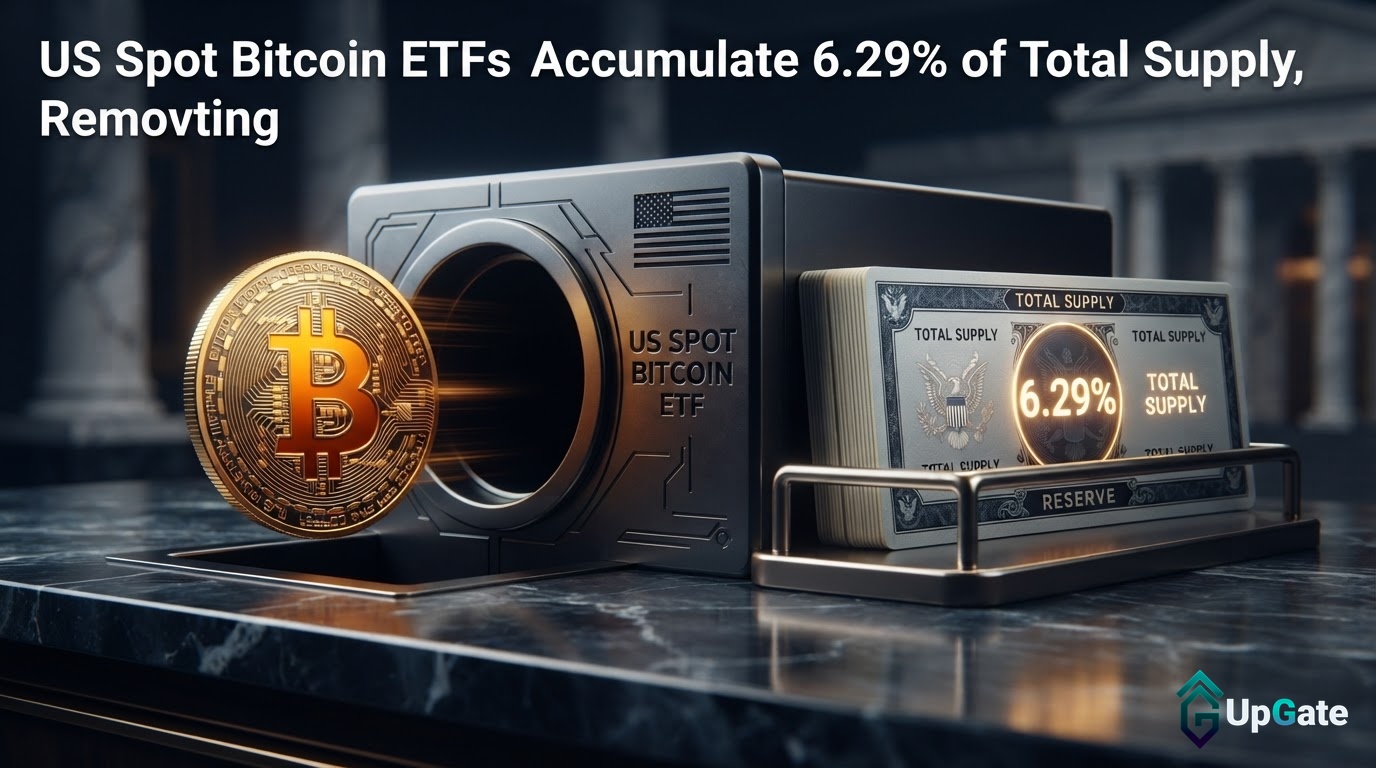
  • US Spot Bitcoin ETFs Accumulate 6.29% of Total Supply, Removing Millions from Circulation

    US Spot Bitcoin ETFs Accumulate 6.29% of Total Supply, Removing Millions from Circulation

    US spot Bitcoin Exchange Traded Funds (ETFs) have amassed approximately $102.5 billion in assets, equivalent to about 6.29% of Bitcoin’s total supply. This accumulation, representing an estimated 1.27 to 1.32 million BTC, has effectively been withdrawn from active circulation since the ETFs’ launch in January 2024.

    This development signifies a substantial increase in institutional participation within the Bitcoin market. The $102.5 billion held by these ETFs represents a notable portion of Bitcoin’s current market capitalization, which stands at roughly $1.63 trillion. Such a level of institutional involvement would have been considered highly improbable during the 2022 bear market, a period when the US Securities and Exchange Commission (SEC) was actively rejecting spot ETF applications.

    Key Players and Performance

    BlackRock’s iShares Bitcoin Trust (IBIT) has emerged as a dominant force, holding an estimated 693,000 to 786,000 BTC. IBIT has attracted over $60 billion in cumulative inflows since its inception, capturing more than 60% of the total assets managed by Bitcoin ETFs. In contrast, other prominent ETFs, including Fidelity and Grayscale’s GBTC product, have experienced net outflows. Grayscale’s GBTC, in particular, has seen significant holdings decrease, potentially due to investors shifting to ETFs with lower fees.

    The cumulative net inflows across all US spot Bitcoin ETFs total approximately $55 billion, underscoring BlackRock’s disproportionate contribution to the capital that has remained invested.

    Impact on Bitcoin Supply

    The mechanism through which these ETFs influence Bitcoin’s supply is direct: Bitcoin held within ETF custody is not available for lending, staking, or trading on exchanges. Consequently, every Bitcoin acquired by an ETF is one less Bitcoin available for active spot market transactions. Considering that approximately 19.7 million BTC have been mined and millions more are likely lost or permanently dormant, the actively traded supply is already constrained.

    Institutional Access and Future Outlook

    The approval of spot Bitcoin ETFs in January 2024 provided a regulated pathway for institutional investors, such as pension funds, registered investment advisors, and wealth management platforms, to gain exposure to Bitcoin without the complexities of direct custody. This has streamlined access for institutional capital.

    Looking ahead, reaching a 10% ownership threshold of Bitcoin’s total supply by ETFs would necessitate an additional $60.5 billion in ETF assets, assuming Bitcoin’s price remains stable. However, this projection carries inherent uncertainty. An increase in Bitcoin’s price would likely raise the capital required to acquire the next tranche of Bitcoin, potentially making the actual cost to reach the 10% mark substantially higher. Furthermore, reducing circulation by an additional 4% to reach this threshold could further compress the liquid supply at a time when demand from various channels continues to expand.

    While ETF inflows have demonstrated resilience through price corrections, with assets under management generally remaining around the $100 billion mark, the long-term implications of this concentrated ownership and reduced liquid supply warrant continued observation by market participants.

    Why This Matters

    The materials describe a narrow update: US spot Bitcoin Exchange Traded Funds (ETFs) now manage approximately $102. The exact amount of Bitcoin held by ETFs (stated as 1.27 to 1.32 million BTC).

    Broader Context

    Source materials place the factual news in this context: US spot Bitcoin ETFs now manage roughly $102.5 billion in assets, holding approximately 6.29% of Bitcoin’s entire supply.

  • Gemini AI Forecasts XRP Surge in Late 2026

    Gemini AI Forecasts XRP Surge in Late 2026

    Google Gemini AI Forecasts Significant XRP Surge by 2027

    Artificial intelligence platform Google Gemini has projected a substantial surge for XRP, predicting it could reach as high as $7 by 2027 under a robust bull market scenario. This forecast represents a potential fivefold increase from current price levels and is likely to energize the XRP community, often referred to as the “Ripple army.”

    As of September 18, XRP is trading in the vicinity of $1.30–$1.32, a notable decrease from its previous cycle peak of approximately $3.65–$3.66. This optimistic outlook contrasts with many baseline forecasts, which typically place XRP in the $3–$5 range. The Gemini prediction aligns with bullish institutional sentiment, including Standard Chartered’s target of around $7 for 2027 and Bitwise’s more ambitious projections nearing $9–$10.

    Key Assumptions for Bullish Scenarios

    These elevated price targets are contingent on several critical factors, including strong market liquidity, significant inflows into potential XRP Exchange-Traded Funds (ETFs), regulatory clarity surrounding digital assets, and an acceleration in the institutional adoption of the XRP Ledger (XRPL). The underlying premise for these optimistic forecasts is a return to sustained “risk-on” market conditions by late 2026. This shift is expected to be driven by improvements in macroeconomic liquidity, increased XRP ETF inflows, greater utilization of the XRPL for cross-border payments and tokenization, and a broader rotation into altcoins once Bitcoin establishes an upward trend.

    Historically, XRP has demonstrated a tendency for sharp, high-beta price movements once market momentum returns. A progression from its current trading range around $1.30 through its prior highs near $3.65 and into the mid-to-high single digits would be consistent with a full bull market environment. This trajectory would also reflect XRP’s established position as a major large-cap asset with a growing institutional infrastructure.

    Technical Analysis and Price Levels

    On higher timeframes, XRP has been consolidating following a significant pullback from recent peaks. The digital asset is currently holding above key demand zones between $1.25 and $1.30. However, it faces immediate resistance around $1.33–$1.40, with further supply expected near $1.50–$1.65.

    A sustained break and a weekly close above the $1.40–$1.50 range, confirmed by trading volume, would bolster the intermediate bullish structure and pave the way toward the previous cycle high of approximately $3.65. In a strong bull market, reclaiming this prior high often serves as a significant psychological and technical catalyst for further price appreciation. Fibonacci projections and measured move analyses from XRP’s multi-year base and recent recovery low suggest potential targets in the $5–$8 zone, assuming continued upward momentum.

    XRP is currently trading above longer-term moving averages, including the 50- and 100-day averages. The Relative Strength Index (RSI) on shorter timeframes indicates neutral-to-oversold conditions, suggesting potential for upside as resistance levels are cleared.

    Key support levels to monitor on any potential retests include the $1.20–$1.28 zone and the broader $1.00–$1.10 area. A decisive breach below these levels would undermine the near-term recovery thesis.

    Overall, the current technical setup suggests a multi-stage advance with considerable upside potential, particularly if broader market risk appetite returns. This aligns with XRP’s historical performance of experiencing sharp rallies once key resistance levels are overcome in bull market conditions.

    Strategic Considerations for Traders

    For traders observing XRP’s price action, some may find it strategically advantageous to allocate capital towards earlier-stage projects with greater growth potential. This approach can be particularly appealing when considering the alternative of waiting for a large-cap asset, which has already experienced significant pullbacks, to regain lost ground.

    One such project highlighted is LiquidChain ($LIQUID), a Layer 3 infrastructure initiative aiming to integrate liquidity from Bitcoin, Ethereum, and Solana into a unified execution environment. The project’s presale is priced at $0.014956, and it has reportedly raised over $967,000 to date.

    LiquidChain’s core offering, its “Deploy-Once Architecture,” enables developers to create a single application that can operate across all three major ecosystems without the need for code rewriting for each individual chain. This is supported by a Unified Liquidity Layer and Single-Step Execution for cross-chain transactions. Further details on its cross-chain methodology are available in previous analyses.

  • Ethereum’s Record Q3: 60% Gains, $10B ETF Inflows

    Ethereum’s Record Q3: 60% Gains, $10B ETF Inflows

    Ethereum Achieves Record Third Quarter Amidst Strong Inflows and DeFi Growth

    Ethereum has concluded its most successful third quarter on record, with the cryptocurrency surging approximately 60.62% by mid-September 2026. This remarkable turnaround follows a challenging first half of the year, during which the asset experienced significant value depreciation, underscoring a dramatic market recovery.

    The recent rally was fueled by a confluence of factors. Spot Ethereum Exchange-Traded Fund (ETF) inflows surpassed $10 billion cumulatively during the quarter. Simultaneously, corporate treasuries significantly increased their holdings, acquiring over $15 billion worth of ETH. The decentralized finance (DeFi) ecosystem also saw substantial expansion, with the total value locked across Ethereum and its Layer-2 networks reaching an estimated $88 billion. In contrast, Bitcoin registered a more modest gain of 6-10% over the same period.

    This performance gains further significance when viewed in context. Ethereum entered the third quarter of 2026 having endured two consecutive quarters of losses, with a 29.26% decline in Q1 and a subsequent 25.28% drop in Q2.

    Historically, the average third-quarter return for ETH stands at approximately 12.28%. The 60.62% gain not only far outpaced this average but quintupled it. This quarter’s performance marks the second-best Q3 in Ethereum’s history, trailing only the 66.55% surge recorded in Q3 2025 and surpassing the 59.5% rally seen in Q3 2020.

    The price action vividly illustrated this trend. ETH traded above the $4,000 mark at various points throughout the quarter and even approached the significant psychological threshold of $5,000. However, a late-September pullback brought the price back into the $2,400-$2,623 range.

    Key Drivers of the Ethereum Surge

    The most impactful developments were not solely reflected in price charts but in the underlying market dynamics. Cumulative inflows into spot Ethereum ETFs exceeded $10 billion, with nearly $4 billion of this amount arriving in August alone.

    Corporate treasury acquisitions further bolstered ETH’s position. Corporate entities collectively purchased more than $15 billion worth of ETH during the third quarter.

    While ETF flows captured significant attention, the growth of the DeFi ecosystem played a crucial role in reinforcing the fundamental strength of Ethereum. By the end of Q3, the total value locked across Ethereum and its associated Layer-2 networks had climbed to approximately $88 billion. This figure represents the aggregated capital deployed in lending protocols, decentralized exchanges, liquid staking platforms, and an increasing number of applications focused on real-world assets.

  • Solana ETFs Show Consistent Inflows While Bitcoin ETF Trading Volume Declines

    Solana ETFs Show Consistent Inflows While Bitcoin ETF Trading Volume Declines

    Solana spot exchange-traded funds (ETFs) have maintained a streak of 12 consecutive weeks with net inflows, accumulating over $1.4 billion and reaching approximately $1.62 billion in total assets under management. This sustained investor interest contrasts sharply with Bitcoin spot ETFs, which have seen their trading volume fall to its lowest point since October 2024, recording only $6.1 million in net inflows for the week ending September 18.

    The divergent performance trends between Solana and Bitcoin spot ETFs highlight evolving investor sentiment and product appeal within the digital asset ETF market. While Bitcoin ETFs, launched in January 2024, took months to achieve a comparable inflow streak, Solana ETFs have demonstrated consistent momentum. For the week ending September 18, Solana ETFs recorded net inflows of $60.7 million, with $47.6 million of that amount occurring on the final trading day of the week.

    Within the Solana ETF market, Bitwise’s BSOL has captured approximately 80% of all inflows. This product’s success is partly attributed to its structure, which offers investors exposure to Solana’s price movements alongside an embedded income stream through staking yields. This structural advantage may pose a challenge for other Solana ETF issuers, including Grayscale’s GSOL, Fidelity’s FSOL, VanEck’s VSOL, and Morgan Stanley’s MSOL, who may need to differentiate their offerings to attract significant investor capital.

    Conversely, Bitcoin spot ETFs are experiencing a period of reduced activity. The trading volume for the full five-session week ending September 18 was the lowest observed since October 2024. Despite this low volume, the ETFs managed to bring in $6.1 million in net inflows. This subdued performance contrasts with the earlier months of their launch, when they saw substantial inflows.

    The price of Solana (SOL) in mid-September was trading between $110 and $112, representing its highest level in approximately seven months. This price action may be contributing to the sustained interest in Solana-based investment products.

    The current trends suggest evolving investor preferences, with a clear focus on Solana ETFs demonstrating consistent accumulation. The velocity of this accumulation for Solana ETFs is particularly noteworthy when compared to Bitcoin ETFs’ periods of extended outflows in recent months. However, uncertainties remain regarding the long-term impact of Bitwise’s dominance on other Solana ETF issuers and whether Solana’s current momentum will be sustained. The competitive landscape for Solana ETFs is likely to evolve as issuers seek to capture a larger share of investor interest.

    This divergence matters because it indicates shifting investor preferences in the digital asset ETF space. The sustained inflows into Solana ETFs, particularly into products offering embedded yields like Bitwise’s BSOL, suggest a growing appetite for specific product features. In contrast, the subdued trading volume and minimal inflows for Bitcoin ETFs, despite their earlier market entry, point to a period of consolidation or re-evaluation of investor interest in established digital asset ETFs. The market is observing how these differing trends might shape future investment strategies and product development within the cryptocurrency ETF sector.

    Why This Matters

    The materials describe a narrow update: Solana spot ETFs have maintained a streak of 12 consecutive weeks with net inflows, accumulating over $1. The long-term impact of Bitwise’s dominance on other Solana ETF issuers.

    Broader Context

    Source materials place the factual news in this context: Solana ETFs have had 12 consecutive weeks of net inflows.

  • Dormant Bitcoin Wallet from 2011 Active, Moves 100 BTC Valued Over $8 Million

    Dormant Bitcoin Wallet from 2011 Active, Moves 100 BTC Valued Over $8 Million

    A Bitcoin wallet created in 2011 became active on Saturday, moving 100 BTC when the cryptocurrency’s price was nearing $82,000. The transaction, recorded at block height 967732, involved funds now valued at over $8 million.

    The wallet, initially established on November 2, 2011, had remained dormant for nearly 15 years. Its recent activity represents a notable on-chain event, drawing attention due to the age of the wallet and the quantity of Bitcoin moved.

    However, the implications of this movement remain uncertain. Holder intent cannot be determined from this data alone, and the transaction does not inherently signal a change in market direction or provide a definitive prediction of future price action. The implications are uncertain.

    On-chain analysts and cryptocurrency investors frequently monitor such events. While the activation of dormant wallets can sometimes indicate long-term holders liquidating or reallocating assets, attributing a specific motive or market impact without further information is speculative. This event underscores the dynamic nature of Bitcoin’s ledger, with older holdings potentially re-entering circulation.

    Why This Matters

    The materials describe a narrow update: A wallet created on November 2, 2011, moved 100 BTC when the price of Bitcoin was nearing $82,000. The wallet had been dormant for nearly 15 years.

    Broader Context

    Source materials place the factual news in this context: With bitcoin’s price almost hitting the $82,000 range on Saturday, at block height 967732, a wallet first created on Nov. 2, 2011, shifted 100 BTC worth more than $8 million using current bitcoin exchange rates.

  • Tether Mints $500 Million USDT on Solana in Under an Hour, Highlighting Network Demand

    Tether Mints $500 Million USDT on Solana in Under an Hour, Highlighting Network Demand

    Solana’s capacity for high-volume stablecoin operations is being tested, evidenced by Tether’s recent minting of $500 million USDT in under an hour. This rapid issuance increases Solana’s native USDT supply, which currently stands between $3.8 billion and $4 billion.

    Solana’s Growing Role in Stablecoin Operations
    Tether first deployed USDT on the Solana blockchain in September 2020, recognizing the network’s potential for high throughput and low transaction costs. For Solana’s ecosystem, stablecoin liquidity is foundational, supporting DeFi protocols for lending, borrowing, and liquidity provision, as well as facilitating settlement on trading platforms.

    Around the same period as Tether’s mint, Circle also minted $250 million USDC on Solana. The simultaneous expansion of supply by two major stablecoin issuers suggests that Solana is becoming a preferred venue for activities driving this demand.

    Market Demand Signals
    Market observers often interpret large stablecoin mints as leading indicators of demand rather than lagging ones, with new USDT signifying a need for liquidity from institutional trading desks, growing DeFi protocols, or exchanges replenishing reserves. However, the specific source of the demand for the newly minted USDT remains uncertain.

    Competitive Landscape
    While Tron remains the dominant network for global USDT circulation due to its established position in peer-to-peer transfers, Solana is carving out its niche by offering speed and cost advantages. Ethereum, meanwhile, continues to command the largest DeFi ecosystem.

    Tether also executed a $500 million USDT transfer to Binance via Solana during this period, further underscoring the network’s utility for high-volume operations. The competitive dynamic between Solana, Tron, and Ethereum for stablecoin market share is a significant factor in the ongoing development of crypto infrastructure.

    Conclusion
    The rapid minting of $500 million USDT by Tether on Solana, coupled with Circle’s concurrent USDC issuance, indicates Solana’s increasing significance in high-volume stablecoin transactions. While the precise reasons for this simultaneous expansion of supply by both issuers on Solana are not fully clear, the event underscores the network’s growing appeal for such operations.

    Broader Context

    Source materials place the factual news in this context: Tether first deployed USDT on Solana back in September 2020, betting early on the network’s high throughput and low transaction costs.

  • Grayscale’s Zcash ETF to Implement 3-for-1 Share Split Aiming for Broader Investor Accessibility

    Grayscale’s Zcash ETF to Implement 3-for-1 Share Split Aiming for Broader Investor Accessibility

    Grayscale has announced a 3-for-1 forward share split for its Zcash ETF (ZCSH), a strategic move designed to increase the accessibility of its shares for investors. This split will triple the number of outstanding shares and proportionally reduce the per-share price, with split-adjusted trading set to commence on September 30.

    The Zcash ETF, which began trading on August 25, 2026, has already garnered significant investor interest, attracting over $233 million in net inflows and accumulating approximately $890 million in net assets as of September 17. The fund has also demonstrated robust market activity, recording over $11 billion in cumulative trading volume since its late August launch.

    Shareholders of record on September 28 will receive two additional shares for every one currently held. The distribution of these new shares will occur after market close on September 29. Grayscale’s objective with this split is to make the ETF shares more accessible to a wider range of investors, potentially leading to a deeper order book and tighter bid-ask spreads, according to market analysis.

    Supporting this development, the underlying asset, ZEC, the native token of the Zcash protocol, has shown recent strength. ZEC traded between $1,478 and $1,521, reflecting an approximate 25% gain over the past week. This price momentum is occurring alongside strengthening network fundamentals, with Zcash’s hash rate climbing to nearly 32 GSol/s and its mining difficulty reaching approximately 291 million.

    The Grayscale Zcash ETF is notable as the first US-listed product offering exposure to ZEC within an ETF structure. The ETF leverages zero-knowledge proofs for shielded transactions, a key feature of the Zcash protocol.

    Looking ahead, the Zcash network is scheduled to undergo the NU7 network upgrade on November 5, 2026, an event intended to reduce block times on the network.

    It is important to note that while the share split aims to enhance accessibility, the total value of an investor’s holdings will remain unchanged by the transaction. The long-term impact on market liquidity and the ETF’s performance will likely be influenced by the continued strength of ZEC, broader market conditions, and the effects of the upcoming protocol upgrade.

    Why This Matters

    The materials describe a narrow update: Grayscale is implementing a 3-for-1 forward share split for its Zcash ETF (ZCSH) on the NYSE Arca. The exact impact of increased retail participation on bid-ask spreads and order book depth.

    Broader Context

    Source materials place the factual news in this context: Grayscale is splitting its Zcash ETF three ways, and no, nobody’s losing anything.