Tag: Market Trends

  • Bitcoin Rally Hits Major Hurdle

    Bitcoin Rally Hits Major Hurdle

    Bitcoin Recovers Sharply, Nearing Key Resistance Zone

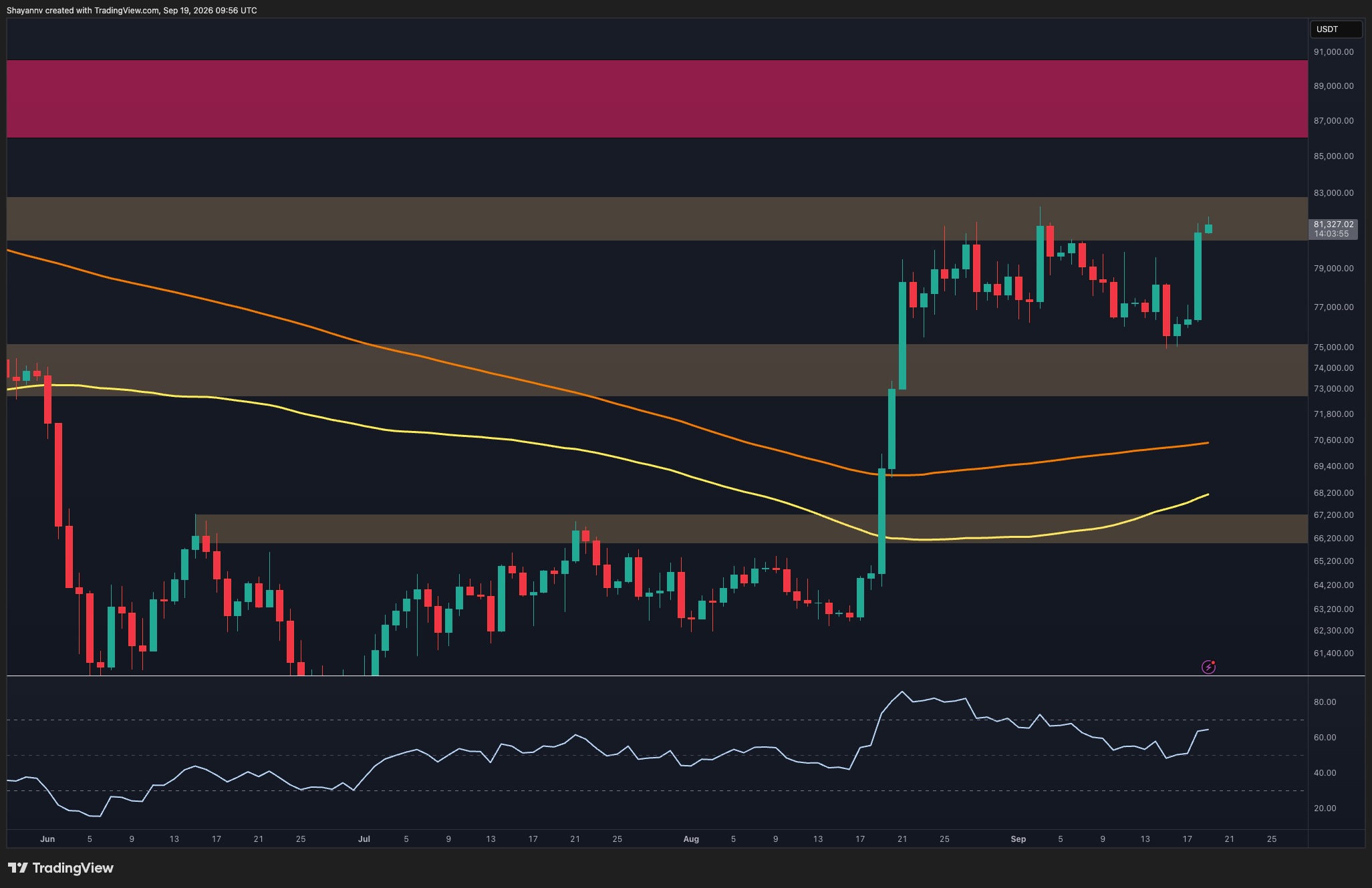
    Bitcoin has staged a strong recovery from its latest pullback, once again testing the upper boundary of its current consolidation range. With BTC trading around $81,500, the market is approaching a critical juncture where a confirmed bullish breakout could propel prices higher.

    Daily Chart Consolidation

    The daily chart indicates that Bitcoin has been consolidating following a significant breakout in August. The recent rebound from the $75,000 level has been particularly robust, with buyers swiftly pushing the price back towards the major resistance zone between $80,500 and $82,500.

    This area has consistently capped upward price movements and remains the primary hurdle for another bullish advance. Bitcoin is currently retesting this zone around $81,500, while the broader market structure remains constructive as long as the support area between $72,500 and $75,000 holds.

    Momentum indicators have also shown improvement. The daily Relative Strength Index (RSI) has moved back above the neutral 50 level and is approaching the mid-60s, signaling renewed buying interest without yet entering overbought territory.

    A sustained daily breakout above the $82,500 resistance level would represent a significant structural development and could open the path towards the next major supply zone, estimated between $86,000 and $90,000. Conversely, another rejection at this resistance could keep Bitcoin trading within its current range, with $75,000 and the broader $72,500-$75,000 region serving as the key support.

    Four-Hour Timeframe Insights

    The four-hour timeframe offers a clearer view of the range-bound structure. Bitcoin recently experienced an aggressive rebound from the lower boundary of its range, near $74,500-$75,000, and has now returned directly to the $81,000-$82,000 resistance region.

    This recovery has been impulsive, particularly the latest move from approximately $76,000 to $81,000. However, the price has yet to achieve a convincing breakout above the upper boundary. Consequently, the market remains within the broader range despite increasingly bullish short-term momentum.

    A clean break and sustained hold above the $81,000-$82,000 zone would likely shift the market structure decisively in favor of buyers. Such a move could trigger another price surge, initially targeting the rising upper trendline around $84,000-$85,000.

    Until this breakout occurs, rejection remains a plausible scenario. Failure to overcome the $82,000 level could send BTC back towards the middle of the range, with the $72,500-$75,000 zone continuing to act as critical support and the broader invalidation area for the current bullish setup.

    Liquidation Heatmap Analysis

    The two-week Binance BTC/USDT liquidation heatmap provides additional context for the recent rally. Liquidation heatmaps illustrate areas of concentrated leveraged positions, with brighter regions indicating larger potential liquidation clusters.

    Bitcoin’s surge above $80,000 has pushed the price into a significant concentration of liquidity within the $80,000-$82,000 region. This aligns closely with the technical resistance observed on price charts, making the current area particularly pivotal.

    Some liquidity remains immediately above the current market price, suggesting that a decisive breakout could trigger additional short liquidations and potentially accelerate the upward movement. This supports the possibility of another sharp spike if BTC successfully breaks through the $81,000-$82,000 resistance zone.

    Simultaneously, a liquidity concentration persists below the current price, around $74,000-$75,000. Therefore, as long as Bitcoin remains capped below resistance, volatility in either direction cannot be ruled out. For now, the combination of improving momentum and price pressing against the range high places the focus squarely on whether buyers can convert the current test into a confirmed breakout.


  • Ethereum Surges as Whales Accumulate, Wallet Count Peaks

    Ethereum Surges as Whales Accumulate, Wallet Count Peaks

    Ethereum Surges Past $2,600 Amidst Whale Activity and Staking Growth

    Ethereum’s recent ascent beyond the $2,600 mark has been propelled by a confluence of factors, including a resurgence in whale transactions, a record number of non-empty wallets, and significant developments in the realm of staking, according to data from Santiment Intelligence.

    While an increase in whale transactions doesn’t definitively signal accumulation, as large transfers can represent both buying and selling, the price action of Ether (ETH) has shown a clear inclination towards purchases.

    Santiment’s analysis reveals that the number of non-empty Ethereum wallets has reached an all-time high, exceeding 207 million. This growth indicates a continued broadening of ETH ownership, even after periods of subdued price performance. Concurrently, a substantial portion of Ethereum’s circulating supply remains committed to staking, rather than being held idly.

    With entities like Bitmine actively staking significant token holdings, the total amount of ETH currently staked has surpassed 40 million. Furthermore, Ethereum continues to dominate the decentralized finance (DeFi) landscape, boasting a total value locked (TVL) of approximately $50 billion.

    This combination of on-chain metrics underscores the underlying strength behind Ethereum’s latest recovery, which saw the leading altcoin rebound from below $2,400 to its current position above $2,600. Ethereum’s investment appeal appears to extend beyond short-term price speculation, with the asset deeply integrated into staking, stablecoins, lending, decentralized exchanges (DEXes), and other DeFi applications.

    Adding to the positive momentum, the cost of transacting on the Ethereum network has become significantly more affordable. The average transaction fee has fallen to below $0.10, representing a decrease of over 85% from its peak of $0.72 in April.

    This improving on-chain environment coincides with Ethereum approaching a critical technical resistance level. Popular analyst Ted Pillows has identified the current resistance zone as a significant hurdle for ETH’s recovery, suggesting that a sustained breakout could pave the way for new local highs.

    On a shorter timeframe, Pillows indicated that a weekly close above $2,550 would strengthen ETH’s potential to reach the $2,900-$3,000 range, a projection echoed by recent analysis from Ali Martinez. Looking further ahead, the long-term outlook for Ethereum appears even more optimistic. Pillows has set an ambitious target of $10,000 for the asset, citing its need to “catch up with global M2 supply.”

    [Image: A tweet from Ted Pillows stating “Ethereum has a lot of catching up to do with global M2 supply. $10,000 ETH remains the target by 2029.”]

  • BlackRock Clients Pour $108M into Bitcoin via IBIT Amid Strong Institutional Demand

    BlackRock Clients Pour $108M into Bitcoin via IBIT Amid Strong Institutional Demand

    BlackRock clients injected $108.44 million into the firm’s iShares Bitcoin Trust (IBIT) in a single trading session, underscoring a consistent demand pattern that has seen daily inflows range from $80 million to over $200 million.

    Dominance in Spot Bitcoin ETFs

    Since its launch in January 2024, IBIT has emerged as the leading product in the U.S. spot Bitcoin exchange-traded fund market. It routinely captures between 50% and 80% of the total daily or weekly inflows across all competing funds. In contrast, Grayscale’s GBTC, which was once the primary avenue for institutional Bitcoin investment, has experienced sustained outflows as investors shift to lower-fee alternatives.

    BlackRock’s Growing Bitcoin Holdings

    IBIT’s holdings have expanded significantly, now ranging between 770,000 and 786,000 Bitcoin. This positions BlackRock as one of the largest institutional holders of the cryptocurrency globally, despite the firm itself not holding any Bitcoin on its balance sheet. BlackRock acts solely as a conduit for client transactions, processing Bitcoin purchases only at their explicit request, a distinction that highlights its role as an intermediary rather than a speculator. Custody of the underlying Bitcoin is managed by Coinbase Prime.

    Sustained Institutional Demand

    Consistent multi-day buying trends have propelled cumulative weekly inflows for IBIT to exceed $680 million in some instances. This sustained level of demand suggests that institutional allocation to Bitcoin via IBIT is not a speculative trend but rather a methodical, recurring investment strategy, akin to how institutions allocate capital to gold through ETFs like GLD.

    Strategic Product Adjustment Fuels Conversions

    A significant, though understated, product adjustment made by BlackRock in 2026 lowered the minimum threshold for in-kind conversions from $25 million to $1 million. This change allows investors who already hold Bitcoin directly to exchange their coins for IBIT shares at a substantially more accessible entry point.

    Cumulative in-kind conversions have now surpassed $5 billion, as investors holding direct Bitcoin positions have transitioned into the regulated ETF structure. Motivations for this shift include simplified tax reporting, enhanced custody solutions, and compliance with institutional mandates that require regulated investment vehicles.

    The reduction in the conversion minimum has broadened participation to include family offices, smaller registered investment advisors (RIAs), and high-net-worth individuals who were previously excluded from this conversion mechanism due to its high entry barrier.

  • Bitcoin Surges: $115K Rally Imminent?

    Bitcoin Surges: $115K Rally Imminent?

    Bitcoin Surges Past $81,000 as Geopolitical Easing and Regulatory Clarity Boost Crypto Market

    Bitcoin, the world’s leading cryptocurrency, has experienced a significant price surge, climbing over 5% to approximately $81,015. This recovery from the mid-$77,000 range comes amid a backdrop of easing geopolitical tensions, forward movement on U.S. crypto regulations, and robust inflows into Bitcoin exchange-traded funds (ETFs). The rally has also led to substantial liquidations of crypto positions, totaling over $603 million.

    Geopolitical Calm Aids Bitcoin’s Ascent

    A key driver behind Bitcoin’s sharp rebound is the de-escalation of tensions in the Middle East. Crude oil prices have fallen below the $100 mark, a development attributed to Saudi Arabia securing alternative supply routes through Oman. This has alleviated concerns about potential disruptions to oil supply and transit. Earlier in the week, oil prices had neared $108, their highest in nearly four months, following reports of suspended crude shipments from Saudi Arabia’s Red Sea export hub in Yanbu and canceled deliveries to Europe after a pipeline attack. Rising tensions between Saudi Arabia and Yemen’s Houthi rebels had previously fueled fears about future oil supplies.

    U.

    S. Regulatory Developments Provide Support

    Further bolstering Bitcoin’s price action are recent moves by U.S. regulators. The Commodity Futures Trading Commission (CFTC) has submitted new proposed rules, titled “Regulation Crypto Asset Transactions and Regulation Crypto Asset Markets,” to the White House for review, marking an early stage in the rulemaking process. Concurrently, the Securities and Exchange Commission (SEC) has granted a five-year exemption for limited on-chain trading of tokenized stocks, allowing regulators to explore blockchain-based trading while ensuring investor protection. These developments follow the Senate’s failure to advance the CLARITY Act, shifting regulatory focus towards direct rule-making.

    ETF Inflows Fuel Institutional Demand

    The demand for Bitcoin ETFs has also played a crucial role in the cryptocurrency’s recent rally. U.S. spot Bitcoin ETFs have recorded net inflows of $591 million over the past two days. September 18 alone saw inflows of $433 million, with Fidelity’s FBTC leading the pack with $311 million and BlackRock’s IBIT following with $108 million. This resurgence in institutional interest is adding significant buying pressure to Bitcoin as it climbs.

    Technical Outlook and Potential Price Targets

    The current price action has also triggered substantial liquidations for short positions. Approximately 119,948 traders have seen their positions liquidated, resulting in total losses of $603.39 million, with short traders accounting for over $523 million in the last 24 hours.

    From a technical perspective, Bitcoin is approaching a bullish W-shaped pattern on its daily chart. A decisive break and sustained hold above the $82,917 level could confirm this bullish structure. Should this breakout occur, the chart suggests an initial move towards approximately $99,000, potentially followed by a pullback to around $91,000. If buyers maintain control after this consolidation, the next significant target is projected to be around $115,751, which represents a major resistance level on the chart. Conversely, failure to breach $82,917 could lead to Bitcoin remaining range-bound, delaying the anticipated bullish setup.

  • Bitcoin and Ethereum ETFs See Strong Inflows, Signaling Renewed Investor Interest

    Bitcoin and Ethereum ETFs See Strong Inflows, Signaling Renewed Investor Interest

    US spot Bitcoin and Ethereum Exchange Traded Funds (ETFs) experienced significant net inflows on September 18th, marking a notable rebound in investor activity. Bitcoin ETFs collectively attracted $433 million, while Ethereum ETFs saw inflows totaling $144 million.

    Fidelity’s FBTC led the day’s performance for Bitcoin ETFs, drawing $311 million in net inflows, with BlackRock’s IBIT contributing an additional $108 million. On the Ethereum front, BlackRock’s ETHA was the top performer, attracting $114 million, while Fidelity’s FETH added $26 million.

    These inflows provide context for the current market standing of these investment products. Total assets under management for Bitcoin ETFs reached $102.532 billion, representing 6.29% of Bitcoin’s overall market capitalization. Since their launch, Bitcoin ETFs have accumulated net inflows of $55.161 billion.

    Spot Ethereum ETFs, while smaller in scale, are also demonstrating growth. Their total assets under management stand at $16.719 billion, accounting for 5.2% of Ethereum’s market capitalization. Cumulative net inflows into Ethereum ETFs since their inception have reached $13.250 billion.

    The aggregate capital committed to both Bitcoin and Ethereum ETFs now exceeds $68 billion. The market capitalization penetration for Bitcoin ETFs at 6.29% and Ethereum ETFs at 5.2% is noted as being narrower than some market observers had anticipated at this stage.

    For Bitcoin ETFs, the significant market share penetration, currently at 6.29% of the total market cap, creates structural dynamics where daily inflows can effectively reduce the amount of circulating supply available on the open market, parking it in institutional custody.

    While these inflows signal a positive shift in investor sentiment, the specific composition of investors driving these flows, whether primarily institutional or retail, is not detailed. Additionally, the precise factors contributing to this rebound compared to preceding sessions are not elaborated upon in the available data.

    Why This Matters

    The materials describe a narrow update: On September 18th, US spot Bitcoin ETFs saw net inflows of $433 million, and spot Ethereum ETFs saw net inflows of $144 million. The exact composition of investors driving these inflows (institutional vs. retail) is not specified.

    Broader Context

    Source materials place the factual news in this context: US spot Bitcoin ETFs pulled in $433 million in net inflows on September 18, while spot Ethereum ETFs added $144 million on the same day.

  • Binance Launches 24/7 FX Perpetual Contracts, Offers 100x Leverage on USD/BRL

    Binance Launches 24/7 FX Perpetual Contracts, Offers 100x Leverage on USD/BRL

    Binance Launches 24/7 Forex Perpetual Contracts, Starting with USD/BRL

    Cryptocurrency exchange Binance has officially entered the foreign exchange market, launching round-the-clock, 24/7 forex perpetual contracts. The initial offering features a perpetual contract for the U.S. Dollar against the Brazilian Real (USDBRL), with leverage up to 100x.

    According to an official announcement released by Binance on PR Newswire on Friday, the USDBRLUSDT contract went live on September 21st, settled in USDT, and offers leverage of up to 100 times.

    Unlike traditional forex markets which close on weekends, Binance’s contracts employ a dual-mode pricing system. During regular forex trading hours, prices track a weighted index provided by third-party data providers. On weekends and public holidays, the system switches to an order book pricing mechanism.

    Binance explained that the weekend system utilizes an Exponentially Weighted Moving Average (EWMA) to calculate order book prices, eliminating reliance on external data sources. This means weekend pricing is determined solely by market supply and demand, circumventing the issue of external price feeds becoming stagnant during market closures.

    Shunyet Jan, Head of Trading at Binance, stated that the purpose of these contracts is to extend price discovery beyond traditional forex trading hours while providing traders with a 24/7 venue for hedging or holding positions.

    While Binance is making a significant move, it is not the first exchange to introduce forex perpetual contracts. Less than two weeks ago, Bybit launched its own 24/7 forex perpetual contracts, tracking EUR/USD, GBP/USD, and USD/JPY, also settled in USDT and offering 100x leverage.

    An earlier pioneer in this space is Kraken, which launched forex perpetual contracts for the Euro, British Pound, Australian Dollar, Japanese Yen, and Swiss Franc in April 2025, with leverage up to 50x. Kraken has been offering spot forex trading since 2020, with its forex spot trading volume reaching $5.7 billion in the first half of 2025.

    The foreign exchange market is the largest financial market globally by trading volume. According to a report from the Bank for International Settlements (BIS) in April 2025, the global average daily turnover in the OTC foreign exchange market reached $960 billion. The introduction of perpetual contracts by crypto exchanges into this market holds immense potential.

    The trading volume of the forex market is five times that of all other financial markets combined, presenting a direct path to mass adoption for crypto exchanges. Compared to stock perpetual contracts, which require navigating both CFTC and SEC regulations, forex is an over-the-counter (OTC) market with a relatively lower regulatory threshold.

    The logic behind integrating forex into crypto trading is straightforward: crypto traders are accustomed to high leverage and 24/7 trading. The traditional forex market’s weekend closures and trading hour limitations create a gap that perpetual contracts are well-suited to fill. The appeal of 100x leverage for retail traders is also significant, though such high leverage inherently carries volatility risks, particularly for emerging market currencies like the Brazilian Real, which typically have thinner liquidity on weekends.

    Key areas to watch moving forward include the number of currency pairs Binance will introduce, the funding rate structures for each pair, and whether actual trading volumes can keep pace with the leading positions held by Kraken and Bybit.

  • Bitcoin Surges to $81,690, Ether Reclaims $2,600 as Over $650M Liquidated

    Bitcoin Surges to $81,690, Ether Reclaims $2,600 as Over $650M Liquidated

    Bitcoin Surges Past $81,000, Ether Tops $2,600 as Market Sentiment Shifts to Greed

    Bitcoin experienced a dramatic rebound in the past 24 hours, climbing from a low of $76,500 to a high of $81,000, marking a 6.6% increase. Ether also surged, breaking above the $2,600 mark. The broader crypto market saw significant liquidations totaling $650 million, with short positions dominating nearly 90% of the market. The Crypto Fear & Greed Index rebounded from 56 to 71, indicating a return to “greed” and a strengthening bullish sentiment.

    Bitcoin Extends Rally, Reaches Two-Week High

    Bitcoin continued its strong performance today, climbing from the previous day’s low of $76,520 to a high of $81,690. This 6.6% surge in 24 hours represents a new two-week peak. Ether mirrored this upward trend, reclaiming the $2,600 level and reaching a high of $2,646. The overall market sentiment has turned optimistic, with capital flowing from safe-haven assets towards riskier investments, driving a substantial recovery in the total cryptocurrency market capitalization.

    Massive Liquidations Follow Sharp Price Increases

    The sharp upward price movement triggered significant liquidations in the derivatives market. According to CoinGlass data, total liquidations across all exchanges in the past 24 hours amounted to $652 million. Short positions accounted for the vast majority, with $583 million liquidated (89.4% of the total), while long positions saw $69.29 million in liquidations. A total of 125,002 traders were affected. The largest single liquidation order occurred on Hyperliquid for a BTC-USD contract, valued at $8.53 million.

    Market Navigates Rate Hikes and Regulatory Setbacks

    This week presented several challenges for the market. The Federal Reserve announced its first interest rate hike of 2023 on Thursday, with Chairman Kevin Warsh emphasizing that “inflation has been too high and has persisted for too long.” Concurrently, the Crypto Clarity Act failed to pass the Senate by a narrow margin of 49 to 50, causing Bitcoin to briefly dip below $76,000. However, the “buy the rumor, sell the news” effect quickly dissipated. Following a strong rebound in tech stocks on Thursday, the crypto market followed suit with a significant rally on Friday, suggesting that investors have largely digested the regulatory uncertainty and interest rate pressures.

    Wall Street and Global Markets Show Positive Momentum

    On Friday, Wall Street saw the S&P 500 and Nasdaq close higher, buoyed by gains in the technology sector. The semiconductor segment advanced nearly 3%, and the yield on the 10-year US Treasury note fell below 5%. Oil prices declined after Saudi Arabia restored its main east-west pipeline, easing some inflationary concerns.

    Altcoins Join the Rally, Signaling Potential Altcoin Season

    Altcoins broadly participated in the upward trend. Solana (SOL) showed the strongest performance, with a 24-hour gain of 12% to trade at $113.69, nearing its recent high of $114.32. XRP was trading at $1.41, up 8.3%, with a bullish golden cross pattern on the verge of formation. Overall, Bitcoin’s market dominance has seen a slight decline, potentially signaling the onset of an altcoin season.

    Technical Analysis: Bitcoin Shows Bullish Dominance

    Bitcoin’s daily technical indicators suggest a dominant bullish trend. The closing price of $80,884 is above the 20-day Simple Moving Average (SMA20) at $78,164, the 50-day SMA (SMA50) at $72,504, and the 200-day SMA (SMA200) at $70,433. The Relative Strength Index (RSI14) stands at 63.5, indicating a strong upward momentum. While the Moving Average Convergence Divergence (MACD) still shows a bearish configuration, its histogram has narrowed, suggesting weakening bearish momentum. The closing price is near the upper Bollinger Band at $81,282. Key resistance levels are the upper Bollinger Band at $81,282 and the 30-day high of $82,300. Support levels are identified at the SMA20 ($78,164), the lower Bollinger Band ($75,046), and the SMA50 ($72,504).

    Technical Analysis: Ether Maintains Strong Momentum

    Ether’s daily technical outlook also points to a strong bullish trend. The closing price of $2,612 is above the SMA20 at $2,472, the SMA50 at $2,243, and the SMA200 at $2,071. The RSI14 is at 64.4, also within the strong upward momentum zone. The MACD histogram in its bearish configuration has narrowed. The closing price is near the upper Bollinger Band at $2,575. The next resistance level is the 30-day high of $2,666, while support levels are the upper Bollinger Band ($2,575), the SMA20 ($2,472), and the lower Bollinger Band ($2,370).

    Fear & Greed Index Signals Strong Greed

    Data from Alternative.me shows the Crypto Fear & Greed Index at 71 (Greed) today, a significant 15-point increase from the previous day’s 56, dispelling the cautious sentiment seen mid-week. The index has ranged between 50 and 71 over the past eight days, indicating a rapid shift in market sentiment from neutral to greedy, which aligns with the technical breakout in prices. If Bitcoin can hold the $80,000 psychological level and maintain strong trading volume, it may challenge the 30-day high of $82,300 in the short term. However, the MACD’s bearish configuration has not yet reversed, and traders should be mindful of potential technical corrections towards the SMA20.

  • Circle Leads Tokenized Equity Market with $306M Deployed

    Circle Leads Tokenized Equity Market with $306M Deployed

    Circle Internet Group’s recent debut on the New York Stock Exchange has propelled it to the forefront of the global tokenized stock market. The company’s shares have been deployed across numerous tokenized platforms, with the top 20 instances alone amassing a combined market capitalization of $305.5 million. This surge places the issuer of USDC at the vanguard of a rapidly expanding tokenized equity sector that has transformed from a niche concept into a multi-billion-dollar industry in less than two years.

    To illustrate the velocity of this market’s growth, the entire tokenized equities landscape was valued at under $20 million in late 2024. By early September 2026, it had surged past $3.1 billion, marking an all-time high.

    Key Tokenized Products Driving Momentum

    Three specific tokenized Circle share products are currently leading this charge. Ondo Finance’s CRCLon holds a market cap fluctuating between $101 million and $154 million, depending on the data snapshot. Binance’s CRCLB is valued at approximately $119 million. While smaller, CRCLx from Backed Finance has seen significant integration into decentralized finance (DeFi) protocols, with around $2.9 million deployed by mid-August 2026.

    The collective momentum of these three products is substantial. In a recent period, they jointly added $36.9 million to their market capitalization, a figure that would have nearly doubled the entire tokenized equities market as recently as late 2024.

    These products, while representing the same underlying Circle share, differ in their issuer relationships, custody arrangements, and the specific blockchains they operate on. These distinctions are crucial for investors assessing counterparty risk. Backed Finance, Ondo, and Binance each bring distinct institutional support and regulatory approaches to their offerings.

    Regulatory Clarity Fuels Growth

    A significant catalyst for this increased activity was a U.S. Securities and Exchange Commission (SEC) order that became effective on September 17, 2026. This order establishes a conditional framework for the trading of tokenized U.S. stocks, providing a five-year window through 2031 for platforms and issuers to develop their offerings within a defined regulatory landscape.

    The market’s reaction was swift. Following the announcement, Circle’s stock price saw an approximate 5.7% increase, reaching $85.03.

    It is important to note the limitations of the SEC’s order. It does not equate tokenized stocks with traditional securities in all aspects, nor does it permit the unfettered issuance of unregistered tokens. The framework is conditional, requiring platforms to meet specific criteria to operate within its bounds.

    Circle’s Strategic Position

    Circle’s prominent position in the tokenized equity rankings is not accidental. The company operates at a unique intersection, being a publicly traded entity whose core business revolves around digital dollar infrastructure. This dual nature attracts a broad spectrum of investors, from traditional equity buyers to crypto-native capital allocators.

    Institutional interest in the tokenization of real-world assets has been growing for years, with tokenized U.S. Treasuries paving the way. Tokenized equities represent the next logical step in this evolution, extending the principle of bringing tradable value onto the blockchain to assets that carry equity risk, rather than solely fixed-income risk.

  • Strive, Inc. Acquires 469 Bitcoin via Preferred Stock, Holdings Reach 25,000 BTC

    Strive, Inc. Acquires 469 Bitcoin via Preferred Stock, Holdings Reach 25,000 BTC

    Strive, Inc. has acquired an additional 469 Bitcoin, valued at approximately $36.6 million, between September 8 and 11. This purchase increases the company’s total Bitcoin holdings to 25,000 BTC, a move funded through the issuance of Variable Rate Series A Perpetual Preferred Stock (SATA). According to the FactSheet, this strategy allows Strive to expand its Bitcoin reserves without diluting its common shareholders, provided Bitcoin’s price appreciation outpaces the dividend cost.

    The recent acquisition brings Strive’s total Bitcoin holdings to 25,000 BTC, with an approximate current market value of $1.95 billion. This positions Strive as the fifth-largest public holder of Bitcoin globally. The company’s accumulation accelerated after its merger with Semler Scientific in January 2026, which added 5,048 BTC. Strive’s current holdings represent approximately 0.119% of Bitcoin’s total supply.

    Preferred Stock Funding Mechanism

    The company’s funding strategy involves issuing preferred stock, known as SATA. Investors purchase these shares at $100 each, and in return, receive a roughly 13% annualized variable dividend. This method enables Strive to deploy capital into Bitcoin without issuing common shares, thereby avoiding dilution for existing common shareholders. The total notional value of outstanding SATA shares exceeds $1.04 billion, with the latest round of preferred stock capital raised amounting to approximately $40.3 million.

    Shareholder Implications and Leverage

    This financial structure introduces a leverage effect for common shareholders. According to the FactSheet, common shareholders may benefit if Bitcoin’s price appreciation outpaces the 13% annual dividend cost. Each Bitcoin purchased with preferred stock proceeds increases the net asset value backing common shares, while the dividend obligation on SATA reduces future cash flows. Strive’s amplification ratio is reported at 53.5%.

    Strive’s Strategic Pivot

    Strive’s transformation into a significant Bitcoin treasury company has been rapid. Originally founded by Vivek Ramaswamy with a focus on asset management, the company’s pivot toward Bitcoin accumulation gained momentum following its merger with Semler Scientific. The company’s strategy relies on Bitcoin’s continued appreciation to ensure that gains exceed the dividend costs associated with its preferred stock financing.

    As reported by the FactSheet, the appreciation of Bitcoin must outpace the 13% annualized dividend cost for common shareholders to realize a net benefit. Strive’s current Bitcoin holdings are valued at approximately $1.95 billion. The acquisition occurred on the Nasdaq.

    Significance

    The acquisition of Bitcoin through preferred stock issuances allows Strive to increase its Bitcoin holdings without diluting common shareholders, provided Bitcoin’s price appreciation outpaces the dividend cost.

    Broader Context

    Strive’s transformation into a Bitcoin treasury company has been remarkably fast.

  • Coinbase Seeks Approval for Single-Stock Perpetual Futures

    Coinbase Seeks Approval for Single-Stock Perpetual Futures

    Coinbase Seeks to Introduce Perpetual Futures for Individual Stocks in U.

    S. Market

    Coinbase is aiming to bring one of the cryptocurrency industry’s most widely used trading instruments to the U.S. stock market, having filed with federal regulators for the listing of single-stock perpetual futures.

    The filing, submitted on Friday by Coinbase Derivatives, requests approval from the Commodity Futures Trading Commission (CFTC) for contracts that would allow American traders to gain leveraged exposure to individual stocks without the need to directly own the shares.

    According to the CFTC’s listing, the product, categorized as a single-stock future, is currently pending approval. Coinbase stated that this filing represents its “first set” of U.S. single-stock perpetuals, with the objective of providing 24/5 trading access to individual equities.

    Perpetual futures, often referred to as “perps,” are derivative contracts designed to mirror the price of an underlying asset. They differ from traditional futures by lacking an expiration date, enabling traders to maintain positions indefinitely, provided they meet margin and funding requirements.

    While a long-standing feature in crypto markets, perpetual futures have largely been inaccessible to U.S. traders in most forms until recently. The Wall Street Journal reported that Coinbase intends to launch approximately 50 to 60 contracts, featuring companies such as Apple, Microsoft, Tesla, and Nvidia, potentially by the end of this year, contingent on regulatory approval.

    This initiative marks an acceleration in Coinbase’s expansion of its domestic derivatives business. Earlier this year, the company became the first U.S. exchange to receive clearance for offering regulated crypto perpetual futures, subsequently introducing contracts with leverage up to 50x. Coinbase already provides stock perpetuals to eligible international traders, having launched that product in March.

    The filing arrives amidst a broader push to introduce perpetual futures to the U.S. market. The CFTC has previously approved Bitcoin perpetual futures for Kalshi, which has since diversified into commodities like copper, while Polymarket is also progressing with its own crypto perpetual futures offerings.

    It is important to note that holding a single-stock perpetual future would not grant any shareholder rights, dividends, or ownership stakes; it would solely provide price exposure. Specific contract details and leverage limits have not yet been fully disclosed, and the products still require regulatory clearance before trading can commence.