Tag: Market Trends

  • Altman: XRP’s True Test Lies Ahead

    Altman: XRP’s True Test Lies Ahead

    XRP Price Outlook Brightens Post-SEC Lawsuit, AI Predicts Significant Gains

    The long-standing lawsuit that cast a shadow over XRP for years has concluded, fundamentally altering the cryptocurrency’s financial outlook. Artificial intelligence models, including ChatGPT, are now forecasting a substantial price surge for XRP. Predictions suggest a potential climb from the current $1.02 level to between $4 and $6 by the close of 2026. In a scenario of robust market optimism, the price could even reach $7 to $8.

    Legal Clarity Fuels Stronger Thesis

    The resolution of the Securities and Exchange Commission (SEC) litigation has effectively removed the most significant legal impediment for XRP. ChatGPT posits that this development strengthens the investment thesis for XRP more than in any previous market cycle.

    Institutional Demand and Regulated Liquidity Expand

    The introduction of U.S. spot XRP Exchange-Traded Funds (ETFs) has opened direct channels for institutional investment. Furthermore, the availability of CME XRP futures and options provides regulated liquidity and essential hedging infrastructure, bolstering market stability and accessibility for larger players.

    On-Chain Activity and Developer Ecosystem Growth

    Simultaneously, broader adoption of ledger technology is expanding. Developments such as RLUSD settlement, the tokenization of assets, and the growth of institutional decentralized finance (DeFi) are collectively driving increased on-chain activity for XRP. The platform’s native lending capabilities and Ethereum Virtual Machine (EVM) compatibility are also enhancing its appeal to developers, enabling a wider range of applications and innovations. Ripple’s strategic acquisitions in prime brokerage, treasury services, and payments infrastructure further solidify its institutional presence.

    Potential for Further Regulatory Catalysts

    Additional clarity on U.S. regulatory frameworks could emerge before the end of the year. ChatGPT identifies this as another significant potential catalyst that remains on the horizon.

    Bearish Case Scenarios

    The bearish outlook for XRP hinges on several factors. Continued weakness across the broader cryptocurrency market represents the primary concern. A second risk involves disappointing demand for the newly launched ETFs. The third and most structural challenge is the substantial supply of XRP still held by Ripple. Under these conditions, XRP could remain within the $0.70 to $1.20 range.

    Chart Performance Trails Positive Developments

    Despite the recent positive news, XRP’s price chart has not yet reflected these improvements. The cryptocurrency reached a peak above $3.60 last July and has since experienced a decline through multiple support levels. October saw a sharp drop towards $2.60, followed by a break below $1.80 in February, pushing the price near $1.15. A range between $1.30 and $1.55 established in the spring appeared to offer a floor, but this was broken in June, sending XRP below $1.20. July and August have been characterized by a gradual decline, with the price currently at its lowest point on record.

    Current Trading Levels and Technical Indicators

    XRP closed at $1.02823, marking a 0.09% decrease of $0.00094 on the day. The trading session ranged between $1.02713 and $1.04020. Immediate support is identified at the psychological level of $1.00, with resistance anticipated at $1.10, followed by $1.20 and $1.40.

    The Relative Strength Index (RSI) stands at 38.25, with its signal line at 41.62. The oscillator’s position, trailing by over three points, indicates that sellers currently maintain control. While the RSI is approaching oversold territory, it has not yet triggered a definitive signal. Momentum indicators point downwards, showing no immediate signs of reversal.

    ChatGPT’s bearish price range begins at $1.20, a level XRP is currently trading below. Holding the $1.00 mark is therefore the critical first step before any upward price movements become significant.


  • Crypto Faces Scrutiny as Over 100 Projects Collapse in 2026

    Crypto Faces Scrutiny as Over 100 Projects Collapse in 2026

    Crypto Faces Dot-Com Style Shakeout as Over 100 Projects Fold

    The cryptocurrency industry is currently undergoing a significant shakeout, reminiscent of the dot-com era, with more than 100 projects reportedly shutting down, filing for bankruptcy, or vanishing in 2026, according to MoonPay President Keith Grossman.

    Grossman, speaking on August 10, suggested that the current downturn is compelling crypto companies to confront a fundamental question: are they developing products that people genuinely need?

    In a post on X, referencing a CoinDesk report, Grossman described himself as “a geriatric” by crypto standards. He noted his experience with market cycles, having joined WIRED in 2002 shortly after the dot-com crash and taking on his first leadership role there during the 2008 financial crisis.

    “Companies fail, people lose jobs, careers change & confidence gets shaken,” Grossman wrote, observing that such challenging environments can prompt individuals to re-evaluate their motivations for building within the crypto space.

    The trend of over 100 crypto initiatives ceasing operations or declaring bankruptcy this year spans a wide range of entities, including exchanges, wallets, decentralized finance (DeFi) projects, NFT marketplaces, and blockchain networks.

    Grossman drew a parallel between the current situation and the dot-com collapse. He argued that the internet’s inability to sustain thousands of businesses did not signify a failure of the technology itself. Instead, it highlighted that merely being an “internet company” was insufficient for building a viable business. He sees a similar test emerging for the cryptocurrency sector.

    “The question is no longer whether you can launch a token, create another chain, raise a large round or generate attention,” he stated. “It is simpler: Are you creating something people actually need?”

    The veteran crypto figure also linked digital assets with artificial intelligence, characterizing AI as “scalable intelligence” and crypto as “scalable truth.” This framework, attributed to John D’Agostino, posits that blockchains can reduce the costs associated with establishing ownership, authenticity, and settlement.

    This perspective led him to discuss tokenization, though he cautioned that placing an asset on a blockchain does not automatically confer value. According to Grossman, the technology must demonstrably improve the user experience to create meaningful value.

    Several project closures underscore that high usage alone has not always translated into sustainable revenue. Tally, a governance platform utilized by over 500 protocols, announced its closure despite having processed more than $1 billion in payments. Similarly, Everclear shut down after reaching $500 million in monthly transaction volume.

    Exchanges have also felt this pressure. As reported last month, BitMart and BitMEX have begun winding down their trading operations. BitMart’s BMX token saw a decline of over 60% following the announcement. Movement Labs filed for Chapter 11 bankruptcy protection on July 23, causing its MOVE token to fall more than 99% from its previous all-time high.

    For Grossman, these failures do not indicate a fundamental failure of cryptocurrency. Instead, they serve as a test of whether individual projects possess a product, customers, and a business model capable of weathering the disappearance of readily available capital.

    “Putting something on a blockchain does not make it valuable,” he wrote. “The technology has to earn its place. And so do we.”

  • Analyst Foresees Major Market Shifts Amidst Trader Boredom

    Analyst Foresees Major Market Shifts Amidst Trader Boredom

    Bitcoin Poised for Major Moves Ahead of Expected Q4 Lows, Analyst Suggests

    The cryptocurrency market is experiencing an unusually quiet period, leaving many participants feeling bored, but one analyst believes this lull is a precursor to significant price action. Crypto analyst Sykodelic predicts that Bitcoin is building momentum for explosive moves well before the fourth quarter, a timeframe many traders are anticipating for a market bottom.

    Sykodelic has already initiated a short position following a weak weekly close, anticipating a swift decline to clear accumulated liquidity before a subsequent upward reversal. The analyst described the current environment as one where “the lack of volatility and compression we are seeing here only ever finishes in one way. MASSIVE moves.” While acknowledging that the prolonged quiet has left “everyone bored out of their minds” in anticipation of Q4 lows, Sykodelic asserted, “We are gonna move way before that. It’s gonna be soon.”

    The trigger for Sykodelic’s short position came with the breach of the $65,300 level and a subsequent weak weekly close for Bitcoin. “My short is filled,” the analyst stated. “After waiting weeks for a clear trigger, we now have one.” The expectation is for a drop to $60,500, which would represent the final downward movement before a substantial advance.

    Sykodelic has long identified the February low, near $60,000, as a significant macro bottom and believes the market is nearing a broader upward trend. The current short position, according to the analyst, is designed to facilitate a sharp liquidation event that will clear out liquidity accumulated below the market for weeks. This, in turn, is expected to create a bear-trap scenario, where late sellers turn bearish and predict new lows, only for a rapid reversal to squeeze them and propel the price above $67,000, potentially towards the mid-$70,000s.

    “Whenever we have been sideways like this for a long time, a massive amount of liquidity builds up either side,” Sykodelic wrote. “It is always so much better if the liquidity below is swiped before actually moving higher.”

    This perspective loosely aligns with an independent analysis from Crypto Patel, who noted the fund market premium index holding steady around 0.14. “For now, the signal is quietly bullish,” Patel commented, adding that institutional selling pressure has not yet materialized in the data, despite the low premium.

    Bitcoin has offered limited trading opportunities recently. The cryptocurrency dipped to $62,200 early last week before buyers pushed it back to $65,000. However, this upward momentum faltered when the CLARITY Act faced another delay in the Senate. A weaker-than-expected jobs report on Friday provided a brief boost to $65,400 before the price settled back down. At the time of writing, Bitcoin was trading near $65,000, showing a modest gain of approximately 0.8% for the day, but remaining down nearly 45% over the past year.

    Despite the recent quiet, some analysts are expressing increased optimism. Figures such as Ali Martinez, Michaël van de Poppe, and Merlijn The Trader have all pointed to signs of a completed correction. Their analyses cite various indicators, including a rare monthly TD Sequential buy signal and what they interpret as a classic breakdown and reclaim pattern.

  • Web3’s Financial Freedom: A Privilege for the Risk-Tolerant

    Web3’s Financial Freedom: A Privilege for the Risk-Tolerant

    Web3 promises a more inclusive financial system, accessible to anyone with a smartphone and internet connection. While this represents significant progress, mere access does not guarantee safety or practicality.

    Users can still lose funds by selecting the wrong network, overpaying on fees, or sending assets to an unsupported destination. When such errors occur repeatedly, they signal a product flaw, even if the industry attributes them to “client error.”

    Permissionless access addresses a limited question: can an individual enter the system? True financial inclusion requires addressing more complex issues: can that person understand their actions, identify risks before confirming, and use the product without incurring significant financial losses during the learning process?

    This distinction is crucial because cryptocurrency is no longer solely for traders with disposable income. In regions where local currencies are collapsing, inflation is rampant, remittances are prohibitively expensive, or foreign currency is scarce, crypto serves a genuine, practical need.

    Consider sub-Saharan Africa. Between July 2024 and June 2025, the region saw $205.7 billion in on-chain value, a 51.7% increase year-over-year, with Nigeria alone accounting for $92.1 billion. Chainalysis attributes much of this activity to inflation, currency devaluation, limited access to foreign exchange, and the growing use of crypto for cross-border payments.

    A preview chapter of Chainalysis’s 2025 Geography of Cryptocurrency Report highlights this trend, noting a 52% growth in Sub-Saharan Africa’s crypto market to $205 billion, making it the world’s third fastest-growing region. The report indicates that Nigeria and South Africa are leading institutional adoption, while retail…

    For many users, crypto is a valuable tool for saving, paying, or sending funds internationally. Stablecoins and blockchain payments can reduce costs by eliminating intermediaries and streamlining clearing processes. However, cheaper technology does not automatically equate to greater accessibility. If users must understand networks, gas fees, bridges, wallet permissions, slippage, address formats, and finality to use a product, the complexity has merely shifted from the bank to the customer.

    Every user of a financial product has an “error budget”—the amount of money they can afford to lose while learning its intricacies before continued use becomes economically irrational.

    Imagine two users performing the same on-chain operation simultaneously, each paying $25 in network and bridge fees. One is transferring $10,000, the other $100. From the protocol’s perspective, the outcomes are identical. However, for the first user, $25 is a minor inconvenience; for the second, it represents a quarter of their transaction.

    Blockchain protocols are unaware of a client’s income, savings, or financial situation, nor should they be. Products, however, often possess sufficient transaction data to recognize anomalies. They can observe the transfer amount, estimate network fees, compare available routes, calculate the expected arrival amount, and sometimes identify when a selected destination does not support the chosen network.

    Despite this, many interfaces continue to present technical decisions as if all users possess equal capital, experience, and risk tolerance. This is not the case. Fixed and unpredictable costs disproportionately affect those sending smaller amounts, while irreversible mistakes carry greater consequences for individuals with limited savings. The less capital a person has, the smaller their error budget.

    Consequently, a financial system that demands costly lessons before safe usage may be open, but openness alone does not ensure inclusivity.

    This critique is not an argument against self-custody. Rather, it asserts that users should not be compelled to relinquish control simply because the underlying technology is complex. The crypto industry often presents a false dichotomy: either a centralized platform dictates the user experience, or the user must manage all technical and security decisions independently.

    In practice, self-custody can involve managing keys, recovery phrases, gas tokens, networks, approvals, bridges, and backups. Users gain financial freedom, but with a workload typically handled by multiple teams within a bank. This can feel like a precarious exchange: “Here is your financial freedom, just try not to click the wrong button.” The core principle is that control over assets and product assistance are not mutually exclusive.

    A self-custodial product could detect incompatible networks, explain permissions in clear language, simulate transaction outcomes, flag fees disproportionate to the transfer amount, and clearly differentiate dangerous actions from routine ones. It could even suggest a safer route without seizing control of the funds.

    This is one of the driving forces behind ChangeNOW’s evolution beyond its initial role as an instant exchange into a comprehensive crypto platform. The objective of a crypto super app should be to minimize the technical decisions users must make for ordinary financial tasks. Buying, storing, exchanging, sending, trading, or growing funds may rely on diverse underlying infrastructure operating in the background, but the user should not be responsible for connecting each component.

    Naturally, users retain their own responsibilities. No financial product can prevent every poor decision, thwart every attack, or reverse every completed transaction. Web3 involves inherent trade-offs, and pretending otherwise—suggesting it is entirely risk-free—would be disingenuous. However, responsibility is not absolute. While an individual can make a single bad call, persistent, similar mistakes across multiple clients likely indicate room for product improvement.

    The industry’s default response is often education: read the documentation, watch tutorials, understand gas mechanics, and differentiate between networks, wallets, bridges, and exchanges before sending funds. While education is important, it cannot excuse predictable failure modes. Sending $100 should not necessitate a degree in distributed systems.

    If users repeatedly confuse networks, another article is insufficient. If they approve permissions they do not comprehend, a longer disclaimer is not a solution. If the true cost is only revealed post-confirmation, the interface is failing to provide informed consent.

    Web3 has already achieved a significant feat: building open, global financial infrastructure outside the traditional banking system. The next priority, though less glamorous, is crucial for widespread adoption: making this technology genuinely usable without requiring users to become experts.

    This entails developing products that consolidate fragmented tools into intuitive experiences, prevent predictable errors, and help users achieve financial outcomes rather than merely completing blockchain transactions. This is the direction ChangeNOW is pursuing with its super app. The goal is not to obscure Web3 or diminish user control, but rather to assume responsibility for the complexity that products have too long offloaded onto users.

    The next billion users should not need substantial disposable income to navigate the Web3 learning curve. Financial freedom cannot be predicated on open access while the cost of learning is prohibitive for most. Web3 will achieve genuine inclusivity not when anyone can open a wallet, but when ordinary people can use one without an expensive mistake being the mandatory price of entry.

  • XRP Price Outlook: Potential Targets if $1.00 Support Fails

    XRP Price Outlook: Potential Targets if $1.00 Support Fails

    Ripple’s XRP Faces Critical Test as Selling Pressure Mounts

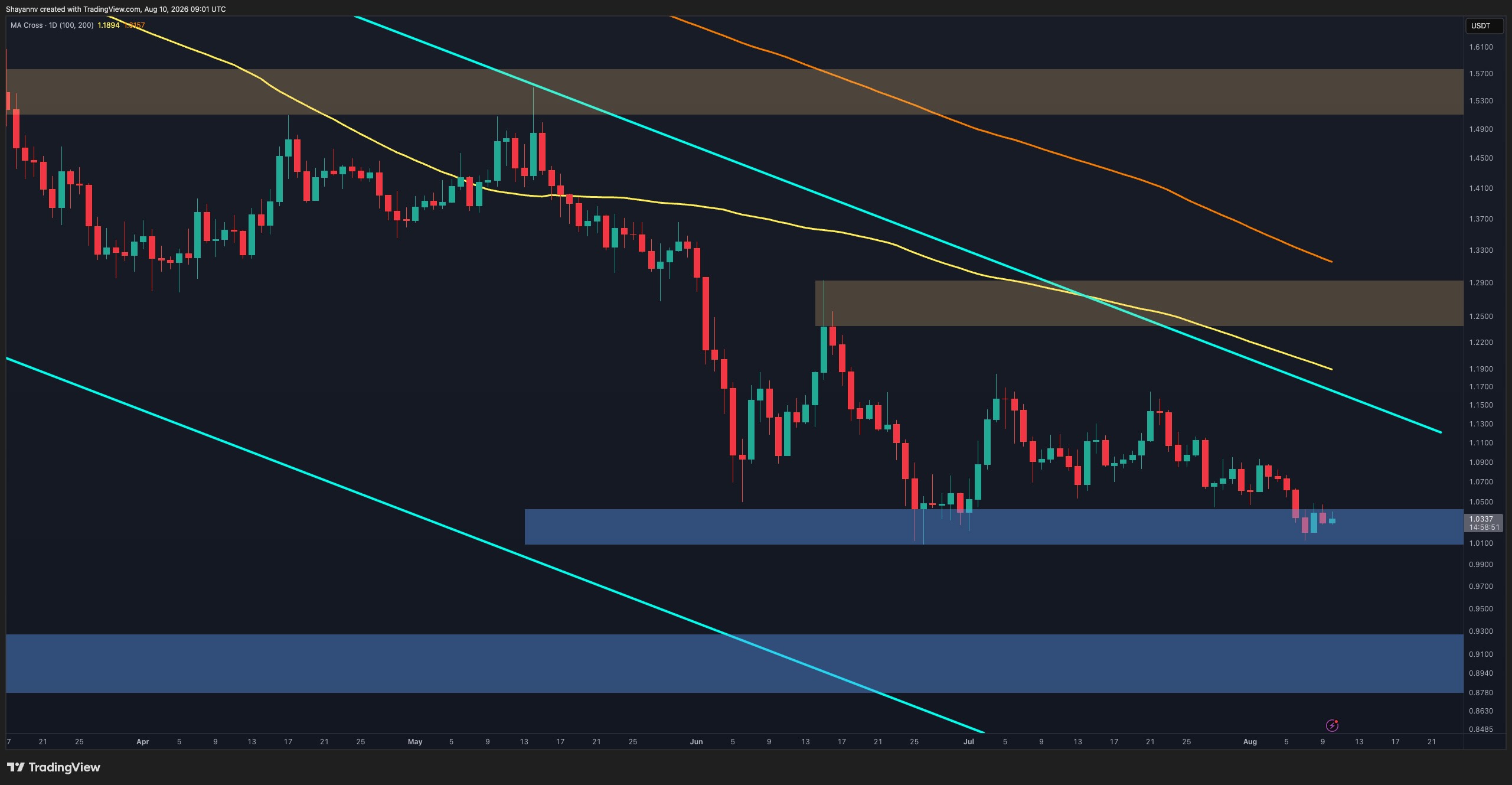
    XRP, the cryptocurrency associated with Ripple, is currently experiencing sustained selling pressure, with its price action pushing the digital asset back into a crucial support area between $1.01 and $1.04. While this zone has historically attracted buyers, the prevailing market structure continues to favor sellers, making the current defense of this level a pivotal moment for determining XRP’s next directional move.

    On the daily chart, XRP is trading near $1.03, having gradually declined back into the $1.01-$1.04 support range. This marks another test of a level that previously spurred notable upward reactions in late June. However, the current approach to this support is occurring with relatively weak bullish momentum.

    More significantly, the broader trend for XRP remains decidedly bearish. The price continues to trade within a large descending channel and remains well below all the moving averages depicted on the chart. The recent pattern of lower highs has also persisted. A prior rebound attempt was met with resistance around $1.14-$1.15, falling short of challenging the more significant resistance zone between $1.24 and $1.29. Consequently, buyers are increasingly reliant on the $1.01-$1.04 support area holding firm.

    A decisive breach below $1.01 would further weaken the existing structure and could expose the demand zone located between $0.88 and $0.93. This lower zone also sits closer to the descending channel’s lower boundary. Conversely, a successful defense of current support could trigger another relief rally. However, for the broader bearish outlook to materially shift, XRP would still need to reclaim higher resistance levels.

    Immediate Pressure on the 4-Hour Chart

    The 4-hour chart offers a clearer view of the immediate pressure XRP is facing. Since a rejection in late July, XRP has consistently printed lower highs beneath the descending trendline, with successive rebounds becoming progressively shallower.

    Most recently, the price dipped into the $1.01-$1.04 support zone, briefly touching around $1.02 before attempting to stabilize. The response thus far has been modest, with XRP consolidating near $1.03 rather than staging an impulsive recovery. This suggests that while buyers are defending the area, they have not yet demonstrated sufficient strength to alter the short-term momentum.

    The first indication of meaningful improvement would require the price to reclaim the descending trendline, which is currently approaching the $1.07 level. Beyond that, the resistance zone between $1.13 and $1.15 represents a more significant hurdle, as the previous rally faltered in this region.

    Until these levels are reclaimed, the possibility of another liquidity sweep below recent lows remains elevated. A decisive loss of the $1.01-$1.04 support zone would confirm a renewed bearish continuation and shift focus towards levels below $1. Alternatively, a strong rejection from current support, followed by a breakout above the descending trendline, could initiate a more substantial recovery toward the $1.13-$1.15 range.

  • XRP Trust Holdings Plummet in H1 Filing

    XRP Trust Holdings Plummet in H1 Filing

    Grayscale XRP Trust Sees Significant Holdings Drop, Raising Concerns

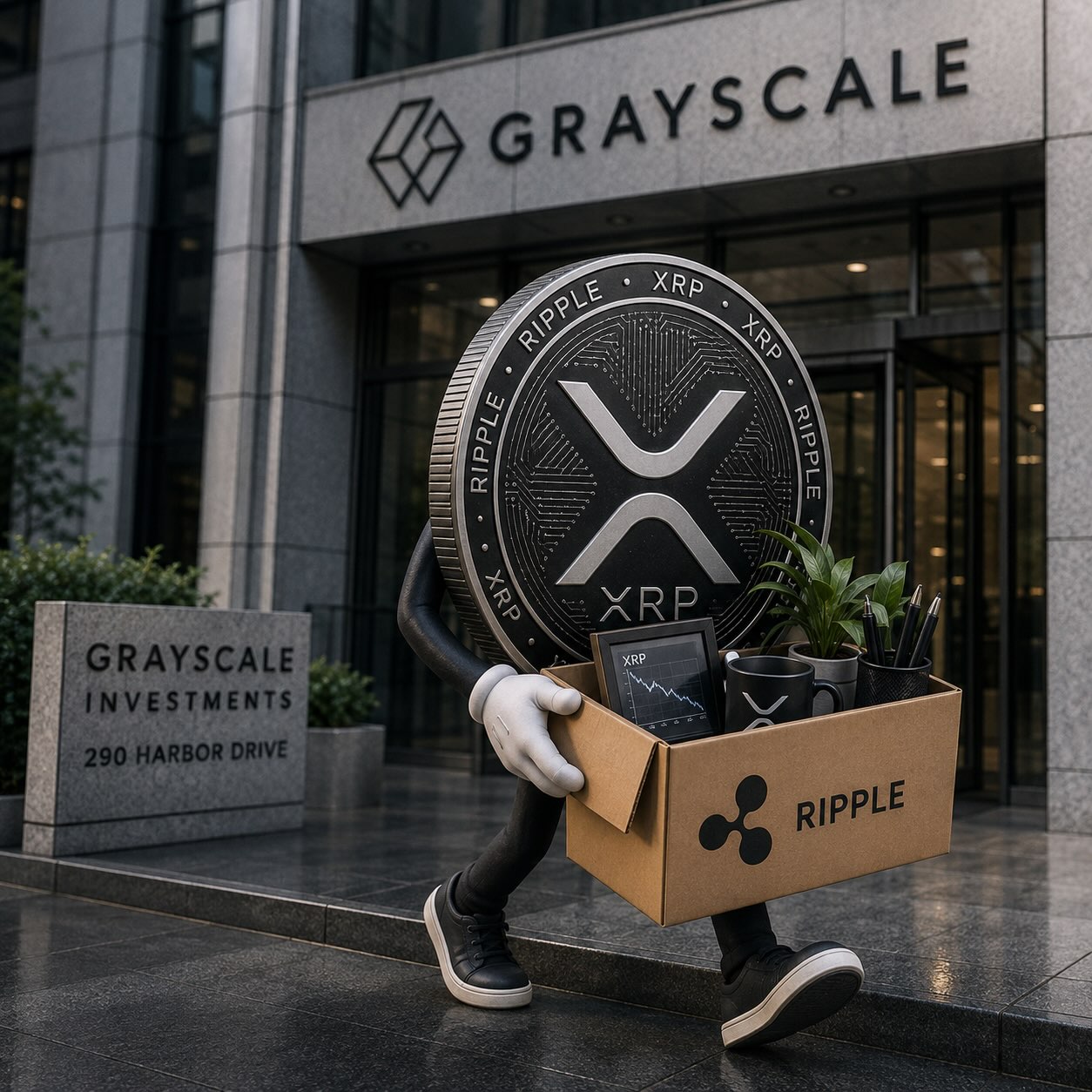
    Grayscale’s XRP Trust ETF offloaded 103.41 million XRP tokens, valued at $180.78 million, during the first half of 2026. This substantial sale reduced the trust’s holdings from 122.23 million XRP at the close of 2025 to 55.04 million by June 30, according to a filing with the U.S. Securities and Exchange Commission (SEC). The significant decrease signals a worrying trend in institutional adoption of the digital asset.

    The news emerged as XRP traded around $1.02 against the U.S. dollar, hovering precariously close to a key support level at $1, following a 0.2% dip overnight. Daily trading volume stood at $732 million, an increase from the previous day’s $670 million.

    Data from CoinGlass indicates that XRP ETF net inflows have totaled $1.42 billion since their launch in November 2024. While this represents a healthy overall figure, it underscores the magnitude of Grayscale’s ETF selloff.

    The SEC filing also revealed that the value of the trust’s XRP holdings plummeted from $223.36 million at the end of 2025 to $57.41 million on June 30. Grayscale reported a realized loss of $34.16 million on XRP sold to facilitate share redemptions, in addition to an unrealized loss of $17.47 million on its remaining XRP position.

    During the six-month period, the trust created an additional 36.27 million XRP, valued at $66.58 million. However, these additions were insufficient to offset the redemptions. The number of outstanding shares decreased from 6.30 million at the end of 2025 to 2.84 million by June 30.

    The trust repurchased 5.33 million shares and sold 1.87 million shares within the same timeframe. It also recorded a realized loss of $39,000 on XRP sold to cover operational expenses.

    Authorized participants are responsible for the creation and redemption of shares in the trust. The filing further attributes the reduction in XRP holdings per share to periodic XRP withdrawals utilized to cover the sponsor’s fee.

    XRP Price Performance and Market Dynamics

    XRP experienced a significant decline, falling from $1.84 on January 1 to $1.05 by June 30, a drop exceeding 40%. On August 7, the token traded within a narrow range of $1.015 to $1.041, positioning it near the lower end of its 52-week trading band, which spans from $1.0095 to $3.3818.

    According to CoinGlass data, weekly inflows into XRP exchange-traded funds saw a sharp decrease to approximately $1 million from $14.9 million the prior week. However, daily flows showed a rebound, reaching roughly $3.5 million on August 6. Over the preceding month, XRP had declined by approximately 10%, and over the seven days ending Friday, it was down about 5.5%.

    In regulatory news, the U.S. Senate has postponed its consideration of the cryptocurrency market-structure legislation, known as the CLARITY Act, until at least September. Factors such as regulatory developments, institutional demand, and Ripple’s XRP holdings are identified as potential influences on XRP’s price trajectory.

    Ripple executed a release of 1 billion XRP from escrow on August 1, as part of its scheduled monthly unlock. Historically, the company has returned a substantial portion of these monthly releases back to escrow, rather than circulating the entire amount.

    The SEC filing details XRP sales for share redemptions and expenses, alongside changes in the trust’s XRP holdings and share count. Redemptions can necessitate token sales to meet investor withdrawal requests, with authorized participants managing the creation and redemption of shares.

    The trust’s XRP holdings were more than halved between the end of 2025 and June 30, with the value of these holdings decreasing from $223.36 million to $57.41 million. The filing also indicates that XRP creations during this period were outpaced by XRP sales for redemptions.

  • Bitcoin ETFs See $854M Inflow as Rate-Hike Fears Subside

    Bitcoin ETFs See $854M Inflow as Rate-Hike Fears Subside

    U.

    S. Bitcoin ETFs See Strong Inflows as Investors Eye Macro Shifts

    U.S. spot Bitcoin exchange-traded funds (ETFs) experienced a significant surge in inflows last week, accumulating $853.5 million across five consecutive sessions. This marks a notable rebound from the $61.5 million net outflow recorded the previous week, bringing the cumulative net inflows since their launch to $52.18 billion, according to data from SoSoValue.

    BlackRock Leads the Charge

    BlackRock’s iShares Bitcoin Trust (IBIT) was the primary driver of this influx, accounting for approximately $690 million, or about 80% of the week’s total inflows, as reported by Stephen Wundke, strategy and revenue director at Algoz Technologies. On Friday alone, IBIT attracted $86.7 million, while Fidelity’s FBTC saw $41 million. Conversely, Invesco’s BTCO experienced an outflow of $19.4 million, and VanEck’s HODL shed $10.6 million.

    The momentum, however, showed signs of easing as the weekend approached, with daily inflows declining from $128.7 million on Thursday to $98.9 million on Friday. By the end of the week, the funds held a total of $79.5 billion in assets, representing approximately 6.1% of Bitcoin’s overall market capitalization.

    Macroeconomic Factors Influence Investor Sentiment

    Tim Sun, a senior researcher at HashKey, suggested that the recent inflows indicate a renewed interest in Bitcoin from institutional investors, following a brief pullback in the artificial intelligence sector. He posited that these flows likely comprise a combination of portfolio rebalancing and basis trading strategies.

    Sun highlighted weakening U.S. employment data and declining expectations for interest rate hikes as more significant catalysts. Official figures revealed that employers cut 23,000 jobs in July, contrary to forecasts of a 95,000 gain. This data coincided with Bitcoin’s technical indicator, the “death cross,” where its 50-day moving average remained below its 200-day moving average. Furthermore, the odds of a September rate hike, as tracked by CME FedWatch, fell to 40% from 55% on Friday, though they rose to 46% by Monday.

    The softening of AI-related equities has reportedly reduced the pull on global risk capital, prompting a shift towards less crowded assets, according to Sun. He identified the $60,000 to $61,000 range as a key support level that the market has repeatedly tested.

    However, Sun cautioned against interpreting the week’s performance as a definitive trend reversal. He noted that the inflows are “not enough to support a trend reversal,” emphasizing that interest rate hike possibilities have not disappeared and long-dated Treasury yields remain elevated.

    Analysts Offer Divergent Outlooks

    CoinShares presented a more optimistic view. James Butterfill, head of research at CoinShares, stated in a Friday update that their “view remains that the cycle lows are probably now behind us,” while acknowledging that “this does not imply an immediate return to strong upside.” He anticipates Bitcoin to trade within a range for the next two to three months, potentially reaching $80,000. As of Monday morning, Bitcoin was trading around $65,100, up 0.4% for the day, according to CoinGecko data.

    Butterfill pointed to three consecutive weeks of accumulation by large holders, or “whales,” following approximately $40 billion in whale selling since October 2025. He also cited $1.05 billion in inflows into digital asset investment products globally last week, a broader metric than U.S. Bitcoin ETFs alone, marking the fifth consecutive week of positive inflows. This pattern, he wrote, “increasingly resembles capitulation followed by early re-accumulation.” A sustained move towards $100,000, he added, would necessitate “a clearer deterioration in employment data and a more meaningful reduction in rate expectations.”

    Meanwhile, Bloomberg ETF analyst Eric Balchunas proposed a different perspective. He noted on Twitter that IBIT, FBTC, and several other Bitcoin ETFs have seen daily inflows since the Coldcard exploit, which led to Bitcoin being drained from air-gapped wallets. Balchunas suggested it is “hard not to see causation in the correlation,” calling it the third-best week since October and deeming it “ironic, but somehow on brand” if a cold storage theft marked the beginning of a new rally.

    Decrypt reported earlier this month that exchange deposits consisting of transfers under 10 BTC reached 7,300 BTC on July 31, the highest figure since February. CryptoQuant indicated that holders appeared to be moving coins for safety, though they cautioned that the connection was not definitive.

    Wundke described the past week as the funds’ strongest since April, suggesting that investors are viewing current prices as a “bottom buying” opportunity. He anticipates little significant market movement before mid-September, when the Clarity Act is expected to have another legislative window and the Federal Reserve is scheduled to hold its next meeting. He expressed doubt that Republicans could secure sufficient votes for the bill’s passage in time. Traders appear marginally less pessimistic, with Polymarket users pricing the bill’s chances of becoming law this year at 21% on Monday, up from the 14% cited by Butterfill on August 6.

    Both analysts also looked to the Middle East for potential catalysts. Wundke suggested that “any realistic Iran peace deal would dampen inflation fears and very much temper the mood for rate rises,” calling it a more likely catalyst for a market he described as oversold. For the present, he added, the market “mostly feels like ‘Groundhog Day,’” with holiday-induced malaise contributing to thin trading volumes.

  • Ripple (XRP) Poised for Bull Run on Two Key Factors

    Ripple (XRP) Poised for Bull Run on Two Key Factors

    Ripple’s cross-border token, XRP, has seen a 3% decline over the past week and a 7% drop on a monthly basis, currently trading around $1.03 according to CoinGecko.

    Potential Catalysts for a Rally

    Despite the recent downturn, prominent analyst Ali Martinez has identified two key factors that could fuel a potential upcoming rally for XRP.

    Martinez points to the Tom DeMark Sequential indicator, which has generated a buy signal on XRP’s monthly chart. He suggests this could signal a significant shift from bearish to bullish momentum. Historically, this indicator has preceded major reversals for XRP, including substantial price surges in April 2020 (1,074%) and August 2022 (973%). Conversely, it also preceded a 57% nosedive in April 2025 after flashing a sell signal.

    The second catalyst highlighted by Martinez is a notable buying spree among large investors, often referred to as “whales.” He revealed that these major players have acquired over 380 million XRP, valued at nearly $400 million, in the last seven days. This has increased their total holdings to approximately 8.2 billion tokens, representing 13.1% of the asset’s circulating supply. This accumulation is seen as an encouraging sign, potentially indicating preparations for further price appreciation. Such activity could also invigorate broader community enthusiasm and attract smaller investors, injecting fresh capital that may support the price.

    Key Resistance and Price Targets

    Martinez also emphasized the critical resistance level at $1.06, where a significant volume of nearly 3 billion XRP has been transacted. He believes a monthly close above this zone could pave the way for XRP to reach $1.35 and potentially surge to $1.64. This is not the first time Martinez has focused on this price point; earlier this month, he warned that a drop below it could lead to a substantial collapse to as low as $0.62.

    Market Reactions and Technical Indicators

    Late last week, XRP dipped to around $1.02 following news that the CLARITY Act, a proposed crypto regulatory framework in the U.S., would be delayed until September. On X, user Dark Defender observed that this decline pushed XRP’s Relative Strength Index (RSI) into an extremely oversold territory, anticipating a significant revival once the price climbs above $1.05.

    Another analyst, Gerla, also commented on the RSI, noting a bullish divergence. Gerla predicted that a reclaim of the $1.08 level could trigger a “serious reversal” for XRP.

    Meanwhile, X user ChartNerd presented a more optimistic outlook, identifying a multi-year cup-and-handle pattern. This pattern, they suggest, could precede a rally to as high as $27. While this target appears ambitious at present, the future trajectory of the cryptocurrency market remains uncertain.

  • Standard Chartered: Tokenization to Propel Chainlink to $200 by 2030

    Standard Chartered: Tokenization to Propel Chainlink to $200 by 2030

    Standard Chartered Initiates Coverage of Chainlink with $200 Price Target by 2030

    Standard Chartered has launched coverage of Chainlink, setting a price target of $200 by the end of 2030. This projection suggests a potential 25-fold increase from its current price of approximately $8, anticipating it to outperform both Bitcoin and Ethereum over the same period.

    Geoff Kendrick, the bank’s global head of digital assets research, outlined a phased approach to this target in a note released Monday. He forecasts a price of $13 by the end of this year, followed by $41, $82, and $133, before ultimately reaching the $200 mark. The same report also projects Bitcoin to reach $500,000 and Ethereum $40,000 by the close of 2030.

    Kendrick anticipates a significant surge in the value of tokenized assets on-chain, estimating a roughly 12-fold increase to $4 trillion by the end of 2028, up from the current $340 billion. Furthermore, assets deployed in decentralized finance (DeFi) are expected to grow 37-fold to $2.7 trillion by 2030. Given that Chainlink earns fees for data delivery and asset transfers between blockchains, the bank forecasts its fee revenue to increase approximately 25 times during this timeframe, with the assumption that the token’s price will mirror this fee growth.

    Chainlink’s established market position is presented as another key factor supporting this outlook. The research note indicates that the total value secured by Chainlink’s oracle network exceeds $110 billion, covering approximately 70% of oracle-dependent value within the global DeFi ecosystem and over 80% on the Ethereum network. Notably, Aave V3 alone accounts for 44% of this secured value.

    Kendrick identified several institutions utilizing Chainlink’s services, including Swift, DTCC, Euroclear, JP Morgan, Mastercard, UBS, Fidelity, and S&P Global. He expects off-chain clients to represent an increasing portion of Chainlink’s fee revenue. The report highlights that tokenized funds and bonds require net asset values, rates, and reserve attestations, making them more data-intensive than crypto-native assets.

    In terms of interoperability, Chainlink is noted to still lag behind LayerZero. The report states that over $7 billion in token value has migrated from legacy bridges to Chainlink’s Cross-Chain Interoperability Protocol (CCIP) since a $292 million exploit in April. Quarterly CCIP volume reached $4.9 billion in the second quarter, marking a 353% year-on-year increase. Decrypt reported in May that KelpDAO had attributed the exploit to LayerZero and intended to rebuild on Chainlink, a characterization that LayerZero disputes.

    This latest note follows a series of DeFi initiations from Kendrick, all based on the same 37-fold growth forecast. In June, he set price targets of $100 for Uniswap and $3,500 for Aave, followed by a $60 target for Morpho in July. Uniswap’s UNI token saw a double-digit jump after its coverage was initiated. Chainlink’s response has been more subdued, with its LINK token currently trading at $8.25, down 0.8% on the day, according to CoinGecko data.

    The report also flagged potential risks, including slower-than-anticipated scaling of institutional tokenization, pilot programs failing to transition into recurring production workflows, increased competition from specialist providers, and technical failures that could erode confidence.

  • Cysic (CYS) Hits Record High After Upbit Listing

    Cysic (CYS) Hits Record High After Upbit Listing

    Cysic Token Surges to Record High on South Korean Exchange Listing, Sparks Insider Trading Concerns

    In a cryptocurrency market largely characterized by stagnation, even minor price movements from smaller-cap altcoins can capture significant attention. Cysic’s CYS token provided today’s notable example, experiencing a dramatic surge before a sharp decline.

    The CYS token experienced a remarkable ascent, climbing over 60% from its previous day’s low of $0.8 to reach a new all-time high of $1.30. However, this peak was short-lived, as the token was subsequently rejected and fell sharply to $0.92 by press time. The primary driver for this volatility appeared to be a significant listing on Upbit, a major South Korean cryptocurrency exchange.

    The timing of the rally has drawn scrutiny. Analysis of trading charts indicates that the most substantial price spike occurred around 23:00 UTC on August 9, when the asset touched $1.30. This preceded the official announcement of the Upbit listing on X, which was published hours later, after 03:00 UTC on August 10. Trading pairs against BTC and USDT commenced at 14:00 KST (05:00 UTC), prompting speculation on Crypto X regarding potential insider trading.

    Despite these concerns, the token’s trajectory exemplifies a common “pump-and-dump” pattern. CYS, representing a decentralized infrastructure project focused on building “ComputeFi,” has emerged as one of the most volatile assets in an otherwise subdued market.

    Listings on Upbit have historically led to immediate price increases for the associated tokens, often followed by retracements. In early May, this publication reported on a similar event when Upbit listed B3, the native token of a layer-3 blockchain network built on Base. At that time, B3’s price surged by triple digits, reaching $0.0021. Currently, B3 is trading approximately 80% below that local peak, struggling to maintain a price below $0.00045, according to CoinGecko data.