Tag: Market Trends

  • Cardano (ADA) Whale Accumulation Continues Amidst Uncertain Price Outlook

    Cardano (ADA) Whale Accumulation Continues Amidst Uncertain Price Outlook

    Cardano (ADA) has seen significant accumulation by large holders over the past week, a trend that briefly elevated its market capitalization above Stellar and into the top 15 cryptocurrencies. This accumulation has reached its highest balance in approximately three and a half years, though future price movements remain subject to diverse predictions and prevailing market sentiment.

    According to Santiment data, over the last seven days, large Cardano wallets have added more than 30 million ADA to their holdings, bringing the total balance for these wallets to 5.69 billion ADA. Wallets holding between 100,000 and 100 million ADA now collectively possess 25.6 billion ADA, the highest recorded balance for this cohort in roughly three and a half years. This sustained buying interest from significant investors is a key development.

    Currently trading around $0.165, ADA is testing support at this level. The immediate resistance is noted at $0.172, with a potential upward movement towards $0.180 if buying volume increases. However, a more cautious outlook suggests stronger support could emerge near $0.148 should market sentiment weaken.

    While the accumulation is notable, its direct impact on future price performance remains uncertain. Charles Hoskinson, a prominent figure in the Cardano ecosystem, has expressed optimism, believing ADA could re-enter the top 10 cryptocurrencies by market cap before the year’s end. Such a feat would require a substantial rally from current levels.

    Market analysis indicates that ADA’s recent price action has been largely influenced by broader sentiment across the altcoin market, rather than specific Cardano-centric catalysts. Consequently, ADA remains highly sensitive to overall cryptocurrency market flows. A return of risk appetite to the broader market could potentially turn the current dip into another accumulation zone.

    Forecasting models present mixed outlooks. Some anticipate a modest recovery in the coming weeks, while others maintain a more cautious stance, highlighting the $0.148 support level. Three potential scenarios are being closely monitored: a bullish case where ADA defends $0.165 support and rebounds towards $0.172 and $0.180; a base case involving consolidation between $0.165 and $0.172 amidst continued whale accumulation; and a bearish scenario where ADA revisits the $0.148 support if market sentiment deteriorates.

    The ongoing accumulation trend by large holders may signal positioning for future price movements. However, whether this represents a strategic move for a significant rally or opportunistic buying at lower prices remains a key question. Traders are closely observing the $0.165 support level, with many likely awaiting technical confirmation before anticipating a sustained recovery. ADA’s current price action underscores its sensitivity to overall market conditions, and any significant upward movement will likely require improved buying volume and a positive shift in broader crypto market sentiment.

    Why This Matters

    The accumulation of over 30 million ADA by large holders in the past week, reaching the highest balance in three and a half years, is a notable development. However, the ultimate impact on ADA’s price direction is uncertain and depends on broader market sentiment and technical factors.

    Broader Context

    Cardano price is trading around $0.165, testing support at this level. Large holders have accumulated more than 30 million ADA over the past week, a trend that briefly pushed ADA into the top 15 by market cap. The future price trajectory remains subject to various predictions and market conditions.


  • XRP Falters on Cup and Handle as Ripple Unveils Mint to Address RLUSD

    XRP Falters on Cup and Handle as Ripple Unveils Mint to Address RLUSD

    XRP Caught Between Technical Promise and Price Resistance

    XRP is currently navigating a challenging market, caught between a technically promising setup and persistent overhead price resistance. This stalemate is testing the patience of bullish investors. A widely tracked cup-and-handle pattern, which traders have been observing for weeks, now faces the risk of invalidation. XRP is trading around $1.11, significantly below the former breakout zone of $2.68 to $2.77 that was anticipated in earlier bullish forecasts.

    Ripple’s Mint Function and RLUSD

    Ripple has introduced a dedicated “Mint” function designed to streamline the issuance of its stablecoin, RLUSD. This update aims to address minting delays and enhance the predictability of settlements. The move strengthens Ripple’s enterprise infrastructure and could potentially increase RLUSD’s appeal to institutional investors. However, the direct benefit of this development is seen as favoring stablecoin adoption rather than immediately boosting demand for spot XRP.

    Regulatory Clarity and Infrastructure

    The broader issue of regulatory clarity across Ripple’s product suite remains a significant variable influencing XRP’s price. Nevertheless, ongoing infrastructure upgrades could foster long-term confidence, particularly if institutional adoption continues to expand. Until then, traders will require stronger demand to push XRP back towards higher resistance levels.

    Macroeconomic Headwinds

    The current macroeconomic backdrop presents additional challenges. Major U.S. stock indexes have faced pressure from megacap technology stocks amid renewed concerns about artificial intelligence spending. Furthermore, headlines regarding tariffs have contributed to a risk-off sentiment across financial markets. Historically, when equities decline, altcoins rarely escape the ensuing selling pressure.

    Technical Outlook for XRP

    XRP is trading near $1.11, positioned just below a key resistance zone that many analysts continue to monitor closely. The measured move target, estimated around $5.18, remains contingent on a sustained breakout above previous swing highs. In the interim, the 50-day and 200-day exponential moving averages (EMAs) are trading below the current price, suggesting a constructive long-term trend.

    A clear breakout trigger would involve a daily close above nearby resistance, supported by strong trading volume. Such a move could pave the way for a rally towards the next resistance zone, situated between $1.30 and $1.40. Until this occurs, XRP may continue to trade within its recent range, potentially frustrating both optimistic and pessimistic traders.

    On the downside, a loss of support around the $1.08 to $1.10 range could lead to further testing of lower price levels. Some wave analysts have cautioned that a more significant correction is possible if momentum continues to wane. However, these bearish projections are currently conditional and not yet confirmed.

    Long-term price targets, such as $33 to $67 or even $60, are still being discussed by prominent XRP analysts. It is important to note that these are multi-cycle projections rather than immediate expectations. For the present, the primary question remains whether XRP can reclaim higher resistance levels and build sufficient momentum for a sustained breakout.

    The Challenge of Late-Cycle Positioning

    XRP’s current cup-and-handle setup highlights a common frustration in late-cycle market positioning: even a technically sound pattern for an asset with a $70 billion market capitalization requires a significant capital event to drive substantial price movement. Traders are increasingly shifting their focus from stalled large-cap assets to early-stage infrastructure projects where the entry price still reflects discovery rather than inflated expectations.

    Emerging Projects Gaining Traction

    One project attracting attention is LiquidChain, a Layer 3 protocol that aims to consolidate liquidity from Bitcoin, Ethereum, and Solana into a unified execution environment. It features a Unified Liquidity Layer with Single-Step Execution and Verifiable Settlement, enabling developers to deploy applications once and access all three ecosystems without the complexities of bridging.

    The project’s presale is currently priced at $0.01483, having raised $920,000 to date. LiquidChain is approaching the $1 million milestone, a point that has historically marked an inflection in presale momentum.

  • Pi Network Price Drops Below $0.09 Amidst Recovery Reversal

    Pi Network Price Drops Below $0.09 Amidst Recovery Reversal

    Pi Network Token Faces Steep Decline Amidst Unraveling Recovery

    While much of the cryptocurrency market has experienced a slight downturn in the past 24 hours, Pi Network’s native token, PI, has suffered a more significant retracement compared to its peers.

    PI’s recent performance is particularly concerning as it appears to have stalled a notable resurgence that followed a series of all-time lows. This raises questions about whether a new price floor is imminent.

    July proved to be a challenging month for the popular, albeit controversial, token. It recorded multiple consecutive all-time lows, notably after breaching the critical $0.10 support level. The most recent record low occurred mid-month, with the token plummeting to just above $0.07.

    However, this support level eventually provided the necessary impetus for a rebound in the subsequent days. At one point, PI emerged as the market’s top performer, surging by 20% and challenging the $0.10 mark, this time from below.

    Despite several hours of attempts to break through, bearish sentiment prevailed, halting its upward momentum. In the days that followed, PI gradually lost traction but managed to hold above $0.09 for the most part. Nevertheless, another breakdown materialized within the last 24 hours, with the token slumping by over 10% and currently trading around $0.082.

    This pattern highlights PI’s consistent, albeit painful, price action: periods of stability lasting several months are followed by sharp declines to new record lows, then double-digit bounces within days, only to be rejected again and set a new lower low. This cycle has been observed for over a year, leading to new all-time lows with remarkable frequency.

    The underlying fundamentals of the Pi Network project have not significantly deteriorated. The Core Team continues to announce updates, protocol upgrades, and product redesigns, but these developments have had only a fleeting impact on the token’s price. Investor confidence appears to have waned, and the regular daily token unlocks offer little support.

    From a technical standpoint, $0.10 remains the primary hurdle for a more substantial recovery. Failure to reclaim this level soon could lead to a rapid deterioration of PI’s situation, mirroring past trends. Should the $0.07 all-time low support falter, PI would enter a new phase of price discovery with no historical support levels beneath it.

    Such a scenario could see PI fall out of the top 100 cryptocurrencies by market capitalization. The token has already seen its ranking drop from the top 50 to outside the top 70 within a matter of weeks.

  • Bitcoin Market Cycles: Debate Continues on Macroeconomic Factors vs. Halving Theories

    Bitcoin Market Cycles: Debate Continues on Macroeconomic Factors vs. Halving Theories

    The cryptocurrency market is currently engaged in a significant debate regarding the potential bottoming of Bitcoin’s bear market. Analysts and firms are divided, with some adhering to traditional four-year cycle theories tied to halving events, while others contend that broader macroeconomic factors are now the primary influence on price movements. There is uncertainty about whether Bitcoin’s bear market has already bottomed or will decline further, and the exact timing of Bitcoin’s market bottom remains unclear.

    Grayscale’s Macroeconomic Perspective

    Grayscale, a prominent digital asset manager, posits that Bitcoin has matured and is increasingly influenced by macroeconomic forces, similar to other major financial assets. According to Grayscale, historical bear markets have often coincided with periods of slowing economic growth and rising real interest rates. This year’s downturn has unfolded alongside shifts in expectations for U.S. Federal Reserve policy and increased real interest rates. Grayscale suggests that if the Federal Reserve refrains from further rate hikes and economic growth remains resilient, Bitcoin’s price may have already found its low, potentially negating the need for further declines predicted by traditional cycle models.

    Historical Cycles vs. Current Deviations

    Historically, Bitcoin has tended to reach its market bottom approximately one year after a cyclical peak and about two and a half years after a halving event, with cumulative declines averaging around 80%. Previous bear markets typically took roughly 365 days to reach their final trough. However, the current cycle’s duration to a potential bottom is estimated at around 260 days. This deviation from historical timing prompts questions about the continued applicability of the four-year cycle theory, and whether cycle lengths for Bitcoin can change.

    Crypto trader Killa noted that Bitcoin’s market structure, including sweeping the “dead cat base low” and completing a five-wave corrective structure, suggests a potential bottom. However, Killa remains uncertain, acknowledging the unusual timing compared to previous cycles and maintaining a “50/50” outlook. Killa explained that while cycle lengths can change, the current timing deviates from historical norms, though the trader believes Bitcoin is more likely to form higher lows than make significant new lows.

    Technical and On-Chain Signals

    Further analysis comes from crypto analyst Ali Martinez, who observed technical signals on the monthly chart resembling those seen at the end of previous bear markets in 2015, 2019, and 2022. Ali Martinez acknowledged that on-chain metrics such as MVRV and CVDD still leave room for a decline toward the $40,000-$50,000 range, but the current technical setup historically points to a dominant accumulation zone with a favorable risk-to-reward profile for spot Bitcoin buyers.

    Crypto analyst Doctor Profit also warned that investors strictly adhering to the traditional four-year cycle and waiting for a bottom in September or October might miss the market’s next upward move. Doctor Profit suggested that Bitcoin could potentially revisit the $54,000 area but does not anticipate a drop below $50,000, believing that gradual accumulation already presents an attractive risk-reward profile.

    Navigating Uncertainty

    The ongoing debate highlights a fundamental uncertainty: whether Bitcoin’s price behavior is still primarily dictated by its internal halving cycles or if it has transitioned to being more closely aligned with broader macroeconomic conditions. The future direction of U.S. Federal Reserve policy and the resilience of global economic growth are key factors that could influence which of these theories ultimately suggests more accurate. Investors face the challenge of navigating this evolving landscape, where historical patterns may offer less reliable guidance than in the past.

    Why This Matters

    The materials describe a narrow update: Analysts and firms are debating the end of Bitcoin’s bear market, with some predicting a further drop based on historical four-year cycles and others suggesting the bottom may have already occurred due to macroeconomic shifts and technical indicators. Whether Bitcoin’s bear market has already bottomed or will decline further.

    Broader Context

    Source materials place the market analysis in this context: Bitcoin’s bear market.

  • Cardano Price Outlook: Bullish vs. Bearish Signals

    Cardano Price Outlook: Bullish vs. Bearish Signals

    Cardano’s native token, ADA, has emerged as one of the top-performing cryptocurrencies among the top 100 by market capitalization over the past week, with its price climbing 8% to approximately $0.17.

    Two significant developments suggest this upward trend may be in its nascent stages, though another factor indicates a potential correction is equally plausible.

    Earlier this month, large ADA investors, commonly referred to as “whales” in the crypto community, increased their total holdings to 25.6 billion coins. This accumulation represents nearly 70% of the token’s circulating supply and marks the highest level seen since February 2023. Concurrently, retail investors have scaled back their exposure to ADA. According to data analytics firm Santiment, this divergence in investor behavior could establish a favorable foundation for the asset.

    More recently, prominent analyst Ali Martinez reported that whales have acquired 30 million ADA units, valued at over $5 million at current market rates, within the last month. This renewed activity from this influential investor group signals their strategic positioning for a potential future price surge. In the cryptocurrency sphere, a prevailing theory posits that whales possess privileged information regarding events or news that could influence an asset’s valuation, and that their investment decisions are rarely driven by mere speculation. Their actions, therefore, could potentially incentivize smaller investors to enter the ecosystem and inject fresh capital.

    The second bullish indicator for ADA is its Relative Strength Index (RSI). This technical analysis tool gauges the speed and magnitude of recent price changes to determine if a token is due for a trend reversal. Readings below 30 typically signal oversold conditions, suggesting a potential rally, while levels above 70 serve as a warning of an impending correction. Currently, ADA’s RSI hovers around 28.

    However, a bearish factor also warrants consideration. In recent times, exchange inflows have outpaced outflows, indicating that investors are moving their assets from self-custody to centralized platforms. This trend can heighten immediate selling pressure.

    Several analysts on the social media platform X have commented on ADA’s rebound, anticipating a more substantial upward movement in the short term. “Master of Crypto” suggested that if the positive momentum persists, the price could reach $0.219.

    Other analysts, such as JAVON MARKS, express even greater optimism, forecasting significant price increases that appear ambitious from the current vantage point. This analyst believes ADA is approaching a “key converging/breaking point” that could pave the way for a rise as high as $2.90. Celal Kucuker also recently weighed in, predicting a major ascent to $5.

  • Bybit TradFi Lists 10 Stock CFDs

    Bybit TradFi Lists 10 Stock CFDs

    New Stock CFDs Now Available

    Ten new stock Contracts for Difference (CFDs) have been introduced, offering traders the opportunity to engage with their preferred stocks and explore emerging market prospects.

    CFD Specifications

    Liquidity Notice: Traders should be aware that CFD quotes may experience reduced liquidity outside of United States trading hours.

    For comprehensive details on all available TradFi trading pairs, please consult the Help Center.

  • Bitcoin Price Action Divides Analysts Amid Shifting ETF Flows

    Bitcoin Price Action Divides Analysts Amid Shifting ETF Flows

    Bitcoin’s valuation has rebounded to hover around $65,000, a notable recovery from its dip below $58,000 in late June. This price movement has triggered a divergence of opinions among market analysts regarding whether the current surge indicates a sustainable uptrend or a potential precursor to a significant downturn.

    Bearish Outlooks and Historical Parallels

    Some analysts express caution, drawing parallels to past market events. X user BATMAN noted that the current price increase mirrors a bullish pump observed in autumn 2022, which was subsequently followed by a substantial price drop to approximately $16,000. BATMAN stated, “Side by side, this level looks concerning. It mirrors a similar bullish pump from 2022 that coincided with nothing afterward. History might not repeat itself, but it sure does rhyme.”

    Echoing this cautious sentiment, X user Kabuki views the latest price setup as a potential bull trap. Kabuki suggests that Bitcoin could decline to as low as $47,000 by August before potentially initiating a major uptrend that could lead to over $200,000 by the start of next year. These perspectives highlight a concern that the current rally might be a deceptive move before a more significant price correction.

    Bullish Undercurrents and Institutional Interest

    Conversely, other market participants point to renewed institutional interest as a positive indicator. Inflows into spot Bitcoin Exchange-Traded Funds (ETFs) have surpassed outflows for seven consecutive days, a trend not seen since April. This development suggests increasing exposure to Bitcoin by institutional investors, including pension funds and hedge funds. This contrasts with the situation at the end of June, when spot BTC ETFs experienced a weekly outflow of approximately $1.8 billion.

    Technical Indicators and Key Levels

    Technical analysis also informs the ongoing discussion. X user Ted emphasized the importance of Bitcoin maintaining its value above certain levels, suggesting that a price of $67,500 to $68,000 could be achievable if the cryptocurrency stays above key support. Meanwhile, Bitfinex’s analysts have identified a critical reaction zone between $67,900 and $68,300. This area is significant as it aligns with the short-term holder realized price and the opening level for the second quarter. According to Bitfinex’s analysts, a decisive move either above or below this range could significantly influence Bitcoin’s short-term direction.

    Navigating Market Uncertainty

    The prevailing sentiment in the market remains one of uncertainty. While recent ETF inflows offer a glimmer of optimism and suggest renewed institutional confidence, historical price patterns and key technical levels present cautionary signals. The market is left to weigh these divergent views, with the potential for both a continued uptrend and a significant price correction remaining possibilities. The future trajectory of Bitcoin’s price is currently unclear.

    Why This Matters

    The materials describe a narrow update: Bitcoin’s valuation has recently risen to around $65,000 after a dip below $58,000 in late June. Whether the current Bitcoin rally marks the start of a new bull run or will end in a major collapse.

    Broader Context

    Source materials place the market analysis in this context: The primary cryptocurrency has staged a minor resurgence over the past week, with its valuation briefly rising to nearly $67,000 and now hovering around $65,000.

  • XRP Recovery: A Trap Until This Key Event

    XRP Recovery: A Trap Until This Key Event

    XRP Faces Key Resistance as Recovery Stalls

    Ripple’s XRP is currently struggling to break through a significant technical resistance level, despite a recent recovery from its late June lows. While the uptick has boosted short-term sentiment, the cryptocurrency is approaching a critical juncture where buyers must overcome substantial overhead supply to signal a broader trend reversal.

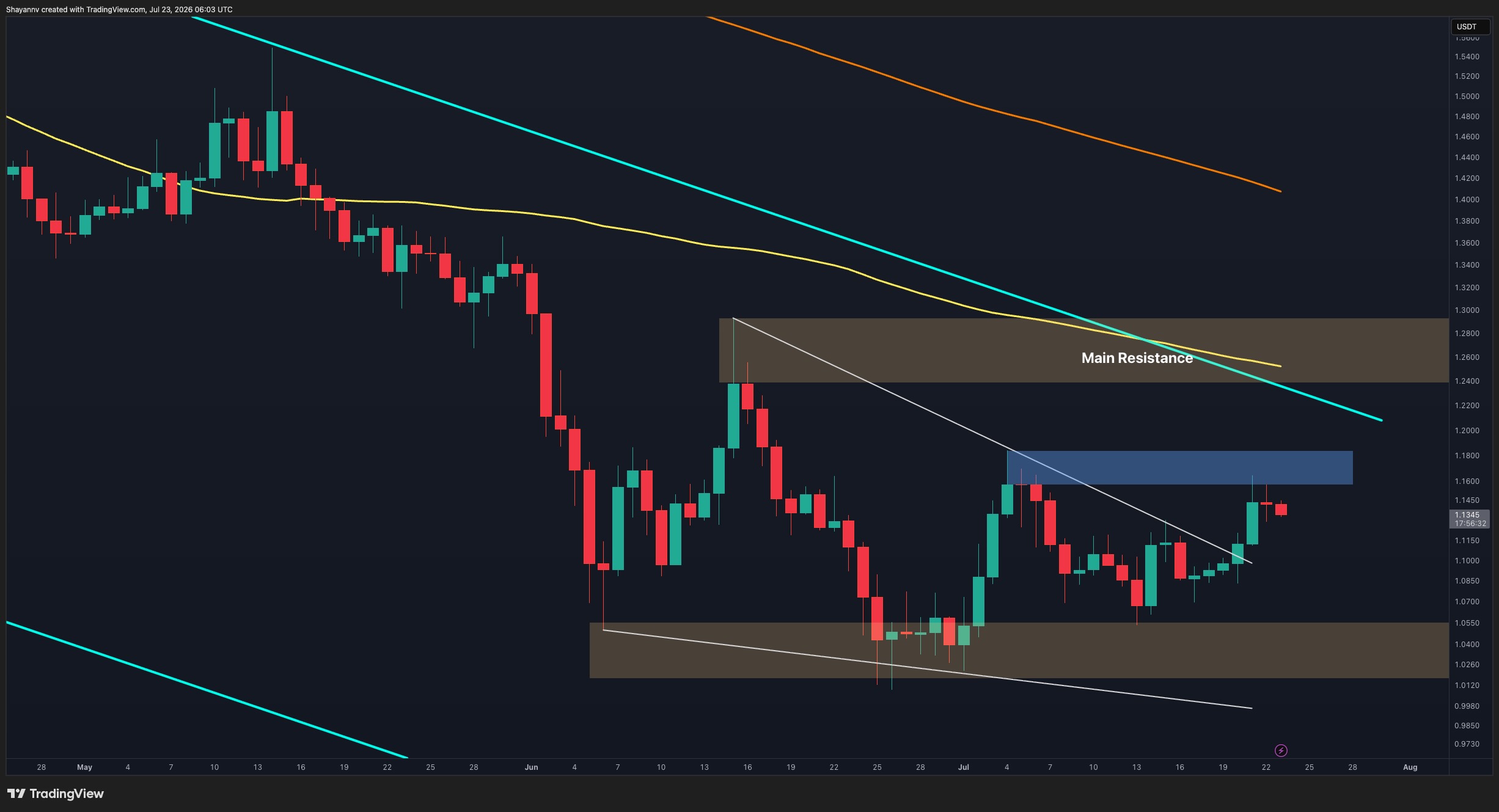
    On the daily chart, XRP continues to trade within a clearly defined long-term descending channel. Although the recent rebound has pushed the asset away from the $1.02 to $1.05 demand zone, the overall structure still favors sellers as long as XRP remains below the channel’s upper boundary and key moving averages.

    The immediate obstacle lies within the $1.24 to $1.29 resistance area, where the upper channel boundary intersects with the 100-day moving average. This confluence of technical indicators makes this zone particularly crucial; a rejection here would serve to reinforce the prevailing downtrend. A successful breach of this region would then bring the 200-day moving average into focus, but buyers must first establish a foothold above the current resistance cluster for a more positive outlook to emerge.

    On the downside, the $1.02 to $1.05 demand zone remains the primary support level. A failure to hold this area could see momentum shift back towards the broader bearish trend.

    Short-Term Outlook Offers Glimmer of Hope

    The 4-hour chart presents a more constructive short-term scenario. XRP has successfully reclaimed a descending trendline that had capped its price action throughout July and is now consolidating just below the $1.16 to $1.18 supply zone. This resistance has repeatedly thwarted bullish attempts in recent weeks, making it a pivotal level to watch. A decisive move above $1.18 could potentially propel the price towards the daily resistance zone of $1.24 to $1.29. Conversely, another rejection at this level would likely lead to a retest of the broken trendline as initial support.

    As long as XRP maintains its position above the reclaimed trendline, buyers hold a modest short-term advantage. However, the broader trend is expected to remain neutral to bearish until the price can establish acceptance above the overhead resistance cluster.

  • UN: Southeast Asian Scam Networks Swindle $114 Billion Annually

    UN: Southeast Asian Scam Networks Swindle $114 Billion Annually

    Southeast Asia’s Scam Industry Evolves into Vast Criminal Network, UN Reports

    Southeast Asia’s burgeoning scam industry has coalesced into a single, interconnected criminal economy, with its financial losses now rivaling the economic output of entire nations, according to a report released Tuesday by the United Nations.

    The UN Office on Drugs and Crime (UNODC) detailed a “fundamental” restructuring of the region’s criminal underworld. Syndicates, once confined by geography and specialization, have merged into a transnational network. These groups now offer a suite of services—including money laundering, fraud, human trafficking, and data harvesting—to one another, operating on shared infrastructure, the report found.

    Technology is rapidly transforming the operational models of transnational organized crime, a shift most starkly evident in Southeast Asia. The latest UNODC threat assessment report highlights the pervasive influence of cyber scams, synthetic drug production, and human trafficking.

    Delphine Schantz, UNODC Regional Representative for Southeast Asia and the Pacific, described the model as akin to “corporate franchising,” with specialized departments for money laundering, human trafficking, and data harvesting integrated into a unified, service-based network.

    The combined losses from scam offenses across East Asia, Southeast Asia, Australia, and New Zealand were estimated to be between $88.3 billion and $114.1 billion in 2025 alone. This figure, the UNODC noted, “outstrips the GDP of several countries in the region.” A significant portion of these illicit funds moves through cryptocurrency, with investment and romance scams, often termed “pig butchering,” laundering proceeds on-chain. The UNODC warned that regional police forces still lack the necessary training to trace these funds in the “new crypto context.” Schantz emphasized that seizing proceeds is now crucial, as “disruption alone does not work.”

    Instead of smuggling physical contraband, criminal groups are increasingly focused on selling cyber-enabled fraud, criminal infrastructure, and platform-based financial settlements that leave minimal traces and are difficult to attribute. This elaborate system is fueled by forced labor on a global scale, with individuals from at least 80 countries identified within scam compounds. The report also indicated that scam networks are actively broadening their recruitment efforts, placing advertisements that target individuals with European and North American language skills.

    The report specifically flags the rise of generative AI, deepfakes, and near-automated fraud. It also noted a 42% year-on-year increase in “malvertising”—the hijacking of legitimate ad networks to spread malware—in 2025. Criminal operations are increasingly “decoupled” from local telecommunications infrastructure, utilizing satellite internet services like Elon Musk’s Starlink to operate from remote locations, the report stated.

    Beyond scams, the UNODC report sheds light on other rapidly expanding criminal markets. It identifies the Sulu and Celebes Seas—the maritime region encompassing Indonesia, Malaysia, and the Philippines—as an emerging smuggling corridor. Furthermore, the report warns that criminals are increasingly employing gamification tactics in online gambling to attract younger users.

    UNODC Executive Director Monica Juma underscored the “flexible, persistent, and adaptable” nature of these networks, which can shift across borders and resume operations even after law enforcement crackdowns. This adaptability, she noted, makes international cooperation essential for their dismantling.

    Law enforcement agencies worldwide are intensifying their response to this growing threat. U.S. prosecutors recently seized over $25 million in cryptocurrency linked to investment and romance scams routed through the region, while Interpol has designated these compound networks as a global threat. The human cost is also becoming increasingly apparent, with Amnesty International documenting a humanitarian crisis as workers flee compounds in Cambodia. This same country was the site of the arrest of alleged Prince Group boss Chen Zhi, pending extradition to China, in a case that involved one of the largest Bitcoin seizures on record.

  • Bitwise CIO Identifies Potential Drivers for Future Digital Asset Market Cycles

    Bitwise CIO Identifies Potential Drivers for Future Digital Asset Market Cycles

    The next digital asset market cycle may be driven by the convergence of traditional and onchain finance, rather than speculative demand, according to Bitwise Chief Investment Officer Matt Hougan. This thesis may reflect changing conditions from previous cycles fueled by speculative interest to one built on “real financial activity and revenue,” which could lead to a larger, albeit potentially slower and less volatile, market expansion.

    Hougan argued that this evolving landscape could be characterized by several key onchain financial activities. These include the increased use of stablecoins, the tokenization of traditional assets, the implementation of 24/7 trading, instant settlement capabilities, and the growth of institutional decentralized finance (DeFi) platforms. This contrasts with earlier market cycles that were primarily propelled by speculative demand.

    The article notes that the idea of revenue and crypto rails driving the next cycle is not entirely new, and institutional involvement in digital assets is also a concept that has been discussed for some time. However, it highlights the significance of the CIO of Bitwise formally presenting this thesis, covering these two factors.

    Hougan framed the opportunity within the digital asset space as two distinct “lanes.” The first, referred to as the “Hyperliquid Lane,” focuses on protocols that create demand for their own tokens, addressing a historical challenge where applications generated fees and volume without necessarily driving token value. The second lane, the “Robinhood Lane,” represents the entry of traditional finance players into the digital asset ecosystem. Examples cited include Citadel’s involvement with Crypto.com, Morgan Stanley’s presence on E*TRADE, the DTCC’s work on tokenization, and Robinhood’s continued engagement in the digital asset space.

    While the analysis and opinions presented are attributed to the author of the original piece and do not necessarily reflect the views of Decrypt, the core argument from Hougan may reflect changing conditions in the underlying forces expected to shape future digital asset market performance. The formal articulation of these drivers by a prominent figure like Hougan provides a structured outlook for the market’s potential evolution.

    It remains uncertain whether Hougan’s prediction about the drivers of the next market cycle will suggest correct. However, the thesis presented offers a framework for understanding potential future market dynamics, emphasizing a move towards more integrated and revenue-driven onchain financial activities.

    Broader Context

    Morning Minute is a daily newsletter written by Tyler Warner.