Tag: Neutral

  • Bitcoin at $96K or $82K? Price Analysis

    Bitcoin at $96K or $82K? Price Analysis

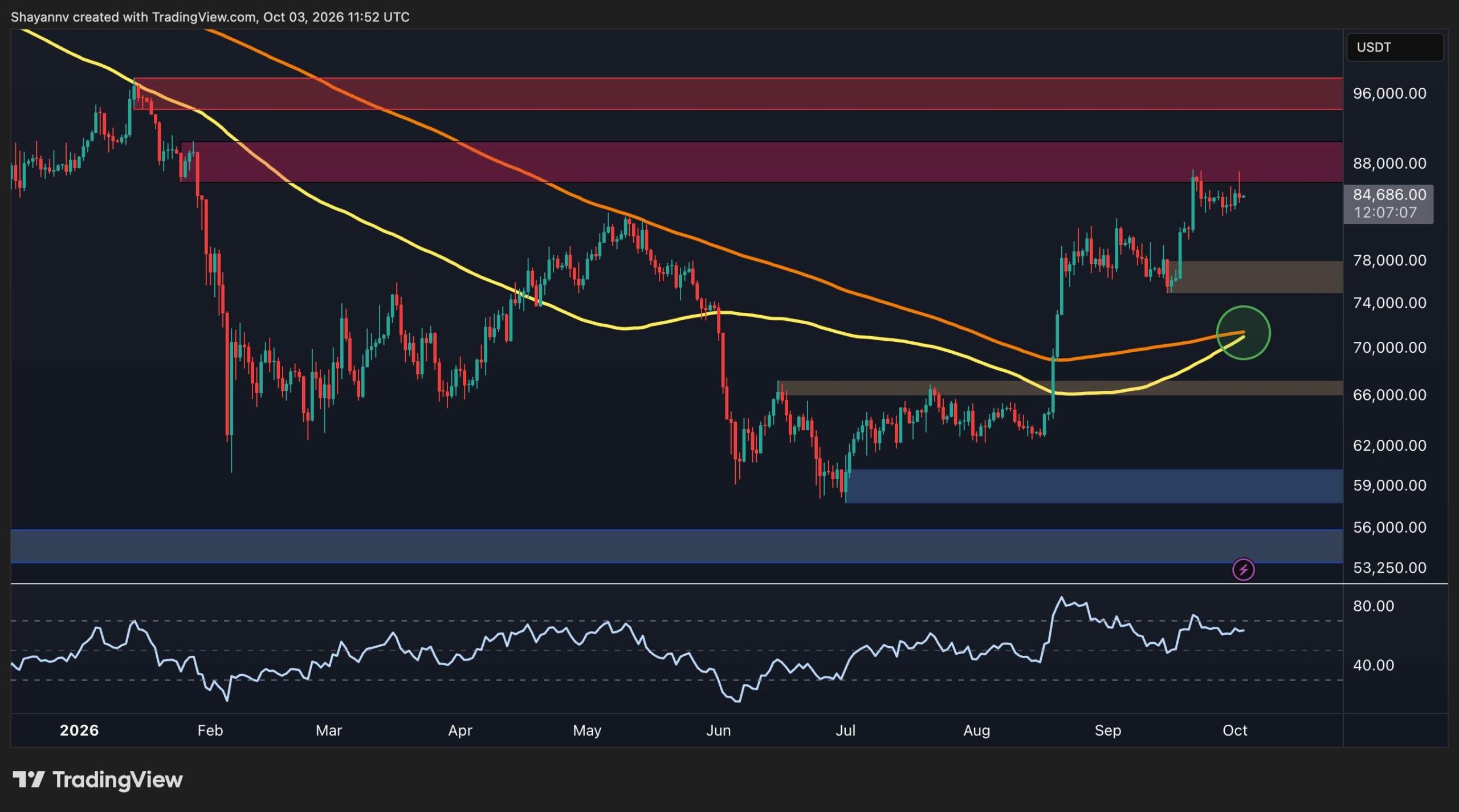
    Bitcoin is currently trading near $84,700, having staged a significant recovery from the $60,000 level over the past two months. While market structure indicators suggest improvement, the cryptocurrency is now approaching a critical resistance zone around $88,000.

    Constructive Momentum Signals Amidst Resistance

    Futures taker flow has once again shifted to a predominantly buyer-driven dynamic, signaling constructive momentum. However, Bitcoin must overcome immediate resistance before its broader upward trajectory can be sustained.

    Summer Rally and Structural Improvements

    The daily chart reveals a notable structural enhancement throughout the summer. Bitcoin established a base in the $60,000 vicinity before a period of consolidation, followed by a sharp ascent from the $66,000 region. The breach of the $75,000 mark initiated a pattern of higher highs and higher lows.

    Key Resistance and Support Levels

    Bitcoin is presently trading around $84,700, with immediate resistance identified between approximately $86,000 and $88,000. This area has previously capped upward movements and represents the primary obstacle for the current recovery. A decisive daily close above $88,000 would bolster the bullish structure and target the next significant resistance level around $96,000.

    On the downside, the first substantial support is located between $74,000 and $78,000. This zone previously served as a consolidation area before the recent impulsive move and could evolve into a crucial bullish order block should the current resistance lead to a deeper correction. Below this, another notable support region is observed around $66,000.

    Moving Averages and Potential Crossover

    The 100-day and 200-day moving averages are also exhibiting more constructive patterns. The 100-day average has turned sharply upward, converging with the 200-day average near $72,000. As long as Bitcoin remains above these averages, the broader recovery structure is expected to hold. Furthermore, a bullish crossover between these averages could serve as a key sentiment driver, potentially propelling the price back above $90,000 in the coming weeks.

    Short-Term Consolidation and Key Levels

    The 4-hour chart offers a more granular view of the current consolidation phase. Following a surge from the $75,000 support area, Bitcoin rapidly advanced towards $86,000 and has since traded sideways. The most apparent short-term structure is a slightly descending range, with its upper boundary at approximately $86,000 and its lower boundary at around $82,000. Bitcoin recently tested the upper boundary and was rejected, retreating to the $84,700 mark.

    Consequently, the $82,000 level serves as the first short-term support to monitor. A breakdown below this area could expose the broader $74,000-$78,000 support zone, particularly if selling momentum intensifies. Conversely, a clear 4-hour breakout above $86,000 would indicate that buyers are attempting to resolve the consolidation to the upside.

    RSI and Momentum Balance

    The Relative Strength Index (RSI) on the 4-hour chart has returned to the 50 area after a brief push higher, suggesting relatively balanced short-term momentum. This aligns with the current sideways price action rather than a strong trend in either direction. The broader outlook remains one of consolidation following a significant upward impulse. The critical technical question is whether the range resolves above $86,000 or if Bitcoin first loses the $82,000 floor.

    Futures Taker Flow Analysis

    The accompanying chart illustrates a 90-day Bitcoin Futures Taker CVD (Cumulative Volume Difference), which measures the net difference between aggressive futures buyers and sellers. Green periods signify taker-buy dominance, while red periods indicate taker-sell dominance. The latest reading has reverted to green after a period of predominantly neutral-to-bearish futures flow during the price decline from its highs. This is significant as the recent recovery towards $85,000 has been accompanied by renewed aggressive buying in the futures market.

    The recent green readings suggest that traders are once again predominantly lifting offers rather than aggressively selling into bids. Historically, sustained green periods on this indicator have often coincided with strong upward price movements, although the indicator itself does not guarantee future performance.

    Confirmation and Potential Absorption

    The key concern is that futures buying has been occurring directly below the $86,000 resistance zone. If aggressive buying persists as Bitcoin breaks above this area, it would provide confirmation that the current consolidation is resolving with increased demand. However, if the CVD remains green but the price repeatedly fails at the $86,000-$88,000 resistance, it could indicate that aggressive futures buyers are being absorbed by sellers at these resistance levels.

    In summary, the technical charts indicate an improving structure, with Bitcoin holding well above its summer base and futures taker flow turning buyer-dominant. For the next directional move, the immediate levels to watch are $86,000 on the upside and $82,000 on the downside.


  • Kalshi Faces Legal Uncertainty Amidst Conflicting Federal Rulings on Event Contracts

    Kalshi Faces Legal Uncertainty Amidst Conflicting Federal Rulings on Event Contracts

    Kalshi, a platform offering event contracts, is navigating a complex legal landscape as various states, tribal nations, and consumers challenge the classification of its offerings. Conflicting rulings from federal circuit courts have created significant uncertainty regarding the platform’s operational future and the regulatory framework governing its contracts.

    At the heart of the dispute is Kalshi’s assertion that its event contracts are financial swaps, subject to regulation by the Commodity Futures Trading Commission (CFTC). However, states and other entities contend that these contracts function as sports wagers, falling under state gambling laws. This fundamental disagreement has coincided with a series of legal battles, with federal circuit courts issuing divergent opinions on whether federal commodities law preempts state gambling regulations.

    Recent court decisions have highlighted this division. On August 28, 2026, the Ninth Circuit ruled against Kalshi in a case involving Nevada. This was followed by the Sixth Circuit’s rejection of Kalshi’s appeal on September 28, 2026, which cleared the path for Ohio and Tennessee to pursue enforcement actions against the platform. In contrast, the Third Circuit had previously sided with Kalshi on the issue of preemption in a dispute concerning New Jersey. Separately, Montana and Kalshi mutually dismissed their lawsuits on September 17, 2026, temporarily pausing enforcement in that jurisdiction.

    The legal uncertainty extends beyond state enforcement. Kalshi is also facing claims from tribal gaming entities and consumer class actions, further complicating its operational environment. The differing outcomes across federal circuits mean that Kalshi’s ability to operate may vary depending on the geographic location of its users, a situation that could persist until the conflict is resolved, potentially by the Supreme Court.

    This regulatory ambiguity occurs against a backdrop of significant growth in the sports wagering market. In 2025, Americans wagered approximately $166 billion on sports bets, with legal sportsbooks handling $166.94 billion, generating $16.96 billion in revenue and $3.71 billion in state taxes. A notable trend reported by Fortune indicates that 35% of bettors are using traditional sportsbooks less, with many shifting their wagers to prediction markets like Kalshi. This migration of funds to platforms not classified as traditional gambling presents a competitive challenge to established sportsbooks and reduces potential tax revenue for state governments.

    The core legal question revolves around preemption: whether federal commodities law supersedes state gambling laws when applied to Kalshi’s event contracts. The current circuit split underscores the complexity of this issue, creating a fragmented regulatory landscape. Until a definitive resolution is reached, the classification of Kalshi’s contracts and its operational scope remain uncertain, with potential implications for both the platform and the broader market for event-based contracts.

    Why This Matters

    The core legal question is whether federal commodities law preempts state gambling laws when applied to Kalshi’s event contracts. The conflicting circuit court rulings create a fragmented regulatory landscape for Kalshi’s operations across different states, with the ultimate classification of Kalshi’s event contracts (swaps vs. gambling) remaining uncertain until a definitive resolution is reached, potentially by the Supreme Court.

    Broader Context

    Americans spent more on sports bets in 2025 than on movies, music, and museums combined, with a growing share of that action flowing to platforms that do not classify themselves as traditional sportsbooks.

  • XRP ETF Outflows and Asset Declines Offer Ambiguous Market Signal

    XRP ETF Outflows and Asset Declines Offer Ambiguous Market Signal

    Recent data on U.S. spot XRP Exchange Traded Funds (ETFs) reveals net outflows and a decrease in combined assets, however, these figures alone do not provide a definitive indication of investor sentiment or future market direction. The observed financial movements on October 2 present an incomplete picture, highlighting the limitations in interpreting such data without broader context.

    On October 2, spot XRP ETFs experienced a net outflow totaling $3.28 million. This outflow was entirely attributed to Bitwise, one of the primary issuers. Concurrently, the combined assets held by these ETFs saw a reduction of approximately $37 million. By the close of trading on October 2, the total net assets for U.S. spot XRP ETFs stood at $1.658 billion. This represents a decrease from the previous day, October 1, when the total net assets were reported at $1.695 billion.

    While these figures represent factual observations, their interpretation as a clear signal of investor sentiment is limited. The decrease in assets and the net outflow could be influenced by various factors beyond a simple reduction in investor interest, such as market volatility, rebalancing activities, or specific trading strategies employed by large holders. The data does not definitively indicate a shift in the overall market outlook for XRP or its associated ETFs.

    According to Sosovalue data, the net outflow on October 2 was solely from Bitwise, and the combined assets dropped by approximately $37 million. The total net assets at the end of October 2 were $1.658 billion, down from $1.695 billion on October 1. These numbers, while precise, do not offer a conclusive narrative on their own. The ambiguity of these signals underscores the need for caution when drawing broad conclusions about investor sentiment or market trends based on short-term ETF performance metrics.

    In conclusion, the observed outflows and asset value decreases in XRP ETFs on October 2 are factual events. However, they serve as an ambiguous signal, offering limited insight into the broader market sentiment or future performance. A comprehensive understanding would require further data and analysis of various influencing factors.

    Why This Matters

    The materials describe a narrow update: Spot XRP ETFs saw a net outflow of $3. Decreasing asset value and outflows suggest reduced investor interest in XRP ETFs.

  • Citi Predicts Major BTC Surge as NEAR ETF Launches

    Citi Predicts Major BTC Surge as NEAR ETF Launches

    Citi Boosts Bitcoin Forecast Amid Crypto Fund Inflow Projections

    Citigroup has significantly raised its 12-month target for Bitcoin, projecting the cryptocurrency could reach $113,000. The financial giant also anticipates substantial inflows into crypto funds, estimating the figure to reach $5 billion.

    Security Incidents Plague Crypto Space

    The cryptocurrency sector experienced notable security breaches this week. NEAR Intents reported a $3.8 million exploit, while Zano was forced to roll back its blockchain by 30 days following the illicit minting of over $200 million in tokens.

    New Crypto Products Emerge

    In product news, Bitwise has launched a […]

  • OpenAI Taps Ex-White House Cyber Chief Thomas Lind for Risk Leadership

    OpenAI Taps Ex-White House Cyber Chief Thomas Lind for Risk Leadership

    OpenAI Taps Former White House Cyber Official for National Security Role

    OpenAI has appointed Thomas Lind, a former White House cyber official, to lead its cyber and strategic risk efforts within the company’s national security policy team.

    Lind joined OpenAI the week of October 2, 2026. Prior to his move, he played a key role in shaping the federal government’s approach to advanced AI systems, including those developed by OpenAI.

    His most recent government position was at the White House Office of the National Cyber Director (ONCD), where he served as head of policy and senior advisor from April 2025 to June 2026. During his tenure at ONCD, Lind focused on the intersection of AI policy and cybersecurity.

    According to research informing this report, Lind was instrumental in the development of an executive order issued on June 2, 2026, which established AI safety frameworks. This order introduced a voluntary review process for highly capable AI models, providing a formal government channel for developers to engage with, though participation is not mandatory.

    Lind departed ONCD in June 2026, citing a desire to spend more time with his family. His exit occurred amidst a wave of departures from tech policy roles following the issuance of the executive order.

    In a panel discussion in August 2026, Lind noted that AI-driven cyber tools have significantly reduced response times for policymakers.

    In his new capacity at OpenAI, Lind will oversee cyber and strategic risk, two domains where advanced AI presents novel challenges. His expertise is particularly relevant, given his prior experience in developing cybersecurity frameworks and strategies from a governmental perspective during a critical period for federal AI safety protocols.

    The timing of Lind’s hire is notable, coming just months after the June executive order that created a review pathway for advanced AI models. This move suggests OpenAI is prioritizing its national security credibility, with Lind’s background poised to bridge private sector work on model safety with federal initiatives.

    The research indicates that OpenAI may influence broader standards as federal safety protocols continue to evolve.

    Several aspects warrant attention moving forward. Firstly, OpenAI’s engagement with the voluntary review process for high-capability models established in June will be closely watched.

    Secondly, Lind’s perspective on the shrinking window for cyber decision-making, driven by AI, is expected to shape OpenAI’s public stances. As a builder of some of the most advanced AI tools, the company now has an internal voice who has publicly acknowledged the accelerating pace of cyber decision-making.

  • Arbitrum Halts Stylus Activations Amid Security Emergency

    Arbitrum Halts Stylus Activations Amid Security Emergency

    Arbitrum Halts New Stylus Contract Deployments Amid Security Concerns

    Arbitrum has temporarily suspended a key developer feature, pausing all new activations of its Stylus contracts across Arbitrum One and Nova. The decision, enacted by the Arbitrum Security Council on October 2, 2026, at 11:30 EST, addresses vulnerabilities within the Stylus framework. Existing Stylus contracts remain unaffected and continue to function.

    Stylus Framework Under Scrutiny

    Stylus is designed to enable developers to write smart contracts in languages such as Rust and C++, while maintaining compatibility with the Ethereum Virtual Machine (EVM). These programs are compiled into WebAssembly (WASM), a compact, low-level code format. The current concern centers on hand-crafted WASM programs that have not been updated.

    Research indicates that these unpatched programs could be exploited as denial-of-service (DoS) vectors, potentially impacting the network’s liveness. While such issues do not pose a risk to user funds, they could lead to network slowdowns or complete halts. Previous patches to Arbitrum’s operating system (ArbOS) had already addressed some of these liveness concerns.

    The pause is intended as a preemptive measure, preventing unpatched WASM programs from being deployed before upcoming ArbOS updates.

    Enhanced Dispute Resolution System

    In addition to pausing Stylus activations, the emergency upgrade introduced a new safety mechanism to Arbitrum One’s dispute resolution system, known as BoLD. This mechanism, a “guard” on the BoLD one-step proof, is designed to protect against potential soundness issues. If the system were to accept contradictory proofs, this guard could delay unconfirmed withdrawals.

    BoLD is Arbitrum’s system for resolving disagreements about the state of the blockchain. A one-step proof represents the final stage of such a dispute, where a single contested computational step is directly verified. The newly added permissionless guard on Arbitrum One’s one-step proof mechanism aims to prevent the system from accepting conflicting proofs, allowing settlements to be paused in a timely manner if such a scenario arises. The practical implication is that unconfirmed withdrawals could face delays if this safeguard is triggered.

    It is important to note that the BoLD guard was specifically added to Arbitrum One, while the Stylus activation pause affects both Arbitrum One and Nova.

    Impact on Developers and Future Outlook

    For development teams with existing Stylus contracts already deployed, daily operations are largely unchanged. These active contracts will continue to function and can be renewed until their expiration. However, developers planning new Stylus deployments will have to wait for an unspecified timeline.

    The Arbitrum Foundation stated that it will collaborate with the ArbitrumDAO to determine when new Stylus activations can resume. The Foundation characterized the emergency upgrade as part of a broader series of proactive measures to safeguard the network’s security and integrity.

    The identified issues primarily affect network liveness rather than the security of user funds, and no user funds are currently at risk. The distinction is crucial: a network outage is an inconvenience, whereas a loss of user deposits constitutes a crisis.

    The implementation of the BoLD guard serves as a backstop against potential misbehavior within the proof system itself. The trade-off for this added security is the possibility of unconfirmed withdrawals being held in limbo if the guard is activated.

    The decision to utilize the Security Council for this emergency upgrade highlights the existence of special powers for critical situations where a full governance vote might leave a known vulnerability exposed. By returning the decision on when to re-enable Stylus activations to the ArbitrumDAO, the council appears to be acting as an initial responder rather than a permanent arbiter of Stylus’s future.

  • Ripple Hints at Major Korea Blockchain Week Announcement

    Ripple Hints at Major Korea Blockchain Week Announcement

    XRP Price Hovers Ahead of Key Seoul Announcement

    XRP is trading at $1.52, a 1% increase over the past 24 hours, as anticipation builds for Ripple’s appearance at an event in Seoul on October 3. The upcoming announcement, though undisclosed, is being closely watched as a potential catalyst for the cryptocurrency’s price.

    “Special Announcement” Set for XRP Seoul Event

    The XRP Seoul program includes a 20-minute session titled “Special Announcement: What’s Coming Next for the XRP Ecosystem in Asia,” scheduled from 2:15 p.m. to 2:35 p.m. Ripple ecosystem growth manager Tatsuya Kohrogi and XRP Asia president Sabrina Tachdjian are expected to deliver the announcement.

    Major Financial Institutions to Attend

    This Saturday’s XRP Seoul event will feature speakers from prominent South Korean financial institutions, including Woori Bank, Kakao Bank, Kbank, and Kyobo Securities, alongside Ripple’s president, Monica Long. The presence of these banks suggests an interest in exploring financial infrastructure rather than a typical cryptocurrency meetup.

    Focus on Cross-Border Payments and Institutional Finance

    The “Special Announcement” session follows a panel discussion on cross-border payments and tokenized deposits, featuring representatives from Ripple and South Korean financial firms. Earlier in the day, Ripple President Monica Long is slated to address institutional finance. The conference schedule confirms these timings.

    Catalyst Potential Remains Uncertain

    While the lineup of institutional participants lends significant weight to the event, it does not guarantee a surge in XRP demand. XRP’s price is currently consolidating near the midpoint of its Bollinger Bands, raising questions about whether the announcement will drive the cryptocurrency beyond its current trading range or simply meet existing market expectations.

    Consolidation Continues Amidst Speculation

    At $1.52, XRP’s 1% gain in 24 hours indicates a positive trading session but not a definitive breakout. The price action near the Bollinger-band midpoint suggests consolidation rather than a strong directional trend.

    Event Timing and Market Reaction

    The timing of the announcement is noteworthy, occurring after discussions on cross-border payments and tokenized deposits, and within a broader program that includes institutional blockchain applications. While coverage of the event has emphasized tokenization and XRPL developments, any specific partnership or use case requiring XRP remains unconfirmed. The market’s reaction could be significant if concrete details emerge, as the “special announcement” label alone may not be sufficient to drive sustained interest.

    Follow-Through Key to Sustained Gains

    The critical factor for XRP’s price will be the follow-through after the announcement’s details are revealed. The question remains whether the price will hold any gains. The event itself is considered a catalyst, not a definitive forecast of future performance.

    Long-Term Outlook Supported by Institutional Calendar

    XRP’s institutional event calendar provides support for its long-term investment case. However, near-term price appreciation hinges on confirmed news and sustained price momentum following the announcement. A strong headline can boost expectations, but it cannot guarantee lasting demand.

    Alternative Investment Opportunities

    For traders seeking different risk profiles, early-stage tokens offer exposure to community momentum, albeit with distinct liquidity and execution risks.

    Maxi Doge (MAXI) Meme Token Launches Presale

    Maxi Doge ($MAXI), an Ethereum ERC-20 meme token, has launched its presale with a price of $0.0002841. The project has already raised $4.8 million. Maxi Doge is built around a canine character and a trading community identity, offering a 60% APY staking reward, holder-only trading competitions, and a Maxi Fund for liquidity and partnerships. The project explicitly positions itself as meme-first, acknowledging that memes often serve as an entry point into the cryptocurrency sector. Investors are advised to research Maxi Doge before the presale concludes.

  • Google’s Manyika Urges Shared AI Regulation

    Google’s Manyika Urges Shared AI Regulation

    Google Executive Calls for Shared Responsibility in AI Regulation

    A senior executive at Google has articulated a nuanced view on artificial intelligence, emphasizing its inherent risks, the necessity of regulation, and the impossibility of assigning oversight to any single entity. This perspective is particularly noteworthy coming from a company at the forefront of developing some of the market’s most powerful AI models.

    James Manyika, Google’s senior vice president for research and technology, outlined his position in an interview broadcast on October 2, 2026. His core argument posited that every stakeholder involved with AI bears a portion of the responsibility for its safety.

    “AI’s risks are real, regulation is necessary, and responsibility has to be shared across industry, government, and society,” Manyika stated.

    He clearly delineated accountability, asserting that companies developing “frontier AI models”—the most advanced and capable systems—should be primarily responsible for ensuring their safety.

    However, Manyika extended this responsibility beyond the research labs, arguing that those who deploy AI, its users, and policymakers all have crucial roles to play.

    Manyika also challenged the notion that the industry should solely await government directives. He suggested that waiting for President Trump to establish AI regulations would be impractical and advocated for voluntary industry initiatives to proceed in parallel with any eventual governmental frameworks.

    These remarks emerge as the AI sector increasingly embraces self-regulation. Prominent technology firms, including Google, OpenAI, and Nvidia, recently committed to a voluntary accord designed to enhance safety protocols.

    The agreement emphasizes the implementation of “robust internal processes” coupled with independent auditing by its signatories.

    The significant limitation of this accord, however, is its lack of legally binding enforcement mechanisms. Should a company fail to meet its commitments, there is no regulatory body empowered to impose penalties.

    Throughout 2025 and 2026, Manyika has consistently argued that AI is too critical to be left entirely unregulated, yet also too important to be subjected to poorly conceived regulations.

    His preferred approach favors balanced and enabling regulatory frameworks—rules designed to mitigate genuine harms without stifling beneficial advancements. He has highlighted sectors such as healthcare and infrastructure as areas where AI holds the potential for substantial positive impact.

    Manyika also co-directs the recently established DeepMind Institute, positioning him at the intersection of Google’s AI research and policy endeavors.

    For the AI industry, Manyika’s statements suggest a desire among leading companies to be perceived as proactive on safety issues rather than merely reactive.

    Critics of self-regulation are likely to focus on the absence of enforcement. While a voluntary accord with independent audits represents a step forward, accountability without legal recourse ultimately hinges on corporate integrity and reputational concerns.

    A key development to monitor will be whether this voluntary approach eventually solidifies into enforceable standards, and who will be instrumental in drafting them. If companies establish the initial benchmarks, governments may find themselves formalizing rules that the industry itself has already formulated.

  • Bitcoin ETFs See Inflows as Ether ETFs Face Outflows on October 1st

    Bitcoin ETFs See Inflows as Ether ETFs Face Outflows on October 1st

    US spot Bitcoin ETFs attracted $102.7 million in net inflows on Thursday, October 1st, marking a positive start to the month. This follows a strong third quarter for Bitcoin ETFs, which recorded $6.34 billion in net inflows, including $2.65 billion in September. Bitcoin itself rose 42.71% over the third quarter.

    In contrast, US spot Ether ETFs experienced net outflows of $55.4 million on October 1st. This marks the third consecutive trading day of outflows for Ether ETFs, with cumulative losses reaching approximately $118 million.

    The broader cryptocurrency ETF market showed mixed performance. Solana ETFs posted around $6 million in net outflows on Thursday, extending an outflow streak to two sessions, while XRP ETFs attracted $4 million in net inflows.

    At the time of publication, Bitcoin was trading around $85,900, up 2.1% over the past 24 hours, according to CoinGecko. The Crypto Fear & Greed Index slipped to 72 from 74, remaining in “Greed” territory.

    US spot Bitcoin ETFs now hold combined net assets of $109.3 billion, with cumulative net inflows reaching $57.6 billion. The year ‘2026’ mentioned in relation to a strong quarter for Bitcoin ETFs appears to be a typo. Interpreting short-term ETF flow data requires caution, as it represents only one aspect of market activity and sentiment.

    Why This Matters

    The net inflows for Bitcoin ETFs on October 1st, following a strong third quarter, indicate continued investor interest. However, this is juxtaposed with sustained outflows from Ether ETFs, highlighting divergent investor sentiment between these two major cryptocurrencies. The broader mixed performance across other crypto ETFs suggests a nuanced market environment rather than a uniform trend.

    Broader Context

    Bitcoin ETFs returned to inflows with $102.7 million on October 1st, while Ether funds recorded a third straight day of net outflows. This data, sourced from SoSoValue and CoinGecko, provides a snapshot of recent investor activity in the cryptocurrency ETF market.

  • Bitcoin 2026: Predicting Uptober’s Surge

    Bitcoin 2026: Predicting Uptober’s Surge

    Bitcoin Kicks Off October With Tentative Gains, Market Eyes Key Resistance

    Bitcoin began October with a familiar “Uptober” trend, sparking optimism that seasonal strength could propel its price higher. The cryptocurrency is currently trading at $86,000, marking a gain of over 2% in the past 24 hours. The immediate focus for traders is whether this rebound can translate into a sustained push above a critical resistance level, or if rising yields and broader macroeconomic risks will cap its ascent.

    Early trading in October has been characterized by volatility. Bitcoin briefly touched the $85,000–$85,600 range following the release of cooler-than-expected U.S. inflation data. However, this momentum faltered as Treasury yields climbed, illustrating the market’s current sensitivity. While softer inflation typically supports risk assets by alleviating interest rate pressure, a surge in yields can swiftly reverse positive sentiment.

    Institutional activity provided a degree of support, with U.S. spot Bitcoin ETFs attracting net inflows of approximately $102.7 million on October 1. Concurrently, 24-hour liquidations eased to around $35 million, indicating a reduction in speculative selling pressure.

    With key economic indicators such as payroll data, Treasury yields, ETF flows, and regulatory developments on the horizon, the technical price structure is arguably more significant than the calendar date. Bitcoin has experienced only five “red Octobers” in its 17-year history. The question remains whether BTC can maintain its recovery trajectory if macroeconomic conditions shift unfavorably.

    Bitcoin’s current price of $86,000 sits above the $85,000–$85,500 resistance zone. However, a brief breach of resistance does not equate to a confirmed breakout and sustained hold. The next crucial test for buyers will be to defend this newfound territory rather than merely touching it.

    On the downside, immediate support is identified at $83,133, with $82,000 serving as a more significant level for the October recovery structure. A sustained hold above $85,500 would bolster the bullish outlook and create room for further upward movement. The base case scenario anticipates consolidation as traders await payroll data, yield movements, and ETF demand. A decisive break below $82,000 would undermine the near-term recovery setup and heighten downside risks.

    While specific volume, moving-average, and momentum indicator data were not provided, the prevailing sentiment is already elevated. The Fear and Greed Index stands at 72, indicating a “greed” reading. While this can support a breakout, it also leaves less room for upside surprises and increases the potential for disappointment.

    Citi’s reported 12-month target of $113,000 represents a longer-term forecast and is not a near-term technical level. For a comparable bullish outlook for the fourth quarter, further analysis is recommended. The key near-term signal remains sustained acceptance above $85,500, rather than mere intraday price spikes.

    Bitcoin’s recovery possesses a credible demand narrative, but the upside potential hinges on successfully clearing resistance and maintaining the $82,000 support level. If BTC falters, the familiar seasonal optimism may offer limited protection. Conversely, a decisive upward move could prompt some traders to explore earlier-stage infrastructure plays beyond the large-cap cryptocurrency.

    Bitcoin Hyper ($HYPER) Unveils Layer 2 Solution

    Bitcoin Hyper ($HYPER), a Bitcoin Layer 2 project, has announced its integration with the Solana Virtual Machine (SVM). This development positions $HYPER as the first Bitcoin Layer 2 solution to feature this architecture. The project aims to deliver faster smart-contract execution on the Bitcoin network, complemented by a decentralized canonical bridge for BTC transfers and low-cost transactions.

    The project’s presale price is set at $0.0136871, with $33.1 million already raised. Staking rewards are currently offering a high Annual Percentage Yield (APY) of 30%. Bitcoin Hyper is targeting performance speeds that surpass Solana, emphasizing its programmability and throughput capabilities.

    Interested parties are encouraged to research Bitcoin Hyper through its presale information before the presale window closes.