Tag: Neutral

  • Galaxy Cuts Clarity Act 2026 Odds to 50%

    Galaxy Cuts Clarity Act 2026 Odds to 50%

    Galaxy Digital Lowers Odds on Crypto Bill Passage Amid Senate Calendar Crunch

    Galaxy Digital has significantly reduced its forecast for the CLARITY Act becoming law in 2026, now deeming its chances a “coin toss.” The firm cited a rapidly closing window for the U.S. Senate to advance the cryptocurrency market structure legislation before its upcoming five-week August recess.

    “We are reducing our odds of CLARITY Act passage in 2026 to 50-50,” Alex Thorn, Galaxy’s head of firmwide research, stated in a social media post on Friday.

    This latest revision marks a steady decline in Galaxy’s predictions. The firm had initially pegged the odds at 75% in May, then lowered them to 60% on June 9, before arriving at the current even-money assessment. Prediction market Polymarket offers an even more somber outlook, pricing the bill’s passage in 2026 at approximately 49%, a notable drop from a high of 74% just a month prior.

    Thorn emphasized that the primary obstacle is not the bill’s substance but its timing. A unified Senate text remains elusive, a firm floor schedule is absent, and the legislative calendar is shrinking as lawmakers approach their summer break. Competition for floor time has reportedly “intensified,” Thorn noted, particularly after President Trump’s recent refusal to sign a bipartisan housing bill until Congress passes the SAVE Act, an election measure focused on proof-of-citizenship. Surveillance and defense legislation are also vying for legislative attention.

    However, a declining probability of passage does not necessarily signal the bill’s demise, according to Tim Sun, a senior researcher at HashKey. “The drop in the probability of passage this time is merely a matter of time delay rather than the rejection of the proposal’s actual content,” Sun told Decrypt. He pointed out that prediction markets have shown odds below 50% since May, a view that is “somewhat more pessimistic than institutional forecasts.”

    Sun reiterated that the core issue is the Senate’s packed schedule, with the housing bill, the SAVE Act, and other priorities continuing to dominate the agenda. Without a clear path to a vote before the recess, he warned, the CLARITY Act could be pushed into a “more complex mid-term election environment.” Nevertheless, Sun added, its prospects could improve rapidly if a final text is released in July and Senate leadership provides a definitive schedule.

    The stakes for the cryptocurrency industry are considerable, Sun noted, especially in a trading environment “characterized by ETF outflows and weakening risk appetite.” The CLARITY Act, he suggested, “remains one of the few domestic U.S. policy catalysts that could potentially improve market sentiment.”

    The proposed legislation aims to establish the first comprehensive U.S. regulatory framework for digital assets, dividing oversight responsibilities between the Commodity Futures Trading Commission (CFTC) and the Securities and Exchange Commission (SEC). The bill passed the House of Representatives in July 2025 and cleared the Senate Banking Committee with a 15-9 vote in May. However, it garnered support from only two Democrats, falling short of the seven needed to overcome a 60-vote threshold on the Senate floor. Democrats, led by Senator Elizabeth Warren, have advocated for ethics provisions targeting cryptocurrency ventures associated with Donald Trump, while banking and law enforcement groups have raised concerns regarding stablecoin yields and potential gaps in illicit finance prevention.

    For the time being, the bill’s fate appears intertwined with the crowded legislative calendar that is also impeding other measures, including the housing bill that President Trump is currently withholding over his election-related demands. Senator Cynthia Lummis indicated to Fox Business last Wednesday that a final version of the CLARITY Act text could emerge around July 4.

  • Binance Adjusts CRWDUSDT Perpetual Contract Size

    Binance Adjusts CRWDUSDT Perpetual Contract Size

    Binance Futures Adjusts CRWDUSDT Perpetual Contract Size Following Stock Split

    Binance Futures will implement an adjustment to the Contract Size of its USDⓈ-Margined CRWDUSDT Perpetual Contract, effective July 2, 2026, at 00:00 (UTC). This change is necessitated by a stock split of the underlying asset issuer’s outstanding Class A common shares, executed in the form of a stock dividend. The adjustment process is anticipated to conclude by July 2, 2026, at 13:30 (UTC), during what will be designated as the “Adjustment Period.” A subsequent “cancel-only” phase may follow, lasting up to five minutes after the adjustment is finalized.

    Stock Split Details

    The underlying company is undertaking a four-for-one stock split of its outstanding Class A common shares, structured as a stock dividend. Trading is expected to commence on a split-adjusted basis on July 2, 2026. These details are based on the official announcement made by the issuer.

    Adjustment Scale Factor and Impact

    The adjustment will utilize a scale factor of 4. To illustrate the impact, consider a user holding a long open position in the CRWDUSDT Perpetual Contract with a contract size of 20 CRWD and an average entry price of 600 USDT. Assuming the Mark Price at the commencement of the adjustment on July 2, 2026, at 00:00 (UTC) is 800 USDT:

    Before Adjustment:

    • Mark Price (USDT): 800
    • Contract Size (CRWD): 20
    • Average Entry Price (USDT): 600

    Unrealised PNL: (800 – 600) 20 = 4,000 USDT
    Notional Position (USDT): 600 20 = 12,000 USDT

    • Margin Balance: 12,000 + 4,000 = 16,000 USDT

    After Adjustment:

    • Mark Price (USDT): 800 / 4 = 200

    Contract Size (CRWD): 20 4 = 80

    • Average Entry Price (USDT): 600
    • Unrealised PNL: 0 (This will be settled and credited)

    Notional Position (USDT): 80 200 = 16,000 USDT

    • Margin Balance: 16,000 USDT

    Note: Minor rounding differences may occur in price and contract size post-adjustment. The price will be adjusted according to the tick size, while the contract size will be adjusted to the minimum trade amount.

    Strategy Bot Termination and Position Handling

    At 23:50 (UTC) on July 1, 2026, all strategy bots (including Grid, DCA, and Snowball) created on the CRWDUSDT Perpetual Contract will be terminated. All associated positions will be automatically closed, irrespective of the “Close all positions on stop” setting. These positions will not be reinstated after the adjustment is complete.

    During the Adjustment Period, users with open positions on the CRWDUSDT Perpetual Contract will have their positions closed first. Unrealised PNL will be settled and credited to users’ Cross Margin Futures Accounts, regardless of their position mode settings. For users in isolated mode, realised PNL and all margin balances from their Isolated Margin Futures Accounts will be transferred back to their Cross Margin Futures Accounts. Following the adjustment, new positions can be established. The margin balance transferred back to the Isolated Margin Futures Account will be based on the initial margin requirement corresponding to the leverage level selected by the user prior to the adjustment.

    Cancel-Only Phase and Chart Adjustments

    During the cancel-only phase, users will only be permitted to submit, modify, or cancel Post-Only orders. The duration of this phase will be determined by Binance based on prevailing market liquidity and could extend up to five minutes.

    The continuous candlestick chart for the CRWDUSDT Perpetual Contract prior to the adjustment will be preserved and will continue with the newly adjusted price after the process is complete. For time intervals of 12 hours (12-H) and below, the price chart preceding July 2, 2026, 00:00 (UTC) will be corrected within the first week post-adjustment. For intervals of 1 day (1-D) and above, the price chart correction will occur before the 7th day of the following calendar month.

    The adjustment process may conclude earlier than scheduled. API users can monitor the latest trading status of the perpetual contract via GET /fapi/v1/exchangeInfo, while UI users can refer to the designated page for updates.

    Trading Status Timeline

    • Before 2026-07-02 00:00 (UTC): Before Contract Size Adjustment – Trading (Continuous Trading Session State)
    • From 2026-07-02 00:00 (UTC) to 2026-07-02 13:30 (UTC): Contract Size Adjustment Process Starts – TRADING_HALT (Halt Session State)
    • From 2026-07-02 13:30 (UTC) to 2026-07-02 13:35 (UTC): Cancel-Only Phase After Adjustment – TRADINGCANCELONLY (Cancel Only Session State)
    • After 2026-07-02 13:35 (UTC): Trading Function Resumes – TRADING (Continuous Trading Session State)

    This information is released in accordance with Rule 96 of the Exchange Rules, Rules 167 and 168 of the Clearing Rules, Procedures 35.10 and 36 of the Clearing Procedures, and paragraph 19 of the Contract Specifications.

    Perpetual Futures on Traditional Assets are not associated with, sponsored, endorsed, or affiliated by the issuer of the relevant underlying shares or the exchange on which they are listed.

  • VELVET Altcoin Surges 1,700% in a Month: Rally Continues or Peak?

    VELVET Altcoin Surges 1,700% in a Month: Rally Continues or Peak?

    Viral Altcoin VELVET Surges 1,700% in a Month: A Path to Further Gains or a Looming Collapse?

    Despite a prolonged bear market gripping the cryptocurrency sector, certain tokens are defying the trend with substantial upward momentum. Velvet (VELVET) stands out as a prime example, having experienced quadruple-digit growth over the past month. While some market observers anticipate continued short-term gains, others caution that the altcoin could represent a significant risk.

    As of this report, VELVET is trading around $1.58, according to CoinGecko. This represents a 250% increase on a weekly basis and a remarkable 1,700% surge over the last 30 days. Its market capitalization has climbed to nearly $700 million, positioning VELVET as the 90th-largest cryptocurrency by market value.

    One factor potentially fueling this price surge is the project’s collaboration with AerodromeeFi. An announcement stated that the integration offers users “tighter pricing,” “less slippage,” access to “deeper liquidity on every trade,” and the ability to “land better fills, automatically.”

    Subsequently, the project unveiled Velvet-1, an Artificial Intelligence (AI) model designed for on-chain intelligence, which may have also contributed to the positive price action.

    Several analysts have noted the coin’s impressive performance and suggest it may have further room for growth. X user Crypto With Gopal observed that the price “is tightening inside a Symmetrical Triangle after a sharp bullish impulse,” indicating a potential loss of control by sellers and setting a short-term target of $2.1.

    The analyst known as The Boss also offered an optimistic outlook, arguing that recent breakout attempts demonstrate sustained buyer activity following consolidation, rather than an immediate reversal of gains. The analyst described the current market structure as “healthier than it did 24 hours ago, with the chart transitioning from recovery mode into expansion mode.” They concluded, “If momentum persists and volume follows through, the market could begin testing higher liquidity zones that were previously rejected during the first impulsive move earlier this month.”

    Conversely, a significant number of analysts advise caution, believing investors should steer clear of the altcoin due to the potential for a sharp decline. Yesterday, June 28, X user Crypto with Haris ₿ predicted that VELVET could plummet to $0.90 within the next six hours, labeling the situation a “generational short opportunity.” This prediction did not materialize.

    Vuori Trading, meanwhile, characterized the token as another “Binance Alpha aka. CZ scam.” This analyst suggested that while the token appears to be approaching its peak, a move above $2 could trigger an explosive rally to $8.

    Adding to the bearish sentiment, the coin’s Relative Strength Index (RSI) has surpassed 80, indicating that VELVET has entered extremely overbought territory. This technical indicator, which ranges from 0 to 100 with readings below 30 typically signaling a buying opportunity, suggests the asset could be poised for a significant correction.

  • Bybit Lists Nibiru (NIBI) v2.15.0 Upgrade

    Bybit Lists Nibiru (NIBI) v2.15.0 Upgrade

    Bybit to Support Nibiru Network Upgrade, Halting Deposits and Withdrawals

    Cryptocurrency exchange Bybit has announced its support for the upcoming Nibiru (NIBI) v2.15.0 network upgrade. The upgrade is scheduled to occur on June 30, 2026, at approximately 02:00 AM UTC, or upon reaching block height 42,739,079.

    In preparation for the transition, Bybit will temporarily suspend deposits and withdrawals for Nibiru (NIBI) starting at 01:00 AM UTC on June 30, 2026. The exchange has assured users that trading activities will remain unaffected during this period.

    Bybit has stated that no further announcements will be made regarding the resumption of deposit and withdrawal services. Users wishing to be notified when these services are back online are advised to visit the Deposit or Withdrawal page and select the “Set Alert” option.

    Further details about the Nibiru network upgrade can be found in the official release notes.

  • CAPUSDT Perpetual Contract Launches on Innovation Zone with 10x Leverage

    CAPUSDT Perpetual Contract Launches on Innovation Zone with 10x Leverage

    Bybit Lists Cap App Perpetual Contract in Innovation Zone

    Cryptocurrency exchange Bybit has announced the listing of the Cap App (CAP) USDT Perpetual Contract, now available for trading in its Innovation Zone. The new contract offers users leverage of up to 10x.

    The CAPUSDT Perpetual Contract is based on the Cap App (CAP) underlying asset and settles in USDT. Key trading parameters include a tick size of 0.00001, a maximum leverage of 10x, and a capped funding rate of 2.5%. Funding fees will be settled every four hours, with trading available 24/7.

    The official website for Cap App is https://www.cap.app/, and its official X (formerly Twitter) account can be found at https://x.com/capapp.

    Bybit has cautioned that the CAPUSDT contract is situated within the Innovation Zone, which entails a higher trading fee compared to other available contracts. Further details regarding the Innovation Zone can be found on Bybit’s help center.

  • Risk Limits Adjusted for HBARUSDT, ROSEUSDT Perpetual Contracts

    Risk Limits Adjusted for HBARUSDT, ROSEUSDT Perpetual Contracts

    Bybit to Adjust Risk Limits and Leverage for Select Perpetual Contracts

    Cryptocurrency exchange Bybit announced it will be adjusting the risk limits and applicable leverage for a number of its Perpetual Contracts. The changes are intended to enhance the trading experience for users.

    Implementation Details

    The adjustments are scheduled to take effect and be automatically applied to user accounts by approximately 7:30 AM UTC on June 30, 2026.

    Affected Contracts

    The following Perpetual Contracts will see their risk limits modified:

    HBARUSDT, ROSEUSDT, MOVEUSDT, ONTUSDT, METUSDT, AXLUSDT, BRETTUSDT, MINAUSDT, ORDIUSDT, TREEUSDT, 1000TOSHIUSDT, AIOZUSDT, CELOUSDT

    Updated risk limit information can be found on Bybit’s website.

    Margin Requirements and Restrictions

    If, by the implementation deadline of June 30, 2026, 7:30 AM UTC, a user’s existing position does not meet the new margin requirements, and the adjustment cannot be automatically applied, traders will only be permitted to reduce their affected Perpetual Contract positions. Any orders that would increase the position size will be restricted until the user selects a supported risk limit or leverage.

    Recommendations for Traders

    Bybit advises users to manage their positions and account risk proactively. This can be achieved by transferring additional funds or adjusting their settings by July 17, 2026, 7:30 AM UTC, to mitigate the risk of potential liquidation.

    Impact on Copy Trading and Trading Bots

    These changes will also extend to positions held within Bybit’s Copy Trading and Trading Bot services. Existing positions managed by a Trading Bot will not be automatically closed, and the bot will not place new orders during a specified buffer period. Users are encouraged to manually terminate their bots or increase their investment in existing bots before the buffer period concludes to accommodate the new risk limits.

    Further details regarding the rules of risk limits are available in a dedicated article on Bybit’s help center.

  • USDT Perpetual Contract Tick Size Change Effective June 30, 2026

    USDT Perpetual Contract Tick Size Change Effective June 30, 2026

    Bybit to Adjust Tick Sizes for Perpetual Contracts

    Singapore – Crypto derivatives exchange Bybit announced it will adjust the tick size for several perpetual contracts on June 30, 2026, at 7:20 AM UTC. The move aims to enhance market liquidity and improve the trading experience for users.

    The following contracts will see their tick sizes modified:

    • OPNUSDT: Current tick size 0.0001, New tick size 0.00001
    • ONDSUSDT: Current tick size 0.01, New tick size 0.001
    • MYXUSDT: Current tick size 0.0001, New tick size 0.00001
    • ESUSDT: Current tick size 0.00001, New tick size 0.000001
    • CTRUSDT: Current tick size 0.00001, New tick size 0.000001
    • DRAMUSDT: Current tick size 0.001, New tick size 0.01

    Bybit clarified that no trading functions for USDT Perpetual Contracts were impacted during the adjustment process.

    API users will be able to retrieve prices reflecting the updated tick size through the GET /v5/market/instruments-info endpoint after the specified timestamp. Further details are available in the exchange’s API documentation.

    Orders that were placed prior to the adjustment will remain in the order book with their original tick size. Traders are advised to review and adjust their trading strategies accordingly to accommodate the new tick sizes.

    Bybit expressed its apologies for any inconvenience this may cause and thanked its users for their continued support.

  • ETH RSI Divergence Signals Potential Bottom

    ETH RSI Divergence Signals Potential Bottom

    Ethereum Faces Selling Pressure, But Signs of Weakening Bearish Momentum Emerge

    Ethereum continues to grapple with downward pressure on higher timeframes, though recent price action suggests that bearish momentum may be losing steam. While the overarching trend remains decidedly negative, current movements indicate that sellers could be nearing exhaustion after weeks of consistent declines.

    Demand Zone Holds Firm

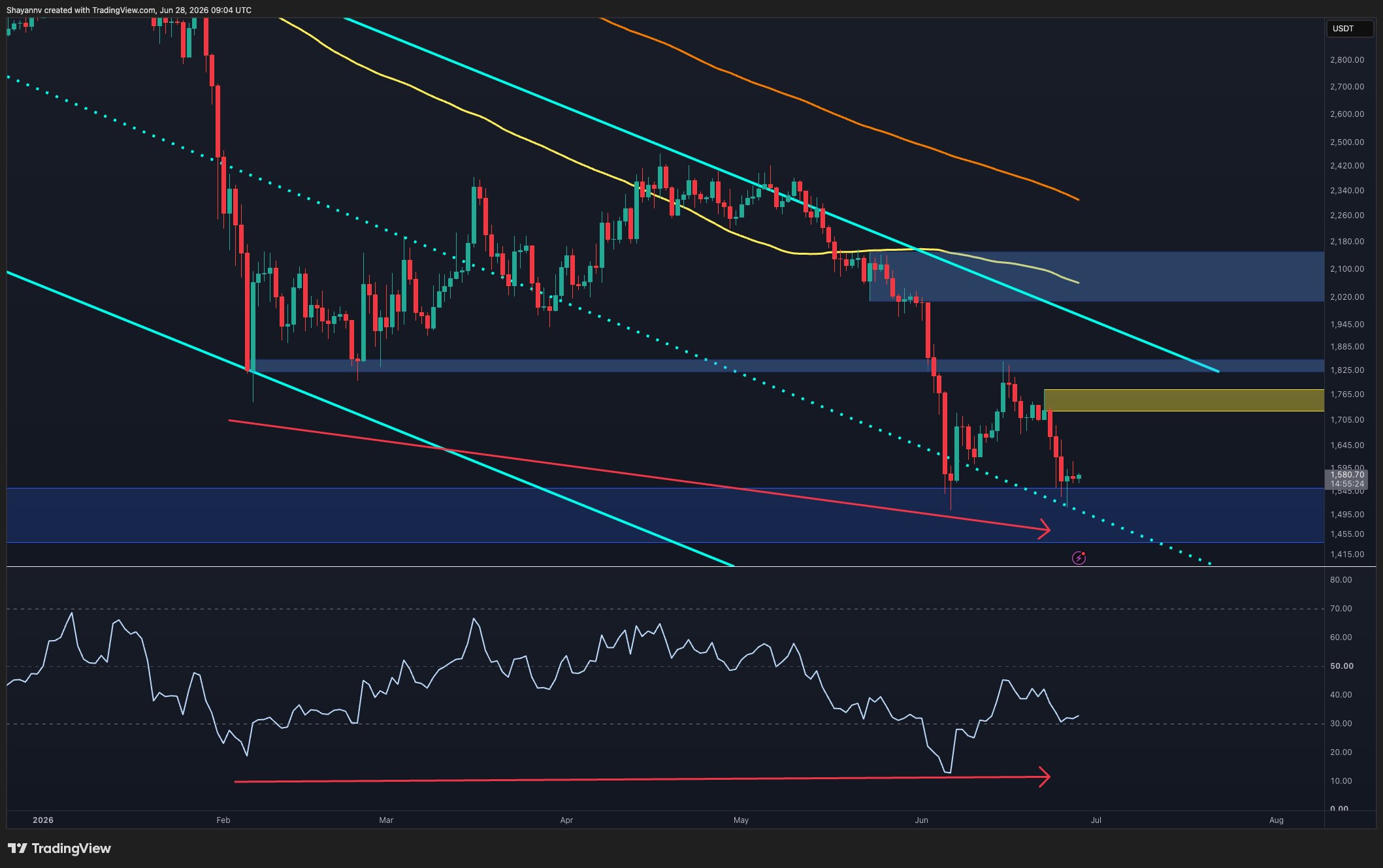
    Ethereum’s recent retreat from the $1.72K-$1.78K supply zone initiated another downward move, pushing the cryptocurrency back into the critical $1.46K-$1.53K demand region. This area has repeatedly served as support throughout June and continues to attract buyers whenever the price approaches it.

    Bullish Divergence on Daily Chart

    A significant development on the daily timeframe is the emergence of bullish divergence on the Relative Strength Index (RSI). While Ethereum has consistently made lower lows during June, the RSI has been forming higher lows near oversold territory. This divergence signals a weakening of downside momentum, even as ETH hovers near cycle lows.

    Although a bullish divergence alone does not guarantee a reversal, it often appears in the later stages of bearish trends and can serve as an early indicator that sellers are losing control. As long as ETH maintains its position above the $1.46K-$1.53K support area, the divergence remains valid, increasing the likelihood of a relief rally.

    Confirmation of a potential reversal would necessitate a break above key resistance zones, particularly the $1.72K-$1.78K supply area. Until then, the broader trend remains bearish, despite the improving momentum indicators.

    Consolidation and Trendline Resistance

    On the 4-hour timeframe, Ethereum has spent recent sessions consolidating above the lower demand zone following a sharp sell-off from resistance. A descending trendline has capped every recovery attempt since the rejection on June 22. However, the asset is now compressing directly beneath this trendline, with contracting volatility. This setup presents the possibility of a short-term breakout if buyers can overcome the trendline resistance.

    A successful breakout could target the $1.72K-$1.78K supply zone, which was the origin of the latest decline. Such a move would align with the bullish RSI divergence observed on the daily chart and could signal the first meaningful recovery rally in several weeks.

    On the downside, the $1.52K area remains a critical level to monitor. A loss of this support would invalidate the short-term bullish outlook and shift focus back toward further downside continuation within the broader downtrend. For now, Ethereum appears caught between support and descending resistance, with the next directional move likely determined by which side breaks first.

    Liquidity Heatmap Reveals Potential Upside Sweep

    The liquidation heatmap indicates an interesting shift in liquidity positioning. While liquidity remains concentrated above the current price, particularly between approximately $1.68K and $1.80K, Ethereum is currently trading below these significant clusters. Markets often gravitate toward areas with substantial leveraged positions, making these overhead liquidity pools attractive short-term targets.

    This scenario suggests that ETH could stage an upside liquidity sweep before any larger directional move develops. A breakout above the 4-hour descending trendline would increase the probability of price moving into these overhead liquidity pockets, triggering short liquidations and fueling a squeeze toward the $1.7K-$1.8K region.

    Simultaneously, the heatmap also shows notable liquidity beneath the market around the lower support region, indicating that both sides of the current range remain vulnerable to liquidation-driven volatility.

    Combined with the bullish daily RSI divergence and the compression beneath the 4-hour trendline resistance, the current setup suggests Ethereum may first attempt an upside liquidity grab before the market determines whether a more sustainable recovery can materialize. The reaction around the $1.72K-$1.80K liquidity cluster will likely offer crucial insights into Ethereum’s next major trend.

  • California’s DFAL Deadline Looms: XRP Fate Uncertain

    California’s DFAL Deadline Looms: XRP Fate Uncertain

    California’s Digital Financial Assets Law Looms, Impacting Ripple and XRP

    California’s Digital Financial Assets Law (DFAL) is set to take effect on July 1, mandating that any firm conducting digital asset business with state residents must obtain a DFAL license or have a pending application with the Department of Financial Protection and Innovation (DFPI). Failure to comply will require cessation of such operations. Public records currently show no Ripple entities among the applicants, a development that coincides with XRP’s price falling below the $1.10 mark amid this regulatory uncertainty.

    The DFAL encompasses a broad range of digital asset activities, including exchanges for fiat or other digital assets, transfers between individuals, custody services, and the issuance of reserve-backed instruments. These provisions directly align with Ripple’s existing operations in California, which include its payments infrastructure, custody services, and the issuance and redemption of RLUSD, its dollar-pegged stablecoin.

    Regulatory Landscape and Ripple’s Position

    Ripple’s existing portfolio of over 40 U.S. money transmitter licenses does not automatically satisfy the DFAL requirements. The new law establishes a distinct regulatory framework managed by the DFPI through the Nationwide Multistate Licensing System.

    By the July 1 deadline, companies have three avenues for legal compliance: securing a DFAL license, submitting a complete application to the DFPI, or qualifying for a limited statutory exemption. This exemption is primarily available to banks, certain trust companies, and entities already registered with the SEC or CFTC that operate within their existing regulated activities.

    Ripple has engaged with the DFPI, submitting a formal comment letter advocating for the elimination of redundant money transmitter license requirements for DFAL-licensed firms. However, this engagement does not equate to a filed license application. Law firms, including those recognized by Chambers, have characterized the DFAL as one of the most comprehensive state-level digital asset licensing regimes in the United States.

    XRP Price Dynamics Amidst Regulatory Scrutiny

    XRP is currently trading near $1.10, a significant drop from the $2.50 price point many had anticipated. Recent price action indicates weak momentum, with sellers consistently capping rallies in the $1.15 to $1.20 range. Despite ongoing attention on Ripple’s regulatory developments, the market has not yet factored in a decisively positive outcome.

    Investors remain keenly focused on several legal and regulatory milestones involving Ripple. While a previous court finding that XRP itself is not inherently a security removed a major source of uncertainty, the outstanding penalty and injunction issues remain significant as they could influence Ripple’s future business operations and market sentiment.

    From a technical standpoint, XRP must first reclaim the $1.15 to $1.20 zone before a stronger trend reversal can be discussed. Should buyers regain control and regulatory developments continue to be favorable, the next resistance level could emerge between $1.30 and $1.50. A sustained move above these levels would likely necessitate a substantial catalyst.

    On the downside, support is currently clustered around $1.05 and $1.00. A weakening of regulatory expectations or a downturn in the broader cryptocurrency markets could place pressure on these levels. The $1.00 mark represents an important psychological threshold, as a decisive breach could trigger further selling.

    For the time being, the market appears to be awaiting confirmation rather than trading on speculation. While regulatory progress could improve sentiment, XRP’s longer-term trajectory will likely be shaped by both legal clarity and a resurgence of stronger market demand.

  • Bitcoin Holds Steady at $60K Amid US-Iran Tensions

    Bitcoin Holds Steady at $60K Amid US-Iran Tensions

    Bitcoin Holds Steady Around $60,000 Amid Geopolitical Tensions

    Bitcoin’s price maintained a relatively stable position around the $60,000 mark over the weekend, weathering new escalations in the Middle East and a broken ceasefire.

    Most altcoins experienced minor losses on a 24-hour basis, with ZEC seeing the steepest decline among larger-cap cryptocurrencies. AAVE also slipped below $90 following a significant correction.

    The primary cryptocurrency began the business week with a strong surge to $65,500, having reclaimed the $64,000 support level over the weekend. However, this upward momentum proved short-lived, leading to a challenging few days. Initially, sellers pushed the price below $62,400, followed by two further declines that brought Bitcoin to multi-year lows.

    On Wednesday, the cryptocurrency plummeted to $59,000 as concerns surrounding Strategy intensified. After a brief rebound to $62,000 on Thursday, often referred to as a “dead-cat bounce,” Bitcoin experienced another substantial drop, plunging to $58,000 – its lowest point since late 2024.

    At this juncture, bulls finally intervened, preventing a further breakdown. Bitcoin subsequently rebounded by a couple of thousand dollars and has largely hovered around $60,000 for the past 36 hours.

    This period of calm is particularly noteworthy given the recent developments in the Middle East, where the United States and Iran have engaged in retaliatory actions and accused each other of violating the ceasefire.

    Bitcoin’s market capitalization currently exceeds $1.2 trillion, according to CoinGecko, with its dominance over altcoins nearing 56% once again.

    While most altcoins are trading in negative territory today, their declines are relatively minor compared to the volatility seen throughout the week. Ethereum remains just below $1,600, XRP is trading at $1.05, SOL is above $70, and HYPE is at $63. BNB has seen a slightly larger drop, while DOGE is down by over 2.3%.

    ZEC has suffered the most significant losses among larger-cap altcoins today, struggling at $385. AAVE has lost much of its recent gains, falling back below $90. M continues to set new lows, with an additional 13% decline pushing it to $0.68. In contrast, VELVET has surged by 30%, entering the top 100 altcoins by market capitalization, and PUMP has followed suit with a 15% increase.

    The total cryptocurrency market capitalization has decreased by approximately $20 billion daily, now standing below $2.160 trillion, according to CoinGecko.