Tag: Project Updates

  • TronBid Enhances TRON Marketplace for Energy and Bandwidth Trading, Aims to Reduce USDT Fees

    TronBid Enhances TRON Marketplace for Energy and Bandwidth Trading, Aims to Reduce USDT Fees

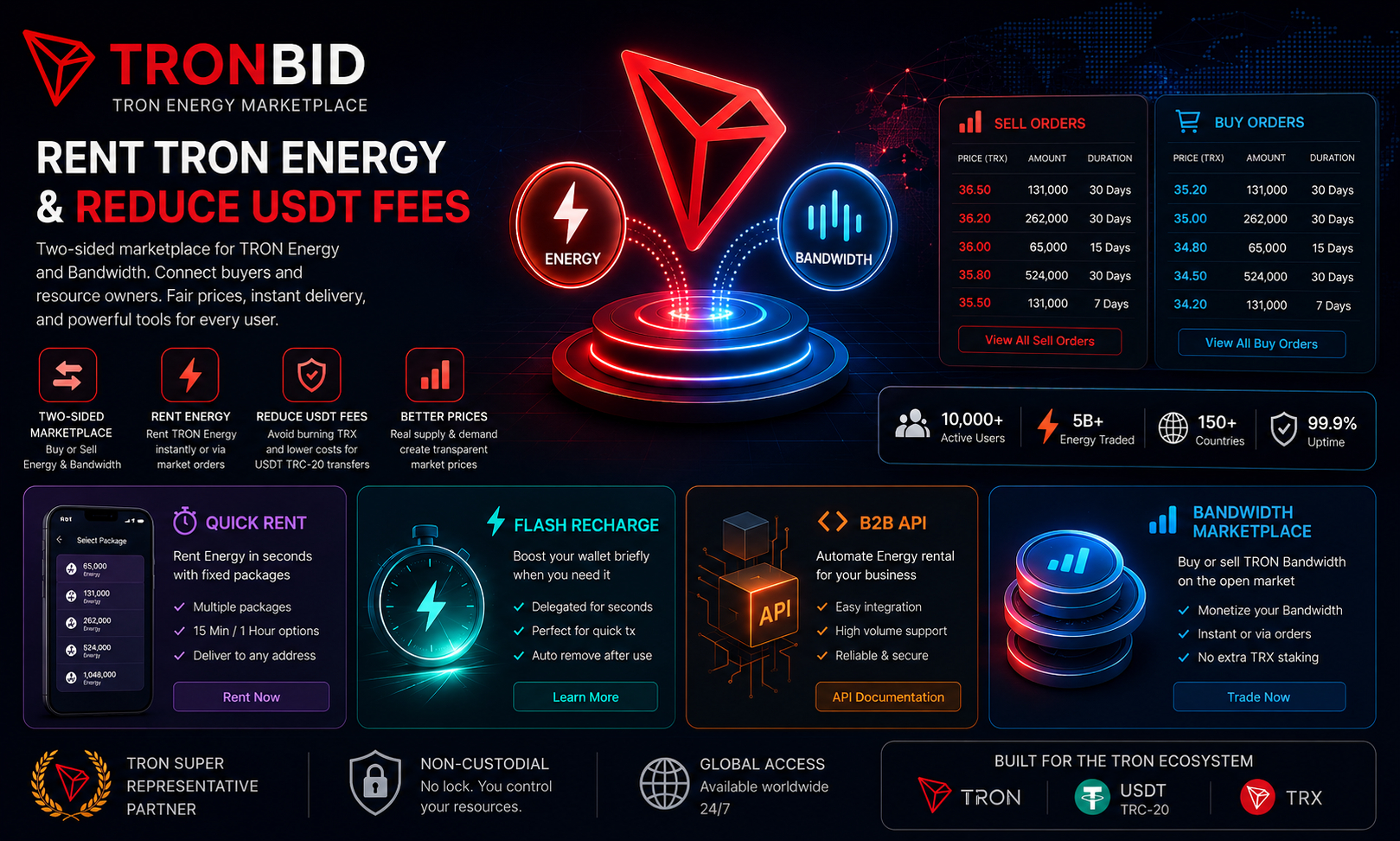
    TronBid has expanded its peer-to-peer marketplace for TRON network resources, introducing new features for renting Energy and Bandwidth, trading these resources, and reducing USDT fees for TRC-20 transactions. This expansion provides users and businesses with enhanced tools to manage their participation and costs on the TRON network.

    TRON utilizes Energy and Bandwidth as its primary network resources. Energy is required for smart contract execution, including processes such as USDT TRC-20 transfers. If a wallet lacks sufficient Energy for a transaction, the TRON network may consume TRX to cover the necessary resources. This scenario has driven demand for alternative methods of acquiring Energy, leading to platforms like TronBid.

    A Two-Sided Marketplace for Resources
    The expanded TronBid marketplace operates on a two-sided model, enabling both buyers and sellers to create orders. Buyers can specify the amount of Energy or Bandwidth they need, the desired rental duration, and their price. Sellers can post offers detailing the amount of resources they wish to rent out, their price, and the rental period. Buyers can then purchase these offers, with the option to acquire only a portion of a seller’s available resources.

    Enhanced Features for Immediate Needs and Businesses
    To address immediate resource requirements, TronBid has introduced ‘Quick Rent,’ offering predefined Energy packages for short-term rentals that can be delivered directly to any TRON address. For users who maintain their own Energy capacity but need to manage consumed resources, the platform provides ‘Flash Recharge.’

    TronBid also caters to businesses through a B2B Quick Rent API. This API allows exchanges, payment processors, wallets, and other businesses handling frequent TRON transactions to automate Energy rental. By integrating this functionality into their transaction infrastructure, companies can manage network-resource costs more efficiently, particularly for large volumes of USDT TRC-20 transfers.

    Monetizing Network Resources and SR Partnership
    Beyond Energy rental, TronBid’s marketplace supports Bandwidth trading, allowing holders of staked TRX to monetize unused network resources. By enabling both buyers and sellers to set their own terms, TronBid aims to foster more transparent price discovery based on actual supply and demand within the TRON ecosystem.

    Alongside these marketplace enhancements, TronBid has become a TRON Super Representative Partner. This development signifies a closer integration with the TRON network’s governance structure and underlying infrastructure.

    Why This Matters

    The materials describe a narrow update: TronBid has launched an expanded peer-to-peer marketplace for TRON network resources. By receiving temporary Energy delegated from another account, users can perform eligible TRON transactions without maintaining enough staked TRX for their maximum resource requirements.

    Broader Context

    Source materials place the factual news in this context: TronBid expands its two-sided TRON resource marketplace, giving users new ways to rent Energy, trade Energy and Bandwidth, and reduce USDT fees for TRC-20 transactions.

  • OKX to Facilitate KITE Crypto Migration

    OKX to Facilitate KITE Crypto Migration

    Kite AI to Migrate to New Ethereum Contract Address; OKX to Support Transition

    Kite AI is set to migrate its KITE token to a new Ethereum (ERC-20) contract address, with cryptocurrency exchange OKX announcing its support for the transition according to a defined schedule.

    Service Suspensions and Migration Timeline

    KITE deposits and withdrawals on OKX will be suspended starting at 2:00 UTC on August 26, 2026, to facilitate the migration process. The migration is expected to take place between 2:00 UTC on August 26, 2026, and 6:00 UTC on August 29, 2026. OKX stated it will endeavor to complete the migration within this timeframe, but noted that potential delays could occur due to necessary coordination with the project team and other involved parties.

    Trading of KITE will remain unaffected throughout this period.

    Post-Migration Procedures and Deposit Information

    Upon completion of the migration, OKX will reinstate KITE deposits and withdrawals exclusively on the new contract address. Deposits made to the old contract address (0x904567252D8F48555b7447c67dCA23F0372E16be) will no longer be supported. Only deposits of the new token, with the Ethereum contract address 0x118B70dF4F06Fa5678E7d543e6066e028C8ea0c, will be accepted. As both the old and new tokens reside on the Ethereum network, the deposit address will remain the same. Users are strongly advised to verify the token contract address before making any deposits to prevent potential losses.

    Risk Warning

    The information provided, some of which may originate from third parties and not OKX, is intended for informational and educational purposes only. OKX does not guarantee the accuracy or completeness of this information, nor does it constitute any representation, warranty, or financial, investment, or other form of advice. This information may not be suitable for all individuals and should not be relied upon for specific investment decisions. It is not intended as an offer, recommendation, or solicitation, nor should it be construed as such. Furthermore, this information is not intended for individuals residing in jurisdictions where its provision would contravene local laws or regulations. Digital assets are highly speculative and subject to significant volatility. They may become illiquid at any time, and investors risk losing the entire value of their investment. Prospective traders should conduct their own thorough research and assess their risk tolerance before engaging with any digital asset. OKX disclaims responsibility for any losses incurred from trading digital assets. For further details, please consult the Terms of Service and Risk & Compliance Disclosure.

  • ChatGPT AI Forecasts XRP Price Potential by 2026 Amid XRPL Upgrades and Institutional Interest

    ChatGPT AI Forecasts XRP Price Potential by 2026 Amid XRPL Upgrades and Institutional Interest

    A ChatGPT AI model has projected a potential price increase for XRP, forecasting a range between $2.20 and $3.00 by the end of 2026, with a base case of $2.50. This outlook is primarily attributed to anticipated enhancements within the XRP Ledger (XRPL) designed to facilitate institutional asset management, alongside Ripple’s strategic investments in related infrastructure.

    XRPL Enhancements and Ripple’s Investments

    The XRPL is set to introduce upgrades, including support for atomic transactions and permission delegation, as detailed in version 3.3.0. These developments, along with features like sponsored fees and confidential token transfers, aim to bolster the ledger’s utility for institutional-grade assets. Ripple’s commitment to this ecosystem is further evidenced by its investments in entities such as ZILO and Licuido, which focus on tokenized issuance and collateral mobility on the XRPL. Additionally, FXRP has been approved as collateral for a substantial $280 million RLUSD lending market on Morpho, indicating growing real-world utility and demand for XRP as collateral.

    Market Signals and Current Price Action

    Recent market activity for XRP shows a dynamic price landscape. After trading above $3.60 last August and experiencing a subsequent period of decline, XRP saw a notable spike to $1.68 last week, following a period of consolidation around the $1.00 mark through July and most of August. The price closed the current session at $1.47614, down 2.92% from its session high of $1.53000 and above its session low of $1.45326. This recent surge of approximately 68% followed by a modest pullback is interpreted by some analysts as healthy consolidation rather than a rejection. Key technical levels to watch include resistance at $1.53000, $1.68, and $1.80, while support is identified at $1.45326 and $1.30, with a structural base at $1.00. Maintaining the price above $1.40 is considered crucial for sustaining the current breakout structure and keeping the path towards the $2.50 target open.

    Broader Ecosystem: Interoperability and LiquidChain

    Beyond XRP’s direct ecosystem, the broader context of crypto infrastructure is evolving. LiquidChain is developing an interoperability solution intended to connect major blockchains like Bitcoin, Ethereum, and Solana, allowing a single deployment to function across multiple ecosystems. This addresses a significant challenge in the current fragmented landscape, where cross-chain communication often requires duplicated efforts and increased fees. As tokenized assets, institutional DeFi, and lending markets continue to expand, interoperability is becoming increasingly essential.

    Uncertainties and Caveats

    However, the prediction from ChatGPT AI is subject to several uncertainties. The actual impact and adoption rate of the XRPL upgrades for institutional use remain to be seen. Furthermore, the long-term demand for XRP is contingent on broader market adoption and the successful integration of its technological advancements. The ability of XRP to consistently hold key support levels, particularly above $1.40, will be a critical indicator of its future trajectory. The success of projects like LiquidChain in achieving seamless interoperability also represents an evolving factor in the digital asset space.

    In summary, while the ChatGPT AI’s prediction offers an optimistic outlook for XRP by the end of 2026, grounded in tangible technological developments and growing collateral demand, its realization hinges on sustained adoption, market dynamics, and the resolution of inherent uncertainties within the rapidly evolving cryptocurrency landscape.

    Why This Matters

    The materials describe a narrow update: A ChatGPT AI model has predicted that XRP could reach between $2. Whether the XRPL upgrades will be fully adopted and impactful for institutional assets.

  • Pi Network’s App Studio Shifts Pricing to Cost-Reflective Model, Prioritizing App Utility

    Pi Network’s App Studio Shifts Pricing to Cost-Reflective Model, Prioritizing App Utility

    The Pi Network Core Team has implemented a significant change to its AI-powered App Studio pricing structure, moving away from heavily subsidized rates to a model that better reflects the actual costs of AI services. This adjustment, effective August 24, aims to ensure that network resources are allocated to applications demonstrating genuine utility, rather than experimental or spam content.

    Previously, developers paid a flat rate of 0.25 PI for both creating and editing an application within the App Studio. The Core Team stated that these previous prices did not accurately represent the underlying expenses of the AI services utilized. The new pricing model will see costs vary based on the AI resources consumed, aligning more closely with actual network expenditures. The team emphasized that this new structure will not include a markup on top of the AI costs.

    Developers whose applications attract a substantial number of real and distinct users will be eligible to continue paying the old subsidized rates. The Pi Network Core Team indicated that eligibility for these subsidized rates is determined by existing App Studio data and is subject to evolution over time, with the qualification criteria potentially changing.

    The primary objective behind this pricing recalibration, as explained by the team, is to prevent the depletion of network resources on non-essential activities. By incentivizing the creation of products that users actively engage with and value, the Pi Network seeks to cultivate a more sustainable and utility-focused ecosystem. This strategic shift aims to redirect subsidies towards applications that exhibit tangible utility, based on data gathered regarding Pioneer platform usage.

    This evolution in the App Studio’s economic model introduces a new dynamic for Pi Network developers. While the move towards cost-reflectivity and utility-based incentives could foster the development of more robust and user-centric applications, it also introduces certain uncertainties. The precise nature of the variable pricing, dependent on consumed resources, and the specific, evolving criteria for qualifying for subsidized rates remain areas where clarity is still developing.

    In the broader cryptocurrency market, Pi Network’s native token (PI) is currently trading around $0.09. This period has seen Bitcoin (BTC) and many other altcoins experience notable gains, a rally that PI has not fully mirrored. The adjustments to the App Studio pricing represent a strategic initiative by the Pi Network Core Team to manage resources effectively and encourage development that aligns with the network’s long-term objectives.

    Why This Matters

    The materials describe a narrow update: The Pi Network Core Team has changed the pricing for its AI-powered App Studio. The exact new pricing model, as it can vary depending on consumed resources.

    Broader Context

    Source materials place the factual news in this context: The Core Team behind the popular yet controversial project has officially implemented a major change to the pricing structure of its AI-powered App Studio, as they announced last week.

  • USDⓈ-M Perpetual Contracts Margin Tiers Updated

    USDⓈ-M Perpetual Contracts Margin Tiers Updated

    Binance Futures Adjusts Leverage and Margin Tiers for Multiple Perpetual Contracts

    Binance Futures announced an upcoming adjustment to the leverage and margin tiers for several USDⓈ-M Perpetual Contracts. The update, scheduled to be completed within approximately one hour, will affect existing positions and may impact futures running grid strategies.

    Key Considerations for Traders

    Users are advised to note that existing positions opened before the update will be subject to the new leverage and margin tiers. Furthermore, futures running grid strategies might expire due to these changes, and traders are encouraged to adjust their positions accordingly before the update takes effect.

    FILUSDT Contract Update

    On August 28, 2026, at 06:30 (UTC), the FILUSDT USDⓈ-M Perpetual Contract will undergo changes to its leverage and margin tiers.

    Previous Leverage and Margin Tiers for FILUSDT:

    | Leverage Before Change | Position Before Change (Notional Value in USDT) | Maintenance Margin Rate Before Change |
    | :——————— | :———————————————- | :———————————- |
    | 51 – 75x | 0 < Position ≤ 50,000 | 0.60% |
    | 41 – 50x | 50,000 < Position ≤ 250,000 | 1.00% |
    | 26 – 40x | 250,000 < Position ≤ 350,000 | 1.50% |
    | 21 – 25x | 350,000 < Position ≤ 600,000 | 2.00% |
    | 11 – 20x | 600,000 < Position ≤ 1,000,000 | 2.50% |
    | 6 – 10x | 1,000,000 < Position ≤ 5,000,000 | 5.00% |
    | 5x | 5,000,000 < Position ≤ 10,000,000 | 10.00% |
    | 3 – 4x | 10,000,000 < Position ≤ 12,500,000 | 12.50% |
    | 2x | 12,500,000 < Position ≤ 25,000,000 | 25.00% |
    | 1x | 25,000,000 < Position ≤ 50,000,000 | 50.00% |

    New Leverage and Margin Tiers for FILUSDT:

    | Leverage After Change | Position After Change (Notional Value in USDT) | Maintenance Margin Rate After Change |
    | :——————– | :——————————————— | :——————————— |
    | 51 – 75x | 0 < Position ≤ 20,000 | 1.00% |
    | 41 – 50x | 20,000 < Position ≤ 200,000 | 1.50% |
    | 26 – 40x | 200,000 < Position ≤ 400,000 | 2.00% |
    | 21 – 25x | 400,000 < Position ≤ 800,000 | 2.50% |
    | 11 – 20x | 800,000 < Position ≤ 3,000,000 | 5.00% |
    | 6 – 10x | 3,000,000 < Position ≤ 7,500,000 | 10.00% |
    | 5x | 7,500,000 < Position ≤ 10,000,000 | 12.50% |
    | 3 – 4x | 10,000,000 < Position ≤ 12,500,000 | 25.00% |
    | 2x | 12,500,000 < Position ≤ 15,000,000 | 50.00% |
    | 1x | NA | NA |

    ROBOUSDT Contract Update

    The ROBOUSDT USDⓈ-M Perpetual Contract will also see adjustments to its leverage and margin tiers on August 28, 2026, at 06:30 (UTC).

    Previous Leverage and Margin Tiers for ROBOUSDT:

    | Leverage Before Change | Position Before Change (Notional Value in USDT) | Maintenance Margin Rate Before Change |
    | :——————— | :———————————————- | :———————————- |
    | 26 – 50x | 0 < Position ≤ 5,000 | 1.50% |
    | 21 – 25x | 5,000 < Position ≤ 10,000 | 2.00% |
    | 11 – 20x | 10,000 < Position ≤ 25,000 | 2.50% |
    | 6 – 10x | 25,000 < Position ≤ 62,500 | 5.00% |
    | 5x | 62,500 < Position ≤ 125,000 | 10.00% |
    | 4x | 125,000 < Position ≤ 250,000 | 12.50% |
    | 3x | 250,000 < Position ≤ 500,000 | 16.67% |
    | 2x | 500,000 < Position ≤ 7,500,000 | 25.00% |
    | 1x | 7,500,000 < Position ≤ 12,500,000 | 50.00% |

    New Leverage and Margin Tiers for ROBOUSDT:

    | Leverage After Change | Position After Change (Notional Value in USDT) | Maintenance Margin Rate After Change |
    | :——————– | :——————————————— | :——————————— |
    | 21 – 25x | 0 < Position ≤ 5,000 | 2.00% |
    | 11 – 20x | 5,000 < Position ≤ 10,000 | 2.50% |
    | 6 – 10x | 10,000 < Position ≤ 20,000 | 5.00% |
    | 5x | 20,000 < Position ≤ 50,000 | 10.00% |
    | 4x | 50,000 < Position ≤ 100,000 | 12.50% |
    | 3x | 100,000 < Position ≤ 250,000 | 16.67% |
    | 2x | 250,000 < Position ≤ 2,500,000 | 25.00% |
    | 1x | 2,500,000 < Position ≤ 5,000,000 | 50.00% |
    | NA | NA | NA |

    LPTUSDT and ZRXUSDT Contract Updates

    The LPTUSDT and ZRXUSDT USDⓈ-M Perpetual Contracts will also be subject to leverage and margin tier adjustments on August 28, 2026, at 06:30 (UTC).

    Previous Leverage and Margin Tiers for LPTUSDT and ZRXUSDT:

    | Leverage Before Change | Position Before Change (Notional Value in USDT) | Maintenance Margin Rate Before Change |
    | :——————— | :———————————————- | :———————————- |
    | 51 – 75x | 0 < Position ≤ 5,000 | 1.00% |
    | 26 – 50x | 5,000 < Position ≤ 10,000 | 1.50% |
    | 21 – 25x | 10,000 < Position ≤ 25,000 | 2.00% |
    | 11 – 20x | 25,000 < Position ≤ 50,000 | 2.50% |
    | 6 – 10x | 50,000 < Position ≤ 125,000 | 5.00% |
    | 5x | 125,000 < Position ≤ 250,000 | 10.00% |
    | 4x | 250,000 < Position ≤ 500,000 | 12.50% |
    | 3x | 500,000 < Position ≤ 1,000,000 | 16.67% |
    | 2x | 1,000,000 < Position ≤ 7,500,000 | 25.00% |
    | 1x | 7,500,000 < Position ≤ 12,500,000 | 50.00% |

    New Leverage and Margin Tiers for LPTUSDT and ZRXUSDT:

    | Leverage After Change | Position After Change (Notional Value in USDT) | Maintenance Margin Rate After Change |
    | :——————– | :——————————————— | :——————————— |
    | 21 – 50x | 0 < Position ≤ 5,000 | 1.50% |
    | 11 – 20x | 5,000 < Position ≤ 10,000 | 2.50% |
    | 6 – 10x | 10,000 < Position ≤ 20,000 | 5.00% |
    | 5x | 20,000 < Position ≤ 50,000 | 10.00% |
    | 4x | 50,000 < Position ≤ 250,000 | 12.50% |
    | 3x | 250,000 < Position ≤ 500,000 | 16.67% |
    | 2x | 500,000 < Position ≤ 7,500,000 | 25.00% |
    | 1x | 7,500,000 < Position ≤ 12,500,000 | 50.00% |
    | NA | NA | NA |

    SPORTFUNUSDT Contract Update

    The SPORTFUNUSDT USDⓈ-M Perpetual Contract will also see changes to its leverage and margin tiers on August 28, 2026, at 06:30 (UTC).

    Previous Leverage and Margin Tiers for SPORTFUNUSDT:

    | Leverage Before Change | Position Before Change (Notional Value in USDT) | Maintenance Margin Rate Before Change |
    | :——————— | :———————————————- | :———————————- |
    | 11 – 20x | 0 < Position ≤ 5,000 | 2.50% |
    | 6 – 10x | 5,000 < Position ≤ 10,000 | 5.00% |
    | 5x | 10,000 < Position ≤ 50,000 | 10.00% |
    | 4x | 50,000 < Position ≤ 100,000 | 12.50% |
    | 3x | 100,000 < Position ≤ 250,000 | 16.67% |
    | 2x | 250,000 < Position ≤ 2,500,000 | 25.00% |
    | 1x | 2,500,000 < Position ≤ 5,000,000 | 50.00% |

    New Leverage and Margin Tiers for SPORTFUNUSDT:

    | Leverage After Change | Position After Change (Notional Value in USDT) | Maintenance Margin Rate After Change |
    | :——————– | :——————————————— | :——————————— |
    | 6 – 10x | 0 < Position ≤ 10,000 | 5.00% |
    | 5x | 10,000 < Position ≤ 60,000 | 10.00% |
    | 4x | 60,000 < Position ≤ 70,000 | 12.50% |
    | 3x | 70,000 < Position ≤ 250,000 | 16.67% |
    | 2x | 250,000 < Position ≤ 2,500,000 | 25.00% |
    | 1x | 2,500,000 < Position ≤ 5,000,000 | 50.00% |
    | NA | NA | NA |

    NOMUSDT Contract Update

    The NOMUSDT USDⓈ-M Perpetual Contract will also see adjustments to its leverage and margin tiers on August 28, 2026, at 06:30 (UTC).

    Previous Leverage and Margin Tiers for NOMUSDT:

    | Leverage Before Change | Position Before Change (Notional Value in USDT) | Maintenance Margin Rate Before Change |
    | :——————— | :———————————————- | :———————————- |
    | 11 – 20x | 0 < Position ≤ 5,000 | 2.50% |
    | 6 – 10x | 5,000 < Position ≤ 10,000 | 5.00% |
    | 5x | 10,000 < Position ≤ 60,000 | 10.00% |
    | 4x | 60,000 < Position ≤ 70,000 | 12.50% |
    | 3x | 70,000 < Position ≤ 250,000 | 16.67% |
    | 2x | 250,000 < Position ≤ 2,500,000 | 25.00% |
    | 1x | 2,500,000 < Position ≤ 5,000,000 | 50.00% |

    New Leverage and Margin Tiers for NOMUSDT:

    | Leverage After Change | Position After Change (Notional Value in USDT) | Maintenance Margin Rate After Change |
    | :——————– | :——————————————— | :——————————— |
    | 6 – 10x | 0 < Position ≤ 10,000 | 5.00% |
    | 5x | 10,000 < Position ≤ 60,000 | 10.00% |
    | 4x | 60,000 < Position ≤ 70,000 | 12.50% |
    | 3x | 70,000 < Position ≤ 250,000 | 16.67% |
    | 2x | 250,000 < Position ≤ 2,500,000 | 25.00% |
    | 1x | 2,500,000 < Position ≤ 5,000,000 | 50.00% |
    | NA | NA | NA |

    SAGAUSDT Contract Update

    The SAGAUSDT USDⓈ-M Perpetual Contract will also see adjustments to its leverage and margin tiers on August 28, 2026, at 06:30 (UTC).

    Previous Leverage and Margin Tiers for SAGAUSDT:

    | Leverage Before Change | Position Before Change (Notional Value in USDT) | Maintenance Margin Rate Before Change |
    | :——————— | :———————————————- | :———————————- |
    | 11 – 20x | 0 < Position ≤ 5,000 | 2.50% |
    | 6 – 10x | 5,000 < Position ≤ 10,000 | 5.00% |
    | 5x | 10,000 < Position ≤ 60,000 | 10.00% |
    | 4x | 60,000 < Position ≤ 70,000 | 12.50% |
    | 3x | 70,000 < Position ≤ 250,000 | 16.67% |
    | 2x | 250,000 < Position ≤ 2,500,000 | 25.00% |
    | 1x | 2,500,000 < Position ≤ 5,000,000 | 50.00% |

    New Leverage and Margin Tiers for SAGAUSDT:

    | Leverage After Change | Position After Change (Notional Value in USDT) | Maintenance Margin Rate After Change |
    | :——————– | :——————————————— | :——————————— |
    | 6 – 10x | 0 < Position ≤ 10,000 | 5.00% |
    | 5x | 10,000 < Position ≤ 60,000 | 10.00% |
    | 4x | 60,000 < Position ≤ 70,000 | 12.50% |
    | 3x | 70,000 < Position ≤ 250,000 | 16.67% |
    | 2x | 250,000 < Position ≤ 2,500,000 | 25.00% |
    | 1x | 2,500,000 < Position ≤ 5,000,000 | 50.00% |
    | N/A | N/A | N/A |

    QNTXUSDT and SHAZUSDT Contract Updates

    The QNTXUSDT and SHAZUSDT USDⓈ-M Perpetual Contracts will also be subject to leverage and margin tier adjustments on August 28, 2026, at 06:30 (UTC).

    Previous Leverage and Margin Tiers for QNTXUSDT and SHAZUSDT:

    | Leverage Before Change | Position Before Change (Notional Value in USDT) | Maintenance Margin Rate Before Change |
    | :——————— | :———————————————- | :———————————- |
    | 16 – 20x | 0 < Position ≤ 100,000 | 2.50% |
    | 11 – 15x | 100,000 < Position ≤ 500,000 | 3.33% |
    | 6 – 10x | 500,000 < Position ≤ 2,000,000 | 5.00% |
    | 5x | 2,000,000 < Position ≤ 5,000,000 | 10.00% |
    | 4x | 5,000,000 < Position ≤ 10,000,000 | 12.50% |
    | 3x | 10,000,000 < Position ≤ 25,000,000 | 16.67% |
    | 2x | 25,000,000 < Position ≤ 50,000,000 | 25.00% |
    | 1x | 50,000,000 < Position ≤ 100,000,000 | 50.00% |

    New Leverage and Margin Tiers for QNTXUSDT and SHAZUSDT:

    | Leverage After Change | Position After Change (Notional Value in USDT) | Maintenance Margin Rate After Change |
    | :——————– | :——————————————— | :——————————— |
    | 6 – 10x | 0 < Position ≤ 200,000 | 5.00% |
    | 5x | 200,000 < Position ≤ 2,000,000 | 10.00% |
    | 4x | 2,000,000 < Position ≤ 3,000,000 | 12.50% |
    | 3x | 3,000,000 < Position ≤ 5,000,000 | 16.67% |
    | 2x | 5,000,000 < Position ≤ 7,500,000 | 25.00% |
    | 1x | 7,500,000 < Position ≤ 12,000,000 | 50.00% |
    | NA | NA | NA |

    STRCUSDT and BSPUSDT Contract Updates

    The STRCUSDT and BSPUSDT USDⓈ-M Perpetual Contracts will also see adjustments to their leverage and margin tiers on August 28, 2026, at 06:30 (UTC).

    Previous Leverage and Margin Tiers for STRCUSDT and BSPUSDT:

    | Leverage Before Change | Position Before Change (Notional Value in USDT) | Maintenance Margin Rate Before Change |
    | :——————— | :———————————————- | :———————————- |
    | 21 – 25x | 0 < Position ≤ 250,000 | 2.00% |
    | 16 – 20x | 250,000 < Position ≤ 1,000,000 | 2.50% |
    | 11 – 15x | 1,000,000 < Position ≤ 2,000,000 | 3.33% |
    | 6 – 10x | 2,000,000 < Position ≤ 5,000,000 | 5.00% |
    | 5x | 5,000,000 < Position ≤ 8,000,000 | 10.00% |
    | 4x | 8,000,000 < Position ≤ 15,000,000 | 12.50% |
    | 3x | 15,000,000 < Position ≤ 25,000,000 | 16.67% |
    | 2x | 25,000,000 < Position ≤ 50,000,000 | 25.00% |
    | 1x | 50,000,000 < Position ≤ 200,000,000 | 50.00% |

    New Leverage and Margin Tiers for STRCUSDT and BSPUSDT:

    | Leverage After Change | Position After Change (Notional Value in USDT) | Maintenance Margin Rate After Change |
    | :——————– | :——————————————— | :——————————— |
    | 6 – 10x | 0 < Position ≤ 200,000 | 5.00% |
    | 5x | 200,000 < Position ≤ 2,000,000 | 10.00% |
    | 4x | 2,000,000 < Position ≤ 3,000,000 | 12.50% |
    | 3x | 3,000,000 < Position ≤ 5,000,000 | 16.67% |
    | 2x | 5,000,000 < Position ≤ 7,500,000 | 25.00% |
    | 1x | 7,500,000 < Position ≤ 12,000,000 | 50.00% |
    | NA | NA | NA |

    Important Note on Collateral Ratio

    Users are reminded that the collateral ratio will influence the Unified Maintenance Margin Ratio (uniMMR). Traders should closely monitor their uniMMR to mitigate any potential liquidations or losses that may arise from these changes.
  • Bybit to Support TRON v4.8.2 Upgrade

    Bybit to Support TRON v4.8.2 Upgrade

    Bybit to Support TRON Network Upgrade

    Bybit has announced its support for the upcoming TRON (TRX) v4.8.2 network upgrade, scheduled for August 25, 2026, at 03:00 AM UTC.

    Service Suspensions

    To facilitate a seamless transition, Bybit will temporarily suspend TRON (TRX) deposits and withdrawals starting at 02:30 AM UTC on August 25, 2026. Trading activities will remain unaffected during this period.

    Resumption Notifications

    Bybit will not issue further announcements regarding the resumption of TRON (TRX) deposit and withdrawal services. Users wishing to be notified when services are back online can set an alert on the Deposit or Withdrawal page.

    Further details on the TRON network upgrade can be found in the official release notes.

  • Bybit to Support Codex USDC Network Upgrade

    Bybit to Support Codex USDC Network Upgrade

    Bybit to Support Codex (USDC) Network Upgrade

    Cryptocurrency exchange Bybit has announced its support for the upcoming Codex (USDC) v7.0.0 network upgrade. The upgrade is scheduled to occur on August 25, 2026, at 04:00 PM UTC.

    Service Suspensions

    To facilitate a seamless transition, Bybit will temporarily suspend deposits and withdrawals for Codex (USDC) beginning at 03:30 PM UTC on August 25, 2026.

    Trading Unaffected

    Trading activities on the Bybit platform will not be impacted by this network upgrade.

    Resumption Notifications

    Users will not receive further announcements regarding the resumption of Codex (USDC) deposit and withdrawal services. To be notified when services are back online, users can visit the Deposit or Withdrawal page and select the “Set Alert” option.

    Further details regarding the upgrade can be found in the official release notes.

  • Bybit to Support BNB Smart Chain Upgrade

    Bybit to Support BNB Smart Chain Upgrade

    Bybit to Support BNB Smart Chain Network Upgrade

    Cryptocurrency exchange Bybit has announced its support for the upcoming BNB Smart Chain (BSC) v1.7.7 network upgrade. The upgrade is scheduled to occur on August 25, 2026, at 02:30 AM UTC.

    Service Suspensions

    To facilitate a seamless transition, Bybit will temporarily suspend deposits and withdrawals on the BNB Smart Chain (BSC) network. This suspension will commence on August 25, 2026, at 02:15 AM UTC.

    Trading activities on the platform will remain unaffected during the upgrade period.

    Resumption of Services

    Bybit has stated that there will be no further announcements regarding the resumption of deposit and withdrawal services. Users wishing to be notified when these services are back online are advised to visit the Deposit or Withdrawal page and activate the “Set Alert” function.

    Further details regarding the network upgrade can be found in the official release notes.

  • Pi Network Final Planned Upgrade v27 Set for September 15, Alongside New App Pricing Model

    Pi Network Final Planned Upgrade v27 Set for September 15, Alongside New App Pricing Model

    Pi Network is preparing for its final planned protocol upgrade, version 27, scheduled for September 15. This upgrade aims to enhance the network’s smart contract capabilities and transaction authorization processes. Concurrently, a new pricing model for application creation and editing will be implemented on August 24.

    The Pi Network Core Team announced the successful deployment of version 26 on the Mainnet, continuing a series of protocol updates that began in February with version 19.6. Version 27 is designated as the last planned upgrade in this series, focusing on incorporating newer protocol features and expanding the network’s smart contract capabilities. According to the team, version 27 will introduce more flexible and secure smart contract authentication and enable more advanced ways for accounts and applications to authorize transactions.

    Recent developments supporting the network’s infrastructure include the release of Pi Node version 0.6.2 last week, which brought improvements to SoloHost, node connectivity, and the Pi Desktop user experience. Additionally, a successful initial distributed computing test was conducted with five volunteer Node operators who performed computations and returned results to a Pi coordinator, indicating progress in network scalability.

    Evolving App Development Economics

    Starting August 24, Pi Network will implement a revised pricing model for creating and editing applications. The current model charges 0.25 PI for both app creation and editing. The new model aims to reflect actual costs more closely and may vary depending on the resources required for each action. However, applications that demonstrate real utility and usage from distinct users will remain eligible for subsidized pricing. The eligibility for this subsidized pricing will be reviewed regularly, allowing developers whose apps gain traction to potentially benefit from the lower rates.

    Uncertainties remain regarding the precise criteria and frequency for reviewing eligibility for subsidized pricing, as well as the specific definition of ‘real utility and usage from distinct users.’ The Core Team has noted that the process for reviewing eligibility will be ongoing.

    The transition to version 27 marks a significant milestone in Pi Network’s development roadmap, emphasizing enhanced functionality and a strategic approach to fostering utility-driven applications within its ecosystem.

    Why This Matters

    The materials describe a narrow update: Pi Network’s Core Team announced the successful deployment of version 26 and detailed the upcoming final planned upgrade, version 27, set for September 15. The exact nature and extent of the ‘significantly higher’ costs that could be covered by the project under the current pricing model.

    Broader Context

    Source materials place the factual news in this context: The article discusses updates and upcoming changes to the Pi Network protocol and related services.

  • OKX to Support NES Crypto Migration

    OKX to Support NES Crypto Migration

    NES Token Migration to New Ethereum Contract

    Nesa’s official plan outlines an upcoming migration of the NES token to a new Ethereum (ERC-20) contract address. Cryptocurrency exchange OKX has announced its support for this transition, detailing the following schedule:

    Service Suspension and Migration Period

    NES deposits and withdrawals will be suspended starting at 8:00 UTC on August 31, 2026, to facilitate the migration. The migration process is scheduled to occur between 8:00 UTC on August 31, 2026, and 12:00 UTC on September 1, 2026. OKX stated it will endeavor to complete the migration within this timeframe, but acknowledged that delays may occur due to necessary coordination with the project team and other involved parties.

    Trading of NES will not be affected during this period.

    Post-Migration Support

    Upon completion of the migration, OKX will reinstate NES deposits and withdrawals exclusively on the new contract address. Importantly, deposits of NES to the BSC Smart Chain address (0x3131f6b80c26936ab03f7d9d29eb4ddf36ac3fb) will no longer be supported. Only deposits of the new token to the Ethereum contract address (0x230f1e241c621d5af670dad83ebcdd18971e2995) will be accepted. Users are strongly advised to verify the token contract address before making any deposits to prevent potential losses.

    Risk Warning

    The information provided, some of which may originate from third parties and not OKX, is intended for informational and educational purposes only. OKX does not guarantee the accuracy or completeness of this information, nor does it constitute any representation, warranty, or financial, investment, or other form of advice. This information may not be suitable for all individuals and should not be relied upon for specific trading decisions. It is not intended as, nor should it be construed as, an offer, recommendation, or solicitation. Furthermore, this information is not intended for individuals residing in jurisdictions where its provision would violate local laws or regulations. Digital assets are highly speculative and subject to significant volatility. They may become illiquid at any time, and investors risk losing the entire value of their investment. Prospective traders should conduct their own thorough research and assess their risk tolerance before engaging with any digital asset. OKX disclaims responsibility for any losses incurred from trading digital assets. Further details can be found in the Terms of Service and Risk & Compliance Disclosure.