Tag: Regulation & Policy

  • Scammer’s $4.8M lost on tampered Ledgers

    Scammer’s $4.8M lost on tampered Ledgers

    Ledger Supply Chain Tampering Leads to Millions in Stolen Funds, Including a Scammer’s Cache

    Ledger, a prominent hardware wallet manufacturer, has been forced to suspend its reseller network across Southeast Asia this week following a sophisticated supply chain attack that saw thieves steal over $103.4 million from 530 addresses. The perpetrators reportedly tampered with Ledger devices, inserting spyware designed to record seed phrases, before they reached consumers.

    In a twist of fate, one of the alleged victims of this scheme was a scammer themselves, according to blockchain analytics firm Chainalysis. The firm reported that this individual lost 60 Bitcoin, valued at approximately $4.8 million, from three newly purchased Ledger devices. The thieves consolidated all the stolen funds into a single wallet.

    Adding to the irony, the scammer in question had been operating a “task scam,” where individuals were paid to post fake reviews and sales for legitimate products. Chainalysis noted that this particular scam often involved victims being told to deposit their own money to receive payments, creating a “negative balance” scenario. This suggests a potential “scammer of scammers” situation, a common occurrence in the volatile cryptocurrency landscape.

    Despite reports of tampered Ledgers surfacing in Europe, prompting electronics retailer MediaMarkt to halt sales, Ledger maintains that all confirmed thefts to date have originated from Asia. The company has instructed resellers in Indonesia, Singapore, Thailand, the Philippines, Vietnam, Malaysia, and Hong Kong to remove its products from sale. Competitor Trezor has also announced it will be discontinuing relationships with some of its more distant resellers starting January 1, citing an inability to guarantee the same level of oversight as with closer partners. No tampered Trezor devices have been reported.

    Amidst this significant hardware wallet security incident, Ledger has unveiled its latest device, the Atom. Priced at $849, the Atom combines a cryptocurrency wallet with Android applications, which are kept separate from sensitive wallet operations. Ledger claims the device incorporates protections designed to thwart the type of implants used in the Asian thefts and can detect tampering even when powered off.

    South Korea Blocks Unregistered Crypto Exchanges, Tightens Cybersecurity

    South Korean authorities have moved to block domestic access to 27 websites operated by unregistered cryptocurrency exchanges and other virtual asset service providers, including major platforms like KuCoin, MEXC, Phemex, and Bitrue. The Financial Intelligence Unit (FIU) announced that these blocking measures will now extend to websites, mirroring previous actions taken against mobile applications.

    The list of blocked entities also includes CoinW, BTCC, BitMart, BingX, and DigiFinex. This move follows an investigation into earlier security incidents involving 16 companies, which revealed significant cybersecurity vulnerabilities.

    In response, South Korea will implement stricter cybersecurity requirements for financial institutions. The Financial Services Commission plans to enhance threat monitoring, conduct more frequent security assessments, and strengthen executive accountability after an industry-wide review found cybersecurity deficiencies at 130 out of 555 financial companies.

    Separately, Jeonbuk Bank has reportedly begun offering Bitcoin-backed loans to corporate clients, with a third-party custodian managing the cryptocurrency used as collateral.

    Thailand Greenlights Crypto ETFs, Cautious Optimism for Inflows

    Thailand’s Securities and Exchange Commission has finalized new rules, effective Friday, that will permit cryptocurrency exchange-traded funds (ETFs) to be listed on the Stock Exchange of Thailand. The initial offerings will focus on Bitcoin and Ether ETFs, which must be exclusively listed on the Thai stock exchange. Products tracking foreign crypto ETFs will not be permitted at this stage, and Thai brokers are prohibited from facilitating investments in overseas crypto ETFs for retail investors, with exceptions for institutional and ultra-high-net-worth individuals.

    James Butterfill, head of research at digital asset investment firm CoinShares, advised a measured approach to the development, suggesting that initial inflows are likely to be modest, with tens of millions of US dollars being a more realistic expectation than billions.

    Australia Consults on Crypto Platform Regulations

    Australia’s securities regulator has initiated a public consultation on proposed capital, custody, and trading requirements for cryptocurrency platforms. These proposals are part of the implementation of legislation passed in April that expands oversight of the digital asset industry.

    Key proposals include three alternative capital models, restrictions on platforms trading for their own accounts, and quarterly reporting of wallets holding customer assets. The Australian Securities and Investments Commission (ASIC) also proposes allowing offshore custody, while seeking feedback on safeguards in the event of a failure of an overseas parent or related company. Furthermore, ASIC is considering extending the rules for contracts for difference (CFDs) to the crypto market, allowing traders to speculate on price movements without owning the underlying asset.

    China Loses Legal Battle Over Seized Bitcoin

    Chinese fraud victims seeking to reclaim 61,000 Bitcoin seized by the British government have suffered a setback after London’s High Court ruled that Chinese law, rather than English law, should govern claims to the assets. Justice Mark Turner stated that the relevant damage and contractual relationships occurred in China.

    The dispute originates from an investment fraud scheme orchestrated by Zhimin Qian between 2014 and 2017, with British authorities seizing the assets during a money-laundering investigation. The claimants intend to appeal the ruling in British courts.

    Philippines Exchange Coins.ph Denies License Revocation Risk

    Coins.ph, a major cryptocurrency exchange in the Philippines, has stated that it remains licensed by the country’s central bank, despite reports suggesting a potential license revocation. The alleged risk stems from transactions involving restricted offshore gambling operators.

    The central bank had previously imposed restrictions on certain incoming transfers involving DCPay Philippines, which manages Coins.ph’s peso e-wallet services. Coins.ph has vehemently denied any claims of knowingly serving offshore gaming or gambling operators, asserting that user funds are secure and that the company continues to operate as a BSP-licensed institution.

    Hong Kong Sees New Solana ETF Launch, Binance Eyes Equities

    Binance co-CEO Richard Teng indicated at the Token2049 conference that the exchange may expand its platform to include Hong Kong, Korean, Taiwanese, and Brazilian equities.

    In related news, Pando Finance’s Solana ETF has launched on Hong Kong’s HKEX under the ticker 2831.hk. This marks the second such fund, and it features a 0.6% fee, undercutting the 0.99% annual fee of the first fund from ChinaAMC.

    Singapore Reports Significant Drop in Crypto Scam Losses

    A crackdown by the Singapore Police, in collaboration with local cryptocurrency exchanges, has contributed to a 43% year-over-year decrease in reported losses from crypto scams.

    Revolut has also announced plans to open a new Singapore office, invest S$350 million (approximately US$273 million) over the next five years, and expand its local workforce from 170 to 300 employees.

  • USDC Earns ‘Significant’ E-Money Token Status Under EU’s MiCA; EBA to Oversee Key Functions from 2026

    USDC Earns ‘Significant’ E-Money Token Status Under EU’s MiCA; EBA to Oversee Key Functions from 2026

    Circle’s USD Coin (USDC) has achieved a significant regulatory milestone, being classified as a “significant” e-money token under the European Union’s Markets in Crypto-Assets Regulation (MiCA). This designation mandates that the European Banking Authority (EBA) will assume direct supervision of critical operational aspects, including capital requirements, reserves, and recovery plans, beginning November 12, 2026. This transition will shift these responsibilities from France’s financial regulator, the Autorité de contrôle prudentiel et de résolution (ACPR).

    USDC is the first stablecoin in the EU to meet the criteria for this enhanced oversight, according to the EBA. While the EBA will take direct control of these key prudential matters, the ACPR will retain oversight of governance, major shareholdings, management suitability, outsourcing, and conflicts of interest. Both regulatory bodies are expected to coordinate their supervisory efforts.

    The new regulatory framework under MiCA becomes effective on November 12, 2026. From this date, the EBA’s direct supervision will encompass capital requirements, asset reserves, liquidity management, and recovery and redemption plans for significant e-money tokens like USDC. Currently, the ACPR handles these responsibilities.

    Circle Internet Financial Europe SAS issues USDC within the EU, while Circle Internet Financial, LLC manages its issuance in the United States. The EBA has also established a memorandum of understanding with the New York State Department of Financial Services, aiming to foster cooperation and information sharing on cross-border stablecoin activities.

    This regulatory development occurs amidst a dynamic stablecoin market. Earlier this year, the unveiling of Open USD (OUSD), backed by a consortium of over 140 companies including major players like Visa, Mastercard, Stripe, Coinbase, and Shopify, highlighted competitive pressures. Despite this, Circle continues to pursue strategic initiatives to expand USDC’s utility and reach.

    Circle has bolstered its partnerships to enhance USDC’s ecosystem. BNY Mellon has expanded its collaboration with Circle by integrating USDC into its Digital Asset Custody platform for institutional clients, building on its role as the primary custodian of USDC reserves. Furthermore, Binance has entered into a new five-year agreement with Circle, accompanied by a $100 million investment in the stablecoin issuer. This partnership aims to leverage Binance’s user base of 240 million across 60 countries for USDC transfers.

    In parallel, Samsung is planning to introduce USDC transfers to its Samsung Wallet service for eligible Galaxy users in the US. This rollout is anticipated in the last week of October 2026 and is designed to allow users to send USDC to compatible crypto wallets and transfer funds to eligible bank accounts globally.

    The EU currently has 45 notified e-money tokens under MiCA, with USDC being the first to be designated as “significant.” The upcoming shift in supervision to the EBA represents a significant step in the EU’s approach to regulating stablecoins, establishing a more centralized and robust oversight framework for tokens deemed critical to the financial system.

    Why This Matters

    The materials describe a narrow update: USDC has been classified as a ‘significant’ e-money token under the EU’s MiCA regulation by the EBA. The specific details of the EBA and ACPR coordination on supervision.

    Broader Context

    Source materials place the factual news in this context: The EU currently has 45 e-money tokens notified under MiCA.

  • SEC Crypto: Coinbase, MARA Binary Options Explained

    SEC Crypto: Coinbase, MARA Binary Options Explained

    SEC Approves Binary Options Tied to Company Performance, Including Crypto Firms

    The U.S. Securities and Exchange Commission (SEC) has reportedly greenlit standardized binary options contracts that will pay a predetermined cash amount if a specific company performance condition is met. These conditions can be linked to metrics such as Coinbase’s trading volume and Marathon Digital Holdings’ (MARA) Bitcoin production.

    This development allows for regulated exposure to cryptocurrency market activity without the necessity of direct token ownership. However, it does not resolve the broader jurisdictional boundary between the SEC and the Commodity Futures Trading Commission (CFTC), nor does it authorize all products built around similar data.

    The reported approval comes as the Clarity Act, a proposed piece of legislation aimed at clarifying cryptocurrency regulation, remains stalled in the Senate. Consequently, the regulation of the crypto market is progressing through existing agency authority and decisions on a product-by-product basis. While related financial instruments have long offered exposure without direct asset holding—as seen with Exchange Traded Funds (ETFs) and total-return swaps—the legal structure of these instruments dictates which regulatory framework applies.

    In an October 13 statement, SEC Chairman Paul Atkins announced that the Commission had approved a rule change for securities exchanges that covers standardized options linked to key performance indicators (KPIs) reported by public companies. These contracts are described as European-style, meaning they can only be exercised at expiration, and they settle in cash. Their payout is contingent on whether a specified metric meets the condition outlined in the contract.

    The approved products are classified as National Market System securities and will be traded under existing rules for standardized options. These rules encompass aspects such as customer accounts, margin requirements, trading halts and auctions, order handling, and obligations for market makers regarding appointments and quoting.

    This regulatory framework is significant because the SEC’s decision is not a blanket authorization for binary wagers on corporate results. Chairman Atkins clarified that the order applies specifically to the approved exchange-traded contracts. Differently structured products, including those that might fall under the CFTC’s jurisdiction, remain outside the scope of this approval.

    This distinction aligns with a broader trend where crypto-linked products are assessed under existing securities laws rather than a comprehensive new legislative framework. The SEC’s approach to a proposed Lido-related ETF, for instance, also illustrates how product design and its classification under securities law can influence what issuers are permitted to offer.

    For Coinbase, the relevant indicators include trading volume, transaction revenue, total revenue, subscription and services revenue, and diluted net income per share. A contract’s outcome would depend on whether the company’s reported figure for a specific period meets the stipulated condition, rather than on the price movement of COIN shares or Bitcoin.

    In the case of Marathon Digital Holdings (MARA), the covered metric is Bitcoin production, linking the contract to the company’s mining output rather than the market price of BTC. The product concept has also been extended to include customer activity and revenue measures for Robinhood, broadening its application beyond crypto-native businesses.

    The distinction between company-reported data and asset prices is substantial. A contract based on Coinbase’s trading volume could settle in one direction even if the broader crypto market moves in the opposite direction. Similarly, a MARA production measure reflects the company’s operational performance rather than the value of its Bitcoin holdings.

    Recent company financial reports provide examples of the data that could be used, though they do not establish contract thresholds. For example, Coinbase reported second-quarter 2026 revenue of $1.22 billion, a 18.5% decrease year-over-year, and a net loss of $359.5 million. Marathon Digital Holdings produced 2,422 BTC in the same period, a 3% increase from the previous year.

    Jurisdictional Boundaries and Future Outlook

    The SEC’s recent action does not resolve how the same corporate data should be treated when incorporated into different legal structures. Chairman Atkins reiterated that the CFTC’s oversight of differently structured products remains in place, preserving a jurisdictional boundary that may hinge on whether a contract is structured as a securities option or another type of derivative.

    The two agencies have been actively examining this boundary. A joint SEC-CFTC consultation in June sought public feedback on swaps, security-based swaps, and related derivatives. According to reports, the CFTC also submitted two proposed rules concerning prediction markets for White House review on September 28.

    If these specific exchange-traded products proceed under the approved rules, traders could gain exposure to reported corporate performance without directly holding crypto assets. This is distinct from spot exposure, as payouts are tied to a defined company metric, and trading risk will be shaped by the contract’s terms, liquidity, and market pricing.

    With the Clarity Act still stalled, regulatory bodies will continue to shape the rules governing the crypto market through their existing authorities, consultations, rulemaking processes, and product-specific approvals, rather than through a new statutory framework. The reported approval establishes a narrowly defined route through securities exchanges, leaving the treatment of other KPI contracts and the broader SEC-CFTC division unresolved.

  • Apple Intelligence Clears China Regulatory Hurdle

    Apple Intelligence Clears China Regulatory Hurdle

    Apple Intelligence Secures Chinese Regulatory Approval, Paving Way for Exclusive Foreign AI Service on iPhones

    Apple’s generative AI suite, Apple Intelligence, has received the necessary regulatory approvals in China, marking it as the sole foreign service of its kind permitted to operate on iPhones within the country.

    Regulatory Hurdles Cleared

    The initial approval was granted by the Cyberspace Administration of China, the nation’s internet regulator, on July 15, 2026. This clearance positioned Apple Intelligence alongside domestic competitors like Huawei and Xiaomi on the roster of AI services authorized for use on smartphones in China, with Apple being the only international entity in this group.

    A subsequent approval arrived on September 29, 2026, from the Ministry of Industry and Information Technology (MIIT). This endorsement updated network access permissions for forthcoming hardware, including the iPhone Duo and the iPhone 18 Pro. The MIIT’s decision also broadened network access to encompass Apple Intelligence in conjunction with Alibaba’s AI models.

    Phased Rollout and Key Partnerships

    Apple intends to introduce these features in December 2026 via iOS 27.3. However, the initial rollout will omit the new Siri AI assistant and certain creative tools developed by Apple.

    The generative text and image capabilities will be supplied by Alibaba, which will also manage the processing of cloud-based queries through its infrastructure. Baidu is slated to power the search functionalities within the AI suite.

    Market Performance and Strategic Implications

    The company recently reported a significant 24% year-on-year increase in iPhone shipments to China during the second quarter of 2026. This growth propelled Apple to the second position among smartphone vendors in the country, trailing only Huawei.

    The absence of the new Siri and some creative tools means Apple Intelligence in China will launch with features that Apple has highlighted as core to the user experience in other markets.

    The partnership with Alibaba is particularly noteworthy. With Alibaba’s models now integrated into the network access approval alongside Apple Intelligence, the Chinese tech giant secures a prominent role within one of the most popular premium smartphone lines in the country. For Baidu, powering search within Apple’s AI offering provides an additional avenue to engage with iPhone users.

    The MIIT’s updated permissions for the iPhone Duo and iPhone 18 Pro indicate Apple’s strategy to equip its next generation of devices with AI capabilities pre-installed upon shipping to China, rather than implementing them at a later stage.

  • Australia’s ASIC Proposes Crypto Exchange Draft: $14M Capital Hurdle, April 2027 Launch

    Australia’s ASIC Proposes Crypto Exchange Draft: $14M Capital Hurdle, April 2027 Launch

    ASIC Unveils Draft Regulations for Crypto Trading Platforms

    The Australian Securities and Investments Commission (ASIC) on Thursday released draft regulations for cryptocurrency trading platforms, proposing capital, custody, and trading standards. The consultation period for these proposals will run until November 27. Under the proposed rules, platforms without third-party custody arrangements will be required to hold AUD 14 million in net tangible assets. Non-compliant entities operating without a license after the legislation takes effect in April 2027 will face significant penalties.

    New Framework for Digital Assets

    The draft regulations, known as Consultation Paper 392, are a significant step in Australia’s formalization of digital asset legislation. They lay out the specific rules for implementing the Corporations Amendment (Digital Assets Framework) Act, which was passed by Parliament in April. The consultation period concludes on November 27, with ASIC aiming to publish the final standards by March 2027. The legislation is set to become effective on April 8, 2027, providing licensed entities with a transition period until October 7 to apply for their licenses.

    ASIC Commissioner Alan Kirkland stated, “Our guidance and standards acknowledge the growing role of digital assets and tokenisation within traditional financial systems.” The framework aims to clarify how crypto platforms will obtain licenses, protect customer assets, and meet financial requirements.

    Capital Requirements and Custody Options

    A key feature of the draft is the introduction of three alternative capital models. The most stringent option mandates that platforms without qualified third-party custody arrangements must maintain net tangible assets of at least AUD 14 million (approximately USD 9.7 million) or 10% of average revenue, whichever is greater.

    Amy-Rose Goodey, CEO of the Digital Economy Council of Australia, indicated that the council would review the capital models thoroughly with its members, paying close attention to their proportionality across different business sizes and the preferential conditions available for third-party custody. “From our perspective, this level of resource commitment and diligence is entirely uncontroversial when clients entrust their assets to you,” she added.

    Shange Chandra, CEO of OKX Australia, described the standards as “appropriately onerous,” noting that they would reward compliant firms while challenging those that have been slow to act.

    Global Custody and Emergency Access

    The draft also allows for offshore custody arrangements, reflecting the global nature of the digital asset market, rather than mandating domestic custody. Goodey highlighted the significance of this approach, acknowledging the global reach of digital asset markets.

    However, ASIC is seeking industry input on whether Australian platforms should have the right to emergency access to private keys if an overseas parent or affiliated company collapses, to safeguard local customer assets. This addresses a critical risk in cross-border crypto operations, where Australian users’ assets could be frozen or caught in liquidation processes if overseas custodians or parent companies face liquidity crises or bankruptcy.

    This issue remains unresolved globally. Singapore’s Monetary Authority (MAS), in its 2023 Digital Payment Token framework, introduced similar requirements for offshore custody, obliging platforms to demonstrate they can ensure customer asset safety in emergencies. If Australia moves towards mandatory “emergency key access,” it could increase compliance burdens for offshore custodians, potentially influencing market choices for offshore solutions.

    Trading Restrictions and Conflict of Interest

    ASIC has also proposed restrictions to address potential conflicts of interest on exchanges. These include prohibiting platforms from trading on their own behalf, limiting arrangements that could lead to preferential treatment of specific tokens, and introducing best execution requirements.

    These rules target long-standing concerns in the crypto exchange space, such as the grey areas surrounding proprietary trading desks, arrangements between users’ hedging or liquidity providers and exchanges, and “preferential terms” for token listings. Goodey believes these restrictions warrant careful consideration, as they will impact how Australian exchanges operate and access liquidity.

    Australia’s Regulatory Position in Asia

    Australia’s digital asset framework is positioned as moderately strict among Asian economies. Hong Kong implemented a licensing regime for crypto exchanges at the end of 2023, requiring licensed operators to be based locally and meet capital and compliance standards, while allowing offshore platforms to continue operating if they do not actively market to Hong Kong users. Singapore, through the MAS’s Digital Payment Token (DPT) licensing system, imposes stringent AML/KYC and capital requirements on exchanges.

    Taiwan’s current regulation of crypto exchanges primarily relies on the Financial Supervisory Commission’s anti-money laundering guidelines for virtual assets, requiring risk assessments and compliance procedures but without a comprehensive licensing system. In contrast, Australia’s framework is more defined, with legislation passed in April and ASIC now developing the detailed rules, set for full implementation in 2027.

    This means that after April 2027, crypto platforms operating in Australia will either need an ASIC-issued license or face compliance risks. ASIC has previously warned that unlicensed operators could face penalties of up to 10% of annual revenue, a figure that could be crippling for mid-sized platforms.

    Key Considerations for the Final Rules

    The consultation period for the draft regulations ends on November 27, after which ASIC will incorporate industry feedback into the final details. Three key areas to watch are:

    Firstly, the specific details of the three capital models are not yet fully disclosed. ASIC may adopt a compromise, maintaining higher capital requirements for large platforms while offering more lenient options for small and medium-sized businesses.

    Secondly, the requirement for emergency key access to offshore custody. If made mandatory, it could deter some offshore custodians, requiring ASIC to balance user protection with the viability of offshore solutions.

    Thirdly, the stringency of restrictions on proprietary trading. This will affect the depth of liquidity on Australian exchanges. Overly strict limitations could push operators towards offshore platforms, potentially exposing users to weaker regulatory oversight.

    Australia’s 18-month roadmap from legislation to implementation places it among the more advanced economies in Asia. If the final standards successfully balance user protection with market vitality, they could serve as a reference for other nations.

  • VanEck Withdraws Proposed Lido Staked Ethereum ETF Registration Amid Regulatory Uncertainty

    VanEck Withdraws Proposed Lido Staked Ethereum ETF Registration Amid Regulatory Uncertainty

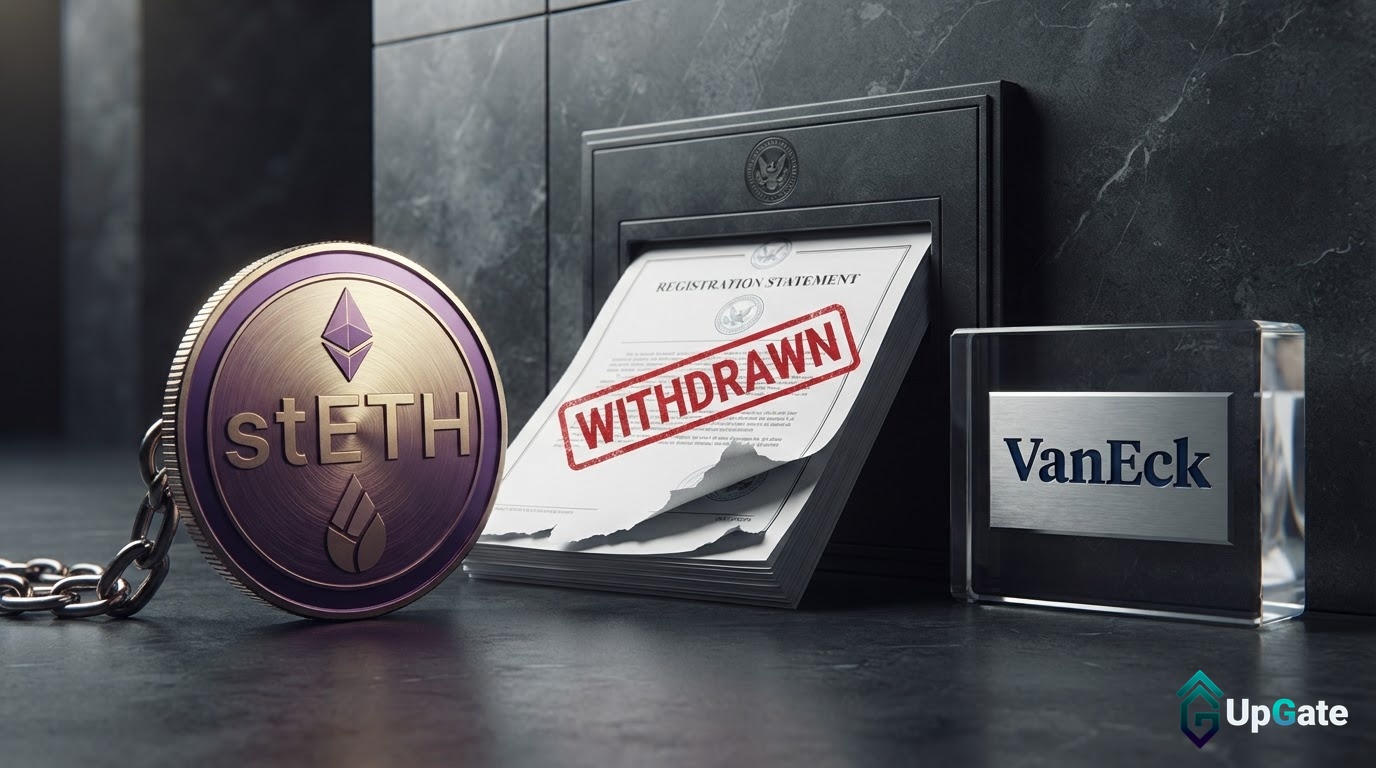
    VanEck has requested the withdrawal of its registration for a proposed Lido Staked Ethereum ETF, nearly a year after initially filing the application with the Securities and Exchange Commission (SEC). The asset manager stated it no longer intends to proceed with the fund. Crucially, no shares were ever issued or sold, meaning the withdrawal will not impact existing ETF holders or necessitate asset sales.

    The withdrawal, submitted last night UK time, concerns a planned product that would have offered investors exposure to staked Ether through a listed vehicle. The proposed ETF aimed to hold stETH, Lido’s liquid-staking token, and track its price while accruing staking rewards, utilizing a MarketVector benchmark. This structure differed from holding spot Ether directly, exposing investors to the specific market mechanics of stETH.

    Navigating Regulatory Ambiguity

    The decision to withdraw comes amidst a complex regulatory landscape for staked cryptocurrency assets. An SEC staff statement issued in August 2025 addressed certain liquid-staking arrangements, distinguishing between qualifying activities and those involving managerial or entrepreneurial efforts. However, this guidance was conditional and did not automatically provide a clear regulatory path for ETFs holding staking tokens.

    The prospectus for the VanEck ETF had identified several risks, including potential validator penalties, smart-contract vulnerabilities, liquidity constraints, and fluctuations in Ethereum’s market value. While Ethereum’s underlying network continues to evolve, network development alone does not resolve the regulatory or product risks outlined in the filing.

    Market Structure and Implications

    VanEck’s withdrawal highlights the product design challenges and regulatory ambiguities that remain for staked crypto products seeking institutional adoption. The Lido Ecosystem Foundation had previously welcomed VanEck’s application in October 2025, viewing it as a potential bridge between liquid staking and traditional investment markets. At that time, Lido reported that its users had earned over $2 billion in staking rewards since launch, with the protocol’s total value locked nearing $40 billion.

    This withdrawal does not affect any existing ETF holders, as the registration statement had not become effective and no securities were issued or sold. The SEC filing requests consent to make the withdrawal effective as of October 14 or at the earliest practicable date thereafter. VanEck has not indicated whether it plans to re-file or propose a different staking-linked ETF in the future.

    Why This Matters

    VanEck’s withdrawal of its proposed Lido Staked Ethereum ETF registration underscores the significant regulatory uncertainties and product development challenges inherent in bringing staked cryptocurrency assets to institutional investors. The SEC’s conditional guidance on liquid staking, coupled with the inherent risks detailed in the prospectus, suggests that a clear regulatory path for such products remains elusive. This event signals a cautious approach from major asset managers navigating the evolving landscape of digital asset investment vehicles.

    Broader Context

    VanEck Digital Assets asked the SEC last night, UK time, to withdraw the registration for its proposed Lido Staked Ethereum ETF, nearly a year after filing. The request concerns a planned route for brokerage investors to gain exposure to staked Ether through a listed product. The filing suggests the registration statement had not become effective, no securities had been or would be issued or sold under it, and no preliminary prospectus had been distributed. Those details matter for market structure: there are no ETF holders who need to redeem and no fund assets that must be sold to meet withdrawals. The SEC filing requests consent to make the withdrawal effective as of October 14 or at the earliest practicable date afterward.

  • Tether Paid Millions to Bo Hines’ Firm While He Was at the White House

    Tether Paid Millions to Bo Hines’ Firm While He Was at the White House

    Tether, the issuer of the world’s largest stablecoin, USDT, sent approximately $6.3 million to a consulting firm co-founded by Bo Hines, according to a report by The Wall Street Journal. Crucially, at least a portion of these funds were transferred while Hines was still employed by the White House.

    Hines later transitioned to Tether, where he now oversees the company’s U.S. operations. This sequence of events has ignited scrutiny over potential conflicts of interest, as Hines played a role in advancing the stablecoin legislation that now governs companies like his current employer.

    Consulting Firm and Ownership

    The firm in question is Nxum. The Wall Street Journal reported that Hines co-founded Nxum and maintained a one-third ownership stake throughout his tenure in government.

    Payment Timing and Government Role

    Tether’s payments to Nxum were part of a deal brokered in May 2025. The initial payment occurred while Hines was still holding his government position as executive director of the White House’s digital assets council, a role he occupied from January to August 2025. The Journal’s findings are based on internal documents and payment records.

    Advocacy for Stablecoin Legislation

    During the same period, Hines was a vocal proponent of the GENIUS Act. This bill established federal regulations for dollar-pegged stablecoins, and President Trump signed it into law in July 2025.

    Tether’s Business and Regulatory Landscape

    As the issuer of USDT, Tether’s business is directly impacted by federal stablecoin frameworks, which dictate who can issue these tokens in the U.S. and under what conditions.

    Transition to Tether

    Hines departed the White House in August 2025. In the same month, he joined Tether as a strategic advisor. By September 2025, he had been appointed CEO of Tether’s U.S. operations, with a primary objective of expanding the company’s presence within the country.

    Nxum’s Defense

    Nxum has contested the interpretation of these events. The firm asserts that Hines had no involvement with Tether during his government service. Furthermore, the reporting indicates Hines participated in discussions concerning the GENIUS Act during a period when he was not actively involved in Nxum’s operations. This distinction appears to be central to Nxum’s defense: while Hines owned a stake in the firm, he was not managing its day-to-day activities.

    Potential Implications

    The GENIUS Act was presented as a framework designed to bring order and credibility to the stablecoin market. A narrative suggesting that a key advocate had financial ties to a major issuer during the law’s development could provide critics with new grounds for criticism.

    For Tether’s ambitions in the U.S., the timing of these revelations is particularly sensitive. The company is seeking to establish a domestic presence under the very regulatory framework that Hines helped to shape, with Hines himself now leading that charge.

    Nxum maintains that Hines maintained a professional distance from Tether while serving in government. However, the payment records detailed by The Wall Street Journal indicate that funds were transferred regardless, and this apparent disconnect between the two entities is likely to remain the focus of scrutiny.

  • Australia’s ASIC Seeks Feedback on Proposed Crypto Platform Rules

    Australia’s ASIC Seeks Feedback on Proposed Crypto Platform Rules

    Australia’s securities regulator, the Australian Securities and Investments Commission (ASIC), has opened a public consultation on proposed capital, custody, and trading rules for cryptocurrency platforms. This initiative follows the passage of digital asset legislation in April and aims to establish clear requirements for the sector.

    The consultation, launched on Thursday, seeks industry feedback on key proposals concerning capital requirements, custody arrangements, and trading restrictions. The deadline for submissions is November 27. ASIC anticipates publishing its final standards and guidance in March 2027, with the new law scheduled to take effect on April 8, 2027. Licensed operators will then have until October 7, 2027, to apply for their licenses.

    Key proposals include three alternative capital models. Under one model, operators without qualifying third-party custody must maintain at least AUD 14 million (approximately USD 9.7 million) in net tangible assets, or 10% of average revenue, whichever is greater. ASIC also proposes restrictions on platforms trading for their own account and accepting benefits that favor specific tokens, aiming to mitigate potential conflicts of interest.

    Custody arrangements are another focus, with ASIC proposing to allow offshore custody. However, this is conditional on robust safeguards being in place to address potential failures of an overseas parent or related company. The consultation specifically requests input on these safeguards and whether Australian operators should retain emergency access to private keys in such scenarios.

    Interpretations suggest these proposed standards will reward operators who have already invested in compliance, capital, and custody, while challenging those who have delayed such investments. The potential allowance for offshore custody is viewed as significant, acknowledging the global nature of digital asset markets.

    Despite the detailed proposals, several uncertainties remain. Specific safeguards for offshore custody in the event of a parent company’s failure require further definition. The proportionality of the proposed capital models for businesses of varying sizes and the concessions available for third-party custody within these models are also areas needing clarification.

    These proposed rules and standards are designed to provide crypto operators with greater clarity on licensing, customer asset safeguarding, and financial obligations under the new regulatory framework. The upcoming implementation is expected to reshape the operational landscape, potentially leading to industry consolidation.

    The proposed restrictions on principal trading, affiliated liquidity arrangements, and best execution requirements are also highlighted as areas requiring careful consideration due to their potential impact on how Australian exchanges operate and access liquidity. This consultation period is a critical step in shaping Australia’s final regulatory framework for digital assets.

    Why This Matters

    The materials describe a narrow update: ASIC has opened a consultation on proposed rules for crypto platforms, including capital requirements, custody arrangements, and trading restrictions. Specific safeguards for offshore custody if an overseas parent or related company fails.

    Broader Context

    Source materials place the factual news in this context: The consultation follows Parliament’s passage of digital asset legislation in April.

  • White House Prioritizes Bitcoin Security Over New Purchases

    White House Prioritizes Bitcoin Security Over New Purchases

    The U.S. government is a significant Bitcoin holder, and before acquiring any more, it intends to ensure a precise accounting of its existing digital assets.

    Focus on Existing Holdings

    Patrick Witt, executive director of the President’s Council of Advisers on Digital Assets, stated on October 14, 2026, that the White House’s immediate priority is the safeguarding and accurate accounting of its current Bitcoin holdings. Any expansion of the Strategic Bitcoin Reserve would be a secondary consideration, if it occurs at all.

    Those anticipating immediate government purchases will need to remain patient. Witt indicated that no specific acquisition strategies have been finalized, nor are there any imminent policy changes or announced timelines for such actions.

    Scale of Government Holdings

    As of early October 2026, the government’s Bitcoin reserves were estimated to be between 319,000 and 328,000 BTC. At prevailing market prices of $82,000 to $83,000 per Bitcoin, this portfolio is valued at approximately $26 billion to $28 billion.

    Recent activity has seen these digital assets on the move. In early October, reports indicated the transfer of over $1 billion worth of Bitcoin, with substantial amounts directed to Coinbase Prime addresses. These movements suggest a consolidation of custody rather than an intent to liquidate, with the coins being secured in institutional-grade storage.

    The majority of the government’s Bitcoin holdings originated from forfeitures linked to cases such as the Silk Road marketplace and the Bitfinex hack.

    Strategic Bitcoin Reserve Established

    The Strategic Bitcoin Reserve was established by executive order on March 6, 2025. Its capitalization is exclusively derived from forfeited Bitcoin, meaning no taxpayer funds have been directly used to acquire these assets.

    This policy represents a departure from previous practices, where seized Bitcoin was typically auctioned off. The current strategy emphasizes strategic holding, with the deposited Bitcoin intended for retention rather than sale.

    Fiscal Constraints and Future Acquisition

    A key fiscal constraint is embedded within the plan: any future acquisition strategy must be budget-neutral, imposing no new costs on taxpayers. To date, no budget-neutral acquisition approach has progressed beyond the discussion phase, and no purchases have been made or detailed.

    Market Implications

    For market participants, the near-term outlook is straightforward: the government is neither actively buying nor selling, thereby removing a potential source of sudden supply or demand volatility. A holder of an estimated 319,000 to 328,000 BTC that commits to not selling effectively removes a significant potential overhang from the market.

    Conversely, the narrative of steady government demand as a future buying force is now deferred. Some market observers had viewed the reserve as a potential source of consistent demand, a scenario that Witt’s comments now push into an undefined future.

    Key Indicators to Monitor

    Several concrete developments warrant attention. Firstly, the administration’s potential publication of a formal accounting of its holdings would replace current estimates with official figures. Secondly, further on-chain movements from government addresses will be scrutinized; consolidation into custody aligns with the current narrative, while transfers to sale venues would contradict it. Thirdly, any tangible progress on a budget-neutral acquisition plan is crucial. Until such a plan advances beyond discussion, the Strategic Bitcoin Reserve will remain primarily a holding operation for seized assets rather than an active market participant.

  • BingX EU Obtains Austrian MiCA License for 29 EEA Nations

    BingX EU Obtains Austrian MiCA License for 29 EEA Nations

    Crypto Exchange BingX Secures European License Amid Regulatory Shift

    Vienna, Austria – Global crypto trading platform BingX has obtained authorization from Austria’s Financial Market Authority (FMA) for its European operations, marking a significant step under the European Union’s new Markets in Crypto-Assets Regulation (MiCA). The Vienna-based entity, BingX EU, announced on October 14, 2026, that the approval grants it the ability to offer crypto-asset services across all 29 member states of the European Economic Area (EEA).

    Navigating the MiCA Framework

    The authorization comes into effect following the conclusion of MiCA’s transitional period on July 1, after which only officially licensed providers are permitted to serve clients within the EEA. BingX EU has now secured this crucial license, positioning it as a registered crypto-asset service provider (CASP) under MiCA’s terminology. The license specifically permits BingX EU to provide custody, exchange, and brokerage services for crypto assets. The operational entity in Vienna is registered as MEGE zweite GmbH.

    Launch Date Remains Unspecified

    Despite securing the regulatory green light, BingX EU has not yet announced a specific launch date for its services to European customers. As of mid-October 2026, the platform had not yet appeared on the CASP register maintained by the European Securities and Markets Authority (ESMA), the EU’s securities watchdog. This registry serves as a public record of authorized entities.

    BingX EU’s application process with the FMA had progressed significantly by June 16, 2026. However, the final approval arrived several months after the July 1 deadline for the MiCA transitional period. Founded in 2018, BingX reports a global user base exceeding 40 million.

    Austria Emerges as a Key Licensing Hub

    Under MiCA’s harmonized regulatory framework, a license granted by a single member state’s regulator provides access to the entire EU bloc. BingX EU’s choice of Austria’s FMA as its licensing authority aligns with a growing trend, as other platforms like Bybit and Bitpanda have also secured authorizations in the country. This positions Austria as an increasingly important hub for crypto-related licensing within the EU.

    For BingX, this license transforms Europe from a complex regulatory landscape into a unified market opportunity. The company can now target both retail and institutional clients across the EEA under a single set of rules, eliminating the need for fragmented, country-specific approvals.

    Key Considerations Moving Forward

    Several aspects warrant attention as BingX EU progresses. Firstly, the absence of a launch date means the authorization is currently a potential capability rather than an active service offering for European consumers.

    Secondly, its eventual appearance on the ESMA register will provide official, bloc-wide confirmation of its authorized status. Until then, potential users may wish to verify BingX EU’s standing directly with the FMA.

    Thirdly, the specific suite of services BingX EU will offer, within the scope of custody, exchange, and brokerage, will be crucial in determining its competitive positioning against existing players operating under the same MiCA regime.

    Finally, Austria’s growing prominence as a licensing jurisdiction could lead to the FMA’s supervisory approach having a substantial influence on the future landscape of crypto services across the entire EEA, should more global exchanges follow suit and seek authorization through Vienna.