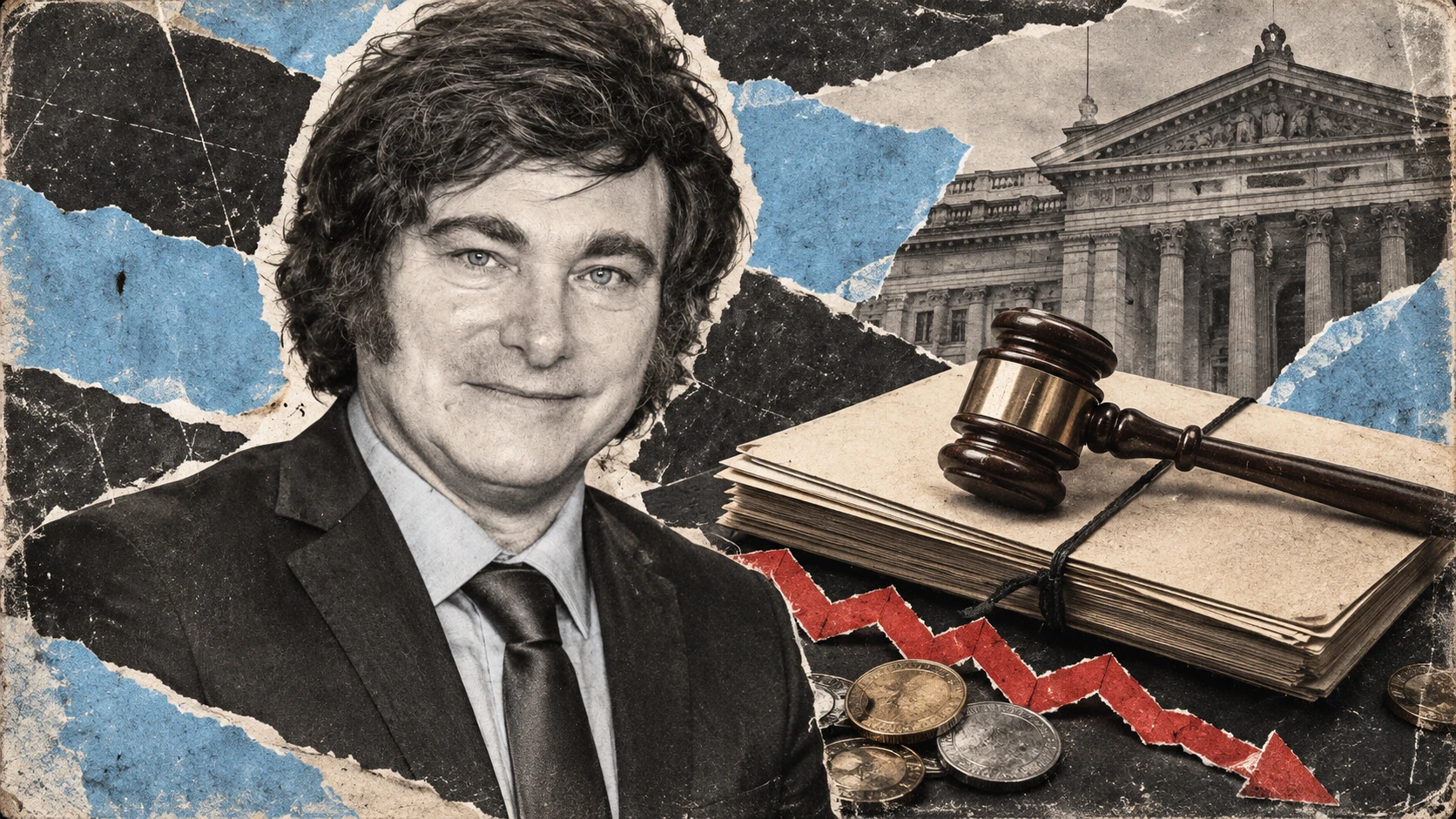
Federal Judge Rules President Milei and 11 Others Cleared in $LIBRA Case
A federal judge in Argentina has dismissed all charges against President Javier Milei, his sister Karina Milei, Hayden Davis, and nine other individuals in the $LIBRA case. The ruling, signed by Federal Judge Marcelo Martínez de Giorgi on October 23, concluded that the president’s influence and public profile do not constitute criminal fraud.
The 60-page verdict, based on Article 336, Section 3 of the Code of Criminal Procedure, stated that the alleged facts did not meet any legal definition of a crime. The ruling also emphasized that the proceedings would not affect the reputations of those involved.
Throughout the investigation, which began in February 2025, none of the 11 individuals were summoned to court or appeared as defendants. The case’s closure was initiated by the prosecution, with Prosecutor Eduardo Taiano formally requesting dismissal, a plea the judge accepted after reviewing the arguments. The core of the court’s decision was that the influence derived from a president’s position does not equate to fraud.
To establish fraud, the verdict argued, proof of “legally significant deception” is required. Judge de Giorgi wrote that merely reconstructing a timeline of promotion, price surges, crashes, and financial losses was insufficient. It would have been necessary to identify specific aspects of the project that were misrepresented or key information that was withheld.
The court echoed and agreed with the prosecutor’s assessment: the project existed, the token was issued, the involved companies were legitimate, and transactions occurred on a publicly traceable blockchain. The defendants never guaranteed future returns, price stability, or compensation mechanisms, and the domain in question was that of highly volatile and speculative meme coins.
The judge did not shy away from addressing the president’s role. He acknowledged that the institutional identity of those promoting the project “could generate particular influence and visibility” and potentially sway the trust of some buyers. However, he distinguished between recognizing such influence and concluding that it inevitably led to misrepresentation, stating that fame and trust alone do not constitute fraudulent practices.
A key piece of evidence under scrutiny was a note found on Mauricio Novelli’s phone. In March 2026, Argentine media outlet El Destape reported on the note, which described three payments totaling $5 million. However, the forensic conclusions cited in the verdict were cautious. The image found on the phone was an automatically generated preview from iOS’s Intents mechanism, proving only that the note existed within Apple Notes and had been opened or edited. The main database of the note was not found, nor were any transmission records in messaging apps like iMessage, WhatsApp, or Messenger, making it impossible to prove the note was sent to Davis or anyone else.
Regarding Karina Milei, the verdict noted that the only written record connecting her to Davis was provided by the presidential palace: her approval on July 16, 2024, for Davis and his partner Bartosz Lipinski to enter the presidential palace (Casa Rosada). The judge concurred with the prosecutor that this entry authorization, “viewed in isolation, is insufficient to prove the existence of an illicit agreement.” Two deleted conversations from Novelli’s phone, with a contact named “Karina Milei RRPP,” and call records between Novelli and Milei also could not be confirmed by investigators.
The verdict also acknowledged flaws in the prosecution’s evidence chain. An internal disciplinary investigation within the judicial system determined that an employee of the forensic unit, DATIP, had improperly accessed confidential files related to the $LIBRA case, with some information subsequently leaking to the media. The judge noted that the lack of rigorous oversight in the forensic process affected the chain of custody and weakened the evidence’s value. Another cited conclusion came from the Anti-Corruption Office, which stated that Milei’s posts from his personal account did not constitute institutional actions and did not involve public resources, thus not violating public ethics laws.
Developments abroad also favored the defendants. The verdict referenced a response from the U.S. Department of Justice, which dismissed Argentina’s request for judicial assistance due to insufficient links between the individuals involved, the alleged crimes, and the data sought. Furthermore, on September 29, 2026, the U.S. District Court for the Southern District of New York dismissed a civil lawsuit against defendants including Kelsier Labs. According to Argentine media outlet Perfil, the case against Davis was dismissed for lack of jurisdiction, without proceeding to substantive review.
On the night of the ruling, Milei posted on X, questioning who would compensate him for “a year, eight months, and nine days of lies, slander, and defamation.” He stated that justice had “put things back in their place” and exposed a “tremendous political and media operation” aimed solely at damaging the presidency with “political purposes of a coup d’état.” His post specifically named the La Nación group and journalists Hugo Alconada Mon and Carlos Pagni, concluding with his signature slogan.
However, the opposition interpreted the outcome entirely differently. Congressman Maximiliano Ferraro, head of the congressional $LIBRA investigation committee and one of the original complainants in the case, posted a video on X stating, “We are facing a clear, pre-planned judicial operation aimed at covering up the crimes and absolving Milei and all the organizers of this scam.”
In the video, he further pointed out that authorities had never explained, nor been asked to explain, the dozens of meetings between $LIBRA promoters and officials at Casa Rosada and Quinta de Olivos, the cryptocurrency transactions before and after meetings with the president, or Milei’s phone calls on the day of the events.
Perfil also highlighted another discrepancy: Ferraro’s committee presented a 205-page investigative conclusion in November 2025, asserting that Milei provided key assistance to the project and identifying 114,410 wallets that incurred losses, with 36 wallets each gaining over $1 million. This conclusion was not mentioned in the court’s verdict.
Changes in the plaintiff’s standing also drew attention. On July 3, 2026, at the request of defendant Novelli’s lawyer, the judge excluded five investors who had joined the case as plaintiffs. Infobae reported on this extensively. On September 4, Federal Appeals Court judges Mariano Llorens and Pablo Bertuzzi upheld this decision, reasoning that the buyers of $LIBRA “voluntarily assumed the inherent risks of such purchases.”
The path forward appears straightforward. Prosecutor Taiano himself requested the dismissal, and Perfil reported that he is not expected to appeal. With no private plaintiffs remaining in the case, the ruling could become final within days. The only potential variable lies at the highest level: the excluded investors have petitioned the Federal Criminal Court of Cassation to reinstate their plaintiff status. If successful, they would have grounds to appeal the dismissal ruling.
However, given that the lower appellate court has already determined that buyers bear their own risks, this path is not guaranteed.
Leave a Reply