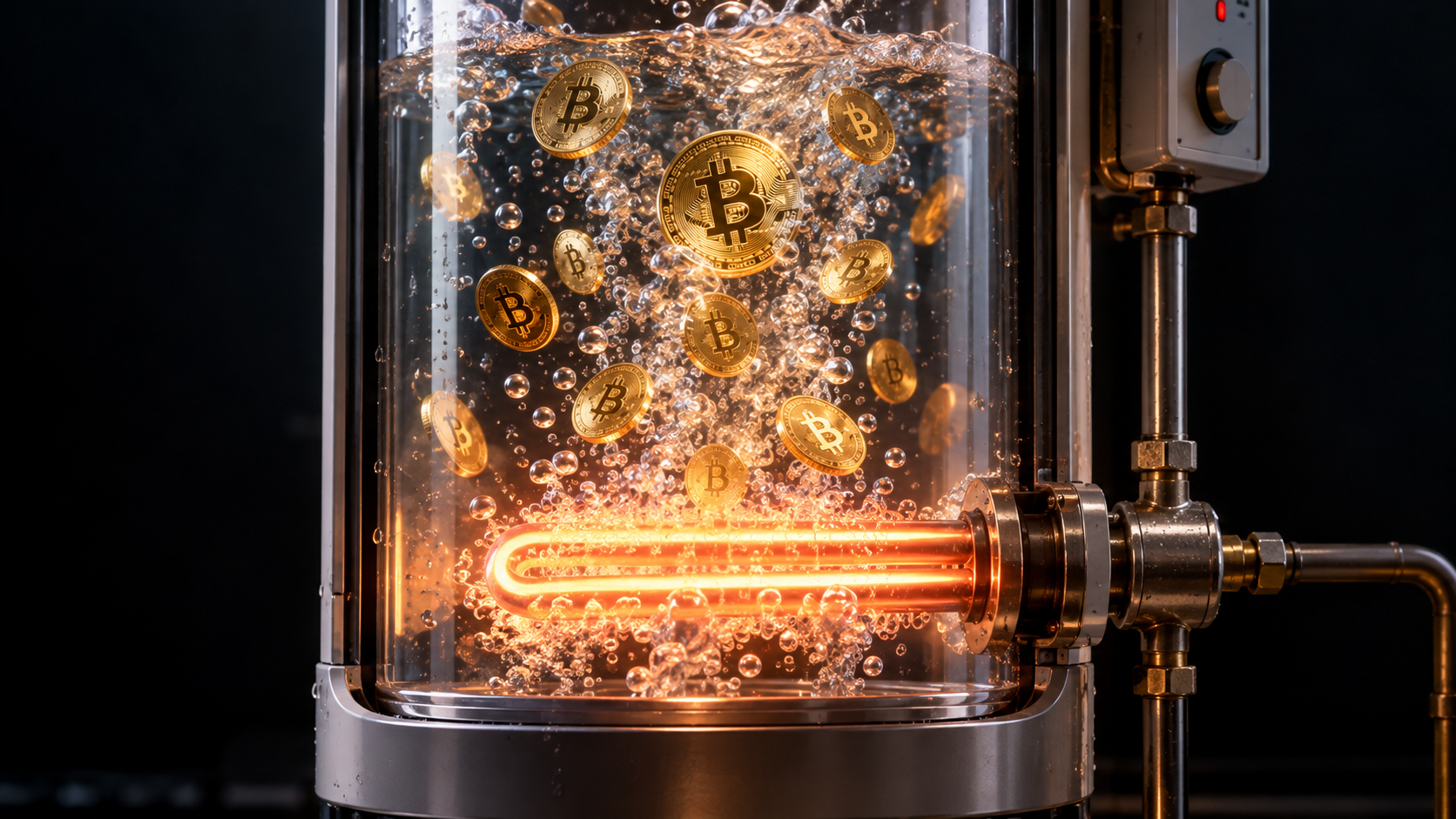
Bitwater: The Bitcoin-Mining Water Heater Element Aims to Turn Household Chores into Crypto Earnings
New York, NY – Home mining manufacturer Heatbit has unveiled its latest innovation: the Bitwater, a Bitcoin mining device designed to replace the heating element in existing electric water heaters. The company is targeting households in the United States and Canada, with the first batch of pre-orders priced at $899 and slated for shipment in the first quarter of 2027. Heatbit claims the device can mine approximately $1.25 worth of Bitcoin per day at full speed, with an estimated payback period of two to three-and-a-half years.
Turning Hot Water into Bitcoin
Heatbit’s core pitch for the Bitwater is simple: “Same heat, same electricity, plus bitcoin.” The device integrates 20 Bitmain BM1370 chips into what would typically be a water heater’s heating rod. Instead of solely using electrical resistance to generate heat, these chips produce heat as a byproduct of their Bitcoin mining operations, with the generated heat directly transferred into the water. The company states the efficiency starts at 12 J/TH.
This isn’t Heatbit’s first foray into the home mining market. The company previously launched a space heater with an integrated Bitcoin miner. The founder, Alex Busarov, drew a parallel to premium home appliances, telling Decrypt in 2023, “Dyson won’t make you money, this will.” He appears to be employing a similar strategy with the Bitwater.
How It Works and Installation
The Bitwater replaces the lower heating element in a standard electric water heater, leaving the upper element and thermostat intact as a backup. According to Heatbit’s FAQ, the device fits the standard 1-inch NPSM threaded opening found in 30 to 80-gallon electric water heaters from brands like A. O. Smith, Rheem, Bradford White, Whirlpool, and GE. Installation is described as a DIY process taking approximately 30 to 45 minutes, involving shutting off the breaker, draining the tank, removing the old element, and screwing in the Bitwater. No plumbing modifications or new electrical circuits are required; it plugs into a standard 110 to 240V outlet. For those seeking assistance, a live video installation guide is available for an additional $99.
Heatbit explains that while typical US water heater elements are rated at 4,500 watts and heat water rapidly before shutting off, the Bitwater operates at a lower, consistent 600 watts for extended periods, aiming for an operational uptime of over 80%. The chips are cooled directly by the water, eliminating the need for fans and thus, any operational noise.
Pricing, Availability, and Profitability Projections
The initial “Genesis batch” of Bitwater units is priced at $899, with subsequent batches expected to cost up to $1,299. Pre-orders are refundable, and shipments are scheduled for the first quarter of 2027, exclusively for customers in the United States and Canada. Heatbit has also indicated plans to release propane and heat pump versions in the future.
Heatbit’s official stance on earnings is that actual revenue depends on network difficulty and Bitcoin’s price, cautioning against any fixed annual return figures. However, an independent calculation using Hashrate Index’s hashprice data suggests that at its maximum 34 TH/s, the Bitwater would generate approximately $1.25 per day, or about $455 annually at full capacity. Assuming an 80% operational rate, this figure drops to around $365 per year. For the $899 Genesis batch, this translates to a payback period of roughly two years at full speed and 2.5 years at 80% uptime. The higher $1,299 price point for later batches extends the payback period to between 2.9 and 3.6 years.
Potential Hurdles and Economic Considerations
A significant factor to consider is the device’s one-year warranty, which falls short of the projected payback period. Furthermore, Bitcoin’s halving events, which reduce mining rewards, will impact profitability over time. The next halving is anticipated around April 2028, cutting block subsidies in half.
The default mining mode is solo mining on Heatbit’s proprietary pool, where the miner receives the entire block reward if successful. While users can switch to other pools like Luxor via an app, the low hash rate of 34 TH/s represents a minuscule fraction of the total network hashrate, making solo block discovery statistically improbable.
When viewed purely as a mining machine, the economics become less favorable. A continuous 600-watt operation consumes 14.4 kWh per day. Based on the US Energy Information Administration’s average residential electricity price of 18.83 cents per kWh in April 2026, daily electricity costs would amount to approximately $2.71, more than double the estimated daily mining revenue of $1.25. This highlights that the economic viability of Bitwater hinges on the premise that the electricity cost is already being incurred for water heating.
This premise also has limitations. The US Department of Energy estimates that heat pump water heaters are two to three times more energy-efficient than traditional electric resistance models. Bitwater offers the same thermal efficiency as a standard electric heating rod, converting 1 kWh of electricity into 1 kWh of heat. Using a heat pump to generate the same amount of heat (approximately 4,200 degrees annually at 600 watts and 80% uptime) could save between 2,100 and 2,800 kWh annually, translating to $400 to $530 in electricity savings, potentially exceeding the Bitwater’s estimated annual mining revenue.
A Niche Product with Potential Upsides
In conclusion, the Bitwater appears to be positioned less as a pure investment product and more as a water heater heating element with a small cryptocurrency bonus. Its appeal may lie more in the novelty and the fact that it doesn’t incur additional electricity costs beyond what’s already budgeted for water heating. Additional benefits cited include anti-scaling properties due to lower surface temperatures and a built-in anode rod for rust prevention.
For consumers with existing electric resistance water heaters who are not planning an immediate upgrade to a heat pump, can accept a payback period exceeding two years and the risks associated with Bitcoin halving, and are willing to configure external mining pools, the Bitwater might offer a justifiable purchase. Otherwise, the $899 price tag might be better viewed as acquiring a Bitcoin lottery ticket with the added benefit of hot water.
Leave a Reply