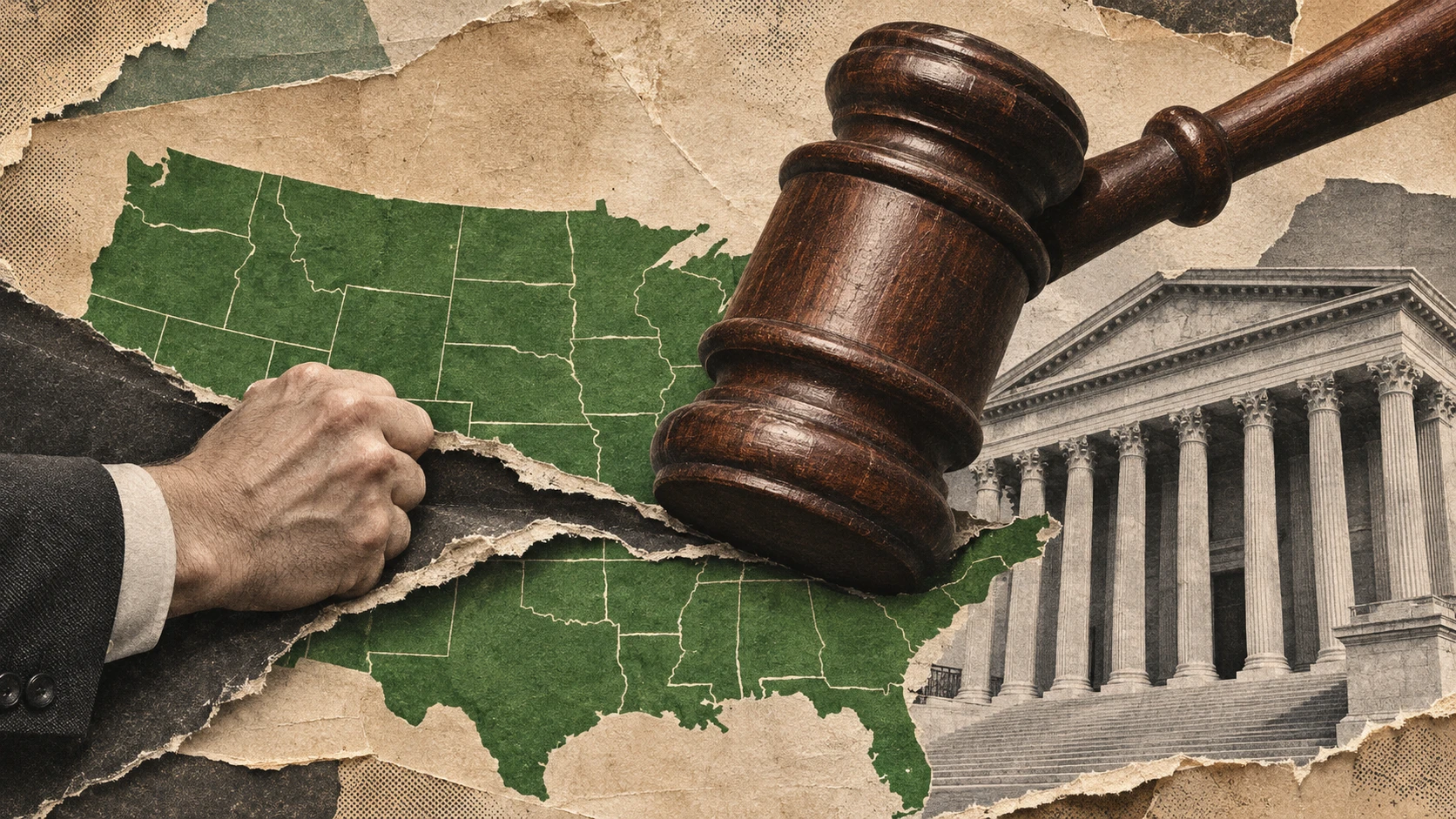
CFTC Issues Directive Against State-Based Trading Blocks, Pitting Regulator Against Courts
The U.S. Commodity Futures Trading Commission (CFTC) issued a new interpretation on Thursday, explicitly prohibiting designated contract markets registered with the agency from blocking trades based on a customer’s state of residence. The directive gives these platforms 30 days to either reinstate nationwide service or provide a written explanation to the regulator detailing why they cannot. This move places the federal agency in direct opposition to several federal courts, which in recent weeks have issued orders demanding precisely these platforms cease operations in specific states.
“Fair Access Requirement” Interpretation Issued
The CFTC’s directive, titled “Fair Access Requirement,” mandates that designated contract markets (DCMs) registered with the agency must cease blocking trades based on a customer’s state of residence. Platforms are given a 30-day deadline to either resume nationwide services or submit a written explanation to the CFTC outlining why this is not feasible. This action pits the federal regulator directly against multiple federal courts, which have recently issued orders requiring these platforms to cease operations in certain states.
The interpretation is based on the fair access provision of Commission Regulation 38.151(b). According to the full text of the CFTC’s interpretation, it applies to all DCMs, not just a single company, encompassing platforms like Kalshi and Polymarket that focus on event contracts. The commission also requires exchanges to review their access standards, exchange rules, and intermediary access arrangements to ensure compliance.
Two Obligations for Platforms
The interpretation outlines two specific obligations. First, DCMs must cease any domestic geographic restrictions that violate the fair access requirement within 30 days. If a DCM believes it cannot comply, it must submit an explanation to the CFTC’s Division of Market Oversight detailing why it is “not feasible.” Second, also within 30 days, DCMs must ensure that intermediary institutions directing traffic to them are not blocking customers and are also adhering to the exchange’s fair access requirements. Failure to do so will also necessitate a written explanation. The commission emphasized in the filing that it will assess whether to take supervisory action based on the facts and circumstances of each individual case.
In essence, after 30 days, platforms will face two scenarios: either resume service in previously blocked states, potentially facing contempt of court charges, or maintain the blockade and provide justification to the federal regulator. This choice is the most impactful aspect of the new interpretation.
State-Level Challenges and Court Rulings
Practically, Kalshi has already implemented geographic restrictions for customers in states such as Nevada, Washington, and Michigan, barring local users due to ongoing legal disputes with these states. Utah has taken the strongest stance, with its constitution broadly prohibiting gambling. The state government is pursuing both civil litigation and criminal charges against the platform.
More critically, recent court rulings have added significant pressure. The Second Circuit Court of Appeals’ rulings concerning Kalshi and Coinbase could lead to renewed enforcement in Connecticut and New York. The Ninth Circuit Court of Appeals found Kalshi’s argument that its contracts do not violate tribal gambling laws to be likely unfounded, remanding the case to a California federal judge. Subsequently, that judge ruled to block access to prediction markets in certain tribal jurisdictions. This presents Kalshi with a rare situation of simultaneous pressure from both federal regulators and federal courts.
Unilateral Action by CFTC
The manner in which this interpretation was issued is also noteworthy. The CFTC is legally led by five bipartisan commissioners, but currently only has one Republican commissioner, Chairman Mike Selig, in office. Consequently, the commission’s action is effectively a unilateral issuance. Since taking office, Selig has made prediction markets a key focus of his agenda, engaging in legal battles with state governments asserting jurisdiction. In July, his CFTC had already instructed Kalshi to disregard a Michigan order to cease local trading, using arguments nearly identical to this week’s comprehensive interpretation.
Selig’s Stance on Market Integrity
In a statement accompanying the interpretation’s release, Selig stated that derivatives markets must operate on a consistent nationwide basis to fulfill the objectives of the Commodity Exchange Act. He argued that access restrictions based on geography are incompatible with these objectives and the act’s requirement for fair access.
Consumer advocacy group Better Markets described the recent string of rulings as “the latest in a series of clear and strong decisions.” In a statement, the group asserted that the law is clear and the CFTC’s stance supporting unregulated prediction markets is untenable. They called for an end to this “illegal gambling” and for accountability for those who violate the law.
Political Pressure from Capitol Hill
Political pressure is also mounting from the Senate. California Democratic Senator Adam Schiff, who oversees the CFTC on the Senate Agriculture Committee, criticized the situation on X on Friday. He stated that the CFTC and its “out-of-control chairman” now appear to be encouraging platforms to continue offering gambling products, openly defying court orders. He described this as the commission’s “worst attempt yet” to undermine state law, then tribal law, and now the courts.
Market Structure Rationale
The interpretation’s text justifies its reasoning on market structure rather than state rights. The CFTC argues that when platforms exclude entire states, markets can become more reliant on a smaller number of participants, particularly when the excluded jurisdictions represent significant trading volume. The filing uses sports contracts as an example: contracts related to whether a home team will make the playoffs, for instance, have highly localized interest. Excluding that region would lead to a decrease in overall liquidity. Election markets are cited as a more sensitive example, as trading volume and local information for state and local elections often originate from residents voting in those areas.
A spokesperson for Kalshi did not respond to media inquiries by press time regarding its compliance plans.
A Clash of Legal Authority
This situation represents a direct confrontation between an “interpretive rule” and “court orders,” with unequal legal standing. Interpretive rules do not require formal rulemaking, offering speed and flexibility, but are more susceptible to being overturned in future litigation. Court orders, conversely, are directly effective and enforceable. For platforms, the most rational approach may be to address both sides: submitting a written explanation of “non-feasibility” to the CFTC within the deadline, while simultaneously seeking a federal court injunction to stay enforcement of any blocking orders. The true pressure test will come in early December when the deadline expires. If any party simultaneously violates both, the issue of enforcement priority will be brought to the forefront.
Escalating Legal Battle
Examining the timeline, this dispute has been escalating. At the end of August, the Ninth Circuit struck down the CFTC’s position in the Nevada case. In late September, appellate courts in Ohio and Tennessee ruled against Kalshi, determining that event contracts do not qualify as futures exchanges. In late October, Utah filed 14 criminal charges against Kalshi and its two co-founders. This week, the CFTC has directly countered by issuing an interpretive rule for nationwide consistency. Divergences are already appearing between circuit courts, and such splits are typically resolved only by the Supreme Court. This suggests that the compliance boundaries for this market will likely continue to be defined on a case-by-case basis by various courts until 2027.
Industry Implications
The industry is also facing concrete consequences. Prediction markets have been the fastest-growing segment for trading platforms this year, with Kalshi’s valuation soaring from $22 billion to $40 billion, driven by its ability to turn sports, politics, and weather into tradable contracts. If geographic blockades become the norm, this growth narrative will need to be recalculated. Each state’s prohibition effectively cuts off a piece of liquidity, which is the sole moat for this business.
Leave a Reply