Author: Admin_Up

  • Analyst Disputes Ripple CEO’s Strategy: ‘Two Giants, Same Model’

    Analyst Disputes Ripple CEO’s Strategy: ‘Two Giants, Same Model’

    Crypto Analyst Challenges Ripple CEO’s Stance on MicroStrategy’s Bitcoin Strategy

    As the cryptocurrency community continues to weigh in on MicroStrategy’s recent decisions regarding its Bitcoin holdings, trader Merlijn has pushed back against the views expressed by Ripple CEO Brad Garlinghouse.

    In a public statement on Twitter, Merlijn directly addressed Garlinghouse’s comments about MicroStrategy’s recent Bitcoin sale. Merlijn argued that both Ripple and the business intelligence firm employ comparable funding models, suggesting that Garlinghouse is in no position to criticize MicroStrategy and its CEO, Michael Saylor, given their similar market approaches.

    Over the weekend, reports indicated that Garlinghouse stated in a CNBC interview that MicroStrategy’s Bitcoin strategy was detrimental to the crypto market. The prominent Bitcoin treasury firm had recently halted its consistent Bitcoin purchasing streak and divested a portion of its holdings. This move generated significant market reaction, as MicroStrategy has been a key driver of Bitcoin demand.

    Although MicroStrategy has since resumed its Bitcoin purchases, the earlier sale drew considerable criticism from prominent figures and market experts. Garlinghouse contended that Saylor had not adequately focused on developing a strategy centered on Bitcoin’s inherent strengths. He suggested that while MicroStrategy’s purchasing model fueled market enthusiasm during Bitcoin’s rallies, the same approach is now exacerbating losses as the asset declines.

    According to the Ripple CEO, MicroStrategy has been utilizing a leveraged purchasing model through its Class A common stock, STRC. With STRC trading approximately 25% below its par value of $100, the market is beginning to observe the negative compounding effects of MicroStrategy’s model during Bitcoin corrections. Garlinghouse believes MicroStrategy should prioritize creating long-term value and utility rather than engaging in financial engineering via its Bitcoin funding strategy.

    While Merlijn acknowledged that Garlinghouse’s concerns about STRC’s performance are valid, the trader asserted that the Ripple CEO should not be targeting Saylor. Merlijn pointed out that Ripple itself funds its operations by selling XRP from escrow on a monthly basis, a model that Merlijn considers similar to MicroStrategy’s.

    From Merlijn’s perspective, MicroStrategy and Ripple are two major entities with analogous funding models that rely on the very markets they operate within. Given that both companies’ funding strategies contribute to selling pressure on their respective assets, Merlijn questioned the rationale behind Garlinghouse’s criticism. The trader found it particularly ironic that Garlinghouse, who does not adhere to the “never sell your XRP” principle, would admonish MicroStrategy for a single Bitcoin sale.

  • Coinbase Plunges 62% After Jim Cramer’s PARC Basket Recommendation

    Coinbase Plunges 62% After Jim Cramer’s PARC Basket Recommendation

    Cramer’s “PARC” Basket Falters as Key Stocks Plummet

    Nearly a year after CNBC’s “Mad Money” host Jim Cramer christened a group of four stocks – Palantir (PLTR), Applovin (APP), Robinhood (HOOD), and Coinbase (COIN) – as the “PARC” basket, three of the quartet have seen significant declines or stagnation.

    The initial grouping, coined on July 14, 2025, led many in the financial industry to interpret Cramer’s move as a bullish signal for the cryptocurrency sector. However, the stock most intrinsically linked to crypto has now experienced the steepest fall. Cramer had described the PARC stocks as those retail investors had “anointed and taken up without any real bounds,” framing the market at the time as bifurcated between the S&P 500 and these momentum-driven names.

    Coinbase Leads the Decline

    New performance data, shared on X by market commentator Heisenberg on June 29, 2026, reveals that Coinbase has been the worst performer since Cramer’s announcement, shedding 62% of its value.

    Yahoo Finance data indicates that over the past 52 weeks, Coinbase’s stock has fluctuated between $139 and $444. It is currently trading near the lower end of this range, around $149, a stark contrast to the strong investor conviction that accompanied its inclusion in Cramer’s basket. Notably, Donald Trump’s financial disclosure in May showed that the former president purchased Coinbase shares between January and March of this year, though these transactions were managed by third-party financial institutions.

    Palantir and Robinhood Lag

    Palantir has also struggled, declining approximately 25% since the “PARC” acronym was introduced, and has fallen about 40% in 2026 alone. Its 52-week high was around $207, and it was trading near $113 at the time of this report.

    Robinhood, meanwhile, has remained largely flat. This performance could be considered a relative success given the steep drops experienced by other members of the group. Earlier this month, Robinhood expanded into the Canadian crypto market with its $180 million acquisition of WonderFi, now boasting over 1 million international funded customers. However, this expansion has not significantly boosted its stock price.

    Applovin Stands Out

    Applovin is the sole outlier in the PARC basket, having genuinely delivered positive returns with a 34% increase since the group was named. Despite this gain, its current price of around $477 remains well below its one-year high of $745. Nevertheless, compared to its PARC counterparts, Applovin’s performance is a clear exception.

    A “CRAP” Forecast?

    In 2025, Cramer had considered two similar acronyms: PARC and CARP (Coinbase, Applovin, Robinhood, Palantir). However, some observers humorously proposed a third: CRAP. A year later, this alternative acronym appears to have been a more accurate predictor of the stocks’ performance.

    Analyst Shanaka Anslem Perera commented on this development via X, stating, “The acronym arrived at the precise moment conviction in these names ran hottest, and the year that followed turned a throwaway joke into a price chart. CRAP was never an insult. It was the forecast, written a year early.”

  • Supreme Court: Trump Can Fire SEC, CFTC Chiefs at Will, Amid Crypto Crossroads

    Supreme Court: Trump Can Fire SEC, CFTC Chiefs at Will, Amid Crypto Crossroads

    Supreme Court Expands Presidential Power, Overturning Century-Old Precedent on Agency Firings

    The U.S. Supreme Court on Monday dismantled a nearly century-old precedent that had restricted presidents to removing federal agency commissioners only under extraordinary circumstances. The landmark 6-3 decision, authored by the court’s conservative majority, significantly bolsters presidential authority over key regulatory bodies, including those overseeing the cryptocurrency sector.

    The ruling affirmed President Donald Trump’s right to dismiss Rebecca Slaughter, a Democratic commissioner at the Federal Trade Commission (FTC). This effectively grants the president the power to terminate other agency commissioners at will, with the sole exception of Federal Reserve governors.

    The case held direct relevance to the cryptocurrency industry, as Commissioner Slaughter’s husband serves as Vice President of Policy at Paradigm, a prominent venture capital firm in the crypto space. This connection allowed the couple to fund Slaughter’s legal challenge all the way to the Supreme Court, as previously reported.

    The Supreme Court’s decision in Trump v. Slaughter overturns a long-standing precedent established during the early years of the Franklin Delano Roosevelt administration. That precedent had stipulated that agency commissioners could only be removed for extreme cases of neglect of duty or malfeasance.

    “Today’s historic Slaughter decision by the Supreme Court is the greatest increase in presidential power in the last 100 years,” President Trump stated in a social media post on Monday. “Such a monumental ruling at such an important time!”

    The ruling means that President Trump, and future presidents, can now dismiss commissioners at influential regulators such as the Securities and Exchange Commission (SEC) and the Commodity Futures Trading Commission (CFTC) at any time and for virtually any reason. This development grants the executive branch substantial new leverage over the direction of these agencies, which have historically been considered independent.

    President Trump has already demonstrated his willingness to exert influence by withholding appointments of Democratic commissioners to the SEC and CFTC, both of which are mandated to have two minority-party commissioners. The SEC currently comprises three Republican commissioners and no Democrats, while the CFTC is led by a sole Republican chairman.

    This issue became a critical point of contention in the year-long effort to pass the Clarity Act, a bill aimed at formally legalizing most cryptocurrency activities in the United States. Senate Democrats had previously indicated they would not support the legislation—which would grant significant regulatory authority over crypto markets to the SEC and CFTC—unless President Trump committed to appointing Democrats to both agencies.

    In December, the president had toldDecryptthat he was “open” to the idea. However, in the six months since, no such appointments have been made.

    Monday’s Supreme Court ruling further complicates the legislative landscape, as President Trump could now theoretically appoint Democrats to federal agencies and then remove them at his discretion.

    The decision arrives as the Clarity Act faces a critical juncture after more than a year of stalled progress. Most stakeholders involved in the bill agree that it must be passed by early August to have a viable chance of becoming law, given the approaching November midterm elections.

    Numerous obstacles beyond regulator independence still impede the legislation’s path. Chief among these is the president’s potential reluctance to approve ethics provisions that would restrict his numerous lucrative cryptocurrency ventures, a demand that Senate Democrats have identified as a non-negotiable “red line.” Earlier on Monday, Republican Senate leadership signaled an intention to bring the Clarity Act to a floor vote next month, regardless of Democratic readiness.

  • XRP Whales Shift Holdings, Binance Loses Favor

    XRP Whales Shift Holdings, Binance Loses Favor

    XRP Whales Shifting Away from Binance, Data Suggests

    Large transfers of XRP are increasingly dominating activity across centralized exchanges, though their presence on Binance has notably diminished. Data tracking the 7-day moving average of the XRP Whale vs. Retail Spread across all centralized exchanges shows a significant rise, climbing from 26% on May 6 to 50.9% by June 29 – an increase of 24.9 percentage points.

    According to analytics firm CryptoQuant, this trend indicates that transactions involving more than 100,000 XRP now constitute a substantially larger portion of exchange outflows compared to smaller, retail-sized transactions, a shift from the dynamics observed in early May.

    However, Binance presents a contrasting picture. CryptoQuant data reveals that the exchange’s Whale vs. Retail Spread decreased from 62% on June 11 to 44.6% on June 29, a drop of 17.4 percentage points. This places Binance’s current reading 6.3 percentage points below the broader centralized exchange average of 50.9%.

    The Whale vs. Retail Spread metric quantifies the difference between XRP outflow volumes from transfers exceeding 100,000 XRP and those involving 100,000 XRP or less. Higher readings signify that whale-sized transactions represent a greater share of exchange outflows relative to retail transfers.

    This divergence suggests that large XRP transfers are becoming less concentrated on Binance and are instead being distributed across a wider array of trading platforms.

    XRP has faced considerable pressure throughout June, declining from over $1.30 at the month’s outset to approximately $1.05 at the time of reporting. Despite a brief mid-June recovery, the upward momentum proved unsustainable as sellers reasserted control, pushing prices lower once more. The cryptocurrency even saw its market capitalization fall behind that of BNB and USDC. With XRP currently testing the critical $1.06 support level, previously identified by analyst Ali Martinez, the asset now faces potential downside to lower support areas at $0.80, $0.62, and $0.51.

    Concurrently, data from Glassnode indicates that XRP investors are currently realizing more losses than profits. Despite this prevailing weakness, some analysts maintain an optimistic outlook. EGRAG CRYPTO, for instance, projects that if XRP adheres to historical price patterns associated with its “Central Line,” the asset could potentially reach between $5.70 and $8, drawing parallels to gains observed in previous market cycles.

  • Galaxy Cuts Clarity Act 2026 Odds to 50%

    Galaxy Cuts Clarity Act 2026 Odds to 50%

    Galaxy Digital Lowers Odds on Crypto Bill Passage Amid Senate Calendar Crunch

    Galaxy Digital has significantly reduced its forecast for the CLARITY Act becoming law in 2026, now deeming its chances a “coin toss.” The firm cited a rapidly closing window for the U.S. Senate to advance the cryptocurrency market structure legislation before its upcoming five-week August recess.

    “We are reducing our odds of CLARITY Act passage in 2026 to 50-50,” Alex Thorn, Galaxy’s head of firmwide research, stated in a social media post on Friday.

    This latest revision marks a steady decline in Galaxy’s predictions. The firm had initially pegged the odds at 75% in May, then lowered them to 60% on June 9, before arriving at the current even-money assessment. Prediction market Polymarket offers an even more somber outlook, pricing the bill’s passage in 2026 at approximately 49%, a notable drop from a high of 74% just a month prior.

    Thorn emphasized that the primary obstacle is not the bill’s substance but its timing. A unified Senate text remains elusive, a firm floor schedule is absent, and the legislative calendar is shrinking as lawmakers approach their summer break. Competition for floor time has reportedly “intensified,” Thorn noted, particularly after President Trump’s recent refusal to sign a bipartisan housing bill until Congress passes the SAVE Act, an election measure focused on proof-of-citizenship. Surveillance and defense legislation are also vying for legislative attention.

    However, a declining probability of passage does not necessarily signal the bill’s demise, according to Tim Sun, a senior researcher at HashKey. “The drop in the probability of passage this time is merely a matter of time delay rather than the rejection of the proposal’s actual content,” Sun told Decrypt. He pointed out that prediction markets have shown odds below 50% since May, a view that is “somewhat more pessimistic than institutional forecasts.”

    Sun reiterated that the core issue is the Senate’s packed schedule, with the housing bill, the SAVE Act, and other priorities continuing to dominate the agenda. Without a clear path to a vote before the recess, he warned, the CLARITY Act could be pushed into a “more complex mid-term election environment.” Nevertheless, Sun added, its prospects could improve rapidly if a final text is released in July and Senate leadership provides a definitive schedule.

    The stakes for the cryptocurrency industry are considerable, Sun noted, especially in a trading environment “characterized by ETF outflows and weakening risk appetite.” The CLARITY Act, he suggested, “remains one of the few domestic U.S. policy catalysts that could potentially improve market sentiment.”

    The proposed legislation aims to establish the first comprehensive U.S. regulatory framework for digital assets, dividing oversight responsibilities between the Commodity Futures Trading Commission (CFTC) and the Securities and Exchange Commission (SEC). The bill passed the House of Representatives in July 2025 and cleared the Senate Banking Committee with a 15-9 vote in May. However, it garnered support from only two Democrats, falling short of the seven needed to overcome a 60-vote threshold on the Senate floor. Democrats, led by Senator Elizabeth Warren, have advocated for ethics provisions targeting cryptocurrency ventures associated with Donald Trump, while banking and law enforcement groups have raised concerns regarding stablecoin yields and potential gaps in illicit finance prevention.

    For the time being, the bill’s fate appears intertwined with the crowded legislative calendar that is also impeding other measures, including the housing bill that President Trump is currently withholding over his election-related demands. Senator Cynthia Lummis indicated to Fox Business last Wednesday that a final version of the CLARITY Act text could emerge around July 4.

  • Ripple: XRP Ledger Lending and Credit Features Under Development

    Ripple: XRP Ledger Lending and Credit Features Under Development

    XRP Ledger Nears Institutional Lending Capabilities with New Protocol Test

    San Francisco, CA – The XRP Ledger (XRPL) is moving closer to enabling direct on-chain borrowing and lending of digital assets for institutions, as Ripple announced Monday that developers can now begin testing the XRPL Lending Protocol in a sandbox environment.

    In a blog post, the company detailed two technical specifications, XLS-65 and XLS-66, which are designed to integrate native credit infrastructure directly into the XRPL. This development aims to offer financial firms a new method for structuring agreements on the blockchain.

    Pending approval from network validators, this dual upgrade would allow tokenized real-world assets (RWAs), such as money market funds and commodities, to be utilized as working capital on the XRPL. Currently, these assets often exist as static inventory across numerous network accounts.

    The XRPL Lending Protocol is built on two core components. The “Single Asset Vault” provides a standardized framework for pooling assets on the XRPL, while the “Lending Protocol” governs loan terms, servicing, and repayment mechanisms.

    Ripple clarified that the underwriting process will remain off-chain. This means that the assessment of a borrower’s creditworthiness will not be recorded on the XRPL, a design choice intended to give institutions control over their lending decisions.

    “This separation mirrors real financial infrastructure,” Ripple stated. “By preserving that distinction, XRPL can support a wider range of credit structures over time, rather than hard-coding one lending model into a single application.”

    Despite the off-chain underwriting, repayment schedules, interest calculations, and default conditions will operate under predefined rules once a loan is initiated. Furthermore, losses stemming from defaults are designed to be contained through a multi-tiered approach, prioritizing the risk of capital from pool managers and underwriters, a structure that mirrors traditional finance.

    Ripple drew a comparison to public lending protocols like Aave, acknowledging their success in facilitating large-scale on-chain lending. However, the firm argued that these protocols’ crypto-native governance and risk frameworks do not align with the risk management procedures favored by Wall Street.

    The company highlighted potential use cases for the dual upgrade, including enabling payment providers to access short-duration liquidity and allowing treasury teams to generate revenue by lending digital assets under more transparent terms.

    This new lending protocol follows a significant milestone for the XRPL in May, when Ondo Finance utilized the network for the first cross-border, cross-bank redemption of tokenized U.S. Treasuries. Ripple described the new lending upgrade as the “missing layer” for on-chain finance, asserting that simply moving an asset onto the blockchain is only part of the equation.

    The XRPL Lending Protocol is also expected to boost the on-chain usage of Ripple’s stablecoin. Since its launch in late 2024, RLUSD has achieved a market capitalization of $1.5 billion, according to CoinGecko.

    On Monday, XRP was trading around $1.05, marking an 8.2% decrease over the past week. Last Thursday, the cryptocurrency experienced a notable dip, falling to its lowest point since President Donald Trump’s reelection, briefly touching just under a dollar, mirroring a broader market trend influenced by Bitcoin’s performance.

  • Binance Adjusts CRWDUSDT Perpetual Contract Size

    Binance Adjusts CRWDUSDT Perpetual Contract Size

    Binance Futures Adjusts CRWDUSDT Perpetual Contract Size Following Stock Split

    Binance Futures will implement an adjustment to the Contract Size of its USDⓈ-Margined CRWDUSDT Perpetual Contract, effective July 2, 2026, at 00:00 (UTC). This change is necessitated by a stock split of the underlying asset issuer’s outstanding Class A common shares, executed in the form of a stock dividend. The adjustment process is anticipated to conclude by July 2, 2026, at 13:30 (UTC), during what will be designated as the “Adjustment Period.” A subsequent “cancel-only” phase may follow, lasting up to five minutes after the adjustment is finalized.

    Stock Split Details

    The underlying company is undertaking a four-for-one stock split of its outstanding Class A common shares, structured as a stock dividend. Trading is expected to commence on a split-adjusted basis on July 2, 2026. These details are based on the official announcement made by the issuer.

    Adjustment Scale Factor and Impact

    The adjustment will utilize a scale factor of 4. To illustrate the impact, consider a user holding a long open position in the CRWDUSDT Perpetual Contract with a contract size of 20 CRWD and an average entry price of 600 USDT. Assuming the Mark Price at the commencement of the adjustment on July 2, 2026, at 00:00 (UTC) is 800 USDT:

    Before Adjustment:

    • Mark Price (USDT): 800
    • Contract Size (CRWD): 20
    • Average Entry Price (USDT): 600

    Unrealised PNL: (800 – 600) 20 = 4,000 USDT
    Notional Position (USDT): 600 20 = 12,000 USDT

    • Margin Balance: 12,000 + 4,000 = 16,000 USDT

    After Adjustment:

    • Mark Price (USDT): 800 / 4 = 200

    Contract Size (CRWD): 20 4 = 80

    • Average Entry Price (USDT): 600
    • Unrealised PNL: 0 (This will be settled and credited)

    Notional Position (USDT): 80 200 = 16,000 USDT

    • Margin Balance: 16,000 USDT

    Note: Minor rounding differences may occur in price and contract size post-adjustment. The price will be adjusted according to the tick size, while the contract size will be adjusted to the minimum trade amount.

    Strategy Bot Termination and Position Handling

    At 23:50 (UTC) on July 1, 2026, all strategy bots (including Grid, DCA, and Snowball) created on the CRWDUSDT Perpetual Contract will be terminated. All associated positions will be automatically closed, irrespective of the “Close all positions on stop” setting. These positions will not be reinstated after the adjustment is complete.

    During the Adjustment Period, users with open positions on the CRWDUSDT Perpetual Contract will have their positions closed first. Unrealised PNL will be settled and credited to users’ Cross Margin Futures Accounts, regardless of their position mode settings. For users in isolated mode, realised PNL and all margin balances from their Isolated Margin Futures Accounts will be transferred back to their Cross Margin Futures Accounts. Following the adjustment, new positions can be established. The margin balance transferred back to the Isolated Margin Futures Account will be based on the initial margin requirement corresponding to the leverage level selected by the user prior to the adjustment.

    Cancel-Only Phase and Chart Adjustments

    During the cancel-only phase, users will only be permitted to submit, modify, or cancel Post-Only orders. The duration of this phase will be determined by Binance based on prevailing market liquidity and could extend up to five minutes.

    The continuous candlestick chart for the CRWDUSDT Perpetual Contract prior to the adjustment will be preserved and will continue with the newly adjusted price after the process is complete. For time intervals of 12 hours (12-H) and below, the price chart preceding July 2, 2026, 00:00 (UTC) will be corrected within the first week post-adjustment. For intervals of 1 day (1-D) and above, the price chart correction will occur before the 7th day of the following calendar month.

    The adjustment process may conclude earlier than scheduled. API users can monitor the latest trading status of the perpetual contract via GET /fapi/v1/exchangeInfo, while UI users can refer to the designated page for updates.

    Trading Status Timeline

    • Before 2026-07-02 00:00 (UTC): Before Contract Size Adjustment – Trading (Continuous Trading Session State)
    • From 2026-07-02 00:00 (UTC) to 2026-07-02 13:30 (UTC): Contract Size Adjustment Process Starts – TRADING_HALT (Halt Session State)
    • From 2026-07-02 13:30 (UTC) to 2026-07-02 13:35 (UTC): Cancel-Only Phase After Adjustment – TRADINGCANCELONLY (Cancel Only Session State)
    • After 2026-07-02 13:35 (UTC): Trading Function Resumes – TRADING (Continuous Trading Session State)

    This information is released in accordance with Rule 96 of the Exchange Rules, Rules 167 and 168 of the Clearing Rules, Procedures 35.10 and 36 of the Clearing Procedures, and paragraph 19 of the Contract Specifications.

    Perpetual Futures on Traditional Assets are not associated with, sponsored, endorsed, or affiliated by the issuer of the relevant underlying shares or the exchange on which they are listed.

  • VELVET Altcoin Surges 1,700% in a Month: Rally Continues or Peak?

    VELVET Altcoin Surges 1,700% in a Month: Rally Continues or Peak?

    Viral Altcoin VELVET Surges 1,700% in a Month: A Path to Further Gains or a Looming Collapse?

    Despite a prolonged bear market gripping the cryptocurrency sector, certain tokens are defying the trend with substantial upward momentum. Velvet (VELVET) stands out as a prime example, having experienced quadruple-digit growth over the past month. While some market observers anticipate continued short-term gains, others caution that the altcoin could represent a significant risk.

    As of this report, VELVET is trading around $1.58, according to CoinGecko. This represents a 250% increase on a weekly basis and a remarkable 1,700% surge over the last 30 days. Its market capitalization has climbed to nearly $700 million, positioning VELVET as the 90th-largest cryptocurrency by market value.

    One factor potentially fueling this price surge is the project’s collaboration with AerodromeeFi. An announcement stated that the integration offers users “tighter pricing,” “less slippage,” access to “deeper liquidity on every trade,” and the ability to “land better fills, automatically.”

    Subsequently, the project unveiled Velvet-1, an Artificial Intelligence (AI) model designed for on-chain intelligence, which may have also contributed to the positive price action.

    Several analysts have noted the coin’s impressive performance and suggest it may have further room for growth. X user Crypto With Gopal observed that the price “is tightening inside a Symmetrical Triangle after a sharp bullish impulse,” indicating a potential loss of control by sellers and setting a short-term target of $2.1.

    The analyst known as The Boss also offered an optimistic outlook, arguing that recent breakout attempts demonstrate sustained buyer activity following consolidation, rather than an immediate reversal of gains. The analyst described the current market structure as “healthier than it did 24 hours ago, with the chart transitioning from recovery mode into expansion mode.” They concluded, “If momentum persists and volume follows through, the market could begin testing higher liquidity zones that were previously rejected during the first impulsive move earlier this month.”

    Conversely, a significant number of analysts advise caution, believing investors should steer clear of the altcoin due to the potential for a sharp decline. Yesterday, June 28, X user Crypto with Haris ₿ predicted that VELVET could plummet to $0.90 within the next six hours, labeling the situation a “generational short opportunity.” This prediction did not materialize.

    Vuori Trading, meanwhile, characterized the token as another “Binance Alpha aka. CZ scam.” This analyst suggested that while the token appears to be approaching its peak, a move above $2 could trigger an explosive rally to $8.

    Adding to the bearish sentiment, the coin’s Relative Strength Index (RSI) has surpassed 80, indicating that VELVET has entered extremely overbought territory. This technical indicator, which ranges from 0 to 100 with readings below 30 typically signaling a buying opportunity, suggests the asset could be poised for a significant correction.

  • Copilot AI Forecasts Massive Bitcoin Surge by 2026

    Copilot AI Forecasts Massive Bitcoin Surge by 2026

    Microsoft Copilot AI has presented a comprehensive outlook on Bitcoin’s price trajectory, suggesting the current market stands at a critical juncture. The AI model forecasts a realistic base scenario of $100,000 to $130,000 by the close of 2026. In a more optimistic “bull case,” the price could surge to $150,000 to $180,000, provided certain conditions align favorably.

    A Pivotal Inflection Point

    Bitcoin is currently trading around $59,800, a level the AI model identifies as a pivotal inflection point. This position signifies a transition between short-term volatility and sustained long-term structural demand.

    Several enduring forces underpin the bull case, rather than relying on a single, short-lived catalyst.

    • Digital Gold Narrative: Institutional investors continue to view Bitcoin as a form of “digital gold.” This perception has strengthened as traditional capital increasingly seeks assets that can act as a hedge against inflation.
    • ETF Demand: Demand from Bitcoin Exchange-Traded Funds (ETFs) remains robust, even amidst recent outflows. This suggests that the core buyer base has not abandoned the market, despite potentially volatile headlines.
    • Halving Impact: The lingering effects of the 2024 Bitcoin halving are also significant. With daily issuance reduced to approximately 450 BTC, supply is tightening precisely as global liquidity is anticipated to ease.

    The AI model posits that if macroeconomic conditions become genuinely supportive, adoption accelerates beyond expectations, and long-term investors gain prominence over short-term traders, the combination of these factors could propel Bitcoin’s price toward the $150,000 to $180,000 range.

    The Bear Case Scenario

    Conversely, the AI model also outlines a plausible bear case. Should prevailing macroeconomic headwinds, such as prolonged high interest rates, a recessionary shock, or renewed regulatory crackdowns, dominate the financial landscape, Bitcoin could remain confined to a range of $55,000 to $75,000 for an extended period.

    This scenario would imply a considerably longer wait for the structural bull case to materialize, with the price essentially trading sideways as these headwinds are resolved.

    Current Market Dynamics

    On a daily chart, Bitcoin is trading at approximately $59,887. This follows a significant decline from highs near $128,000 reached in October. The downtrend has been persistent, punctuated by a relief rally in May that peaked near $83,000 before reversing into the current period of weakness.

    For the past several weeks, Bitcoin’s price has been consolidating in the high $50,000s to low $60,000s, aligning closely with the $59,800 level identified as the pivotal point in the AI’s prediction. This type of tight, prolonged consolidation around a psychologically significant number often indicates a market awaiting a definitive catalyst rather than committing to a particular direction.

    Immediate resistance is observed near $64,000, a level that has been tested and failed multiple times recently. A more substantial ceiling lies further up, around $76,000, where the May rally ultimately lost momentum.

    Support is holding in the $58,000 to $59,000 zone, an area Bitcoin is currently testing. The broader market structure remains a clear downtrend dating back to October, characterized by lower highs and lower lows throughout the move.

    Momentum on the daily charts appears subdued rather than decisive, with small, choppy candles clustering near the lows, indicating a lack of strong directional conviction.

    Given the precise alignment of the current price with the predicted inflection point, the next decisive break above $64,000 or below $58,000 is likely to signal which trajectory—the base or bull case—will begin to unfold.

    A Shift in Capital Allocation

    The market is already experiencing a rotation, though its full implications may only become apparent in hindsight. Large-cap cryptocurrencies are not failing but are instead facing limitations in their upside potential. Bitcoin, Ethereum, and XRP have been consolidating against similar resistance levels for weeks, while anticipated macroeconomic tailwinds continue to be delayed.

    Institutional inflows are being postponed to subsequent quarters. Holding assets whose upside is contingent on uncontrollable catalysts is less a strategy and more a form of waiting. Capital that has weathered multiple market cycles tends to move proactively rather than waiting for destinations to become obvious.

    Early-stage infrastructure projects operate on a different economic model. Their smaller market capitalization means that even modest capital rotations can lead to significant price movements. This asymmetry arises because the market has not yet fully priced in the potential of these nascent developments. The returns are generated from the gap between current valuations and the true worth of the project.

    The fragmentation of multi-chain ecosystems imposes substantial costs on decentralized finance (DeFi) daily. Bitcoin, Ethereum, and Solana maintain isolated liquidity systems with no native interoperability. Users transferring value between these ecosystems incur direct costs through fees, slippage, and failed transactions.

    LiquidChain aims to unify these three networks into a single execution layer, enabling one deployment and full ecosystem access without cross-chain transaction taxes. The market has yet to discover this solution, which is the core of its potential.

    The LiquidChain presale is currently priced at $0.01454, having raised over $840,000. This represents an early stage in its lifecycle, with inherent risks such as unproven execution and unknown adoption rates. While established assets offer a more predictable path to a visible ceiling, this opportunity provides an earlier entry into a project still in its foundational phase.


  • XRP Faces Crucial Decision as Calm Precedes Potential Volatility

    XRP Faces Crucial Decision as Calm Precedes Potential Volatility

    XRP Faces Intense Selling Pressure Amidst Broader Crypto Downturn

    XRP is currently experiencing significant selling pressure, a trend that mirrors the broader cryptocurrency market. Both its trading pairs against Tether (USDT) and Bitcoin (BTC) are entrenched in clear downtrend structures. While the dollar-denominated pair is testing a critical demand zone, the BTC pair is hovering just above a key support level, placing the market at a pivotal juncture.

    XRP/USD Analysis

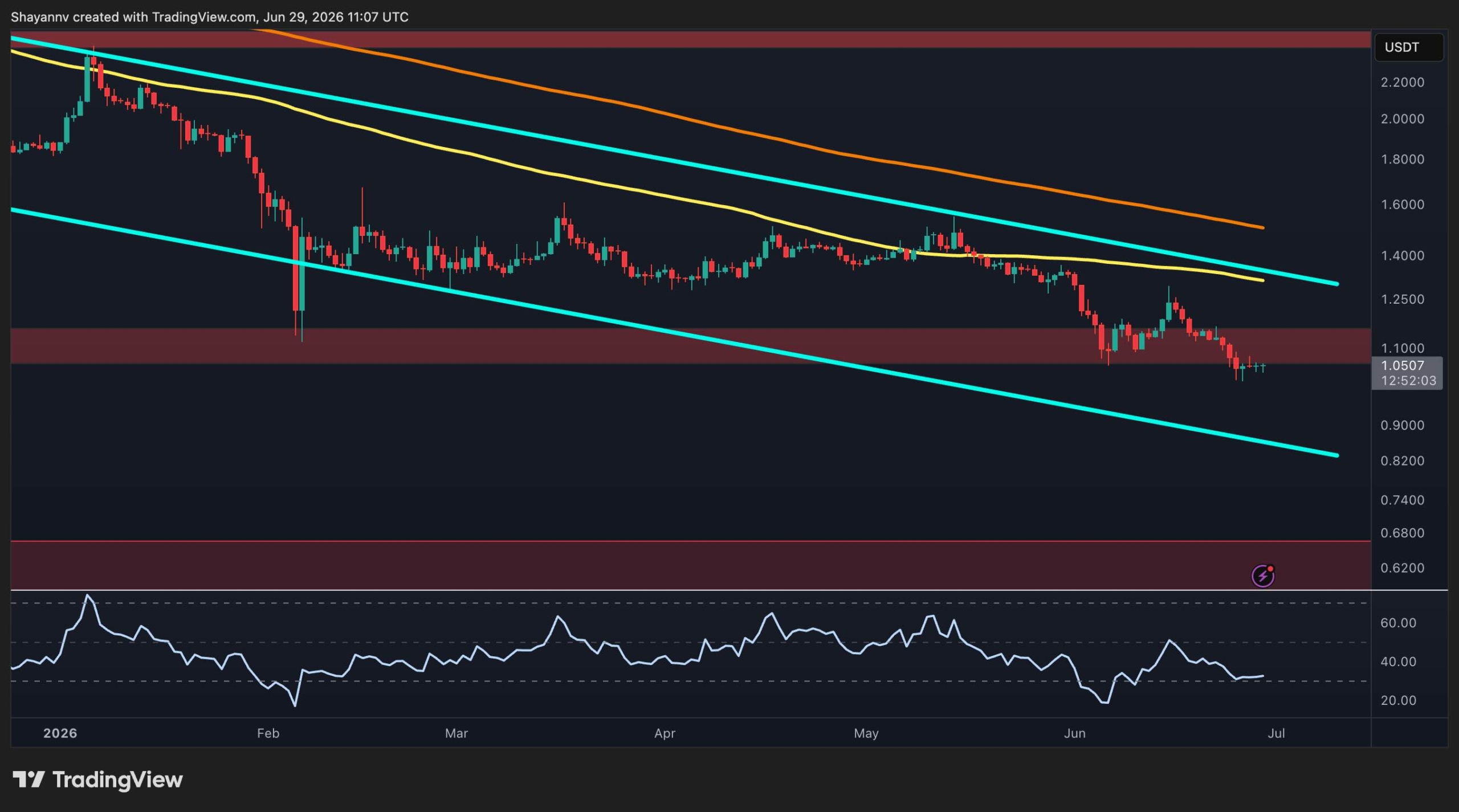
    On the daily chart, XRP continues to exhibit its established bearish structure, remaining confined within a long-term descending channel. The digital asset is presently trading around the $1.05 mark, having failed to establish higher lows in recent weeks, a clear indication of sustained seller dominance on higher timeframes.

    The most significant support for XRP/USD is now situated between $1.00 and $1.10, an area where the price is attempting to find stability. This zone has historically attracted buying interest and could potentially trigger a relief bounce if buyers successfully defend it. However, the overarching trend remains bearish, with XRP trading below both its 100-day and 200-day moving averages. These averages are both sloping downwards, serving as dynamic resistance levels.

    Any attempt at a recovery is likely to encounter its initial hurdle around the 100-day moving average, which is positioned near the $1.30 level and aligns with the upper boundary of the descending channel. A decisive break above both this channel resistance and the moving average would be necessary to signal a meaningful shift in the market’s structure.

    Conversely, a failure to hold the current support area could expose XRP to the lower boundary of the descending channel, located near the $0.80 region. This makes the current support zone particularly crucial for the medium-term outlook.

    XRP/BTC Analysis

    Against Bitcoin, XRP continues to underperform, with the XRP/BTC pair firmly entrenched within its own descending channel. The pair is currently trading at approximately 1,750 satoshis, sitting directly above a horizontal support level that has repeatedly halted deeper declines since May.

    Despite this support holding on multiple occasions, none of the subsequent rebounds have resulted in a clear bullish breakout, underscoring persistent selling pressure and a lack of sustained upward momentum. Repeated rejections near the 100-day moving average further reinforce the bearish structure.

    On the upside, the first major horizontal resistance is observed around 1,850 satoshis, which converges with the declining 100-day moving average. Above this, stronger resistance emerges near 2,000 satoshis, followed by the descending 200-day moving average and the upper channel resistance. As long as XRP remains below these resistance clusters, the trend against Bitcoin suggests continued relative weakness.

    On the downside, a confirmed breakdown below the 1,700 satoshis support region would likely invalidate the current consolidation pattern and pave the way for another downward leg towards the psychological support level around 1,500 satoshis, and potentially lower. This positions XRP at a critical decision point on both its USDT and BTC charts, as buyers and sellers vie for dominance over the prevailing trend.