Author: Admin_Up

  • Wintermute Fuels Liquidity on Kalshi and Polymarket

    Wintermute Fuels Liquidity on Kalshi and Polymarket

    Wintermute, a major market maker in the cryptocurrency industry, confirmed on Friday that it is providing liquidity on prediction markets.

    The London-based firm, which claims to process over $3.5 trillion in annual trading volume, announced in a blog post that it has been actively “quoting two-sided markets across event contracts on leading venues.”

    A source familiar with the matter told Decrypt that these venues include Polymarket and Kalshi. This suggests that capital is flowing dynamically between the two platforms, a process designed to make it easier for traders to buy and sell positions without significant price fluctuations.

    Liquidity and Market Development

    In a statement, Wintermute’s Head of OTC Trading, Jake Ostrovskis, described the liquidity profile for prediction markets as being in an “early-stage,” a characteristic that contrasts with growing demand.

    “For these markets to become a reliable real-time source of probability estimates, they need sustained two-sided liquidity,” he said. “That depth tightens spreads, supports larger trade sizes, and in turn improves the signal embedded in market prices.”

    The announcement underscores a fundamental operational connection between two companies operating in an emerging market. Kalshi has repeatedly stated that its business is exclusively based in the U.S., while Polymarket’s primary venue operates offshore.

    The Role of Liquidity Providers

    Rather than betting on the outcome of an event, liquidity providers aim to facilitate trades, primarily profiting from the “spread,” or the difference in costs associated with buy and sell orders. In a casino analogy, they would be akin to card dealers rather than gamblers.

    Wintermute stated that its involvement in the prediction market space transforms the platforms from “a nice forecasting tool into a broader venue for trading event risk,” adding that providing liquidity enhances the reliability of the probabilities displayed on Polymarket and Kalshi.

    Separately, the Commodity Futures Trading Commission (CFTC) issued an order on Friday allowing Kalshi to offer perpetual futures in the U.S. that are tied to Bitcoin’s price. Last year, Wintermute CEO Evgeny Gaevoy told Bloomberg that the firm plans to place a “new added focus on the U.S.”

  • Sui Network Suffers Second Day of Outage, Token Value Plummets.

    Sui Network Suffers Second Day of Outage, Token Value Plummets.

    The native token of the Sui blockchain, SUI, has fallen 20% this week following a “network stall” that caused downtime on the layer-1 blockchain for the second consecutive day.

    Price Performance

    Recently trading at $0.89, SUI has dropped an additional 2% in the last 24 hours and is now more than 83% below its January 2025 all-time high of $5.35. According to CoinGecko data, its weekly decline has placed it among the five worst-performing assets in the top 100 cryptocurrencies by market capitalization.

    Network Outage

    “Sui mainnet is currently experiencing a network stall. Network activity may be paused at this time,” the network’s team posted on X on Friday morning.

    Sui developers shared the same message on Thursday when the layer-1 blockchain was down for over five hours before a patch was deployed to validators, temporarily restoring the network.

    “Activity on Sui mainnet has resumed after a halt due to a crash bug in the gas charging logic introduced by the 1.72 release. A full incident review will be shared in the coming days,” the network announced.

    Investigation and Response

    While a comprehensive postmortem of the incident is pending, the network indicated that Thursday’s outage was caused by a bug introduced in its latest release.

    It remains unclear whether Friday’s outage is related to Thursday’s incident or the subsequent patch. Representatives for the network and Mysten Labs, the core team behind it, did not immediately respond to requests for comment.

    Previous Issues

    These outages follow a similar network stall in January, which resulted in six hours of downtime for the layer-1 blockchain’s mainnet.

    Background

    Hailed as a “Solana-killer,” the network has faced some of the same challenges as the high-speed layer-1 network, which has also experienced major outages in the past.

    Sui was launched in 2023 by Mysten Labs, which raised $300 million in a Series B funding round in 2022, valuing the company at approximately $2 billion at the time. Despite the recent decline, the network’s token currently trades with a market capitalization of around $3.6 billion.

  • Hyperliquid Surpasses Nasdaq in Trading Volume

    Hyperliquid Surpasses Nasdaq in Trading Volume

    Hyperliquid’s Rise

    Jeff Sprecher, founder of Intercontinental Exchange and architect of the modern NYSE, stated at Bernstein’s 42nd Annual Strategic Decisions Conference that Hyperliquid, a cryptocurrency exchange, is larger than Nasdaq by volume. Sprecher noted that Hyperliquid was built by a team of only eleven people and cannot be ignored.

    Hyperliquid has attracted market participants, including traders who would typically operate in traditional markets like ICE and Nasdaq, to its blockchain platform. Sprecher highlighted the significance of Hyperliquid’s trading of crude oil perpetuals on weekends, when ICE’s markets are closed, particularly given that key price-moving events related to the Iran conflict have occurred on weekends.

    He also commented on institutional clients, stating that while most are not yet trading on blockchain, they are closely monitoring price discovery, and it is becoming part of the prevailing sentiment. Sprecher also discussed the potential impact of the SpaceX listing, suggesting that regulators and market participants will assess its relevance. He concluded that the industry will need to adapt to the 24/7, 365-day interplay of retail and professional trading.

    The market responded positively to Sprecher’s comments, with HYPE rebounding 10% overnight to $62.50.

    JPMorgan on the “Debasement Trade”

    JPMorgan analysts released a research note on Thursday arguing that the “debasement trade” is losing momentum. This trade involved buying Bitcoin and gold as hedges against inflation, geopolitical instability, and currency weakness.

    The analysts pointed to simultaneous outflows from both Bitcoin and gold ETFs over the past two weeks, along with weakening institutional positions in CME futures for both assets. JPMorgan suggested that the recent pullback may reflect growing expectations of easing tensions between the United States and Iran, leading investors to adjust their positions.

    The report suggests that geopolitical tensions are subsiding, reducing the need for hedging. However, Bitcoin’s performance as a debasement hedge during the Iran conflict was not particularly strong compared to stocks and gold.

    The true test of the debasement thesis will unfold over time as inflation continues to impact the US and global economies, which is the primary driver of the thesis, more so than geopolitical hedging.

    Standard Chartered’s Ethereum Outlook

    Standard Chartered analyst Geoffrey Kendrick published a note comparing Ethereum’s current situation to Amazon following the dot-com bubble burst, arguing that its price does not reflect the network’s improving metrics.

    Kendrick referenced Jeff Bezos’s statement during that period: “The stock is not the company. And the company is not the stock.” He noted that Amazon’s stock has increased significantly since its post-dot-com lows. Kendrick believes a similar disconnect exists for ETH.

    Standard Chartered maintained its year-end price target of $4,000 for Ethereum and $40,000 by the end of the decade. The bank’s bullish outlook is based on the dominance of DeFi and stablecoins. They forecast the stablecoin market cap to increase sevenfold to $2 trillion by 2028 and real-world assets (RWAs) to reach $2 trillion by 2028. Ethereum is expected to be the primary beneficiary of this growth, driving transaction volume and total value locked (TVL) to new highs, thus supporting higher ETH prices.

    In contrast, Polymarket bettors give only a 15% chance of ETH reaching $4,000 in 2026.

    Anthropic’s Funding Round

    Anthropic raised $65 billion in a Series H funding round at a $965 billion post-money valuation, becoming the most valuable AI company in Silicon Valley. The round was led by Altimeter Capital, Dragoneer, Greenoaks, and Sequoia Capital, each contributing over $2 billion.

    Anthropic’s valuation has more than doubled since February, increasing from $380 billion.

    The company’s revenue has surged due to its AI coding assistant, Claude Code. Annualized revenue has surpassed $47 billion, up from a $30 billion run rate earlier this year and $10 billion in annual revenue last year. Anthropic also highlighted strategic infrastructure relationships with Micron, Samsung, and SK Hynix, and expanded its computing footprint through agreements with Amazon, Google, Broadcom, and SpaceX. Anthropic simultaneously released Claude Opus 4.8.

    This could be the AI startup’s final private fundraising before entering the public markets.

  • Crypto Prices Fall Amid ETF Outflows, Macro Concerns

    Crypto Prices Fall Amid ETF Outflows, Macro Concerns

    Crypto Market Downturn

    Cryptocurrency markets experienced a downturn over the past week, with Bitcoin leading the decline as investors moved away from riskier assets. Bitcoin began the week trading near the $77,000-$78,000 range but steadily lost momentum, falling to approximately $73,000 by Friday.

    This decline reflects a combination of macroeconomic pressures, renewed outflows from exchange-traded funds (ETFs), and reduced liquidity, rather than a single industry-specific event.

    The primary factor contributing to the downturn was the waning institutional demand. U.S. spot Bitcoin ETFs saw significant redemptions, with over a billion dollars leaving in a single day. Simultaneously, activity among large holders increased, with whale outflows reaching their highest level since February, raising concerns that some investors are preparing to sell during the market weakness.

    Macroeconomic factors also played a role. Geopolitical tensions between the U.S. and Iran diminished hopes for near-term interest rate cuts, negatively impacting speculative assets. Furthermore, analysts reported that central banks are increasing their gold reserves at an unprecedented rate, signaling a broader risk-off market sentiment.

    Altcoins followed Bitcoin’s downward trend, with Ethereum trading near $2,000. Overall risk appetite remains cautious.

    The week highlighted the crypto market’s sensitivity to ETF flows and macroeconomic risks. Bitcoin’s inability to maintain its price around the mid-$70,000 level suggests a defensive market outlook heading into the following week.

    Market Cap: $2.54T | 24H Vol: $83B | BTC Dominance: 57.7%
    BTC: $73,158 (-5.4%) | ETH: $1,995 (-5.9%) | XRP: $1.33 (-3.4%)

    SpaceX Pre-IPO Market Flash Crash

    The pre-IPO market for SpaceX on Hyperliquid, powered by Ventuals, experienced a sudden flash crash. The price plummeted by 45% before recovering, leading to mass liquidations. Ventuals has stated that affected traders will be compensated.

    Google Engineer Charged with Insider Trading

    U.S. prosecutors have charged a Google software engineer with allegedly using confidential information to profit from betting on Polymarket. He allegedly made $1.2 million by using proprietary search data.

    Hyperliquid Expands with Macro Prediction Markets

    Hyperliquid has expanded the range of outcome markets available on its platform. Initially, only fixed bets on Bitcoin’s daily price were available, but users can now trade on macro events such as monthly CPI prints and other economic indicators.

    Coinbase CEO on Financial System Evolution

    Brian Armstrong, CEO of Coinbase, stated that the financial system still requires significant upgrades. He emphasized that substantial technological innovation and policy work are needed to achieve these advancements.

    Galaxy Digital and BitGo Legal Battle Continues

    BitGo and Galaxy Digital are continuing their legal dispute over the failed $1.2 billion acquisition agreement, which was once expected to be the largest merger in the industry.

    Sui Network Experiences Another Outage

    The Sui Network experienced another period of downtime. The blockchain was offline for nearly six hours on Thursday. This is not the first time the network has experienced such an outage.

  • Dogecoin Bulls Struggle Amid Whale Activity, Capitulation Signals

    Dogecoin Bulls Struggle Amid Whale Activity, Capitulation Signals

    Dogecoin Shows Signs of Valuation Stress

    Dogecoin is exhibiting classic signs of valuation stress, according to an analysis by Alphractal AI. The analysis suggests that Dogecoin bulls are missing a crucial element for a sustained rally: stronger support from large holders, often referred to as “whales.”

    At the time of the analysis, Dogecoin was trading at $0.099, with a market capitalization of $15.48 billion and a 24-hour trading volume of $1.06 billion. The asset ranked ninth by market cap, but its overall performance profile remained under pressure. While DOGE was up 2% over 24 hours, it was still down 5.96% over seven days, 4.28% over 30 days, 30.82% year-to-date, and 54.39% over one year.

    Whale Data Weakens Dogecoin’s Recovery Case

    A key concern is the positioning of large holders. Alphractal’s data indicates a whale-versus-retail delta of -0.2464 and a whale-versus-retail ratio of 0.8963, suggesting that larger players are not leading the price movement. The report describes the situation as “mixed but fragile,” noting that funding remains subdued and whale behavior does not confirm a strong bullish trend.

    The analysis stated, “Funding is only 0.01%, so leverage is not overheated, but the negative whale-vs-retail delta suggests larger players are less aggressive than smaller participants. That weakens the quality of bullish positioning.”

    The depressed valuation metrics could otherwise make the asset appear attractive to dip buyers. However, a market can trade below the aggregate cost basis for extended periods if larger holders are not accumulating or if exchange supply remains elevated. In Dogecoin’s case, exchange reserves totaled 28.26 billion DOGE, worth approximately $2.77 billion, with balances rising 0.45% over seven days. Alphractal considers this “mildly negative” because it suggests that available sell-side supply is not being aggressively moved into long-term storage.

    Capitulation Signals Are Clear, But Not Enough

    Dogecoin’s valuation profile presents some constructive aspects, albeit with caveats. The asset’s realized price was $0.12929, placing the spot price 22.99% below the average holder cost basis. The Market Value to Realized Value (MVRV) ratio was 0.7754, while the Net Unrealized Profit/Loss (NUPL) came in at -0.2897, indicating a capitulation regime.

    Alphractal noted, “The exact numbers show a market with capitulation-type holder conditions, subpar trend strength, and limited broad user participation, even though larger on-chain value transfer has improved. The clearest conclusion is this: DOGE looks cheaper than its average holder cost basis, but not structurally strong yet.”

    Dogecoin’s technical structure also remains weak. The token traded 13.46% below its 200-day moving average, with the daily Moving Average Convergence Divergence (MACD) still bearish. Relative Strength Index (RSI) readings were near 40 on both the 24-hour and weekly timeframes, indicating weak momentum but not necessarily extreme exhaustion.

    The moving-average picture was mixed but largely negative. Dogecoin traded below its 12-day, 21-day, and 50-day moving averages, while sitting only 1.37% above its 100-day average. This keeps the broader trend tilted bearish despite the 24-hour bounce.

    Derivatives data did not show excessive leverage, but it also failed to show a strong return of speculative interest. Open interest stood at $907.32 million, up 0.57% over 24 hours but down 7.82% over seven days. Alphractal stated that leverage has stabilized in the short term, while the longer-term open interest trend remains negative.

    On-Chain Value Moves, But Participation Lags

    One of the few improving signals came from adjusted transfer volume, which rose 32.52% in one day and 57.64% over seven days to $213.59 million. However, this increase was not matched by broader network participation. Active addresses fell 3.90% daily and 3.36% weekly, while the transaction count dropped 8.37% over seven days. This divergence suggests larger-value transfers rather than broad retail re-engagement.

    For Dogecoin’s recovery to strengthen, Alphractal’s framework points to a healthier combination: rising active addresses, falling exchange reserves, improving long-term open interest, and a momentum shift back above key trend levels. Until these conditions are met, Dogecoin remains in a challenging position. The data suggests the asset is undervalued relative to the holder cost basis, but the whale signal is not yet strong enough to validate a sustained recovery.

  • Paxos Registered as Clearing Agency by SEC

    Paxos Registered as Clearing Agency by SEC

    Paxos Securities Settlement Company, a subsidiary of blockchain infrastructure firm Paxos, has been granted registration by the Securities and Exchange Commission (SEC) as a clearing agency under Section 17A of the Securities Exchange Act.

    Blockchain-Native Status

    According to a press release from the company, this registration makes Paxos the “only blockchain-native firm” approved by the SEC to operate as a central securities depository in the United States.

    Temporary Registration

    The SEC order designates the approval as a temporary registration, permitting the company to offer clearing and settlement services while adhering to ongoing regulatory requirements. “Most importantly, it allows us to offer the most complete infrastructure for our partners to continue evolving with the market and blockchain technology,” said Charles Cascarilla, Paxos CEO and Co-Founder, in a statement.

    Seven-Year Regulatory Journey

    Cascarilla noted that this milestone concludes a seven-year regulatory process, “beginning with our No-Action Letter in 2019 and the settlement pilot we operated with some of the world’s largest and most sophisticated financial institutions.”

    The pilot program, which commenced in February 2020, has been clearing and settling U.S. equities daily with participation from “top global financial institutions” under SEC no-action relief, the firm stated. In 2022, a blockchain-based pilot launched by Paxos in collaboration with State Street achieved same-day settlement times for stock trading, known as “T+0.”

    Industry Context

    The registration arrives as established infrastructure providers embrace tokenization. The Depository Trust & Clearing Corporation recently unveiled plans for its own tokenization service, supported by major Wall Street firms.

    Paxos issues several digital assets, including PayPal’s PYUSD stablecoin and Pax Gold (PAXG). In October 2025, an “internal technical error” led the firm to accidentally mint and subsequently burn 300 trillion PYUSD tokens. Months later, the company received conditional approval to convert to an OCC national trust bank, enabling it to operate under a unified federal regulatory framework instead of a collection of state regulations.

  • DTCC Collateral Lists Clarify XRP Status, Dispelling Delisting Rumors

    DTCC Collateral Lists Clarify XRP Status, Dispelling Delisting Rumors

    DTCC Update Sparks Crypto Panic, Misinterpreted by Retail Traders

    A recent update regarding collateral eligibility from the Depository Trust and Clearing Corporation (DTCC) circulated on Crypto Twitter, triggering a wave of panic among retail investors. This led to a sell-off of Ripple’s XRP and a shift into Stellar’s XLM, fueled by the belief that the DTCC had effectively blacklisted Ripple’s token from institutional infrastructure. However, this interpretation is inaccurate.

    The DTCC’s collateral eligibility lists serve as post-trade operational reference tools, not directives for exchanges. Analysts are characterizing the resulting price dip as a “Fear, Uncertainty, and Doubt” (FUD)-driven capitulation event, rather than a structural delisting.

    On-chain data revealed $900 million in weekly Ripple realized losses during the peak of the panic, marking the largest capitulation spike since 2022, when realized losses reached approximately $1.93 billion. Historically, such spikes have often signaled local bottoms.

    The retail rotation from XRP to XLM, following the DTCC–Stellar Development Foundation tokenization partnership announcement, was a misinterpretation of back-office infrastructure as a trading signal.

    Understanding the DTCC’s Role

    The DTCC is a critical component of U.S. capital markets. Its subsidiaries, the National Securities Clearing Corporation (NSCC) and the Depository Trust Company (DTC), handle clearing, settlement, and custody for trillions of dollars in securities transactions daily.

    Collateral eligibility lists published by these entities specify which assets are acceptable for use within the DTCC’s clearing and margin operations. These lists govern what banks and broker-dealers can pledge as collateral within that specific post-trade infrastructure.

    Misconceptions and Reality

    The focus on the DTCC’s partnership with Stellar overlooks the broader context. The DTCC launched a Tokenization Working Group in May, with Ripple’s involvement. Additionally, the DTCC adopted Chainlink (LINK) CRE standards in May. The partnership with XLM, announced later, was misinterpreted as a preference for XLM over XRP.

    The DTCC’s lists do not instruct exchanges to delist any assets. The assumed chain of events – collateral eligibility update, XRP absence from the list, institutional trading ban, and exchange delisting – is flawed at every step. Exchange listing decisions are based on each venue’s risk framework, regulatory standing, and commercial judgment, which are separate from DTCC’s back-office operations.

    The DTCC has also emphasized its chain-agnostic approach to digital assets. Its 2024 “Great Collateral Experiment” involved tokenized collateral across multiple networks with 10 major banks, demonstrating interoperability as a key design principle.

    The Ripple Effect

    The misinterpretation followed a familiar pattern. Screenshots of DTCC and NSCC eligibility files were shared on Crypto Twitter without proper context. XRP’s status on these lists was then interpreted as evidence of an impending delisting. This narrative was amplified by influencers, prompting an emotional reaction from retail traders, and causing XRP to fall below $1.30 as the rotation accelerated.

    The DTCC–Stellar announcement further fueled the confusion. The Stellar Development Foundation’s partnership with DTCC, with DTC-tokenized assets expected to launch on the Stellar network in the first half of 2027, was seen by some as a displacement of XRP from institutional pipelines. This interpretation disregards the DTCC’s multi-chain strategy and the fundamental nature of global financial infrastructure, which does not operate on a winner-take-all basis.

  • Bitcoin Strategy Shift? Standard Chartered Bullish on Ethereum’s Future.

    Bitcoin Strategy Shift? Standard Chartered Bullish on Ethereum’s Future.

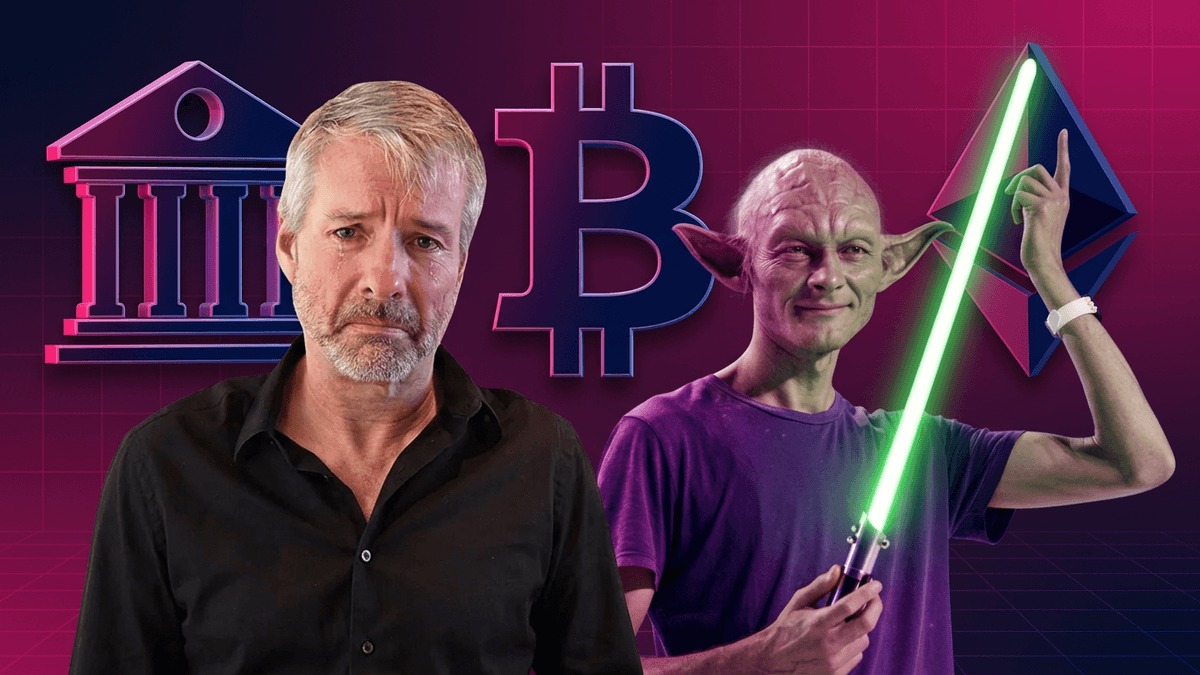
    Crypto markets are ending the week on a surprisingly strong note, with Bitcoin holding steady despite significant options expiry pressure. The crypto community is currently navigating three key narratives: movements from Michael Saylor’s Bitcoin holdings, Standard Chartered’s comparison of Ethereum’s long-term potential to Amazon’s early growth, and Vitalik Buterin’s announcement that he is writing a sci-fi novel about decentralized governance.

    Geopolitical Developments

    Adding to the market’s dynamics, reports indicate that the U.S. and Iran have reached an agreement on a memorandum of understanding, including a 60-day ceasefire. This development, which is reportedly awaiting final approval from Donald Trump, could potentially boost the entire risk sector if confirmed.

    MicroStrategy’s Bitcoin Transfers

    A significant development involves MicroStrategy, with 411.48 Bitcoin transferred to Coinbase Prime. This move has drawn considerable scrutiny, and Polymarket odds that MicroStrategy will sell any Bitcoin before the end of the year have risen to 84 percent. However, this could be a routine treasury management or custody adjustment. While MicroStrategy’s Bitcoin holdings are currently in the red, the company remains a core holder, and there are no signs of panic. If Michael Saylor does sell some Bitcoin, it would likely be part of the company’s strategy to fund high dividends on preferred stock and optimize its balance sheet. These moves appear strategic rather than bearish.

    Standard Chartered’s Ethereum Outlook

    Standard Chartered has issued a bullish outlook on Ethereum, suggesting a potential 1,000x upside by comparing ETH’s growth potential to Amazon’s. In a recent client note, Geoffrey Kendrick, Standard Chartered’s Global Head of Digital Assets Research, compared Ethereum’s current price action to Amazon after the 2001 dot-com crash. Kendrick noted that Ethereum will eventually catch up to its internal metrics. Standard Chartered reaffirmed its bullish ETH price targets of $4,000 by the end of 2026 and $40,000 by the end of 2030.

    Vitalik Buterin’s Novel

    Adding an unexpected element, Vitalik Buterin, the face of Ethereum, announced that he is writing a sci-fi novel about decentralized governance. This news has become a community meme, but it could also indicate Buterin’s continued focus on visionary ideas beyond code.

    Sui Network Outage

    In other news, the Sui network experienced a two-hour stall before recovering. This brief outage had little impact on market sentiment and was quickly resolved.

    SEC Approvals

    The SEC has granted Paxos clearance, providing another regulatory green light for stablecoins and infrastructure players. This move alleviates compliance concerns and could encourage more institutional participation.

    Upcoming SEC Meeting

    Looking ahead to next week, the SEC Investor Advisory Committee meeting will be held on June 4. The agenda includes private market assets, passive index funds, shareholder proxy voting, and quarterly versus semi-annual reporting. This meeting could affect crypto, retail protection, and fund rules. Any constructive tone could spark fresh buying.

    Market Outlook

    Overall, despite early-week challenges, the crypto market appears poised for upside. Geopolitical stability, regulatory clarity, and the positive momentum surrounding Ethereum create a favorable environment. The situation with MicroStrategy’s Bitcoin holdings appears tactical, and Vitalik’s creative endeavors contribute to the culture. With potential headwinds seemingly behind us, there is reason to remain bullish.

  • Cardano Millionaire Wallets Hold Most ADA Since 2017

    Cardano Millionaire Wallets Hold Most ADA Since 2017

    Cardano Whales Accumulate, Holdings Reach Highest Point Since 2017

    On-chain data indicates that Cardano addresses holding at least one million ADA have reached their highest combined holdings since 2017. The trend suggests continued accumulation by large Cardano investors.

    In a recent post on X, the on-chain analytics firm Santiment discussed the latest developments in the supply distribution among significant Cardano investors. The “Supply Distribution” metric tracks the amount of ADA held by specific wallet groups. These groups are categorized based on the number of ADA tokens held in their balances. For this analysis, the focus is on wallets holding a minimum of one million ADA. At current exchange rates, this equates to approximately $230,000, representing a substantial investment.

    Santiment’s chart illustrates the supply distribution trend for these “Cardano millionaire” wallets over the past decade. The graph reveals an upward trend since 2024, indicating that large investors, often referred to as “sharks” and “whales,” have been increasing their ADA holdings.

    Santiment noted that accumulation by key stakeholders generally signals confidence from those with the most significant investments and potential gains or losses. Notably, this upward trend has persisted despite the overall bearish sentiment in the cryptocurrency market since the fourth quarter of 2025, suggesting that the price decline has not deterred large investors from accumulating the altcoin.

    Following the latest increase, the total holdings of these wallets have reached 25.11 billion ADA tokens, the highest level since December 2017. In terms of supply percentage, these key holders currently control 64.49% of all circulating ADA, the highest share since July 2020.

    “As a long-term indicator, this is a bullish signal for those who can be patient enough to hold,” stated Santiment.

    However, while accumulation by Cardano whales has been consistent, the indicator warrants continued monitoring. The chart reveals a similar trajectory during the 2022 bear market, followed by a selloff by large holders that drove the coin to its cycle lows.

    At the time of writing, Cardano is trading around $0.23, down nearly 6% over the past week.

  • Dell Stock Surges After AI-Driven Earnings

    Dell Stock Surges After AI-Driven Earnings

    Dell Technologies has emerged as a major beneficiary of the artificial intelligence boom, with investors driving up the stock price following a strong earnings report.

    Stock Surge and Political Attention

    The rally has also attracted political attention after former President Donald Trump praised the company earlier in May.

    Dell Technologies experienced a significant surge in its share price during after-hours trading. This followed the company’s first-quarter results, which significantly surpassed Wall Street expectations, largely due to soaring demand for artificial intelligence servers.

    The company reported adjusted earnings per share of $4.86 on revenue of $43.8 billion, far exceeding analyst forecasts of approximately $2.99 – a 1.6x increase.

    Revenue nearly doubled compared to the previous year, while orders for AI-optimized servers increased dramatically. This highlights Dell’s central role in the infrastructure supporting the ongoing AI boom.

    The company also raised its full-year outlook, projecting revenue of about $167 billion for the fiscal year ending January 2027. It anticipates approximately $60 billion of that revenue to come from sales of AI-oriented servers.

    Furthermore, Dell CEO Jeff Clarke stated that their “AI opportunity shows no signs of slowing,” as customers have reportedly been investing in data centers capable of supporting large-scale deployment of AI-based solutions.

    The stock price jumped approximately 39% after the earnings release, extending a rally that has already made the firm one of the year’s top performers.

    Trump’s Praise and Market Impact

    The recent surge has also drawn attention to former President Donald Trump’s public praise of Dell. On May 8th, he encouraged people to “go out and buy Dell computers,” a statement that was followed by a sharp increase in the company’s stock price.

    Since then, Dell’s shares have increased by about 80%, adding roughly $120 billion in market capitalization. The same post also highlighted Dell’s reported $9.7 billion Pentagon contract, awarded on May 27, as another factor fueling investor enthusiasm.

    Trump has also recently praised the cryptocurrency industry and Bitcoin, stating that the United States is the “crypto capital of the world” and that “builders and entrepreneurs are coming back to the United States where they belong.” He also said that they will “codify a future-proof digital asset market structure that cannot be undone by the crypto haters.” However, the cryptocurrency market has declined since these remarks, with Bitcoin trading slightly above $73,000 at the time of this writing.