Category: Uncategorized

  • Sony: Digital Games Aren’t Owned

    Sony: Digital Games Aren’t Owned

    Sony Contends Digital Game Purchases Grant Licenses, Not Ownership

    Sony has informed a federal judge that consumers do not reasonably believe they own the digital games they purchase through the PlayStation Store, according to a filing reviewed by Game File on August 21.

    This submission marks the company’s initial substantive response to a proposed class-action lawsuit filed in June in the Northern District of California by four PlayStation customers. The plaintiffs allege that the store’s “Buy Now” and “Confirm Purchase” buttons create a false impression of ownership, when in reality, the transaction grants only a revocable license.

    The lawsuit’s primary claim is brought under Section 17500.6 of California’s false advertising law, which was enacted by AB 2426 and took effect in January 2025. This statute prohibits sellers from using terms like “buy,” “purchase,” or any other language that a reasonable person would interpret as conferring unrestricted ownership, unless the checkout process includes a clear and conspicuous statement, in plain language, that the purchase of a digital good constitutes a license.

    Sony asserts that its checkout process already fulfills this requirement. Fine print within the shopping cart directs users to the PlayStation Terms of Service and the Software Product License Agreement. The terms of service, in the eighth of 18 sections, explicitly state that customers “do not own the product.” Similarly, the license agreement clarifies that the software is “licensed to you, not sold,” a detail presented several hundred words into the document.

    The filing further argues that the concept of ownership is not something a buyer could plausibly expect in this context. Sony’s legal team pointed to the example of Jason Mendoza purchasing “Resident Evil Requiem” on February 14 and Edward Heycock buying the same game for $69.99 on February 25. The lawyers contended that if Mendoza had truly owned the game, Heycock would not have been able to purchase it, rendering it “not plausible to allege that reasonable consumers believed they were obtaining ‘ownership’” of a digital game.

    Sony’s principal request, as reported by Game File, is for the judge to compel the dispute into private arbitration, citing that PlayStation’s terms of service commit users to settle claims through this method. The arguments regarding ownership would only apply if the judge denies this arbitration request.

    Arbitration serves to eliminate the risk of a jury verdict, and PlayStation’s terms of service include an express class-action waiver that mandates claims be brought individually.

    Sony announced on July 1 that it will cease production of physical discs for new PlayStation games starting in January 2028, leaving the PlayStation Store and digital retailers as the sole avenues for new releases. Sony Group is reportedly also planning a dollar-denominated stablecoin for transactions across its digital ecosystem.

    The judge has not yet issued a ruling on the arbitration request.
  • XRP at Crossroads as Support Falters

    XRP at Crossroads as Support Falters

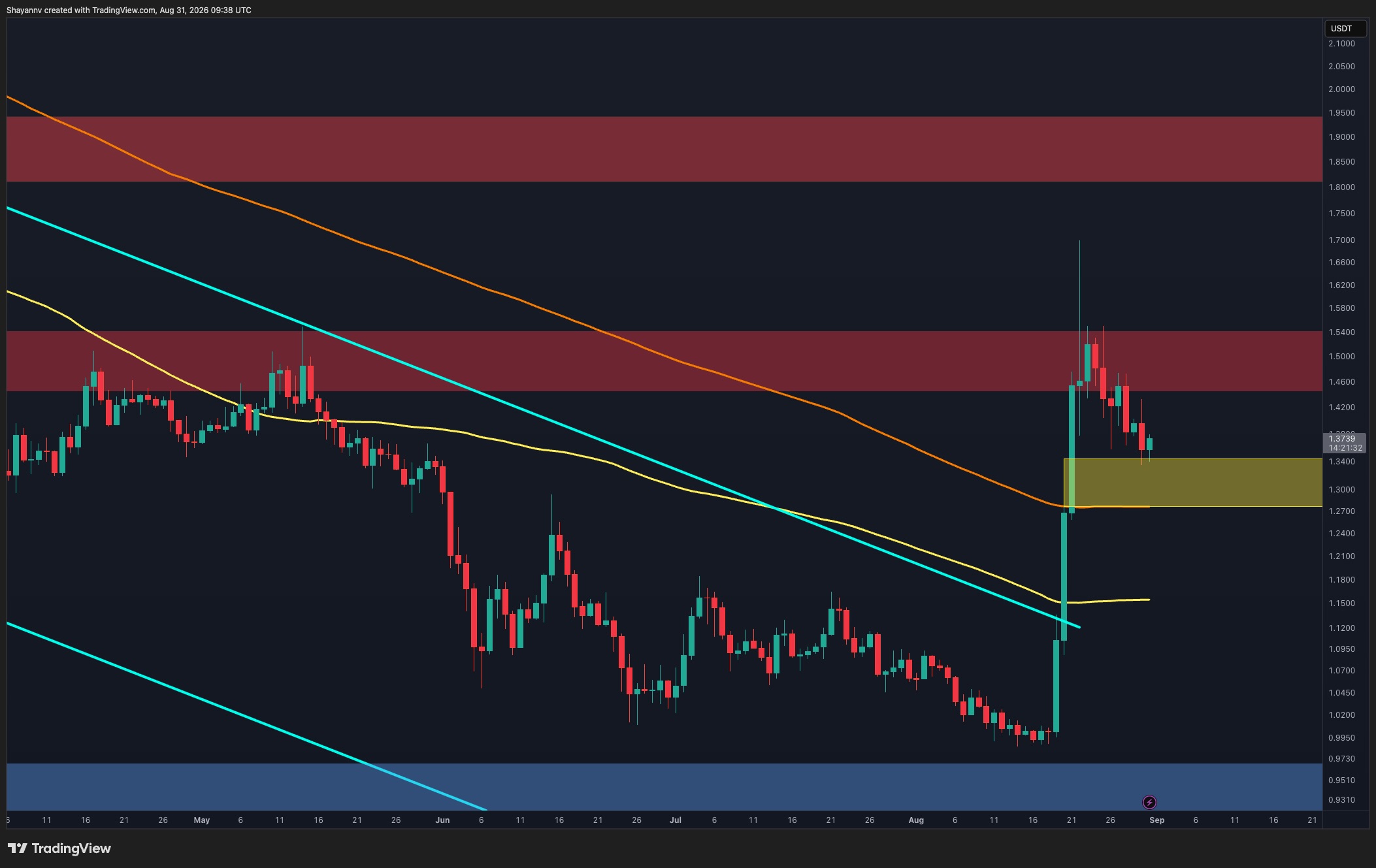
    Ripple’s XRP is currently in a corrective phase following its significant surge past the $1 mark. While the cryptocurrency’s broader market structure has seen considerable improvement, a waning momentum below the $1.45-$1.55 resistance zone suggests that a deeper pullback or extended consolidation may be necessary before XRP can mount another sustained advance.

    On the daily chart, XRP’s breakout signaled a substantial structural shift, as the price exited a prolonged descending channel and decisively moved above key moving averages. However, the rally encountered significant selling pressure within the $1.45-$1.55 resistance area. The long upper wick reaching towards $1.70 further underscores the rejection of higher price levels.

    Since then, XRP has retreated to approximately $1.37. The subsequent pattern of lower highs and lower lows indicates that short-term momentum has turned corrective.

    The initial significant support level is identified as the $1.27-$1.34 zone. This area also coincides with the higher moving average on the chart, enhancing its technical importance. A positive reaction from this region could enable XRP to stabilize before attempting to challenge the $1.45-$1.55 resistance zone once more.

    Conversely, a daily close below $1.27 would undermine the post-breakout structure and increase the likelihood of a more pronounced correction. In such a scenario, the lower moving average, situated around $1.15, could become a relevant price point, preceding the broader demand zone between $0.93 and $0.97.

    Technical Outlook on Shorter Timeframes

    Examining the 4-hour chart reveals XRP consolidating after its initial ascent from around $0.99 to $1.70. The subsequent rejection from the $1.43-$1.55 supply zone has gradually pushed the price back towards the 0.5 Fibonacci retracement level, which sits at $1.34.

    This positions the $1.33-$1.34 area as a critical near-term decision point. XRP has already tested this level, eliciting a modest response, but buyers have yet to engineer a convincing recovery. Maintaining a position above this level could lead to continued sideways trading and potentially another attempt at the $1.43-$1.55 resistance.

    However, if the $1.34 level fails to hold, the correction could extend towards subsequent Fibonacci retracement levels. The 0.618 retracement at $1.26 falls within the first notable pullback zone, while the 0.702 level near $1.20 offers another support reference. A more substantial correction would bring the 0.786 retracement at $1.14 and the broader $1.09-$1.14 support zone into focus.

    For the time being, the short-term structure remains corrective below the $1.43-$1.55 resistance. A sustained reclaim of this zone would be essential to decisively shift momentum back in favor of the bulls and re-open the possibility of challenging the $1.70 high.

  • Ripple’s 4-Stage Quantum Security Plan: XRP’s Future Impact?

    Ripple’s 4-Stage Quantum Security Plan: XRP’s Future Impact?

    Ripple’s Quantum Security Roadmap Could Redefine Network Risk Pricing

    Ripple has unveiled a comprehensive four-stage post-quantum roadmap for the XRP Ledger (XRPL), a plan that could significantly alter how the market assesses long-term network risk. A key detail within the phasing schedule is particularly noteworthy for traders.

    Quantum-Proofing the XRP Ledger

    Ripple is proactively preparing the XRPL for the advent of “Q-Day,” the theoretical point at which quantum computers could compromise current cryptographic security protecting digital assets. The company’s plan outlines a migration strategy that begins with an emergency “Q-Day” recovery protocol and culminates in a targeted mainnet code amendment by 2028.

    The initial phase allows users to transition to quantum-safe accounts without compromising their existing private keys. The second phase, scheduled for the first half of 2026 on AlphaNet, will involve testing algorithms recommended by the National Institute of Standards and Technology (NIST), specifically ML-DSA. The XRPL’s built-in key-rotation functionality provides a structural advantage that many older blockchain networks lack.

    While Shor’s algorithm-capable quantum computers remain theoretical, markets often price in future narratives long before immediate threats materialize. XRP holders are likely to see the narrative of being the “first major Layer 1 with a formal quantum timeline” gain traction over the next two years.

    XRP’s Market Position

    XRP has experienced a pullback from its August highs, currently consolidating within the $1.34 to $1.40 range. The 7-day chart shows a decline of nearly 10%, although the monthly performance remains positive.

    Trading volume has diminished in tandem with price compression, a common indicator that the market is awaiting a catalyst rather than committing to a specific direction. Recent analysis suggests that for bulls to reclaim the $1.40 resistance level, volume confirmation, not just headline momentum, will be crucial.

    Shorter-Term Opportunities

    Despite the bullish implications of Ripple’s quantum security news on paper, the 2028 implementation timeline offers little immediate benefit for traders focused on weekly charts. Holders who have realized gains from August are now facing a market that appears to be prioritizing patience over immediate returns.

    This market dynamic often prompts capital to seek opportunities with shorter investment horizons. Support-testing scenarios like these can drive traders toward earlier-stage projects where significant upside potential is not yet fully priced into a multi-billion-dollar market capitalization.

    Maxi Doge Emerges as an Alternative

    In this environment, Maxi Doge ($MAXI), an Ethereum-based meme token, is positioning itself as an alternative. Built around a mascot and an ethos of consistent effort, the project combines gym-bro humor with a trading community focus.

    The presale has reportedly raised $4.8 million, with the token currently priced at $0.0002836. Early buyers can benefit from a 65% APY staking reward. Notable features include exclusive trading competitions for holders with leaderboard prizes and a Maxi Fund designated for liquidity and strategic partnerships. Investors are encouraged to research Maxi Doge via its official presale page before the presale concludes.

  • Polygon Crypto Deploys Austin and Kyoto Hard Forks to Bolster Network Security

    Polygon Crypto Deploys Austin and Kyoto Hard Forks to Bolster Network Security

    Polygon Crypto has implemented two coordinated hard forks, named Austin and Kyoto, to address critical security vulnerabilities in its Bor and Heimdall clients. These upgrades, designed to mitigate denial-of-service, resource-exhaustion, and consensus-hardening risks, were deployed privately and validated on the Amoy testnet before being activated on the mainnet, according to a Polygon forum post published August 27.

    The Austin hard fork, integrated into Bor client version v2.10.0, resolved two denial-of-service vectors. Firstly, it introduced an explicit per-block gas bound for state-sync events, which previously lacked metering and could potentially cause temporary chain stalls. Secondly, Austin removed Bor’s TxDependency wire field, an unbounded hint for parallel execution that posed a risk of crashing block-processing peers.

    Concurrently, the Kyoto hard fork, applied to Heimdall client version v0.11.0, targeted consensus-edge-case risks. Its primary focus was on deeply nested google.protobuf.Any fields within Heimdall transactions. To prevent potential exploitation where a single transaction could impose disproportionately high decode work on all validators, Kyoto now enforces a byte-level pre-scan for these fields at both mempool admission and on the consensus path.

    Kyoto also incorporated several smaller hardening fixes, including a cap on fee-coin counts and normalized checkpoint signature recovery bytes, contributing to overall protocol resilience. These layered validation hardening measures align with broader industry efforts to secure transaction-processing edge cases.

    Both hard forks were activated on the Amoy testnet and Polygon PoS mainnet prior to the public disclosure. Austin activated at Amoy block 44,120,000 and mainnet block 91,949,700, while Kyoto activated at Amoy height 42,252,000 and mainnet height 51,533,000.

    Participation in these upgrades is mandatory for network integrity. Bor v2.10.0 is required for all nodes, and Heimdall v0.11.0 is mandatory for all validators and full nodes. These are plain binary upgrades, meaning operators already running current versions do not require state migration or genesis changes. However, nodes operating on pre-fork binaries past the activation heights have diverged from canonical consensus and must upgrade and roll back to resync.

    Polygon Crypto clarified that the vulnerabilities addressed were primarily resource-exhaustion and consensus-edge-case risks, rather than fundamental correctness failures. Crucially, no mainnet disruption or exploitation was observed in connection with these issues. The network’s security management approach involved fixing the issues, confirming fleet safety, and then disclosing the details.

    This proactive and private deployment of critical security patches by Polygon Crypto underscores a commitment to maintaining network integrity and stability, effectively mitigating potential risks before they could impact the network.

    Why This Matters

    The materials describe a narrow update: Polygon Crypto implemented two coordinated hard forks, Austin (Bor v2. The exact nature and severity of potential exploits if the vulnerabilities had not been patched.

    Broader Context

    Source materials place the factual news in this context: Polygon Crypto deployed two coordinated hard forks , Austin on Bor v2.10.0 and Kyoto on Heimdall v0.11.0, to close denial-of-service, resource-exhaustion and consensus-hardening risks across its Polygon PoS client stack.

  • Cardano Integration Enhances Supply Chain Verification on Blockforce Platform

    Cardano Integration Enhances Supply Chain Verification on Blockforce Platform

    Cardano’s ADA blockchain has been integrated as the public proof layer in Blockforce’s supply-chain traceability platform, enabling independent verification of records. This integration allows for the anchoring of cryptographic proofs of supply-chain data onto the Cardano blockchain, while sensitive commercial details remain on a permissioned network, specifically Hyperledger Fabric.

    The dual-ledger approach ensures that while the integrity of supply-chain records can be independently verified by auditors, regulators, or customers, the underlying commercial data is not exposed. This addresses a key challenge in supply chain management: the need for transparency and verifiability without compromising business confidentiality.

    More than 500,000 supply-chain records have already been anchored using this model. Joint engineering efforts between Cardano and Blockforce have resulted in a significant cost reduction, with the cost per record for public verification cut by 92%. This substantial reduction is critical for making large-scale public verification economically viable for enterprises.

    Guilherme Pereira, from the Cardano Foundation, framed this integration as a milestone in fitting blockchain technology naturally into enterprise infrastructure, delivering the verifiability, traceability, and scale that companies require. Suelen Joner highlighted the importance of a public network for maintaining the integrity of supply chain records over their full lifecycle, especially when records are questioned years after they are written.

    The Blockforce platform utilizes Hyperledger Fabric for managing detailed records on a permissioned network, accessible only to involved parties. Only the cryptographic proofs of these records are then anchored to the Cardano blockchain. This architecture is detailed in a case study by the Cardano Foundation.

    While the announcement highlights the capability for auditors and regulators to independently verify record integrity, it does not certify compliance with any specific regulatory regime. Broader references to EU sourcing rules circulating in trade coverage should be considered market context rather than direct claims made by the Cardano Foundation or Blockforce.

    The system is already in use with some of Brazil’s largest fashion groups. Azzas 2154, for instance, aims to trace 100% of the leather across its brands by 2030, utilizing this dual-ledger structure. The solution is designed to work with existing data suppliers produce, turning it into a single auditable record without requiring new systems from them.

    Expansion of this model is planned for other sectors, including automotive, agribusiness, pharmaceuticals, and cosmetics, all leveraging the same dual-ledger structure for enhanced traceability and verification.

    Why This Matters

    The materials describe a narrow update: Cardano’s ADA blockchain has been integrated as the public proof layer within Blockforce’s supply-chain traceability platform. The specific regulatory regimes for which this model provides verification capability are not named.

  • Ireland’s New State Savings Scheme Excludes Cryptocurrency

    Ireland’s New State Savings Scheme Excludes Cryptocurrency

    Ireland is launching a new tax-advantaged state savings scheme next year, designed to encourage domestic investment in traditional financial products, but it may explicitly exclude cryptocurrency assets. This move signals a cautious regulatory approach by the Irish government towards digital assets.

    The scheme, expected to open for accounts next year, will permit investments in shares, bonds, funds, exchange-traded funds (ETFs), and insurance-based products. Details on contribution thresholds and tax rates are scheduled for announcement on Budget day, October 6.

    Minister for Public Expenditure, Simon Harris, stated the scheme aims to “make a real difference in building up your own economic resilience.” It targets the approximately $203 billion (€175 billion) held in Irish household deposit accounts. This initiative comes as Irish households demonstrate a lower propensity for direct investments and investment funds compared to the EU average, holding only 2.3% of their financial assets in direct investments and 2.2% in investment funds, according to Central Bank of Ireland research published in late 2025.

    The exclusion of crypto assets aligns with broader governmental efforts to enhance financial crime prevention and anti-money laundering measures. Ireland launched its first national anti-money laundering strategy on August 13, introducing enhanced checks on transfers involving private wallets and stricter due diligence on firms dealing with overseas crypto companies. This strategy builds on a June action plan that identified crypto-asset misuse as an evolving financial-crime threat.

    While the new savings scheme will not accommodate cryptocurrencies, approximately 10% of Irish adults reportedly own digital assets, with an average holding of €2,266. The government’s stance, evidenced by the savings scheme’s exclusion and recent anti-money laundering measures, suggests a deliberate effort to channel savings into more traditional and regulated financial products.

    In parallel, the tax treatment of eligible investments is under review. The tax rate for deemed disposal, a tax on the increase in value of certain assets, was previously cut from 41% to 38% and is being further considered, with a government report recommending its potential scrapping. This contrasts with the outright exclusion of crypto from the new savings scheme.

    Key uncertainties remain regarding the precise contribution caps and tax thresholds for the new savings scheme, which will be fully announced in Budget 2027. The scheme’s introduction is part of a broader effort to encourage domestic investment and financial resilience among Irish tax residents, who are entitled to one account each. Contributions up to a tax-free threshold will be exempt from tax, while amounts exceeding this may be subject to a low, annual flat rate. There will be no minimum contribution or lock-in period, though an annual contribution cap will apply.

    The government’s approach prioritizes traditional financial instruments while maintaining a cautious stance on the cryptocurrency market.

    This story matters because Ireland’s decision to exclude cryptocurrency from its new state savings scheme reflects a broader regulatory trend. By channeling domestic savings into traditional assets, the government aims to bolster economic resilience and align with anti-money laundering efforts, despite a segment of the population holding digital assets. This cautious approach to crypto, contrasted with incentives for traditional investments, highlights Ireland’s evolving stance on digital assets within the European financial landscape.

    Why This Matters

    The materials describe a narrow update: Ireland is launching a new state savings scheme for tax-resident adults, which will allow investments in shares, bonds, funds, ETFs, and insurance-based products. The exact thresholds and rates for the tax-free and flat-rate contributions.

    Broader Context

    Source materials place the factual news in this context: The target is the roughly $203 billion (€175 billion) sitting in Irish household deposit accounts.

  • Monero Surges to 7-Month High: Analysis and Outlook

    Monero Surges to 7-Month High: Analysis and Outlook

    Monero Surges to 7-Month High, Defying Broader Market Downturn

    Most major digital assets experienced minor losses over the past 24 hours, with the overall cryptocurrency market capitalization also seeing a slight retreat. However, the privacy-focused token Monero (XMR) bucked the trend, posting a significant double-digit gain and inching closer to the top 10 cryptocurrencies by market value.

    XMR’s Impressive Performance

    Monero emerged as the top performer among the top 100 cryptocurrencies on August 31, with its price briefly soaring to nearly $530. This marks the highest valuation for XMR since January of this year. According to CoinGecko, the token is currently trading around $525, representing a substantial 43% increase over the past month.

    The asset’s market capitalization has climbed to nearly $10 billion, surpassing prominent altcoins such as Chainlink (LINK) and Cardano (ADA), and positioning it as the 13th-largest cryptocurrency.

    Key Catalysts for the Rally

    A primary driver behind Monero’s upward momentum appears to be an upgrade to the THORChain network, which reportedly introduced native support for XMR swaps.

    On social media platform X, user Nebrasangooner identified breaking above the $410 resistance level as a crucial bullish trigger, suggesting the asset is poised for further ascent. Meanwhile, commentator David Gokhshtein expressed surprise at Monero’s significant gains, noting its absence from many major exchanges.

    It is worth recalling that at the start of 2024, Binance discontinued all services related to Monero, which led to a considerable price drop. XMR also remains unavailable on Coinbase. Among the few prominent platforms that still support the token are Kraken, KuCoin, and MEXC.

    Other X users, including Mav and Sweep, have weighed in on the price surge. Mav suggested that the move above $500 confirms Monero’s comeback, while Sweep described it as “an absolute sleeping giant” and “the real privacy token.”

    On-Chain Data Signals Potential for Further Gains

    Recent exchange net flow data for Monero indicates a potential for continued upward movement. CoinGlass data reveals that outflows have exceeded inflows in recent days. This trend suggests that investors are shifting away from centralized exchanges in favor of self-custody, thereby reducing immediate selling pressure.

    Technical Indicators Hint at Caution

    Despite the bullish sentiment and on-chain signals, Monero’s Relative Strength Index (RSI) suggests a potential for an upcoming correction. The RSI, a technical analysis tool that ranges from 0 to 100, typically indicates an overbought condition when it exceeds 70, signaling a possible downward price adjustment. Conversely, readings below 30 suggest an oversold territory, which can be interpreted as a buying opportunity. As of this report, the RSI for XMR stands at approximately 77.

  • XRP Eyes $2 on Bullish Metric

    XRP Eyes $2 on Bullish Metric

    XRP Price Eyes $2 Amidst Surge in Network Activity and Stablecoin Volume

    XRP is currently in a consolidation phase following a strong August performance. While the ambitious $2 price target appears challenging on current charts, a fundamental metric is providing a glimmer of hope for bullish investors.

    Despite a recent 5% dip over the past week, XRP remains up approximately 31% for August. This pullback occurred after a period of volatility, with the cryptocurrency trading between $1.35 and $1.55 for much of the month. Concurrently, the volume of the RLUSD stablecoin on the XRP Ledger surpassed $1 billion on August 30.

    XRPL Activity Surges

    The XRP Ledger (XRPL) has witnessed a significant uptick in activity. The number of receiving addresses briefly surged to 926,000, while the transaction rate climbed by an impressive 151%. The expansion of tokenized assets, including stocks, metals, and real estate in Dubai, on the XRPL is contributing to this growth. While the burgeoning real-world asset (RWA) sector is expanding, it remains unclear if it is the sole driver of this activity spike.

    Network Participation Skyrockets

    Beyond just volume, active addresses on the XRPL have also seen a dramatic increase, soaring over 650%. In just two weeks, this figure jumped from 47,180 to 356,070. This sharp rise in network engagement coincided with XRP’s recent rally, suggesting that the price movement was underpinned by robust blockchain activity. Should this momentum persist and XRP successfully reclaim the resistance zone between $1.55 and $1.60, it could pave the way for further gains, targeting $1.70, $1.80, and ultimately the psychologically significant $2 mark.

    Bitcoin traded just below $78,000 on Monday morning, showing little movement for the day, as the broader market experienced a significant divergence. Current market sentiment indicates uneven risk appetite, and XRP’s next directional move will likely depend on its ability to break free from this market choppiness.

    Technical Outlook and Support Levels

    Short-term support for XRP is identified in the $1.30–$1.36 range, with a daily pivot point near $1.36 and deeper structural support around $1.28. Immediate resistance lies at $1.41–$1.45, a zone XRP must reclaim to sustain any serious upward momentum. The current pullback from the upper Bollinger Band, which hovers near $1.40, appears to be a cooling-off period rather than a breakdown, as momentum gradually eases.

    Investor attention will remain focused on whale flows in contrast to demand from exchange-traded funds (ETFs).

    Holding XRP through this period of market fluctuation requires conviction. While the RLUSD volume surge is a positive development, a move from $1.37 to $2 represents a gain of “only” 46%. This may be sufficient for a strategic position, but it is unlikely to generate outsized returns at this stage of the market cycle. Consequently, more traders are reportedly shifting their focus to infrastructure projects in their presale stages, where the potential for higher upside is perceived to be greater.

    One such project, Bitcoin Hyper ($HYPER), is developing the first Bitcoin Layer 2 solution with native SVM integration, promising smart contract execution faster than Solana, all built upon Bitcoin’s foundational security. The presale has already raised $33 million, with the current token price at $0.0136855. Early participants can benefit from an attractive 35% APY staking reward. The project’s Decentralized Canonical Bridge aims to address Bitcoin’s long-standing programmability limitations without compromising trust assumptions. Investors are encouraged to research Bitcoin Hyper before the presale window closes.

  • Bitcoin ETF Inflows Reverse Amidst Divergent Regulatory Outlook for Digital Assets

    Bitcoin ETF Inflows Reverse Amidst Divergent Regulatory Outlook for Digital Assets

    U.S. spot Bitcoin exchange-traded funds (ETFs) experienced a reversal in investment flows at the end of last week, concluding a nine-day streak of inflows. This development occurs as regulatory clarity for Bitcoin appears more established compared to that for more complex digital assets like decentralized finance (DeFi) protocols and altcoins, with the CLARITY Act’s progress remaining uncertain.

    Robert Mitchnick, BlackRock’s head of digital assets, stated that the CLARITY Act, officially known as the Digital Asset Market Clarity Act of 2025 (H.R. 3633), is less critical for Bitcoin than for other segments of the crypto market. He indicated that institutional investors do not consider further legislation a base-case assumption for Bitcoin, viewing potential regulatory progress as an upside rather than a requirement. This contrasts with the DeFi and altcoin sectors, where Mitchnick described the regulatory landscape as unsettled.

    The recent shift in ETF flows saw a nine-day inflow streak, which had accumulated $2.8 billion, come to an end. While specific daily figures for the outflows were not detailed, the trend marks a pause in the consistent demand observed previously. BlackRock’s iShares Bitcoin Trust (IBIT) was noted as leading inflows on the preceding Thursday with $277 million. Overall, Bitcoin ETFs have seen cumulative net inflows totaling $55 billion, with total net assets reaching $98.6 billion, as Bitcoin traded near $78,500.

    Mitchnick’s perspective suggests that Bitcoin’s institutional case is not contingent on the passage of new legislation. This is in contrast to the broader digital asset market, where regulatory uncertainty persists. The CLARITY Act has passed the House of Representatives, according to Congress.gov, but its latest recorded action is a Senate cloture motion from August 8, 2026, indicating it has not yet been enacted into law.

    BlackRock has been expanding its digital asset offerings. Beyond its Bitcoin ETF, the firm has introduced Ethereum-based products, including both staking and non-staking options. This summer, BlackRock also launched a Bitcoin premium income product designed to offer investors potential upside while generating yield and moderating volatility. Furthermore, Mitchnick noted opportunities for stablecoins beyond trading, including applications in cross-border payments and capital markets, with the implementation of the Genius Act approaching.

    The divergence in regulatory outlooks may influence institutional investment strategies. While Bitcoin appears to have a more defined regulatory path, the uncertainty surrounding DeFi and other complex crypto assets could present challenges or opportunities for investors navigating the evolving digital asset space. The CLARITY Act’s progress, or lack thereof, remains a key factor in shaping the future regulatory environment for these markets.

    Why This Matters

    The materials describe a narrow update: U. The ultimate impact and timeline of the CLARITY Act on different crypto assets.

    Broader Context

    Source materials place the factual news in this context: U.S. spot Bitcoin ETFs turned negative at the end of last week, ending a nine-day inflow streak that had brought in a total of $2.8 billion.

  • XRP Sharpe Ratio Hits One-Year High

    XRP Sharpe Ratio Hits One-Year High

    XRP Sees Strongest Risk-Adjusted Returns in a Year

    XRP has demonstrated a significant improvement in its risk-adjusted returns, with its Sharpe Ratio on Binance reaching its highest point since August 2025. The metric is currently hovering around 0.207, according to data from CryptoQuant, as the token’s price approaches $1.40.

    Improved Volatility-Adjusted Performance

    In recent months, XRP’s Sharpe Ratio had largely remained in negative or neutral territory, experiencing a notable decline during broader market downturns. The current uptick suggests that investor returns have strengthened relative to the level of volatility they are encountering. This rise in the Sharpe Ratio coincides with XRP’s price recovery, which has seen a nearly 30% increase over the past month. CryptoQuant noted that this suggests the recent price movement is underpinned by stronger risk-adjusted performance, rather than being solely an isolated price surge.

    Institutional Demand Fuels Inflows

    However, the indicator’s ascent to its yearly high does not definitively signal a sustained uptrend for XRP. The Sharpe Ratio could potentially reverse if market volatility escalates or if the token experiences a substantial correction.

    Meanwhile, institutional interest in XRP-linked investment products has been robust. Last week, U.S.-based spot ETFs attracted $110.49 million in inflows over five days. CryptoPotato reported this as the first weekly inflow exceeding $110 million since early December 2025. Each trading session concluded with positive inflows, with every day seeing more than $10 million invested. Monday recorded $13.82 million, followed by $23.87 million on Tuesday. Wednesday saw the highest daily inflow of $28.14 million, marking the strongest single-day performance for these funds since January 5. Thursday added another $18.47 million, and Friday brought in $26.2 million. These latest figures have propelled the total net inflows across the five ETFs to a record $1.66 billion. Bitwise continues to lead other issuers, with its ETF now holding cumulative inflows exceeding $600 million.

    Key Resistance Levels to Watch

    Despite the positive outlook, crypto analyst ChartNerd suggests that a move towards $1.80 or $2 for XRP may be contingent on the token reclaiming the $1.54 level. This price point represents a six-month resistance barrier as well as the weekly 50 Exponential Moving Average (EMA). ChartNerd clarified, “Just to be clear, and to reaffirm. I am not suggesting XRP can’t push up towards $1.80/$2. I am suggesting we are under resistance, and if we do get the follow through, it will likely open up an even deeper retrace than what we would witness rejecting the weekly 50 EMA at $1.54.”