Category: Uncategorized

  • Digital Asset Market CLARITY Act: Senate Path Uncertain Amid Procedural Steps

    Digital Asset Market CLARITY Act: Senate Path Uncertain Amid Procedural Steps

    The Digital Asset Market CLARITY Act (H.R. 3633) has passed the House of Representatives, but its progression through the Senate remains uncertain, with a key procedural step taken but no guarantee of final passage.

    The bill, which aims to establish a regulatory framework for digital commodities, cleared the House on July 17, 2025, with a vote of 294-134. Subsequently, on August 8, 2026, a cloture motion on the motion to proceed was filed in the Senate. This procedural step indicates an effort to end debate and move forward, but it does not signify final Senate approval of the bill.

    According to the Congressional Research Service summary published on Congress.gov, the legislation defines digital commodities as digital assets whose value derives from a blockchain. The bill generally assigns primary regulatory responsibility for digital commodity transactions to the Commodity Futures Trading Commission (CFTC), while the Securities and Exchange Commission (SEC) retains jurisdiction over certain specified digital commodity activities and transactions. Digital commodity exchanges, brokers, and dealers would also be subject to the Bank Secrecy Act under the proposed framework.

    Despite the official legislative actions, the outlook for the bill’s passage in the Senate is not definitively clear. Market odds from sources like Polymarket have suggested a lower probability of the bill receiving the necessary support, with odds pricing in a 60-plus Senate vote at approximately 25%. This market signal, alongside broader industry commentary, presents a divergence from the formal legislative status.

    Industry figures have expressed differing views on the bill’s prospects. For instance, BitGo CEO Mike Belshe has warned that regulators might take action on digital assets independently of the CLARITY Act’s passage. SEC Chair Paul Atkins and CFTC Chair Michael Selig have also signaled similar intentions, suggesting that regulatory bodies may proceed with guidance or rule-making even if the bill does not become law.

    Congress.gov identifies the Senate’s latest action as the August 8, 2026, cloture motion. The legislative record documents this procedural step but does not indicate whether the Senate will take a further vote or the outcome of any such vote. The Senate Banking, Housing, and Urban Affairs Committee is listed among the committees associated with the measure.

    The official legislative record currently documents House passage, Senate committee involvement, and the cloture motion on the motion to proceed. It does not resolve whether the Senate will take a further vote or whether the bill will ultimately become law. Therefore, while the bill has advanced through a significant House hurdle and seen procedural movement in the Senate, its ultimate enactment remains uncertain.

    Why This Matters

    The Digital Asset Market CLARITY Act’s journey through Congress highlights the complexities of legislative processes and the distinction between official status and market speculation. Understanding the bill’s current standing is crucial for navigating the evolving regulatory landscape of digital assets.

    Broader Context

    Source materials place the factual news in this context: The outlook for the Digital Asset Market Act remains unsettled as the bill moves through the Senate process.

  • Dallas Fed: Tokenized Deposits May Cut Bank Lending by $700 Billion

    Dallas Fed: Tokenized Deposits May Cut Bank Lending by $700 Billion

    Tokenized Deposits Could Undermine Bank Stability, Dallas Fed Warns

    Tokenized deposits, while potentially enabling faster payments, could also destabilize bank funding, according to a new report from the Dallas Federal Reserve. The study, released Tuesday, explores the implications of widespread adoption of this technology on bank liquidity and the practice of maturity transformation—where banks use demandable deposits to fund longer-term loans.

    The report highlights that advancements in distributed ledger technology, most notably blockchain, have paved the way for digital payment infrastructure and real-time settlement. While stablecoins have attracted significant attention and regulatory scrutiny both domestically and internationally, tokenized deposits have received comparatively less focus.

    Unlike stablecoins such as USDT and USDC, tokenized deposits are regulated and can offer interest payments. However, the Dallas Fed report cautions that features like instant settlement, smart contracts, and agentic artificial intelligence could empower customers to more easily seek higher yields, thereby diminishing the “stickiness” of current deposits.

    “Sticky deposits rely in part on the existence of frictions preventing rapid reallocation from one bank to another,” the agency stated. “Instant settlement would allow deposit holders who prioritize yield to switch banks almost instantaneously.”

    The prospect of faster deposit outflows and increased sensitivity to interest rate fluctuations could lead banks to become more hesitant in holding longer-term, fixed-rate assets. The Dallas Fed estimates that a 10% increase in deposit-rate sensitivity could reduce banks’ capacity to manage interest-rate risk by approximately $700 billion in 10-year-equivalent terms.

    Furthermore, the authors calculated separately that a 10% reduction in the weighted average life of deposits could diminish the banking system’s maturity-transformation capacity by $580 billion.

    “Alternatively, banks could strive to leave the composition of lending close to unchanged by altering their liabilities in other ways,” the report suggests. “This would likely include greater reliance on term debt issuance; on the margin, the economics of such lending activity funded by wholesale debt would resemble those of non-bank financial firms and would thus likely adversely impact the cost of credit for consumers and businesses.”

    This report emerges amid a growing wave of tokenized payment experiments by financial institutions. In October 2025, Custodia and Vantage launched a U.S. tokenized-deposit network. Barclays was reportedly exploring tokenized deposits and stablecoin payments as of February 2026, and BMO announced plans in March for round-the-clock tokenized cash settlement in collaboration with CME Group and Google Cloud.

    More recently, in July, the global payment system Swift revealed a pilot program involving 17 international banks to facilitate the transfer of tokenized deposits outside of standard banking hours. However, final settlement in this pilot would still be contingent on legacy payment systems operating during business hours.

  • XRP Leads Crypto Dip as Leverage Unwind Tests Rally

    XRP Leads Crypto Dip as Leverage Unwind Tests Rally

    Crypto Markets Brace for Inflation Data and Tech Earnings Amidst XRP Pullback

    Cryptocurrency markets are navigating a significant week, with Bitcoin briefly surpassing the $80,000 mark on Tuesday before settling around $78,000. Traders are now keenly awaiting crucial economic indicators, including the core Personal Consumption Expenditures (PCE) inflation data and Nvidia’s earnings report, both anticipated to shape market sentiment leading into the Jackson Hole Economic Symposium.

    While overall risk appetite has seen a broad improvement this month, the gains have not been evenly distributed across all digital assets. XRP, in particular, is experiencing a more pronounced retracement of its recent rally compared to the wider market.

    According to CoinMarketCap data, XRP has fallen 6.23% in the past 24 hours, trading near $1.38. This performance marks the weakest among the ten largest cryptocurrencies by market capitalization. This sharp reversal contrasts with XRP’s position earlier in the week, where it stood out as a market leader. Despite the recent dip, XRP remains up 35.55% over the past seven days, trailing only Hyperliquid’s 38.65% weekly gain among the top 10 and significantly outperforming Bitcoin, Ethereum, and other major cryptocurrencies.

    The current pullback can be attributed to the rapid pace of XRP’s recent ascent. The token surged from approximately $1.00 on August 18 to an intraday high near $1.69 just four days later. This aggressive move briefly touched the psychologically significant $1.70 level before Bitcoin’s own retreat from its $80,000 peak began to exert downward pressure on altcoins across the board.

    A notable positive development, however, comes from XRP-linked Exchange Traded Funds (ETFs). These traditional investment vehicles, which track XRP’s price without requiring direct ownership of the cryptocurrency, have recorded nine consecutive days of net inflows. This suggests that the current market dynamics are more indicative of leverage adjustments rather than institutional investors exiting their positions.

    XRP Price: Leverage Catches Up With the Rally

    On the daily chart, XRP opened at $1.4344, reached a high of $1.4513, and is currently trading around $1.3790, representing a 3.86% decline for the current trading session.

    This price action brings XRP back to the $1.40 zone, a level that recently transitioned from resistance to support following last week’s breakout. This is also the same level where XRP first reclaimed its 200-day exponential moving average, a technical milestone that chart watchers had identified as an early indicator of a potential trend reversal. The ability of XRP to hold the $1.40 level will be critical in determining whether this pullback remains a healthy correction or evolves into a more significant downturn.

    Technical indicators are presenting a mixed outlook. The Relative Strength Index (RSI), which gauges an asset’s overbought or oversold conditions on a scale of 0 to 100, stands at 66.7. While still in bullish territory, it is approaching the 70 mark, a level where traders often begin to take profits.

    The Average Directional Index (ADX), which measures trend strength irrespective of direction, is elevated at 44.1, well above the 25 threshold that signifies a confirmed trend. Furthermore, the positive directional line (DI+) remains above the negative directional line (DI-), indicating a bullish bias.

    However, moving averages present a conflicting view. The longer-term (EMA 200) and shorter-term (EMA 50) moving averages show the latter still positioned below the former. This structural arrangement is a remnant of the broader downtrend that has characterized XRP’s chart for much of the year, even as the price experienced its most substantial rally in months.

    Bitcoin’s ability to maintain support within the $77,000-$78,000 range will be a significant factor for all altcoins, including XRP. Tonight’s PCE data and Nvidia’s earnings report are the next scheduled catalysts that could influence this trend in either direction.

    For XRP specifically, the immediate focus is on defending the $1.40 level. Holding this support would likely preserve the integrity of its seven-day rally, suggesting a normal market cooldown. A daily close below $1.40, however, could trigger further selling pressure, with short-side indicators suggesting potential declines toward the lower boundary of the support zone established since August’s breakout.

  • ECB Outlines Digital Euro Privacy Amidst US CBDC Restrictions

    ECB Outlines Digital Euro Privacy Amidst US CBDC Restrictions

    The European Central Bank (ECB) is designing its planned digital euro to offer the maximum level of privacy achievable with current technology, according to ECB executive board member Piero Cipollone. This approach contrasts with recent US legislation that imposes significant restrictions on the Federal Reserve’s ability to issue a central bank digital currency (CBDC), highlighting divergent global strategies in digital currency development.

    In an interview published Monday, Cipollone stated that offline digital euro payments would be conducted directly between the payer and payee, with transaction details visible only to them. For online transactions, the Eurosystem would not be able to identify the individuals involved. However, commercial banks would still have access to transaction data for anti-money laundering (AML) purposes and would retain their reporting obligations.

    The ECB’s emphasis on privacy is seen as a response to concerns that a central bank digital currency could enable widespread surveillance of citizens’ spending habits. The Eurosystem has clarified that while privacy features are being built into the digital euro, these do not exempt it from existing regulations applicable to all forms of money.

    In contrast, the United States enacted the 21st Century ROAD to Housing Act on July 11, which prohibits the Federal Reserve from issuing a CBDC until the end of 2030. This legislation, passed by the US Senate in June with a vote of 85-5, requires explicit authorization from Congress for any future US CBDC issuance after the ban expires. The US law does, however, include an exemption for dollar-denominated currency that is open, permissionless, and private, and it does not affect stablecoin issuers regulated under last year’s GENIUS Act.

    These differing regulatory paths raise questions about the future development and adoption of CBDCs globally. The European Parliament agreed on its negotiating position for the digital euro regulation in July, with talks targeting a deal with member states by the end of 2026. A 12-month pilot program involving 36 payment providers is scheduled to begin in the second half of 2027, with the first issuance of the digital euro targeted for 2029.

    Cipollone has previously warned that the increasing use of stablecoins could erode retail deposits in European banks, in addition to the fees and transaction data already being lost to mobile payment platforms. The ECB’s focus on privacy for the digital euro may be an attempt to counter these trends and ensure public trust and adoption.

    Despite the assurances on privacy, uncertainties remain regarding the exact technical implementation of these features and the extent to which commercial banks will be able to monitor transactions. The final form of the digital euro regulation is also subject to ongoing negotiations, and the specific conditions and process for any future US CBDC issuance after 2030 remain to be determined by Congress.

    Why This Matters

    The materials describe a narrow update: Piero Cipollone, an ECB executive board member, stated in an interview that a digital euro would provide users with the highest possible level of privacy, with offline payments being direct between payer and payee, and online transactions not identifiable by the Eurosystem. The exact technical implementation of privacy features for the digital euro.

    Broader Context

    Source materials place the factual news in this context: The article discusses privacy concerns surrounding a potential digital euro and contrasts it with recent US legislation regarding central bank digital currencies.

  • TronBid Enhances TRON Marketplace for Energy and Bandwidth Trading, Aims to Reduce USDT Fees

    TronBid Enhances TRON Marketplace for Energy and Bandwidth Trading, Aims to Reduce USDT Fees

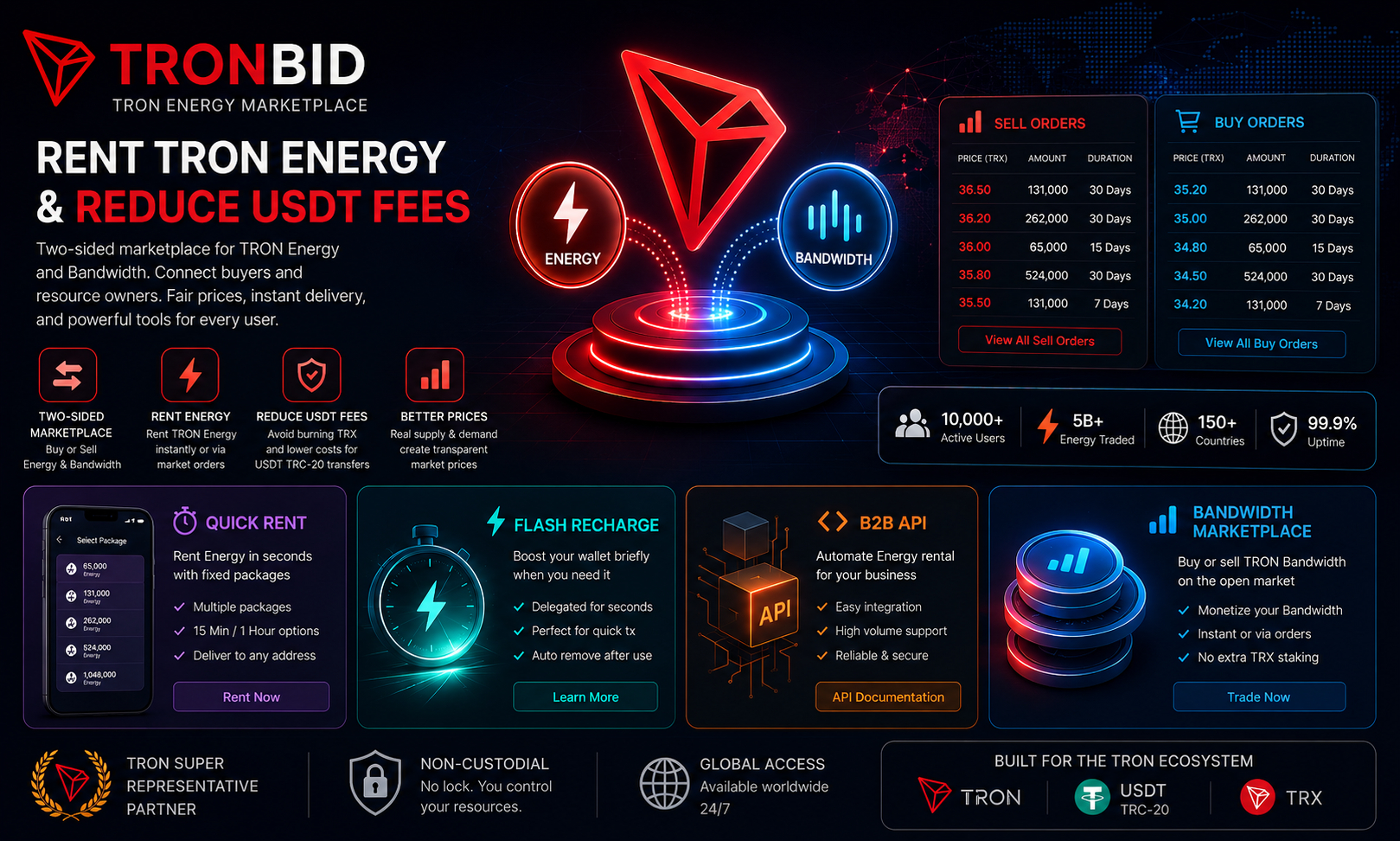
    TronBid has expanded its peer-to-peer marketplace for TRON network resources, introducing new features for renting Energy and Bandwidth, trading these resources, and reducing USDT fees for TRC-20 transactions. This expansion provides users and businesses with enhanced tools to manage their participation and costs on the TRON network.

    TRON utilizes Energy and Bandwidth as its primary network resources. Energy is required for smart contract execution, including processes such as USDT TRC-20 transfers. If a wallet lacks sufficient Energy for a transaction, the TRON network may consume TRX to cover the necessary resources. This scenario has driven demand for alternative methods of acquiring Energy, leading to platforms like TronBid.

    A Two-Sided Marketplace for Resources
    The expanded TronBid marketplace operates on a two-sided model, enabling both buyers and sellers to create orders. Buyers can specify the amount of Energy or Bandwidth they need, the desired rental duration, and their price. Sellers can post offers detailing the amount of resources they wish to rent out, their price, and the rental period. Buyers can then purchase these offers, with the option to acquire only a portion of a seller’s available resources.

    Enhanced Features for Immediate Needs and Businesses
    To address immediate resource requirements, TronBid has introduced ‘Quick Rent,’ offering predefined Energy packages for short-term rentals that can be delivered directly to any TRON address. For users who maintain their own Energy capacity but need to manage consumed resources, the platform provides ‘Flash Recharge.’

    TronBid also caters to businesses through a B2B Quick Rent API. This API allows exchanges, payment processors, wallets, and other businesses handling frequent TRON transactions to automate Energy rental. By integrating this functionality into their transaction infrastructure, companies can manage network-resource costs more efficiently, particularly for large volumes of USDT TRC-20 transfers.

    Monetizing Network Resources and SR Partnership
    Beyond Energy rental, TronBid’s marketplace supports Bandwidth trading, allowing holders of staked TRX to monetize unused network resources. By enabling both buyers and sellers to set their own terms, TronBid aims to foster more transparent price discovery based on actual supply and demand within the TRON ecosystem.

    Alongside these marketplace enhancements, TronBid has become a TRON Super Representative Partner. This development signifies a closer integration with the TRON network’s governance structure and underlying infrastructure.

    Why This Matters

    The materials describe a narrow update: TronBid has launched an expanded peer-to-peer marketplace for TRON network resources. By receiving temporary Energy delegated from another account, users can perform eligible TRON transactions without maintaining enough staked TRX for their maximum resource requirements.

    Broader Context

    Source materials place the factual news in this context: TronBid expands its two-sided TRON resource marketplace, giving users new ways to rent Energy, trade Energy and Bandwidth, and reduce USDT fees for TRC-20 transactions.

  • XRP Price Analysis: Examining Market Indicators Amidst Recent Price Movement

    XRP Price Analysis: Examining Market Indicators Amidst Recent Price Movement

    XRP’s price has seen a notable increase of over 45% in the past week, accompanied by a surge in active addresses and ETF trading volume. However, the sustainability of this rally remains uncertain, with key technical levels and market indicators providing a mixed outlook.

    The cryptocurrency experienced a significant price surge, gaining over 45% in the past seven days and 50% over the trailing week, though it remains down 20% year-to-date. Currently trading around $1.41, XRP saw a slight 2% decrease in the past 24 hours, suggesting traders are digesting the recent gains rather than reversing the trend.

    On-chain data indicates a substantial spike in network activity. According to analyst Ali Charts, active addresses surged by 650%, from 47,180 to 356,070. Receiving addresses reportedly increased by over 698%. This heightened activity, combined with three consecutive days of record trading volume for the Bitwise XRP ETF, has been interpreted by some as a sign of increased participation and potential accumulation.

    Whale positioning offers a more nuanced perspective than retail hype. While some initial profit-taking occurred, long positions that had dipped are reportedly climbing again. This pattern, where significant market participants re-enter after booking gains, often precedes continuation rather than a collapse, provided macro conditions remain favorable. XRP’s market capitalization currently stands at $80 billion.

    Technically, XRP is in a post-notable move consolidation phase. Key resistance levels are identified at $1.51, $1.53, $1.57, and $1.62. Support is layered at $1.31 and $1.30, with a more significant floor near $1.00. The current consolidation range is observed between $1.31 and $1.52.

    A sustained close above $1.51, supported by consistent ETF inflow volume, could potentially lead to a move toward $1.62 and beyond. Some analyst models suggest an upside target of $2.50 if new catalysts emerge. However, a break below the $1.30 support level would invalidate the near-term bullish structure and could bring the $1.00 zone back into play.

    The possibility of XRP reaching $10 this year is considered unlikely based on current data, as it would require approximately a seven-fold increase, and no clear catalysts of that magnitude are apparent yet. This outlook underscores the inherent uncertainties surrounding extreme price targets.

    In summary, XRP’s recent price action is characterized by increased on-chain activity and positive ETF trends, alongside cautious whale positioning. While technical indicators suggest potential upside if key resistance levels are breached, significant support levels and the absence of strong catalysts for extreme price targets introduce considerable uncertainty. Investors are advised to monitor established technical levels and consider the prevailing market conditions.

    Why This Matters

    The materials describe a narrow update: XRP’s price increased by over 45% in seven days, reaching $1. Whether the current XRP surge is the start of a larger trend or a temporary bounce.

    Broader Context

    Source materials place the factual news in this context: XRP is trading at $1.41, down 2% over the past 24 hours in a mild pullback after one of the sharpest weekly moves in the top-10.

  • CoinMarketCap Secures SOC and ISO Certifications to Enhance Data Trust and Security

    CoinMarketCap Secures SOC and ISO Certifications to Enhance Data Trust and Security

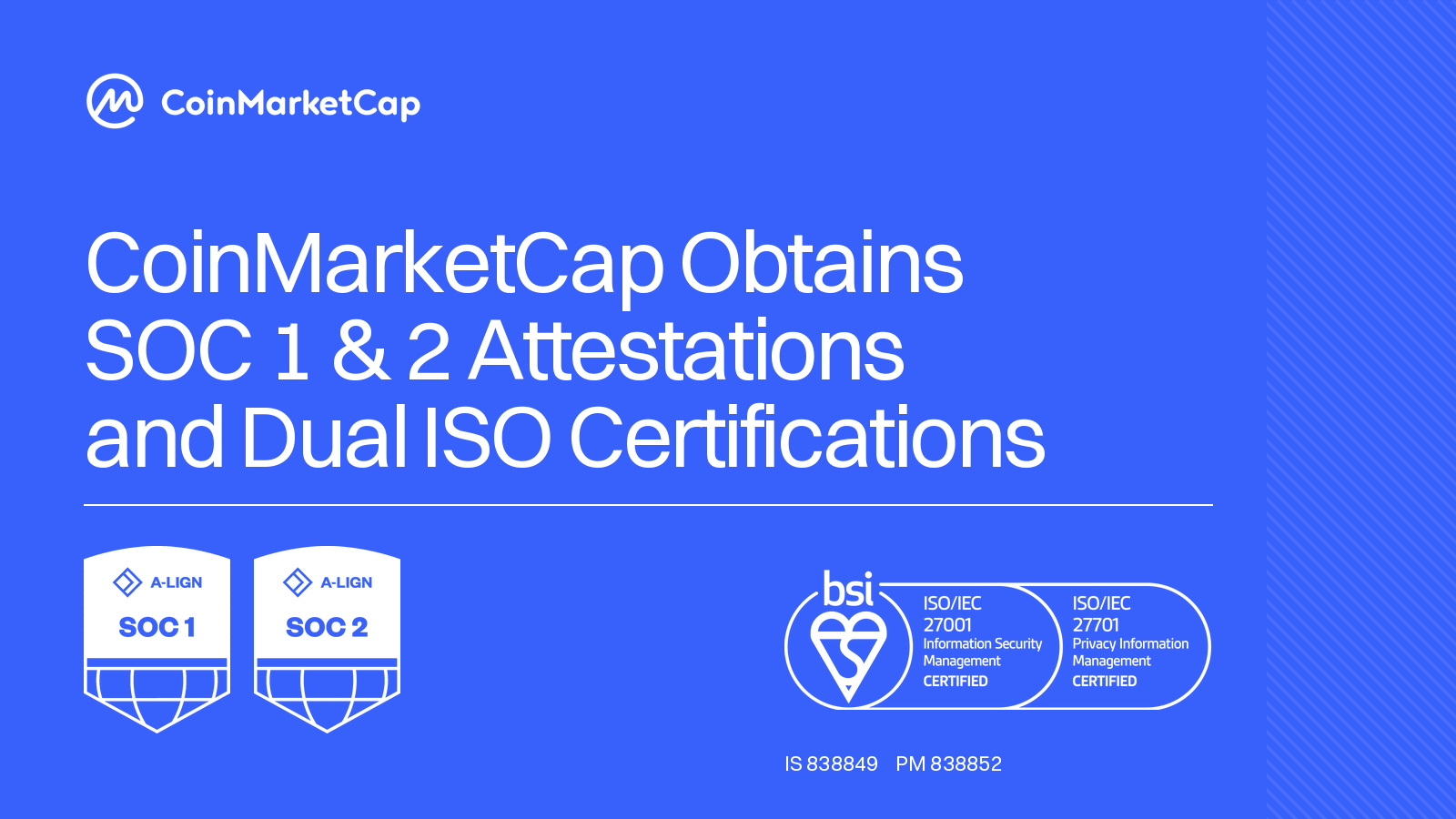
    CoinMarketCap has announced the attainment of SOC 1 Type 1 and SOC 2 Type 1 attestations, alongside dual ISO certifications for information security and privacy management. These certifications, obtained on August 26th, 2026, are designed to bolster trust and assurance for its institutional clients and the broader cryptocurrency ecosystem.

    Why This Matters

    The materials describe a narrow update: CoinMarketCap has successfully completed SOC 1 Type 1 and SOC 2 Type 1 examinations, which independently assess the controls protecting its market data systems and financial reporting controls, respectively. SOC 2 is the assessment most often requested by enterprise buyers evaluating a technology vendor.

    Broader Context

    Source materials place the announcement in this context: CoinMarketCap has obtained a SOC 2 Type 1 attestation report, following an independent examination of the controls protecting the systems behind its market data.

    Independent Verification of Controls

    The company has successfully completed independent examinations of its controls, including those protecting its market data systems and financial reporting. These attestations complement the existing ISO/IEC 27001:2022 certification for information security management and ISO/IEC 27701:2019 certification for privacy information management. Both ISO certifications were awarded by the British Standards Institution in June 2026.

    Understanding the Attestations and Certifications

    SOC 2 is frequently requested by enterprise buyers when evaluating technology vendors, assessing controls against the Trust Services Criteria for Security. The SOC 1 Type 1 report, meanwhile, covers controls relevant to internal control over financial reporting. Both Type 1 reports reflect controls as at a specified date and are available to partners and clients upon request.

    The scope of these assessments encompasses critical areas of CoinMarketCap’s operations, including price tracking, market data, APIs, cloud systems, operational processes, account management, the handling of personally identifiable information (PII), and its mobile applications. This comprehensive review aims to provide verifiable assurance of the company’s security and privacy practices.

    Demonstrating Trust Through Examination

    According to CoinMarketCap, the distinction being drawn is between security that is asserted and security that has been examined. Rush, CEO of CoinMarketCap, stated, “Trust in that data should be demonstrated rather than claimed. Independent assessors have examined how we run security and privacy, and documented it in a form our partners and clients can review.”

    Meeting Institutional Demands

    These credentials are increasingly a prerequisite for institutional clients, whose own obligations require them to evidence the controls of the vendors they depend on. CoinMarketCap, which serves as a primary data source for major financial news outlets and powers a significant portion of crypto infrastructure, including wallets and trading interfaces, aims to meet these rigorous demands.

    The ISO/IEC 27701:2019 certification, an extension of ISO 27001, specifically governs how personal data is collected, processed, and protected, aligning with global privacy regulations such as GDPR. For a platform with a global user base, this alignment is crucial.

    CoinMarketCap intends to maintain and extend its assessment program over time, reinforcing its position as a foundational data provider in the crypto space. With over 1 billion monthly page views and tracking 53 million cryptocurrencies, the company plays a significant role in organizing and delivering crypto intelligence.

  • Cardano Drops 6% Amid Correction Fears

    Cardano Drops 6% Amid Correction Fears

    Cardano’s native token, ADA, experienced a significant pullback on August 26, halting a recent rally as the broader cryptocurrency market saw a slight downturn. While many analysts maintain a positive outlook on the asset, some are cautioning that a double-digit percentage decline from current levels could be on the horizon.

    Recent Surge and Market Dynamics

    ADA had surged by 22% over the preceding two weeks, a rally attributed in part to a broader market revival influenced by monetary policy shifts announced by the U.S. Treasury Department. At its peak, the token reached a three-month high of over $0.25. However, the past 24 hours have seen a correction, with ADA trading around $0.21 at press time. This represents a 6% decline on the day, making it one of the day’s biggest decliners.

    Divergent Analyst Perspectives

    On the social media platform X, user SBlockSpy observed that ADA faced rejection around the $0.22 mark and is closely watching the current pullback. They suggested that the move indicates increased seller activity and predicted a potential downtrend to as low as $0.164 if selling pressure continues. Conversely, SBlockSpy believes that if buyers emerge, they could initiate an initial surge towards $0.24, followed by a move to $0.30.

    Another X user, Rand Group, also weighed in. Earlier this week, they highlighted ADA’s strong breakout, asserting that it had breached its primary downtrend resistance. However, Rand Group indicated they would remain on the sidelines until ADA consolidates above the $0.25 resistance level.

    Meanwhile, More Crypto Online expressed uncertainty about whether a “B-wave” pullback has commenced. They noted that as long as ADA maintains support above $0.157, upward momentum could persist, potentially pushing the price into the $0.314-$0.404 range.

    Bullish Outlooks Persist

    Despite the recent dip, several prominent figures on X remain firmly bullish on ADA. Earlier this month, analyst Lucky informed their nearly two million followers that ADA was among their “hot picks,” forecasting a short-term ascent to approximately $0.50. The last time ADA traded at such levels was in November of the previous year.

    Analyst CW also expressed optimism, opining that ADA has broken through a significant resistance line and transitioned into a bullish trend. “The long downtrend is over. The real bull market has begun,” CW stated.

  • Morning Minute: LayerZero Taps ATLAS for New Settlement Engine

    Morning Minute: LayerZero Taps ATLAS for New Settlement Engine

    LayerZero Aims to Power Global Exchanges with New Settlement Engine

    LayerZero, a company that has spent six years developing infrastructure for cross-blockchain token transfers, announced Tuesday the launch of ATLAS, a trading and settlement engine designed to operate behind the scenes of exchanges rather than directly compete with them. The news sent the price of its native token, ZRO, up more than 20%, trading near $1 earlier in the session.

    ATLAS is a backend system with no user interface. Trading platforms can integrate with it, retaining their own branding and customer base while outsourcing the complexities of matching, clearing, settlement, and risk management. LayerZero argues that platforms built on existing exchanges often find themselves in direct competition with the host exchange’s own applications, a situation that deters institutions from entrusting their core operations to such systems. The company is releasing two versions of ATLAS: one tailored for cryptocurrency applications and prediction markets, and another for firms requiring custom rule enforcement on the same engine. The system is designed to support a wide range of markets, from spot and perpetual futures to stocks, bonds, commodities, and prediction markets.

    “ATLAS is the embodiment of our belief that the world’s rapidly expanding asset base needs a neutral, performant engine that underpins the venues that will build across markets spanning the globe. Any market, anywhere in the world, 24/7, with industry-leading performance, all…” LayerZero stated in a post on X (formerly Twitter) on August 25, 2026.

    The ZRO token is integral to the ATLAS ecosystem. Trading venues can stake ZRO to receive fee rebates ranging from 20% to 65%. After these rebates, 75% of the remaining fees are used to buy and burn ZRO, while the other 25% is distributed to the market creator. This mechanism positions the token as a claim on trading volume, explaining the price surge following the announcement.

    This significant development arrives at a crucial juncture for LayerZero. In April, attackers siphoned approximately $292 million from Kelp DAO, a bridge utilizing LayerZero technology. This incident was followed by a notable exodus of protocols, including BitGo’s $7.7 billion in wrapped Bitcoin and Wyoming’s state stablecoin, collectively representing around $15 billion. However, the launch of ATLAS signals a potential resurgence in momentum. LayerZero has now established the infrastructure to support prominent players in the upcoming market cycle across perpetuals, tokenized stocks, prediction markets, and broader real-world assets (RWAs). The market’s response from potential partners will be closely watched.

  • Binance to Distribute Corning and Goldman Sachs Dividends via bStocks

    Binance to Distribute Corning and Goldman Sachs Dividends via bStocks

    Tokenized Securities to Distribute Dividends via Multiplier Adjustment

    BTech Holdings Limited, an affiliate of the Binance group, has announced that its tokenized securities, known as bStocks, will distribute dividends to holders of GLWB and GSB tokens. These bStocks are classified as certificates representing underlying financial instruments, rather than direct ownership of shares in the listed companies.

    Dividend Eligibility and Distribution

    On-chain holders of GLWB tokens will be eligible for dividend distribution based on a snapshot taken on August 31, 2026, at 00:00 UTC. Similarly, GSB token holders will be eligible based on a snapshot on September 1, 2026, at 00:00 UTC. The dividends will be applied through a multiplier adjustment to their holdings. Trading of GSB/USDT and GLWB/USDT pairs will not be impacted by this process.

    Service Suspensions for GLWB and GSB

    To facilitate the dividend distribution, several services will be temporarily suspended. For GLWB:

    • The token conversion service for 1:1 swaps between GLW stock and GLWB bStocks will be suspended at 23:30 UTC on August 28, 2026.
    • Deposits and withdrawals of GLWB tokens will be suspended at 23:30 UTC on August 30, 2026. Users are advised to ensure sufficient time for their GLWB token deposits to be fully processed before this deadline.

    For GSB:

    • The token conversion service for 1:1 swaps between GS stock and GSB bStocks will be suspended at 23:30 UTC on August 31, 2026.
    • Deposits and withdrawals of GSB will also be suspended at 23:30 UTC on August 31, 2026. Users should ensure their GSB deposits are fully processed prior to this time.

    Deposits, withdrawals, and the token conversion service for both GSB and GLWB will resume once the dividend distribution is complete. No further announcements will be made regarding the resumption of services. Users can opt to subscribe to recovery notifications where available.

    Dividends earned from assets held in accounts other than the Spot Account, such as Savings or Margin Accounts, will be credited to the Spot Account. Binance will manage all technical aspects of this event for affected users. Dividends, after the deduction of withholding tax, will be reinvested and distributed.

    Additional Information

    Users can refer to announcements from Corning Incorporated and Goldman Sachs Group for dividend history details. Further information regarding bStocks dividend distribution can be found in the FAQ section.

    Binance Convert will pause the conversion of GLWB and its associated pairs at 23:30 UTC on August 30, 2026. Similarly, the conversion of GSB and its associated pairs will be paused at 23:30 UTC on August 31, 2026.

    Binance reserves the right to amend or cancel this announcement at any time without prior notice. The information provided regarding tokenized securities is not intended as an offer or solicitation to buy or sell securities. Tokenized securities are not offered, sold, or made available in the United States or to U.S. persons. They have not been registered under U.S. securities laws, and a public offering will not be conducted in the United States or other jurisdictions, except for the ADGM. Users accessing this product represent and warrant that they are not U.S. persons and will not transact in tokenized securities from within the United States.