Category: Uncategorized

  • Crypto Market Shifts from Fear to Extreme Greed

    Crypto Market Shifts from Fear to Extreme Greed

    Crypto Market Surges into “Extreme Greed” for First Time Since Late 2024

    The cryptocurrency market has entered “extreme greed” territory for the first time since late 2024, according to the Crypto Fear and Greed Index.

    The index, measured by Coinmarketcap, reached 81 late Sunday evening and has maintained that level, surpassing the 80-point threshold that signifies panicked buying and strong conviction. This marks a significant turnaround for a market that has largely languished in “fear” over the past year, with only brief excursions into “neutral” territory.

    The rapidity of this shift is particularly striking. Just one month ago, the index stood at 36, firmly within the “fear” zone. A week prior, it was at 41, barely in neutral territory. The surge to 81 on Sunday and its sustained presence today represents a 45-point climb in 30 days, effectively erasing much of the caution that characterized the first half of 2026.

    This is also the fastest sentiment reversal between two extremes ever recorded, and the only instance of a move from extreme fear to extreme greed since Coinmarketcap began tracking the index. While Alternative.me, which has been monitoring sentiment for a longer period, places its index in “greed” (though not yet “extreme” by 6%), the momentum shift is consistent: traders are rapidly becoming extremely bullish, mirroring a similar movement observed in 2021.

    The index had previously bottomed out at 5 on February 5, deep within “extreme fear” and marking its lowest point of the year. The journey from that nadir to this week’s 81 represents a complete cycle from total capitulation to unbridled greed within six months – an arc typically associated with significant price volatility in spot markets.

    This sentiment reversal coincides with a surge in Bitcoin’s performance, which has outpaced the broader crypto market. Bitcoin saw gains of approximately 24% in a single week, while the overall crypto market experienced more modest growth, a disparity evident in Bitcoin’s increasing share of the total crypto market capitalization.

    The recent breakout appears to be linked to an announcement last Wednesday by the U.S. Treasury. The department stated it would double its long-bond buybacks – purchases of its own debt aimed at bolstering demand – from $2 billion to $4 billion per operation, effective September 9. This move is expected to weaken the dollar and encourage investors to turn to Bitcoin as a hedge against inflation.

    The same market conditions also compelled bearish traders to cover their positions at a loss. As Bitcoin surpassed the $70,000 mark, a short squeeze liquidated over $4 billion in crypto shorts within two to three days. Bitcoin ETFs recorded their largest single day of inflows since May, with both Ethereum and Bitcoin ETFs collectively attracting approximately $2.3 billion in assets.

  • XRP Soars on ETF Hopes

    XRP Soars on ETF Hopes

    XRP Price Surges as Spot ETF Inflows Skyrocket

    XRP is currently trading around the $1.50 mark, a seemingly stable figure that belies a dramatic three-week surge from $1.00 to nearly $1.70, defying bearish forecasts. Beneath the surface of this price action lies a significant shift in the ETF landscape, transforming a niche category into a crucial driver of demand.

    ETF Category Sees Explosive Growth

    Spot XRP Exchange-Traded Funds (ETFs) recorded net inflows of $39.78 million last week, marking the strongest weekly performance since mid-May. This influx has propelled cumulative net inflows to approximately $1.55 billion, a stark contrast to the week ending August 8th, when inflows plummeted to a mere $1.01 million. This dramatic turnaround has been described as a “zero to hero” narrative.

    Institutional Appetite Reaffirmed

    The timing of this surge in ETF inflows closely aligns with XRP’s breakout above the $1.20 level. This correlation suggests that institutional interest in XRP exposure, far from waning, has simply become more assertive and impatient.

    XRP is currently consolidating around the $1.50 area, with intraday trading between $1.46 and $1.54. This reflects a market still processing last week’s substantial 50% price increase. While trading volume has subsided from its peak during the breakout, it remains elevated compared to early August levels.

    Key Technical Levels to Watch

    The immediate technical hurdle for XRP lies at the $1.51 resistance level. Further upside targets are positioned at $1.60 and the recent high of $1.70. On the downside, bulls must defend the $1.45 level; a breach below this could lead to a retest of $1.36 and, in a worst-case scenario, a return to the $1.00 floor.

    The daily chart indicates that the Relative Strength Index (RSI) is in overbought territory. The price is currently positioned between the 20-day Exponential Moving Average (EMA20) and the 50-day Exponential Moving Average (EMA50), a configuration that often precedes a period of consolidation rather than continued upward momentum.

    Future Outlook for XRP

    Sustained ETF inflows could propel XRP past the $1.51 and $1.60 resistance levels, potentially leading to new price highs. Alternatively, consolidation may occur between $1.36 and $1.51 as momentum recalibrates. However, a stall in ETF inflows coupled with a sharp decline in the RSI could bring the $1.00 level back into play.

    Emerging Infrastructure Plays

    While XRP holders who entered at $1.00 have already realized significant gains, a cryptocurrency with a market capitalization exceeding $85 billion typically requires a substantial catalyst to double its value. The current overbought RSI and stacked resistance near $1.60 suggest that the easiest gains on this upward leg may have already been captured. This dynamic is prompting capital to shift towards earlier-stage infrastructure projects with greater growth potential.

    One such project, Bitcoin Hyper ($HYPER), is developing the first Bitcoin Layer 2 solution with full Solana Virtual Machine (SVM) integration. It claims to offer smart contract execution faster than Solana itself, while leveraging Bitcoin’s inherent security. The presale has reportedly raised $33 million at a current token price of $0.0136852, with a 35% Annual Percentage Yield (APY) staking option available for early investors. The project’s value proposition includes low-latency L2 processing, a decentralized bridge for Bitcoin transfers, and enhanced programmability for Bitcoin.

  • Las Vegas Businessman Convicted in $24 Million Cryptocurrency Investment Fraud

    Las Vegas Businessman Convicted in $24 Million Cryptocurrency Investment Fraud

    A Las Vegas businessman, Brent C. Kovar, has been convicted by a federal jury for defrauding over 400 investors of approximately $24 million through a cryptocurrency investment scheme operated by his company, Profit Connect. The scheme ran from late 2017 through July 2021.

    According to the US Justice Department, Kovar misled investors with false claims about Profit Connect’s operations and financial health. He allegedly promised fixed annual returns of 15% to 30%, a 100% money-back may provide, and asserted that the company was backed by hundreds of millions of dollars in cryptocurrency reserves. Furthermore, Kovar falsely claimed that investments were insured by the Federal Deposit Insurance Corporation (FDIC).

    Prosecutors demonstrated that Kovar was aware of these misrepresentations. Evidence revealed that Profit Connect was not profitable, lacked the purported crypto reserves, and was unable to fulfill the promised returns or may provide them. Instead, Kovar allegedly diverted investor funds for personal expenses, employee gifts, and the purchase of a house. He also reportedly used funds from new investors to repay earlier ones, creating a deceptive appearance of profitability and legitimacy.

    Kovar was found guilty on 11 counts of wire fraud, two counts of mail fraud, and two counts of money laundering. “The victims in this case thought they were engaged in revolutionary technological advancement, but it was merely a deception crafted by the falsehoods and trickery of Mr. Kovar,” stated Special Agent in Charge Christopher S. Delzotto of the FBI Las Vegas Field Office. Special Agent in Charge Ryan Korner with the Federal Deposit Insurance Corporation Office of Inspector General reported that Kovar’s claim of FDIC insurance was also false.

    Kovar is scheduled for sentencing on November 30, 2026, and faces a potential maximum penalty of 280 years in prison.

    In a separate case, Japheth Dillman was convicted of wire fraud and conspiracy to commit wire fraud for defrauding more than 20 investors of nearly $1 million through a cryptocurrency trading fund, Block Bits Capital. This scheme operated from June 2017 to August 2018.

    Dillman and a co-conspirator allegedly told investors that their fund used an automated trading software called “Autotrader” to generate profits. However, evidence presented at trial indicated that Dillman knew the trading algorithm was not functioning as claimed. Investor funds were reportedly used for personal payments and invested in other high-risk cryptocurrency ventures that suffered significant losses, rather than for the promised trading activities.

    Dillman, 48, remains released on bond and is scheduled for sentencing on December 8, 2026. He faces up to 20 years in prison and a $250,000 fine for each count.

    These convictions underscore a pattern of deceptive practices within the cryptocurrency investment sector, where misrepresentations regarding profitability, technology, and security are common tactics used to defraud investors. Regulatory bodies continue to pursue enforcement actions against such fraudulent schemes.

    Broader Context

    Source materials place the factual news in this context: The article discusses two separate but similar cryptocurrency investment fraud cases.

    Why This Matters

    These convictions highlight the persistent risks and deceptive practices within the cryptocurrency investment space. They serve as a cautionary tale for potential investors, demonstrating the significant financial losses that can result from fraudulent schemes and underscoring the ongoing enforcement actions by regulatory bodies against such activities.

  • Blockchain Association Urges Regulators to Limit Stablecoin KYC Scope Under GENIUS Act

    Blockchain Association Urges Regulators to Limit Stablecoin KYC Scope Under GENIUS Act

    The Blockchain Association has urged U.S. federal regulators to narrowly define Know Your Customer (KYC) requirements for stablecoin issuers under proposed rules for the GENIUS Act. The group warned that extending these identity checks beyond direct customer relationships to peer-to-peer transfers could significantly harm the burgeoning stablecoin industry.

    In a comment letter submitted on August 21, the association addressed five federal financial regulators: the Financial Crimes Enforcement Network, the Office of the Comptroller of the Currency, the Federal Reserve, the Federal Deposit Insurance Corporation, and the National Credit Union Administration. The letter responds to proposed rules for customer identification mandated by the GENIUS Act, which establishes a framework for stablecoin issuance and use in the United States.

    The Blockchain Association believes regulators are correct in focusing customer identification on direct customer relationships, particularly in the primary market. The association interprets the GENIUS Act as not extending KYC to downstream, peer-to-peer stablecoin transactions that issuers do not intermediate, facilitate, or approve. They argue that broader requirements could be “nearly impossible” to enforce and would “cripple the industry.”

    Beyond limiting the scope of KYC, the Blockchain Association sought clarity on liability for issuers relying on third-party identity checks. They requested that an issuer who reasonably relies on another institution’s Customer Identification Program should not automatically be held liable if that institution fails to meet its obligations. The association also asked regulators to allow flexibility in adopting modern methods for identity verification.

    The group emphasized that the implementation of these rules should preserve the GENIUS Act’s goals: strong safeguards, workable rules, and room for continued innovation. They also requested coordination with existing anti-money laundering and sanctions requirements, such as those under the Bank Secrecy Act and enforced by the Office of Foreign Assets Control.

    This submission follows recent industry advocacy by the Blockchain Association, including an amicus brief urging the Supreme Court to review a case where a federal appeals court ruled the Federal Reserve could deny a state-chartered crypto bank access to its payment system. Summer K. Mersinger, CEO of the Blockchain Association, is a former CFTC commissioner.

    The exact scope and finalization of the proposed customer identification rules for stablecoin issuers remain uncertain. It is also unclear whether regulators may adopt the Blockchain Association’s recommendations regarding KYC for peer-to-peer transfers.

    Why This Matters

    The materials describe a narrow update: The Blockchain Association urged regulators to limit Know Your Customer (KYC) requirements for stablecoin issuers to direct customer relationships and not extend them to peer-to-peer transfers, warning that broader application could harm the industry. The exact scope and finalization of the proposed customer identification rules for stablecoin issuers.

    Broader Context

    Source materials place the factual news in this context: The GENIUS Act was signed into law in June of last year.

  • XRP’s Momentum Falters After $1.70 Rejection

    XRP’s Momentum Falters After $1.70 Rejection

    XRP Faces Critical Resistance After Sharp Recovery

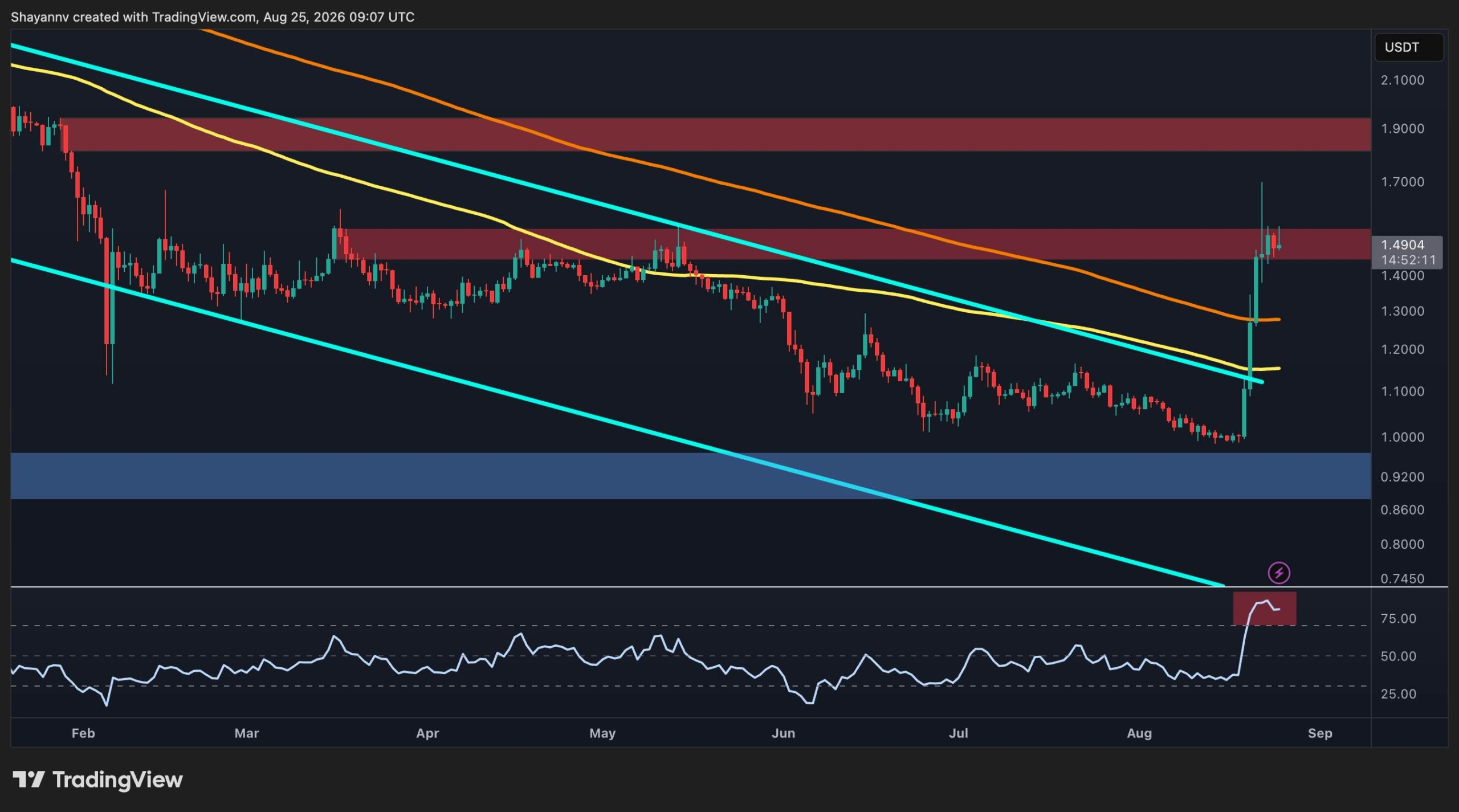
    XRP has experienced a significant rebound, climbing back from the $1.00 mark and successfully breaking through long-standing descending trendlines on both USD and BTC charts. However, the cryptocurrency’s recent rally has now encountered major resistance levels, placing current price action at a crucial juncture for determining its next directional move.

    The digital asset found support around the $1.00 level before breaching its broader descending channel. Subsequently, XRP has re-established its position above both the 100-day and 200-day moving averages, which were previously situated around $1.2 and $1.3, respectively. The move beyond $1.3 has effectively transformed these former resistance points into immediate support zones.

    Currently, XRP is testing the critical $1.50 resistance area, where price consolidation has begun. A decisive daily close above $1.50 could pave the way for a potential advance towards the $1.80-$1.90 range. Conversely, a rejection at this level, followed by a descent below $1.30, would undermine the recent breakout structure and increase the likelihood of a more substantial correction, potentially pushing prices back towards the $1.00 area.

    The Relative Strength Index (RSI) has surged past the 70 mark, remaining in overbought territory. While this indicates strong upward momentum, it also suggests the possibility of a short-term cooldown, which could lead to a retest of the 200-day moving average.

    XRP/BTC Pair Shows Mixed Signals

    On the XRP/BTC daily chart, the price has attempted to break out of its descending channel after reaching a low near 1,500 satoshis. However, unlike its USDT counterpart, this breakout has so far been unsuccessful. The pair briefly traded above the channel’s upper boundary before experiencing a significant rejection wick, indicating persistent selling pressure around this resistance level.

    XRP/BTC is now retracing towards the previously breached 200-day moving average, which is currently serving as a potential support level. The price action around this moving average will be a key determinant for the pair’s next move. If XRP/BTC can maintain its position above this average and solidify the former breakout area as support, another attempt at the 2,000 satoshis resistance zone may follow.

    A successful breach above 2,000 satoshis would bolster the relative strength outlook for XRP against Bitcoin. Conversely, a decisive failure to hold the 200-day moving average would suggest that the recent breakout attempt was a false signal, potentially exposing the pair to further downward pressure. The RSI has also pulled back after a brief stint above 70, reflecting a loss of momentum following the failed breakout and hinting at potential consolidation or correction in the coming weeks.

  • Hayes: More Dollar Liquidity to Fuel Bitcoin Rally

    Hayes: More Dollar Liquidity to Fuel Bitcoin Rally

    Bitcoin Enters Bull Market as Treasury Operations Poised to Inject Liquidity, Says Arthur Hayes

    Arthur Hayes, co-founder of BitMEX, believes Bitcoin has entered a new bull market, driven by anticipated actions from U.S. Treasury Secretary Scott Bessent to increase dollar liquidity through Treasury market operations.

    Hayes’s long-standing thesis posits that when policymakers inject liquidity to manage Treasury yields, risk assets like Bitcoin tend to perform well. In a recent essay, he drew parallels between Bessent and his predecessor, Janet Yellen, both of whom have faced pressure to control borrowing costs amidst ongoing government spending. Hayes highlighted the 10-year Treasury yield as a critical indicator in U.S. financial markets.

    According to Hayes, regulators become concerned when the 10-year Treasury yield approaches 5%, as higher yields can increase mortgage and corporate borrowing costs, potentially impacting the broader economy.

    He recalled an instance in December 2023 when Yellen shifted the issuance mix towards Treasury bills from longer-duration bonds. This maneuver facilitated the movement of funds from the Federal Reserve’s Reverse Repo program into T-bills. Hayes estimates that the RRP balance decreased from approximately $2.5 trillion to $100 billion by the time Bessent assumed office in January 2025. He characterized this $2.4 trillion flow as a liquidity injection that benefited financial markets, leading to rallies in Bitcoin and the Nasdaq 100, while the 10-year yield moved away from the 5% mark, despite the Federal Reserve maintaining interest rates near 5.3% and continuing to shrink its balance sheet.

    Hayes suggests Bessent is now employing similar tactics through the Treasury’s debt management tools. On August 19, the Treasury announced an increase in buybacks from $2 billion to at least $4 billion per operation. Initially, 10-year yields declined, and Bitcoin saw a rally in the subsequent days. However, this effect proved temporary, with the 10-year yield climbing back above its pre-announcement level in the following trading session.

    This is why Hayes argues that the Treasury’s planned buybacks are insufficient relative to the approximately $40 trillion U.S. debt stock. “Bitcoin ripped off its lows after Yellen announced her money printing scheme, and I argue it will do the same after Bessent reestablished his conviction to follow in his predecessors’ footsteps and materially increase the pace of dollar liquidity creation,” he wrote.

    Hayes outlined three potential paths for Bessent: reducing spending, which he deems unlikely given upcoming elections; adopting an aggressive, Bank of Japan-style commitment to buy unlimited bonds if yields exceed 5%; or, most plausibly in his view, implementing smaller, more frequent increases in buybacks unless volatility escalates rapidly.

    He also pointed to the Treasury General Account (TGA), currently holding around $1 trillion, as another potential source of liquidity. A CNBC report indicated that the Treasury Secretary could draw down the TGA to finance additional buybacks.

    These developments coincide with Bitcoin’s significant price appreciation, having recently surpassed $80,000 for the first time since May. At the time of writing, Bitcoin had retreated slightly from its peak but still reflected a substantial gain of over 23% in seven days and a similar increase over the past month. However, it remains approximately 37% below its all-time high of over $126,000, recorded in October 2025.

  • Coinbase Launches Tokenized Stocks on Base

    Coinbase Launches Tokenized Stocks on Base

    Coinbase Launches Tokenized Stocks on Base

    Coinbase’s tokenized stocks officially went live on the Base blockchain on Monday, beginning with fractional shares of Apple and Nvidia. Eligible users outside the United States can now hold a claim on real equity within a self-custody wallet, trade it on Aerodrome, or use it as collateral on Aave. The native token of Aerodrome, AERO, saw a surge of over 13% on the day.

    Each token represents a share held by Alpaca, a regulated broker and custodian. This structure grants holders a direct claim on the underlying share, rather than mere exposure to a derivative that tracks its price, signifying a significant development in the tokenization of real-world assets. Coinbase has implemented a token standard known as B20, designed to manage dividends and stock splits without altering token balances. This ensures that open lending positions or liquidity pools remain unaffected by corporate actions like dividend payouts.

    This marks the second instance within a week where a U.S. company has introduced a product that is inaccessible to American users. Last Wednesday, Coinbase integrated perpetual futures into its Base App via Hyperliquid, a feature also unavailable to users in the U.S., U.K., and Canada. Similarly, Robinhood launched its own layer-2 chain last month, featuring tokenized stocks as one of its initial offerings, accessible in over 120 countries but notably not domestically.

    Vlad Tenev, CEO of Robinhood, spent the past week publicly urging U.S. policymakers to revise existing regulations. He expressed concern that the world might build the future of ownership around American assets while Americans are excluded. The Securities and Exchange Commission (SEC) currently has a delayed exemption for tokenized stocks, and its recent Regulation Crypto Assets proposal focuses on token fundraising rather than equity tokenization.

    Despite the regulatory landscape, Coinbase is proceeding with its expansion plans. Base has indicated that additional Coinbase-issued stocks and other real-world assets will be introduced in the coming weeks. The underlying infrastructure is reportedly complete and operational, though regulatory clarity remains pending. The situation raises questions about whether Washington will address the regulatory gap before offshore alternatives become the established norm.

  • Grayscale Launches Zcash ETF Amid Privacy Concerns

    Grayscale Launches Zcash ETF Amid Privacy Concerns

    Grayscale Launches World’s First Zcash ETF Amidst Privacy Coin Scrutiny

    Grayscale’s Zcash Exchange Traded Fund (ETF) commenced trading Tuesday on NYSE Arca, introducing a nine-year-old investment product to the public markets months after developers disclosed and subsequently patched a critical vulnerability within the privacy coin’s shielded transaction system.

    Trading under the ticker ZCSH, the fund represents the world’s first exchange-traded product offering direct exposure to Zcash. This allows investors to track the price of ZEC through their existing brokerage accounts without the need to directly purchase or hold the cryptocurrency themselves.

    “Grayscale has a long history of identifying emerging technologies and investment themes early, and our nine-year history operating this fund is the clearest signal of demand,” Steve Vanourny, Grayscale’s Head of Index, told Decrypt.

    The ZCSH fund originated as the Grayscale Zcash Trust in October 2017. Grayscale filed with the Securities and Exchange Commission in November to convert the trust into an exchange-traded fund. As an ETF, shareholders do not directly own ZEC; instead, they own shares designed to mirror the value of the fund’s Zcash holdings.

    Vanourny cited Zcash’s maturity, its inherent privacy features, and growing investor interest in digital assets beyond Bitcoin and Ethereum as key factors making this the opportune moment to list the established fund.

    “Investors increasingly want exposure to digital assets beyond Bitcoin and Ether through the brokerage accounts they already use, and Zcash occupies a distinctive place in that landscape,” Vanourny explained. “With its nearly decade-long network history, monetary design derived from Bitcoin—including proof of work and a 21 million coin limit—in addition to optional privacy technology that Bitcoin does not possess.”

    Grayscale anticipates that ZCSH will primarily attract self-directed and advised investors seeking Zcash exposure via a brokerage account, according to Vanourny.

    “We view ZCSH as a focused, higher-risk satellite position within a broader digital-asset allocation that is complementary to, but not a replacement for, Bitcoin,” he stated. “It offers a distinct thesis: Bitcoin-like scarcity and proof-of-work economics, plus optional privacy, for investors who see privacy as the next major theme for the industry to address as it scales.”

    While Vanourny highlighted Zcash’s fixed supply and proof-of-work model as parallels to Bitcoin, its optional privacy features presented complexities in addressing a recent critical security flaw.

    In May, security researcher Taylor Hornby identified a four-year-old vulnerability in Zcash’s Orchard shielded pool that could have potentially enabled an attacker to generate counterfeit ZEC. Developers implemented an emergency patch on June 1. However, the network’s privacy features made it impossible to cryptographically verify whether the flaw had been exploited.

    In July, Zcash activated the Ironwood upgrade, which replaced the Orchard shielded pool with a new one. This upgrade incorporated accounting rules designed to prevent more ZEC from exiting the retired pool than entered it, thereby trapping any potential counterfeit coins.

    Looking forward, Grayscale intends to measure Zcash’s progress based on its adoption, utility, and network security, rather than solely on the token’s price.

    “On the security and infrastructure side, we will be watching the continued rollout and adoption of the Ironwood upgrade, which closed the vulnerable shielded pool from the June 2026 incident and added independently audited, formally verified supply guarantees,” Vanourny said. “Grayscale will also be monitoring exchange support and regulatory treatment of Zcash and privacy assets more broadly.”

  • Jury Finds Man Guilty in $24M AI Crypto Ponzi Scheme

    Jury Finds Man Guilty in $24M AI Crypto Ponzi Scheme

    Jury Convicts Las Vegas Businessman in $24 Million Cryptocurrency Ponzi Scheme

    A federal jury in Las Vegas has found a local business owner guilty of orchestrating a $24 million cryptocurrency Ponzi scheme that defrauded at least 400 investors, the Department of Justice announced Monday.

    Brent C. Kovar, the owner of Profit Connect, a Las Vegas-based company, operated the scheme from late 2017 until July 2021. He falsely claimed the company utilized artificial intelligence software on a supercomputer to mine cryptocurrency and verify transactions on other networks. Investors were enticed with promises of fixed annual returns ranging from 15% to 30%, a full money-back guarantee, and assurances that the company was backed by hundreds of millions of dollars in crypto reserves.

    Prosecutors presented evidence that Kovar was aware Profit Connect was not profitable, possessed no actual reserves, and was incapable of delivering the advertised returns or honoring its guarantees. Funds from new investors were allegedly used to sustain company operations, purchase employee gifts, and acquire a house for Kovar. A portion of this money was also recirculated to earlier investors, misrepresented as mining profits.

    Adding to the deception, Kovar reportedly informed investors that their funds were insured by the Federal Deposit Insurance Corporation (FDIC). This claim was investigated by the FDIC’s Office of Inspector General, in conjunction with the FBI and IRS Criminal Investigation.

    Following a nine-day trial, Kovar was convicted on 11 counts of wire fraud, two counts of mail fraud, and two counts of money laundering. He is scheduled for sentencing on November 30 and faces a potential maximum sentence of 280 years, though the final term will be determined by the judge based on federal sentencing guidelines.

    The Securities and Exchange Commission (SEC) had previously intervened, shutting down Profit Connect five years ago. In July 2021, the SEC obtained a restraining order and asset freeze, initially estimating investor losses at up to $12 million from at least 277 investors. This figure is now understood to be half of the total losses established by prosecutors. The SEC noted that over 90% of the company’s income originated from investors, and none of these funds were used for actual cryptocurrency trading.

    Kovar reportedly ran the business with his mother, Joy, who was 86 at the time. The SEC indicated that $1.2 million was transferred into her personal account in ten equal installments over less than two months, with an additional $1.7 million withdrawn through cash, credit card payments, and the purchase of a vehicle. The Justice Department’s announcement on Monday specifically named Brent Kovar in relation to the criminal convictions.

    This is not Kovar’s first encounter with regulatory action. The SEC had previously filed a civil injunction against him and his father, Glenn, in 2009 for their involvement in a “pump-and-dump” scheme operated through a company called Skyway Global, which also resulted in $12 million in investor losses.

    Investment fraud continues to be the most significant category of cryptocurrency-related crime reported to the FBI. In 2025, the bureau logged $11.37 billion in losses, a 22% increase from the previous year. The Consumer Federation of America, using a multiplier to account for unreported fraud, estimated total losses to be $80.7 billion, with individuals over 60 accounting for $4.4 billion of the reported figures.

  • Dogecoin Price Action Faces Scrutiny Amidst Divergent Market Signals

    Dogecoin Price Action Faces Scrutiny Amidst Divergent Market Signals

    Dogecoin (DOGE) has seen a 3.02% price bounce to $0.090 in the last 24 hours, yet this uptick is shadowed by conflicting indicators. Data indicates that whale wallets have been reducing their holdings, and inflows into spot Dogecoin ETFs have cooled, suggesting a complex market sentiment that warrants careful analysis.

    Whale Activity and ETF Trends

    Wallets holding between 1 million and 100 million DOGE have collectively offloaded approximately 280 million tokens since Friday. This distribution by larger holders contrasts with Dogecoin’s 34% rally last week. Concurrently, spot Dogecoin ETFs recorded inflows of $146,020 on Monday, a significant decrease from the $653,420 seen in the prior week, according to data.

    Technical Indicators and Momentum

    Technically, DOGE is trading above its 50-day EMA ($0.076) and 100-day EMA ($0.081), and has reclaimed a downtrend line near $0.070, which now acts as support. Immediate protection is noted at the $0.088 horizontal level. Analysts suggest that a sustained break above $0.094, supported by consistent ETF inflows, could potentially target $0.10 to $0.104.

    However, momentum indicators present a more cautious picture. The Relative Strength Index (RSI) is near 77, indicating overbought conditions. Furthermore, the long-to-short ratio stands at 0.93, approaching a one-month low. This positioning data suggests traders may be anticipating a pullback, even as the price holds steady. A base case scenario, according to the article, involves consolidation between $0.088 and $0.094 as overbought conditions subside. A break below $0.088 could lead to a retest of the 100-day EMA near $0.081, followed by the $0.076 level.

    Broader Market Context and Investor Focus

    The broader cryptocurrency market sentiment remains choppy, with Bitcoin’s price action heavily influencing assets like Dogecoin. Macro liquidity conditions are also a factor traders are monitoring. The current market dynamics suggest that while DOGE’s chart setup appears structurally bullish, underlying momentum and investor positioning warrant caution. Whale distribution and a long-to-short ratio below one indicate that the easier gains from the recent rally may have already been realized.

    This environment is reportedly prompting some traders to explore earlier-stage investment opportunities. For example, the Maxi Doge (MAXI) presale has raised $4,848,993.00, with tokens priced at $0.0002835. The project offers dynamic APY staking and other features.

    Uncertainties persist regarding Dogecoin’s immediate recent price action, specifically whether it can sustain momentum above $0.090 or if it may stall. The impact of macro liquidity conditions also remains a key consideration. It is not guaranteed that the current Dogecoin rally is sustainable without further support from institutional investors or large holders.

    Why This Matters

    The materials describe a narrow update: Dogecoin saw a short-term price increase, but underlying data from whale wallet activity and ETF inflows suggests a potential weakening of buying pressure. Whether DOGE price can push through $0.090 or stall into another leg down.