Category: Uncategorized

  • UNITREEUSDT Bybit Perpetual Pre-Market Launch Aug 3

    UNITREEUSDT Bybit Perpetual Pre-Market Launch Aug 3

    UNITREEUSDT Perpetual Pre-Market Trading to Launch on Bybit

    Bybit has announced that UNITREEUSDT will be available for Perpetual Pre-Market Trading on its platform. This offering allows traders to engage with the asset before its official listing on the derivatives market.

    Pre-Market Trading Schedule for UNITREEUSDT

    The pre-market trading for UNITREEUSDT is set to commence with a structured schedule:

    • Call Auction: This phase will begin on August 3, 2026, at 3:00 AM UTC.
    • Order Withdrawal: Traders will have a 20-minute window to withdraw orders immediately following the start of the Call Auction.
    • Match-Making Tradeoff: This trading period will commence 25 minutes after the Call Auction opens.
    • Continuous Auction: Should the match-making tradeoff prove successful, the Continuous Auction will start 30 minutes after the Call Auction begins.

    Important Considerations for Traders

    Participants should be aware of several key points to ensure a smooth trading experience. Orders may be subject to cancellation if account balances are insufficient. Furthermore, if the match-making tradeoff phase does not succeed, the UNITREEUSDT contract will be delisted from Bybit’s Perpetual Pre-Market Trading. Traders are strongly advised to monitor updates regarding the delivery schedule, as adherence to the established timeline is critical.

    Pre-Market Trading can be accessed via the Bybit website or the most recent version of the Bybit App.

    Further details on Perpetual Pre-Market Trading are available in the platform’s Trading Rules.

    Disclaimer: This announcement serves exclusively as a notice for pre-market trading activities. It does not constitute a guarantee that UNITREEUSDT will be officially listed on Bybit’s Derivatives trading platform. Any subsequent decision by Bybit to list UNITREEUSDT for Derivatives trading will be communicated through a separate announcement.


  • PayPal Reports Q2 Growth, Establishes Dedicated Crypto Division Amid Restructuring

    PayPal Reports Q2 Growth, Establishes Dedicated Crypto Division Amid Restructuring

    PayPal reported its second-quarter financial results on July 28, revealing a 10% year-over-year increase in total payment volume to $486.4 billion and a 5% rise in revenue to $8.68 billion. The company also reported a significant corporate reorganization, establishing a dedicated division for cryptocurrency operations named Payment Services & Crypto, and identified stablecoins as a key area for future expansion.

    Financial Performance and Guidance

    In the second quarter, PayPal’s non-GAAP earnings per share reached $1.38, exceeding analyst estimates. Transaction margin dollars increased by 1% to $3.9 billion, and adjusted free cash flow was reported at $1.83 billion. The company raised its full-year transaction margin guidance to approximately $15.6 billion and adjusted the lower end of its full-year earnings per share range to roughly $5.38.

    Net losses on strategic investments and crypto assets held for investment amounted to $81 million in the quarter, compared to $74 million in the first quarter. PayPal anticipates that its full-year 2025 GAAP earnings will see a positive impact of about $0.14 per share from this investment portfolio.

    Crypto Division and Stablecoin Strategy

    The newly formed Payment Services & Crypto division will operate alongside other key units such as Checkout Solutions & PayPal and Consumer Financial Services & Venmo. This structural change underscores PayPal’s strategic focus on integrating and developing its cryptocurrency-related services.

    PayPal’s stablecoin, PYUSD, has seen its supply decrease to approximately $2.8 billion in mid-July, down from over $4 billion in March. Despite this reduction, the stablecoin launched natively on the Polygon network on July 9 and is reportedly available in 70 markets. YouTube began utilizing PYUSD for payments to US creators in December.

    Market data indicates that PYUSD and Societe Generale’s EURCV hold a small share of the fiat-backed stablecoin market. Tether (USDT) and USD Coin (USDC) collectively account for 93.5% of the total fiat-backed stablecoin supply, according to CryptoPotato’s reporting on CoinGecko research.

    Cost Savings and Future Outlook

    As part of a broader financial restructuring effort, CEO Enrique Lores, who assumed the role on March 1, is targeting at least $1.5 billion in gross run-rate savings over the next two to three years. Approximately $400 million of these savings are expected to be realized by the end of the current year. The savings plan, extending to 2029, is driven by three primary factors: simplifying the company’s structure, optimizing operations and portfolios, and accelerating the adoption of artificial intelligence. PayPal projects that AI adoption will contribute around 40% of the total projected savings.

    Why This Matters

    The materials describe a narrow update: PayPal announced its second-quarter financial results, reporting a 10% year-over-year increase in total payment volume to $486. The specific reasons for the decrease in PYUSD supply from March to mid-July.

    Broader Context

    Source materials place the factual news in this context: PayPal has reported $486.4 billion in total payment volume for the second quarter on July 28, up 10% year over year.

  • Robinhood Reports Record Q2 Revenue, Diversified Trading Offsets Crypto Decline

    Robinhood Reports Record Q2 Revenue, Diversified Trading Offsets Crypto Decline

    Robinhood achieved a record $1.31 billion in net revenue for the second quarter, a 32% year-over-year increase, driven by significant growth in event contracts, options, and equities trading. This diversification helped to offset a notable decline in cryptocurrency revenue.

    The company’s transaction-based revenue surged 44% to $776 million in Q2. Event contracts emerged as a particularly strong growth area, generating $156 million in revenue—more than a tenfold increase from the previous year. The volume of event contracts traded also saw a more than 10x surge, reaching a record 13.6 billion contracts during the quarter. According to Chairman and CEO Vlad Tenev, the momentum in prediction markets is expected to continue.

    Traditional trading segments also demonstrated robust performance. Options revenue contributed $342 million, up 29% year-over-year. Equities revenue saw even more substantial growth, rising 95% to $129 million, with equity notional trading volumes reaching a record $956 billion, an 85% increase compared to the same period last year.

    Despite the overall positive financial results, Robinhood’s cryptocurrency revenue decreased by 38% year-over-year, totaling $100 million for the quarter. Crypto notional trading volume stood at $40 billion.

    In parallel with its financial performance, Robinhood is actively pursuing strategic initiatives in blockchain and international markets. The company unveiled the public mainnet for Robinhood Chain, an Ethereum Layer 2 network designed for financial services and real-world assets, and announced stock tokens for eligible users in over 120 countries. Furthermore, the launch of Agentic Trading in May, an AI-powered trading feature, has attracted nearly 100,000 customers and secured over $100 million in assets under custody.

    Robinhood also expanded its international presence by closing the acquisition of WonderFi, a Canadian digital asset products and services platform, marking its official entry into the Canadian market. The company launched Rothera, a CFTC-licensed exchange and clearinghouse, in June through its joint venture with Susquehanna International Group. To date, more than 3.5 billion event contracts have been traded. Chairman and CEO Vlad Tenev emphasized Robinhood’s product velocity is focused on making everyone an owner, which he described as essential for a free, stable, and prosperous society.

    Why This Matters

    The materials describe a narrow update: Robinhood’s Q2 net revenue reached $1. The exact date of the WonderFi acquisition closing within Q2 is not specified.

    Broader Context

    Source materials place the factual news in this context: Robinhood posted record second-quarter net revenue of $1.31 billion, up 32% year-over-year, as activity across prediction markets, options, and equities helped offset a sharp decline in crypto income.

  • White House Operator No Longer Employed Amid Prediction Market Betting Allegations

    White House Operator No Longer Employed Amid Prediction Market Betting Allegations

    A White House teleprompter operator, Gabriel Perez, is no longer employed by the federal government following allegations that he used insider knowledge to place bets on prediction markets, potentially earning over $100,000. Perez had been placed on unpaid leave earlier this month after the allegations surfaced.

    Kalshi, the prediction market platform where the alleged bets were placed, detected the trades, investigated them, and referred the matter to the U.S. Commodity Futures Trading Commission (CFTC). Robert Denault, Kalshi’s lawyer and head of enforcement, stated that the trades amounted to political insider trading under the platform’s CFTC-approved rules.

    It is uncertain whether Perez resigned or was fired, and the precise amount of money he may have profited from the alleged bets is not definitively established. The White House has not provided further comment on the matter.

    Broader Regulatory Landscape

    This incident occurs within a broader context of increasing regulatory scrutiny and legal challenges surrounding prediction markets. Kalshi has faced legal hurdles in several states this year, including Massachusetts, Michigan, Nevada, and Washington. In April, the platform suspended three political candidates for betting on elections in which they were participating, after determining the trades constituted political insider trading.

    Separately, federal prosecutors charged U.S. soldier Gannon Ken Van Dyke with allegedly betting on whether former Venezuelan President Nicolás Maduro would be removed from power. Authorities stated that Van Dyke, who reportedly worked on the operation targeting Maduro, made approximately $400,000 from these trades. The exact earnings of Gannon Ken Van Dyke are subject to confirmation.

    In a related development, a federal judge has temporarily blocked Minnesota from enforcing a new law that would have banned prediction markets in the state. Judge Katherine Menendez stated that the law is likely preempted by the federal Commodity Exchange Act, as many event contracts may qualify as federally regulated swaps. The law, signed by Governor Tim Walz in May, was scheduled to take effect on Saturday. The future scope of the injunction against Minnesota’s law is also uncertain.

    The judge’s ruling provided a temporary reprieve for platforms like Kalshi and Polymarket as the legal case progresses. The injunction could potentially be narrowed in scope at a later stage.

    Uncertainties Remain

    Several uncertainties remain regarding the case. It is not yet clear whether Perez resigned or was fired, nor is the precise amount of money he may have profited from the alleged bets definitively established. Similarly, the exact earnings of Gannon Ken Van Dyke are also subject to confirmation. The future scope of the injunction against Minnesota’s law is also uncertain.

    The situation highlights the evolving regulatory landscape for prediction markets, which are facing both internal rule tightening and external legal challenges, alongside allegations of insider trading involving individuals with access to potentially sensitive information.

    Why This Matters

    The materials describe a narrow update: Gabriel Perez, a White House teleprompter operator, is no longer employed by the federal government. Whether Gabriel Perez resigned or was fired.

  • XRP ETFs Show Net Inflows in July Amidst Reduced Daily Activity and Asset Price Trends

    XRP ETFs Show Net Inflows in July Amidst Reduced Daily Activity and Asset Price Trends

    Spot exchange-traded funds (ETFs) tracking Ripple’s XRP token recorded net inflows of $27.29 million in July, contributing to a cumulative total net inflow exceeding $1.5 billion since their inception. However, the monthly figures and trading activity in July present a complex picture, with a notable number of days showing no reportable flow activity.

    Data from SoSoValue indicates that July’s net inflows were the second-lowest since January, which saw $15.59 million. In contrast, previous months showed higher figures, with June recording close to $60 million and May nearly $132 million in net inflows. The all-time high for monthly net inflows remains $666.61 million, recorded in November.

    Further complicating the interpretation of investor engagement, July saw 11 out of 22 trading days with no reportable action in terms of net flows. This contrasts with earlier periods, such as the week ending July 2, which saw $17.19 million in net inflows, and the week ending with the article’s reporting date, which recorded $14.86 million. The recent reduction in daily activity, coupled with the modest monthly total, suggests a potential shift in investor interest, according to some interpretations.

    Despite the continued positive net inflows into the ETFs, the performance of the underlying XRP asset has shown different trends. XRP is currently trading below $1.10 and has experienced a monthly decline of over 3%. While XRP managed to defend its $1.05 support level during a recent weekend, its price performance has lagged, even amidst developments within the broader Ripple ecosystem.

    Among the individual ETFs, Bitwise’s XRP fund has accumulated $511 million in net inflows, while Canary Capital’s XRPC has garnered $467 million. These figures highlight the substantial overall capital that has entered XRP-focused investment products.

    Historical data suggests that August has often been a challenging month for XRP’s price performance. The current divergence between ETF inflows and asset price trends, alongside the observed reduction in daily trading activity, presents a complex scenario for investors monitoring XRP. The precise implications of these trends remain subject to interpretation, with uncertainties surrounding specific past monthly inflows and broader Ripple ecosystem developments.

    Why This Matters

    The materials describe a narrow update: Spot exchange-traded funds tracking Ripple’s XRP token saw net inflows of $27. The exact performance of XRP ETFs in the week prior to July 2.

    Broader Context

    Source materials place the factual news in this context: The spot exchange-traded funds tracking Ripple’s cross-border token continue with their impressive performance in times of market uncertainty, and saw only one day of no reportable action in the past week, unlike the previous ones.

  • Meta’s ‘Pervert Glasses’ Spark Controversy

    Meta’s ‘Pervert Glasses’ Spark Controversy

    Meta’s Smart Glasses Face “Pervert Glasses” Backlash Amid Privacy Concerns

    Meta is developing AI-powered smart glasses designed to serve as a smartphone replacement. However, these devices are increasingly being labeled “pervert glasses” online, and for understandable reasons.

    Despite Meta’s inclusion of privacy protections in the glasses’ design, critics are raising alarms about their potential misuse and data handling practices.

    Growing Public Apprehension

    The backlash against AI-powered glasses is so significant that users are reportedly hesitant to wear them in public.

    Genesis of the “Pervert Glasses” Moniker

    The controversy surrounding Meta’s AI glasses, and the origin of their unflattering nickname, stems from several concerning incidents.

    In January, a BBC investigation revealed that women were being secretly filmed with Meta’s Ray-Ban smart glasses after being approached in public. These videos were subsequently posted to TikTok without consent, garnering hundreds of thousands of views and comments. The BBC identified one account that had shared over 100 similar videos.

    A joint investigation by Swedish newspapers in February uncovered that contractors in Nairobi, hired to train Meta’s AI, reviewed footage captured by the smart glasses. This footage reportedly included individuals using the bathroom, undressing, changing clothes, as well as credit card numbers and intimate moments, reigniting concerns about how such sensitive data is shared with Meta’s AI systems.

    In March, Meta was hit with a class-action lawsuit alleging that the company failed to adequately disclose that human contractors could review content shared with Meta AI. Later that month, Democratic senators Edward Markey, Jeff Merkley, and Ron Wyden questioned the company regarding its reported facial recognition plans, warning that such technology could facilitate real-time identification, stalking, and harassment.

    Calls for Abandonment of Facial Recognition

    The ACLU, along with 75 other organizations, urged Meta in April to abandon plans to integrate facial recognition into future versions of the glasses, deeming it “a red line society must not cross.” This coalition cautioned that the technology could enable wearers to identify strangers in public and link them to personal information.

    The following month, Texas Attorney General Ken Paxton launched an investigation into Meta’s AI glasses, citing concerns that the devices could secretly record individuals, collect facial data, and mislead consumers about the use of their personal information.

    Attempts to Address Recording Concerns

    In July, Meta updated its Ray-Ban smart glasses after users discovered methods to bypass the recording indicator light that signals when the camera is active. The update is designed to disable the camera if it detects tampering with the light, as part of a broader effort to prevent covert recording.

    However, this update did little to quell the public outcry. In the same month, advocacy groups, both online and in major cities like New York, London, and Washington, initiated campaigns highlighting the privacy implications of the devices.

    Regulatory and Event-Based Scrutiny

    By the end of July, Police Scotland opened an investigation into a TikToker, Scott Margerison, accused of secretly filming people with Meta smart glasses. To safeguard attendees, event organizers such as Comic Con (Monopoly Events) and DEF CON have banned the devices from their venues due to privacy concerns.

  • Cardano Surges 9% Amidst Stagnant Crypto Market

    Cardano Surges 9% Amidst Stagnant Crypto Market

    Cardano’s ADA Surges Amidst Stagnant Crypto Market

    In a market environment where most altcoin gains are quickly stifled, Cardano’s ADA has defied the trend, emerging as a significant performer over the past weekend. While broader market movements have been notably subdued, particularly on Saturdays and Sundays, ADA has experienced a substantial uptick.

    The current market inertia is evident, with even geopolitical developments, such as conflicting statements from former President Trump and Iran regarding the Strait of Hormuz, failing to stir significant price action in Bitcoin and most other cryptocurrencies.

    However, Cardano’s ADA has distinguished itself, registering a gain of over 9% and surpassing the $0.19 mark for the first time in nearly a month. This resurgence appears to be driven by a specific market dynamic.

    Whale Accumulation Fuels ADA’s Rise

    While a general market rally is not the apparent catalyst, the recent behavior of “whales” – large-scale investors with the capacity to influence asset prices – is the most probable reason behind ADA’s impressive performance. These significant market participants have reportedly engaged in a substantial accumulation spree.

    Data from Santiment Intelligence, shared by analyst Ali Martinez, indicates that whales have acquired more than 240 million ADA tokens in less than a week. Their total holdings reached 14.55 billion ADA before a slight retracement. Martinez concluded that this considerable acquisition has been instrumental in fueling ADA’s notable 22% surge over the past five days, contrasting sharply with the stagnation seen across the wider cryptocurrency market.

    Analysts Eyeing Further Upside for ADA

    Further analysis suggests that ADA may be poised for continued gains. Another analyst, known as Gerla on X, has indicated that ADA is “knocking on the door of a major breakout.” Their charts highlight ADA’s current struggle against the $0.19-$0.20 resistance level, a barrier that previously halted its upward momentum last month.

    However, indicators such as bullish Relative Strength Index (RSI) divergence and the completion of an inverse head-and-shoulders pattern suggest that ADA may possess the necessary strength to overcome this resistance. Should it succeed, analysts believe the next target could be around the $0.30 level.

    More optimistically, ZAYK Charts has suggested that a successful breach of the initial resistance could pave the way for a further ascent, potentially reaching $0.50.

  • XRP Tests Critical Support Zone Amid Selling Pressure; Future Direction Uncertain

    XRP Tests Critical Support Zone Amid Selling Pressure; Future Direction Uncertain

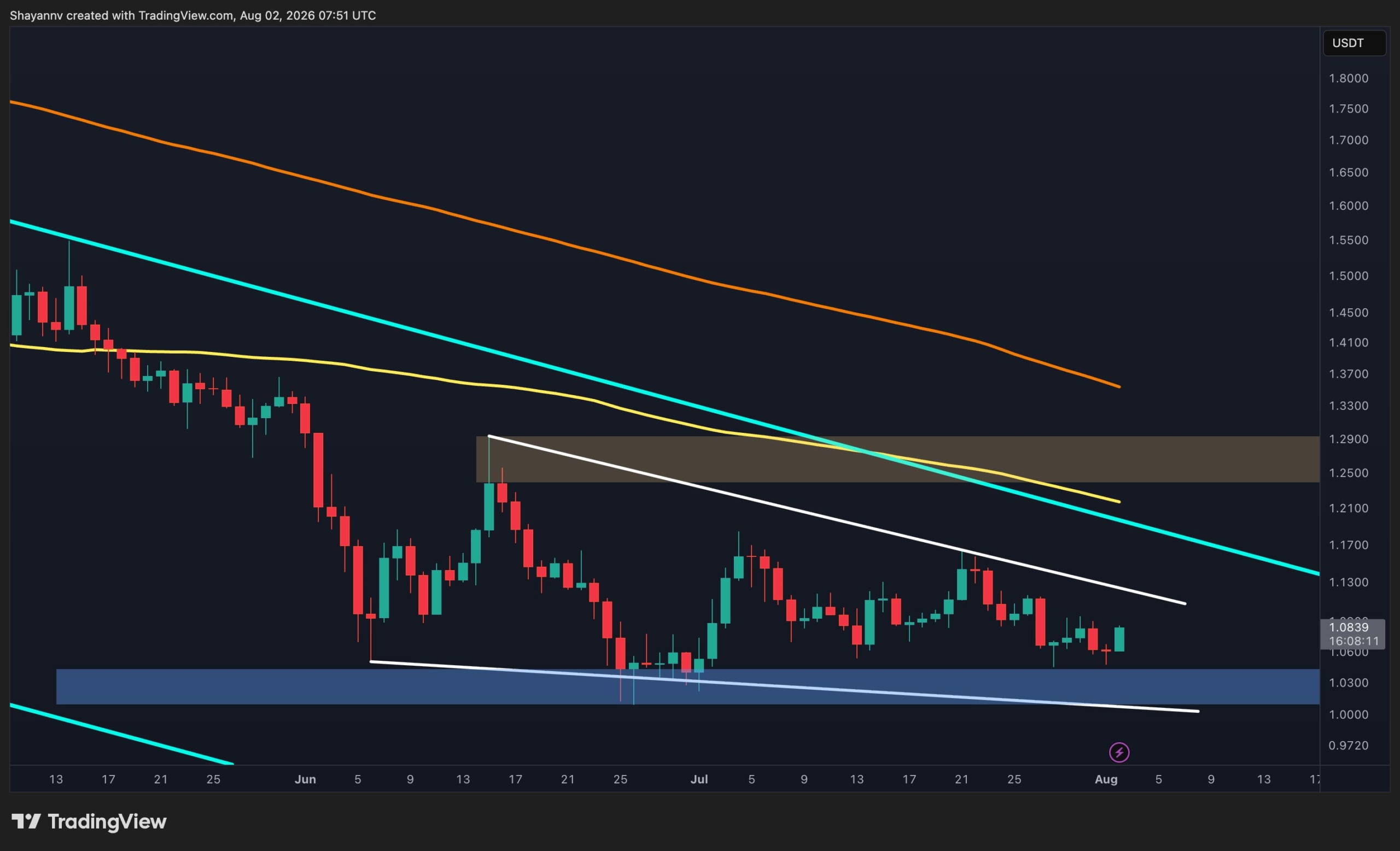
    XRP is currently navigating a critical support zone between $1.01 and $1.04, a level that has historically prevented deeper declines. The asset is experiencing significant selling pressure and remains below a descending resistance trendline and major moving averages, indicating a bearish market structure. The outcome of this test at the support zone remains uncertain, with the potential for further downside if this level fails.

    Technical Indicators Point to Bearish Structure

    According to the analysis, XRP continues to trade beneath a descending resistance trendline and remains well below major moving averages. This technical setup preserves the broader bearish market structure. Recent price action shows failed attempts at recovery, with sellers appearing to maintain control and pushing the price back toward the key demand zone.

    The Significance of the $1.01-$1.04 Support Zone

    The support area between $1.01 and $1.04 has proven to be a significant level, having prevented deeper declines in recent weeks. This makes it the most important short-term level to monitor for XRP holders and traders. However, the data suggests that if XRP breaks decisively below this zone, it could accelerate a decline toward the next major support level around $0.89.

    Short-Term Dynamics and Potential Scenarios

    On shorter timeframes, such as the 4-hour chart, XRP has continued to print lower highs and lower lows while remaining capped by the descending resistance trendline. A recent rejection near $1.09 was followed by another decline toward the $1.01 to $1.04 demand zone, underscoring the current lack of buying momentum. This area remains the last significant short-term defense for the bulls.

    The article suggests that if this support fails, the recent price movement is likely to intensify and extend the decline toward lower levels. Conversely, for any meaningful recovery to occur, buyers would first need to reclaim the descending trendline. Until this happens, rallies are likely to face selling pressure and remain corrective in nature.

    The central question remains whether XRP buyers can defend this crucial support zone, or if sellers will succeed in pushing the price below $1. The current market dynamics indicate that the outcome is uncertain. A notable move below the $1.01-$1.04 support zone could lead to a decline towards $0.89, a scenario that remains a possibility rather than a certainty. Buyers need to regain control and push XRP back above the descending trendline for a more optimistic outlook.

    Broader Context

    Within the scope of the sourced market analysis, XRP is described as follows: The latest price action suggests sellers are maintaining control.

  • Ethereum’s July Surge Meets Historically Volatile August Performance

    Ethereum’s July Surge Meets Historically Volatile August Performance

    Ethereum concluded July with its most significant monthly price increase in a year, surging approximately 20%. This performance notably outpaced Bitcoin’s 9% gain during the same period. However, Ethereum’s historical data for August presents a mixed and volatile record, introducing uncertainty into its short-term price outlook.

    Following a challenging period of six consecutive monthly losses after reaching an all-time high in August of the previous year, Ethereum staged a notable rebound in July. The cryptocurrency’s price fluctuated, dipping towards $1,500 before reaching $1,980 at one point, and ultimately closing the month around $1,900. This recovery followed substantial drops in November (-22.38%), January (-17.52%), and February (-19.81%). While March and April offered modest gains of around 7% each, May saw an 11% decline, and June experienced a significant 21.7% drop, reflecting broader market bearishness.

    August’s Mixed Track Record

    Historically, August has been a month of significant price action for Ethereum, characterized by considerable volatility. Some years have delivered substantial gains, such as the nearly 93% surge in August 2017, a 25.32% increase in August 2020, and a 35.62% pump in August 2021, during which Ethereum broke its previous all-time high record. Conversely, August has also presented challenges. Notably, Ethereum slumped by almost 35% in August 2018, experienced a further 21.31% decline in August 2019, and saw a 22.21% drop in August 2024. In fact, six out of the eight Augusts since 2016 have closed in the red.

    Navigating Short-Term Uncertainty

    This historical pattern of mixed results in August suggests that while Ethereum’s recent July performance was strong, it does not guarantee continued gains. The cryptocurrency’s short-term price future remains subject to the volatility historically associated with the month of August. Investors and market analysts will be closely observing Ethereum’s performance in the coming weeks, given the contrast between its recent positive momentum and the unpredictable nature of Augusts past.

    Why This Matters

    The materials describe a narrow update: Ethereum’s price surged by approximately 20% in July, outperforming Bitcoin’s 9% gain. Ethereum’s short-term price future.

    Broader Context

    Source materials place the market analysis in this context: The second-largest cryptocurrency by market cap had a violent end to 2025 and a similarly painful start to 2026.

  • Japan Simplifies Free XRP Acquisition via Credit Card

    Japan Simplifies Free XRP Acquisition via Credit Card

    Japan has provided XRP holders with a mainstream on-ramp that many Western markets still lack, a development that could prove bullish for Ripple’s price prediction. However, the current market pullback tells only part of the story. Tokyo’s latest move in the cryptocurrency space may hold more significance than today’s price action suggests.

    New Loyalty Program Integrates Crypto Redemption

    Effective July 31, 2026, SBI VC Trade and Orient Corporation will launch a pioneering integration. Holders of Orico credit cards will soon be able to convert Orico Points into Bitcoin (BTC), Ether (ETH), or XRP directly through the VCTRADE platform. The conversion rate is set at 1,200 Orico Points for ¥1,000 worth of cryptocurrency.

    Orico cards typically earn points at a base rate of 1.0%, which increases to 2.0% for new cardholders during their initial six months. This marks the first time cryptocurrency has been introduced as a redemption option within the Orico Points program. The launch signifies SBI’s ongoing efforts to bridge traditional finance with digital assets.

    Normalizing XRP for Millions

    A loyalty program that allows everyday spending to translate into XRP exposure could help normalize the token for millions of Japanese consumers. This initiative has the potential to gradually reduce the disparity between retail interest and actual blockchain activity. While cryptocurrency prices remain volatile, increased accessibility often fosters long-term adoption.

    XRP Price Analysis and Outlook

    XRP is currently trading near $1.05 following a volatile week, with bulls finding themselves confined to a familiar trading range. Recent weakness appears to stem from cautious market sentiment rather than significant XRP-specific selling. Meanwhile, relatively light trading volumes suggest consolidation rather than heavy distribution.

    Support for XRP is currently established between $1.00 and $1.02, levels where buyers have consistently defended the price. A daily close below $1.00 would undermine the current market structure and elevate downside risk. Resistance is observed between $1.08 and $1.10, areas where recent attempts at recovery have faltered.

    Over the next two days, XRP is likely to trade within the $1.00 to $1.10 range, unless a new catalyst shifts market sentiment. A move above $1.10 could pave the way for a test of $1.15. Conversely, a breach of the $1.00 support level might trigger a renewed test of the $0.95 region.

    Longer-term bullish forecasts, projecting prices above $2.00, remain contingent on sustained institutional adoption. Japan’s newfound embrace of crypto initiatives could bolster this case over time. Nevertheless, investors are likely to await tangible user activity before factoring in a lasting breakout.

    At its current price, XRP presents a viable holding for exposure to Japan’s institutional adoption narrative. However, achieving significant upside at its current market capitalization necessitates a multi-month timeline and broader macroeconomic predictions. Traders seeking asymmetric early-stage returns are increasingly focusing on infrastructure projects that have yet to reach their full valuation potential.

    Bitcoin Hyper: A Promising Infrastructure Play

    Bitcoin Hyper ($HYPER) is positioning itself as precisely this type of infrastructure investment. The project is the first Bitcoin Layer 2 solution to integrate the Solana Virtual Machine (SVM), enabling smart contract execution at speeds comparable to Solana but built upon Bitcoin’s security layer. This offers a distinct value proposition compared to existing on-chain solutions.

    The presale has already raised $32.9 million, with the current price at $0.0136839. Staking is already available for participants. The combination of a unique technical selling point, a substantial presale fundraise, and the positive institutional momentum surrounding Bitcoin makes $HYPER a project worth researching.