Category: Uncategorized

  • AI Models Project Wide Range of XRP Price Predictions for 2026, Emphasizing Conditional Factors

    AI Models Project Wide Range of XRP Price Predictions for 2026, Emphasizing Conditional Factors

    Artificial intelligence models have generated a wide spectrum of price predictions for XRP in 2026, with forecasts ranging from a pragmatic low of $1.40 to an ambitious high of $6.00. These predictions, provided by AI platforms including ChatGPT, Grok, Perplexity, and Gemini, are heavily contingent on a complex interplay of market conditions, regulatory developments, and broader cryptocurrency trends.

    Divergent Forecasts Emerge

    According to ChatGPT, a realistic peak for XRP in 2026 is around $2.50. This scenario, the AI suggests, would require XRP to recover in line with the broader market, maintain institutional interest, and benefit from Ripple’s expanding regulatory footprint. Grok and Perplexity offered similar outlooks, with their upper price boundaries also set at $2.50. Perplexity’s lower target for XRP was $1.50, while Grok indicated a floor of approximately $1.80.

    Gemini presented a more conservative view, noting that a pragmatic outlook places XRP between $1.40 and $1.65 for 2026. Despite these lower figures, Gemini acknowledged XRP’s resilience in the first half of 2026, even amidst inflation fears, a hawkish Federal Reserve, and general market uncertainty. Historically, XRP has dipped toward $1.00 on a couple of occasions in 2026, and its all-time high in 2025 was $3.65.

    Conditions for Higher Targets

    More optimistic forecasts emerged from Grok and Perplexity, which indicated that XRP could potentially surpass its 2025 all-time high of $3.65 and reach approximately $5.00. This higher target is conditional on the passage of the CLARITY Act in the US, a significant reduction in global uncertainty, and a substantial rebound in the broader crypto market. Gemini’s bull case scenario was even more expansive, suggesting XRP could peak between $2.75 and $6.00. However, Gemini cautioned that such ambitious targets are currently far-fetched and depend on factors such as decisions in Washington, ETF inflows, and investor risk tolerance.

    ChatGPT, while also offering a higher target, remained more skeptical, suggesting $4.50 as the highest possible price for XRP even in its most bullish scenario. This outcome, according to ChatGPT, would necessitate a genuine altcoin season, strong and sustained ETF demand, continued recent price movement for Bitcoin, and available evidence that XRPL activity and Ripple’s payment infrastructure are driving demand for XRP itself.

    Understanding AI Prediction Limitations

    The range of these AI-generated predictions underscores the inherent uncertainties in forecasting cryptocurrency prices. Factors such as the passage of specific legislation like the CLARITY Act, shifts in global economic conditions, investor sentiment, and the performance of major cryptocurrencies like Bitcoin all play a significant role. The AI models themselves acknowledge these dependencies, framing their higher price targets as contingent on a confluence of positive developments.

    It is important to note that AI predictions are not guarantees of future performance. History has often shown that market outcomes can differ significantly from initial projections. The AI models’ outputs should be viewed as analytical insights into potential future scenarios, rather than definitive forecasts. The actual price of XRP in 2026 will be shaped by a multitude of evolving factors, many of which remain uncertain.

    Why This Matters

    The materials describe a narrow update: The article presents price predictions for XRP in 2026 from four AI models: ChatGPT, Grok, Perplexity, and Gemini. The actual future price of XRP in 2026.

    Broader Context

    Source materials place the market analysis in this context: The article is a speculative piece asking AI models for XRP price predictions in 2026.


  • LAB Token Plummets 97% Amid Team Wallet Sales Allegations

    LAB Token Plummets 97% Amid Team Wallet Sales Allegations

    LAB Token Plummets 97% Amid Allegations of Team-Funded Wallet Dumping

    The LAB token has experienced a dramatic collapse, shedding 97% of its value in a matter of days, following accusations from prominent blockchain investigator ZachXBT that wallets funded by the project’s creators have dumped millions of coins onto the market.

    This development has further exacerbated the already precarious state of LAB, which had previously defied the broader market downturn. The token had enjoyed a period of significant growth, briefly entering the top 20 cryptocurrencies by market capitalization due to consistent double- and triple-digit gains.

    According to CoinGecko data, LAB reached an all-time high of over $27 just over a month ago. However, it now trades below $0.55, marking a 97% decline from its peak, with the majority of these losses occurring in recent days.

    ZachXBT attributed the latest sharp decline, which saw LAB fall from $1.20 to $0.54, to substantial sales executed by the founding team. The on-chain analyst stated that a wallet initially funded by the LAB team deposited 18.4 million tokens, valued at approximately $18.3 million at the time, to the decentralized exchange Aster before liquidating the holdings on the open market.

    This revelation follows an earlier warning from ZachXBT, issued a few months prior, in which he accused the LAB team of maintaining excessive control over the token’s supply and engaging in opaque over-the-counter transactions.

    In a recent Telegram post, ZachXBT detailed that the entity responsible for the sales received over 196 million tokens directly from the team in April 2026. Further analysis indicates that 100 million coins were initially sent to Bitget deposit addresses on April 8, with an additional 97 million tokens transferred to other wallets later that month.

    In May, 100 million LAB tokens were withdrawn from Bitget and distributed across ten separate addresses. ZachXBT argued that there was no market evidence to suggest an independent buyer had acquired such a significant position, leading him to conclude that these wallets likely remained under the control of the same entity.

    After remaining inactive for nearly two months, the entity transferred and sold millions of tokens to Aster on July 10 and 11. The on-chain investigator also noted that these wallets still hold over 80 million coins, despite the recent sales.

  • Japan’s Regulatory Path and Institutional Engagement Create Potential Market for XRP Amidst Ongoing Legislation

    Japan’s Regulatory Path and Institutional Engagement Create Potential Market for XRP Amidst Ongoing Legislation

    Japan is accelerating its modernization of digital asset regulations, a move that, coupled with significant institutional engagement, suggests the country could become a substantial growth market for XRP. Over the past several months, Japan has proposed legal reforms to classify many cryptocurrencies as financial instruments, a step that could pave the way for spot exchange-traded funds (ETFs). Concurrently, a more investor-friendly tax regime has been introduced.

    This evolving regulatory environment creates a distinct landscape for digital assets, particularly for XRP. In contrast to the prolonged legal battle in the United States where XRP’s classification as a security was contested by the SEC, Japanese regulators have consistently treated XRP as a crypto asset. This regulatory clarity has been instrumental in establishing one of XRP’s strongest international footholds, according to available information.

    Ripple and its partner SBI have been actively leveraging this environment. The launch of Ripple’s stablecoin, RLUSD, in Japan, following approval from the Japan Financial Services Agency (JFSA), marks a significant step. Furthermore, SBI is pursuing the creation of what could be the first Japan-based XRP ETF, having filed for the product. SBI Ripple Asia has also been working to expand cross-border payments across the region, with SBI VC Trade noted as one of Japan’s largest XRP-friendly exchanges.

    Potential for New Financial Products

    The proposed ETF products, which reportedly included Bitcoin (BTC) and XRP, highlight a conviction that Ripple’s token could become a core institutional asset in the country. Proper regulatory frameworks are seen as key to attracting additional investments from larger players and institutions. XRP has generally benefited from Japan’s proactive approach to crypto regulation.

    However, the path to launching new financial vehicles like spot crypto ETFs is not yet complete. The legislation still needs to go through the entire process before such products can be officially permitted. This ongoing legislative process introduces a degree of regulatory uncertainty regarding the exact timelines for these potential market developments.

    Despite these procedural steps, the overall direction of Japan’s legal reforms for digital assets is becoming clearer. This evolving framework, combined with the active participation of institutional players like SBI, could be significantly beneficial for XRP, positioning Japan as a key market for its future growth, though legislative processes for products like ETFs are still ongoing.

    Why This Matters

    The materials describe a narrow update: Japan is modernizing its digital asset framework, proposing to classify cryptocurrencies as financial instruments for spot ETFs and introducing a more investor-friendly tax regime. Legislation for spot ETFs still needs to complete the entire process before such financial vehicles are allowed to launch.

    Broader Context

    Source materials place the factual news in this context: Even in times when XRP and the company behind it were not in good shape in their home country, Japan has long stood out as a major ally.

  • Grok AI’s XRP Price Prediction: A Look at Potential Upside and Key Uncertainties

    Grok AI’s XRP Price Prediction: A Look at Potential Upside and Key Uncertainties

    Grok AI has presented a speculative price forecast for XRP, projecting a range of $4.50 to $6.00 by the end of 2026. This projection is based on an analysis of institutional developments within the XRP ecosystem, including the potential resolution of the SEC lawsuit, increased ETF inflows, stablecoin scaling, and the growth of tokenized real-world assets on the XRP Ledger. However, the AI model also outlines a less optimistic scenario, suggesting a potential consolidation or pullback to $1.50 to $2.50 if macroeconomic headwinds intensify or regulatory progress encounters delays.

    The AI’s outlook is significantly influenced by the anticipated resolution of the ongoing lawsuit between the U.S. Securities and Exchange Commission (SEC) and Ripple. Grok AI suggests that a formal confirmation in 2025 that XRP is not a security on secondary markets would remove a major institutional barrier. This, combined with sustained inflows into U.S. spot XRP ETFs, which have already attracted between $1.4 and $1.5 billion in cumulative net inflows, is seen as creating potential supply scarcity for the token. These ETFs have locked up hundreds of millions of tokens, which could impact market availability.

    Further contributing to the AI’s view are developments surrounding Ripple’s RLUSD stablecoin and the XRP Ledger’s capabilities. The RLUSD stablecoin is reportedly scaling, with planned launches in Japan via SBI and full MiCA CASP licensing in Europe expected by July 2026. This is anticipated to facilitate seamless XRP bridging for cross-border payments. Additionally, tokenized real-world assets on the XRP Ledger have surpassed $4 billion across more than 500 products. Institutional pilots, such as those involving JPMorgan for settlements, are cited as adding credibility to the on-chain activity.

    Grok AI posits that these factors could lead to increased ETF inflows, boost on-ledger demand driven by RLUSD and XRP Ledger synergies, and encourage a broader institutional rotation into utility tokens. This confluence of events, according to the AI, supports its $4.50 to $6.00 price target.

    Conversely, the AI acknowledges a more contained downside scenario. If macroeconomic conditions worsen, ETF flows decelerate, or legislative efforts like the CLARITY Act face significant delays, XRP could consolidate or pull back to the $1.50 to $2.50 range. Despite this possibility, the AI argues that XRP’s core utility and the clarity following the SEC lawsuit resolution would provide a firm downside support, suggesting a more robust floor than in previous market cycles.

    From a technical perspective, XRP is currently trading around $1.11. The asset recently showed a recovery after testing the $1.00 psychological floor in June. The daily chart indicates a move into the $1.11 to $1.12 zone, representing the highest close in approximately three weeks. Resistance levels are noted near $1.20 and $1.60, with support holding at $1.00. A sustained close above $1.20, followed by $1.40, would be required to provide the first technical evidence of the institutional accumulation that Grok AI describes.

    While Grok AI’s analysis highlights potential growth drivers, significant uncertainties remain. The full resolution of the SEC lawsuit and its specific outcomes are not guaranteed. The extent of future ETF inflows, the adoption rate of RLUSD, and the impact of broader economic factors are all subject to market dynamics and external events. The AI’s mention of LiquidChain, a project focused on addressing cross-chain fragmentation, is also presented with caution, as its execution and adoption remain unproven.

    Ultimately, Grok AI’s projection serves as a speculative signal based on identified trends and potential developments. Investors are advised to consider this forecast within the context of current market conditions, ongoing regulatory processes, and the inherent uncertainties associated with cryptocurrency price predictions.

    Why This Matters

    The materials describe a narrow update: Grok AI analyzed institutional developments in the XRP ecosystem and predicted a significant price increase for XRP by the end of 2026, citing factors like the resolution of the SEC lawsuit, increased ETF inflows, stablecoin scaling, and tokenized real-world assets on the XRP Ledger. Whether the SEC lawsuit will be fully resolved in 2025.

    Broader Context

    Source materials place the factual news in this context: Elon Musk Grok AI.

  • Meta AI Forecasts Gold, Silver Price Surge by 2026, Citing Macro Factors Amidst Uncertainty

    Meta AI Forecasts Gold, Silver Price Surge by 2026, Citing Macro Factors Amidst Uncertainty

    Meta AI’s predictive model forecasts significant price increases for gold and silver by the end of 2026, projecting gold to reach between $4,800 and $5,200, and silver between $78 and $90. However, these bullish outlooks are contingent upon a specific set of macroeconomic conditions, with considerable uncertainties surrounding their realization.

    Macroeconomic Drivers and Bull Case
    The core of the prediction rests on the expectation of negative real interest rates, driven by anticipated central bank rate cuts and persistent fiscal deficits. According to the model, this environment, coupled with accelerating de-dollarization leading to increased central bank gold purchases, would provide a strong structural bid for the precious metal. Silver is seen as benefiting from a dual demand driver: its traditional monetary role and a growing industrial demand from sectors such as solar panels, electric vehicles, and electronics. Supply-side constraints, including declining ore grades and underinvestment in mining, are also cited as factors contributing to a potential scarcity premium for both metals.

    Geopolitical risks and continued retail ETF inflows are also noted as elements supporting higher prices. The model suggests that the opportunity cost of holding non-yielding assets like gold and silver diminishes significantly when real interest rates are negative and central banks are easing monetary policy.

    Risks and Current Market Action
    A significant macro reversal is identified as the primary risk to these predictions. The model outlines a ‘bear case’ scenario where inflation collapses faster than anticipated, prompting the Federal Reserve to increase interest rates to 6% or higher. In such a scenario, gold could retest $3,600 and silver $48. Despite this potential downside, the model suggests that dips in prices might be aggressively bought, partly due to anticipated debt ceiling dynamics and election uncertainties in 2026 that could cap dollar strength.

    Examining current market action, gold prices were recently reported at $4,098.72. This follows a substantial rally from around $3,400 in September of the previous year to a peak near $5,500 in early February. The subsequent pullback has brought prices back towards $4,000 over the past five months. Current support for gold is holding near $4,000, a level that has been tested multiple times recently. Resistance is noted first at $4,300, with a heavier ceiling anticipated near $4,700 to $4,800. The overall price structure is interpreted as a normal correction within a longer-term bull trend rather than a trend reversal.

    Silver’s price action presents a more volatile picture. It was trading at $59.329 after an even more dramatic run from approximately $48 in November to a peak near $120 in early February. A sharp collapse and period of choppiness have since returned the price to the $57 to $60 zone. This level is close to the $48 bear case floor, indicating that silver has already relinquished most of its 2026 gains, even as the fundamental drivers remain intact. Resistance for silver is seen near $68 to $70, with a more significant barrier around $80. Support is holding at recent lows near $56 to $57. For silver to reach the bull case targets of $78 to $90, it would need to overcome the $68 resistance and build momentum through $80, a move that would likely require a more sustained macro catalyst than has materialized thus far in 2026.

    Contrasting Opportunities: Early-Stage Crypto
    In contrast to the established precious metals market, early-stage cryptocurrency projects present a different investment profile. Meta AI has flagged LiquidChain as a project worth watching. Its presale is priced at $0.01454, with $835,000 raised to date. However, the project’s execution remains unproven, and its adoption rate is unknown. This highlights the asymmetric return potential often associated with early-stage ventures, where the gap between intrinsic value and market price can be significant, but carries higher risk due to the inherent uncertainties.

    Ultimately, Meta AI’s predictions for gold and silver are based on a complex web of macroeconomic factors and are subject to considerable uncertainty. While the bull case presents a compelling scenario, the potential for a macro reversal and the current technical levels underscore the conditional nature of these forecasts. Early-stage crypto projects like LiquidChain offer a distinct, higher-risk, higher-reward proposition, emphasizing the diverse strategies available to investors navigating market dynamics.

    Why This Matters

    The materials describe a narrow update: A Meta AI model has forecast that gold prices could reach $4,800-$5,200 and silver prices could reach $78-$90 by the end of 2026. The exact timing and magnitude of central bank pivot to cuts.

    Broader Context

    Source materials place the market analysis in this context: The article discusses predictions from a Meta AI model regarding gold and silver prices.

  • XRP Poised for Rebound as Selling Pressure Eases

    XRP Poised for Rebound as Selling Pressure Eases

    Ripple’s XRP Shows Signs of Stabilization Amidst Downtrend

    XRP, the cryptocurrency associated with Ripple, is exhibiting signs of stabilization following an extended period of decline. Buyers have successfully defended a critical support level, leading to a short-term shift in market structure. While the overall trend remains bearish, recent price action suggests a weakening of selling pressure and a potential prelude to a more significant recovery attempt, provided current support levels hold firm.

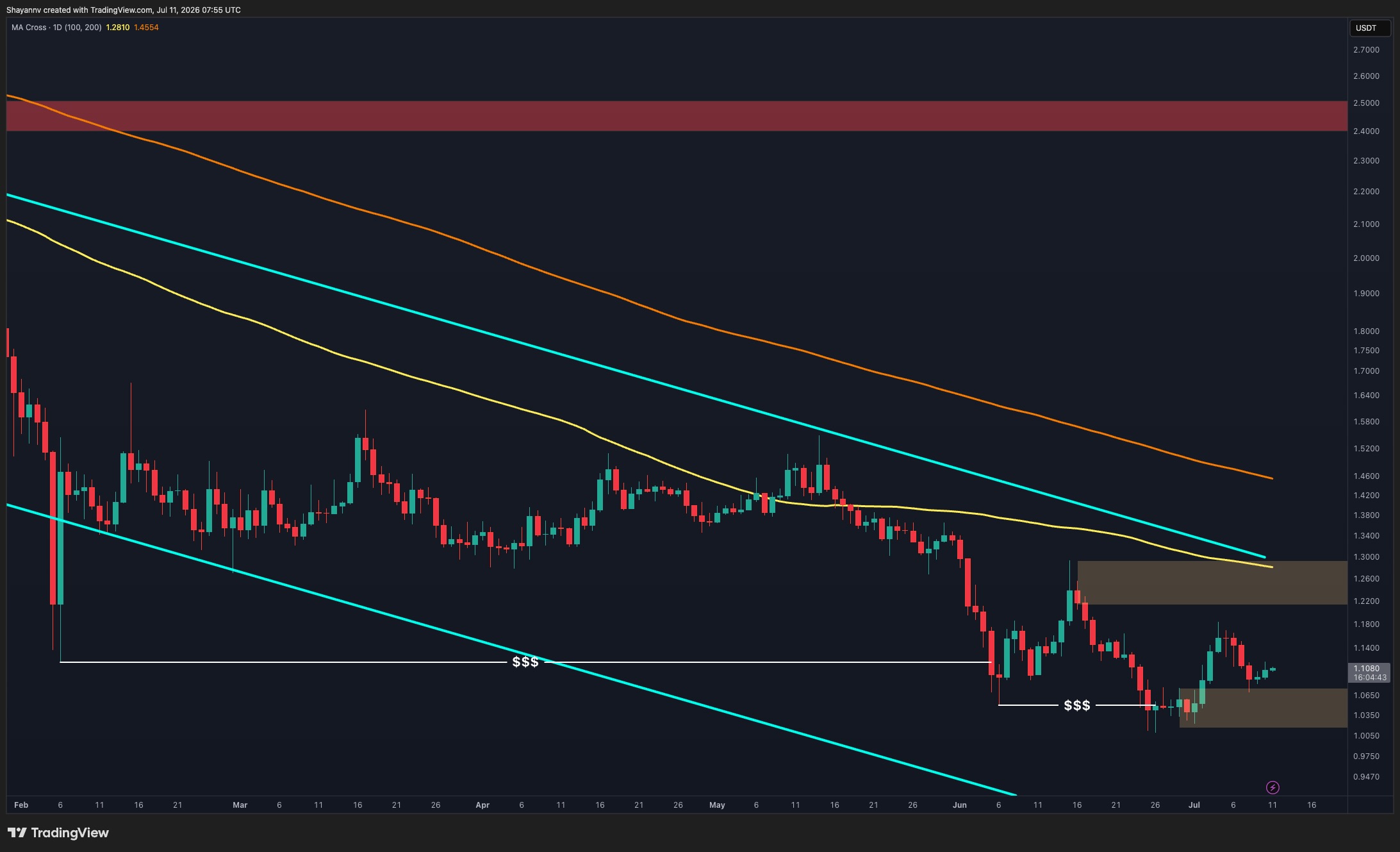
    On the daily chart, XRP continues to trade within a broader descending channel and remains below its 100-day and 200-day moving averages. Both averages are trending downwards, reinforcing the long-term bearish outlook.

    However, the recent dip towards the $1.02-$1.06 support zone appears to have spurred considerable demand. This area coincides with a previous sweep of liquidity below April’s lows, where the market briefly traded below support before a swift rebound. Since then, XRP has established a higher low and is building a base above this demand area.

    The price has recently bounced from this support zone and is now attempting to re-establish itself above the horizontal resistance region between $1.22 and $1.28. This zone is particularly significant as it also aligns with the descending 100-day moving average and the upper boundary of the prevailing bearish structure.

    A successful reclaim of the $1.22-$1.28 resistance zone would bolster the recovery narrative and could pave the way towards the major supply area situated near $1.55. Until such a breakout occurs, the broader trend is expected to remain corrective within the larger downtrend.

    Constructive Outlook on Shorter Timeframes

    The 4-hour chart presents a more optimistic perspective. Following the liquidity sweep below the $1.02-$1.06 support region, XRP experienced a market structure shift (MSS), signaling the first indication that sellers were losing their grip on the short-term trend.

    The subsequent rally resulted in a change of character (ChoCh), as the price broke above a previous lower high and challenged the descending trendline that has capped rallies since mid-June. Although the token initially faced resistance near the trendline around $1.16-$1.18, the pullback has been relatively shallow, with buyers continuing to defend the former breakout zone.

    Crucially, the market has not retreated to its previous lows despite the rejection, suggesting that demand remains active at current price levels. As long as XRP holds above the $1.03-$1.06 support area, the bullish structure established after the liquidity sweep remains intact.

    The key levels to watch are the descending trendline and the $1.15-$1.18 resistance area. A decisive breakout above this region would confirm a higher-high formation and could accelerate momentum towards the larger daily resistance zone between $1.22 and $1.28.

    Conversely, a failure to break the trendline could lead to further consolidation between support and resistance before a more significant directional move materializes.

    In summary, recent price action suggests a gradual recovery for XRP. However, the cryptocurrency still needs to reclaim the trendline resistance and the $1.22-$1.28 supply zone before a broader bullish reversal can be definitively confirmed.

  • CASHCAT Meme Coin Sees Over 3,200% Surge, Presenting Both Profits and Potential Missed Gains

    CASHCAT Meme Coin Sees Over 3,200% Surge, Presenting Both Profits and Potential Missed Gains

    The meme coin CASHCAT, built on the Robinhood Chain, an Ethereum Layer 2 network, has experienced a price surge of over 3,200% in the past week, reaching a market capitalization that briefly touched $200 million. This rapid increase has coincided with realized profits for some investors, while others may have sold too early, potentially missing out on larger gains.

    According to CoinGecko data, CASHCAT’s value has seen a significant increase, highlighting the volatile nature of meme coin investments. The coin’s market capitalization briefly reached $200 million during this period.

    Investor Outcomes: Realized Profits and Potential Missed Opportunities

    Lookonchain reported on investor outcomes related to CASHCAT. In one instance, an individual invested approximately $838 worth of ETH to acquire over 15 million CASHCAT tokens. This investor later sold the tokens for 580 ETH, realizing a profit exceeding $1 million. However, the report suggests that this investor might have missed a greater opportunity; had they held onto the tokens for a few more days, their investment could have potentially yielded profits of up to $2.9 million, according to Lookonchain.

    Another investor’s experience, also noted by Lookonchain, illustrates a similar pattern. This user sold 20 million CASHCAT tokens for $711, representing a tenfold return on their initial $69 investment. Despite this profit, the report indicates that holding the tokens longer could have resulted in a significantly higher value, potentially over $2.7 million, a scenario that underscores the unpredictable trajectory of meme coins.

    The Meme Coin Landscape

    The cryptocurrency space frequently sees the creation of new, hype-driven assets. The inherent volatility and speculative nature of these coins mean that outcomes can vary significantly. The CASHCAT situation serves as an example of how timing can play a critical role in meme coin investments, where substantial realized profits can coexist with the possibility of larger potential gains left unrealized.

    While the exact identity of the investor who potentially missed out on $2.9 million in profits remains uncertain, with some speculation pointing to influencer Brian Jung based on social media posts, the reported financial outcomes highlight the high-risk, high-reward environment associated with meme coins. Substantial gains are possible, but timing and market volatility are key factors.

    Why This Matters

    The materials describe a reported factual news event: CASHCAT, a meme coin on the Robinhood Chain, saw its value increase by over 3,200% in a week, reaching a market capitalization of $200 million. The exact identity of the participant who made over $1 million profit is uncertain, with speculation it might be Brian Jung.

    Broader Context

    Source materials place the factual news in this context: The cryptocurrency space frequently sees the creation of new hype-driven assets that bring immense joy to a handful of early adopters, or, in most cases, insiders.

  • XRP Ledger Activity Declines Amid Price Stagnation Around $1.10

    XRP Ledger Activity Declines Amid Price Stagnation Around $1.10

    Recent weeks have seen a notable decrease in on-chain activity on the XRP Ledger, coinciding with XRP’s price consolidating around the $1.10 mark. While the network experienced a surge in activity during the first quarter of the year, current data indicates a significant slowdown in user engagement.

    Subdued Network Activity

    Data from Santiment Intelligence suggests that activity on the XRP Ledger has become notably subdued. The network registered only 25,350 active wallets on a recent day, marking the second-lowest figure of the year. Furthermore, new wallet creation has dropped to 2,130, a level not seen in almost two years. This decline in network participation occurs as XRP’s price has struggled to break out of a narrow range, trading between $1.05 and $1.15. The cryptocurrency had previously defended the $1.00 support level a few weeks ago.

    Historical Context and Analyst Views

    Despite the current quiet on-chain period, some analysts view the current price range as a historical accumulation zone. According to EGRAG CRYPTO, XRP is trading within its historical accumulation band of $0.85 to $1.20. This range has repeatedly served as macro support during previous market cycles. However, EGRAG also suggested that a dip to $0.85 is possible, though the broader bottoming structure is expected to remain intact.

    Looking ahead, EGRAG CRYPTO identified the first major resistance level for XRP at $1.65. Breaking this level could potentially lead to higher price targets, with projections ranging from $3.00 to $3.50. A more ambitious long-term target of $15 has also been mentioned as a full cycle expansion target, though this is considered a distant possibility.

    Ecosystem Developments and Uncertainties

    While on-chain metrics show a slowdown, the XRP ecosystem continues to develop. Factors such as the growth of RLUSD, activity in tokenized assets, and institutional payment use cases are cited as potential catalysts that could re-engage users on-chain if momentum improves. However, the extent of RLUSD’s growth and the full implementation of institutional payment use cases remain uncertain.

    The current situation presents a mixed picture for XRP. The decline in on-chain activity and price stagnation could be interpreted as a pause before a significant move, or it could indicate waning demand. Historical patterns suggest potential for future appreciation, particularly if key resistance levels are breached and ecosystem developments gain traction. Nevertheless, the uncertainty surrounding these factors means that the future trajectory of XRP remains subject to various market dynamics and developments.

    Why This Matters

    The current lull in XRP Ledger’s on-chain activity and price consolidation, contrasted with historical performance and potential future developments, is significant for investors and market observers. Understanding these subdued network metrics is crucial for assessing XRP’s underlying health and potential for future growth, especially as it trades within historical accumulation zones. The interplay between declining user engagement and potential ecosystem catalysts highlights the evolving landscape of digital assets and the challenges in predicting market movements based solely on current data.

    Broader Context

    Ripple’s cross-border token has stagnated around $1.10 ever since it defended the $1.00 support a few weeks ago. This price action occurs against a backdrop of declining on-chain activity, with metrics like active wallets and new wallet creation reaching multi-year lows. While past performance and analyst projections offer some insights, the future trajectory remains subject to ecosystem developments and broader market dynamics.

  • Standard Chartered’s $500K Bitcoin Target: A Look at the Uncertainties and Geopolitical Framing

    Standard Chartered’s $500K Bitcoin Target: A Look at the Uncertainties and Geopolitical Framing

    Standard Chartered’s Head of Digital Assets Research, Geoffrey Kendrick, has reiterated a prediction that Bitcoin could reach $500,000, potentially before former President Donald Trump leaves office. This forecast, which has resurfaced following Trump’s recent public endorsement of the cryptocurrency, contrasts with Bitcoin’s current trading price and follows a previously missed target for 2025.

    Kendrick’s $500,000 Bitcoin price target, with a potential endpoint by 2030 or sooner, is now framed by the former president’s emphasis on geopolitical competition and the national security implications of digital assets. Trump has publicly supported Bitcoin, framing it as a tool to counter China’s influence and assert U.S. sovereignty in the digital sphere. Kendrick suggests this stance could provide a potential regulatory tailwind, supporting the long-term outlook.

    This renewed attention on Kendrick’s forecast comes after Bitcoin did not reach his earlier prediction of $200,000 by 2025. The cryptocurrency peaked at approximately $126,198 in October 2025, falling significantly short of that mark. Despite this miss, Standard Chartered and Kendrick maintain their long-term roadmap, citing institutional inflows, sovereign adoption, and Bitcoin’s fixed supply as foundational pillars of their thesis.

    Trump’s recent public endorsement at a White House event has brought Standard Chartered’s long-term forecast back into the spotlight. The former president explicitly cited geopolitical competition as a primary rationale, warning that allowing rivals to dominate the digital asset space would carry strategic costs the U.S. cannot afford. He emphasized that preventing China from gaining an advantage was a key reason for his support, framing digital asset dominance as a question of sovereignty. This national security angle provides a potentially more durable basis for regulatory support than a purely market-driven endorsement.

    The underlying thesis for Standard Chartered’s bullish case relies on legislative clarity under a potentially sympathetic administration, coupled with increased institutional access through spot Exchange Traded Funds (ETFs). Kendrick has framed the $500,000 target around the idea that Trump’s regulatory agenda could provide a long-term structural boost to Bitcoin.

    However, the path to such a high valuation remains uncertain. Bitcoin is currently trading around $64,000, a substantial distance from the $500,000 target. Some outside analysts offer a more conservative outlook, suggesting that a sustained low-to-mid six-figure Bitcoin price over the longer term is a more realistic base case, and that further downside remains possible before any durable recovery takes hold.

    The realization of Standard Chartered’s prediction hinges on several factors, including the extent to which Trump’s national security framing translates into concrete regulatory policy, continued institutional adoption, and the broader macroeconomic environment. The uncertainty surrounding the exact timeframe of Trump’s departure from office also adds ambiguity to the prediction’s timeline. Despite the missed 2025 target, Standard Chartered maintains its long-term view, emphasizing that the core structural elements supporting their forecast remain intact.

    Why This Matters

    Standard Chartered’s Geoffrey Kendrick maintains a $500,000 Bitcoin price target, citing a potential regulatory tailwind from former President Trump’s focus on geopolitical competition and national security implications of digital assets. This prediction, while ambitious, is contingent on political will and the translation of geopolitical rhetoric into policy, with past misses serving as a cautionary note.

    Broader Context

    Donald Trump’s recent public endorsement of Bitcoin, framed through national security and geopolitical competition, has brought renewed attention to long-standing bullish predictions. This context necessitates an examination of the underlying drivers and potential risks associated with such forecasts, particularly given the significant gap between the target price and current market realities.

  • XRP Price: Will it Hit $1.20 Before Clarity Act?

    XRP Price: Will it Hit $1.20 Before Clarity Act?

    XRP Price Prediction: Can XRP Break Through $1.20 Amidst Regulatory Uncertainty?

    The central question for XRP price predictions remains whether buyers can finally overcome the resistance range between $1.15 and $1.20. Currently, XRP is trading in the $1.08 to $1.12 corridor, indicating it is still confined to a familiar trading band. While maintaining support levels is positive, markets seldom reward stagnation.

    Sustained Support Holds

    Despite the sideways movement, the sustained defense of the $1.00 to $1.05 area over several weeks warrants attention. Sellers have repeatedly tested this floor without triggering a significant, lasting downturn. This resilience keeps the bullish outlook intact, even if it has not yet translated into substantial gains.

    Exchange Outflows Signal Accumulation

    Concurrently, exchange outflows have surged, climbing from approximately 41 million XRP to around 123 million. This trend typically suggests that coins are being withdrawn from trading platforms rather than being prepared for sale, a positive indicator. However, relying on a single metric to forecast price movements is insufficient.

    Price Action Awaits a Catalyst

    Nevertheless, the current price action requires a significant impetus. Without renewed buying pressure, XRP could continue to fluctuate within its established support and resistance levels. While markets can exhibit patience, traders often do not.

    The $1.15-$1.20 Hurdle

    A decisive move by buyers to reclaim the $1.15 to $1.20 zone could rapidly improve momentum. Until then, XRP remains in a consolidation phase, awaiting an external catalyst rather than generating its own.

    Technical Indicators Offer Mixed Signals

    XRP is currently trading in the $1.08 to $1.10 range, but the critical battleground is closer to $1.18. This level coincides with the 50-day exponential moving average (EMA) and a concentration of sellers aiming to exit their positions at break-even. A successful breach of this zone could pave the way for targets between $1.20 and $1.25. However, breaking resistance is one challenge; sustaining price levels above it is another.

    The technical chart is showing signs of improvement, though it has not yet signaled a definitive bullish trend. The Relative Strength Index (RSI) remains below 50, while the Moving Average Convergence Divergence (MACD) has re-entered positive territory. This suggests that selling pressure is easing, but buyers have not yet asserted full control. The market is still seeking a compelling reason to commit.

    Regulatory Developments on the Horizon

    A potential catalyst could emerge from Washington. The CLARITY Act remains a focal point for traders after missing its initial timeline, with the Senate expected to address the issue later this month. Any indication of progress could swiftly boost sentiment. Conversely, further delays in legislative action might prolong XRP’s current trading range.

    Prediction Markets Show Balance

    Prediction markets currently present a balanced outlook. Traders are assigning nearly equal probabilities to XRP testing $1.20 and revisiting the $1.00 area within the current month. A clear move above $1.18 could open the door to $1.25 or even $1.30. On the downside, a loss of the $1.00 support level would expose $0.87, with $0.80 serving as the next significant support.

    Institutional Demand and Partnerships

    Institutional demand for XRP has not waned. Spot XRP Exchange-Traded Funds (ETFs) continue to attract consistent inflows, indicating that larger investors are actively accumulating the asset. Ripple’s recent strategic partnerships have also contributed positively to sentiment. Despite these factors, XRP continues to encounter selling pressure before reaching the $1.20 mark. The market can be resistant to predictable breakouts, especially when expectations are widespread.

    XRP’s Consolidation and Future Outlook

    XRP’s persistent struggle to break through its resistance, coupled with strong underlying demand, capped upside potential due to overhead supply and the timing of regulatory clarity, presents a scenario that might lead traders to seek opportunities elsewhere offering more asymmetric exposure. With the current contested move towards $1.20, the near-term upside potential for XRP trades is measured in modest percentages. While the XRP Ledger infrastructure continues to evolve, near-term price catalysts remain binary and contingent on specific events.