Category: Uncategorized

  • Payward Secures $22 Million Arbitration Award Against Former Auditor Mazars USA

    Payward Secures $22 Million Arbitration Award Against Former Auditor Mazars USA

    Payward, the parent company of cryptocurrency exchange Kraken, has been awarded $22 million in arbitration against its former auditor, Mazars USA, following the auditor’s abandonment of a nearly completed audit. Payward is seeking to have this award entered as a final judgment by the Delaware Court of Chancery.

    According to Arjun Sethi, co-CEO of Kraken, the auditor’s withdrawal occurred during a period Payward claims was associated with reputational harm and financial losses, particularly during what critics describe as ‘Operation Choke Point 2.0’—a campaign to pressure banks into cutting off the crypto industry. Sethi stated that when an auditor walks away without findings, the client is left to repair reputational damage at a significant cost.

    Mazars USA had audited Kraken’s financials for three years, delivering two clean opinions. However, the firm quit the third audit in December 2023, days before its completion. Mazars reported in writing that it had no disagreement with management, no concerns about integrity, and found no fraud before withdrawing. The firm cited legal uncertainty, including an SEC complaint filed against Kraken weeks prior, as a reason for its withdrawal.

    This dispute unfolded against a backdrop of increased regulatory scrutiny on the crypto industry. In December 2022, Mazars Group had already halted its proof-of-reserves work for the crypto sector. In January 2023, regulators including the Federal Reserve, FDIC, and OCC issued a joint statement warning banks about crypto risks. Around the same time, the FDIC sent approximately 25 ‘pause letters’ to 24 banks, which advocates say instructed lenders to halt or reconsider crypto-related activities.

    The SEC had filed a complaint against Kraken weeks before Mazars abandoned its audit. This suit was later dismissed with prejudice in March 2025, with no penalties or admission of wrongdoing by Kraken, noted as part of a broader shift in regulatory approach.

    In a related development, Kraken co-founder and former CEO Jesse Powell’s home was raided by federal agents in March 2023. The investigation was reportedly closed about two years later with no charges filed.

    Sethi has pointed to these events as a reason to support legislative efforts like the Clarity Act, a bill aimed at dividing oversight of digital assets between the SEC and the CFTC. The Clarity Act cleared the Senate Banking Committee in May with a 15-9 vote, after passing the House in the previous year, but has faced hurdles and requires further votes to become law.

    Payward’s claim in arbitration centered on the reputational and financial damage was associated with by Mazars’ abrupt departure from the audit. Sethi argued that proving a lawful crypto business deserves ordinary banking and professional services should not require winning a legal fight.

    Uncertainties remain regarding the exact date of the arbitration award announcement and the specific years the Clarity Act passed the House and cleared the Senate Banking Committee. The full extent of legal uncertainty cited by Mazars and whether the firm acted independently or under pressure are also points of ambiguity. The precise reasons for the SEC’s initial complaint against Kraken and the full impact of ‘Operation Choke Point 2.0’ on the broader crypto industry are also not fully detailed.

    Why This Matters

    The materials describe a narrow update: Payward, the parent company of Kraken, received a $22 million arbitration award from its former auditor, Mazars USA. The exact date of the Tuesday announcement.

    Broader Context

    Source materials place the factual news in this context: Operation Choke Point 2.0 is a widely used term for what critics describe as the Biden administration’s unofficial campaign to pressure banks into cutting off the crypto industry after the collapse of FTX.

  • Ripple’s XRP Logo to Adorn Kansas Jayhawks Jerseys in Landmark College Sports Deal

    Ripple’s XRP Logo to Adorn Kansas Jayhawks Jerseys in Landmark College Sports Deal

    The University of Kansas’ athletic teams, the Jayhawks, will feature the XRP logo on their game jerseys starting this fall, marking a significant development described as the first cryptocurrency sponsorship of a major college athletics program. This partnership between Ripple, the company behind XRP, and the University of Kansas introduces a new element to collegiate sports marketing.

    According to Ripple, the XRP patch will be designed to match the team’s uniform color scheme, appearing in Crimson, Blue, or White as appropriate. The logo will be exclusively featured on game jerseys and will not be present on practice, travel, or sideline gear. Furthermore, officially licensed Adidas game jerseys sold at retail stores will not include the XRP patch. However, fans will have the option to add the patch to official game jerseys purchased directly from the Jayhawk Outfitters store, the University of Kansas’ official team store.

    This collaboration is framed by both parties as a “shared commitment to innovation and excellence.” Ripple CEO Brad Garlinghouse, an alumnus of the University of Kansas, commented on the partnership, describing it as a “rare moment where my professional and personal worlds collide.” Garlinghouse holds a Bachelor of Arts in Economics from the University of Kansas.

    The University of Kansas athletic teams boast a decorated history, having secured 15 national championships and 12 NCAA Division I titles across various sports. The inclusion of the XRP logo on their jerseys signifies a new frontier for cryptocurrency marketing within the collegiate sports landscape.

    While the sponsorship is positioned as a notable development, its scope is defined by specific details regarding jersey availability. The XRP patch will be a feature of game jerseys purchased at Jayhawk Outfitters, distinguishing it from mass-market retail versions. This approach aims to integrate the sponsorship directly into the fan experience at the point of official merchandise purchase.

    Why This Matters

    The materials describe a narrow update: Ripple’s XRP logo will be featured on the game jerseys of the University of Kansas’ athletic teams, the Jayhawks, starting in the fall. XRP logo to be featured on major college sports uniforms.

    Broader Context

    Source materials place the factual news in this context: Ripple’s team on X described the new partnership between the company and the Kansas Jayhawks as ‘History on a jersey patch.’.

  • Hedge Funds Bet Heavily Against Yen; XRP Eyes $2.00 Amid Japan Shift

    Hedge Funds Bet Heavily Against Yen; XRP Eyes $2.00 Amid Japan Shift

    XRP Trades Near $1.07 Amid Yen Weakness and Japanese Investor Interest

    XRP is currently trading around $1.07, marking a roughly 3% decline over the past 24 hours. Despite this dip, the digital asset maintains a weekly gain of 6-7%, suggesting its broader upward trend remains intact.

    The key question for traders is whether sustained demand from Japan, driven by the weakening yen, will fuel further gains, or if the current consolidation signals a pause before a more significant correction. Hedge funds have adopted their most bearish stance on the yen since 2007, with short positions reaching nearly 138,000 contracts as of June 30, according to Commodity Futures Trading Commission (CFTC) data.

    This significant shift in currency markets represents a structural foreign exchange dislocation that historically prompts Japanese retail investors to seek refuge in hard assets and cryptocurrencies. In contrast, Bitcoin is consolidating in the mid-$60,000 range, down approximately 0.6% on the day but up over 6% for the week. Bitcoin has shown resilience against macroeconomic pressures that have significantly impacted Korean equities, with the Kospi index shedding about 20% from its recent peak.

    The current volatility across foreign exchange and equity markets is palpable. XRP, with its established positioning in cross-border payments, stands to benefit directly should the yen’s slide accelerate and Japanese exchange volumes surge in response.

    XRP’s Technical Landscape

    At $1.07, XRP occupies a technically challenging position. It hovers above the psychologically significant $1.00 level, which short-term traders view as strong support, but remains well below the previous resistance band near $2.00 that capped its last major rally.

    The 3% single-day drop is noteworthy, indicating active selling pressure at current price levels rather than a mere absence of buyers. Volume data suggests strategic positioning rather than panic-driven liquidations.

    The Bull Case: Japanese Retail Re-engagement

    The optimistic outlook for XRP hinges on renewed engagement from Japanese retail investors. XRP has historically enjoyed substantial popularity on Japanese exchanges. The current multi-decade lows for the yen provide domestic holders with a compelling incentive to reallocate funds into crypto-denominated assets.

    This catalyst could accelerate if the Bank of Japan signals further tolerance for yen weakness or delays intervention. On-chain data already indicates growing institutional interest. The base scenario anticipates a period of range-bound trading between $1.00 and $1.50 as macroeconomic conditions evolve.

    The Bear Case: Potential Breakdown

    The bearish argument is more straightforward. A decisive break below $2.03 could trigger a move towards $1.91 on any subsequent recovery attempt, marking a point where the near-term bullish thesis would be invalidated.

    Analysis based on the Market Value to Realized Value (MVRV) ratio suggests XRP is not yet in overheated territory. While this limits the potential for panic selling, it does not guarantee that current support levels will hold. Should the $1.00 floor falter, the next significant support level lies considerably lower.

    Market participants are advised to monitor the Bank of Japan’s policy decisions and the flow of partnerships from Ripple. While the underlying conditions for a potential rally are present, definitive confirmation is still pending.

    Infrastructure Plays: LiquidChain

    While XRP’s appeal is linked to foreign exchange dynamics, its current price point positions it as a recovery trade rather than an early-entry opportunity for those seeking asymmetric exposure to cross-border liquidity trends. Investors looking for such opportunities at a different risk profile are exploring infrastructure projects.

    LiquidChain is one such project gaining traction among analysts tracking Layer 3 development. The project aims to create an execution environment that unifies liquidity from Bitcoin, Ethereum, and Solana into a single layer. It promises unified liquidity, single-step execution, and a deploy-once architecture designed to address the fragmentation issues that developers find problematic.

    The LiquidChain presale has reportedly raised $889,886.53, with the current token price at $0.01477. This represents significant traction for a pre-launch infrastructure token.

    Key differentiators for LiquidChain include its Unified Liquidity Layer and Verifiable Settlement features. If the cross-chain thesis proves successful, the project’s value accrual potential is substantial.

    However, presale tokens inherently carry execution risk, and the absence of a live mainnet means proof of concept is yet to be demonstrated. Investors interested in the infrastructure angle are encouraged to research LiquidChain before its next price tier concludes.

  • AngelList Ends Ripple Rail Partnership, Phasing Out Crypto Payments

    AngelList Ends Ripple Rail Partnership, Phasing Out Crypto Payments

    AngelList will discontinue support for cryptocurrency payments via Ripple’s Rail platform by July 31, 2026, prompting users to switch to traditional payment methods like ACH and wire transfers for investments. The platform reported that existing investments and user data will remain unaffected.

    The termination means that cryptocurrencies including USDC, USDT, DAI, and ETH will no longer be available for payments after the deadline.

    Ripple acquired Rail in August 2025 for $200 million as part of a larger $2.45 billion M&A strategy. Rail’s core proposition was to enable enterprises to process stablecoin payments across various fiat currencies, aiming to simplify crypto adoption without requiring significant backend infrastructure overhauls.

    AngelList’s decision to end its partnership with Rail raises questions about the operational priorities and traction of Ripple’s enterprise payment solutions. While AngelList has not provided specific reasons for the termination, the move suggests a potential misalignment with its operational priorities. This development underscores the persistent challenges in enterprise adoption of crypto payments.

    This shift occurs as Ripple has recently achieved regulatory milestones, including securing a key European regulatory license in early July 2026. Concurrently, Clearstream, a major European post-trade services provider, expanded its custody offering to include XRP and other tokens.

    However, AngelList’s departure serves as a reminder that conventional fiat payment methods, such as ACH and wire transfers, continue to be preferred by many institutional operators due to their perceived simplicity and compliance predictability. Broader uncertainty surrounding stablecoin settlement infrastructure may also have influenced AngelList’s decision.

    Ripple’s institutional engagement presents a mixed picture, with expansion in some areas and contractions in others. The $200 million acquisition of Rail is more easily justified when key enterprise clients remain active. The loss of a partner like AngelList, prominent in the startup and venture ecosystem, prompts scrutiny regarding the depth of Rail’s enterprise traction.

    Several uncertainties persist following the announcement. The precise reasons behind AngelList’s decision beyond the official notice remain undisclosed. The long-term impact on Rail’s enterprise traction and Ripple’s ability to secure replacement partners are points of interest. It is also unclear if or when AngelList might reinstate crypto payment support.

    AngelList continues to serve approximately 50,000 funds and 800,000 accredited investors, with its core functionality for these users remaining intact. The focus for investment transactions will now shift to traditional banking channels.

    Why This Matters

    The materials describe a narrow update: AngelList will stop supporting crypto payments, including USDC, USDT, DAI, and ETH, through Ripple’s Rail platform by July 31, 2026. No explanation was given for AngelList’s decision beyond the wind-down notice.

    Broader Context

    Source materials place the factual news in this context: Ripple acquired Toronto-based Rail in August 2025 for $200 million as part of a broader $2.45 billion M&A push.

  • Bankers Flag Farage’s £5M Gift From Crypto Billionaire

    Bankers Flag Farage’s £5M Gift From Crypto Billionaire

    Bankers Flagged £5 Million Gift to Nigel Farage to UK Crime Agency

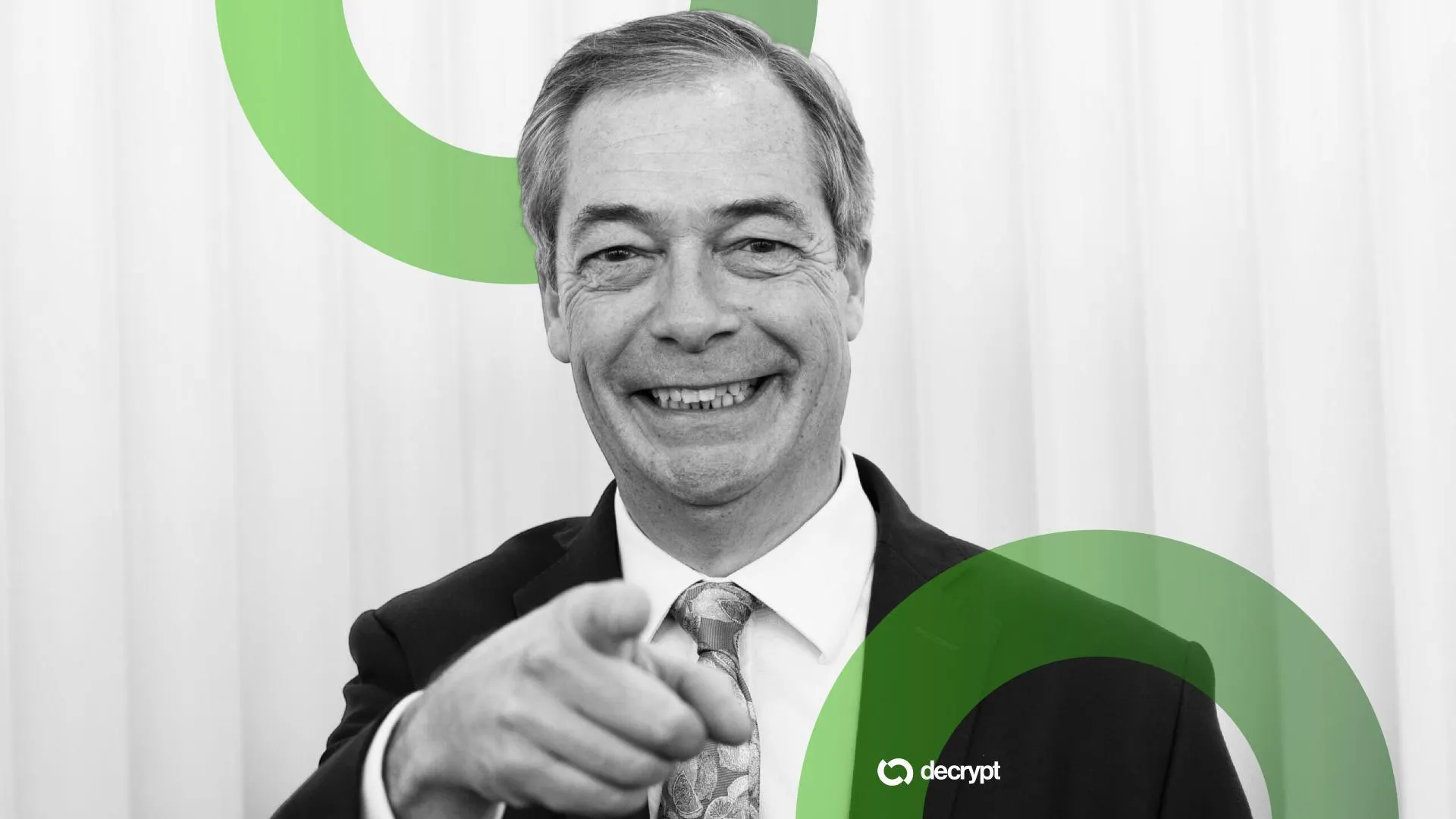
    Bankers flagged a £5 million donation to Nigel Farage from billionaire Tether investor Christopher Harborne to the UK’s National Crime Agency (NCA), according to a report by The Guardian.

    The financial institution filed a suspicious activity report (SAR) with the agency on May 16, 2024, The Guardian reported, noting that the bankers were unable to trace the ultimate origin of the funds. A SAR is not an accusation of wrongdoing but rather a notification prompting the agency to review a transaction for potential further investigation.

    Harborne, a British businessman based in Thailand, who owns a 12% stake in USDT issuer Tether and ranks sixth on The Sunday Times Rich List, has also made substantial donations to the Reform UK party.

    Banks are particularly vigilant with transactions involving “politically exposed persons” (PEPs), who are considered to be at a higher risk of bribery or corruption. Financial Conduct Authority (FCA) guidance mandates that firms adopt a “risk-based and proportionate approach to PEPs when considering money laundering risks.” Harborne’s cryptocurrency holdings further elevated this risk from a banking perspective, The Guardian stated, due to the inherent difficulty in tracing funds moving in and out of digital assets.

    Farage told The Guardian that he was unaware of the SAR and had “no reason to doubt the ultimate source of the money.” He asserted that the information had been “illegally obtained” by the newspaper and claimed he had no knowledge of any discussions with the NCA concerning transactions involving him.

    The NCA declined to confirm or deny to The Guardian whether it had received any report, citing the confidentiality of SARs and the potential for breaching this confidentiality to constitute a “tipping off” offense under the Proceeds of Crime Act.

    Discrepancies in Donation Timeline Emerge

    Harborne’s lawyers informed The Guardian that Farage received the funds on April 5, 2024. However, financial industry sources cited by the newspaper indicated that at least a portion of the £5 million arrived after May 23, 2024, the date Farage announced his decision not to stand in that year’s general election, citing it was “not the right time for me.” He later reversed this decision days later to contest the Clacton seat.

    This timeline appears to conflict with an account in a new book, “The Farage Factor” by Conservative peer Michael Ashcroft. The book suggests that Reform UK was already preparing to launch Farage’s candidacy by mid-May, having enlisted a GB News producer to assist with promoting a planned announcement event.

    Farage has characterized the donation as an “unconditional gift” and has provided various explanations for its purpose, including security funding, a reward for his Brexit advocacy, and as “nobody’s business,” stating he could use it for luxury items like Ferraris.

    Scrutiny Over Declaration and Potential By-Election

    Farage has argued that he was not obligated to declare the gift as he was not a politician at the time of receipt. According to The Guardian’s reporting, he became a “person of significant control” of Reform’s corporate entity on May 1, 2024, and served as the party’s honorary president from March 2021 to June 2024.

    Parliament’s standards commissioner is already investigating whether the failure to declare the funds breached parliamentary rules. The Labour party has accused him of evading scrutiny over the gift.

    Hours before The Guardian’s latest report, Farage stated his intention to force a by-election in his Clacton seat. However, this move appeared to backfire on Tuesday night as the Conservatives, Labour, the Greens, the Liberal Democrats, and Restore Britain all announced they would not field candidates, dismissing the contest as a “circus.”

    Should Farage be re-elected, he would still face the ongoing standards inquiry and any subsequent reprimand.

    Separately, George Cottrell, a convicted fraudster with connections to an offshore crypto casino, has called for an investigation into Farage’s “failure to declare financial support.” The Reform UK leader has denied that the benefits required declaration, and Cottrell denies having expected any reciprocal benefit.

  • Vanguard Creates Head of Digital Assets Role Amid Evolving Crypto Engagement

    Vanguard Creates Head of Digital Assets Role Amid Evolving Crypto Engagement

    Vanguard, the asset management firm with approximately $11 trillion in assets under management, has established its first Head of Digital Assets position. This move signifies a strategic evolution for the company, which has historically expressed skepticism towards cryptocurrencies.

    The new role will focus on developing a multi-year strategy for digital assets, including plans for tokenization, stablecoins, custody, and blockchain settlement. The appointed executive will also be tasked with engaging with regulators concerning these emerging technologies.

    This development represents a notable shift from Vanguard’s previous approach. In early 2024, the firm declined to offer spot Bitcoin ETFs to its clients, characterizing Bitcoin as an immature asset class that did not align with its long-term investment philosophy. However, Vanguard began to adjust this stance in December by allowing brokerage clients to trade third-party crypto funds.

    Zcash Technical Progress and Price Movement

    In parallel, Zcash (ZEC) saw a price increase on Tuesday, rising over 10% and briefly trading above $500 for the first time since early June. This price movement appears connected to reported progress by Zcash developers on its upcoming “Ironwood” shielded pool, a component of the larger Project Tachyon overhaul.

    Developers have indicated they are nearing the completion of a formal proof demonstrating that the new shielded pool is free of hidden counterfeiting vulnerabilities. This is a significant step, as a similar soundness issue identified in the Orchard shielded pool in June was associated with a notable price decline for ZEC. Although that earlier bug was addressed promptly and reportedly not exploited, the privacy-focused nature of Zcash’s model made it challenging to cryptographically suggest the absence of counterfeit coin creation, leading to a ZEC price drop of over 40% within two days.

    The “Ironwood” upgrade is designed to address these concerns by introducing a new shielded pool and a migration pathway enabling users to transfer funds from Orchard while providing assurance against hidden inflation. The deployment of “Ironwood” is scheduled for this month. Beyond the counterfeiting proof, Project Tachyon aims to enhance the scalability of private transactions to thousands per second and improve quantum resistance by removing on-chain data that could potentially be harvested by future quantum computers.

    While Vanguard’s new hiring suggests increasing institutional interest in digital assets, several uncertainties persist. It remains unclear whether Vanguard’s client base will ultimately seek exposure to cryptocurrencies. Additionally, the market awaits definitive confirmation regarding the Zcash bug and its exploitation status before a clearer outlook on the implications of the Tachyon upgrade can be established.

    This report is based on information from Tyler Warner and Decrypt. The analysis and opinions presented are those of the author and do not necessarily reflect the views of Decrypt.

    Why This Matters

    Vanguard, a major asset manager, has posted its first-ever Head of Digital Assets role, indicating a shift in its approach to cryptocurrencies. However, it remains uncertain whether Vanguard’s user base will ultimately want crypto exposure.

    Broader Context

    Morning Minute is a daily newsletter written by Tyler Warner.

  • RBI Reportedly Renews Push for Crypto Restrictions Amid Financial Stability Concerns

    RBI Reportedly Renews Push for Crypto Restrictions Amid Financial Stability Concerns

    The Reserve Bank of India (RBI) is reportedly renewing its advocacy for policies that would restrict cryptocurrencies and privately issued stablecoins, according to internal government documents reviewed by Reuters. This intensified push is driven by ongoing concerns within the central bank regarding financial stability and monetary sovereignty.

    The RBI’s stance, as detailed in the documents, suggests a policy leaning towards prohibiting banks and financial institutions from holding, trading, or otherwise gaining exposure to cryptocurrencies and privately issued stablecoins. Officials reportedly view such a prohibition as a means to keep digital assets outside the regulated financial system and to mitigate potential risks. A specific concern highlighted by the RBI relates to stablecoins, particularly those pegged to foreign currencies or the rupee, due to their potential to affect domestic monetary sovereignty and financial stability, especially during periods of economic stress.

    Despite the RBI’s reported internal advocacy for stricter measures, India has not implemented an outright ban on cryptocurrency trading. The sector currently operates within a regulatory grey zone. Major lenders in the country generally avoid direct exposure to cryptocurrencies, having received multiple warnings from the central bank. This cautious approach from financial institutions reflects the central bank’s persistent concerns and the lack of clear regulatory guidelines.

    Adding to the complexity of the crypto landscape in India, the country’s tax department has also raised concerns about the increasing difficulty in tracking cryptocurrency transactions. This challenge is particularly pronounced when transactions are routed through offshore exchanges, peer-to-peer rupee trades, or private self-custody wallets. Data from 2023 indicates a significant gap in tax compliance, with fewer than a quarter of the approximately 645,000 individuals who engaged in crypto transactions reporting them on their tax returns. India currently imposes a 30% tax on crypto gains, with overseas platforms, valuation discrepancies, and unclear ownership further complicating compliance efforts for taxpayers.

    The RBI’s renewed focus on restricting crypto activities, coupled with the tax department’s warnings about tracking difficulties and low compliance, points to a potentially challenging regulatory environment for digital assets in India. While a formal prohibition has not been enacted, the central bank’s persistent concerns and the existing tax framework create significant uncertainty for the crypto sector. The exact timeline for any potential formal prohibition or specific regulatory actions remains unclear, as do the precise measures the RBI might pursue if a full ban is not implemented. These uncertainties highlight the evolving and complex nature of cryptocurrency regulation in India.

    Why This Matters

    The materials describe a narrow update: The Reserve Bank of India (RBI) has reportedly reiterated its support for a policy that leans towards prohibiting cryptocurrencies and privately issued stablecoins. The exact timeline for any potential formal prohibition by the RBI.

    Broader Context

    Source materials place the factual news in this context: The source article is a report from Reuters.

  • Cardano Whale Selling Activity Creates Market Uncertainty, Technicals Point to Bearish Outlook

    Cardano Whale Selling Activity Creates Market Uncertainty, Technicals Point to Bearish Outlook

    Cardano’s recent on-chain data, revealing significant selling activity from whale wallets, presents an ambiguous picture of market direction rather than a clear indicator of future price movements. While substantial token outflows have been observed, the interpretation of these actions and their potential impact on ADA’s price remains subject to considerable uncertainty.

    Whale Distribution Continues Amidst Price Decline

    Per Santiment Supply Distribution data, whale wallets holding between 100,000 and 100 million ADA have sold approximately 190 million tokens since July 1. This selling pressure has coincided with a price decrease, with Cardano’s ADA reaching $0.172 on July 8 and experiencing a four-day losing streak. This pattern echoes a similar offloading event in early June, when approximately 260 million ADA were sold by comparable whale cohorts. The current setup is directionally consistent with that of the prior cycle, but it is not yet at peak pessimism by that metric alone, per FXStreet’s technical analysis.

    Bearish Sentiment on Derivatives Markets

    Derivatives data from CoinGlass corroborates the bearish sentiment. The funding rate for ADA has flipped negative, printing at -0.0060% on an OI-weighted basis. This indicates that short-sellers are paying long-position holders, reflecting a market consensus that the price is likely to move lower. Furthermore, the long-to-short ratio stands at 0.79, suggesting more traders are positioned short than long. Crucially, these shorts are not being squeezed out; they are being paid to hold, which removes a common catalyst for a short-term bounce.

    Technical Indicators Signal selling pressure

    Technically, ADA’s structure is uniformly bearish. The 50-day Exponential Moving Average (EMA) is at $0.185, the 100-day EMA at $0.216, and the 200-day EMA at $0.289. All these key moving averages sit above the current ADA price and are acting as overhead supply. The most recent price recovery attempt was capped by the 32.82% Fibonacci retracement at $0.195, confirming that sellers are active at each recovery attempt. Immediate resistance clusters at $0.173, which corresponds to the 23.6% Fibonacci retracement. ADA is currently testing this level from below. Above $0.173, the 50-day EMA at $0.185 and the 38.2% retracement at $0.195 form the next meaningful supply zone, followed by a wider band between $0.213–$0.217 where the 50% retracement, the 100-day EMA, and a broken descending trendline converge.

    On the downside, initial support sits at the psychological floor of $0.150. A clean break below this level could open the path to the Fibonacci cycle low at $0.138, which is identified as the primary price forecast target for the bearish scenario. However, the question remains whether the current distribution cycle is approaching exhaustion or still has room to run toward this target.

    While momentum indicators like the MACD have turned positive and the Relative Strength Index (RSI) is hovering near 50, their significance is diminished by the broader bearish trend structure. The negative funding rate and the fact that shorts are not being squeezed out further suggest that the bearish path is the more technically supported of the two at present. If whale offloading continues and the $0.173 resistance holds, ADA could test $0.150 within the current weekly range. A failure at this support level, particularly if accompanied by further deterioration in the funding rate or long-to-short ratio, would set up a move toward the $0.138 Fibonacci cycle low.

    Potential Bullish Pivot and Broader Market Context

    The bull case requires a specific sequence: whale distribution must exhaust, the cohorts tracked by Santiment must flip from selling to accumulation, and ADA must reclaim $0.173 on meaningful volume. While this scenario is not impossible, as prior cycles have seen similar whale cohorts pivot from offloading to accumulation at depressed levels, the current derivatives data does not yet signal that rotation is underway. The structural setup for Cardano mirrors the broader dynamic affecting much of the altcoin market, where technically complex assets are being weighed down by macro-driven risk-off positioning, a dynamic also observed in the Bitcoin technical outlook for 2026.

    Until on-chain data shows whale behavior shifting decisively, the $0.138 target remains the more credible near-term outcome, though significant uncertainty persists regarding the exact trajectory and timing of any potential price movements.

  • New Listing: 20x Leverage COSTUSDT Perpetual Contract

    New Listing: 20x Leverage COSTUSDT Perpetual Contract

    Bybit Lists COSTUSDT Perpetual Contract, Offering Up to 20x Leverage

    Cryptocurrency exchange Bybit has announced the listing of its COSTUSDT Perpetual Contract, enabling traders to engage with the asset with leverage of up to 20 times.

    The new contract is also accessible through Bybit’s suite of Futures bots, including Futures Grid, Futures Martingale, and Futures Combo.

    The COSTUSDT Perpetual Contract is based on the underlying asset Costco Wholesale Corporation (COST) and settles in USDT. The contract features a tick size of 0.01 and a maximum leverage of 20.

    Key details of the COSTUSDT Perpetual Contract include a capped funding rate of 2.5%, with funding fees settled every 8 hours. Trading is available 24/7.

  • Bybit Delists ESUSDT Perpetual Contract July 10, 2026

    Bybit Delists ESUSDT Perpetual Contract July 10, 2026

    Bybit will cease support for its ESUSDT Perpetual Contract on July 10, 2026, at 9:00 AM UTC, the exchange announced. This delisting will affect all users, including those employing automated trading strategies.

    Following the delisting, Bybit will automatically cancel all active and conditional orders for the ESUSDT Perpetual Contract. Open positions will also be automatically closed, with the settlement price determined by the average index price over the 30 minutes preceding the delisting.

    The ESUSDT Perpetual Contract will be removed from Bybit’s Trading Bots service. Additionally, all unfilled orders within the Copy Trading feature related to this contract will be canceled.

    Traders are advised to manage their positions and orders for the ESUSDT Perpetual Contract before the July 10 deadline to prevent automatic closures and cancellations.

    Broader Context

    Source materials place the announcement in this context: Bybit will be delisting the ESUSDT Perpetual Contract at Jul 10, 2026, 9:00AM UTC.