Category: Uncategorized

  • Pi Network Hits Major Milestone Amidst Price Plunge

    Pi Network Hits Major Milestone Amidst Price Plunge

    Pi Network Completes Major Milestone Amidst Price Plunge

    The team behind the controversial cryptocurrency project has rolled out a significant upgrade aimed at bolstering its entire ecosystem. However, this positive development has failed to spur a recovery for PI, whose valuation has plummeted to a new all-time low.

    Recent Protocol Advancements

    Pi Network has demonstrated considerable progress in recent months. In February, the Core Team introduced protocol version 19.6, followed by an upgrade to v19.9. Subsequently, they launched the highly anticipated v20.2, which laid the groundwork for smart contract functionalities.

    Last month, the team announced a migration to protocols v22 and v23, setting June 2 as the deadline for transitioning to v24. This update was shared on Pi Network’s official X account earlier today, June 5.

    “Great job to all Nodes! This was one of the most challenging migrations,” the announcement stated.

    The upgrade to protocol 24 primarily focuses on enhancing the underlying infrastructure that supports node operations and mainnet activity. The Core Team has indicated that migration to v25 is the next step, with June 18 designated as the completion deadline.

    Expansion into Gaming

    In addition to protocol updates, Pi Network has recently made further strides in the gaming sector. CiDi Games, a company within the Pi Network Ventures portfolio, has released four new games for Pioneers: Coin Whack, Fruit Stack, Gemnova, and RainbowCubes.

    Persistent Price Suppression

    Despite these developments, PI’s valuation remains heavily impacted by the prevailing bear market and the recent market-wide pullback across the cryptocurrency landscape.

    Earlier this week, the token’s price collapsed to a new all-time low of approximately $0.12. This represents a 33% decrease for the month and a staggering 96% drop from its historic peak of $3, recorded at the beginning of 2025. PI’s market capitalization has consequently fallen to around $1.3 billion, positioning it as the 58th-largest cryptocurrency.

    Indicators of Further Correction

    Several factors suggest that an additional price correction may be imminent. Data indicates a substantial increase in PI coins held on exchanges, with over 500,000 coins added in the past 24 hours, bringing the total to over 550 million. This surge suggests that a significant number of investors have moved their holdings to centralized platforms, potentially increasing immediate selling pressure.

    Upcoming token unlocks also present a potential challenge, with approximately 160 million PI tokens slated to enter circulation within the next 30 days. June 11 is projected to be a notable day, with 16 million coins scheduled for release. While this does not guarantee a steeper decline, it could provide an opportunity for some investors to liquidate long-held tokens.

  • Flare Secures $4M XRP Liquidity Milestone

    Flare Secures $4M XRP Liquidity Milestone

    Flare Network Achieves Milestone with $4 Million XRP Liquidity Rollover

    The decentralized finance ecosystem on Flare Network has reached a significant milestone with an automated liquidity rollover, successfully moving over $4 million in capital between fixed-term yield markets without disrupting trading activity.

    Seamless Transition for Yield Markets

    The rollover, which occurred on June 4, 2026, involved the largest stXRP fixed-term pool on Spectra Finance reaching its maturity date. Managed by GamiLabs’ FXRP MetaVault, the process automatically transferred liquidity into successor pools scheduled to expire on August 27 and November 26, 2026.

    MetaVaults Streamline DeFi Operations

    Introduced in February 2026, MetaVaults were designed to address operational challenges inherent in fixed-term yield tokenization. The system utilizes a single smart contract to monitor market expiries, identify new investment opportunities, and route liquidity according to predefined on-chain rules.

    Under this model, liquidity providers deposit assets once and receive a vault token representing their stake. The vault then autonomously manages subsequent rollovers, eliminating the need for users to manually withdraw and reallocate funds each time a market expires.

    Overcoming the “Expiry Cliff”

    This automated transition directly tackles a persistent issue in fixed-term DeFi markets known as the “expiry cliff.” Historically, maturing pools have often led to fragmented liquidity and diminished market activity as participants scramble to move capital into new opportunities.

    In the case of the June rollover, liquidity was already established in the replacement markets prior to the original pool’s maturity. This proactive approach ensured the maintenance of continuous market depth, thereby avoiding the typical disruptions associated with fixed-term expiries.

    Significant Market Activity Precedes Rollover

    The importance of this rollover was underscored by the substantial scale of the maturing market. The stXRP pool had recorded over $25 million in lifetime trading volume during its four-month tenure. By May, it was offering double-digit fixed rates, a testament to sustained activity leading up to its expiry.

    Spectra Finance continues to be a prominent yield trading platform on Flare, facilitating structured yield products through FXRP. FXRP itself functions as a trustless and overcollateralized representation of XRP within Flare’s FAssets framework.

    Collaborative Ecosystem Drives Growth

    GamiLabs manages the FXRP MetaVault, while Firelight is responsible for issuing the stXRP utilized within the ecosystem. In conjunction with Spectra’s protocol infrastructure, these elements collectively support a burgeoning market for XRP-denominated yield strategies.

    The operational advantages of this structure were highlighted by Spectra Finance co-founder Gaspard Peduzzi. He stated that the MetaVault framework transforms expiry events into seamless market transitions. Peduzzi further suggested that this methodology could foster deeper and more efficient XRP yield markets by mitigating the operational friction associated with fixed-term maturities.

  • XRP Price Plunge Risk: What Happens If $1 Support Fails?

    XRP Price Plunge Risk: What Happens If $1 Support Fails?

    XRP Begins June With Steepest Decline in Three Months

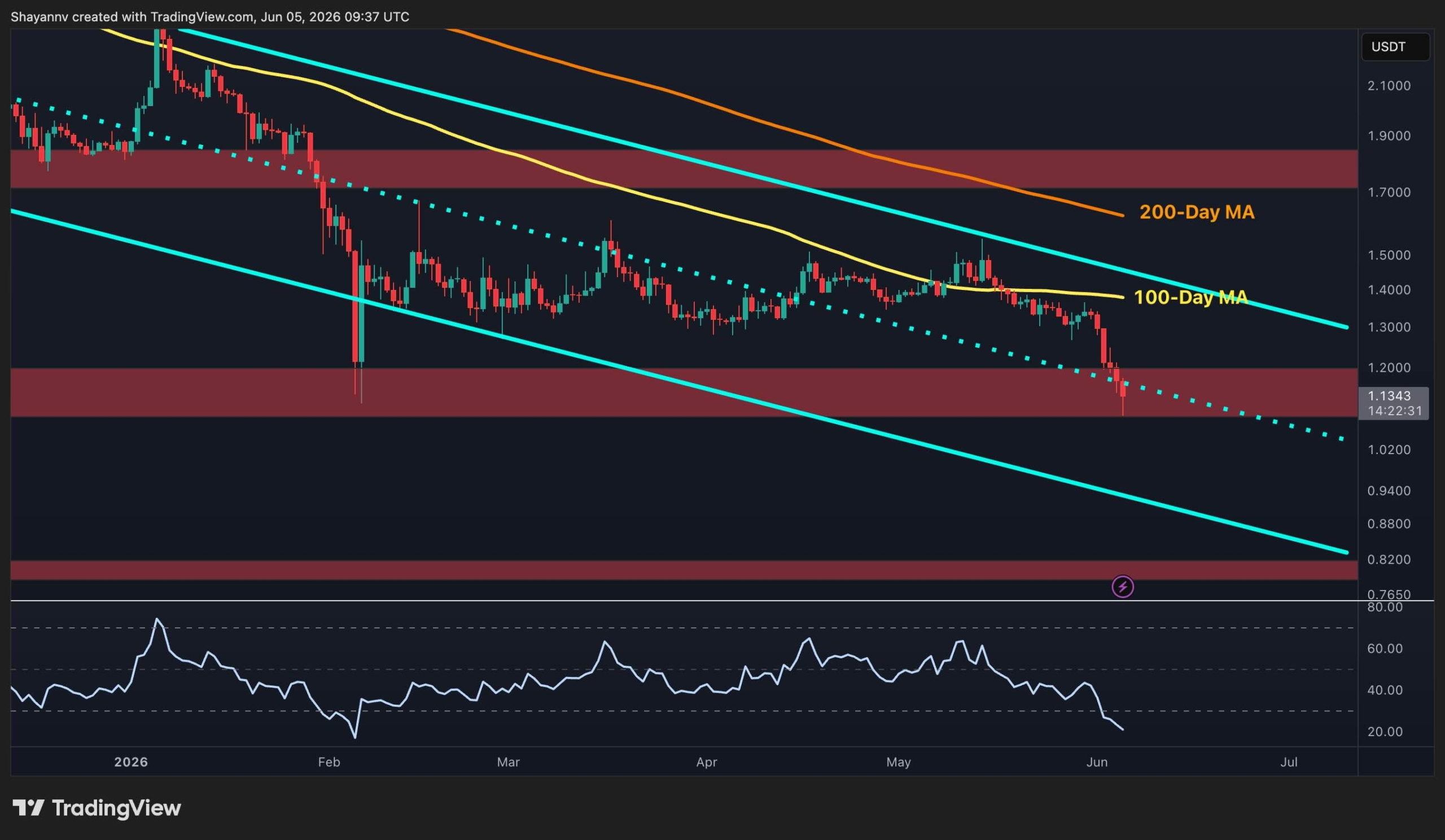
    XRP has opened June with its most significant price drop in the past three months, as the critical $1.20 support level, which had acted as a firm floor for months, is now being breached. The cryptocurrency is currently trading at $1.11. The Relative Strength Index (RSI) is also registering its lowest point since the capitulation seen in February, with the next significant support level appearing to be approximately $0.30 lower. Analysts suggest this is not merely a pullback from resistance but rather a breakdown of XRP’s last line of defense.

    On the USDT chart, the $1.20 support band, which proved resilient during the February market crash and had remained untouched since, is now on the verge of collapse. The RSI has similarly plummeted to around 20-25, nearing the oversold territory observed during the February capitulation low. This reading alone is noteworthy, as historically, RSI levels at this extreme have preceded at least a sharp relief bounce, even within a broader downtrend.

    However, an oversold RSI does not automatically signal that a bottom has been established. The $1.20 level is now likely to transition into resistance. For the current breakdown to be considered reversed rather than merely paused, any subsequent bounce would need to reclaim this level on a sustained closing basis.

    Below the current trading price, the next key structural reference point is the $0.80 demand zone. This area also aligns with the lower boundary of a descending channel, presenting a significant confluence of support, albeit at a considerably lower valuation. With the 100-day moving average at $1.35 and the 200-day moving average at $1.60 now both acting as substantial overhead resistance, the USDT-paired chart shows XRP facing considerable selling pressure above and limited structural support below.

    XRP/BTC Pair Shows Greater Resilience

    In contrast, the BTC pair is presenting a more robust picture. XRP/BTC is currently trading at 1,800 satoshis, holding above recent lows of 1,740 satoshis. The RSI, which had surged to 70 at the end of May, suggesting a potential shift in momentum, has since retreated to 50. This indicates that the brief period of strength has not translated into sustained buying pressure.

    The price is trading below the short-term resistance of 1,850 satoshis, having been rejected at this level once again. The declining 100-day moving average, situated around 1,900 satoshis, is acting as immediate dynamic overhead resistance. The fact that the XRP/BTC ratio has held its ground while the USDT pair has weakened suggests that XRP’s dollar-denominated weakness is partly attributable to broader altcoin selling pressure rather than a specific deterioration of XRP’s standing against Bitcoin.

    A confirmed close below 1,740 satoshis on the BTC pair, especially if it occurs concurrently with continued weakness in the USDT pair, would signify a definitive breakdown across both pairings. Such a scenario would expose the 1,500 satoshis area as the next significant level of support.

  • Lawmaker: Government Stablecoins Risk Fueling Tax Evasion

    Lawmaker: Government Stablecoins Risk Fueling Tax Evasion

    Sherman Slams Stablecoin Payments as Tax Evasion Tool

    Longtime cryptocurrency critic U.S. Representative Brad Sherman (D-CA-32) voiced strong opposition to government stablecoin payments during a House hearing on banking regulators Thursday, asserting that such a system would facilitate tax evasion.

    During the hearing, titled “Oversight of Prudential Regulators,” National Credit Union Administration Chairman Kyle Hauptman presented the idea of the federal government distributing funds via stablecoins. He highlighted that stablecoins operate around the clock, unlike traditional payment systems constrained by business hours. Hauptman suggested this could allow for tax refunds to be issued on Sundays or holidays and emergency stimulus payments to be delivered more swiftly and securely.

    Sherman, however, countered that he “can’t think of a worse idea,” arguing that government payments in stablecoins would “sanctify an alternative to the U.S. dollar, an alternative designed to facilitate a tax-evasion economy.”

    Hauptman defended dollar-pegged tokens as a means to counter rivals in Beijing, Tehran, and Moscow and to preserve the dollar’s global standing by stimulating demand for U.S. Treasuries.

    The issue of stablecoin yields also arose, with Sherman warning that “the smartest, or at least the best-paid lawyers in the country” were already seeking loopholes around interest payments on stablecoins. He urged supervisors to “write regulations that withstand that.”

    World Liberty Financial Charter Application Sparks Confrontation

    The hearing also featured Comptroller of the Currency Jonathan Gould defending his agency’s handling of the national trust-bank charter application from World Liberty Financial, a firm linked to the Trump family.

    The House Financial Services Committee hearing became contentious when Representative Gregory Meeks (D-NY-5) directly questioned Gould’s independence, asking if he was “working for the American people or working for the Trump family.”

    Gould pushed back, labeling Meeks’ remarks as “unfortunate and without precedent.” He added, “Your attempts to continue to pressure me are the only political pressure I’ve felt from anyone other than your Senate colleagues.”

    Regulators Outline Stablecoin Oversight Progress

    Beyond the World Liberty Financial issue, federal regulators provided updates on their progress in overseeing stablecoins under the GENIUS Act, passed last summer. FDIC Chairman Travis Hill stated that his agency, along with others, would soon propose customer identification requirements for stablecoin issuers.

    These regulatory developments coincide with increased access for cryptocurrency firms to traditional banking infrastructure. Falcon Financial launched its fUSD stablecoin on Wednesday, utilizing Anchorage Digital—the first federally chartered crypto bank—as a GENIUS-compliant payments token. The Federal Reserve has also granted cryptocurrency exchange Kraken a master account, though with certain limitations, similar to the “skinny” master account proposed by the Fed’s board of governors last year.

    World Liberty Financial claimed last month to be in the “final stages” of receiving conditional approval, asserting that the Trump sons have not abandoned the project despite regulatory hurdles.

    Banking charter approvals for crypto firms have become a politically charged issue. Senator Elizabeth Warren (D-MA) has deemed approvals for firms like Coinbase and Ripple as illegal. Meanwhile, the Trump White House had previously directed the Federal Reserve to review master account access for crypto firms and instructed federal regulators to remove “overly burdensome and fragmented regulations and supervisory practices.”

  • XRP Sentiment Sours: Divine Ray ICO’s Live Product Outshines Waiting

    XRP Price Faces Stagnation Amidst Institutional Accumulation and Shifting Crowd Sentiment

    XRP’s price saw a 3% dip last week, now trading within the $1.30 to $1.40 range, a situation that has proven frustrating for many holders. However, beneath the surface of this price stagnation, significant activity is unfolding. Institutions are reportedly making daily purchases, and Exchange Traded Fund (ETF) inflows continue to pour in. Concurrently, crowd sentiment has once again turned sharply negative.

    Divine Ray ICO Surpasses $100,000 on Launch Day

    In contrast, a cryptocurrency presale known as Divine Ray ($DCR) has achieved a notable milestone, raising over $100,000 on its opening day. Divine Ray distinguishes itself with a live social media application and its own proprietary blockchain.

    While XRP holders await a delayed breakout, Divine Ray presents a functional product and a $5 million valuation, a combination that analysts suggest is compelling.

    Analyst Predicts Bold XRP Targets Amidst Accumulation

    Crypto analyst Patel recently shared an updated XRP chart on a four-day timeframe. The analysis places XRP’s current trading price at $1.3607, situated firmly within a multi-year accumulation zone that spans roughly from $0.50 to $1.80.

    Patel has outlined ambitious long-term price targets for XRP, indicating potential upside levels of $5, $10, and even $15 per token. He attributes this optimistic outlook to sustained institutional buying, noting that these entities are not selling but are instead quietly increasing their holdings daily.

    Data supports this observation, with total net ETF inflows for XRP reaching $1.41 billion since their inception. Over the past 15 trading days alone, there have been $116.48 million in direct inflows. Outflow days have been infrequent, occurring on only 13 out of 193 days, meaning over 90% of trading days have seen net inflows. This suggests substantial capital accumulation by large investors while retail interest appears subdued. Patel characterizes this period as “the calm before the storm,” advising potential buyers to consider accumulating during significant market downturns within the $1 to $0.70 range.

    Crowd Sentiment Dips into “FUD Zone”

    Santiment’s latest data on XRP crowd sentiment reveals a significant shift, with the ratio of positive to negative commentary dropping to a mere 1.1 bullish comments for every bearish comment. This marks the highest level of crowd fear, uncertainty, and doubt (FUD) observed in three weeks. The sentiment ratio chart indicates a sharp decline into the “FUD Zone,” a region historically associated with price stabilization and subsequent bounces, as seen in late April and early May.

    Historically, such widespread fear and skepticism have served as a contrarian indicator for XRP’s price. When social media sentiment becomes excessively fearful, it often signifies that many less committed investors have already exited the market, thereby reducing selling pressure and creating conditions conducive to a rebound. Conversely, periods of extreme optimism, where the sentiment ratio enters the “FOMO Zone,” have often coincided with local price peaks due to widespread bullish positioning. Currently, the market’s position within the fear zone suggests a potentially opportune time for buying.

    XRP Price Prediction and Divine Ray’s Value Proposition

    Based on this data, an XRP price prediction suggests a potential bounce towards the $1.50 to $1.60 range in the coming weeks. Continued ETF inflows and sustained institutional demand could propel XRP above $1.60, potentially opening the path to $2.00 and beyond. However, even the most optimistic long-term targets of $5 to $15 per XRP, representing a 3x to 10x return over multiple years, are considered respectable but not necessarily life-changing for smaller investment portfolios.

    Divine Ray, on the other hand, offers a tangible product with its fully functional mobile social media application, available on both the Apple App Store and Google Play. This approach, launching a product before its token, is a rarity in the cryptocurrency space. Users can download the app, create an account, and begin using it immediately.

    The project is built on its own blockchain infrastructure, developed using the Cosmos SDK and integrated with the IBC network, granting Divine Ray complete control over its technology, scalability, and future ecosystem development. Divine Ray Coin ($DCR) is already trading on the Osmosis decentralized exchange, providing immediate liquidity and market validation from the presale’s inception.

    Divine Ray targets the expanding global consciousness and wellness economy, a sector encompassing meditation, yoga, retreats, spiritual content, and conscious communities. The platform aims to connect creators, retreat centers, events, and communities within a unified ecosystem. The $DCR token possesses multiple utilities, including memberships, advertising, NFT minting, creator rewards, and community growth incentives, each contributing to demand drivers within the platform’s social economy.

    The project’s initial valuation of approximately $5 million during Phase 1 of its ICO is considered exceptionally low compared to industry norms, where many projects launch with websites alone at valuations of $50 million or $100 million. Divine Ray’s existing live app, functional blockchain, and DEX listing present a significant valuation gap, offering potential for substantial returns.

    The $DCR presale is structured in four phases, with prices increasing incrementally. Phase 1 offers 400 billion DRC at $0.0000015 per token, with subsequent phases moving to $0.000002, $0.0000025, and $0.0000035. Phase 1 remains open, but its momentum, evidenced by exceeding $100,000 on day one, suggests it may not last. Divine Ray is positioned as a presale to watch this summer.


  • Bitcoin Price Analysis: BTC’s Next Move After Falling Below $61K

    Bitcoin Price Analysis: BTC’s Next Move After Falling Below $61K

    Bitcoin Faces Intense Selling Pressure After Breaching Key Support Levels

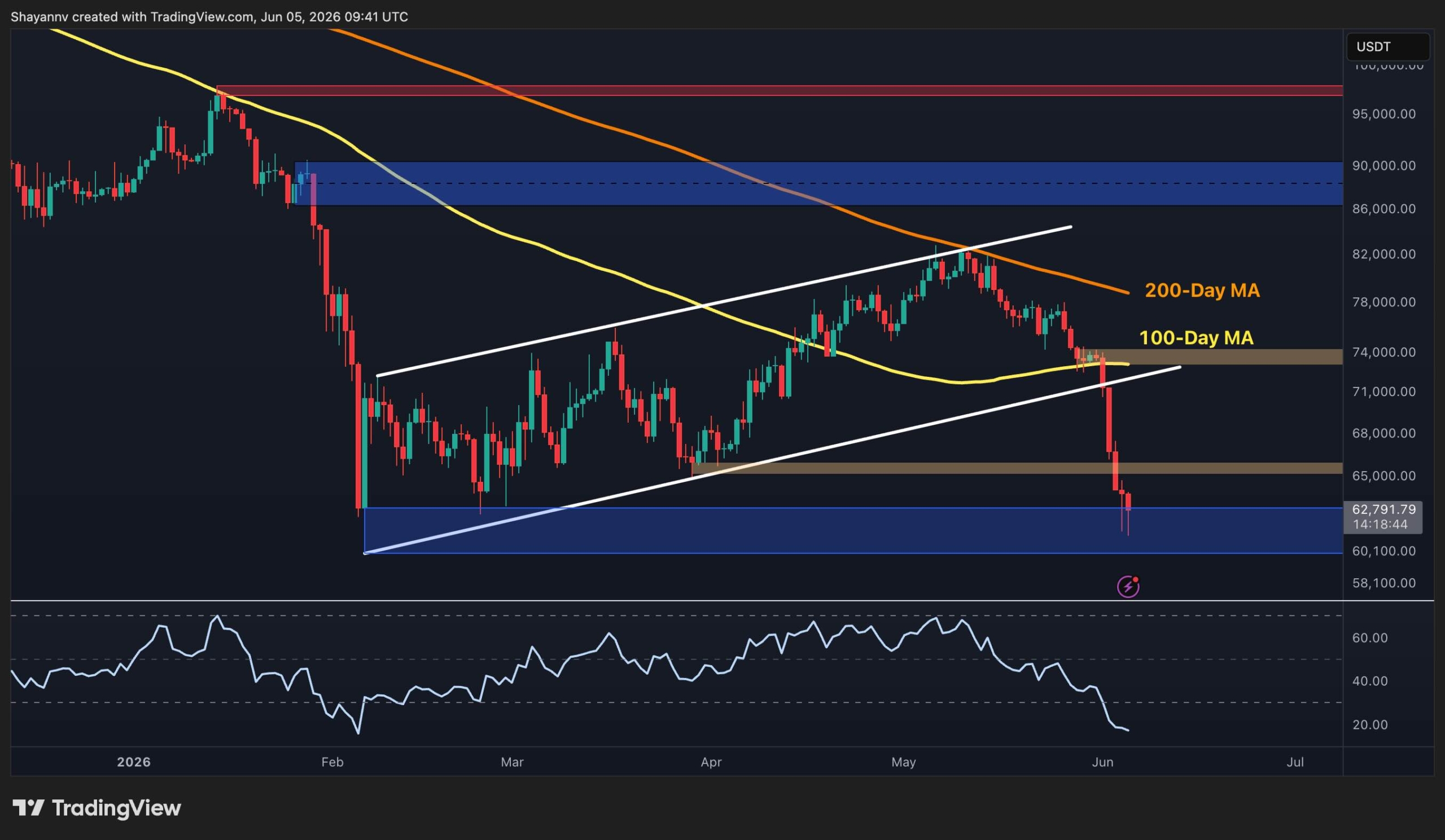
    Bitcoin is currently experiencing significant selling pressure, having rapidly fallen below multiple critical support levels. A recent rejection from the descending 200-day moving average triggered a sharp sell-off, invalidating the prior rising channel and pushing BTC back towards a major demand zone around $60,000. Concurrently, on-chain data indicates that market participants are increasingly realizing losses, signaling a deterioration in investor sentiment.

    Bearish Breakdown Confirmed

    On the daily chart, Bitcoin has confirmed a substantial bearish breakdown after dropping below both its ascending channel and the 100-day moving average, which had been situated near $74,000. This channel had previously supported the cryptocurrency’s recovery from February lows, but its recent violation suggests that buyers have lost control of the intermediate trend.

    The rejection occurred near the confluence of the channel’s upper boundary and the descending 200-day moving average, around the $82,000 mark. Since then, BTC has undergone an aggressive decline, slicing through the $74,000 support area and the significant low of $65,000 from late May with minimal resistance.

    The price is now testing a major support block at $60,000, a level that previously served as a strong rebound area following the February capitulation. This zone represents the last significant line of defense for bulls before the market potentially opens the door to substantially lower levels.

    Severity of Breakdown Evident on Shorter Timeframes

    The 4-hour chart underscores the severity of the recent breakdown. Following an extended period of consolidation near the $74,000 region, BTC failed to reclaim this level and subsequently broke below the lower boundary of the daily ascending channel that had supported price action for months.

    As the breakdown accelerated, the $65,000 support area also gave way, driving the price directly into the $60,000-$62,000 demand region. This area is currently acting as a floor, preventing further downside and has already attracted some buying interest.

    An important observation comes from the Relative Strength Index (RSI), which has formed a mild bullish divergence under extremely oversold conditions while the price has established fresh local lows. Although this signal is still in its early stages, it suggests that bearish momentum may be weakening in the short term and could support a temporary rebound towards the $65,000 resistance zone.

    However, from a structural perspective, the market continues to print lower highs and lower lows. As long as BTC remains below the broken support levels at $65,000 and $74,000, any recovery is likely to be viewed as a corrective move rather than the commencement of a new uptrend.

    On-Chain Data Signals Widespread Losses

    The Adjusted Spent Output Profit Ratio (aSOPR), a metric that measures whether coins moved on-chain are being sold at a profit or loss, is providing a significant signal regarding investor behavior.

    The chart indicates that the 30-day Exponential Moving Average (EMA) of aSOPR has fallen below the critical 1.0 threshold. Historically, readings above 1 signify that market participants are realizing profits on average, while values below 1 suggest that coins are being spent at a loss.

    The recent drop below 1 coincides with Bitcoin’s decline towards the $60,000 area and reflects growing capitulation among holders. This shift suggests that a larger proportion of investors are now exiting positions at a loss, a behavior commonly associated with bearish market phases and periods of weak confidence.

    While persistent readings below 1 often accompany downtrends, they can also signal the later stages of a corrective phase as weaker hands exit the market. Therefore, traders should closely monitor whether aSOPR can reclaim the 1.0 level. A recovery above that threshold would indicate renewed profitability across the network and could support broader market stabilization.

    For now, both price action and on-chain data continue to favor sellers, with the $60,000 support region remaining the key battleground that will likely determine Bitcoin’s next major directional move.

  • Bitcoin Dips Near $60K Amid Strategy Sell-Off; Zcash Faces Critical Vulnerability

    Bitcoin Dips Near $60K Amid Strategy Sell-Off; Zcash Faces Critical Vulnerability

    Crypto Markets Suffer Steep Losses as Bears Dominate

    The cryptocurrency markets endured a tumultuous week, largely dictated by a strong bearish sentiment.

    The preceding weekend saw a subdued trading environment, with Bitcoin (BTC) already having fallen to $74,000 from its May peak of nearly $83,000. However, the most significant downturn was yet to come. As the new business week and month commenced on Monday, Bitcoin experienced a rapid and sharp decline. It initially dropped towards the $70,000 mark. While this psychological level provided temporary support, it ultimately failed, leading to a swift deterioration of the market landscape.

    Cryptocurrencies continued to shed key support levels sequentially, with every attempt at a rebound being quickly suppressed. Bears appeared to be firmly in control throughout the week, including on Friday. Earlier in the day, BTC dipped below $62,000 once more, falling to $61,000. Within minutes, it rebounded to $63,000, a move that paradoxically fueled liquidations across the market before the asset was again rejected.

    The latest downward movement occurred just minutes ago, with Bitcoin slumping below $61,000 to reach a fresh four-month low. Consequently, the cryptocurrency has now lost well over $20,000 from its mid-May high and is currently struggling to maintain its position above the critical $60,000 support level.

    The weekly decline is stark and undeniable. Bitcoin has plummeted by 15% since this time last Friday and a substantial 26% over the past month. Its market capitalization has decreased by over $400 billion in recent weeks, now standing at $1.2 trillion according to CoinGecko. Even Bitcoin’s dominance over altcoins has weakened, despite many alternative cryptocurrencies experiencing similar or even more severe price drops.

    Among the notable decliners, Cardano (ADA) has fallen by over 30% following co-founder Charles Hoskinson’s announcement of a temporary break. Zcash (ZEC) saw a 41% drop after the discovery of certain technical vulnerabilities.

    Market Cap: $2.18T | 24H Vol: $138B | BTC Dominance: 55.7%
    BTC: $60,650 (-15.5%) | ETH: $1,600 (-17%) | XRP: $1.11 (-14%)

    Key Developments and Market Reactions

    Strategy Sold Bitcoin, But It’s Not What You May Think
    Bitcoin’s significant price struggles began shortly after Strategy announced its first sale of the cryptocurrency in years. Although the firm disposed of a very small portion of its Bitcoin holdings, the move triggered a notable reaction within the community and may have contributed to a significant downturn in overall market sentiment.

    Peter Schiff Warns Bitcoin Could Plunge Below $20K as Complacency Sets In
    In a widely anticipated commentary on X, Peter Schiff capitalized on Bitcoin’s price crash, predicting an even more dire scenario of a decline to $20,000 if the $50,000 support level is breached.

    Strive Doubles Down on Bitcoin With $185M Buy, Holdings Near 19,000 BTC
    In contrast to Strategy’s sale, Strive made its first purchase in a considerable period, expanding its Bitcoin holdings to nearly 19,000 BTC after a substantial $185 million acquisition.

    Arthur Hayes Dumps Entire Zcash (ZEC) Position After Major Flaw Emerges
    Shortly after news of Zcash’s technical issues gained traction on X, Arthur Hayes, a long-time supporter of the project, announced he had divested his entire ZEC position, citing significant uncertainty.

    Cardano (ADA) Faces Make-or-Break Moment as Social Buzz and Network Activity Explode
    Hoskinson’s break, coupled with ADA’s sharp price decline, has coincided with a surge in Cardano’s social media activity and network engagement, creating a pivotal moment for the project.

    Ethereum Crashing to 14-Month Low Is a ‘Screaming Buy-The-Dip Opportunity’ – Analyst
    Ethereum (ETH) was not immune to the broader market downturn, falling to consecutive 14-month lows, first below $1,800 and then to $1,600. However, some analysts view this significant price drop as a prime opportunity to buy the dip.

    This week’s analysis includes charts for Ethereum, Ripple, Cardano, Binance Coin, and Hyperliquid.

  • Hayes Sells Zcash, Bets Big on Worldcoin

    Hayes Sells Zcash, Bets Big on Worldcoin

    Hayes Ditches Zcash After Vulnerability Disclosures

    Arthur Hayes has announced that his fund, Maelstrom, has liquidated its entire Zcash (ZEC) holdings. The decision follows new disclosures regarding a vulnerability in the Zcash Orchard Pool, which Hayes believes has significantly heightened the perceived risk to ZEC’s monetary integrity. This move effectively marks the end of his recent “Holy Trinity” trade, which encompassed ZEC, NEAR, and HYPE. Worldcoin (WLD) remains the sole AI-linked asset in the fund’s portfolio, according to Hayes.

    “The Holy Trinity is dead,” Hayes declared on the social media platform X. “Sadly, due to the Orchard Pool exploit, I had to dump our entire ZEC bag.”

    The Orchard Pool Vulnerability and Market Reaction

    Hayes’ announcement came shortly after a detailed statement from Zooko Wilcox, Jason McGee, and Taylor Hornby, who characterized the issue as “The Orchard Counterfeiting Vulnerability.” According to their summary, Hornby discovered a critical flaw in Zcash’s Orchard pool on May 29. This vulnerability was disclosed to the Zcash Open Development Lab (ZODL), which then orchestrated an emergency response that concluded on June 2. The core of the problem, as stated, was that the vulnerability “could have been exploited to undetectably create an unlimited amount of counterfeit ZEC within Orchard.”

    This disclosure fundamentally altered the market’s perception. Earlier communications from the Zcash ecosystem had emphasized that the vulnerability had been fixed, with no evidence of exploitation and user funds remaining secure. However, Wilcox, McGee, and Hornby introduced a crucial caveat: due to the privacy features of Orchard, it is impossible to cryptographically prove whether the vulnerability was exploited during its existence.

    This distinction proved pivotal for Hayes’ decision to exit his Zcash position. “While I think it’s extremely unlikely of any minting, it cannot be formally cryptographically proved impossible,” Hayes explained. “The privacy from AI, govt, big tech narrative demands perfection not improbability. I read about the exploit yesterday, and didn’t appreciate how it violated my narrative mental map.”

    ZODL’s Explanation and the Impact of Uncertainty

    Josh Swihart, founder and CEO of ZODL, offered his perspective in a post titled “Never Again.” He described the Orchard bug as a failure in one of the system’s rules, noting that the rule was written with enough leniency to accept false information and still pass. Swihart clarified that the issue was not a privacy leak but a soundness failure within the proof system, a type of problem that can erode confidence in the possibility of invalid value creation within a shielded pool.

    The emergency fix necessitated a coordinated network-wide action, rather than a simple software update for wallets or applications. ZODL and the broader Zcash community temporarily disabled Orchard operations before restoring them with a corrected circuit. While the remediation addressed the vulnerability, the residual uncertainty surrounding the event cast a shadow over the privacy-focused asset. The absence of evidence of counterfeiting is not equivalent to a cryptographic guarantee that counterfeiting never occurred.

    Reassessment and Future Outlook

    Hayes indicated that the approximately 30% sell-off in ZEC prompted a reassessment of his position. “The 30% dump made me rethink, and I had to take profit on the entire position,” he stated. His rationale was not based on confirmed exploitation, but on the principle that the privacy thesis he associated with ZEC demanded a higher standard than probabilistic assurances.

    This sale marks a swift reversal from Hayes’ May 22 “Holy Trinity” call, where he had identified HYPE, ZEC, and NEAR as a promising trio. At the time, he had described HYPE as representing the on-chain derivatives and protocol revenue trade, NEAR as the AI and chain-abstraction play, and ZEC as the privacy component.

    Just a day prior to divesting his Zcash holdings, Hayes had already announced the sale of his HYPE and NEAR positions, citing rising energy prices, anticipated major AI initial public offerings, and political risks surrounding artificial intelligence as reasons for taking profits.

    Despite his exit from Zcash, Hayes has not entirely closed the door on the asset. “We will consistently re-evaluate our thinking and if my assumptions are proven incorrect, will rebuy, hopefully at lower prices,” he wrote. “Privacy is priceless and I have no issue eating humble pie and rebuying much higher.”

    For the time being, Worldcoin remains the sole public manifestation of his AI-linked investment strategy. “We still hold WLD and are excited for Lord Elon to pump our bags,” Hayes added, referencing recent speculation around AI assets and an OpenAI IPO that has fueled renewed interest in Worldcoin.

    At the time of reporting, ZEC had experienced a decline of over 45% in the preceding 24 hours.

  • XRP Faces Critical Juncture: ‘Wick or Brick’ to Dictate Macro Trend

    XRP Faces Critical Juncture: ‘Wick or Brick’ to Dictate Macro Trend

    Crypto Markets Plunge, XRP Faces Critical Juncture

    Cryptocurrency markets have once again experienced significant turmoil, with Bitcoin falling to $61,000 this morning, a level not seen in four months. While some altcoins initially resisted the downturn, they have since followed suit, registering even steeper losses.

    Ripple’s XRP has not been spared. The digital asset, which traded above $1.55 just weeks ago, has seen a sharp decline following a rejection at higher levels. XRP plunged to just under $1.10 today, marking its lowest price point since before the U.S. presidential elections in late 2024.

    Analyst Foresees Potential for XRP’s Next Major Cycle

    Despite the current short-term volatility, a prominent analyst known as EGRAG CRYPTO has offered a broader perspective, suggesting that the current market movements could be the prelude to a significant shift.

    EGRAG CRYPTO pointed out that XRP is approaching a critical juncture that could determine its next major cycle. Drawing a parallel to early 2017, the analyst highlighted a historical pattern where XRP briefly dipped below a key structural support level, termed the “Bifrost Bridge,” before embarking on a substantial upward trend.

    This previous bull phase, EGRAG explained, was initiated by a sharp downside wick designed to purge less committed investors and reconfigure market positions.

    ‘Wick or Brick’ Scenario for XRP’s Future

    The analyst posed a crucial question: “Will we get another massive liquidity wick… or will price build a solid brick structure above support?”

    EGRAG CRYPTO predicted that a deep wick scenario could lead to a significant shakeout of weak hands, foster widespread fear, rapidly sweep liquidity, and establish a final macro reset. This aggressive downward move would challenge the broader market’s current positioning.

    Alternatively, EGRAG’s analysis presents a “brick” structure scenario. In this case, XRP would consolidate above key support levels, such as $1.00 and $1.10, gradually building a stable foundation. This outcome would indicate stronger accumulation and increased market confidence, potentially paving the way for an earlier upward continuation without the need for a dramatic price flush.

    Analyst Leans Towards a Final Emotional Move

    While acknowledging the prevailing uncertainty, EGRAG CRYPTO expressed a personal inclination towards the former scenario.

    “Personally…I still think the market wants one final emotional move before the real expansion,” the analyst concluded.

  • ZCash Exploit Discovered, Scale Uncertain

    ZCash Exploit Discovered, Scale Uncertain

    Zcash Exploit Discovered by White-Hat Hacker Using Advanced AI

    A critical vulnerability in Zcash’s privacy-focused Orchard pool, which could have allowed for the minting of unlimited counterfeit ZEC, was discovered by security researcher Taylor Hornby. The exploit, which had been present for approximately four years, was identified using Anthropic’s Claude Opus 4.8 AI model. The Zcash ecosystem deployed an emergency fix on June 1, addressing the issue.

    The Nature of the Vulnerability

    The Orchard pool, Zcash’s most advanced shielded transaction layer launched in May 2022, utilizes zero-knowledge proofs to validate transactions without revealing sender, receiver, or transaction amounts. The flaw lay in a specific validation check for transaction inputs, which failed to enforce the intended rules. This allowed an attacker to submit false inputs that would still pass the validation, enabling the creation of ZEC out of thin air, with the zero-knowledge proof system erroneously marking the fraudulent transactions as legitimate.

    Hornby, working with Claude Opus 4.8, successfully developed a functional exploit that could generate unlimited, undetectable counterfeit ZEC. He promptly disclosed his findings to ZODL, Zcash’s development coordination body, instead of exploiting the vulnerability on the mainnet.

    Undetermined Impact Due to Privacy Features

    The very privacy features that make the Orchard pool valuable also render it impossible to cryptographically determine if the vulnerability was exploited between May 2022 and June 2026. The Zcash team, which hired Hornby, has stated that exploitation prior to the fix is unlikely. They cited the bug’s evasion of years of scrutiny from expert cryptographers, the necessity of cutting-edge AI tools for its discovery, and a narrow window for remediation. However, they cautioned that users should not solely rely on their assessment.

    Future Network Upgrades and Security Initiatives

    Shielded Labs is proposing a network upgrade that would introduce a new shielded pool and implement “turnstile accounting” for all existing Orchard pool coins. This mechanism would require every Orchard coin to pass through a verifiable checkpoint, thereby exposing any counterfeited supply. This proposal requires broad community governance support and will undergo the standard Zcash network upgrade process. A detailed proposal is anticipated next week.

    Furthermore, Shielded Labs is initiating a project to mathematically verify the entire Orchard circuit from the ground up. The organization is also actively recruiting for a Head of Security and a Cryptographer.

    Broader Implications for the Crypto Space

    This incident serves as a significant real-world demonstration of the capabilities of advanced AI models like Anthropic’s Claude Opus 4.8 when wielded by expert security researchers. Hornby discovered the four-year-old critical bug within 24 hours of Opus 4.8’s public release on May 28, a flaw that had previously withstood multiple rounds of expert human review.

    The discovery highlights the increasing importance of AI in cybersecurity and serves as a stark warning to all cryptocurrency protocols. The industry is urged to proactively engage white-hat hackers to test their own protocols for vulnerabilities, rather than risk exploitation by malicious actors. The evolving landscape suggests that the near-term stability of the broader crypto space may hinge on these proactive security measures.