Category: Uncategorized

  • HYPE Fuels Rally, Eyes $170 Target

    HYPE Fuels Rally, Eyes $170 Target

    Whale Traders Bullish on HYPE Token as Retail Sentiment Dips

    Whale traders have established their most aggressive net-long positions in eight months on Hyperliquid’s HYPE token, even as retail investors hold a 12-month bearish extreme. Data suggests this divergence typically resolves in favor of the larger players.

    Diverging Positions

    Data from Alphractal indicates that since early May, large traders have been quietly accumulating leveraged long positions, while retail participants have turned bearish and begun short selling into the rising trend. Historically, such a split has triggered a wave of short covering by retail traders, pushing prices higher. At the time of reporting, HYPE was trading at $62.05, with a 24-hour trading volume of $830 million and a market capitalization exceeding $15 billion. The token experienced a 2% dip over the past day, but its technical outlook remains bullish. Prices are trading well above the 20-day simple moving average of $47.97 and have broken above the upper Bollinger Band, which analysts suggest signals strong momentum but also potential short-term overextension.

    Technical Analysis and Key Levels

    Crypto analyst Bitcoin Meraklisi noted that HYPE closed a daily candle above $59.54, a level that had previously acted as significant resistance. Based on the cup formation on the chart, this breakout opens a technical path toward $170, representing a roughly 175% increase from current prices. The $59.54 zone is now considered critical support. If the price holds above this level, traders believe the bullish case remains intact; failure to do so could jeopardize the breakout.

    Institutional Interest Grows

    In related news, Grayscale has filed a third amendment with the SEC regarding a potential Hyperliquid ETF. Payments firm MoonPay has also launched access to USDH and USDC through the Hypercore network, reflecting growing institutional interest in the Hyperliquid ecosystem.

    Broader Market Context

    The broader rally began in mid-May, following a period of consolidation in April. Prices have risen sharply since then, and the Moving Average Convergence Divergence (MACD) indicator has been trending upward in positive territory, with increasing green histogram bars supporting the move. The Bollinger Bands have widened significantly, indicating elevated volatility. TradingView data shows a sharp price increase from early February lows to its current range.

  • Ethereum Price Stalls Amid Record Staking, Analyst Says

    Ethereum Price Stalls Amid Record Staking, Analyst Says

    Ethereum has fallen below the $2,100 level as selling pressure intensifies, overshadowing a recovery that has struggled to find solid support since mid-May. While the decline is concerning, an analysis by CryptoOnchain has identified a contradiction within the network data, suggesting the current price weakness is more complex than a simple bearish outlook implies.

    The Contradiction in Data

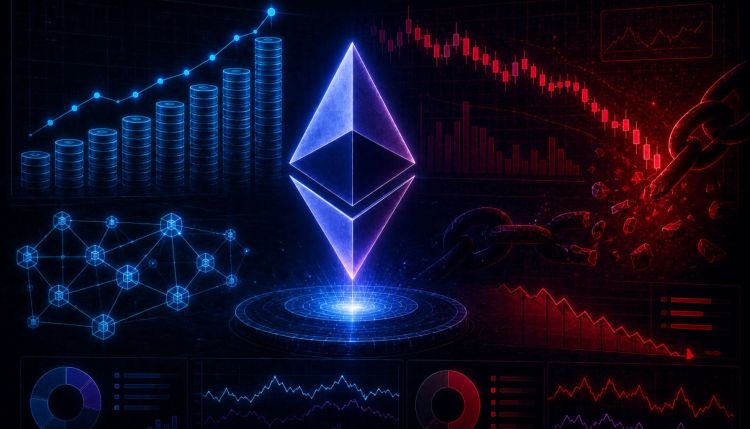
    The contradiction lies between two data points that should not be moving in opposite directions simultaneously. The ETH 2.0 staking rate has reached a new all-time high of 32.18%, representing the largest portion of Ethereum’s total supply ever committed to the network’s validator infrastructure. This indicates that more ETH is locked in long-term staking contracts than ever before, reflecting strong conviction in Ethereum’s long-term value among a significant group of holders.

    However, the network’s organic activity tells a different story. Median token transfer size and transaction fees have plummeted by 80% to 90% compared to the 90-day average. The daily utility that drives genuine demand for block space, including transactions, DeFi activity, NFT volume, and protocol interactions, has nearly vanished. CryptoOnchain describes the current state of the Ethereum blockchain as an “on-chain ghost town.”

    This presents a paradox: record conviction on one hand, and near-zero organic activity on the other, both occurring simultaneously within the same network at the same price. The analysis examines what is holding the structure together, and the answer is the most alarming element revealed by the data.

    Record Staking and Empty Network

    The CryptoOnchain analysis poses a critical question: if organic network activity has collapsed and US institutional spot demand has disappeared, why isn’t Ethereum’s price reflecting these twin absences more severely?

    The Coinbase Premium has dropped to -0.12, confirming that American institutional spot buyers, who fueled the most significant phases of Ethereum’s previous recoveries, have reduced their active accumulation. On-chain activity metrics confirm that retail and protocol users are also largely absent. The two categories of participants whose genuine demand has historically supported Ethereum price levels are both missing simultaneously.

    The Phantom Network: Binance Leverage vs. On-Chain Ghost Town

    The analysis suggests that offshore derivatives are the key factor. Binance Funding Rates have surged 688% above the 90-day baseline, remaining positive at +0.01. Speculative leveraged positioning on the world’s largest derivatives exchange is currently sustaining Ethereum’s price in the absence of spot demand and network utility, which would typically provide that foundation.

    The structural assessment is direct. Peak staking creates a genuine supply floor, as 32.18% of total ETH locked in validators represents a meaningful reduction in immediately available sell-side supply, thus limiting downside in a structural sense. However, a price sustained by derivatives leverage rather than spot demand or network utility is vulnerable. Leverage flushes do not occur gradually. When funding rates at 688% above baseline encounter a catalyst that forces deleveraging, the adjustment happens rapidly, and the supply floor provided by staking cannot absorb the speed of that kind of unwind.

    Technical Outlook

    Ethereum continues to trade near the critical $2,100 level after weeks of sustained selling pressure. The daily chart shows ETH trapped below the major resistance region between $2,280 and $2,380, an area that repeatedly rejected bullish momentum throughout May. Technically, Ethereum remains below the 200-day moving average, which continues trending downward, reinforcing the broader bearish market structure.

    Despite the weakness, bulls are still defending the $2,050–$2,100 support region aggressively. A decisive breakdown below this area would likely expose Ethereum to a deeper move toward the broader demand region around $1,800–$1,900. Volume has gradually declined during the recent consolidation, reflecting market indecision. For bulls to regain momentum, Ethereum likely needs to reclaim the $2,200 level and then break decisively above the $2,300–$2,400 resistance cluster.

  • Scammers Steal $400K via Fake Uniswap Site

    Scammers Steal $400K via Fake Uniswap Site

    Fake Uniswap Site Steals Crypto Funds

    A fraudulent website masquerading as Uniswap is currently siphoning funds from multiple cryptocurrency wallets, according to on-chain analyst “b-block.” The analyst estimates that the scammers have already amassed at least $400,000 in stolen assets.

    Users are advised to only use official links and to verify protocols through DefiLlama.

    Rise in Malicious Google Ads

    This warning follows a report from the security group SEAL, which detailed a significant increase in malicious Google Ads targeting cryptocurrency users. SEAL found that attackers were impersonating popular decentralized finance (DeFi) platforms, wallets, and trading applications to steal funds.

    SEAL reported blocking over 356 malicious Google ad URLs linked to crypto scams. These ads targeted platforms including Uniswap, Morpho Finance, PancakeSwap, Hyperliquid, CoW Swap, and 1inch.

    The attackers utilized compromised or fraudulently obtained Google advertiser accounts and employed cloaking, fingerprinting, and nested iframe delivery systems to circumvent Google’s automated review processes. Many of the fake ads leveraged trusted Google services like sites.google.com and docs.google.com to appear legitimate in search results.

    SEAL identified crypto drainer families, including Inferno Drainer and Vanilla Drainer, as the primary malware used in these campaigns. These tools trick users into signing malicious wallet transactions or entering recovery seed phrases on cloned websites, enabling attackers to seize control of wallet assets.

    SEAL also noted that the sophisticated infrastructure used in these attacks, including Cloudflare Workers, Arweave-hosted payloads, traffic redirection systems, and proxy layers, allows for the interception of Ethereum RPC requests and real-time monitoring of user activity.

    Uniswap was the most impersonated platform, accounting for 41% of the malicious sites tracked. Between March 13 and March 30, confirmed and unattributed losses linked to these campaigns exceeded $1.27 million, though SEAL believes the actual figure is likely much higher.

    Other Recent Phishing Campaigns

    While the recent Uniswap-related scams primarily involved fake websites and malicious Google Ads, a separate phishing campaign earlier this year targeted Ledger users via fraudulent emails. This attack followed a data breach at Ledger’s third-party e-commerce partner, Global-e, which exposed customer contact and order information.

    The scammers falsely claimed that Ledger and Trezor had merged and urged users to migrate their wallets through fake websites that requested 24-word recovery phrases. The phishing pages closely mimicked the companies’ official branding and messaging.

    More recently, Ripple CTO David Schwartz warned of a phishing campaign that sent fake security alerts appearing to originate from Robinhood’s official email system. These emails passed authentication checks because attackers exploited Robinhood’s account creation process, making the messages appear legitimate.

    The phishing emails claimed a new login from an “iPhone 17 Pro” and prompted users to review suspicious activity via a “Review Activity Now” button, which then led to credential theft. Robinhood later confirmed the issue, stating that no systems were breached and no funds were affected.

  • Bitcoin Spot Volume Plunges 81% Since October 10th

    Bitcoin Spot Volume Plunges 81% Since October 10th

    Bitcoin Faces Selling Pressure Amidst Market Uncertainty

    Bitcoin is experiencing renewed selling pressure as global financial markets remain dominated by uncertainty, though bulls have thus far managed to defend the crucial $75,000 region. The cryptocurrency remains trapped below key resistance levels after failing to regain momentum above $80,000 earlier this month, leaving traders seeking signs of stabilization or further declines.

    Spot Trading Volumes Plunge

    While recent weakness has raised concerns across the market, analyst Darkfost believes a significant indicator is the dramatic collapse in spot trading activity. According to Darkfost’s data, Bitcoin spot trading volumes have fallen to levels historically associated with bear markets. The analyst notes that one must look back to July 2023 to find a period where BTC spot volumes were this low across major exchanges.

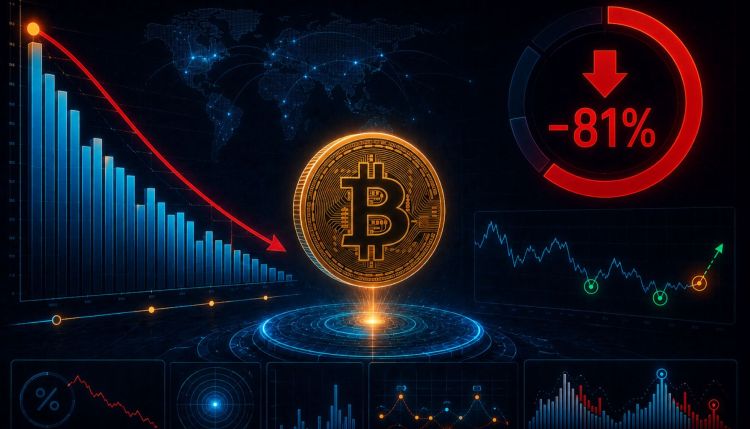
    Binance, the dominant venue in the crypto market, currently processes around $36.4 billion in trading volume. In October 2025, that figure stood at approximately $198.6 billion. The decline is significant, with Binance volumes nearly five times lower than at the cycle peak, representing an 81% decrease. Other exchanges show similar weakness, with Gateio volumes falling nearly 80% and Bybit recording a 66% drop in activity.

    Macroeconomic Factors Weigh on Crypto

    Darkfost explains that the collapse in Bitcoin spot trading activity reflects a broader macroeconomic environment increasingly hostile toward risk assets like cryptocurrencies. Rising inflationary pressures, persistent uncertainty surrounding global monetary policy, and the prolonged US/Iran conflict have pushed investors toward safer assets. Commodities, energy markets, and major equity indices have absorbed a large portion of capital flows that previously rotated into crypto during periods of stronger risk appetite, resulting in a sharp contraction in participation across spot crypto markets.

    Lower trading activity often reflects declining enthusiasm, weaker speculative demand, and reduced institutional engagement. However, Darkfost argues that the current setup may not be entirely bearish from a structural perspective. Historically, prolonged declines in spot volume have frequently coincided with the later stages of corrective phases rather than the beginning of major collapses. As participation fades, aggressive selling pressure also begins to weaken because fewer market participants remain actively distributing positions into the market. The analysis points specifically to the 2023 bear market structure, where spot volumes collapsed to similarly depressed levels shortly before Bitcoin stabilized and volatility returned. That period of extreme inactivity ultimately became the foundation for the recovery phase that followed, as exhausted sellers gradually lost control of the market.

    Bitcoin Holds Key Support

    Bitcoin continues trading above the critical $75,000 support region despite persistent selling pressure and weakening market participation. The daily chart shows BTC consolidating near $76,800 after rejecting the $82,000 resistance zone earlier this month, with price now trapped between major moving averages as traders await a decisive breakout or breakdown.

    Technically, Bitcoin remains above the 50-day moving average, which is currently acting as short-term support around the mid-$75,000 area. That level has become structurally important because it aligns closely with the broader horizontal demand zone between approximately $73,000 and $75,000 highlighted on the chart. Bulls have repeatedly defended this region throughout May, preventing sellers from regaining full control of the trend.

    However, the broader structure still reflects caution. The 100-day and 200-day moving averages continue sloping downward overhead, reinforcing the idea that Bitcoin remains inside a larger corrective environment despite the recovery from February’s lows near $63,000. For now, Bitcoin remains in a compression phase. A decisive reclaim of the $80,000–$82,000 region would strengthen bullish momentum, while losing the $75,000 support zone could expose BTC to a deeper retrace toward the $70,000 area.

  • XRP’s Utility Outpaces Market Cap Measures

    XRP’s Utility Outpaces Market Cap Measures

    XRP Redefines Value Assessment in Crypto Market

    XRP is gradually reshaping how value is assessed in the cryptocurrency market, as its utility-focused narrative expands beyond simple market capitalization comparisons. While some assets are primarily judged on speculative valuation, XRP’s role within the global payments infrastructure introduces a different framework centered on efficiency, liquidity, and real-world usage.

    How Institutional Payment Flows Could Shape XRP Demand

    XRP should be viewed less as a traditional cryptocurrency and more as a digital commodity designed to facilitate liquidity across global financial networks. According to CharuSan, market capitalization is a stock metric that fails to capture XRP’s true role as an institutional bridge asset powering global value transfer and liquidity pools.

    As adoption expands across banks, foreign exchange (FX) markets, and clearing institutions such as the Depository Trust and Clearing Corporation (DTCC), Nostro and Vostro accounts, and others, are beginning to use XRP at scale. Consequently, the price will be calculated based on the supply within Ripple payments (ODL). Currently, it is being calculated through the available effective liquidity, not just the circulating supply alone.

    CharuSan explains that transaction velocity alone cannot replace liquidity depth, particularly when multiple institutions are processing larger simultaneous volumes of global transactions. Furthermore, velocity has limits. Even in an optimized system, one XRP can realistically circulate a maximum of ten times per day. XRP is designed for deep liquidity pools and enables high-value unit capacity, which is required to eliminate slippage and neutralize volatility risk for banks during high-value transfers.

    Trump’s Fintech Order Sparks New Optimism For XRP Adoption

    A recent fintech-focused executive order from President Donald Trump could represent a significant development for the broader digital asset industry and potentially for XRP’s long-term utility. A crypto analyst known as BankXRP on X stated that by instructing the Federal Reserve (Fed) to evaluate granting crypto firms direct access to US payment infrastructure, the policy introduces a pathway for blockchain companies like Ripple to integrate directly with the traditional financial system.

    This administration could be transformational for Ripple, allowing it to access Fed payment rails to bypass legacy banking intermediaries entirely. For the XRP ecosystem, the result would likely be faster settlement speeds, lower institutional transaction costs, and direct access to Fed master accounts. BankXRP argues that if this review is successful, such a shift could elevate XRP’s role from a largely speculative asset to a regulated financial instrument embedded within global payment networks and a foundational pillar of international commerce.

    Analyst Skipper has updated that Ripple has reportedly reached a significant milestone by securing a banking license. The report suggests that the move has helped elevate Ripple’s valuation above $120 billion, reaffirming its position as a major financial infrastructure company tied to the XRP ecosystem.

  • Clean Athletes Triumph Over Doping Rivals

    Clean Athletes Triumph Over Doping Rivals

    The inaugural Enhanced Games concluded with a mixed outcome, featuring a record-breaking swim, strong weightlifting performances, and victories for clean athletes over their enhanced rivals in several key events.

    Record-Breaking Swim and Financial Rewards

    Greek swimmer Kristian Gkolomeev delivered the event’s highlight, clocking a time of 20.89 seconds in the men’s 50-meter freestyle. This performance surpassed the official world record and earned him a $1 million prize from the organizers.

    “The [Enhanced Games] last Saturday were not only a spectacular event – they were also a major business success,” wrote Christian Angermayer, an investor and co-founder of the Enhanced Games, on X.

    Unexpected Results and Criticism

    Despite the initial hype, several results contradicted the core premise of the Enhanced Games. Multiple athletes using performance-enhancing drugs were defeated by competitors who claimed to be competing without such enhancements.

    American sprinter Fred Kerley, competing as a non-enhanced athlete, won the men’s 100-meter final in 9.97 seconds. While this was 0.39 seconds slower than Usain Bolt’s 2009 world record of 9.58 seconds, it came despite claims that Bolt’s record would be “destroyed.”

    Kerley reportedly mocked the enhanced athletes he competed against. According to SB Nation, he said in an interview after the race, “They gotta do better than that. They need to train a little harder, get on that shit a little bit more, and go a little harder some more.”

    In other events, Tristan Evelyn, a non-enhanced athlete, won the women’s 100-meter final, and swimmer Hunter Armstrong defeated two enhanced competitors to win the men’s 50-meter backstroke.

    The Vision and Backing of the Enhanced Games

    The event marks the culmination of a multi-year effort by Aron D’Souza, an Australian lawyer who previously assisted Peter Thiel in his lawsuit against Gawker Media. D’Souza founded the Enhanced Games in 2024 and has received backing from Donald Trump Jr., Peter Thiel, and former Coinbase CTO Balaji Srinivasan. D’Souza has argued that current anti-doping regulations are outdated.

    “The Olympics are all about the past, they’re about Ancient Greece,” D’Souza previously told Decrypt. “They’re about this natural sports ethos, and they’re stuck in the past. We’re about the future, science, and progress. We’re about acceleration.”

    Organizers have positioned the Enhanced Games as part of a broader movement focused on biohacking, longevity research, and human enhancement, with biohacker Bryan Johnson serving as a host.

    “I’m cohosting the Enhanced Games this Sunday, first time as a broadcaster,” Johnson wrote on X. “I spent the week with the athletes and doctors. So many moving stories of courage and triumph.”

    Controversy and Skepticism

    The competition highlights the growing intersection between Silicon Valley’s optimization culture and elite sports. While organizers frame the Games as a science-driven alternative to Olympic rules, critics argue that it normalizes dangerous drug use for the sake of spectacle and profit.

    “Everything about the enhanced games seems so deeply unserious and stupid,” author Brad Stulberg wrote on X.

    A post by Steve Magness on X highlighted the underperformance of enhanced athletes, noting that some were slower than their personal bests and, in some cases, slower than high school runners.

    Official Rejection and Future Plans

    The World Anti-Doping Agency and World Aquatics have both rejected the legitimacy of the competition, stating that performances from the Games will not be recognized as official records. Despite this, organizers maintain that the Enhanced Games represent the future of athletics.

    “Now that we have broken the ice and proven the Games can be done at the highest level, I expect many more partnerships to be signed in the months ahead,” Angermayer wrote. “We are just getting started!”

  • Data Theft Exploits GTA 6 Anticipation, NordVPN Alerts

    Data Theft Exploits GTA 6 Anticipation, NordVPN Alerts

    Cybercriminals are exploiting the widespread anticipation for Grand Theft Auto 6, flooding the internet with phishing scams and malware ahead of the game’s highly anticipated November release.

    Exploiting Anticipation

    According to research from NordVPN’s Threat Intelligence team, malicious actors have quickly moved to capitalize on recent rumors of soon-to-open pre-orders for the game, viewing the hype as an opportunity to harvest data from unsuspecting victims.

    The threats range from basic phishing sites to sophisticated, multi-platform malware campaigns targeting platforms that the game won’t initially support, NordVPN reported. The firm added that these threats are appearing in various forms and targeting gamers.

    While the VPN provider’s researchers identified campaigns targeting PC and mobile users—platforms on which GTA 6 is not confirmed to release—several websites are promising “exclusive beta keys” for owners of PS5 and Xbox Series consoles. In one case, users seeking access are prompted to pay for subscriptions or download software.

    Preying on FOMO

    The company’s findings highlight how cybercriminals often prey on the fear of missing out (FOMO), according to NordVPN CTO Marijus Briedis.

    “When people are desperate to get early access to something, their guard comes down,” he noted. “That’s the window attackers exploit.”

    Other cybercriminals are targeting gamers who want to obtain Rockstar Games’ next title for free. NordVPN identified several clones of well-known piracy websites designed to distribute malware disguised as game files for Windows machines.

    In one instance, running a fake package activated a malicious file disguised as an Nvidia graphics driver, which quietly allowed cybercriminals to alter a device’s memory, download additional malware, and receive external instructions, according to NordVPN.

    Fake Apps and Phishing

    Furthermore, a fake Android app—which contains no actual game—uses the game’s branding to silently serve full-screen ads. The app’s users are also directed to websites that encourage subscriptions or the download of further malware, NordVPN said.

    Finally, NordVPN reported tracking “hundreds of amateur phishing pages” that target Rockstar Social Club credentials via fake login forms. NordVPN noted that these accounts can be resold on the dark web or used for in-game fraud.

    The firm’s researchers traced one fake GTA 6 app for Android users to a domain with a history of distributing banking trojans, ransomware, and infostealers—representing a unique threat to cryptocurrency owners who safeguard digital assets using private keys.

    While rumors have circulated for years that GTA 6 will incorporate crypto, these claims remain unsubstantiated as the game approaches its November release. Bitcoin gained prominence in relation to the game when a doctored trailer was leaked years ago.

  • Sharplink and Forward Industries to Join Russell Indexes

    Sharplink and Forward Industries to Join Russell Indexes

    Sharplink, a publicly traded firm holding Ethereum, will be added to the Russell 2000 and 3000 indexes on June 29, according to an announcement made Tuesday. The inclusion is part of the indexes’ semiannual restructuring.

    Peer Inclusion

    Sharplink’s inclusion follows that of BitMine Immersion Technologies, another Ethereum treasury firm, which will be added to the Russell 1000 index, tracking the top 1,000 U.S. companies by market capitalization.

    “Joining the Russell 2000 and Russell 3000 is a meaningful validation of Sharplink’s institutional-grade ETH treasury strategy and we believe will broaden SBET’s shareholder base while strengthening our access to capital markets,” said Joseph Chalom, CEO of Sharplink, in a statement.

    Sharplink currently holds 874,351 ETH, valued at approximately $1.8 billion. According to Yahoo Finance data, the firm was trading at a discount to its Ethereum holdings, with a market capitalization of around $1.22 billion at the close of trading on Tuesday.

    Forward Industries Joins

    Forward Industries, a Solana-focused crypto treasury firm, will also be included in the Russell 2000 and 3000 indexes, the company announced.

    The medical design firm, which has become a significant holder of Solana, purchased $1.58 billion worth of SOL last year at an average price of about $232 per SOL. However, SOL is now trading at $83.78, a 64% decrease since the firm’s purchase.

    Consequently, Forward Industries’ Solana holdings are now valued at approximately $588 million, significantly exceeding its current market capitalization of $350 million. Based on this valuation, the firm is approximately 2.4 times larger than the smallest market capitalization member of the Russell 2000, according to the index fund’s website.

    Index Impact

    The inclusion of these firms in the Russell Indexes places them within a group of U.S. indexes with over $12.2 trillion in benchmarks or investments.

    “We believe index inclusion will expand our shareholder base, improve trading liquidity, and increase visibility among long-term institutional investors,” said Ryan Navi, CEO of Forward Industries, in a statement.

    Shares of the firms reacted differently to the news. Sharplink (SBET) shares dipped about 0.8% on Tuesday, closing at $6.18 per share. Meanwhile, Forward (FWDI) shares rose 2.62%, trading around $4.70 at the close of trading.

  • CLARITY Act Passage in 2026 Less Likely, Says TD Cowen

    CLARITY Act Passage in 2026 Less Likely, Says TD Cowen

    The prospects of the CLARITY Act becoming law this year are diminishing, according to TD Cowen, despite the bill’s passage through key Senate committees. While the measure successfully cleared the Senate Agriculture Committee and the Senate Banking Committee, a full Senate vote—and the final approval needed to enact the bill—appears increasingly unlikely before the end of the year.

    CLARITY Act Momentum Stalls

    Jaret Seiberg, a managing director at TD Cowen’s Washington Research Group, wrote in a Tuesday note that his team remains pessimistic about the CLARITY Act’s enactment this year. He attributes the main challenge to political hurdles, specifically whether Democrats can support the bill if it includes provisions addressing presidential conflicts of interest.

    Seiberg also cautioned that Republicans could become more hesitant to advance the legislation if it requires them to vote against amendments targeting or responding to Trump-related concerns. He noted that the progress in the Senate Banking Committee earlier this month does not necessarily indicate broad bipartisan agreement. He characterized the committee’s advancement of the bill, despite objections from Democrats and banks, as shifting the debate to the full Senate rather than resolving underlying disputes.

    Rising Washington Tensions

    Seiberg also pointed to several Trump-related developments that he believes are complicating the political environment for the CLARITY Act. One factor is a resolved legal case involving the Internal Revenue Service (IRS). The dispute led to the creation of a $1.776 billion anti-weaponization fund and permanently prohibits the IRS from auditing past tax returns for Trump, his family, and related companies. Seiberg believes the fallout from this dispute will likely heighten tensions in Washington, making it more difficult to reach a consensus on legislation like the already delayed CLARITY Act.

    Seiberg also cited a recent New York Times investigative report alleging that prediction markets and crypto-related interests may have influenced efforts aimed at the Commodity Futures Trading Commission (CFTC). He emphasized that these claims remain unconfirmed. However, he noted a response from CFTC Chair Michael Selig, who told the New York Times that the agency is focused on major wrongdoing and is not “playing favorites.”

    Another factor cited in the TD Cowen note involves government financial disclosures released earlier this month. These reports indicated that approximately 3,600 stock trades were executed on Trump’s behalf during the first three months of 2026. Seiberg argued that the surrounding controversy makes it more likely that lawmakers will choose to delay action, especially as the midterm election approaches and the political calendar narrows the window for further postponements.

  • XRP Ledger Update: What Holders Need to Know

    XRP Ledger Update: What Holders Need to Know

    The XRP Ledger Gears Up for Version 3.2.0 Update

    The XRP Ledger is undergoing another significant update, with version 3.2.0 currently in development. According to Hussein Zangana, Director of Community at the XRP Ledger Foundation, known on X as Vet, this update aims to further fortify the underlying infrastructure of the XRP Ledger. This follows the recent activation of version 3.1.3 in early May.

    Focus on Strengthening the Foundation

    The upcoming update, version 3.2.0, is less about introducing flashy new features and more about reinforcing the network’s core functionality. Vet emphasized that the update is designed to strengthen the foundation upon which the XRP Ledger operates. He highlighted the use of AI-powered red and blue team efforts, along with attackathons and bug bounties, as key contributors to this strengthening process.

    Version 3.1.3: A Precursor to 3.2.0

    The development of version 3.2.0 follows the release of version 3.1.3 on May 8. According to the official XRPL blog, version 3.1.3 included the fixCleanup313 amendment, which addressed issues related to NFTs, Permissioned Domains, Vaults, and the Lending Protocol. The importance of these fixes led to a default “Yes” vote for the release. This update was particularly significant as it followed the January introduction of Single Asset Vaults and the Lending Protocol in version 3.1.0. The Single Asset Vaults are pools of a single asset designed for use with the Lending Protocol, which facilitates fixed-term, uncollateralized loans using funds from these vaults.

    Impact on XRP Holders

    While no specific release date for version 3.2.0 has been announced, the update is primarily an infrastructure upgrade and is not expected to directly impact short-term price movements. However, such updates are crucial for long-term holders. A consistently updated ecosystem demonstrates an active community, which can foster confidence in XRP’s value over time. Version 3.1.3 demonstrated the developers’ commitment to refining newer aspects of the protocol, particularly concerning NFTs, Vaults, Permissioned Domains, and Lending. Version 3.2.0 appears to build upon this work by further solidifying the XRP Ledger’s foundation.