Category: Uncategorized

  • Hyperliquid Hits New High, Eyes Ethereum’s Spot

    Hyperliquid Hits New High, Eyes Ethereum’s Spot

    Hyperliquid (HYPE) recently entered the top 10 cryptocurrencies by market capitalization, joining the ranks of Bitcoin (BTC) and Ethereum (ETH), after its price surpassed $50 and reached a new all-time high. On-chain analytics platforms are now examining HYPE’s potential price if it surpasses Ethereum’s market cap.

    Hyperliquid’s Potential Price if It Surpasses Ethereum’s Market Cap

    Hyperliquid’s price surged past $50 a few days ago, surpassing Dogecoin to become the ninth-largest cryptocurrency by market capitalization. This marks the first time the token has traded above this level since late October 2025.

    Currently, HYPE has extended its rally beyond $60. This breakout reflects a significant shift in trading activity, as well as renewed interest and confidence in DeFi protocols and AI-backed tokens. HYPE’s return to this historic price range also suggests increased engagement with Hyperliquid’s perpetual futures DEX.

    The recent rally in HYPE has drawn renewed attention to Ethereum, one of Hyperliquid’s primary competitors in the crypto and DeFi space. While Ethereum remains a dominant benchmark for decentralized applications, Hyperliquid is specifically designed for financial trading and derivatives.

    Data from Marketcapof suggests that HYPE’s price could reach approximately $1,127 if its market capitalization of $15.99 billion surpasses Ethereum’s, which is around $250.99 billion. This would represent a 17.92x increase from current levels. In more extreme scenarios, with market euphoria at its peak, estimates place HYPE as high as $2,633, a gain of about 42x from current prices.

    Competition Intensifies

    Hyperliquid has been strengthening its market position as capital shifts from major assets like Bitcoin and Ethereum toward newer, high-growth protocols. HYPE’s recent performance reflects both the growing adoption of its DEX platform and a broader shift in liquidity across the crypto sector.

    A key driver behind the bullish momentum was the launch of spot HYPE ETFs by investment management firms Bitwise and 21Shares in May. These products have attracted millions of dollars in inflows, indicating steady institutional demand for HYPE amid increased derivatives activity.

    Earlier in the year, market volatility linked to the US-Iran war triggered record perpetual futures volume on Hyperliquid, pushing platform activity to new highs. Liquidity conditions also improved after Coinbase, the world’s largest crypto exchange, became the official USDC provider on Hyperliquid.

    Against this backdrop, Ethereum’s dominance is waning. The cryptocurrency’s price has struggled to maintain momentum, falling roughly 30% year-to-date. ETF flow data reflects this shift, with approximately $1 billion exiting Bitcoin and Ethereum products while XRP and HYPE funds recorded about $94 million in combined inflows.


  • Crypto Markets Plunge Amid Bearish Sentiment

    Crypto Markets Plunge Amid Bearish Sentiment

    Tuesday saw a significant downturn in the cryptocurrency market, with a broad sell-off impacting various altcoins. Zcash (ZEC) led the decline, dropping 11%, followed by World Liberty Financial’s WLFI, which fell 8%, and Ondo Finance (ONDO), down 7%.

    Bearish Sentiment Rises

    The losses occurred amid growing bearish sentiment among investors. Blockchain analytics firm Santiment noted that such sentiment has historically preceded price rebounds. Santiment highlighted the declines of Ondo, Zcash, WLFI, and DeXe, among others, in a post on X.

    Ondo Finance Faces Setback

    Ondo Finance’s drop came shortly after the death of its 32-year-old founder and CEO, Nathan Allman. The company announced that Ian De Bode, the longtime president, will take over as CEO. The token is currently trading near $0.41, representing a gain of approximately 9% over the past seven days.

    Zcash and WLFI Performance

    Zcash’s 11% single-day drop was the steepest among the mentioned assets. However, the decline was approximately 7.5% over the last 24 hours, with ZEC trading around $570. The asset is up 60% over the past month and nearly 970% over the past year. WLFI’s 8% dip added to the token’s recent struggles, having reached a new all-time low in late April after a 16% single-day crash. The token has also faced a controversial lock-up proposal, a lawsuit from Tron’s Justin Sun, and ongoing scrutiny over its ties to the Trump family.

    Other Tokens Show Gains

    Despite the losses, some tokens showed positive performance over the week. NEAR was up more than 55% over seven days, trading around $2.50, although it declined nearly 8% on Tuesday. Hyperliquid’s HYPE token also saw gains, increasing 25% according to Santiment’s data. RAIN was the week’s standout performer, reaching an all-time high of around $0.012 on Tuesday, with a weekly increase of almost 55% and a 24-hour increase of over 44%.

    Market Outlook

    Santiment’s data indicated that bearish expectations have been building for about 10 days. The firm noted that this collective caution has historically preceded price recoveries, as markets often move against the prevailing sentiment. However, traders will be watching to see if this pattern holds, especially with Bitcoin remaining below $77,000 and struggling to break above its 200-day moving average near $80,000.

  • Dogecoin’s Key Pattern Returns, Echoing 2021 Surge

    Dogecoin’s Key Pattern Returns, Echoing 2021 Surge

    Dogecoin Rally Setup Revived Amidst Technical Analysis

    Dogecoin has been trading around the $0.10 mark for several months. However, a new monthly chart shared by market analyst @TATrader_Alan is drawing comparisons to the pattern that preceded the cryptocurrency’s significant rally in 2021. The analyst highlights a recurring triangle formation that has appeared before each major Dogecoin expansion cycle. The current setup is now approaching the same breakout zone that historically triggered substantial upward momentum.

    Dogecoin Rally Setup Reappears

    The analyst’s latest monthly chart reveals a repeating formation observed across three distinct market cycles. In each instance, Dogecoin traded within a narrowing triangle structure for months before experiencing a sharp, vertical advance. The first instance occurred before the 2017 bull market, while the second preceded the massive 2021 breakout, which delivered gains exceeding 30,000% from cycle lows.

    The chart shows that both previous formations followed nearly identical patterns. Price gradually compressed between descending resistance and rising support lines before eventually breaking upward with force. Following the breakout, Dogecoin entered a rapid expansion phase characterized by large green monthly candles and increased momentum.

    The current structure appears to mirror those earlier conditions closely. Dogecoin has spent several years tightening within converging trendlines, with the price now positioned near the formation’s apex. According to the chart projection, this region historically marked the beginning of Dogecoin’s most significant advances.

    The pattern’s long-term timeframe is notable. Monthly structures often carry greater technical significance because they reflect broader investor positioning and multi-year market behavior rather than short-term volatility. Analysts tracking the setup believe the extended compression phase could amplify the intensity of any eventual breakout move if historical behavior repeats.

    Monthly Breakout Signals Growing Momentum

    The formation’s timing is also attracting attention because Dogecoin continues to hold near the psychologically important $0.10 level on the monthly chart. Despite broader market fluctuations, the asset has maintained support around that range while gradually pressing against descending resistance that has capped price action since the previous cycle peak.

    The analyst’s projection suggests the breakout zone has now been reached, mirroring the positioning seen before earlier rallies. On the chart, projected purple candles indicate a possible expansion phase that could push Dogecoin toward levels not seen since the previous bull market’s peak.

    Beyond the technical structure, market participants are also watching growing institutional involvement in the digital asset sector. Speculation surrounding crypto-based exchange-traded products, renewed meme coin activity, and increased retail participation have all contributed to improving sentiment around Dogecoin in recent months.

    While the chart does not guarantee another parabolic rally, the similarity between the current structure and the formations that preceded previous rallies has become difficult for traders to ignore. With Dogecoin now at another critical monthly inflection point, analysts believe the coming months could determine whether the meme coin will experience another historic rally.

  • XRP’s Trillion-Dollar Play Could Surge Price to $300+

    XRP’s Trillion-Dollar Play Could Surge Price to $300+

    CharuSan Reiterates Bullish XRP Prediction, Addressing Market Cap Concerns

    Crypto analyst CharuSan has again commented on his prediction that XRP could surge above $300, addressing concerns about the token’s potential market capitalization. He argues that the market cap metric is not a relevant factor for XRP’s price trajectory.

    Trillion-Dollar Markets as Catalyst

    In a post on X, CharuSan pointed to the vast sums of money in global Nostro/Vostro accounts, the foreign exchange markets, major banks, the Depository Trust & Clearing Corporation (DTCC), and institutional corporations as reasons why XRP could reach $300. He suggested that a bridge asset carrying this volume would need to reach a value of $10 trillion to prevent the system from becoming congested.

    The analyst emphasized that XRP is designed as an institutional bridge asset and liquidity tool, specifically engineered to facilitate large cross-border value transfers without slippage. He further explained that the market cap metric is more applicable to stocks and not to institutional bridge assets or liquidity tools like XRP. CharuSan believes that traditional financiers misunderstand this, dismissing an $8 to $10 trillion market cap as unrealistic. He clarified that market capitalization does not imply that all circulating coins will be cashed out at the current price; it is simply the unit price of the last transaction multiplied by the supply.

    CharuSan previously predicted that XRP would rally to $300 as banks adopt it for cross-border transactions. He explained that a high price is necessary to avoid bottlenecks and slippage during settlements. The analyst also cited the CLARITY Act as a potential catalyst for increased bank adoption of XRP.

    On-Chain Data Suggests XRP Could Be Undervalued

    On-chain analytics platform Santiment has also weighed in on XRP’s potential for a rebound. In an X post, they noted that the average XRP trader active in the past 30 days is down approximately 47%, with many selling at a loss. Santiment stated that the market value-to-realized value ratio (MVRV) historically averages out to 0%, making the current period an “extreme” zone for XRP.

    Santiment noted that XRP’s 30-day MVRV has reached its lowest level since December 2020, indicating that fear and frustration among traders have reached rare extremes. Historically, such conditions have preceded strong rebounds, suggesting a potential recovery for XRP. The platform added that this deeply negative MVRV zone creates conditions where even small positive catalysts could trigger significant price increases.

    As of the time of writing, the price of XRP is trading around $1.32, according to CoinMarketCap.

  • Mastercard Obtains New York BitLicense for Crypto Expansion

    Mastercard Obtains New York BitLicense for Crypto Expansion

    Mastercard Secures BitLicense in New York

    Mastercard announced Wednesday that it has obtained a BitLicense from the New York Department of Financial Services, signaling its commitment to the cryptocurrency sector and adherence to stringent regulatory standards.

    Regulatory Compliance a Priority

    The move underscores Mastercard’s emphasis on regulatory compliance within a rapidly evolving industry. The company stated in a blog post that the BitLicense is part of its long-term strategy to support stablecoins and tokenized deposits.

    “Clear regulatory frameworks play an important role in building trust and confidence,” said Jorn Lambert, Mastercard’s Chief Product Officer. “This approval underscores our focus on aligning innovation with regulatory expectations.”

    Mastercard noted that the New York Department of Financial Services requires crypto companies to adhere to regulations concerning consumer protection, cybersecurity, financial integrity, and operational resilience. The BitLicense framework, established in 2015, has influenced regulations adopted by other states.

    Strategic Expansion in the Crypto Space

    While the regulator’s rules were initially designed for crypto-focused firms, Mastercard’s efforts represent a strategic approach to innovation. The pace of adoption accelerated last year following the passage of the GENIUS Act, which incorporated stablecoins into federal law.

    Acquiring a BitLicense is known to be a challenging and costly process. However, Mastercard, which processes approximately $9.5 trillion in annual payments, has already invested significantly in stablecoins and related technologies.

    In March, Mastercard announced its planned acquisition of infrastructure firm BVNK for $1.8 billion, demonstrating its commitment to supporting businesses in sending, receiving, converting, and storing stablecoins globally.

    As fintech companies increasingly utilize stablecoins to modernize payments and treasury operations, Mastercard has been actively expanding its network, aiming to maintain its market dominance by connecting digital assets with traditional financial systems.

    Earlier this year, SoFi Technologies partnered with Mastercard, enabling the online bank’s stablecoin to be used across Mastercard’s global payments network. Additionally, Mastercard has collaborated with crypto-focused companies like MetaMask and MoonPay, allowing customers to use stablecoins at millions of merchant locations.

  • Meme Coin Soars 6,000% After Creators’ Arrest

    Meme Coin Soars 6,000% After Creators’ Arrest

    South Korean prosecutors have charged five individuals in connection with an alleged “meme coin rug pull” on the Pump.fun platform, resulting in 900 million WON ($600,000) in damages. In a twist, the news of the charges has triggered a nearly 6,000% surge in the value of the affected meme coin, as traders attempt to revive the token.

    The Alleged Scheme

    According to the Seoul Southern District Prosecutors’ Office, the defendants created a token called CatFi on the Solana-based launchpad Pump.fun in February 2025. The meme coin quickly reached a market capitalization of $8.37 million, according to DEX Screener, before plummeting to a mere $12,170 within hours. Prosecutors attribute the collapse to the defendants’ “mass selling,” which they have classified as a “rug pull.”

    The Prosecutors’ Office estimates that 256 investors suffered losses totaling 900 million WON ($600,000), with the defendants allegedly pocketing over 400 million WON ($267,000). Two individuals responsible for promoting the token on social media have been arrested. The remaining three, who managed the technical aspects of the scheme and assisted in the other defendants’ escape, have been charged but not arrested.

    Legal Precedent

    The case is notable as the first instance of South Korea’s new Virtual Asset User Protection Act being applied to penalize an alleged rug pull, according to a translated press release. It also represents the nation’s first prosecution of a crypto crime executed on a decentralized exchange.

    Nick Vaiman, co-founder of blockchain data analytics firm Bubblemaps, told Decrypt that the charges are a “good move by the Korean government.”

    “There have always been community investigations on rug pulls, but they led nowhere because there were no real legal consequences,” Vaiman said. “Now, with the law and real precedent, we hope to see more justice and fewer retail investors getting burned.”

    The “Unrug” Attempt

    Ironically, the news of the charges has spurred renewed interest in the CatFi token. Traders have driven its value up by almost 6,000% in less than a day, from a market cap of $2,350 to its current value of around $167,000. Before this surge, the token had not seen any buying activity since August 2025, according to the block explorer SolScan.

    A new X account has been created for the token, with its operators claiming they intend to “unrug” the token. Despite the recent surge, CatFi remains down 96% from its peak, leaving investors who held the token since its all-time high in February 2025 hoping for further gains.

  • XRP’s MVRV Ratio Plunges to 2020 Low Amid Sell-Off

    XRP’s MVRV Ratio Plunges to 2020 Low Amid Sell-Off

    XRP Traders Face Significant Short-Term Losses

    XRP traders are currently experiencing substantial short-term losses, with on-chain analytics firm Santiment reporting that the token’s 30-day Market Value to Realized Value (MVRV) has plummeted to its lowest level since December 2020. Santiment characterized this as an “extreme undervalued zone,” noting that months of selling pressure have left recent buyers significantly underwater.

    The chart provided by Santiment, which tracks XRP Ledger’s price alongside its 30-day and 365-day MVRV ratios on Sanbase, indicates that XRP’s 30-day MVRV is approximately minus 47%. The 365-day reading is also deeply negative, hovering around minus 36%. Santiment’s analysis identifies the current situation as an “opportunity” zone, contrasting it with previous periods of elevated MVRV, which were labeled as sell-risk territory.

    Undervalued Zone Signals Potential Rebound

    Santiment stated that the data suggests the average XRP trader active over the past month has suffered significant losses, a level that has historically coincided with periods of intense capitulation. “The average XRP trader that has been active in the past 30 days is down a whopping -47% with many selling at the bottom,” Santiment wrote. “Historically, MVRV’s average trading returns will always average out to 0%, making this current time an extreme undervalued zone for XRP. The chart shows that XRP’s 30-day MVRV has now fallen to its lowest level since December, 2020, suggesting that fear and frustration among traders have reached rare extremes that have historically preceded strong rebounds.”

    MVRV, a metric used by on-chain analysts, helps estimate whether holders are experiencing unrealized profits or losses. Deeply negative short-term MVRV readings, according to Santiment, suggest that recent market participants have largely been washed out, reducing marginal selling pressure from traders who purchased near local highs.

    Market Dynamics and Broader Narratives

    XRP’s recent decline followed a strong rally in late 2024 and early 2025, according to Santiment. The firm noted that many traders entered the market near local peaks before momentum waned, leaving short-term holders vulnerable as subsequent selloffs drove the asset lower. This has resulted in a market structure where recent buyers are not only underwater but significantly so.

    Santiment also linked the current market setup to broader XRP narratives, which remain active despite the price retracement. The firm highlighted continued optimism among long-term investors regarding regulatory progress, ETF speculation, and Ripple’s adoption story, while acknowledging that the token has lost more than half its market value since the previous summer.

    “Despite the major price retracement that has seen XRP lose over half its market value since last summer, patient investors still have optimism surrounding regulatory progress, ETF speculation, and Ripple’s long-term adoption narrative,” Santiment said. “XRP rallied aggressively in late 2024 and early 2025, which left many traders buying near local tops before momentum cooled off. But since then, repeated selloffs have pushed many short-term holders deeply underwater.”

    The key question is whether the negative MVRV reading indicates market exhaustion or simply reflects the severity of the downtrend. Santiment did not present the metric as a standalone timing signal. However, the firm argued that historically depressed MVRV levels often appear when retail traders have largely capitulated, creating conditions where relatively modest positive news can have a significant impact.

    “The deeply negative MVRV zone that we’re seeing for XRP now tends to appear when retail traders have largely given up, creating conditions where even small positive catalysts can trigger strong recoveries,” Santiment wrote. “While weak MVRV readings alone do not guarantee a reversal, they often signal that the majority of panic selling has already occurred and downside risk becomes more limited compared to potential upside.”

    At the time of this report, XRP was trading at $1.33.

  • Bitwise ETF Becomes World’s Largest; Is Hyperliquid the Cycle’s Top Performer?

    Bitwise ETF Becomes World’s Largest; Is Hyperliquid the Cycle’s Top Performer?

    Bitwise HYPE ETF Sees Strong Debut

    Early volume data for Bitwise Asset Management’s physically-backed spot HYPE ETF suggest a robust launch. This raises the question of whether HYPE is emerging as a genuine cycle winner, or if the Bitwise ETF’s premium is already factored in.

    Bitwise’s BHYP debuted on the New York Stock Exchange with a 0.34% sponsor fee, temporarily waived to 0% on the first $500 million in assets under management (AUM) for the initial month. The firm manages approximately $11 billion in client assets. Within 48 hours of its launch, the two U.S.-listed HYPE ETFs experienced a 50% single-day volume surge on May 20 and recorded $25.5 million in net inflows, with $8.8 million attributed to BHYP alone. This early performance positions it as one of the largest altcoin ETF launches based on initial metrics.

    Bitwise’s HYPE Purchases

    Bitwise ETF clients purchased a total of $35.9 million in HYPE last week, representing an 18-fold increase from the previous week when Bitwise ETF flows began. BHYP launched on the New York Stock Exchange on May 15, 2026, and is the first HYPE ETF to be natively staked.

    Hyperliquid’s Derivatives Volume and Fee Revenue

    Meanwhile, Hyperliquid’s derivatives volume reached $2.9 trillion in 2025, reflecting over 400% year-on-year growth. The protocol also captured 44% of weekly blockchain fee revenue last week, generating $11 million compared to Ethereum’s $3 million.

    Hyperliquid accounts for 44.58% of all crypto fees this week, with 97% of those fees automatically allocated to buy and burn HYPE.

    HYPE’s Price Performance

    HYPE is experiencing a rally amidst the current market conditions, with major resistance levels being breached. Currently, HYPE is in a price discovery phase following a more than 50% increase in the past two weeks. It is currently outperforming the market significantly.

    If BHYP and the 21Shares product maintain eight-figure monthly net inflows, HYPE could surpass $70 decisively, with a target of $80. Moderate flows after the fee-waiver window closes could stabilize HYPE around the $60 range.

    For short-sellers, the best-case scenario involves ETF inflows reversing or stalling below $5 million weekly, which could push the price below $55 support and towards the $48 range, where structural buybacks provide a floor.

    The Assistance Fund

    The Assistance Fund mechanic is a key factor to consider. By March 2026, the Fund had accumulated 28.5 million HYPE through automated open-market purchases, spending over $1.3 billion cumulatively. This resulted in an annualized buyback rate of 7% of market cap, significantly higher than BNB’s equivalent rates.

    Bitcoin Hyper

    HYPE’s potential is real. The ETF wrapper expands access but also reduces the asymmetry available to early participants. Traders are increasingly seeking leverage earlier in the infrastructure stack.

    Bitcoin Hyper ($HYPER), currently in an active presale at $0.0136, positions itself at a different point on the risk curve. It is the first Bitcoin Layer 2 integrating the Solana Virtual Machine, offering sub-second finality and low-cost smart contract execution while settling on Bitcoin’s security layer.

    The project has raised over $32.7 million to date, with a decentralized canonical bridge enabling native BTC transfers. Staking is live with a high 36% APY for early participants. The core thesis is that Bitcoin holds $1.8 trillion in idle capital, and programmability unlocks it.

  • XRP Slides Toward $1.20 Support Amid Bearish Pressure

    XRP Slides Toward $1.20 Support Amid Bearish Pressure

    XRP Slides Toward Critical $1.20 Support as Bears Stay in Control

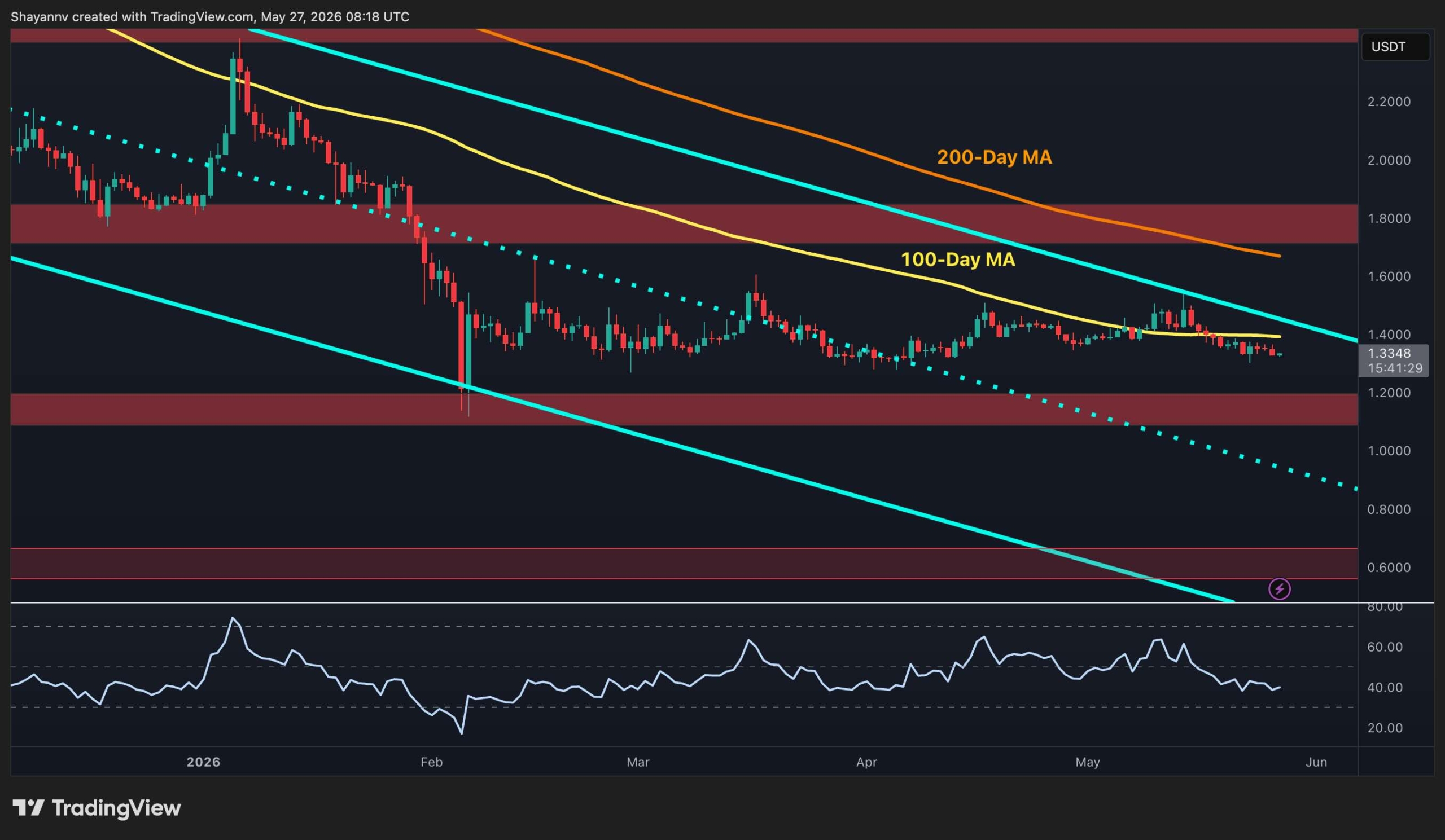
    XRP is trading at $1.33 as May concludes, steadily declining to its lowest levels since March without any specific trigger. This downward trend has characterized the altcoin’s performance throughout the latter half of the month.

    Key Support Levels Tested

    The $1.20 support level is the closest it has been in weeks, and the 100-day moving average has been breached again. The XRP/BTC pair is also testing its recent low, appearing increasingly vulnerable.

    Against USDT, the cryptocurrency is just below the upper boundary of a descending channel. The 100-day moving average, around $1.40, now acts as overhead resistance after being surpassed during May. The 200-day moving average continues to decline, currently around $1.60.

    The Relative Strength Index (RSI) is hovering around 40, indicating weak momentum with no signs of a bottom forming.

    Potential Breakdown Looms

    The $1.20 demand zone is now within reach, making the next few daily closes crucial. A potential breakdown below $1.20 would be the first breach of that level since February, potentially leading to a further decline towards the $0.60 zone. Conversely, any recovery attempt would need to reclaim $1.40 and the 100-day moving average to suggest a genuine recovery is underway.

    XRP/BTC Pair Analysis

    The XRP/BTC pair is trading at 1,760 sats and is testing the pink horizontal support level, which marks the recent low near 1,730 sats.

    The price has struggled to sustain a modest recovery above 1,800 sats. The RSI has been oscillating between 30 and 60 throughout May, without any sustained directional movement, reflecting a pair in a state of equilibrium rather than clear directional momentum.

    The 100-day moving average, around 1,900 sats, and the 200-day moving average, near 2,050 sats, remain the dynamic recovery targets on either side of the critical 2,000 supply zone.

    Below, the lower channel boundary and the demand area near 1,500 sats are the next potential targets if the recent low breaks down. XRP is expected to continue underperforming against BTC, as market sentiment remains largely pessimistic regarding Ripple.

  • South Korea Arrests in First DEX Rug Pull Case

    South Korea Arrests in First DEX Rug Pull Case

    South Korea Makes First DEX Rug Pull Arrest in Catfi Case

    The Seoul Southern District Prosecutors’ Office in South Korea has arrested and indicted the operators behind Catfi, marking the country’s first prosecution related to a rug pull on a decentralized exchange (DEX).

    The case, brought under the Virtual Asset User Protection Act, accuses the group of market manipulation after 256 investors lost 900 million won ($586,000) when liquidity was drained following an artificial price surge.

    According to Digital Asset, South Korean prosecutors charged a criminal group accused of manipulating the price of the Solana-based meme coin CATFI and generating approximately 400 million won (~$260,000) in illegal profits.

    The scheme began on Pump.fun in early 2025. The main suspect, identified by the surname Park and operating online as the influencer ‘Eth Father,’ created Catfi before listing it on a decentralized exchange. Park allegedly posed as an unrelated third party to recommend purchases, inflated follower counts, managed project social accounts, and spread tokens across multiple wallets while using circular trading to obscure issuer control.

    Catfi’s price surged 1,001-fold within 26 hours of issuance, attracting 6,000 investors before the liquidity vanished. The group used approximately 10 million won in criminal funds and profited 400 million won, or $260,000.

    Regulatory Shift

    Until the Catfi case, South Korea’s virtual asset enforcement primarily focused on centralized exchanges. DEX fraud existed in a legally ambiguous area due to non-custodial design, pseudonymous wallet operators, and the absence of a regulated intermediary, making it difficult to assign criminal liability under frameworks designed for traditional finance or even centralized exchange (CEX) abuse.

    The Virtual Asset User Protection Act, which took effect in July 2024, provided prosecutors with a statutory basis, covering “the use of fraudulent means, plans, or techniques” and false statements about material facts in digital asset trading, regardless of venue.

    The Catfi prosecution is only the second known case under the Act, following the January 2025 ACE token manipulation case on Bithumb, but the first to target a DEX environment.

    The Seoul Southern District prosecutors explicitly stated their enforcement mandate, declaring the office would “resolutely deal with acts that disrupt the digital asset market and undermine public trust.”

    DeFi regulation in South Korea has shifted from exchange oversight to on-chain conduct, and operators who believed decentralization offered immunity are now taking note.

    Investigative Template

    The Catfi case illustrates the investigative methods that make on-chain forensics increasingly dangerous for rug pull operators. Prosecutors identified circular trading patterns and coordinated wash trades across wallets controlled by the issuing group, which created artificial volume and masked insider ownership concentration.

    The off-ramp, where criminal proceeds are converted into fiat or stablecoins, typically exposes the operators. This process often involves centralized exchanges with Know Your Customer (KYC) obligations, revealing the identities of pseudonymous operators.

    South Korea’s enforcement bodies have developed this pattern across prior cases. The 149-arrest USDT laundering ring announced earlier this year demonstrated prosecutors’ ability to map complex multi-wallet schemes at scale. The Catfi group’s use of approximately 10 million won in traceable criminal funds suggests the on-chain trail was coherent enough to support the indictment.

    Two suspects were arrested and indicted for market manipulation; one was indicted without detention; two others were charged for assisting the main suspect’s flight. Similar reconstruction methods were used in the Squid protocol exploit, where on-chain tracing helped identify the flow of drained funds across multiple transactions.