Category: Uncategorized

  • Kraken Granted VARA License, Eyes Dubai Launch

    Kraken Granted VARA License, Eyes Dubai Launch

    Kraken, the cryptocurrency exchange, announced on Thursday that it has received regulatory approval to operate in Dubai. Its parent company, Payward, obtained preliminary broker-dealer and investment management authorization from the emirate’s Virtual Asset Regulatory Authority (VARA).

    Services Offered

    The authorization allows Kraken to offer virtual asset services to both retail and professional investors in Dubai, according to a company statement. The exchange will provide clients in the United Arab Emirates with spot and margin trading, over-the-counter services, staking, crypto transfers, and access to its institutional platform, Kraken Prime.

    UAE traders will have access to Kraken’s global order books across Europe, the United States, and Asia-Pacific markets. Customers can fund accounts and make withdrawals in dirhams through Payward FZCO, the locally regulated subsidiary.

    The company plans to expand its Dubai offerings to include derivatives, lending, and new investment products for qualified clients.

    Executive Commentary

    “Dubai wrote a rulebook for crypto before most jurisdictions even acknowledged the asset class,” said Arjun Sethi, Co-CEO of Payward and Kraken, in a statement. “That clarity is why real liquidity and institutional capital now sit in the UAE. Operating under VARA puts Kraken inside that perimeter, serving clients through a local, supervised entity rather than from offshore.”

    Sethi contrasted Dubai’s framework with other markets. “Clients in the UAE get the same order book, the same balance sheet, and the same multi-asset coverage we run in every other market,” Sethi said. “The difference is that the rulebook is written down and the supervisor is local.”

    Dubai’s Regulatory Framework

    Dubai established VARA in 2022 to regulate digital asset businesses, creating one of the world’s most comprehensive crypto frameworks. The authority has since licensed major exchanges, including Binance, Crypto.com, and OKX, as the emirate builds its position as a Middle Eastern crypto hub.

    VARA’s licensing categories cover trading, custody, and advisory services. The framework has attracted firms seeking regulatory clarity amid uncertainty in other jurisdictions, with institutional players particularly drawn to the defined operational requirements.

    Recent Developments

    Kraken joins several crypto firms recently navigating Dubai’s regulatory landscape. Ripple gained VARA approval for its RLUSD stablecoin earlier this year, while Animoca Brands secured a license as the authority tightened oversight measures. The regulator has also demonstrated enforcement capabilities, ordering KuCoin in March to cease services to Dubai residents for operating without proper authorization.

    Kraken filed last November for a still-pending U.S. IPO after raising $800 million in fresh funding at a $20 billion valuation. Payward also recently filed for a national trust bank charter from the U.S. Office of the Comptroller of the Currency.


  • Grok AI Predicts Gold Price Surge by 2026

    Grok AI Predicts Gold Price Surge by 2026

    Gold Price Surge Predicted

    The price of gold has risen dramatically, from $3,300 to $5,400 per ounce in less than a year, yet many still perceive it as a conservative investment. Grok AI has analyzed this trend and forecasts further gains, predicting a rise to between $5,500 and $6,300 per ounce by the end of 2026. This projection comes after the precious metal has already broken numerous historical records.

    Factors Driving the Bullish Outlook

    Grok’s optimistic outlook is not solely based on market anxieties but also on a fundamental shift in demand, particularly from central banks. These institutions have been steadily increasing their gold reserves for years, purchasing over 800 tonnes annually, a pace that has not slowed despite record-high prices. This is not speculative buying but rather strategic allocation of sovereign wealth, driven by a trend of de-dollarization that shows no signs of reversing.

    Additional factors supporting this demand include geopolitical risks, high global debt levels, and fiscal uncertainties. Furthermore, inflows into emerging market ETFs are boosting both retail and institutional demand from economies that have historically under-invested in gold.

    Simultaneously, constrained mine supply limits the ability of production to respond to rising prices, further tightening the market as demand accelerates. Grok emphasizes that the price increase from $3,300 to $4,500 was driven by these same factors, and the projected rise to $6,300 is a continuation of this multi-year trend.

    Potential Risks and Bear Case Scenario

    The bearish scenario hinges on three simultaneous developments: a sharp decline in inflation, which would reduce the need for gold as a safe haven; a significant strengthening of the U.S. dollar, which could redirect global capital flows; and a slowdown in central bank purchases, which would weaken the institutional demand. Grok acknowledges these risks but believes that even in such a scenario, the broader reallocation trend would provide substantial support, maintaining a bullish bias. The bear case would likely result in consolidation towards $4,000 to $4,400, rather than a reversal of the trend.

    Technical Analysis and Key Price Levels

    Currently, the spot price of gold is trading at $4,510. The chart displays a strong upward trend over the past 14 months. After a period of sideways movement between $3,000 and $3,400 in early 2025, the price surged in September 2025, reaching $5,600 by February 2026, a 65% increase in five months.

    The current pullback from $5,600 to $4,510 represents the first significant correction since the breakout. The $4,400 to $4,600 range, where consolidation occurred before the final push to $5,600, is a critical support zone. Grok’s bear case floor of $4,000 to $4,400 lies just below this zone. Whether this support holds will determine if the current pattern is a bull flag reset or a more serious correction.

    Resistance levels are at $4,800 to $4,900, where multiple rejections occurred during the March and April consolidation phase. Further resistance is at $5,200, with the February peak of $5,600 needing to be surpassed before Grok’s target zone of $5,500 to $6,300 can be realized.

    Grok’s forecast of $6,300 by year-end hinges on the $4,400 support level holding.

  • Cardano Dips 10% Weekly, Yet Buy Signal Emerges

    Cardano Dips 10% Weekly, Yet Buy Signal Emerges

    Cardano’s native token, ADA, continues to trade in negative territory on a weekly basis, reflecting the prevailing bearish sentiment in the cryptocurrency market.

    Potential Rebound Signal

    Despite the overall market downturn, a key technical indicator suggests a potential price rebound for ADA.

    As of the time of this report, ADA is trading just below $0.25, representing a 10% decrease from approximately $0.28 a week ago. According to analyst Ali Martinez, the asset may be poised for a recovery, as the TD Sequential indicator has issued a buy signal.

    Martinez noted the indicator’s historical accuracy in predicting short-term momentum shifts for ADA. For instance, on May 10, the indicator signaled a sell-off, which preceded a 15% correction over the following ten days.

    “Now that this cooling-off phase has fully run its course, the same indicator is flashing a buy signal today. This implies that a local bottom is forming,” Martinez stated.

    Martinez set an initial rebound target of $0.255 if buying pressure increases at current levels. Breaking above this level could lead to a test of $0.262. However, he cautioned that the bullish outlook would be invalidated if ADA fails to maintain support around $0.246.

    Earlier this month, Martinez highlighted the significance of the $0.25 level, noting its historical role as a major turning point. In January 2023, ADA rebounded from this level, subsequently increasing by 88% in the following weeks. In September of the same year, the same price zone provided strong support, triggering a substantial 243% surge.

    Conflicting Analyst Opinions

    Other analysts have offered differing perspectives on ADA’s outlook. Sssebi described ADA at $0.25 as “extremely undervalued,” citing the ongoing development of Cardano’s ecosystem.

    However, Sssebi’s predictions have been inconsistent. Earlier in the week, the analyst anticipated a further price decline for ADA if Bitcoin (BTC) also declined.

    “Considering that ADA got rejected exactly at the upper trendline of the descending channel, we can assume that it will also retest the bottom of the channel around $0.22,” Sssebi stated.

    Erick Crypto also expressed a degree of pessimism, suggesting that ADA remains within a bearish structure, with sellers in control. However, he also noted that the $0.25 level could become a strong support area if buyers step in with significant volume.

  • Analyst: SUI Is Undervalued in Crypto

    Analyst: SUI Is Undervalued in Crypto

    SUI’s Potential Overlooked Amidst Price Decline, Analyst Argues

    According to analyst Michaël van de Poppe, SUI may be one of the more overlooked large-cap crypto setups in the current market. He contends that the network’s institutional, stablecoin, and technical advancements have been overshadowed by a significant drop in the token’s price.

    In a post on X, van de Poppe noted that market attention has been heavily focused on SUI’s decline from $5.35 to approximately $0.90. However, he argued that a broader infrastructure buildout has continued in the background. His analysis suggests that the market may be underpricing the extent to which institutional infrastructure, liquidity channels, and protocol-level upgrades have developed during the downturn. “SUI is one of the most under-discussed setups in crypto right now,” van de Poppe wrote. “While everyone was watching the price drop from $5.35 to ~$0.90, this is what was actually being built.”

    He pointed to several key developments, including the listing of a fifth spot crypto ETP in February 2026, the launch of CME futures, and the introduction of three US staking ETFs from Grayscale, Canary Capital, and 21Shares. Van de Poppe also highlighted Nasdaq-listed SUIG staking its full 108.7 million SUI treasury, the launch of USDsui through Stripe’s Bridge subsidiary, cumulative stablecoin transfers crossing $1 trillion in March, Hashi going live with native BTC collateral with over 20 institutions committing on day one, and the Mysticeti consensus upgrade, which increased checkpoints per second from one to four.

    Infrastructure Development Challenges Negative Sentiment

    Van de Poppe believes these developments challenge the view that Sui risks fading into irrelevance after a major price correction. “This is not a narrative chain. This is rails being laid. That’s why arguing that the chain becomes a ghost chain doesn’t make sense at all,” he wrote. “Every chain has had the same impact since October 10th, which destroyed all the markets.”

    Beyond the headline institutional developments, van de Poppe emphasized the importance of the three US staking ETFs. He cited 232 million total users, 1.5 billion cumulative transactions, a roughly $500 million stablecoin baseline that held through the drawdown in total value locked, and consistent network revenue since launch.

    The decline in Total Value Locked (TVL) was a central point in his argument. According to van de Poppe, Sui’s TVL fell from $2 billion to $500 million. However, the underlying asset also dropped by about 70% during the same period. He framed this as a crucial distinction for investors assessing whether the ecosystem experienced significant capital flight or if the drawdown was primarily tied to the token’s lower market price. “The overall TVL has dropped substantially, with a slight caveat,” he wrote. “The TVL dropped from $2 billion to $500M. In the same period, the underlying asset dropped by 70%.”

    His conclusion was that the decline should not be interpreted as a simple exodus from the ecosystem. “That means there wasn’t any money flowing out of the ecosystem; in fact, the underlying value just dropped,” van de Poppe said. “Additionally, the ecosystem’s reduced activity is simply due to the markets being destroyed as a whole, as confidence needs to be rebuilt.”

    Bullish Divergence Signals Accumulation

    Van de Poppe also included a SUI/BTC daily chart, suggesting that the pair is showing signs of accumulation after a prolonged decline. The chart indicates a bullish divergence into the recent lows, followed by a sharp upward movement and a subsequent pullback into what he described as a mean-reversion area. The SUI/BTC pair is currently trading near 0.000136 BTC, with an accumulation zone highlighted below the current level and a potential resistance zone much higher, around the 0.000207 BTC region.

    The annotated setup suggests that van de Poppe is monitoring whether the recent pullback will hold as a base after the breakout attempt. “The chart looks great for accumulation purposes. They announced many updates to the protocol last week as they keep shipping,” he wrote. “Technically, the bullish divergence on the Bitcoin pairs looks strong and valid, suggesting more upside for SUI.” He added that the move has already seen an initial breakout, followed by a pullback that he characterized as part of the setup rather than a negation of it. “Yes, they have already had a breakout, and this has come back down because it’s a mean-reversion play,” van de Poppe said. “However, this is the area where you’d want to look for accumulations on those protocols, and I personally think it is an attractive one to look at.”

    At the time of this report, SUI was trading at $1.0896.

  • Gemini AI Predicts Soaring XRP Price by June 2026

    Gemini AI Predicts Soaring XRP Price by June 2026

    XRP Price Prediction

    XRP is currently trading at $1.37, but recent developments suggest a potential price surge, according to predictions from Google’s Gemini AI. Gemini forecasts a price range of $1.80 to $2.50 by the end of June 2026. This prediction is based on specific catalysts that have recently emerged.

    Key Catalysts

    Gemini’s analysis highlights two key events that it believes have not yet been fully reflected in XRP’s price. The first is a U.S. Executive Order that accelerates the review of Federal payment accounts for digital asset non-banks, potentially benefiting Ripple’s institutional partners. The second is SBI Holdings’ filing for Japan’s first spot XRP ETF, which could open a new avenue for institutional demand from the world’s third-largest economy. Gemini argues that these developments are shifting XRP’s narrative from a speculative token to a regulated global settlement layer, leading to increased institutional on-chain volume.

    Bearish Scenario

    The analysis also considers a bearish scenario. XRP has faced technical resistance between $1.40 and $1.45. If the broader crypto market experiences a macroeconomic downturn or if regulatory approvals face delays, the price could fall to test support levels between $1.10 and $1.30.

    Technical Analysis

    XRP’s price has been under sustained selling pressure for the past 10 months, dropping from $3.70 to its current level. While a recovery has occurred since the February crash to $1.20, the price has struggled to break through the $1.50 to $1.55 resistance zone. Gemini’s target requires a break above this resistance level, which has been tested unsuccessfully multiple times. A daily close above $1.55 could trigger a move towards $1.80, followed by potential targets at $2.00 and $2.40 to $2.50.

    Market Context

    The current price of $1.37 is close to the lower end of the support band, indicating that the downside risk is structurally closer than the upside target. Gemini’s prediction sets a deadline of June 30 to validate its forecast.

    Emerging Opportunities

    The article also touches upon the broader market dynamics, suggesting that the current environment is ripe for identifying the next significant opportunity. It highlights LiquidChain, a project aiming to create a bridge layer that connects different blockchain ecosystems. The presale price is currently at $0.01454, with just over $700,000 raised.

  • ETFs Surge in First Week, Timing Called “Perfect”

    ETFs Surge in First Week, Timing Called “Perfect”

    Two newly launched U.S.-based exchange-traded funds (ETFs) linked to Hyperliquid’s HYPE token are experiencing strong early momentum, with trading activity continuing to rise since their market debut.

    Trading Volume Surges

    According to data from SoSoValue, 21Shares’ THYP and Bitwise Asset Management’s BHYP have generated nearly $41 million in combined trading volume since launching earlier this month.

    Commenting on the rapid growth in activity, Bloomberg ETF analyst Eric Balchunas noted that both funds recorded another 50% increase in trading volume on Wednesday alone. In a post on X, Balchunas described the launches as “perfectly timed,” adding that most major asset classes, including stocks, bonds, gold, Bitcoin, and the broader crypto market, have declined recently. HYPE, however, has climbed 37% since THYP launched on May 12.

    Balchunas also stated that the steady increase in trading activity during the funds’ first week is “rare” for new ETFs, which often see initial excitement fade quickly after launch. 21Shares was the first issuer to launch a HYPE-linked ETF in the U.S. with THYP on May 12, attracting $1.2 million in net inflows. BHYP followed on May 14 with $750,000 in net inflows and has continued trending upward since its launch.

    Institutional Interest

    Grayscale Investments also entered the race for a Hyperliquid-linked investment product after filing for a HYPE ETF in March. The proposed fund is still under review by U.S. regulators. Meanwhile, blockchain analytics platform Lookonchain reported that wallets linked to Grayscale bought and staked 510,387 HYPE tokens worth approximately $24.95 million over the past week.

    A wallet linked to Galaxy Digital also purchased 158,100 HYPE, valued at around $8.8 million.

    HYPE Token Performance

    Looking at the broader picture, HYPE has gained nearly 40% so far this month, pushing its year-to-date returns to almost 123%. Bitwise CIO Matt Hougan recently described the platform as one of the most important crypto projects to emerge in recent years. He also believes that investors still underestimate both its long-term impact and the value of the HYPE token.

    Hougan said Hyperliquid has evolved beyond a crypto perpetual futures exchange into a financial “super-app” offering exposure to commodities, S&P 500 futures, pre-IPO stocks, and prediction markets. The executive added that nearly half of the platform’s trading volume now comes from non-crypto assets and could rise further by the end of the year.

  • NOW Wallet Adds Perpetuals and Prediction Markets

    NOW Wallet Adds Perpetuals and Prediction Markets

    NOW Wallet Integrates Perpetual Futures and Prediction Markets

    Kingstown, Saint Vincent and the Grenadines, May 21st, 2026 – NOW Wallet, a non-custodial crypto wallet focused on security, multi-chain access, and a seamless DeFi experience, has integrated direct access to perpetual futures and prediction markets within its app. This integration provides users with direct access to platforms such as Hyperliquid, Aster, Lighter, GMX, and dYdX for perpetuals trading, and Polymarket and PancakeSwap for prediction markets, all without leaving the wallet.

    Perpetual Futures and Prediction Markets Explained

    Perpetual futures (“perps”) enable users to speculate on cryptocurrency price movements without owning the underlying asset. These instruments offer features like leverage, short selling, and continuous trading, contributing to their popularity in digital asset markets.

    Prediction markets operate differently, reflecting the perceived likelihood of specific outcomes rather than tracking asset prices. Participants bet on whether an event will occur, such as a cryptocurrency reaching a certain price level or a macroeconomic development. Market prices adjust based on changing expectations, and positions are settled once the outcome is determined.

    Both perpetual futures and prediction markets have experienced significant growth within decentralized finance (DeFi) in recent years.

    Streamlined In-Wallet Access

    Previously, accessing advanced DeFi trading tools required a fragmented workflow, involving separate accounts on different platforms, funds spread across multiple locations, and constant switching between apps and browser tabs.

    This update consolidates access within the NOW Wallet. Users can now connect to supported protocols directly through their wallet, fund trading balances, sign transactions, and manage positions, all while maintaining self-custody of their assets. Centralized exchange accounts are no longer required.

    The goal is to make on-chain trading more direct, less fragmented, and more user-friendly on mobile devices.

    Part of a Broader UX Shift

    Wallets are evolving beyond simple storage tools. As users increasingly engage with swaps, staking, trading, and prediction markets simultaneously, the expectation has shifted. A wallet should serve as the primary access point for all these activities, not just a place to store funds.

    The addition of perpetual futures and prediction markets is a step in this direction for NOW Wallet.

    About NOW Wallet

    NOW Wallet is a non-custodial multi-chain crypto wallet supporting storage, swaps, staking, fiat purchases, and dApp access across over 70 blockchain networks.

    The new feature is available now in the latest version of NOW Wallet.

    Users can download NOW Wallet at: https://walletnow.app/

  • XRP Faces Further Downside After 100-Day MA Rejection

    XRP Faces Further Downside After 100-Day MA Rejection

    XRP Price Analysis: Where’s XRP Going Next After Latest Rejection at the 100-Day MA?

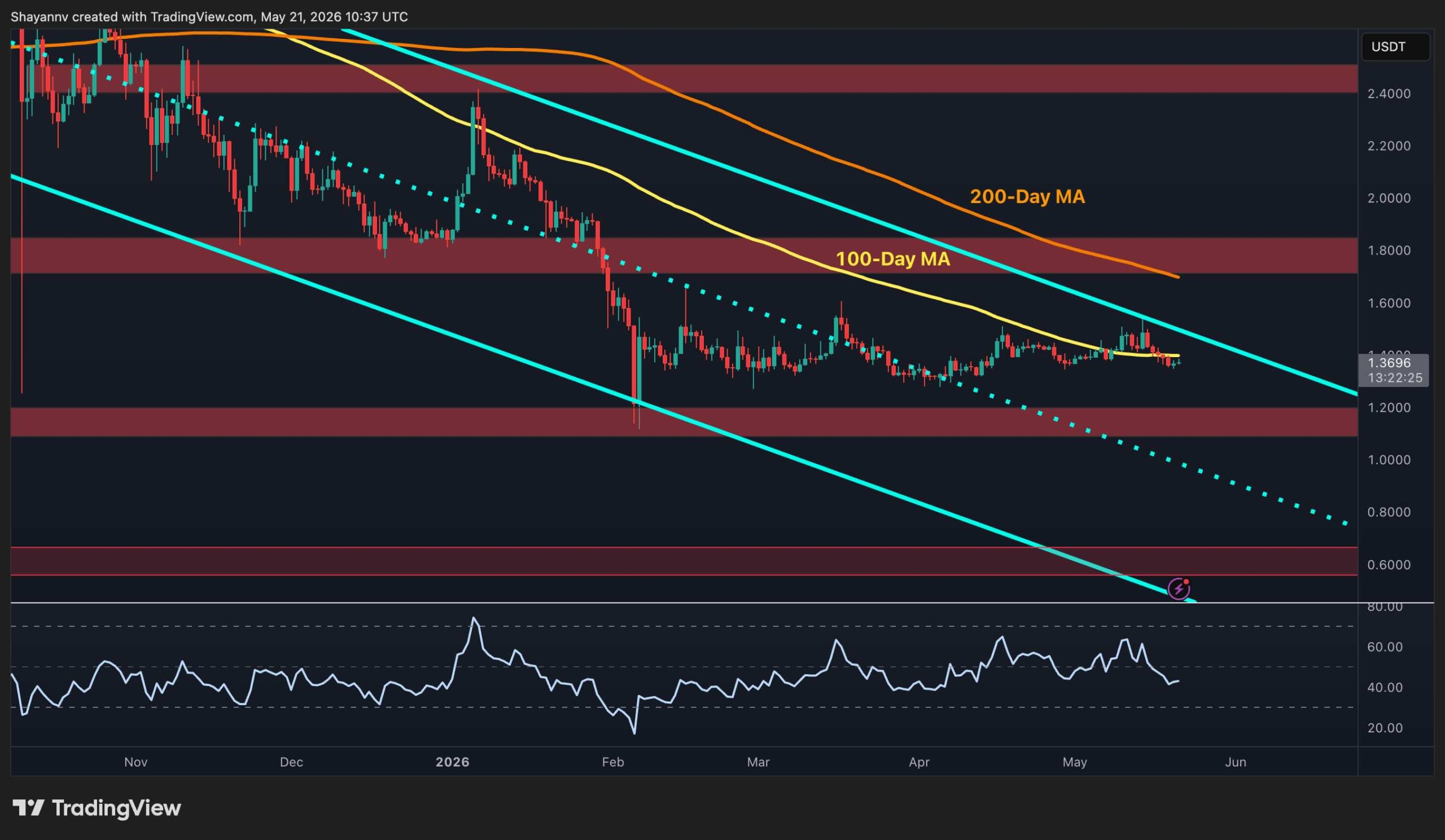
    XRP is trading at $1.37 as May nears its end, having reversed all gains from what briefly appeared to be the most promising technical setup of the corrective cycle. The breakout above the 100-day moving average on the USDT chart has failed to hold, and a lower high has formed on the BTC pair. The levels that looked like support last week are now the targets bulls need to reclaim to return to their starting point.

    USDT Pair Analysis

    The USDT pair’s daily timeframe setup appeared compelling last week. The asset was testing the upper boundary of the long-term descending channel and holding above the 100-day moving average at approximately $1.45, with the Relative Strength Index (RSI) climbing toward 65.

    However, this move has played out as a textbook rejection. XRP failed to close a single candle above the channel, and the subsequent sell-off has brought the price back to $1.37. The 100-day moving average, which was considered dynamic support just days ago, is now nearby overhead resistance at $1.40, just below the descending channel ceiling.

    The RSI has fallen from 65 back to the 40s, eliminating the momentum that made the setup optimistic. The $1.20 demand zone below should now be monitored as a potential floor, while a recovery above $1.45 and the 100-day moving average remains the minimum requirement to rebuild any constructive case. Yet, with the broader altcoin market declining, the path of least resistance points toward another test of support rather than another attempt at resistance.

    BTC Pair Analysis

    The brief breakout above 1,800 sats that appeared on the BTC pair last week has proven to be a fakeout. XRP/BTC has slipped back to around 1,770 sats, creating a lower high at approximately 1,800-1,900 sats. The RSI, which had recovered from an extreme low of roughly 25 to above 50 while demonstrating a bullish divergence, has also faded back toward 40. The relief bounce is losing energy before it accomplishes anything structurally meaningful.

    The failed reclaim of 1,800 sats is the defining development on this pair. It confirms that the oversold bounce was corrective rather than structural, and that the broader downtrend in the ratio remains intact. The 100-day moving average at approximately 1,900 sats and the 200-day moving average at approximately 2,100 sats continue to decline well above, offering no nearby reference for a recovery.

    Below, the lower channel boundary near 1,550 sats and the 1,500 sat horizontal support band remain the next downside targets if the current level gives way. With altcoin sentiment deteriorating across the board, there is little in the near-term macro picture to suggest that pressure is about to ease.

  • ChatGPT AI Predicts Soaring Dogecoin Price by 2026

    ChatGPT AI Predicts Soaring Dogecoin Price by 2026

    Dogecoin Price Prediction: ChatGPT Sees Potential Gains by 2026

    Dogecoin, despite numerous predictions of its demise, continues to persist in the cryptocurrency market. ChatGPT, the AI language model, has analyzed Dogecoin’s current price of $0.10 and forecasts significant upside potential by the end of 2026.

    Bull and Bear Cases

    ChatGPT’s base target for Dogecoin is $0.60, with a more optimistic scenario potentially reaching $1. The AI model avoids arguments based on utility, focusing instead on Dogecoin’s established strengths: strong retail recognition, a robust community, and a history of explosive price movements during bullish periods. ChatGPT identifies three specific catalysts not present in previous cycles: ongoing integration with Elon Musk’s ventures, potential developments regarding X payments, and the renewed meme coin mania fueled by a Bitcoin-led bull run.

    The AI’s logic is straightforward: in a strong crypto market cycle with rising Bitcoin prices and increased retail speculation, Dogecoin’s success hinges on its ability to attract a crowd, a feat that newer meme coins have struggled to replicate.

    Conversely, the bear case acknowledges Dogecoin’s lack of significant utility compared to newer blockchain projects. If the broader market weakens or meme coin narratives fade, Dogecoin could stagnate between $0.08 and $0.15 throughout much of 2026. This scenario, while not a crash, represents a “dead money” situation, which could disappoint holders expecting substantial returns.

    Technical Analysis

    Dogecoin is currently trading at $0.1038. The price chart reveals a meme coin that experienced rapid growth followed by a correction. The price peaked around $0.45 in January 2025, declined throughout the year, rebounded to $0.30 in August driven by Musk-related news, and then fell again in the second half of 2025, reaching $0.08 in February 2026.

    The recovery since February has been the most sustained upward movement in over a year, with the price rising from $0.08 to $0.12 before the current pullback to $0.10. The price structure since February is considered constructive, with consistent higher lows in March, April, and May. The $0.08 to $0.12 range has held for three months without a significant breakdown.

    Resistance levels are at $0.12 to $0.13, which has capped recovery attempts since March. Above that, $0.15 is the next reference point, representing the upper limit of ChatGPT’s bear case range. Above $0.15, the chart opens up, with $0.20 and $0.30 as the next significant supply zones. ChatGPT’s $0.60 target requires clearing these levels. Support is at $0.08 to $0.09, the February low.

    ChatGPT’s $1 optimistic scenario requires a full bull market and an Elon Musk-related catalyst. However, the chart needs to break $0.13 first.

    Emerging Meme Coins

    If the cryptocurrency market enters another bull cycle or altseason, meme coins could see particularly explosive gains.

    One new entrant attracting attention is Maxi Doge ($MAXI). The project has already raised $4.7 million through its ongoing presale, as traders speculate it could challenge established meme coins such as BONK or Floki.

    Maxi Doge is positioned as a more aggressive version of Dogecoin, capitalizing on the viral internet culture and speculative enthusiasm that drove the meme coin boom in 2021. The token is an ERC-20 asset on Ethereum’s proof-of-stake network, offering a lower environmental footprint compared to Dogecoin’s proof-of-work system.

    Presale investors can currently stake MAXI tokens to earn rewards of up to 65% APY, although returns decrease as more tokens join the staking pool. The token is priced at $0.0002808 during the current presale phase, with incremental increases in subsequent funding rounds.

  • Ripple’s XRP: Today’s News, May 21st

    Ripple’s XRP: Today’s News, May 21st

    Ripple Secures Spot in Top Disruptor Ranking and Announces Strategic Partnership

    Ripple has been recognized in a prominent ranking and has forged a new strategic partnership, even as its native token, XRP, experiences a slight dip.

    CNBC’s Top 50 Disruptors

    CNBC, the American business news channel, recently released its updated list of the top 50 disruptor companies for 2026. Ripple secured the 16th position in the ranking, which highlights innovative, fast-growing, and industry-shaping firms globally. Ripple surpassed well-known companies such as Canva, Samsara Eco, Harvey, and Revolut. Anthropic, OpenAI, and Databricks hold the top three spots, respectively.

    Prime Unicorn Index and Valuation

    Earlier in May, Ripple was also included in the Prime Unicorn Index, ranking sixth with a valuation exceeding $26 billion. SpaceX leads the index with a valuation of over $1.2 trillion. The index tracks the performance of U.S. private companies valued at over $1 billion and includes 232 entities with a combined valuation exceeding $3.4 trillion.

    Partnership with EDX Markets

    Ripple Prime, the company’s institutional-grade prime brokerage platform, has partnered with EDX Markets and EDX International. This collaboration allows the entities’ clients to access EDX’s spot and perpetual futures liquidity for cryptocurrencies within a “unified, capital-efficient” framework.

    Michael Higgins, International CEO of Ripple Prime, stated, “Building the next generation of prime brokerage requires partnering with venues that provide a secure, liquid bridge between traditional and digital markets. EDX is institutional-grade and delivers the performance, reliability, and depth that our clients expect.”

    The partnership also sets the stage for the future integration of Ripple’s stablecoin, RLUSD. Prior to this, Ripple secured a $200 million debt facility with Neuberger Specialty Finance, which will enable Ripple Prime to scale its platform and serve more institutional clients.

    Institutional Interest in XRP ETFs

    Spot XRP ETFs have recently seen strong interest. Data from SoSoValue indicates that millions of dollars have flowed into these products in recent weeks, with the latest negative day occurring on April 30. In contrast, spot Bitcoin and Ethereum ETFs have experienced outflows.

    This suggests that institutional investors, including pension and hedge funds, are increasing their exposure to Ripple’s cross-border token, potentially setting the stage for a price recovery. Issuers behind these products include Canary Capital, Bitwise, Franklin Templeton, Grayscale, and 21Shares, which have collectively brought in almost $1.4 billion in net inflows since their debut.

    XRP Price and Analyst Predictions

    Despite these developments, Ripple’s native token is down approximately 4% for the week and is currently trading at $1.36, according to CoinGecko. However, many analysts remain bullish.

    X user CoinForge suggested that XRP is at a critical level that previously led to a 700% increase. JAVON MARKS believes the asset is “holding broken out” against Bitcoin and has the potential to outperform by nearly 800%.

    Whale Activity and Market Sentiment

    Whale activity reinforces the bullish sentiment. Ali Martinez reported that large investors have accumulated over 71 million XRP in the last week, potentially positioning themselves for a rally and encouraging smaller investors to follow suit.