Category: Uncategorized

  • Bitcoin Price Edges Up as Soft Inflation Data and Fed Comments Reduce Rate Hike Odds

    Bitcoin Price Edges Up as Soft Inflation Data and Fed Comments Reduce Rate Hike Odds

    Bitcoin’s price saw a modest increase on September 30, briefly touching $85,598, as market participants significantly reduced their expectations for a Federal Reserve rate hike in October. This shift was primarily driven by the release of August’s Personal Consumption Expenditures (PCE) data, which indicated lower-than-expected inflation, and comments from Federal Reserve officials suggesting a lack of urgency for further rate increases. The possibility of future Fed rate hikes remains, as odds are not zero, and a strong jobs report or an inflation surprise could quickly raise these odds again.

    The August PCE data showed that core inflation, which excludes volatile food and energy prices, rose by 3.0% year-over-year, falling short of the 3.3% anticipated by forecasters. The headline PCE also came in lower than expected, at 3.4% compared to predictions of 3.7%. These inflation figures landed alongside remarks from NY Fed President John Williams on September 29, who stated there was “no need for urgency” regarding future rate hikes.

    As reported by the source, these combined signals coincided with a sharp repricing of Federal Reserve policy expectations. The odds of a Fed rate hike in October fell from above 70% to approximately 37% on September 30. This macroeconomic backdrop provided a lift to Bitcoin, which had largely traded between $83,000 and $84,000 for much of September.

    Bitcoin concluded September with a 7% gain, marking its first positive September following a positive August since 2013. The cryptocurrency’s performance in the third quarter exceeded 40%. This gain occurred even as Treasury yields remained above 5.2%, offering a substantial return for holding government debt.

    Spot Bitcoin Exchange-Traded Funds (ETFs) continued to experience inflows, with one reported week seeing a surge of $2.8 billion. According to the article, Grayscale’s Zach Pandl characterized the Federal Reserve’s September hike as a “mid-cycle adjustment” rather than the beginning of an aggressive tightening campaign. This perspective suggests that ongoing capital allocation toward Bitcoin is unlikely to be significantly disrupted.

    The article states that the current market behavior echoes trends seen in the late 1990s, when policy adjustments did not derail broader risk appetite. A key takeaway highlighted is how closely Bitcoin’s price now correlates with macroeconomic data, with the PCE release and Fed speech having a more pronounced impact on its price than crypto-specific news during the week.

    However, uncertainties remain. The odds of a Fed hike, while lower at around 37%, are not zero. The article points out that a strong jobs report or an unexpected inflation increase could quickly raise these odds again. Furthermore, the structural nature of institutional demand for Bitcoin, as evidenced by ETF inflows despite high Treasury yields, is contingent on continued inflows. A slowdown in these flows would serve as an early warning sign, according to the source.

    Why This Matters

    The materials describe a narrow update: Bitcoin’s price rose to $85,598 on September 30 following the release of August’s Personal Consumption Expenditures (PCE) data, which showed lower-than-expected inflation, and comments from NY Fed President John Williams suggesting no urgency for further rate hikes. The possibility of future Fed rate hikes remains, as odds are not zero.

    Broader Context

    Source materials place the factual news in this context: Bitcoin had spent much of the month trading between $83,000 and $84,000.

  • Circle Launches Stablecoin Services on Arc

    Circle Launches Stablecoin Services on Arc

    Circle Aims to Transform Apps into Mini Banks with New Arc Blockchain Tools

    Circle is empowering developers to integrate banking-like functionalities directly into their applications on the Arc blockchain. On September 30, 2026, the company unveiled three developer kits designed to enable seamless embedding of stablecoin purchases, lending, and borrowing within third-party products.

    These kits significantly streamline the process for developers, allowing them to add sophisticated financial features without the need to build their own complex and potentially error-prone smart contracts, a common hurdle in launching crypto-based services. The release follows closely on the heels of Arc’s public mainnet launch on September 16, 2026.

    Onramp Kit: The Digital Gateway

    The Onramp Kit serves as the primary entry point, enabling users to purchase USDC and EURC stablecoins directly within an application using familiar payment methods like Apple Pay, Google Pay, or a debit card. Currently, this feature is available to eligible users in the US, UK, and EU, who must complete Know Your Customer (KYC) verification through the designated payment provider.

    Earn Kit: Generating Yield

    With the Earn Kit, applications can offer users opportunities to earn yield on their USDC and EURC holdings. The underlying mechanism relies on the Morpho protocol, a decentralized lending platform that facilitates deposits from users and loans to borrowers, with depositors receiving a share of the generated interest.

    Borrow Kit: Accessing Liquidity

    The Borrow Kit allows users to take out USDC loans, utilizing cirBTC as collateral. This functionality is also powered by Morpho-supported markets. cirBTC, Circle’s token backed by Bitcoin, provides users with a way to access liquidity without having to sell their underlying Bitcoin holdings.

    A Comprehensive Developer Suite

    These new kits are integrated into Arc App Kits, Circle’s overarching software development kit. The entire suite is engineered to embed a range of financial services, including payments, swaps, onramps, and yield generation, directly into applications.

    Historically, Circle’s on-chain financial infrastructure, such as Circle Mint, has primarily catered to institutional clients handling substantial transaction volumes. The introduction of these new kits signals a strategic shift towards supporting consumer-facing applications.

    Arc operates as a proof-of-authority layer-1 blockchain, specifically optimized for stablecoin-centric applications. In this consensus model, a select group of authorized validators verifies transactions, differing from the open participation of many other blockchain networks. A key feature of Arc is that transaction fees are paid in USDC, eliminating the need for users to hold a separate, volatile cryptocurrency for network operations.

    In the initial days following its mainnet launch, the Arc network saw significant activity, with $649 million in USDC and $7 million in EURC being transferred onto the platform.

    Circle’s recent strategic moves include the acquisition of Singapore-based Tazapay for $400 million, bolstering its cross-border payment capabilities. The company has also launched StableFX, a product offering 24/7 stablecoin foreign exchange settlement, directly challenging the limitations of traditional FX markets that operate within standard business hours.

    For developers, integrating features like lending or onramps from scratch typically involves considerable expertise in smart contracts, rigorous security audits, and establishing relationships with payment providers. Circle’s new kits bundle these essential components, offering a streamlined solution.

    Applications that adopt these kits will inherently link their financial functionalities to Circle’s infrastructure, Morpho’s lending markets, and third-party KYC providers. This interconnectedness means that any disruptions within this chain could have downstream effects on end-users.

    Notably, Circle is not developing its own lending engine independently. Instead, it is leveraging Morpho’s existing infrastructure, positioning the partnership as a significant distribution channel rather than solely a competitive offering.

    The Borrow Kit introduces an alternative method for users to borrow against their Bitcoin holdings via cirBTC without liquidating their assets. However, it’s important to note that positions on lending markets remain susceptible to liquidation if the collateral’s value experiences a sharp decline, a risk that user-friendly interfaces do not negate.

    The current geographical restrictions for the Onramp Kit, limited to eligible users in the US, UK, and EU, highlight the ongoing fragmentation of stablecoin access across different jurisdictions.

    The success of Circle’s strategy will be measured by adoption metrics. Key indicators will include the number of applications integrating these kits, the growth of USDC and EURC circulation on the Arc network beyond the initial figures, and the volume of lending activity within Morpho-supported markets. These metrics will collectively determine the impact of Circle’s push into consumer-focused financial applications.

  • Senate’s Clarity Act Failure Spurs Faster, Less Durable Crypto Regulatory Actions

    Senate’s Clarity Act Failure Spurs Faster, Less Durable Crypto Regulatory Actions

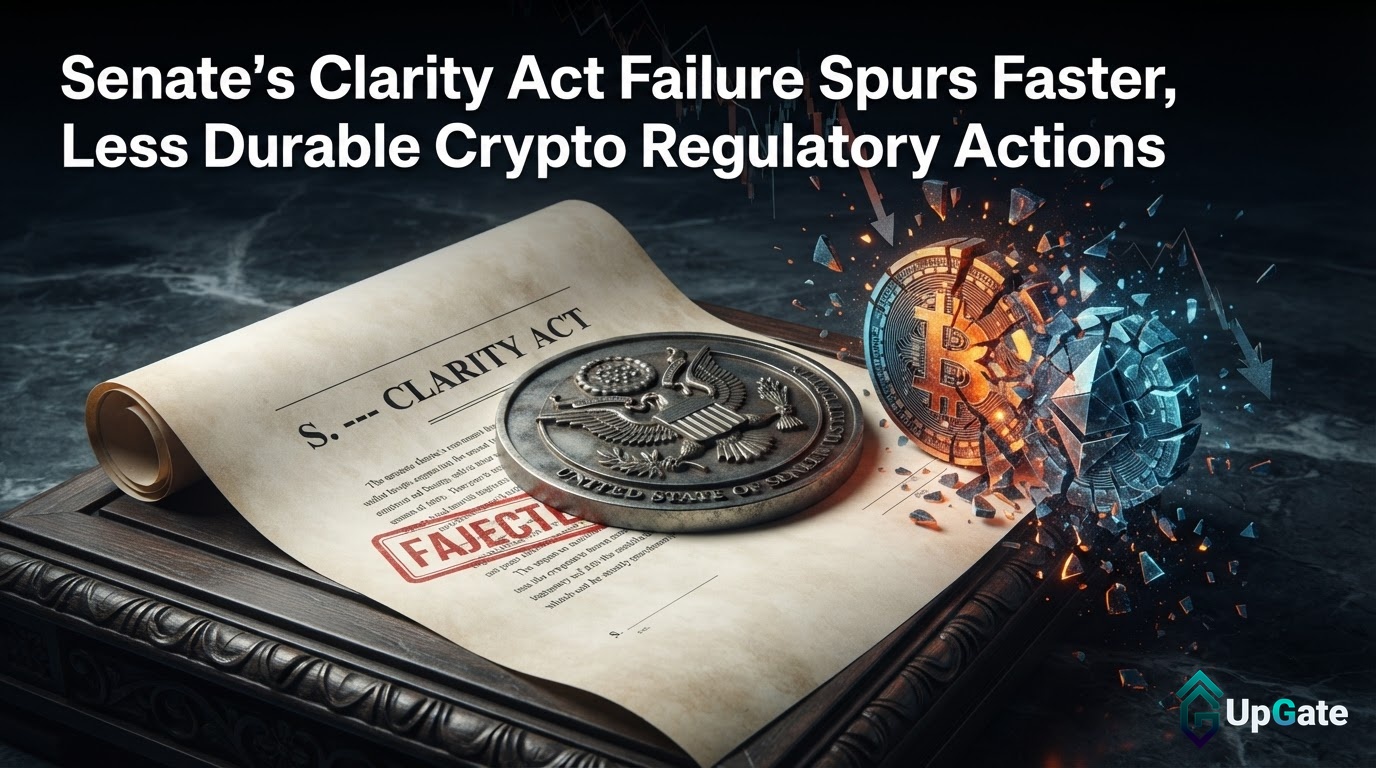
    The US Senate’s failure to advance the crypto market structure bill, known as the Clarity Act, on September 15 has coincided with a rally in the cryptocurrency market. This outcome suggests a trade-off where the industry may have gained faster, albeit less durable, regulatory actions from agencies in exchange for legislative certainty.

    Following the procedural vote in the Senate, which fell short of the 60 votes required to move forward, Bitcoin saw gains of approximately 8%, and Ether rose by about 7%. Tokens such as NEAR, Uniswap, and Avalanche experienced even more substantial increases. This market reaction aligns with the view that the industry may have prioritized immediate regulatory flexibility over the long-term stability that legislation could have provided.

    Bitwise Chief Investment Officer Matt Hougan argues that several compromises within the Clarity Act would have been less favorable to certain segments of the crypto industry than regulatory actions subsequently taken by federal agencies. For instance, Hougan said the bill’s failure benefits platforms like Coinbase that utilize stablecoin rewards to attract customers. He also noted that with the legislation stalled, established crypto exchanges can retain advantages derived from their existing state licenses and infrastructure.

    In the wake of the legislative setback, regulators have moved more swiftly than Congress might have on key issues. Two days after the Senate vote, the Securities and Exchange Commission (SEC) approved a five-year conditional “innovation exemption.” This exemption allows qualifying venues to trade tokenized US-listed stocks through permissioned automated market makers and liquidity pools without needing to register as traditional exchanges. Certain liquidity providers also received conditional relief from dealer registration.

    Further clarifying the regulatory landscape, SEC staff provided guidance on September 25 regarding revenue-generating tokens. This clarification, which is not an SEC rule and does not carry the force of law, stated that announcing a buyback program for a non-security crypto asset does not, by itself, constitute a promise of “essential managerial efforts” under the Howey test, a key factor in determining if an asset is an investment contract. This guidance reduces uncertainty for protocols including Hyperliquid, NEAR, and Uniswap.

    However, Hougan acknowledged that the accelerated pace of agency action comes with a trade-off in durability. Rules and exemptions established by agencies like the SEC and the Commodity Futures Trading Commission (CFTC) can be modified by future administrations or challenged in courts, unlike legislation, which provides a more difficult-to-reverse framework. JPMorgan analysts have also commented on this distinction between the durability of agency action versus legislation.

    Despite the potential for future shifts, the growing adoption of digital assets by major financial institutions could eventually make a broad reversal of current regulatory approaches increasingly difficult. The current environment presents a complex interplay between immediate regulatory opportunities and the inherent uncertainties of agency-driven frameworks compared to congressionally enacted laws.

    Why This Matters

    The materials describe a narrow update: The US Senate failed to advance the crypto market structure bill (Clarity Act) on September 15. The long-term durability of agency interpretations and exemptions compared to legislative rules.

    Broader Context

    Source materials place the market analysis in this context: The Clarity Act was a crypto market structure bill.

  • Solana’s Information Exchange Launches, Powered by Decrypt and MYR

    Solana’s Information Exchange Launches, Powered by Decrypt and MYR

    Information has always been a catalyst for market movements. Consumers of information seek to comprehend the world, anticipate future events, and guide their actions accordingly. However, the systems through which individuals acquire knowledge have historically been distinct from those enabling their participation in markets. This division, we believe, is now dissolving.

    Today, we are unveiling The Information Exchange: a unified network for information and finance that integrates news, data, market prices, probabilities, and direct participation around topics of public interest. This initiative is brought to you by Decrypt, powered by Myriad and the MYR token.

    A user following Bitcoin, for instance, should be able to grasp past events, monitor the asset’s current performance, understand market sentiment regarding future movements, and act directly. The Information Exchange will combine proprietary products with integrated third-party solutions. Decrypt will provide authoritative information and global reach. Myriad will deliver the technological infrastructure connecting information to financial engagement. Solana will offer the high-performance on-chain environment necessary for a new generation of users to participate. The MYR token will function as the coordination layer, linking users, creators, traders, publishers, liquidity providers, applications, data providers, and autonomous agents.

    News + Data + Markets + Prediction + Participation

    This represents the next phase in the evolution of Myriad and the core concept we have been developing all along.

    Historically, readers would learn about assets through publications like Decrypt, then transition to exchanges and trading platforms. Each step introduced friction, leading to a loss of the original context, an end to the publisher-reader relationship, and the accrual of financial value generated by user attention to a different platform.

    As financial products become increasingly composable, they can be seamlessly integrated into the applications where users discover them. A Decrypt reader should not have to leave an article to reconstruct the context for a trade. The opportunity to act can now coexist with the information that inspires conviction.

    “Solana provides Decrypt with the speed, low costs, and expanding financial ecosystem necessary to embed participation directly into the information experience.”

    Information is becoming machine-readable, markets are becoming programmable, and the gap between an event and an economic response is rapidly shrinking. This convergence of media, markets, and machine intelligence is what makes The Information Exchange feasible today.

    For eight years, we have been building around information and the communities that imbue it with value. Decrypt was established to help individuals navigate rapidly evolving financial and technological systems, growing into one of the leading crypto-native media platforms.

    Rug Radio emerged from a different perspective, demonstrating that creators and community members could actively participate in the media they helped produce, contribute to its distribution, and share in the surrounding culture and value. Its audience is deeply embedded in the crypto space.

    The integration of Rug Radio into Decrypt has brought this native viewpoint together with the established reach and authority of a seasoned newsroom. This combined entity now reaches approximately 1.6 million unique monthly users and generates 3.7 million monthly page views, with over 73,000 active newsletter subscribers. Furthermore, it has achieved hundreds of millions of impressions through social platforms and syndication.

    Myriad cultivated a third audience: active market participants who have already shown a propensity to move directly from information to action when presented with a compelling product.

    These audiences represent three distinct points on a single participation curve, spanning understanding, discovery, conviction, and execution.

    Myriad Prediction Markets began as an experiment to determine if an information-focused audience could evolve into a market network. Prediction markets served as the natural initial instrument, offering one of the most direct ways to financialize information.

    Our central question was not whether people desired another platform for trading predictions, but rather whether individuals consuming information could become active market participants within the same experience.

    With over $600 million in prediction market volume to date, the answer is unequivocally yes.

    Throughout this journey, we have deployed Myriad across various ecosystems, experimented with automated market makers and order books, developed a wallet, and built our own market infrastructure. Not all strategies yielded the intended results. At times, we prioritized becoming a conventional prediction market venue over concentrating on the broader relationship between information and participation.

    However, the underlying experiment proved successful. We built a novel financial product from the ground up, distributed it through an existing information network, and demonstrated that passive content consumers could indeed become active market participants.

    Prediction markets were not the ultimate goal; they were the validation.

    Prediction markets represent one financial manifestation of information, and they will not be the last. The Information Exchange extends this model across the broader financialized internet. Its fundamental unit is not an article, a token, or a trade, but rather the subject.

    Myriad can aggregate reporting, data, market prices, probabilities, and opportunities for participation. These opportunities will encompass:

    We do not intend to create every financial product we distribute. Myriad will continue to provide native market infrastructure while also integrating products from third-party protocols and exchanges. Our objective is to become the information and participation layer through which individuals discover, understand, and interact with markets.

    Supporting our ongoing media expansion will be our in-house agentic media operating system, designed to identify emerging subjects, organize data, curate intelligence, assist in content production, and connect relevant financial products to informational graphics.

    MYR serves as the shared economic coordination layer of The Information Exchange. MYR can be staked by participants responsible for securing network functions, including information verification and market resolution. Applications, professional trading systems, data consumers, and autonomous agents can stake MYR to access scarce network resources. These may include higher API throughput, low-latency market data, probability feeds, resolution infrastructure, programmatic market creation, execution services, and premium intelligence.

    MYR will also align the interests of those supplying information, distribution, capital, liquidity, and computation. Holders and stakers will receive benefits such as reduced transaction costs, enhanced data access, and premium products or services.

    Economic activity across The Information Exchange will generate revenue. Portions of network economics will be directed towards open-market acquisition of MYR, supply reduction (Buyback + Burn), staking incentives, network rewards, treasury funding, and ecosystem development.

    This approach creates demand tied to the network’s usage and growth, rather than solely to speculation. The aim is not to attach a token to a collection of disparate products, but to provide an expanding information network with a common economic language.

    The history of Decrypt, Rug Radio, and Myriad is the narrative of a single idea becoming increasingly refined. The Information Exchange consolidates our accumulated capabilities. Prediction markets remain central to it, as probabilities represent some of the clearest and most valuable expressions of collective belief. However, they are just one product within a much larger opportunity.

    We are building a network where individuals can understand past events, gauge market expectations for the future, and participate directly. It is a network where creators and publishers can share in the financial activity their information generates.

    In a world where everything, including attention itself, is being financialized, individuals should be able to benefit from their knowledge and participate in the markets their activity helps create. This was the foundational purpose of Myriad. Everything we have built and learned has led us back to this principle.

    One network for information and participation. One unifying technical layer. One token connecting every product and every participant.

    Expect a phased product rollout over the coming weeks, culminating at Solana Breakpoint.

  • Garlinghouse: XRP Key to Ripple’s Payments

    Garlinghouse: XRP Key to Ripple’s Payments

    Ripple CEO Brad Garlinghouse has detailed the company’s strategy for XRP, cross-border payments, and the broader digital asset market, emphasizing the critical need for clear cryptocurrency regulations.

    Practical Use Cases and XRP’s Role

    In a recent interview, Garlinghouse asserted that cryptocurrencies must offer tangible utility and solve specific problems. He identified cross-border payments as a key area where Ripple leverages XRP. The company utilizes XRP to overcome challenges in international transactions, citing the digital asset’s rapid transaction speeds and comparatively low costs.

    Garlinghouse also touched upon the potential for digital assets in machine-to-machine and micro-payment scenarios, suggesting these applications might necessitate payment systems capable of handling transactions valued at fractions of a cent. He clarified, however, that XRP is not universally applicable and that different digital assets are suited for distinct purposes.

    The Impact of Regulation

    The Ripple CEO underscored the significant influence of regulation on cryptocurrency adoption. He noted that financial institutions exhibit caution when adopting digital assets amidst regulatory ambiguity. Garlinghouse pointed to the GENIUS Act as an example of legislation that enhanced clarity for stablecoins, particularly concerning disclosure and reserve requirements. He observed an increase in stablecoin payment activity following the implementation of these clearer rules.

    Garlinghouse also referenced Ripple’s protracted legal battle with the U.S. Securities and Exchange Commission, stating the company incurred approximately $150 million and four years defending the case. He highlighted the court’s determination that XRP itself is not a security, a finding that provided greater clarity for Ripple. Nevertheless, he acknowledged that the broader cryptocurrency industry continues to grapple with regulatory uncertainty regarding the classification of various digital assets.

    Strategic Expansion and Distribution Channels

    Ripple’s initial focus was on banks and payment providers, but the company is now broadening its reach through strategic acquisitions. Garlinghouse cited the acquisition of GTreasury, a treasury management firm serving large corporations, as a prime example. He noted that companies utilizing GTreasury collectively processed around $13 trillion in payments last year. Ripple views the network of corporate finance teams and treasurers on the GTreasury platform as a potential distribution channel for its payment technologies. Garlinghouse suggested that Ripple could offer stablecoin or XRP-based payment solutions to companies seeking alternatives for international transactions.

    Ripple’s Relationship with XRP

    The Ripple CEO also addressed the company’s connection to XRP. He explained that the XRP Ledger is open-source and decentralized, with Ripple controlling approximately 2% of its validators. Garlinghouse emphasized that ownership of XRP does not confer control over the network’s governance, as the ledger does not operate on a proof-of-stake system. Consequently, he argued, Ripple’s holdings of XRP should not be construed as control over the XRP Ledger.

    Cryptocurrencies as Long-Term Assets

    Garlinghouse also discussed the potential for cryptocurrencies to serve as long-term financial assets. He characterized Bitcoin as a store of value and posited that other digital assets could evolve to support diverse use cases, specifically identifying payments as XRP’s primary focus. He anticipates that financial institutions will continue to explore digital assets as the cryptocurrency industry matures. For XRP, the ongoing emphasis remains on payments, financial institutions, and the application of blockchain technology for cross-border value transfer.

  • Bitcoin ETFs Notch 9-Day Winning Streak

    Bitcoin ETFs Notch 9-Day Winning Streak

    Bitcoin Continues Upward Trend as ETF Demand Persists

    Bitcoin is steadily climbing, fueled by consistent inflows into U.S. spot Bitcoin exchange-traded funds (ETFs). On Tuesday, these ETFs attracted $66.19 million, marking their ninth consecutive session of net inflows, according to Decrypt’s Bitcoin ETF tracker. By Wednesday, Bitcoin was trading near $84,400, a roughly 1% increase for the day, recouping losses from Monday.

    Sustained Inflows Drive Rally

    This recent surge began on September 17 and has since accumulated approximately $3.08 billion in inflows, based on Decrypt data. This performance surpasses August’s nine-day streak, which ran from August 17 to August 27 and totaled around $3.04 billion. While the length of the streaks is identical, the current run has brought in an additional $33 million, a notable difference given that the August rally is widely credited with pulling Bitcoin out of a bear market.

    Understanding Bitcoin ETFs

    Bitcoin ETFs offer investors a way to gain exposure to the cryptocurrency without directly purchasing Bitcoin on an exchange or managing a digital wallet. These ETFs track Bitcoin’s price and trade like traditional stocks on brokerage platforms. They have seen significant popularity since their introduction two and a half years ago, with market observers closely monitoring their inflows and outflows as a key indicator of investor sentiment.

    Sentiment Shift Amidst Economic Factors

    Investor sentiment has undergone a significant shift in recent weeks. On September 16, the Federal Reserve increased interest rates by 25 basis points to a range of 3.75%–4%, the first such hike since 2023. This move, which traders had anticipated with nearly 93% certainty, typically makes investors more cautious about riskier assets like Bitcoin due to the increased cost of borrowing.

    Following the rate hike, Bitcoin experienced a dip to around $75,000 that week, and its ETFs saw outflows totaling approximately $746 million over two days. However, the trend reversed on September 17 with inflows of $159.5 million, and Bitcoin quickly surpassed the $80,000 mark within two days.

    Record Weekly Inflows

    The influx of capital accelerated rapidly thereafter. Inflows reached $999 million on September 21, and the week ending September 25 recorded $2.4 billion in inflows, the largest weekly haul since October 2025. This substantial inflow pushed the funds back into positive territory for the year 2026.

    The broader economic environment has not necessarily eased. Bitcoin’s summer rebound can be traced back to August 19, when the Treasury announced it would double its longer-dated bond buybacks to at least $4 billion per operation. On that day, Bitcoin reached $69,000 for the first time in two months.

    Currently, Bitcoin remains about a third below its all-time high of $126,296, set in October 2025. The current streak of inflows, however, still trails the 13 consecutive days of inflows seen in June 2025. To match that record, inflows would need to continue through Monday, October 5.

  • Ethereum Foundation Grants $100K for Vyper Compiler Verification

    Ethereum Foundation Grants $100K for Vyper Compiler Verification

    Ethereum Foundation Funds Formal Verification for Vyper Compiler

    The Ethereum Foundation has allocated $100,000 to support the development of a formally verified compiler for Vyper, a Python-like smart contract language that currently secures over $2 billion in total value locked across decentralized finance (DeFi) protocols such as Curve and Yearn.

    Enhancing Security Through Formal Verification

    This grant is part of the ETHSecurity Initiatives Round Two, a broader $600,000 funding pool dedicated to Vyper-specific security enhancements. The initiative addresses a critical, often underestimated, challenge in smart contract development: the potential discrepancy between source code and the Ethereum Virtual Machine (EVM) bytecode produced by compilers. Formal verification of a compiler mathematically guarantees that the translation process accurately preserves the original program’s intent, ensuring that every input yields the precise output specified by the source code without subtle errors.

    Towards a Verified Compilation Mode

    The Ethereum Foundation’s funding aims to integrate a publicly accessible “verified compilation” mode directly into the official Vyper compiler. This feature would empower developers and auditors to confirm that the on-chain bytecode is a faithful representation of the source code they have reviewed. The project involves a collaborative effort with the Foundation for Verified Software, an organization associated with the Verifereum project. This work builds upon prior research in formal semantics conducted using HOL4, a proof assistant employed for rigorous mathematical verification of software systems. The Vyper development team is also actively participating to ensure the verification efforts align with the compiler’s architecture and ongoing development. The Ethereum Foundation has also encouraged additional contributions from the wider ecosystem to broaden the initiative’s scope beyond the initial funding.

    Vyper’s Significant Role in DeFi

    While Solidity is the dominant language in Ethereum smart contract development by volume, Vyper has established a significant presence in protocols that prioritize simplicity and auditability. Curve Finance, a leading decentralized exchange by trading volume and total value locked (TVL), is a prime example of a protocol utilizing Vyper.

    The more than $2 billion in TVL secured by Vyper contracts underscores that a compiler-level bug could have far-reaching consequences, potentially jeopardizing funds across multiple major protocols simultaneously, irrespective of the thoroughness of source code audits.

    Lessons from Past Vulnerabilities

    In 2023, a reentrancy vulnerability linked to specific Vyper compiler versions led to exploits affecting several Curve pools. The issue stemmed not from flawed source code, but from a compiler bug that undermined a correctly implemented security mechanism. This incident resulted in the loss of approximately $70 million and sent ripples of concern throughout the DeFi ecosystem.

    A formally verified compiler would render such exploits structurally impossible. The mathematical assurance would guarantee that if a security mechanism is correctly implemented in the source code, it will be accurately reflected in the generated bytecode.

    The $100,000 grant, while modest in comparison to the value it aims to protect, represents a crucial step. The ultimate success and speed of this project’s transition from a research milestone to a production-ready tool will likely depend on the Ethereum Foundation’s ability to attract further ecosystem funding.

  • Base Network Activates Cobalt Hard Fork, Enhancing Transaction Flexibility and Upgrade Automation

    Base Network Activates Cobalt Hard Fork, Enhancing Transaction Flexibility and Upgrade Automation

    The Ethereum Layer 2 network Base has successfully activated its Cobalt hard fork on mainnet, introducing a suite of engineering improvements designed to enhance transaction flexibility, upgrade automation, and network security. The activation took place on September 30 at 18:00 UTC.

    This upgrade, preceded by a trial on the Sepolia test network, required node operators to update their software to Base v1.4.2 or newer. During the upgrade window, major exchanges, including Binance, temporarily halted transfers on the network to ensure a smooth transition. Initial reports indicate the activation was successful with no significant disruptions.

    Key Engineering Advancements

    The Cobalt hard fork introduces several significant technical advancements:

    • B20 Token Standard Updates: Enhancements to the native B20 token standard are expected to improve reliability and consistency for users interacting with tokens built on this standard.
    • Validity and Conditional Transactions: This new feature allows transactions to execute only if specific on-chain conditions are met at the time of inclusion. This adds conditional logic to transaction processing, preventing execution if conditions are not satisfied and enhancing operational predictability.
    • Dynamic On-Chain Upgrade Scheduling: A new framework enables future upgrades to be scheduled and executed with reduced operational friction, potentially leading to less downtime and fewer coordination challenges for node operators.
    • Accelerated TEE Signer Registration: The registration process for Trusted Execution Environment (TEE) signers has been accelerated by moving verification fully on-chain. This change tightens the network’s security model and speeds up the process by removing a dependency on off-chain verification steps.

    Developer Experience and Upgrade Strategy

    These changes are largely backward-compatible for developers and protocols, meaning application-level code should not require significant modifications. The new transaction types are additive, ensuring that existing transaction formats continue to function as before.

    The Cobalt hard fork is part of Base’s aggressive upgrade cadence in 2026. The network previously activated the Azul upgrade on June 25, followed by the Beryl upgrade. The Denim hard fork is currently targeted for October 2026. This strategy of implementing four hard forks in approximately four months reflects a deliberate approach to ship improvements incrementally rather than bundling them into larger, potentially riskier upgrades.

    The successful activation of the Cobalt hard fork represents a significant step in Base’s ongoing development, enhancing its capabilities as an Ethereum Layer 2 network and supporting its strategic goal of incremental, efficient network evolution.

    Why This Matters

    The materials describe a narrow update: The Cobalt hard fork was activated on the Base mainnet, introducing several engineering improvements including updates to the B20 token standard, validity and conditional transactions, dynamic on-chain upgrade scheduling, and accelerated Trusted Execution Environment (TEE) signer registration. The Cobalt upgrade aims to make the Base chain more flexible, more efficient, and easier to upgrade in the future.

    Broader Context

    Source materials place the factual news in this context: Base has been on an aggressive upgrade cadence in 2026. Azul activated on June 25, Beryl followed sometime after, and Cobalt landed at the end of September. Denim is expected next month. Four hard forks in roughly four months reflects a deliberate strategy to ship improvements incrementally rather than bundling everything into one risky mega-upgrade.

  • Stacks Labs Eyes Muneeb Ali for CEO Amid Bitcoin Staking Surge

    Stacks Labs Eyes Muneeb Ali for CEO Amid Bitcoin Staking Surge

    Muneeb Ali Assumes CEO Role at Stacks Labs to Drive Bitcoin DeFi Development

    Muneeb Ali, a co-founder of the Stacks protocol, is stepping into the role of CEO at Stacks Labs, the organization tasked with spearheading core protocol development and fostering ecosystem growth. This leadership transition comes as Stacks Labs prepares to launch ambitious new products aimed at enhancing Bitcoin’s utility in decentralized finance.

    Community Backs Staking Upgrades

    A significant indicator of internal ecosystem health was a community vote held in July 2026, which garnered approximately 99% support for staking upgrades within the Stacks ecosystem. Such near-unanimous backing is a rarity in cryptocurrency governance, often characterized by voter apathy and internal disagreements. This strong consensus suggests the Stacks community is aligned on a unified technical trajectory, mitigating the governance risks that can impede protocol advancements.

    Stacks Labs: A Lean Engine for Growth

    Stacks Labs was established in 2025 following community approval of SIP-031, a governance proposal that formally defined the organization’s responsibilities in overseeing protocol development, managing developer relations, and driving ecosystem expansion. With a global team of around 33 employees, Stacks Labs operates as a lean entity relative to its expansive objectives.

    sBTC and the Genesis Bond: Unlocking Bitcoin’s DeFi Potential

    Central to Stacks Labs’ ambitions is sBTC, a decentralized asset designed to be pegged to Bitcoin. This innovation allows Bitcoin holders to engage in decentralized finance (DeFi) activities without the need to entrust their assets to centralized custodians. The upcoming “genesis bond” is intended to showcase this capability, offering a product linked to self-custodial Bitcoin yield. Its launch is anticipated around key network events in 2026.

    The Stacks protocol itself has been in development since 2013, when Ali and his co-founders initially launched the project as Blockstack. The platform rebranded to Stacks in 2020 and utilizes a consensus mechanism known as Proof of Transfer (PoX). Instead of competing with Bitcoin’s security framework, PoX anchors Stacks transactions directly to the Bitcoin blockchain, effectively leveraging Bitcoin’s proof-of-work security to support a smart contract layer built atop it. Developers on Stacks utilize Clarity, a programming language designed for predictability and auditability, distinguishing it from languages like Ethereum’s Solidity.

    Ali, who holds a Ph.D. in Computer Science from Princeton University, has a track record of raising over $200 million across his various ventures. Before his current focus on Stacks Labs, he led Trust Machines, a company dedicated to building applications on the growing Bitcoin software stack.

    Prior to Ali’s appointment, Stacks Labs was led by Alex Miller, who was instrumental in establishing the organization and its initial operational framework after the SIP-031 approval.

    Gauging Market Appetite for Self-Custodial Yield

    The staking upgrade vote and the genesis bond announcement serve as two distinct signals for market observers. While the vote reflects internal ecosystem health and community alignment, the genesis bond represents a product-level test. Its launch will provide crucial data on whether both retail and institutional Bitcoin holders are receptive to self-custodial yield opportunities. The demand for this bond is expected to be a key indicator of sBTC’s potential for widespread adoption.

    With a lean team of 33 employees and an ambitious product roadmap for 2026, Stacks Labs is poised to enter a market where its Bitcoin DeFi offerings will inevitably be compared against emerging alternatives from other ecosystems.

  • Polymarket Adds Sportsbook-Style Protections Amid Regulatory Pressure

    Polymarket Adds Sportsbook-Style Protections Amid Regulatory Pressure

    Polymarket Faces Dual Pressure as Legal Battle Intensifies

    Polymarket, a prominent prediction market platform, is currently navigating a complex defensive strategy on two distinct fronts. On September 30, 2026, the company quietly introduced a suite of consumer protection tools, features that would be instantly recognizable to users of licensed sports betting platforms. Simultaneously, Polymarket is engaged in a legal dispute with New York’s top legal officials, who contend that the platform is operating as an unlicensed and illegal gambling enterprise within the state.

    The timing of these developments is notably conspicuous. The rollout of the new consumer protection measures occurred less than a week after New York Attorney General Letitia James and Governor Kathy Hochul initiated legal action against Polymarket US on September 24, 2026. The lawsuit alleges that the platform has been facilitating unlicensed sports-related gambling contracts within New York.

    New Consumer Protections Introduced

    The newly implemented consumer protection measures include self-imposed deposit limits, a self-exclusion list allowing users to temporarily or permanently block themselves from trading, and access to mental health resources through a partnership with Birches Health. The latter initiative is specifically designed to assist users identified by the platform as exhibiting compulsive trading behaviors.

    These features are standard offerings on regulated sportsbooks in states such as New Jersey and Colorado, where licensed operators are legally mandated to provide them. Polymarket’s decision to offer these tools is voluntary.

    Voluntary Measures and Enforcement Gaps

    This distinction is significant. Voluntary consumer protections lack inherent enforcement mechanisms. On a regulated platform, if a user exceeds their self-imposed deposit limit, the operator is legally obligated to intervene. In contrast, Polymarket’s system is opt-in, meaning these safeguards are only effective if users actively choose to utilize them.

    Polymarket’s defense hinges on the argument that blockchain’s inherent transparency provides a level of accountability that traditional gambling platforms cannot match. The platform operates on-chain, ensuring that every transaction is publicly verifiable. Polymarket asserts that its multi-layered surveillance systems, combined with this transparency, can establish a model for responsible operations within the prediction market sector.

    Legal Maneuvers and Federal Preemption Claims

    Polymarket has not passively accepted the New York lawsuit. The company has filed a countersuit and sought to move the case to federal court, invoking the doctrine of federal preemption. Polymarket contends that its U.S. operations fall under the oversight of the Commodity Futures Trading Commission (CFTC) through its subsidiary, QCX LLC. Essentially, the argument is that federal commodity trading law supersedes state gambling statutes concerning Polymarket’s contracts.

    Polymarket acquired QCX LLC in July 2025, using this acquisition to re-establish its U.S. operations in December 2025. This relaunch occurred nearly three years after the platform was compelled to block American users following a 2022 settlement with the CFTC. That settlement, which involved a fine and an agreement to cease operations for U.S. traders, now looms over the current legal proceedings as evidence of past regulatory challenges.

    Complicated Relationship with the CFTC

    The relationship between Polymarket and the CFTC is complex. In June 2026, the agency initiated a separate investigation into Polymarket, reportedly examining its marketing practices. This places Polymarket in the position of arguing that federal oversight legitimizes its operations, while simultaneously being investigated by that same federal regulator.

    Focus on Sports Contracts and Regulatory Scrutiny

    The New York lawsuit specifically targets sports-related contracts, a category of prediction market that closely resembles sports betting under most state gambling laws. New York maintains one of the most stringently regulated sports betting markets in the United States, with licensed operators facing substantial fees and ongoing oversight. Polymarket’s engagement in sports-related contracts without adhering to this licensing framework is the direct catalyst for the Attorney General’s action.

    Prediction markets have seen substantial trading volume in 2026, driven in part by major election cycles and the expansion into sports contracts. This growth has made them a focal point for regulators.

    Industry Reactions and Potential Precedents

    Traditional sportsbooks argue that voluntary compliance is insufficient, having invested considerable time and capital in obtaining licenses, establishing compliance infrastructure, and meeting state-mandated responsible gambling requirements.

    For traders and market participants, the immediate concern is the impact of these legal battles on Polymarket’s operational viability in key jurisdictions. An unfavorable ruling in the New York case could lead to another wave of restrictions on U.S. users, mirroring the consequences of the 2022 CFTC settlement.

    The broader cryptocurrency and decentralized finance ecosystem is closely observing these proceedings, as the arguments presented in the Polymarket case carry implications beyond a single platform. If federal CFTC oversight is deemed sufficient to preempt state gambling laws for on-chain prediction markets, it could establish a precedent for other platforms. Conversely, a victory for New York would signal that states retain the authority to impose their own licensing requirements irrespective of federal commodity oversight, potentially creating a more fragmented and costly regulatory environment for platforms operating nationwide.