Category: Uncategorized

  • Solana App Revenue Hits Nine-Month High Amid Shifting Market Share

    Solana App Revenue Hits Nine-Month High Amid Shifting Market Share

    Solana’s application revenue surged to a nine-month high of $180 million in September, marking a significant uptick in the network’s economic activity. According to DeFiLlama data, this figure represents a 32% share of all blockchain application revenue for the month. The network also saw its daily app revenue peak at $7.935 million on September 12, the highest single-day total recorded in 2026, with weekly revenue reaching $49.9 million in late September.

    Beyond revenue, Solana logged 7,699 monthly active programs in September, the highest count since August 2025. Programs are Solana’s equivalent of smart contracts, which power decentralized applications (dApps). This increase in active programs suggests growing developer engagement and a potentially expanding ecosystem.

    However, despite this strong performance in revenue and active programs, Solana’s overall market share of blockchain app revenue decreased to 32% in September from 38.1% in August. In August, Solana apps generated $143.23 million, contributing to a global app revenue total of $375.53 million. This shift indicates that while Solana’s own revenue grew, other blockchain networks also experienced growth or increased their revenue-generating activities, intensifying the competitive landscape.

    It is important to note that the precise total for Solana’s September app revenue can vary based on the methodology employed by different data trackers. For instance, one Spanish-language report estimated Solana’s September app revenue at approximately $145.75 million, a figure notably lower than the $180 million reported by DeFiLlama. This discrepancy underscores the importance of understanding tracking methodologies, as they can significantly impact reported figures.

    The combination of rising revenue and an increasing program count could signal sustainable economic growth on the Solana network. Nevertheless, the concurrent decrease in market share highlights the dynamic and competitive nature of the blockchain ecosystem. Future data will be crucial in determining the long-term implications of these trends for Solana’s position.

    Why This Matters

    The materials describe a narrow update: Solana’s applications generated $180 million in revenue in September, the highest amount in nine months. The exact total of Solana’s September app revenue depends on the methodology of different trackers.

    Broader Context

    Source materials place the factual news in this context: Programs are Solana’s version of smart contracts, the code that powers apps on the network.


  • Stacks Crypto Surges 30% Overnight

    Stacks Crypto Surges 30% Overnight

    Stacks Crypto Surges as Founder Takes Helm, Bitcoin Staking Goes Live

    Stacks (STX) cryptocurrency is experiencing a significant rally, trading at $0.385 and marking a 19% increase over the past 24 hours, according to CoinGecko. This surge follows a decisive breakout that propelled the token above the $0.34 resistance level. The upward momentum has been consistent, with STX already posting a 50% gain in September.

    Leadership Transition and Growth Phase

    The project is set to enter a new growth phase with Stacks founder Muneeb Ali assuming the role of CEO of Stacks Labs on October 15. This leadership change coincides with reports that four institutions have collectively bonded approximately 250 BTC in the Genesis Bond program. Earlier reports indicated that the program had secured 230 BTC and 310,000 STX within its initial 14 days.

    Ali has also outlined strategic priorities for the project, including capital markets, privacy, and post-quantum Bitcoin, though specific implementation timelines for these initiatives have not yet been announced. While the leadership transition provides a near-term milestone, it does not guarantee an immediate increase in token demand.

    Market Dynamics and Technical Outlook

    Broader market conditions for Bitcoin (BTC) play a crucial role, as macro-driven movements in BTC can either amplify or overshadow ecosystem-specific catalysts. Current indicators, such as moderating inflation and Bitcoin’s price action, offer a backdrop against which STX’s performance will be measured. The immediate challenge for STX is to sustain its current breakout by defending the newly established support zone.

    At present, STX has reached $0.4006, trading within the $0.387–$0.40 range, with CoinGecko confirming a 19% daily gain. Market data from OKX and price analysis from Bybit corroborate these figures.

    From a technical perspective, the chart indicates that $0.34 has been overcome as resistance, with the $0.30–$0.35 area now serving as the primary support zone, according to Bybit. If STX maintains its position above $0.34–$0.35, the breakout is considered intact, with a potential extension towards $0.40–$0.45, though this remains an unconfirmed target.

    Should the price consolidate around $0.40, the base scenario suggests a retest of the former resistance level. A return below $0.34 would undermine the current bullish setup, and a deeper retreat into the $0.30–$0.35 range would place the breakout at risk. The key question for investors is whether the recent rapid price appreciation can translate into sustained demand.

    Fundamental Narrative and Future Prospects

    The proposed Bitcoin-staking mechanism for Stacks crypto provides a fundamental narrative for the current rally, but widespread adoption and successful execution are still necessary to fully align with the technical chart. A neutral next step involves observing how the price reacts around the $0.34–$0.35 level.

    The significant upward movement in STX validates market interest in Bitcoin-native yield and infrastructure solutions. However, after reaching the $0.40 mark, the immediate upside potential may appear less attractive compared to its position below $0.35. A failed retest of the breakout zone could quickly put early buyers under pressure.

    This dynamic underscores the appeal of early-stage projects for traders, though such entries also carry higher execution and liquidity risks. Historically, these types of risks have been associated with the potential for substantial, life-changing gains.

    Bitcoin Hyper Integrates Solana VM

    In related developments, Bitcoin Hyper (HYPER), a Bitcoin Layer 2 project, is integrating the Solana Virtual Machine (SVM). This integration aims to enhance fast smart contract execution and high-speed, low-cost transactions on the Bitcoin network. The project’s stated goal is to address Bitcoin’s limitations in transaction speed, fees, and programmability while preserving its core security and trust. The current presale price is $0.013687, with a total of $33,166,357.73 raised. Bitcoin Hyper also promotes live staking with a high APY and claims to offer a decentralized canonical bridge for BTC transfers. As with any ecosystem trade, Bitcoin market conditions and price scenarios remain relevant for further due diligence.

  • EU Demands Binance Clarify User Exemption

    EU Demands Binance Clarify User Exemption

    European regulators are scrutinizing how Binance continues to offer services within the European Union months after failing to obtain a license under the bloc’s new crypto regulations, according to a report by The Financial Times, which cited individuals familiar with the matter.

    Regulatory Scrutiny

    The European Securities and Markets Authority (ESMA) and national financial watchdogs in countries including France, Germany, and Greece are investigating Binance’s reliance on “reverse solicitation.” This is an exemption under Article 61 of the Markets in Crypto Assets (MiCA) regulation that allows firms based outside the EU to provide services at the client’s “own exclusive initiative.” Some regulators have reportedly requested information from Binance and may pursue enforcement actions, including fines, if they are not satisfied with the exchange’s responses.

    Under the MiCA framework, firms operating without a license were expected to cease their EU operations by July 1, with existing customers only being served to facilitate the transfer or sale of their holdings.

    Interpretation of Reverse Solicitation

    ESMA’s guidelines emphasize that the reverse solicitation exemption should be interpreted narrowly. The authority stated that whether a client was solicited is a factual matter, and that “contractual arrangements or disclaimers cannot supersede contrary facts.” ESMA further clarified that the exemption is “very narrowly framed” and should “not be used to circumvent MiCA requirements.”

    The Dutch regulator, the AFM, has also indicated that firms “cannot simply claim reverse solicitation,” and that clear requirements and guidelines must be met. Regulators in France, Germany, and Greece, along with ESMA and the AFM, declined to comment specifically on Binance’s situation.

    Operational Structure and Lapsed Registrations

    In practice, customers outside the countries where Binance held local registrations are reportedly served by an entity regulated in Abu Dhabi, which received authorization in December 2025. This arrangement was described by one user and two individuals familiar with the matter. Binance previously held registrations in six EU member states: France, Italy, Lithuania, Poland, Spain, and Sweden. These registrations have all lapsed under the MiCA rules.

    Binance has stated that it “complies with applicable regulatory requirements” in all jurisdictions where it operates and that it continuously reviews its products against relevant obligations. The company added that it is “actively working toward becoming MiCA-authorised.”

    Withdrawal from Greece and Compliance Efforts

    The exchange withdrew its MiCA application in Greece in June, a week after reports indicated that the Hellenic Capital Market Commission was poised to reject it. At the time, Binance announced it would seek authorization in another member state while taking necessary steps to remain compliant before the July deadline. The company had warned that some users might be affected by these changes.

    There was no grace period for compliance. Days before the July cutoff, the chairman of Spain’s securities regulator ruled out any exceptions or extensions and confirmed that supervisors were in contact with unlicensed firms to ensure they had plans for transferring client assets.

    Regulators are also reportedly examining other, smaller firms in a similar manner, according to one source.

  • Bitcoin Sees Volatility Post-PCE Data; Altcoins NIGHT, BTW, STX Post Significant Gains

    Bitcoin Sees Volatility Post-PCE Data; Altcoins NIGHT, BTW, STX Post Significant Gains

    Bitcoin experienced notable price volatility on September 30, reacting to the release of US Personal Consumption Expenditures (PCE) data. The cryptocurrency initially surged to $85,600 following the data publication, but faced rejection and subsequently retreated to $83,600 as of press time, according to reports.

    This price action occurred within Bitcoin’s established trading range of $83,000 to $85,000. The lower boundary of this range had been tested more frequently, with occasional dips below it, though Bitcoin managed to hold the level.

    While Bitcoin navigated its trading range, several altcoins demonstrated significant upward momentum. BTW recorded a substantial 35% increase, reaching $1.41. NIGHT saw a 26% surge, trading above $0.04, and STX rose by 22%, nearing $0.4.

    In the broader market, Ethereum continued to face resistance around the $2,700 mark. BNB traded above $765, and XRP saw a slight dip below $1.50. Other assets, including SOL, TRX, LINK, RAIN, XLM, and BCH, posted minor losses over the past day. HYPE approached $90 after a 3% increase, and QNT saw a similar daily jump, trading above $290.

    The total cryptocurrency market capitalization experienced a modest increase of just over 1% from the previous day, reaching $2.890 trillion. Bitcoin’s market capitalization stood at $1.680 trillion, with its dominance on CoinMarketCap remaining stable at 58.6%.

    Previously, Bitcoin had reached a high of over $87,000 in late January. After a vigorous rejection at this level, it had fallen to under $83,000 in September. The recent PCE data, which exceeded expectations, initially propelled Bitcoin upwards, but the momentum proved unsustainable, leading to its retreat to the $83,600 level.

    Why This Matters

    The materials describe a narrow update: Bitcoin’s price fluctuated significantly after the US PCE data release, initially surging to $85,600 before falling to $83,600. The exact timing of the ‘wild price moves’ for Bitcoin after PCE data.

    Broader Context

    Source materials place the factual news in this context: The article is a market watch report from CryptoPotato.

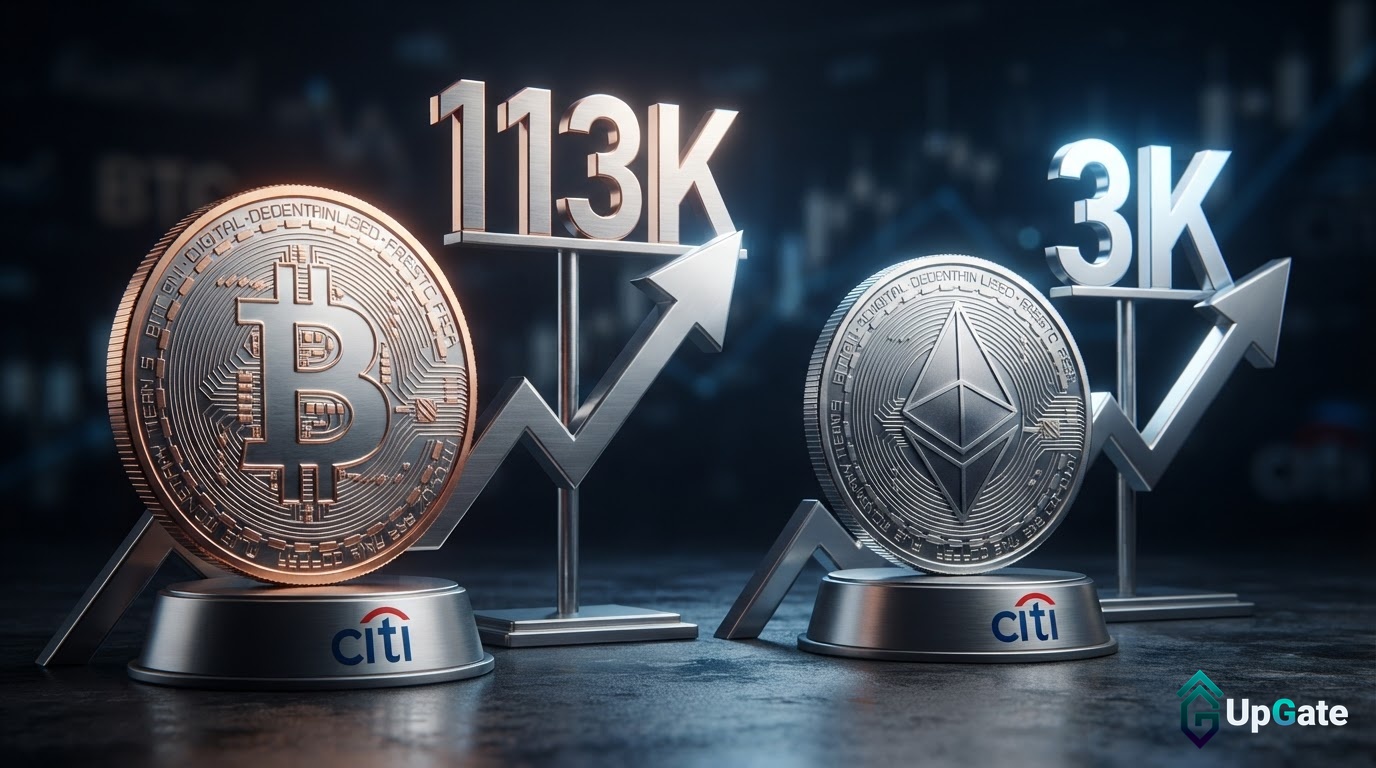
  • Citi’s Bitcoin Price Forecast Raised to $113K, Ether to $3K, Amidst Conditional Inflows

    Citi’s Bitcoin Price Forecast Raised to $113K, Ether to $3K, Amidst Conditional Inflows

    Citi has raised its 12-month price forecast for Bitcoin to $113,000, an increase from its previous $82,000 projection, and lifted its Ether forecast to $3,028 from $2,240, according to reports on October 1. These revised targets are conditional on a gradual resumption of institutional inflows rather than an immediate surge.

    Conditions for Credibility
    According to Citi, the updated Bitcoin forecast reflects stronger crypto activity, a more supportive macroeconomic backdrop, and the potential for renewed exchange-traded fund (ETF) inflows. The bank anticipates approximately $5 billion in crypto inflows over the next 12 months. This slower-but-steadier expectation suggests a base case where institutional participation rebuilds over time, potentially providing a persistent bid without the sharp price movements often associated with concentrated inflows.

    The revised forecast profile is described as constructive but less forceful than one built on an immediate wave of new allocations. Citi noted that if demand were to stall or reverse, the updated target would have less near-term flow support, highlighting the conditional nature of the projection.

    Market Context and Recent Performance
    This forecast revision follows a recent recovery in Bitcoin’s price. The cryptocurrency rose nearly 40% over the three months leading up to October 1, narrowing its year-to-date loss to approximately 4%. While this recovery improves the momentum backdrop, Citi’s analysis suggests that a rally already recorded is not evidence that the next phase of growth is assured.

    Regulatory and Macro Influences
    Citi’s assessment also considers the regulatory environment. While the Senate’s failure to advance the Clarity Act was noted as a setback for the digital-asset industry, Citi indicated that subsequent Securities and Exchange Commission rule announcements helped to dampen negative sentiment. Macroeconomic factors, such as a softer dollar and the US Treasury’s move to buy back longer-dated bonds, are also cited as contributing to Bitcoin’s recent recovery. However, the bank cautions that these factors shape risk appetite and financial conditions, but their timing does not alone explain Bitcoin’s advance.

    Outlook and Uncertainties
    The $113,000 Bitcoin projection is considered more credible if ETF demand returns and builds in line with Citi’s gradual-allocation scenario, alongside continued supportive crypto activity and a favorable macro backdrop. The relevant signal for sustained demand is not a single positive-flow session, but rather sustained demand over time. A renewed stretch of outflows would challenge the demand assumption underpinning the upgrade.

    For market positioning, Citi’s forecast serves as a higher 12-month reference point, rather than a standalone entry signal. The next test for the market, according to Citi’s view, is whether institutional flows can extend Bitcoin’s recent recovery rather than merely follow it. The bank’s revised Bitcoin price target remains conditional on this measured pace of inflows.

    Why This Matters

    Citi has raised its 12-month price forecast for Bitcoin to $113,000 from $82,000 and for Ether to $3,028 from $2,240. Whether slower, steadier institutional allocations can sustain the upgrade without sharp acceleration remains a key uncertainty.

  • A16z Crypto: Genius Act Locks In Onchain Shift

    A16z Crypto: Genius Act Locks In Onchain Shift

    GENIUS Act Designed to Withstand Policy Shifts, a16z Exec Argues

    Seoul, South Korea – October 1, 2026 – In a political landscape where policy often shifts with changes in leadership, the recently enacted GENIUS Act is designed to be a bulwark against such volatility, according to Miles Jennings, head of policy and general counsel at a16z Crypto. Speaking at the a16z Crypto Korea Summit in Seoul, Jennings asserted that the U.S. stablecoin legislation creates significant hurdles for future administrations seeking to reverse the ongoing migration of finance onto blockchain networks.

    Jennings delivered the keynote address on global digital asset policy at the summit, held at the Chosun Palace Gangnam Hotel, with the GENIUS Act taking center stage. His core argument revolved around how the act embeds stablecoin regulations within a robust, structured legal framework. This inherent structure, he contended, is precisely what makes the law resilient to potential rollbacks by subsequent administrations.

    Signed into law on July 18, 2025, the GENIUS Act establishes a comprehensive framework for payment stablecoins in the United States. These dollar-pegged tokens are crucial for facilitating value transfer across cryptocurrency networks. The legislation imposes stringent requirements on issuers, notably mandating that they maintain reserves of high-quality liquid assets on a 1:1 basis.

    Jennings characterized the act as a foundational measure, designed to foster the growth of decentralized protocols while simultaneously injecting clarity and stability into the broader regulatory environment.

    The summit attracted a diverse array of participants from the crypto industry, including representatives from projects such as Morpho, Digital Asset, and OP Labs. Discussions explored the transformative potential of decentralized finance for institutional finance and the implications of on-chain infrastructure for artificial intelligence integration.

    This event marks a significant step in a16z’s expansion into Asia, a strategic push that began in earnest with the firm’s announcement of a new Seoul office in December 2025, its first in the region. The a16z summit also coincided with a period of intense policy discussions in the city. In September 2026, events like the Upbit Institutional Summit (UIS 2026) featured discussions on stablecoins with the participation of U.S. officials. Additionally, EastPoint: Seoul 2026 hosted high-profile policy conversations where U.S. officials reaffirmed their commitment to refining legislation surrounding stablecoins and related technologies.

    The distinction between a statutory law and agency guidance is critical. Unwinding legislation passed by Congress typically requires a new act of Congress, a process that is considerably slower and more public than reversing an administrative directive. By codifying stablecoin rules into law with firm requirements, such as the 1:1 reserve standard, the GENIUS Act significantly increases the cost and complexity of any future attempts to alter its course.

    A clearly defined regulatory landscape is expected to grant stablecoin issuers enhanced access to traditional financial markets and institutional investors, thereby bolstering liquidity and market stability. As South Korea and the wider Asian market increasingly engage with digital asset infrastructure, alignment with U.S. regulations could stimulate cross-border investment and collaborative initiatives. U.S. officials in Seoul indicated that the refinement of stablecoin legislation and the pursuit of effective market structures and compliance suggest the GENIUS Act serves as a foundational step rather than a definitive conclusion.

  • Bitcoin Price Reacts to Inflation Data Amidst Elevated Treasury Yields

    Bitcoin Price Reacts to Inflation Data Amidst Elevated Treasury Yields

    Bitcoin experienced a price movement above $85,000 following the release of US Personal Consumption Expenditures (PCE) inflation data that indicated a cooling trend. However, the cryptocurrency’s upward momentum was tempered as Treasury yields remained elevated, suggesting that the inflation report alone was insufficient to drive sustained gains.

    In August, headline PCE inflation rose 3.4% year over year, while core PCE increased 3.0% year over year. Monthly core PCE inflation registered at 0.2%, falling short of the 0.3% forecast. According to the report, this softer inflation picture initially lowered market expectations for a Federal Reserve rate hike and briefly boosted appetite for risk assets.

    Despite the positive inflation news, the 10-year Treasury yield held near 5.3%, and the 30-year Treasury yield remained close to its highest levels since 2002. As per the source, persistent high yields can limit the sustainability of rallies in risk assets like Bitcoin, as they increase the attractiveness of safer investments.

    Bitcoin traded as high as $85,500 following the data release, but pulled back to trade around $84,100. The article states that the price action points to consolidation after a failed breakout, which is not a clean trend signal. For traders, softer inflation is supportive, but not sufficient; lower yields would provide more room for a recovery to run.

    Market Uncertainty and Technical Outlook

    The immediate question for market participants is whether Bitcoin can reclaim the breakout zone and turn resistance into support, particularly while Treasury yields remain elevated. The chart suggests measured positioning rather than assuming a breakout until Treasury yields decline sustainably. A sustained decline in Treasury yields would provide stronger confirmation for a bullish trend.

    Bitcoin’s rebound offers a constructive signal, but the pullback serves as a reminder that macro relief can fade quickly when yields remain high. The October 28 Federal Reserve decision is noted as a potential catalyst for future market movements.

    Bitcoin Hyper Project Update

    In related news, Bitcoin Hyper, a Bitcoin Layer 2 project integrating the Solana Virtual Machine (SVM), has reportedly raised $33.1 million. The project aims to address Bitcoin’s slower transaction speeds, higher fees, and limited programmability. Bitcoin Hyper offers staking with a reported 30% APY for early IPO buyers, though readers are advised to research the project and review terms before making any decisions.

    Why This Matters

    The materials describe a narrow update: Bitcoin’s price rose above $85,000 after the release of PCE inflation data that was lower than anticipated. Whether buyers will reclaim the breakout zone for Bitcoin while Treasury yields remain elevated.

    Broader Context

    Source materials place the factual news in this context: The article discusses Bitcoin’s price movement in relation to US PCE inflation data and Treasury yields.

  • Bitcoin ETFs See Strong Q3 Inflows Amid 42.71% Price Gain

    Bitcoin ETFs See Strong Q3 Inflows Amid 42.71% Price Gain

    US spot Bitcoin ETFs attracted $6.34 billion in net inflows during the third quarter, a period that also saw Bitcoin’s price increase by 42.71%. This marks Bitcoin’s strongest quarterly performance since 2017 and a significant reversal from the approximately $5 billion in net outflows recorded in the second quarter.

    The positive trend continued into September, with Bitcoin ETFs attracting $2.65 billion in net inflows. While this figure represents a decrease of about 25% compared to August’s inflows of $3.52 billion, it followed a nine-day streak of inflows that accumulated approximately $3.1 billion prior to Wednesday. July saw $172 million in net inflows for Bitcoin ETFs.

    Beyond Bitcoin, other cryptocurrency ETFs also demonstrated positive performance in the third quarter. US spot Ether ETFs attracted about $3.05 billion in Q3, a notable shift from the roughly $714 million in net outflows seen in Q2. During the same period, Ether’s price appreciated by approximately 71%.

    XRP ETFs recorded net inflows of $308 million in the third quarter, bringing their cumulative net inflows to $1.79 billion. In September specifically, Solana ETFs drew $272 million in net inflows, and Zcash ETFs attracted $246 million.

    The Q3 performance for Bitcoin ETFs and the cryptocurrency’s price appreciation may suggest increased investor interest in digital assets. This renewed institutional engagement, as reflected in ETF flows, follows a period of outflows and highlights a potential shift in market sentiment. However, the long-term implications of these trends require continued observation.

    Why This Matters

    The materials describe a narrow update: US spot Bitcoin ETFs attracted $6. Increased investor interest in crypto assets reflected in ETF inflows and price appreciation.

    Broader Context

    Source materials place the factual news in this context: Bitcoin rebounded from the first half.

  • XRP’s October Outlook: Recent Gains Meet Historical Volatility

    XRP’s October Outlook: Recent Gains Meet Historical Volatility

    XRP concluded September with a three-month winning streak, extending gains from July and August. As the cryptocurrency enters October, its performance outlook is shaped by historical uncertainty and mixed results for the month.

    Recent Performance Highlights

    XRP experienced a significant 30% increase in August and followed it with a gain of just under 10% in September, ending the month trading above $1.50. This positive momentum has also been reflected in XRP-tracking spot ETFs, which added over $120 million in September. Data from SoSoValue shows these ETFs have achieved cumulative net inflows of nearly $1.8 billion since early July.

    October’s Historical Record

    Despite recent strength, October presents a historically inconsistent picture for XRP. Data from CryptoRank shows that out of the last 13 Octobers, only five have resulted in gains for the cryptocurrency. While XRP saw a notable 16.5% jump in October 2023, the month has also seen significant downturns, including a 16.7% loss in October 2024. This historical pattern suggests that October is a period of potential volatility for XRP, rather than a guaranteed continuation of its recent winning streak.

    Analysis: A Crossroads for XRP

    The current situation places XRP at a juncture where its recent positive performance is juxtaposed against a history of mixed outcomes in October. The central question for market observers is whether the current recent price movement can overcome the historical tendency for volatility during this specific month. While ETF inflows have been consistently positive, the asset’s price performance in October has varied significantly over the years.

    Conclusion: Navigating Uncertainty

    Analysis of the data suggests that while XRP’s recent performance is a positive indicator, its historical performance in October warrants a cautious approach. The cryptocurrency has demonstrated resilience in recent months, but the mixed historical record for October means that future price action remains uncertain. Investors and traders may be closely watching to see if XRP can break its historical pattern or if the month will bring renewed volatility.

    Why This Matters

    XRP concluded September with a price increase, extending a streak of gains from July and August. The question remains whether XRP can continue its winning streak in October, a month with a historically mixed record for the cryptocurrency.

    Broader Context

    Ripple’s native token ended September with gains, extending its streak that began with a minor increase in July. All eyes are now on October, a month with a historically mixed performance for XRP.

  • Open Standard Alliance Launches OUSD Stablecoin, Introducing Partner Revenue-Sharing Model

    Open Standard Alliance Launches OUSD Stablecoin, Introducing Partner Revenue-Sharing Model

    The Open Standard Alliance has launched the OUSD stablecoin, introducing a novel model designed to distribute reserve interest income to its partners. This approach marks a departure from the traditional stablecoin model where issuers typically retain all interest earned on reserves.

    Founding partners of the Open Standard Alliance include major players such as Stripe, Coinbase, Mastercard, Shopify, and Visa. These entities have committed an initial $1 billion to the OUSD ecosystem. The stablecoin’s reserves are held by BlackRock, Lead Bank, and BNY, with monthly proof of reserves intended to ensure transparency. OUSD can be minted and redeemed at a 1:1 ratio for free through channels like Stripe, while the Open Standard Alliance will charge predictable transaction fees.

    Challenging the Traditional Model

    Unlike established stablecoins such as USDT, which held approximately 62% of the market share in April, and USDC, which held about 25%, OUSD aims to incentivize participation by sharing revenue. The traditional model, where issuers profit solely from reserve interest, is being challenged. The Open Standard Alliance’s model suggests that a significant portion of company equity will be distributed based on partners’ contributions to network growth and transaction activity. This structure is particularly attractive to payment and trading platforms, as they can leverage their existing traffic and balances to earn yield.

    Market Implications and Reactions

    This new revenue-sharing approach could place pressure on the profit margins of existing stablecoin issuers. While OUSD’s current scale does not match that of USDT or USDC, its design may compel competitors to adjust their own models. Payment partners using OUSD could potentially negotiate for greater revenue sharing, even if OUSD does not capture substantial existing liquidity. Circle’s stock price reportedly dropped over 13% on the day of the initial OUSD announcement, and its CEO, Jeremy Allaire, has questioned the long-term sustainability of giving away most reserve income while also welcoming innovation and competition. Paolo Ardoino, CEO of Tether, commented, “Welcome OUSD. Player 2 has entered the game,” acknowledging the new entrant.

    Uncertainties Remain

    However, several uncertainties surround OUSD’s model. The exact percentage of management fees has not been disclosed, making it difficult to verify the actual amount partners will receive. The total number of partners involved has also seen varying figures, with initial announcements mentioning over 140 companies and later reports suggesting over 200. It remains to be seen whether these partners will actively deposit balances into OUSD and how effectively the consortium will make decisions.

    OUSD’s stated goal appears to be capturing new on-chain payment volume rather than immediately disrupting existing cryptocurrency liquidity. Forerunners like USDT and USDC may face limited short-term threats, but a medium-term impact on their business models is considered possible. Future observations will focus on partner adoption, the transparency of fee and profit distribution, and the long-term competitive positioning within the stablecoin market.

    Why This Matters

    The materials describe a narrow update: The Open Standard Alliance, with founding partners including Stripe, Coinbase, Mastercard, Shopify, and Visa, has launched the OUSD stablecoin. The exact percentage of management fees for OUSD.

    Broader Context

    Source materials place the factual news in this context: Visa, BlackRock, and other giants launched a new stablecoin Open USD (OUSD)!.